Grow Your Blog Community

With Wix Blog, you’re not only sharing your voice with the world, you can also grow an active online community.

Readers can become engaged members of your blog who like to share their thoughts, ideas and discover interesting people.

See All Your Members

Readers can easily sign up to become members of your blog and get a personal profile page. Members can follow one another and be followed, they can check out each other’s profiles, see what people have liked or commented on, and get notifications.

You can view all blog members by clicking the Members icon in the login bar.

Tip:

To quickly find individual members, use the Member search bar and sort by option.

#dream

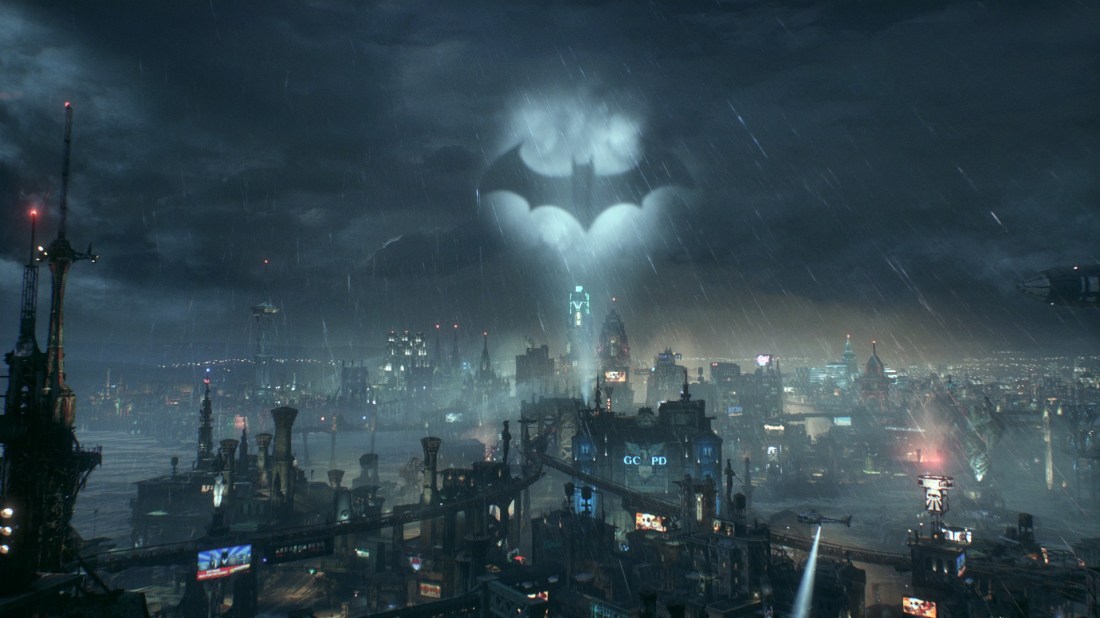
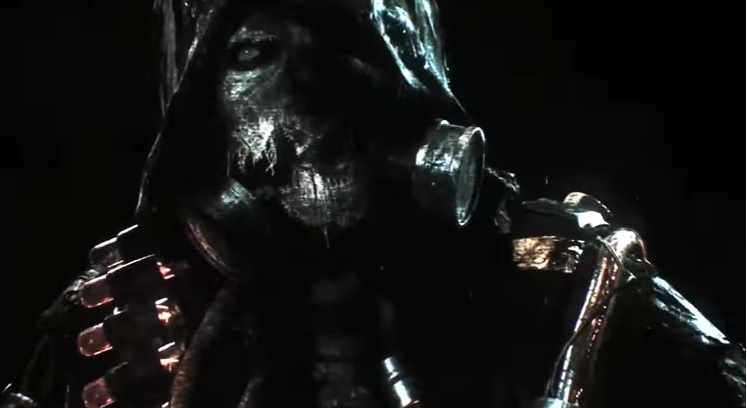
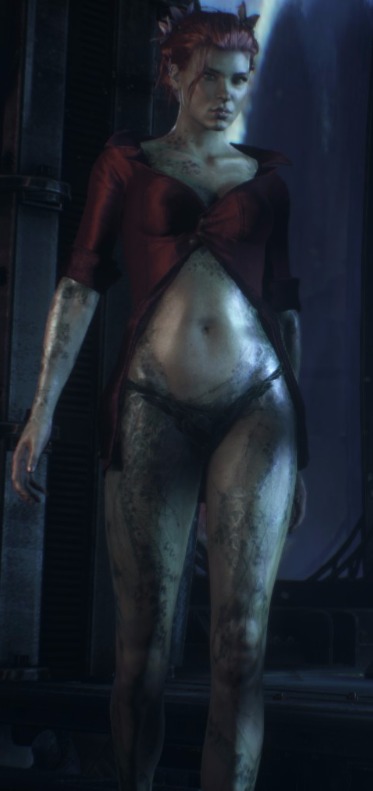
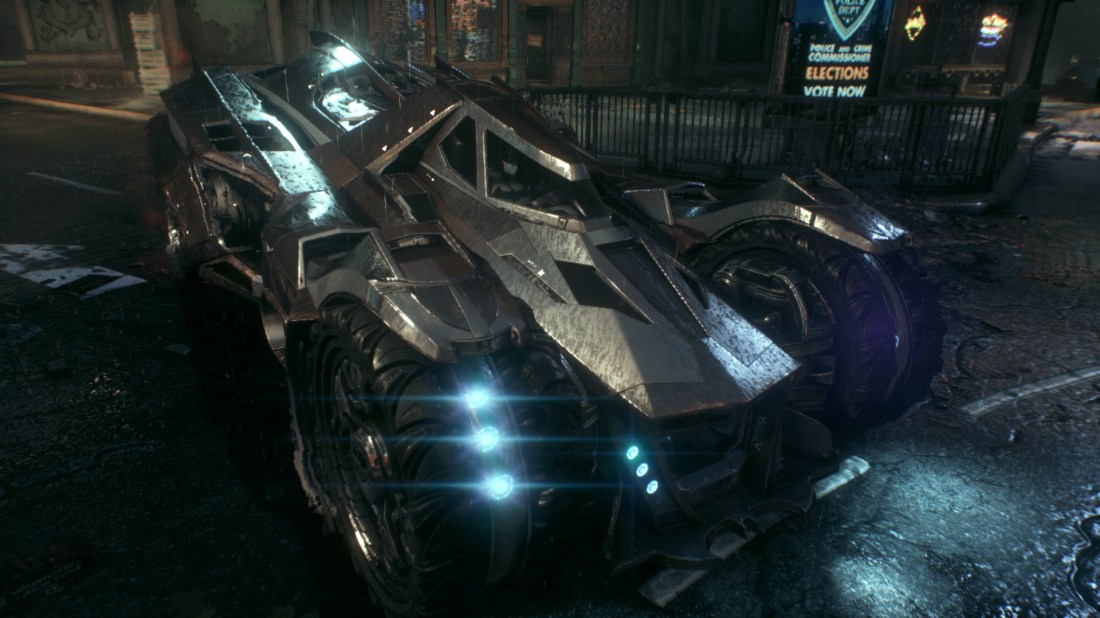
Batman Arkham Knight

A Rage Quit review

Batman Arkham City was one of FBT’s favourite games. Will the Knight ruin it for him?

Rocksteady’s Arkham Asylum finally allowed us to say ‘I’m Batman’ and mean it. Bats was largely grounded and faced appalling boss battles but AA was brilliant – gaming’s Batman Begins. And then Rocksteady gave us The Dark Knight as a follow up; Arkham City. Freed of the boxed-in Asylum, it was Escape from New York and you were Snake in a Cape. With the exception of yet more infuriating watch-and-learn-with-Bats boss battles, AC was one of the best games of all time, a towering achievement of gaming and story-telling worthy of any graphic novel. And now, Arkham Knight – Dark Knight Rises or Batman and Robin? I’ll give you a clue; Robin’s in it. Oh yeah. I’ll give you another clue – this review is filed under Rage Quit.

After the ending of AC, Gotham is bracing itself after the power-vacuum left by Bats and Joker’s epic battle. This time it’s Scarecrow, who was roundly beaten by Bats in the previous games – well, beaten, inhaled his own fear toxin and chewed on by Killer-Croc – Understandably pissed off, Scares unleashes a toxin causing Gothamites to go murderously insane. Everyone except the law-breakers scarper. And Bats.

The city is extraordinary to look at, like it was designed by a fan of The Crow having a fever-dream after reading a book about Art Deco while watching Metropolis and listening to the Bladerunner soundtrack. Its twisting labyrinth streets, uneven rooftops, modern-on-gothic look makes for a rainy, gritty, dirty maze of crime and grime. It’s perfect. It’s perhaps the most beautiful and detailed game world I’ve ever seen, decay and misery included. Never mind you had to own a Sunway to run it (Ok Google, what’s the world’s most powerful supercomputer?) – this is worth upgrading for. Gothman is sheer rotting beauty.

From a lithe and leafy Poison Ivy, Bats learns that Scares’ toxin is only the start; he clubbed the Rogues Gallery together to support him in destroying Gotham. Before Bats can even grimace at the idea of Gotham dying, a militia force rolls in, tanks and tech’ed to the teeth and starts pulling the town apart looking for him, commanded by the mysterious Arkham Knight, who has the kind of hatred for Bats that borders on the fanatical, becoming fantastical, eventually farcical. Time and time again he has the chance to kill Bats but doesn’t take it, conveniently says it’s not time for him to die, or leaves him alone to escape; “I’m going to place him in an easily escapable situation involving an overly elaborate and exotic death” – Arkham Knight is Dr Evil. But for now, we’re only concerned about the tanks rolling in. Of course, this Bat doesn’t take things lying upside down.

Bats in AC was fear gliding over the city. In AK he’s a bus driver with a grudge, the one that waits till you nearly reach it then shuts the doors. Once you get control of the beast-like Batmobile, it’s the only way to travel. It’s a monster and better than the Tumbler – It is. It’s a terrifying joy just to look at, Bats’ mood rendered in cold dead steel. It looks like the kind of thing Death would drive – talking of Death, there’s no way Bats’ no-kill policy extends to the Batmobile, without doubt that thing kills people. Aside from that, the sheer destruction you cause just turning a corner is doing Scarecrow’s work for him. It has two settings, pursuit and battle mode. Battle mode works yet doesn’t. The BM basically becomes a crab, able to sidle side to side, spin around, but why turn into a merry-go-round when under attack? Bats has always been about Arrive, Express how much he hates crime, Leave. Why is stationary is the best defence? Is it because the tanks stay still once they see the BM? That’s lucky. The pursuit mode lets you fire disabling rockets at vehicles but it handles like a caravan and goes like a rocket so it’s all so fraught and crashy until you activate battle-mode and it turns into a ballerina. It’s just not the assured, dominant pose you expect from Bats; the thugs are more scared of Bats behind the wheel than the wheel itself.

It’s great to drive once you get used to it, assuming you have enough fingers to operate all the options, but within the game it’s a gimmick. Rather than a complement to his crime-fighting ways there’s convoluted reasons to use it, and everything is solved by either gliding or driving – not both, you don’t get to choose how to approach a problem. You’re also confined to close-quarter chases when it should be GTA Gotham; you never really open it up, let lose. You can remote control it too, but that’s irritatingly underused or forced in as a problem-solver.

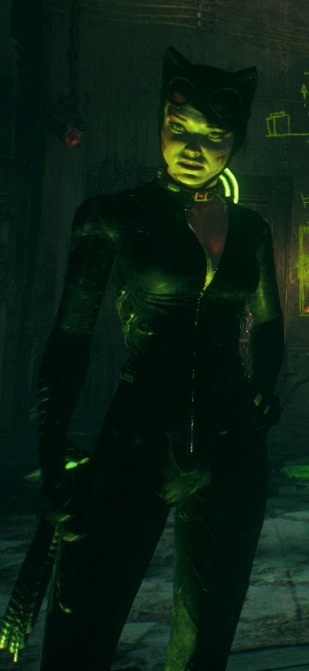
So, apart from Knight and his boo-hissing, Scarecrow’s open-season means we also tangle with Azrael, who’s interesting appearances in AC are completely undermined, mockney Penguin doing something or other, Two-Face for padding, and then there’s helium-voiced Harley Quinn; she should be a loose-cannon threat given Mr J’s fate but she’s got nothing to do and only there because we’d complain if she wasn’t. There’s a ton of filler-villains too; zeroes like Man-Bat, Professor Pyg and Firefly are crammed in (Can’t we find something better to do than chase a fly? You don’t even get to smoosh him on the BM’s grill). But the real rager is Riddler. Taking convenient advantage of the Batmobile, he sets a route of time-based chases around Gotham’s sewer system for Bats to conquer. There’s a city filling with poison, do you really have time to play Mario Kart, Bats? Yes, because Riddler has kidnapped Catwoman. She’s not key to the poison plot or anything, but we’re all a sucker for Rocksteady’s Catwoman. The issue is though, Bats always out-thinks his opponents – sure he’s got the gadgets, the cash and the bod, but his mind was his super-power. Yet in AK he just goes along with Riddler’s demands, jumps through his hoops to save Catwoman. He doesn’t outwit him, figure ways around the problems, he just solves them. Boring. And reducing Catwoman to a damsel in distress is a huge disservice to one of the more interesting female characters in Batman. In AC she was hot and formidable, Bats’ equal. Riddler may be helping Scarecrow to distract Bats, but he would have known that – plus Catwoman is imprisoned, not in danger so from our perspective it’s filler and annoying for it. I get so bored with Rids’ games I leave Catwoman chained up.

While the thugs are largely the same, the Knight’s men are anti-Bat trained; electrified fields, the ability to revive fallen comrades, armed with mini-guns, tasers, blades, they can also counter Bats’ moves and scan to spot where he is. The best thing about AC brawling was Bats had the tactical and technical superiority; they just had numbers. Now they have both and the fights turn into button-mashing scraps. It was fun to fight in AC, test Bats’ mettle; now it’s an annoyance. I once played AC for so long the entire city was silenced. I’d offed every thug in Arkham. There’s so much locked down arena fighting in AK it’s more Tekken than Taken; Bats should be brutal and efficient, not hopping around in the background like Pumaman. Bats can be accompanied by Catwoman, Robin or Nightwing and reaching a certain streak-count allows you to body swap; sounds cool but it’s a bit gimmicky and who cares, I’m Batman; just make fighting more satisfying.

We’re also supported by Gordon and his daughter Oracle as well as the occasional dry comment from Alfred. We even get to use the police precinct to doss about in, pick up crimes in progress and drop off the side-villains we take down. AK has some RPG DNA in it, and you wish Knight and Scarecrow would naff off and let us tidy up the city in the Batmobile instead of all this ominous stuff. There is one ominous element that almost saves AK though.

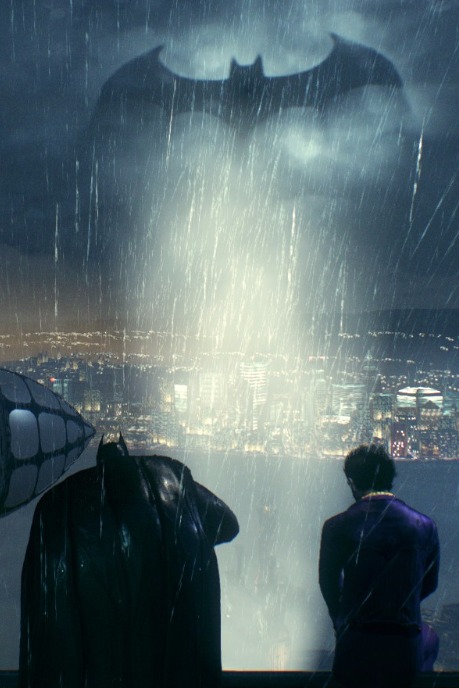
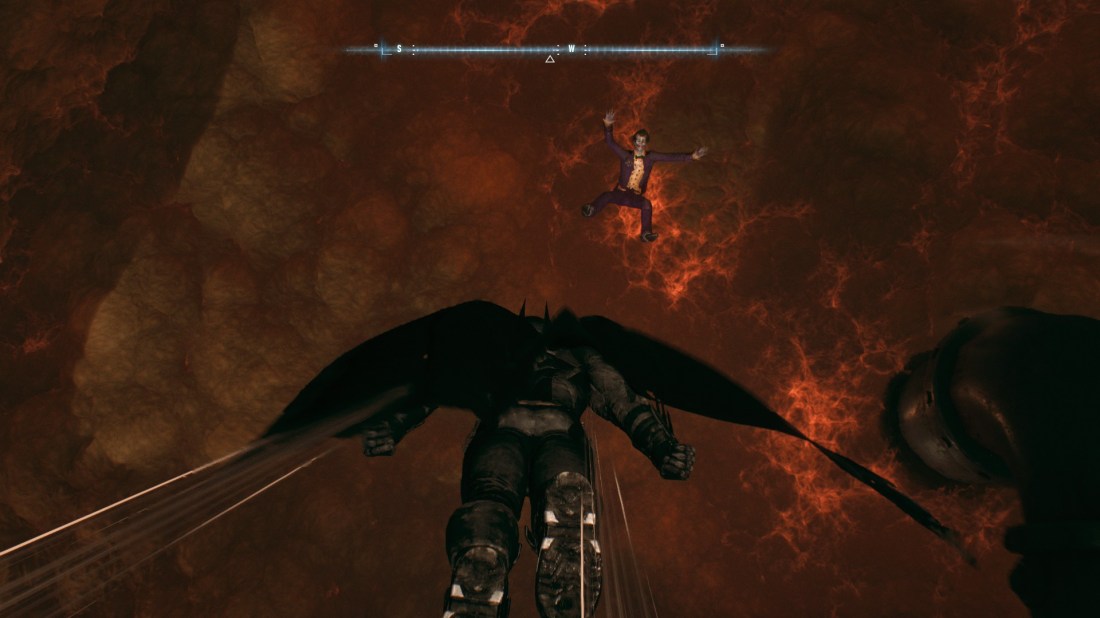
Bats has another side-kick … The Joker. This is a brilliant dynamic. Bats and Joker have always had a complicated relationship, so to have Joker in his mind, reminding him of his failures and his guilt is proper stuff. It’s the best thing in the game as Joker corrodes Bats’ mind and looks set to take over completely, intertwining with the main plot (until Knight’s histrionics make everything daft again) and its really good when Bats conveniently needs to get a little crazy (It’s a shame it’s scripted though, would have been great to get Joker-time as an option like bullet-time). They have some great moments together.

The plot of AK is huge, epic and a fitting end to the trilogy; everything that is happening is Bats’ fault – Scarecrow’s revenge has been a thread throughout the series and more and more people get pulled into – or pay for – Scarecrow’s obsession and Bat’s actions. The game asks if Bats is really doing the right thing, or just making things worse. And it’s played out in the most beautiful environment, by a Bats at his most grizzled and agitated, with all the usual suspects, and the Batmobile – and we’ve even got the Joker doing a Tyler Durden. AK is pure class, and I’m still giving up on this gem? Hell yes.

AK has a lot of annoyances – the fights aren’t fun, the Batmobile has a puncture, Riddler is an idiot and Knight is Widow Twanky with a painfully obvious secret identity. But the real rage-quit is AK’s habit of rug-pulling. The plotting is like one of those old 30’s serials where each episode ends with certain death then the next tells us Rocketman or Flash actually escaped in time. There’s some real mouth-hits-the-floor, eyes-wide, ‘holy shit’ moments where you really think Bats can’t come back from this. Game-changing, narrative-impacting, how-you-play and how you feel moments. And … then it undoes the moment. This happens at least three times – as far as I got anyway, who knows if there’s more.

At the risk of a spoiler, a perfect example is the fate of the Batmobile. After a huge (and daft) fight with Knight in the sewers the Batmobile is destroyed. DESTROYED?! No! OMB. Now what? I feel naked, worried about how I’ll get about town, the toxin everywhere, the tanks, this is real hell-no, game-changing stuff. I’m terrified and excited, and we’re stuck trying to rescue someone, surrounded by tanks and … wait, Bats isn’t worried … oh yeah, just call Alfred and get Batmobile Mk2 delivered. Which is actually a meatier and better version. What?! Fine that Bats has a spare, but games always put you in extreme situations and you go along with it because that’s the world you’ve been told exists – it was Bats, trapped in the city, alone. If Bats can just call in backup, if Alfred can pilot a replacement then the world changes; roll everything out – get the Batwing to take out the militia, have Nightwing rescue Catwoman, Robin can chase Firefly; let me and Joker go get a beer. It sounds like a whinge but it changes the reality we trusted the game to maintain. The other twists are even more of a betrayal because they undercut emotional reactions. They’re soap-opera twists. In AK it turns out J.R shot himself.

Another example of the game’s treachery; when the militia’s commander-in-chief is run off, what happens? Another Merc rocks up and takes over. Where did he come from, why didn’t he get involved earlier? What, he was just sitting in the super-villain waiting room?! You kept a spare henchman, Scarecrow? It’s exactly the same, just different voice goading you. The game can’t let things change too much because there’s so much non-linear stuff going on it would impact – Bats needs the BM outside the main mission, so it has to reappear and that’s a cheat, like Skyrim had Dragons that don’t damage anything and a civil war you never see, AK gives you show-stoppers then restarts the show rather than having the guts to let it stay changed. Each time you think this is the boldest, bleakest, bravest Bats ever and then it double-crosses you. I can’t believe AK became a let-down, especially after how AC played out. That game stuck to its shocks. I’ve had enough. To the Bat-Exit.

Arkham Knight opens with the line ‘this is how the Batman died’. This game pranked me so many times I suspect Bats doesn’t die either. AK gets so much right; it can make you gasp in shock, at it’s beauty, the story, but eventually you’re gasping in annoyance.

2015 | Developer Rocksteady Studios | Publisher WB Interactive

platforms; Win | PS4 | XO

Bioshock

An Agree To Disagree Review

As 2K’s FPS turns a decade old, FBT & TheMorty go head-to-head as they replay the original deep blue, sci-fi classic.
Rescue by FBT

There’s a lot of games I love, but Bioshock is as close to my favourite as is possible. At its core it’s nothing new – We make our way through relatively linear levels killing anything that moves; It’s a shooter and conforms to shooter standards. But that’s just FPS DNA and Bioshock DNA can be altered, changed, spliced … The setting, a city beneath the sea called Rapture is more believable than most ‘real-world’ game environments and the enemies are as much victims as villains. Most of all, it has a complex plot that you get tangled up in; a story that like a good book, you disappear into. All in, Bioshock adds up to an experience that transcends its medium – like all good art.

FPS as a genre is just digital Cowboys and Indians and usually you have the same emotional attachment but Bioshock got under your skin like a plasmid. It has adult inferences, plot plots and themes – it’s a grown-up’s game; you ponder the values and philosophies while surviving a complex horror that evokes the uneasiness of Stephen King and the sickness of cinema’s Seven as much as Ayn Rand’s Atlas Shrugged, from which Irrational took their inspiration. While many games are adult due to their content or appropriateness, Bioshock is just thematically mature, intellectual.
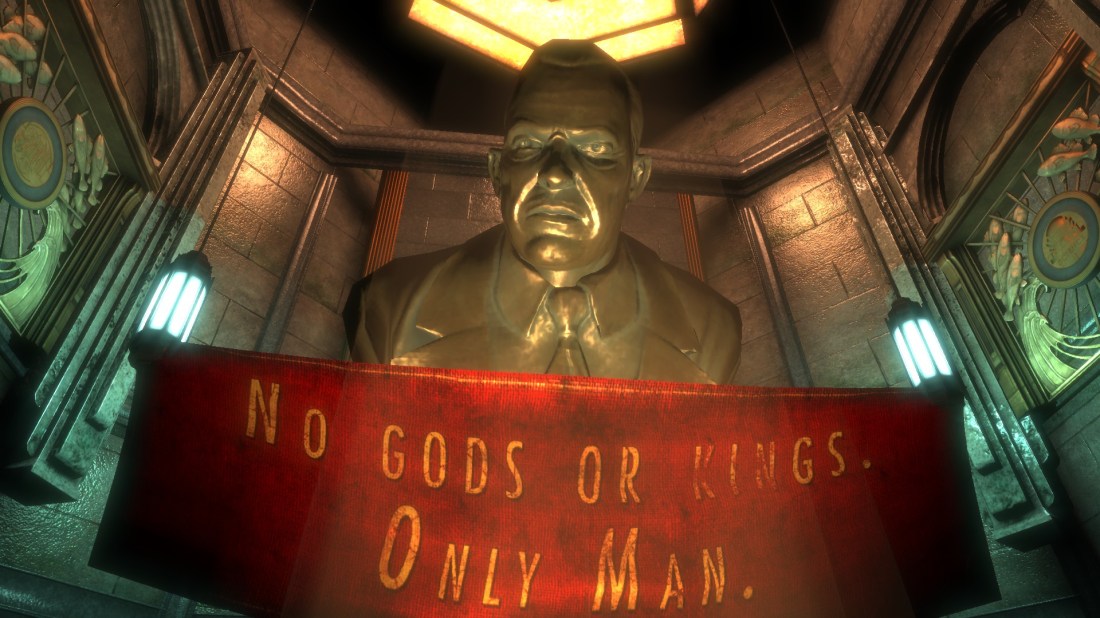
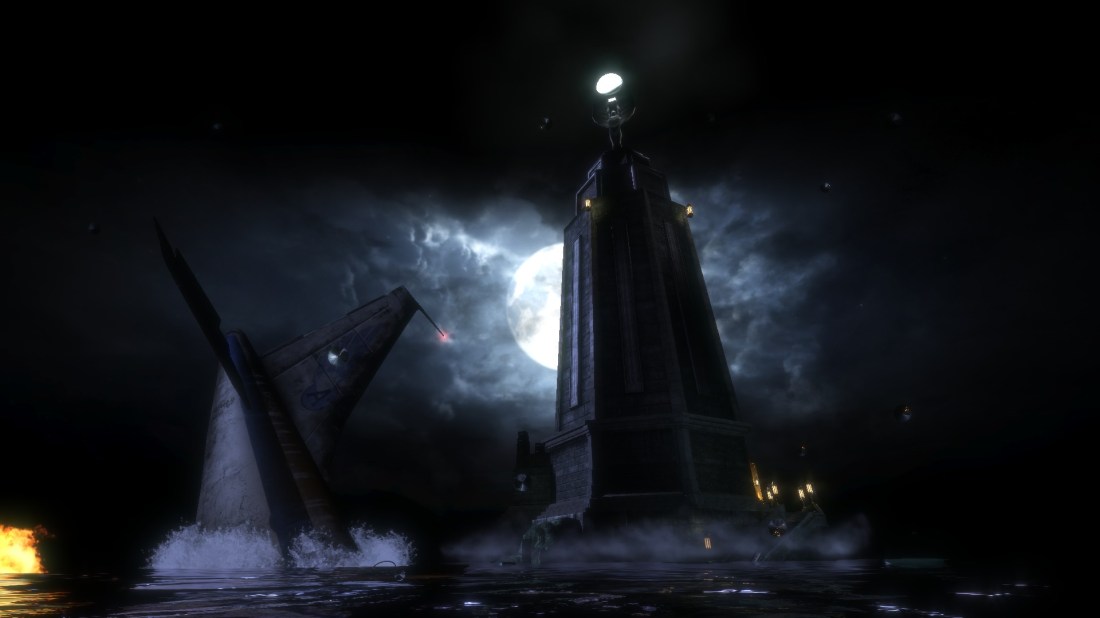
Andrew Ryan, a Howard Hughes-style industrialist created Rapture as a place ‘where the great would not be constrained by the small’; namely the ‘parasites’ (government meddling, religious belief, the less fortunate) – only the Self mattered. Freed of morals and regulation, Rapture made huge if questionable advances in the pursuit of art and invention – but those geniuses needed someone to pick up after them, to serve them drinks, to stop the place flooding and that created a class-struggle comparable to Metropolis. Along with those who failed to succeed, a destitute and disregarded under-class formed. Into this mix was thrown ‘Adam’, a DNA-splicing substance found in sea-slugs which was used to create Plasmids, tonics which gave the users remarkable abilities. The denizens of Rapture abused this latest fad as a distraction and edge on competitors while others turned to religion to help contend with the isolation, but the biggest change was the success of Fontaine, who owned the docks bringing in the slugs. Fontaine’s power rivalled Ryan’s (who knew a conman when he saw one) – he responded by ‘removing’ Fontaine and nationalising his industries; an act of government and the beginning of Ryan’s slide towards the dictatorship he once despised. Meanwhile a working-class hero rose in the shape of Atlas. Supported by the under-class, Atlas declares war and Ryan seals his own fate. He orders Adam be infused with a pheromone so he can direct those addicted to it against Atlas – compromising his one belief; the Self. And it’s just as Ryan and Atlas are at a stalemate that our Silent Hero lands. Now that’s a backstory. And best of all, none of that is in an opening cut scene. Instead, we’re deposited into Rapture via a plane crash. Gasping for air surrounded by fire and debris, we spot a forlorn lighthouse and start swimming. As we piece it together, we realise Rapture’s story isn’t over yet.
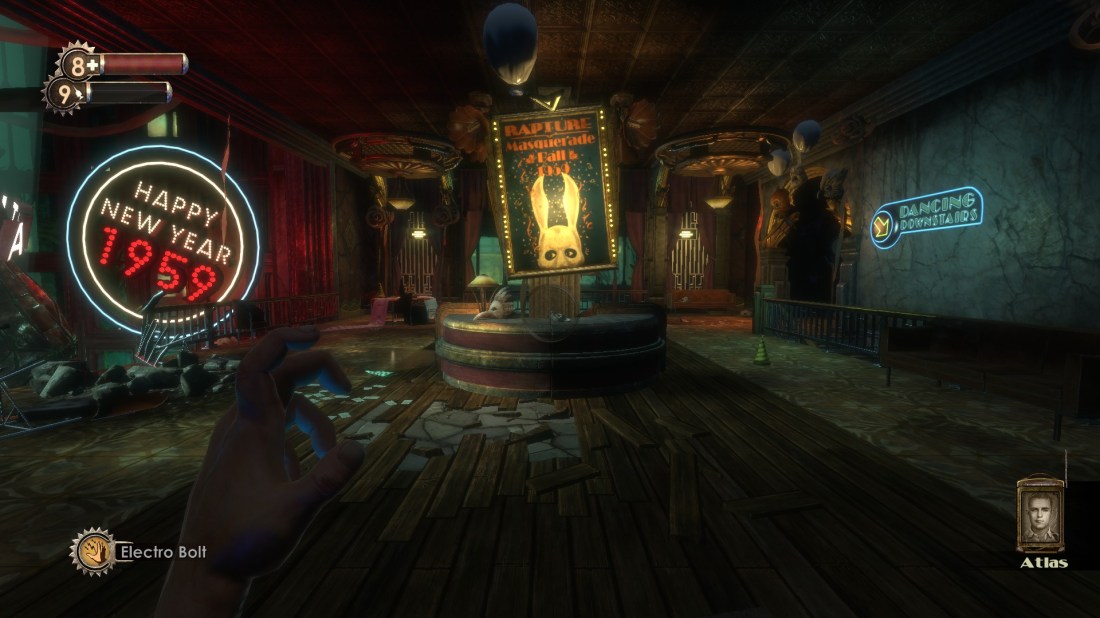
Arriving in Rapture is like being dropped into Paris in the midst of the Nazi occupation. Underneath all the decay is a beautiful world at the height of art and refinement. Picking your way through the rubble there’s a persistent sense of horror – the kind you can’t see, the kind you build up in your own mind, the best kind – it rotted on the inside as well as out yet you can picture upper-class Rapture folks enjoying cocktail parties and taking in shows; it’s so real Rapture could actually be out there, somewhere. There’s water leaking everywhere, it groans and creaks and gives way; it feels like an incredible achievement and a folly, built through sheer will. The light from the city gives us glimpses of the seabed but it’s not the Great Barrier reef or warm blue tones with god rays from the surface; it’s dark, dank and cold – there’s nothing, no escape, no leaving, nowhere to go. You start to feel contained, claustrophobic and understand why the Rapture citizens eventually fell into abuse and extremes; under the art-deco façade is an oppressive, pressurised place. Audio recordings reveal the struggles and it feels as if most people lived in fear it would collapse in on itself at any second; instead it was society that couldn’t handle the pressure. Splicers (those deformed by Adam and controlled by Ryan) were just caught in the middle and we’re in the middle of it too; this isn’t just a case of a heroic ‘you’re the only one who can do this’ as we cut a way towards a boss battle, turns out we were always the only one who can do this.
As we fight our way past those wretched addicts to reach Ryan, locked away in his office as his Rome burns, Bioshock is revealed as a solid shooter. The Splicers attack on sight but they’re sorrowful creatures crying out for lost loves, apologising for horrific acts (‘I found her like that’), clinging to some memory of a better time while they search desperately for their next Adam fix. Dressed in 1940s attire with masquerade party masks to hide their deformities, they leap, scuttle and in later levels, clamber on ceilings to ambush. They fire guns and use plasmids too but they also attack with fish hooks, pipes, anything they can find. And then there’s the little sisters.

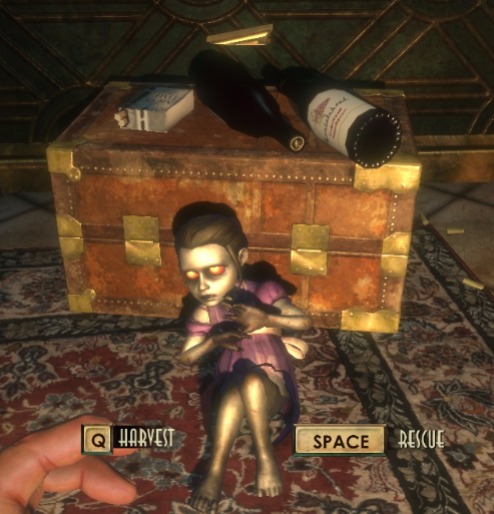
Roaming the corridors, playfully singing and dancing, the Little Sisters were once young girls now brainwashed into drinking the Adam-infused blood of corpses littering Rapture’s corridors. If that wasn’t sickening enough, they do this to feed the slugs implanted in their bellies, filtering the Adam for collection. That makes them invaluable. And that’s why they have Big Daddy. Hearing one clumping about fills you with a mix of dread and excitement. They’re horrible, sad things. Somewhere inside that stinking hulk is a man, stripped of his individuality and driven only to protect little sisters, moaning and calling out for her. Seeing them be gentle with the Sisters just breaks your heart, and seeing them tear apart Splicers also breaks your heart. I have to kill that thing? Once you’ve put him down though, you have the most infamous moral-choice decision in gaming. Kill or save a little girl. Seems like a no-brainer and the first time you face it, with her cowering in the corner it’s effecting. We’ve been told there’s still a little girl in there somewhere; we’ve also been told the girl is just a husk and killing her to get the Adam is the only way you’ll survive down here. It’s you or them. That’s not cowboys and Indians.

The weapons we use are familiar but the real shooter selling point is the Plasmids. Electro Bolt to stun or electrocute Splicers, Incinerate to chargrill them or melt ice. We also get to launch swarms of angry Bees, hypnotise Big Daddies and so on – they are a variation on any fantasy game’s spell casting but they’re hella fun and seeing adverts for Plasmids as life-aids and health tonics you realise how desperate this war became with everything, including people weaponised.

By the time we reach Ryan, we have mixed feelings – our Silent Hero has seen a lot of loss, horror and sadness, and it is completely Ryan’s fault. We should be ready to murder him but as we find him holed up in his office playing golf, both resigned to his fate and unbowed we feel some pity, and a little intimidated by this giant of a man. Ryan’s control of the Splicers seemed like his final mistake, but there was one more. It’s the biggest twist in gaming and Bioshock carries it off with such class that Ryan’s words -a man chooses, a slave obeys- haunt you. Partly because Ryan was right. I’ve never been angry at myself as a character before. I am a slave.

It’s true that this scene is as incredible as the rest of the game is a let-down, experience-wise. It continues to be a great shooter, a beautiful environment and an unsettling journey but it’s much more generic after this. But the ending saves it; easily one of the most moving, satisfying cut-scenes of all time – assuming you took the ‘Good’ route. If you took the bad, it’s amazingly dark. Bioshock is as close to art as gaming ever has gotten, that it’s a great shooter as well just makes it perfect. At the start, we descend to the city and hear Ryan’s pre-recorded welcome ‘with the sweat of your brow, Rapture can become your city’ – it has.

I’ll be in Rapture forever.
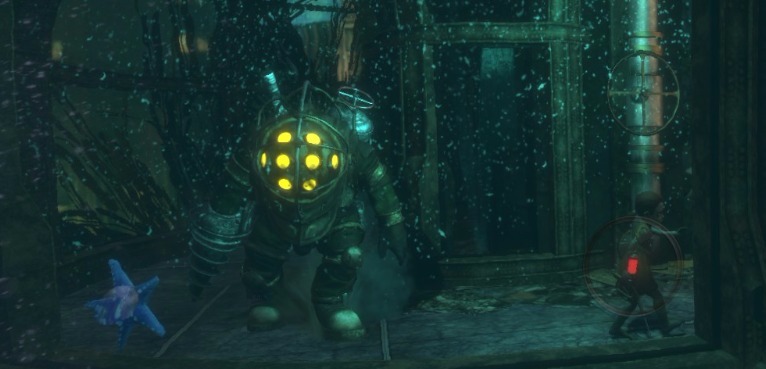
Harvest by TheMorty

2007. A year when gaming just kept releasing more of the boring same. Call of Duty 4, Halo 3 and Half-Life 2 were the top sellers as the market drowned in a flood of sequels. As developers went for the tried and tested money spinners, no-one was brave enough to release anything remotely unique in the FPS genre. That is, until Bioshock came along. At last we had an FPS that was diverse enough to move away from the traditional setting and immerse you in an unexplored location under the sea. One of the biggest mysteries of Planet Earth regards what lies beneath – with over 70% of the it being water and around 95% of that yet to be explored – absolutely anything could be down there. Until Bioshock the closest we’d ever got to exploring the blue was SEGA’s Echo the Dolphin some 15 years previous. So it’s fair to say there was nothing like this game in the FPS genre – or in any genre of gaming at all. With my hopes high I headed into the first playthrough, but was bitterly disappointed with what I encountered.

It starts with a fantastic opening sequence where a plane crash sends us tumbling into the drink (a fitting example of why it’s against the law to smoke a mile high). As we surface, an Art Deco lighthouse, miles from civilization greets us. Inside, a strange orb awaits which plunges us into a world beneath the waves. At first, I was astounded by the lure of what resembles a 40-fathoms deep Las Vegas but that’s all smoke, mirrors and an unhealthy dose of make-up. The hidden truth is that Rapture is a rundown world full of nothingness. With the exception of the odd scripted moment where of a shark swims by one of raptures many dirty windows, we never truly get to experience life on the ocean floor. All bar one level you’re indoors and even that brief flirtation with the water is just you trying to get from one building to the next. The entire game could be set in a rundown motel and you wouldn’t really notice the difference – as you spend most of your time going room-to-room in the hope you’ll find a shred of ammo, a half empty Adam refill or an Audio Diary to give you a resemblance of backstory.
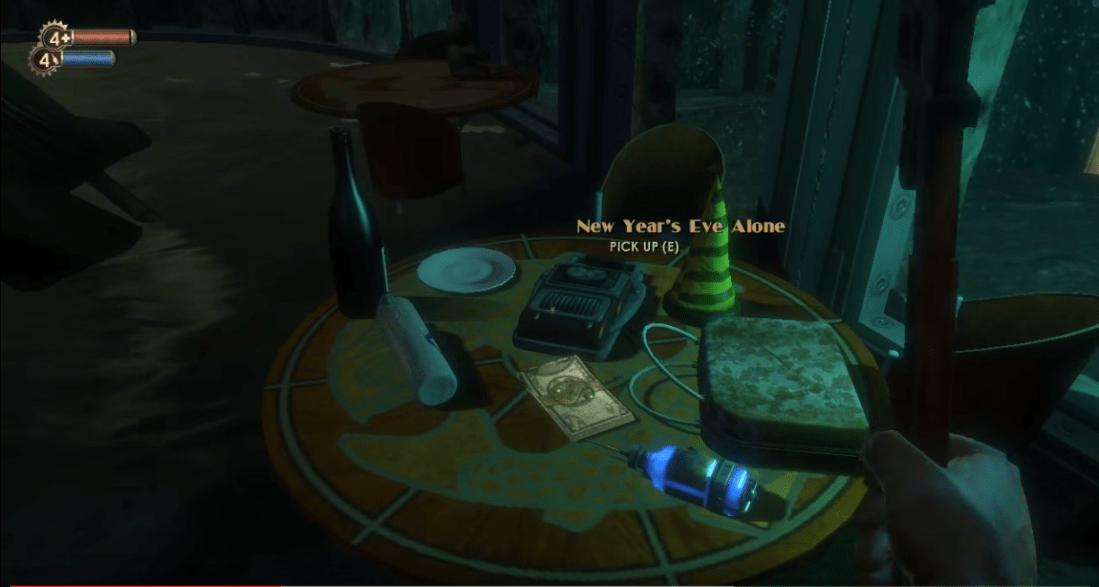
See, the well-hidden Audio Diaries are very important to your gaming experience since Bioshock is not driven by cinematic cutscenes. Rather frustratingly, there’s a couple of Quicktime moments at inopportune times and you really have to rely on your own discovery to advance your understanding of the plot. Many first-person games have taken the collectible route, classics such as Doom, Half-Life and the recent Fallout sequels are advocates of this technique, but in Bioshock, this doesn’t have the same effect and instead makes the story feel stale. When you have to stop to search every room in the building to make sure you don’t miss a second of the story, it prevents you from feeling fully immersed in the survivalist nature of the game. This might work fine in an RPG where you there’s a slower pacing, or you can return at a later date if you miss something, but in a linear FPS the collectible aspect really feels out of place.

Mechanically, Bioshock isn’t a bad first person shooter but what makes it feel stiff is the lack of dual wield functionality. BS2 clears this up, but theirs a gaping hole in the first game that the plasmids alone can’t fill – as your ability to react to deadly situations is severely limited. The choice between going into battle with a plasmid or a pistol often leaves you frantically switching back and forth as quick as you can to avoid ending up dead. This is particularly annoying when fighting Splicers that love close quarter combat – by the time you switch over to your gun, you’re already dead.

Mind, I shouldn’t really complain about the difficulty of this, especially when you consider how easy Bioshock is to complete. Even playing on ‘Hard’ difficulty, you know that the worst case scenario post-death is waking up in a Vita chamber with no re-spawned enemies or reloaded checkpoints. Getting out of your chamber and carrying on as you were doesn’t have the same impact as the Borderlands model where one wrong move and you’ll have half of your wallet wiped out – now that’s a real fear of death!
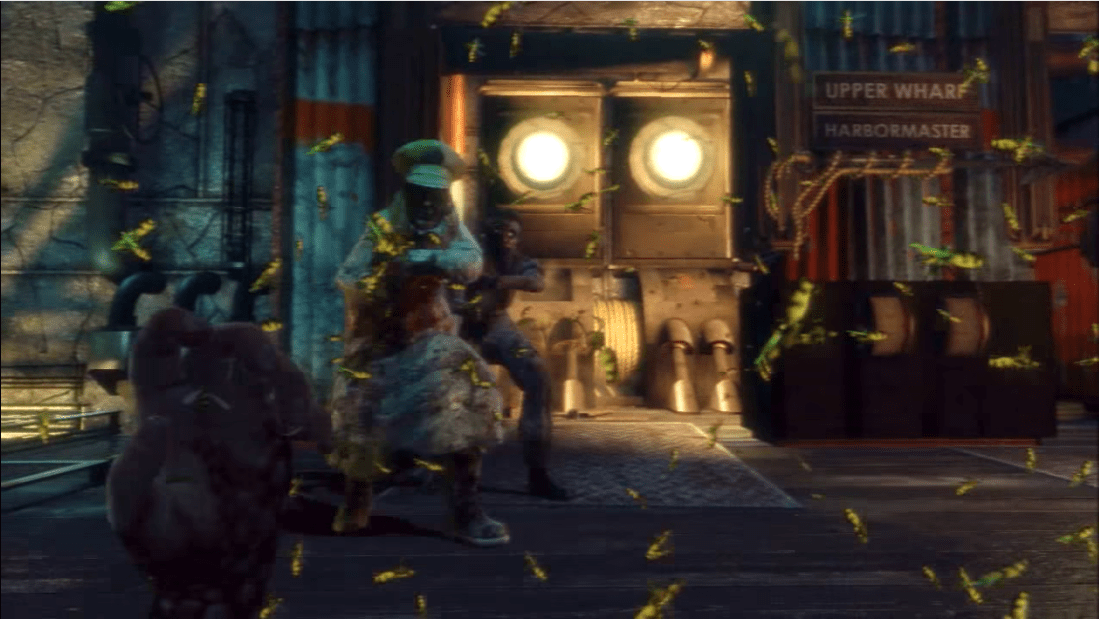
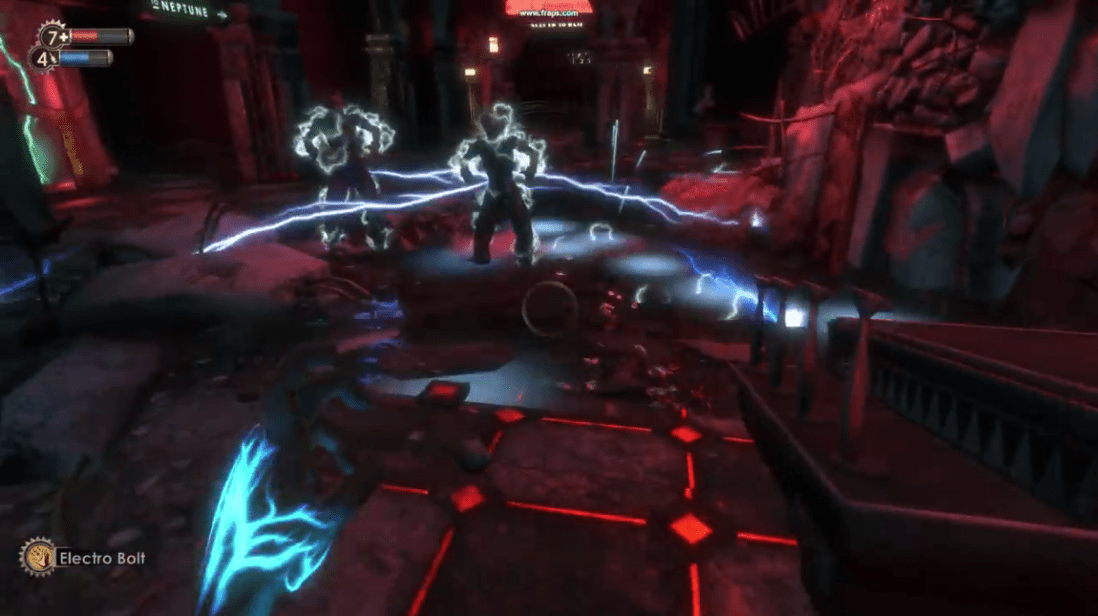
Despite the lack of slots available for your plasmids, forcing you to choose the few you want to carry at the annoyingly scarce vending machines throughout Rapture, I concede the biotic weapons are pretty cool. Sadly, the more these plasmids level up the more you realise just how easy they make the game. Those cold, dark alleys where you would usually approach with caution become a breeze if you fire off the Insect Swarm and send a hive of Bees off to attack any of the targets in the room. That particular strategy gives you the heads up of who is hiding and creates ample time to prepare for your assault. Checking out the terrain in Bioshock is an indication to whats ahead and gives you fair warning of what’s to come. If ever you see a pool of water on the floor, you can be guaranteed to encounter some villains up ahead – so best get the Electro Bolt ready and prepare to zap the floor. The copy and paste nature of the environment in Bioshock makes the game too predictable and you become lackadaisical, often ploughing through each level with an air of invincibility, hardly breaking a sweat. What should be a taut, suspenseful thriller ends up feeling like a joy ride and while that can be enjoyable in the right setting (a la Bulletstorm) Bioshock just isn’t that kind of game, often it feels like that movie that you end up laughing all the way through, not realising it’s supposed to be a dark drama.
The little sisters are an eerily odd touch. They’re designed to play with your morals and emotions. You can waste an entire cache of ammo defeating a Big Daddy protector, only to be presented with an obvious choice. While killing a child or rescuing her might seem like a no-brainer, this isn’t a straightforward Paragon/Renegade decision. Atlas tells you to kill them, after all, they’re just husks masquerading as children and they’re no different to your average splicer. They even have this evil Gollum look about them to try and push you to making the right decision. Atlas also informs you’ll be heavily rewarded for harvesting them and have a shed load more Adam at your disposal. So at this point, why wouldn’t you kill them? You’ve trusted Atlas implicitly to now – so why would you go against him? He’s your ticket out of here… your voice of reason… What Bioshock fails to tell you is that IF you follow him – you’ve made one major wrong move and it’s effectively killed your game. Sure, you can still carry on to complete the game – but harvest one Little Sister’s power and you’re condemned. There’s no majority winner, there’s no chance of redemption. No matter what you do after this point you may as well just kill them all. The only way to get the good ending, is to Rescue every single Little Sister you meet and making even one ill-informed or uneducated choice kills any chance of that for you. It’s feels a bit unfair…
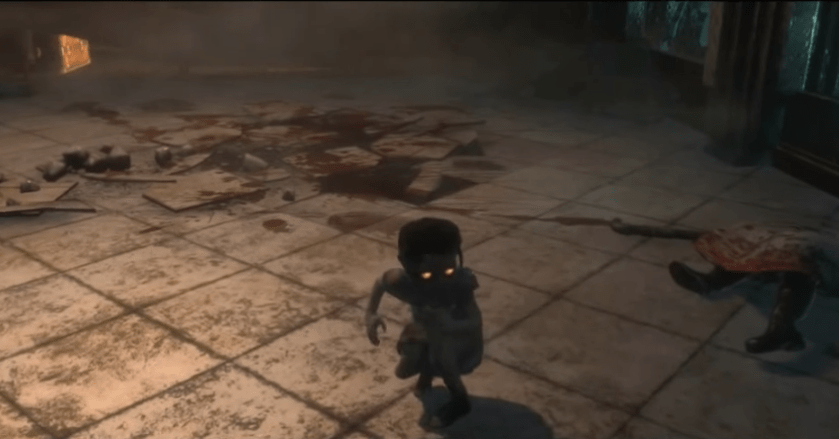
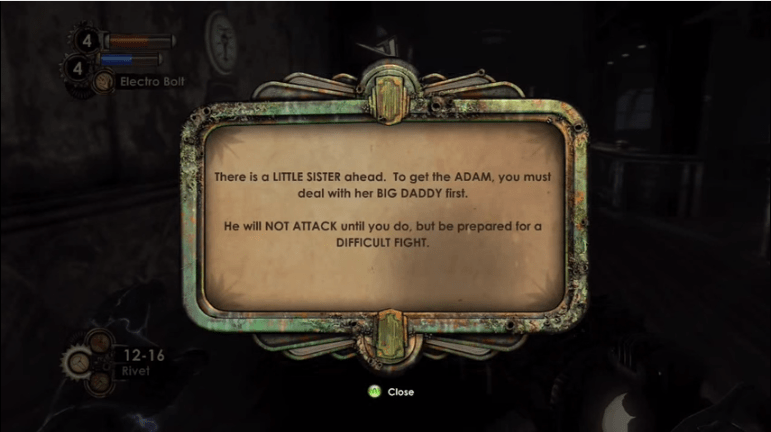
Their Big Daddy bodyguards are seen to be ruthless, killing machines. You’re shown not to mess with them very early on as you see them mercilessly take down a group of splicers through the safety of some unbreachable glass. However, in reality, they’re not all that hard to defeat. Firstly, a Big Daddy will only respond when provoked or when his Little Sister is under attack. If you have a few villains on your tail then, fear not, just lure them toward a Big Daddy and take the easy way out as he’ll destroy them without opening fire toward you, allowing you to hide behind them like it’s your big brother on the school playground. When it’s time to kill them, you get time to set up the room and catch them off guard. You’re given free reign to set traps and hack turrets to make stabbing the Daddy in the back all the easier. Again, this makes the game very easy to beat and takes any suspense out of the level. You’re even given a warning the first time you encounter one which I absolutely hated. The first encounter could have been magnificent and been a trial and error of terror, where you brick it and open fire without realising what you’ve done. Instead, the mood is well and truly killed!
The antagonists are quite frustrating and neither are really Raptures Darth Vader. For the first part of the game we’ve been solely focused on killing Ryan. Sure, we’ve had our head filled with conflicting stories from both him and Atlas which does add a bit of mystery to the plot, but when you finally encounter him it’s all a bit pointless and surreal. After an astonishing plot twist, Ryan gives you a command that you can’t not obey. While this is certainly apt and helps the story to pick up some much needed pace, it’s incredibly frustrating not being able to pick a side. Despite his cries of “a man chooses – a slave obeys” you end up obeying regardless and you are unable to do anything about it – even though you know your impending actions are inherently wrong. It’s such a pivotal moment that sends you off on a revenge driven rampage, but being given a choice and only having one option seems a very dated mechanic. It would have been much better had we acted without knowing the truth and only discovered it afterwards.

As FBT argues, Bioshock is as close to art as gaming gets – and that’s certainly hard to disagree with. The art-deco paintjob throughout the halls mixed with a 1920’s soundtrack is certainly something we’d not seen in shooters before and has undoubtedly inspired games which have come after it. It won a number of high profile awards and it does have a distinct style that is very unique in the marketplace. However, like all art it’s true worth lies in the eyes of the beholder and one man’s Picasso can easily be another man’s Damien Hirst. So for FBT, this game is a timeless classic that he looks on with great fondness. For me, it’s a glass case of maggots feeding on a rotting cow’s head.

2007 | Irrational Games | 2K

win, xbox 360/One PS3/4
Total Overdose

A Blast from the Past review

FBT remembers when he was a Mexican not a mexican’t.

My memories of TO are good. I spout on about insane gameplay, a DGAF attitude and feeling like I was in a Mexican GTA. I also remember I picked it up solely because it’s tagline was ‘Chili Con Carnage’; You knew what you were in for. I recalled TO as the granddad of Bulletstorm and Saints Row III, games that let you play insane.

But when I try to remember specifics, I struggle. I take this to mean it wasn’t important, I was too busy living a Rodriquez movie; I can’t really remember what GTA 3 was about either, beyond the fact Claude never spoke (Or maybe he did and I don’t remember), so not recalling any detail doesn’t make a game unmemorable … it’s the experience you took from it and I would describe TO as great, but have no demonstrable specifics to back that up. It was great though, honest.

Thinking about it though, if I consider TO so great why’d I only play through once? It came out in 2005 and the budget edition a year later (big seller then) and within that time there were a few other distractions; Star Wars’ Republic Commando and Battlefront 2, FEAR, Quake 4, Gun, King Kong, Just Cause and TES Oblivion to mention a few, many of which are still being mentioned ten years on yet TO is long forgotten; was it Bulletstorm, one of those underground games only a few knew about or was it best forgotten? Deadline Games, the devs weren’t high-end but it was shepherded by Square Enix who’d overseen Tomb Raider and Thief so it had pedigree. Plus, my copy had avoided the great eBay purge of 2007 (when Steam started releasing major non-Valve games and I figured everything would be on there soon – Still waiting, NOLF) so something about TO stopped me from parting with it. Time to work out what’s going down in Mexico.

Shoulda stayed there?

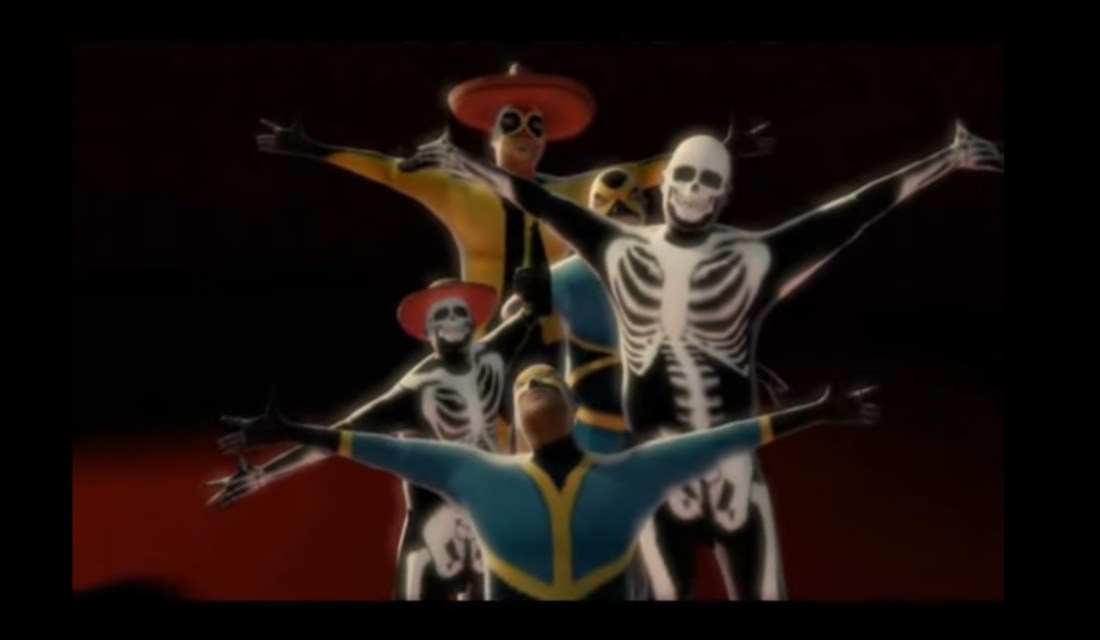
So after two production credits that feature Day of the Dead characters dancing in skeleton outfits (one in a sombrero) I already wish I’d played this hundreds of times. I can tell this is going to be awesome. Mexican rap plays over the menu and I feel like I’m in Desperado. Then I’m into the story. I’m a DEA agent whose cover has been blown, attempting to escape some airfield and being shot at by drug runners. I begin by sliding down a zip-rope uzi’ing the smugglers and then take out everyone between me and my plane; which once aboard, I’m promptly thrown out of by my double-crossing extraction team, bought out by the drug kingpin I’ve sworn to bring down. Given how heroic I’ve just been, I expected to have expected this, but I didn’t and I’m actually dead. The action then switches to later and I’m now playing my son, also a DEA agent who is also in deep cover in the same kingpin’s crew to prove dad didn’t die of an ‘overdose’ – what kind of drug gets you so high you die from the fall? Let’s not worry about it, the game is either joking around or doesn’t care, and that’s part of its appeal – As the son, I’m instructed to drive a car towards a gas truck and use a ‘stunt exit’ option. I slo-mo out of the car as it crashes causing an explosion, then I wipe out everyone around me. Finally, down to me and one last guy who taunts me with a grenade, in cut-scene I shoot him between the eyes then stand about looking cool, before realising the grenade landed by a petrol pump. It goes up and so do I. Does every mission end with the death of my character?! No, I survive although with a broken leg. I’m then transported into the son’s wayward twin brother who has been released from prison on the understanding he’ll pretend to be who his brother was pretending to be and continue his (their father’s) work to bring down mr kingpin. Got it so far? In return, my sentence will be reduced (so, I’m in prison and the DEA sends me to a country with no extradition order and expects me to infiltrate a drug business filled with criminals in return for reducing my sentence? Again, don’t sweat the small stuff). Cue opening credits. What a start!

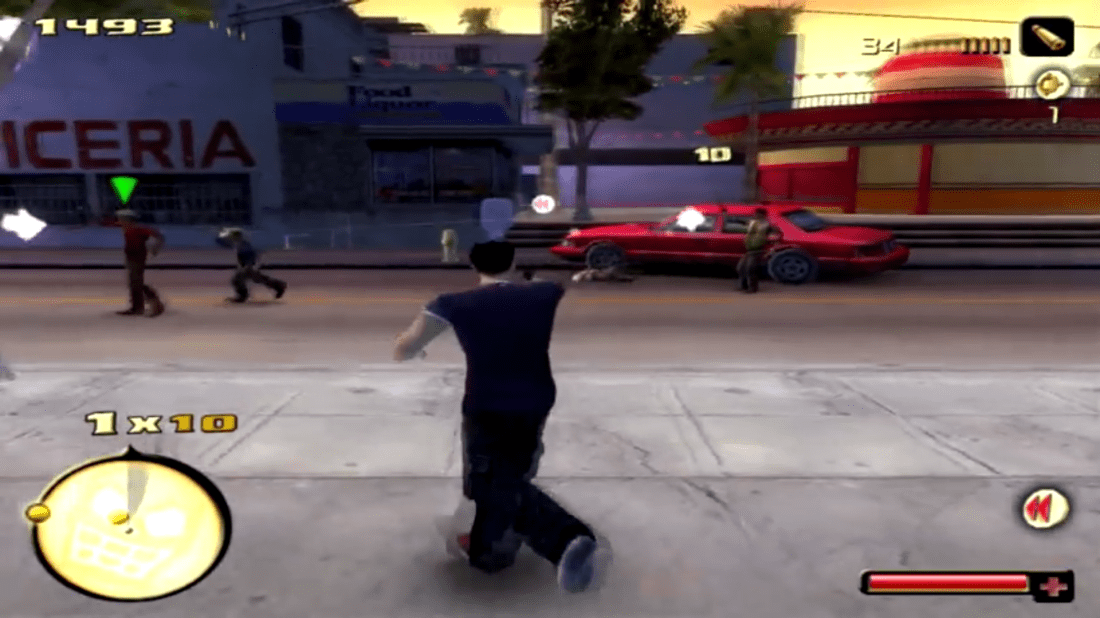
Once in the Mexican city, I do various small criminal jobs to attract the interest of the Kingpin then work my way to his side by doing missions alongside various side quests to build up health and xp. So far, so typically free-roam but the initial fun has worn off and I start to see how old this plays (despite being built on Renderware, the same engine that underpinned GTA SA the year before); the cars drive worse than Driver which was 6 years old and the on-foot sections are less refined than GTA 3, 4 years earlier. I try to remind myself it’s a decade old but it plays like a decade before that. It’s not from some deep-pocketed dev so you can forgive some creakiness, some unrefined gameplay but you’d expect more than this. By 2005 driving, running and general mayhem were, if not a fine art, past blocky characters and wobbly car behaviours. It’s just not fun to play and worse, not nice to look at.
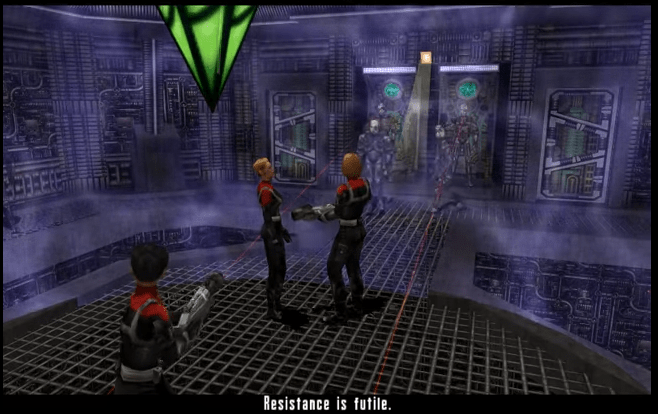
Deadline Games seem to be on their first major free-roam game here, but whereas Stainless Games managed to pull off Carmageddon, DG seems to have made a vanilla GTA; but it’s actually softer than that; this is Midtown Madness meets Blake Stone; not mad or bad enough to actually be anything but a Clone and a largely inoffensive one at that. Worse, the world is tiny with very little to interact with or get lost in. There’s nothing to see and all too soon I give up wandering. You never feel like you’re in a Mexican town let alone one controlled by a drug cartel, it’s a bland featureless concrete area with no interaction, where running is preferable to driving and the side missions are all races or brawls, which get dull quick.

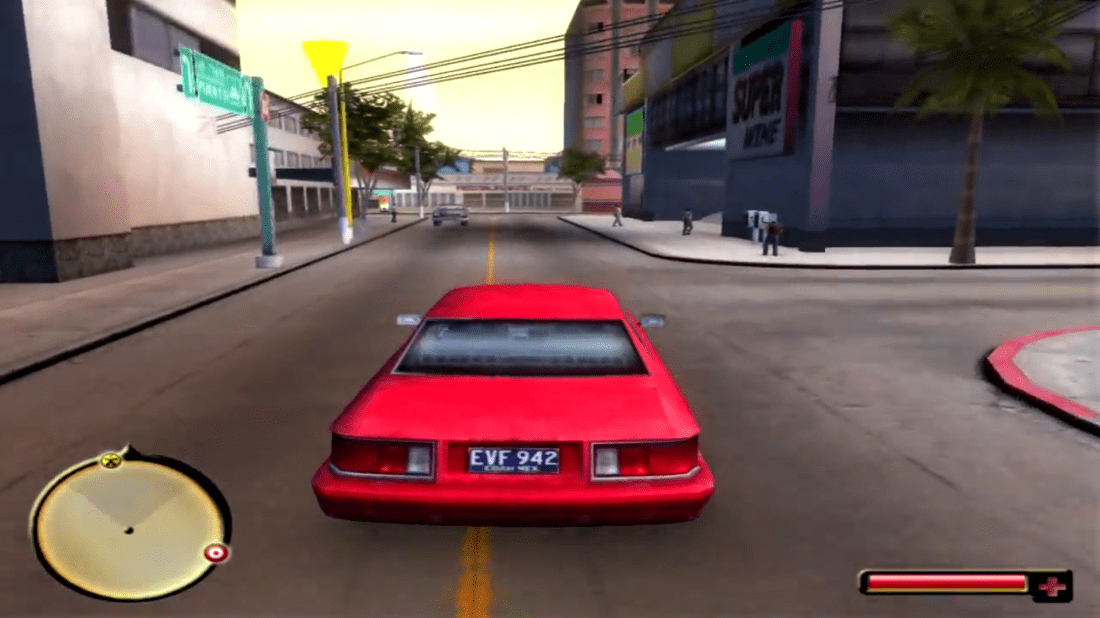
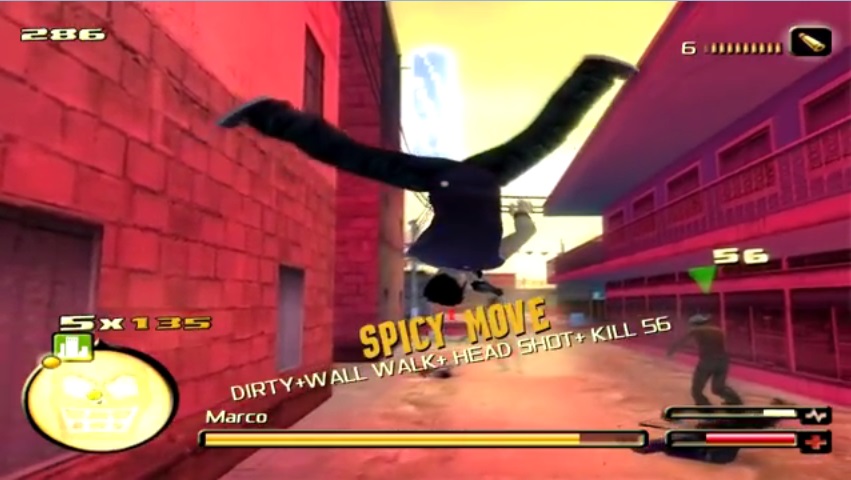
While many story missions are great in their layout (a level in an abattoir is a standout) and there’s some nice cinematic cut-scenes, they’re hamstrung not just by the featureless look but the shootouts themselves aren’t especially exciting. Baddies stand and shoot or run at you, they’re hidden in areas they couldn’t possibly have chosen to stand in unless they knew you’d walk past and every single door will have someone behind it; it’s so simple it’s like playing a shooter from the Doom era. To spice it up you have bullet-time and insane power-ups including reversing time, onscreen graphics congratulating good kills and comments from our hero (‘spicy move!’, his favourite phrase is uttered over and over) but it all comes across as set-dressing, gimmicky after a while and irritating soon after. This is one of those games where the engine and development just couldn’t compete with the concept and spirit and that’s best illustrated by the launch trailer that still makes TO look like the game you always wanted someone to make.

Maybe much of this banality could be overlooked if it was great shakes with storyline and characters – a gaming element not curtailed by budget or graphical constraints – but while in the game’s head you’re Antonio saving a feisty Salma-alike, the reality is a cliché story and strained, obvious dialogue.

When TO came out in 2005, Free-roam (Sandboxing, nonlinear, open-world, whatever) was in its most exciting period. We’d had three GTAs, Morrowind and Far Cry building up to Boiling Point, Oblivion, Gun and Just Cause and barely a year after that Assassin’s Creed, Crysis and STALKER. TO was dead in the centre but there’s none of the reckless enthusiasm that pervaded those games; if TO’s limitations were down to a budget constraint, then they should have constrained themselves to a clean linear game and dropped the free-roam. Released around TO was Call of Duty 2, FEAR and Doom 3 – not suggesting TO should have reached for those lofty heights but how much more immersive could TO have been as a straight shooter with all the free-roam work funnelled into a real Drug Cartel experience saving a Mexican town.

In the end, Total Overdose isn’t just dated, it was five years too late to the (open) world. Despite my disappointment at finding my memory lied to me, it had its moments; our hero yells lines other than Spicy on rare occasion that get a snigger, flies descend on your kills, if you shoot a guy wearing a hat, it’ll fly into the air. Position yourself under it and your hero will be wearing it until it gets shot off. It has flashes of brilliance that makes TO feel like an unfinished game, like it’s still in beta phase. It’s frustrating because it could have been so much more; it’s got a lot to give – but there’s no world to be given it in.

2005 | Developer Deadline Games / Square Enix | Publisher SCi / Eidos Interactive

Platforms; Win | PS2 | XBox

Blood

A Blast from the Past review

FBT goes back to when FPS spoke to him on a spiritual, personal level. The weirdo.

The Past

Should I ever get into a discussion about the best shooter from the “Post Doom – Pre Half Life” era I tend to turn the conversation bloody real quick. Folks go for Doom because it was a quantum leap; Doom wasn’t released; it was unleashed they cry, claiming it was the Jaws of the game world. They are right. But while Doom was gaming’s We’re Gonna Need A Bigger Boat moment, for me it was when I saw Elvira’s calendar in ‘Blood’ -the same calendar on the wall of my bedroom– and I knew, Blood and I got each other.

Like anyone else staggered by Doom’s release, I played everything and anything similar; Wolf3D, Duke, Shadow Warrior, RotT, Heretic, Dark Forces, Jedi Knight, Blake Stone, Redneck Rampage, Quake. I bought them, played them, loved them and eventually lost them. All but Blood; I still have the CD. It’s burnt into my memory so deeply that in my advanced years I may begin to confuse its levels with actual memories. That should make the old folks’ home interesting.

Thinking about it now, I recall that Blood was made up of everything I was into. Packed with references and nods to my VHS collection, my posters and film quotes, everything I thought was the coolest thing ever was in there. And, Blood had a plot. A real, on-screen story and reason why everyone in my eye-line had to go, not some vague background written in the manual. And Blood’s storyline was explored by an equally perfect lead character; Caleb, a wild-west era killer-for-hire who worshipped a Dark God which inexplicably has Caleb, his beloved wife and friends murdered for an unknown failing. Reborn (‘I live…again!’), Caleb was the perfect antihero to inhabit as I waded through a thousand bodies in a dark gothic setting, looking for revenge and reasons. Caleb wasn’t a jokey celebration of macho like Duke and he wasn’t just an arm like Doomguy; Caleb was every dubious hero you adored while watching straight-to-video films in those big puffy WB cases. He was Snake Plissken meets Eric Draven with a dash of Ash. Ultimately I loved Blood for its ‘soul’ despite Caleb not having one; It’s so fatalistic, the tone so foreboding it could have been a John Carpenter film. Blood is one of my best gaming experiences and I’d defend it with my boomstick. But I admit now, my love for Blood is based on it matching my bedroom walls, not it’s comparison to other shooters, its graphics or whether it’s actually any good. So, at the risk of losing a 20yr long argument (Blood is better than GoldenEye), time to see if Blood still courses through my veins.

Still a Blast?

The opening menu is satisfyingly gothic, blood drips down the screen and demos play, instantly taking me back. Okay so I ignore that it’s looking blocky, that maybe the menu is Doom Clone, but that’s no reason to mark it down. So far, so top ten.

the guy she told you not to worry about

I kick into the level and … the opening cutscene. I watch Caleb, his wife and friends summoned by their dark god, talking through an acolyte who disintegrates as he speaks, seared apart by the power of his Lord’s voice. Which isn’t happy. Caleb demands to know what they’ve done to earn his ire, but he can only watch helplessly as his wife and friends are attacked by monstrous creatures and he is sealed alive in a grave. Now that’s an opening. There was nothing like this back then (or since). Okay so now it’s graphically on a par with that Dire Straits video about MTV but it’s bleak, gothic and I’m taken by it; It reinforces that it’s not graphics that make a game; Blood’s opening would have been as effective in any gaming age. When Caleb fails to reach his beloved before she’s taken away I’m moved. I have a reason to live… again.

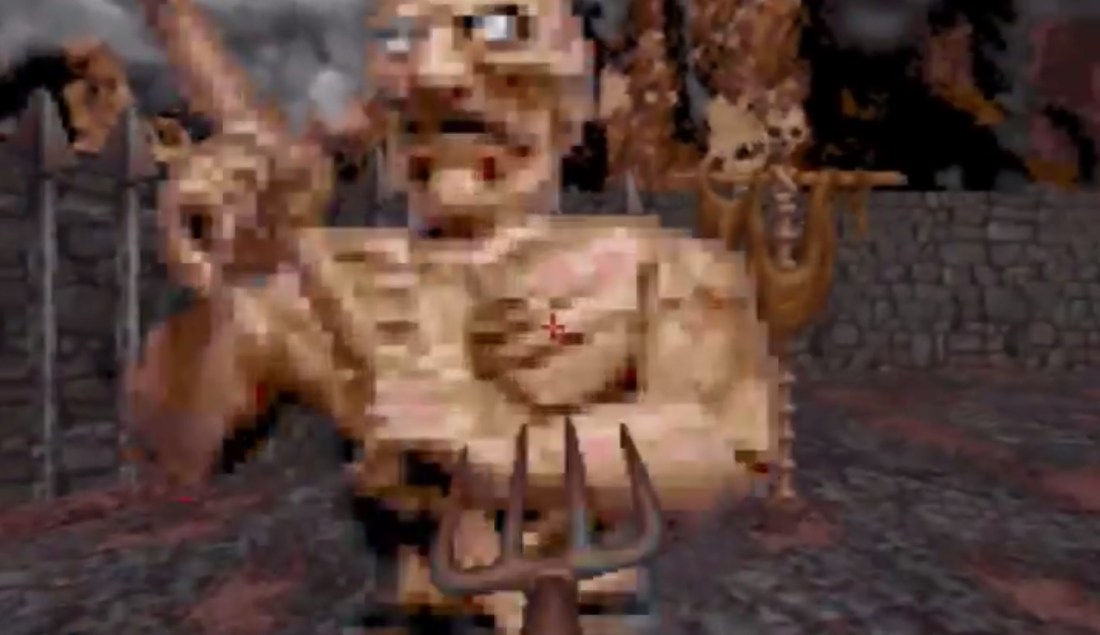
I emerge from the ground armed with only a pitchfork and Army of Darkness quotes. The zombies come running and once it’s over I’ve forgotten I’m playing something 20yrs old. I had at them and the excitement, the frantic killing and the thrill are still there. Yes, I have problems with mouse doing the movement instead of looking but I soon get used to it. Sort of. I still lob Caleb off cliffs and into pits when subconsciously trying to look up but at least I can quick save.

What happened to quick saves? AutoSave in a shooter encourages you either play ultra-safe or to mow mindlessly hoping you reach one before being offed. You’re scared not by the game but of being respawned at a checkpoint miles away; it’s not a genius level design or a carefully constructed battle that bested me and it’s a lazy way to add tension. Worst of all, AutoSave icons spoil the moment – you just got told something bad is about to happen. Just add a quicksave and leave me to fire a rocket-launcher at point blank range cos I panicked and span the mouse wheel too quick, don’t punish me by making me trawl through all that crap again.

I’m seriously getting my ass kicked. My reload (thank you quicksave) is higher than my bodycount. I can’t keep blaming the mouse. Is it the game? Is it me, am I too old, is Blood something I can grumble about to kids of today telling them, hunched over the latest COD reskin that they don’t know how easy they have it? I just needed time to adjust, this era of shooters wasn’t as forgiving. I have less options, I can’t hide in tall grass or go invisible. And quickly I realise it’s all on me, I have to win this situation not manage it, and that’s actually really exciting, more exciting than any recent shooter that practically encourages cowardice. I just gotta shut up and man up.

Finally able to survive a level or two, it all comes back to me and lost in the world again, grinning like Caleb when he gets the shotgun (‘Good, bad, I’m the one with the gun’), I’ve got this. I’m enjoying this. It’s like meeting up with an old friend and instead of realising how far apart you’ve grown, you actually have a ton of fun and stuff to share.

i ain't got nobody

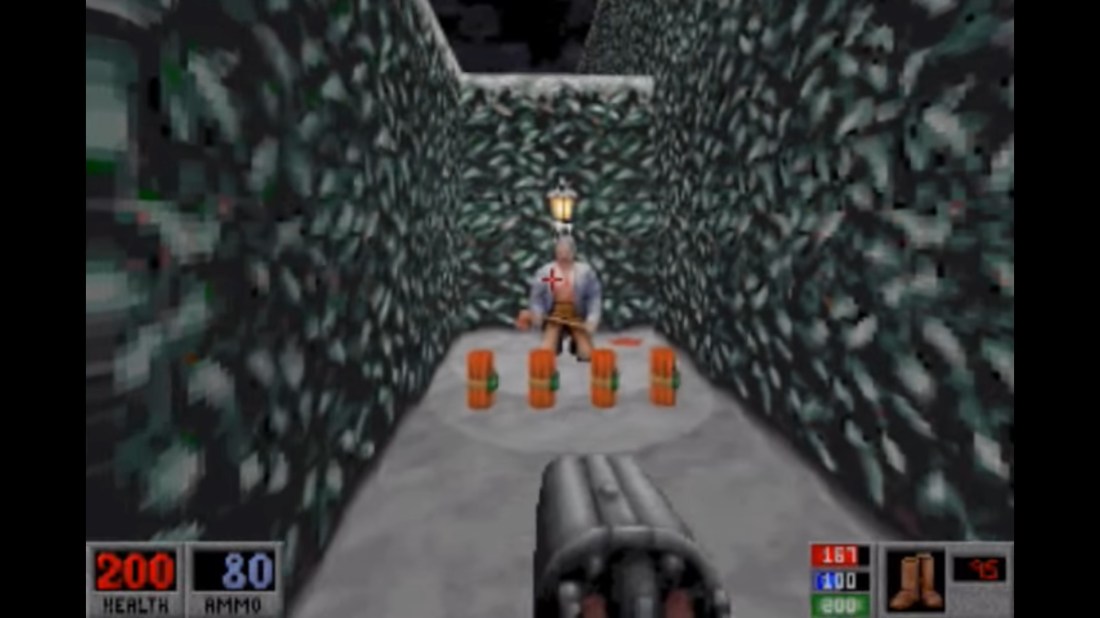
Blood squeezes every drop out of the Build engine. The graphics aren’t hard on the eye; in fact they hold up incredibly well and I don’t feel like I’m playing an old game. Levels are cleverly constructed to draw you in and then spring a trap, they encourage exploration even when you know better; they reward and double-cross you in equal measure. Best of all, you always feel like you’re pushing forward and you’re getting somewhere rather than Doom’s drudge towards whatever. 20 yrs on and I’m still amazed at the sheer inventiveness of the locations; frozen mazes, moving trains, disused fairgrounds, Haunted Houses, Crystal Lake complete with the ki ki ki, ma ma ma sound in the woods, a Meat packing factory, it’s like playing through every horror film I watched when I was too young to watch them; Lovecraft, Poe, Tolkien and Sinatra refs are thrown in too. Modern games, better by every technical yardstick, don’t have this inventiveness. Why are modern games so samey? Within Blood’s levels, buried deep are multiple references to … well pretty much everything you ever thought was cool but your mum would have taken off you if she found it. But Blood doesn’t go for the Duke cheap shots. There’s no strippers who show their pixel-nipples for a dollar, In Blood you have to know your stuff; Dismembered hands scream “I’ll swallow your soul!”,

all work and no play...

Caleb growls “Son of a bitch must pay”, “Are you gonna just stand there and bleed?”, “Victims. Aren’t we all?”. There’s an orange jumpsuit with Kimble on it during the train level, a room filled with magic-tree air fresheners and a body strapped to a bed, a reference to the Flukeman. They are absolutely everywhere and 20yrs later they’re still gloriously retro and I’m still finding them; I heard a dog barking and Caleb muttered ‘Cujo?’ Blood was built for the kind of folks who’d get the zombie in a bath in room 237 of the Overlooked Hotel. Borderlands, Far Cry Blood Dragon and Saints Row owe Blood a debt and still didn’t do it as Rat Pack cool. And this attention to cool, in its clever locations and level design, its references and quotes go a long way to forgiving any of its graphical limitations, it’s playability or its age. Which I honestly don’t find confining.

Like all games of the era, the limitations of the engine also extended to the monsters and the weapons. The monsters head towards your muzzle with little more thought than zig-zagging and the weaponry is just a variation on Doom’s, but they’re as inventive and macabre as you’d expect. A flare gun is a personal fave, just to clip a distant zombie and watch him burst into flames feet from you. There’s the bloody butcher lobbing cleavers, a tommy gun, the cultists mumbling what’s likely some film ref I’ve still not figured out, the voodoo doll. And the zombies with heads you can kick off. Still fun. It’s a shame games grew up, COD could do with some kickable heads and have shooters really progressed any further than dressing up Doom’s gameplay anyway? When they do try something different, we moan about it. We still want to run and gun. That’s what we’re here for and when I battle in Blood I’m having a better experience than most recent games because it gets me; it’s as much fun as freak.

it's stone, it's stone, it's stone

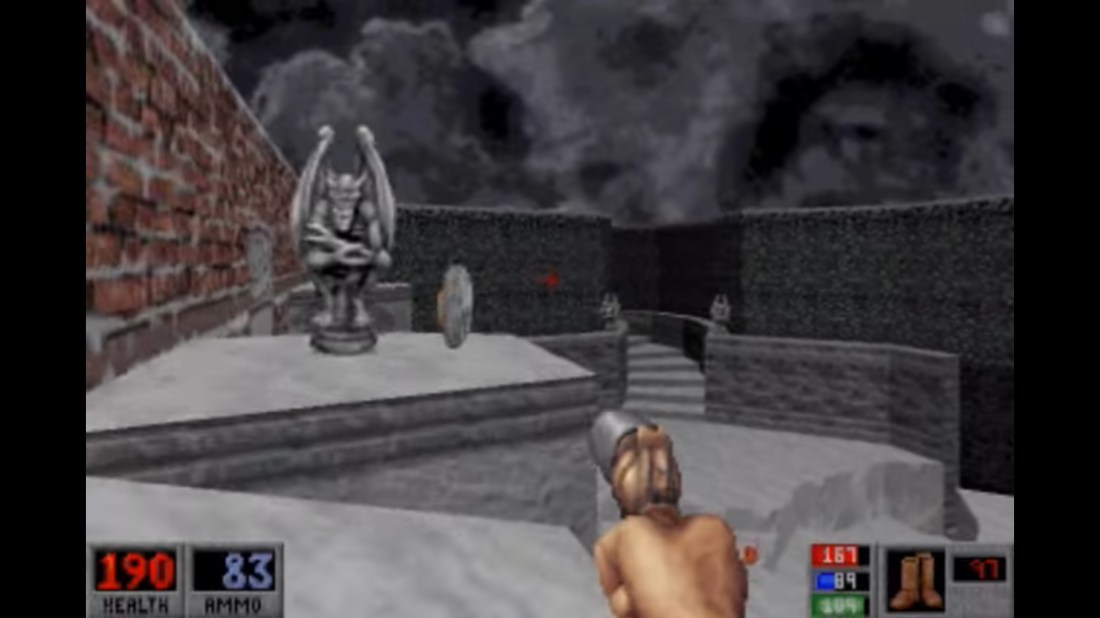
The level design is way above Blood’s peers too. I’d forgotten how much your survival and fun depended on using the environment – which can’t be trusted. The haunted house has some great secret passageways letting you get the jump on creatures waiting in rooms, but the ghosts found there screech and scare you back into the open; Outside, jumping into swimming pools or lakes to escape gunfire is not always a good idea – there’s often a gill monster thing lurking and worse, it can get out the water to chase you, so you just added to the monster count. Clambering on top of buildings keeps you out of range but watch those stone gargoyles … Blood is not for cowards. It’s for explorers ready for a fight. I found myself exhilarated the entire time and when I’d cleared a level, I’d happily wander taking in the style and the references. It’s not lost anything and anyone who grew up on today’s shooters would find this more rewarding an experience if they could see past the graphic limitations.

So involved was I, that when I finally reached the Dark God and demanded a reason for all this, I was speaking alongside Caleb; and the answer didn’t disappoint. Neither did our response. The mystery solved, my wife sadly avenged and the day saved, the game was played and I am no less a Blood fan than I was 20yrs ago. Quite possibly more so because it showed me how placid and safe shooters have become. Once in the zone I forgot it’s age; it’s exciting and so engrossing you don’t care the world isn’t photo-realistic.

Subtly subversive and rewarding, there’s few games even now that can offer Blood’s depth and that transcends any advancements the genre has made; against its peers, Blood still reigns down; Doom has not aged well, Duke is best remembered and not replayed, and the others? I can’t remember what Quake was about at all. Technology may have improved immeasurably, but mo-cap and pseudo-moral choices don’t hold a candle to a game that gets you. Blood still gets me, and it still sits proudly in my top ten.

Elvira. Still got it

Spoiler alert, aka that ending.

I remember the ending being hysterical. Like a real Snake Plissken exit. But this time something different struck me. Call it age, over analysis, maybe I’ve become used to moral choices and my actions having an impact but Blood’s finale was dark. Really dark; even for a shooter, which usually ends with the hero’s murderous mayhem at least justified. I remembered Caleb, having killed the God (He kills a god!), walking into the night victorious; the lone hero. But now, in my later years, I see a man who leaves with nothing; his faith shattered and the society he belonged to gone, Caleb is left with no friends and no future – all by his own hand. Other heroes got their reward; Duke and his babes for example. Calab got nothing but blood on him. So far, so dramatic. But then, his work done, he outright murders someone; someone innocent who was thanking him for their liberation. Games don’t portray real bastards generally. Indifferent maybe, narcissistic perhaps, but typical anti-heroes on the side of right if not the law, sitting comfortably in the ‘he’s bad but they’re worse’ camp. What actually shocked me was the realisation I’d played Caleb just how he was. He was a murderer before and he’s a murderer still. So many games sit on a contradictory fence where the cutscene character is behaving one way, but me inhabiting them sure isn’t. They lament the murder, the horror, then let you take control to enjoy doing just that. You as the player ignore whatever’s troubling that cutscene character; I recall killing endless pedestrians from the outset in GTA SA, just to get some money. That’s not the behaviour of cutscene CJ who desires to rise above the mindless violence of the streets. I wasn’t true to him; your character may be a goody goody, but you aren’t and what caught me was Blood’s Caleb was as true as I was playing him – a cold murderous villain. He was who he was.

20 yrs on and Blood still had one impression left to make; The cutscenes did not justify or ignore the death I’d wrought, they showed Caleb intended to do exactly what I did. For all of Bioshock’s Rescue or Harvest, Mass Effect’s Paragon vs Renegade or whatever the hell Far Cry 4 was trying to say, I’d always do what was best for me the player, not me the character. But Blood knew both of us; it is a brilliant game.

1997 | Developer Monolith Productions | Publisher GT Interactive Software / Atari

Platform; Win

Painkiller

A Blast from the Past review

FBT relives a painful memory.

The Past

My memories of Painkiller are vague yet vibrant. It stayed with me somehow, despite playing once and never going back. I recall the best ‘melee’ weapon of any shooter (The eponymous weapon) as I fought through the lost and pissed off souls of Purgatory to re-join my wife in Heaven, assisted by none other than Eve, looking typically seductive. What really stuck with me, my first thought when I recalled Painkiller is endlessly battering baddies; that’s the point of any shooter, but it was such a consistent onslaught and not in a frenetic, frantic or exhilarating way. I remember them in their hundreds plodding towards me as I plodded towards them, Painkiller akimbo. I think I enjoyed it but didn’t want to be stuck in purgatory again.

Painkiller was released in 2004 – a big year for gaming, starting with Rockstar’s GTA San Andreas. It finally cracked what we’d been after since the beginning; an immersive shooter experience. Along with 2004’s other open world release, Far Cry, games that would have been traditionally linear shooters changed – Now we could choose how and when we shot it. Shooters began to absorb more Role-Playing tropes; xp, level ups, choices and side missions and eventually games like Borderlands became the modern shooter, only CoD laboured lineally on. Meanwhile, 2004’s Doom 3 had one thing going for it – it’s iDTech4 engine; Doom 3’s guts and GTA:SA’s heart meant games were going to get interesting again.

And in the middle of this revolution was Painkiller, in its own kind of purgatory. It’s ‘shut up and shoot’ approach seemed dated, a year too late like Daikatana or SiN, steamrolled by their contemporaries. But somehow Painkiller held on, kept coming like its monsters. A steady stream of add-ons, DLC, odd remakes, and a sequel – Painkiller was one of those games most gamers had played but didn’t really talk about, like living through ‘Nam.

So, my expectations for Painkiller are mixed. Would it play like a refreshingly clean game, a change to the overly complicated shooters of today? Why did I play it once and never go back?

Still a Blast?

Despite it being all about Hell, Purgatory, Regret, Loss and all that, I wasn’t prepared for how Gothic it is in here. An opening cut scene shows a car on the road at night, our hero Daniel (What kind of name is that for a hero? I’ll assume some biblical reference that I can’t be bothered to google) looking lovingly at his wife instead of the road and ploughing their car into a truck. She goes to Heaven while Daniel, in purgatory is left to his own device. The Painkiller. Easily one of my favourite Melee weapons, beating the Grav-Gun from HL2 or Duke’s foot, PK is a bladed fan that slices through enemies like one of those Dicers that cuts anything on a teleshopping channel. But wait, that’s not all! If you order now you’ll also get an alt fire that sends a tracer firing out creating a laser that eviscerates anything walking through it, while the tracer also grabs an enemy and pulls them towards the blades. Plus it can rip open anything destructible. It’s the multipurpose tool of any Purgatory survivor and one of those early weapons you keep going back to because it shakes things up a bit. I’m in a graveyard and looking forward to letting loose.

But two steps of exploration later and I’m battling through pretty much an endless roll-call of Gothic, horror nightmare-ish villains. Crone Witches, Skeletons in armour wielding swords. Fine, this is a shooter afterall and it’s a strong start. But after this happens two or three times, I sense a trend. For no real reason, I’m locked or forced into battles, trapping me into what really are mini arenas; walk into an area and a door locks and off I go, spinning and shotgunning until it opens again. I’m just corralled and set upon. But that’s what a shooter is surely? I justify this as Hell’s punishment for me, to eternally wander into firefights, fighting for my non-life. A dozen baddies pop up, I dispatch and continue. And keep doing it.

Eventually my smiting is over and the entire graveyard smote, my stats are revealed like a deathmatch game and on we go. For levels and levels I repeat this until Eve appears, who along with an angel (who looks like the keyboardist from a ‘80s Swedish pop band) explain Lucifer is on the march to claim Heaven via Purgatory and all I have to do to join my wife is stop him. That’s … big. That’s a big boss battle, the devil. And then it’s back to killing groups in areas in levels, with no real sense of moving forward, of getting anywhere because each level is it’s own part of Purgatory – that makes sense thematically, it just doesn’t work narratively, when in the game itself. When I die I expect it to ask me to insert more coins.

Painkiller is schizophrenic. The cutscenes do all the telling, I do all the shooting. They could be different games if it wasn’t for the backgrounds. Sure, that’s the basic structure of any FPS, but the stages, the stats completely remove me from any personal involvement. I just wander looking for traps to spring waiting for the exit to open. I have no investment; This feels like a bot-controlled deathmatch, like I have no friends to play with online. There’s no story elements to the parts I control, no reveals, no curiosity to be had. Just shoot.

Daniel, in a pleather jacket and frowny face, doesn’t seem too concerned about it. He’s like a Max Payne knock-off. Had Daniel been a bit more of a Maxalike, constantly doubting himself in-game, it could have been interesting but once you’re back in control, Daniel is silent (except for those annoying ‘huh, haa, oof’ noises first person heroes used to make every time they jumped.); All the apprehension and seemingly unwinnable situation carefully woven into the cutscene’s narrative is swept aside in favour of literally hundreds of creatures who take the quickest route towards Painkiller’s blades. Zero AI, zero challenge. All I got from this was RSI from clicking fire. You could mod the backgrounds into anything (Serious Sam springs to mind) and it would have no effect on your experience; Your purpose is to clear out the baddies and start the next battle.

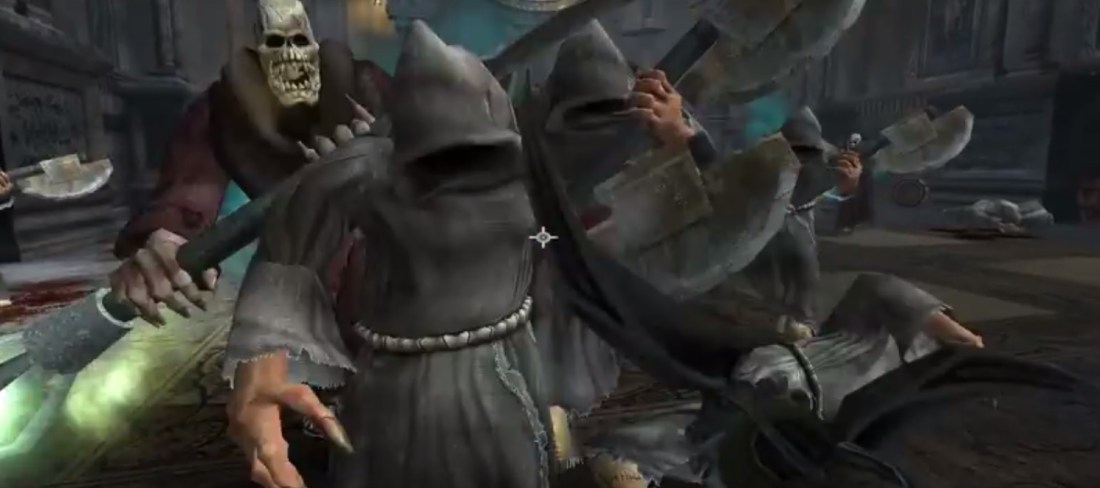
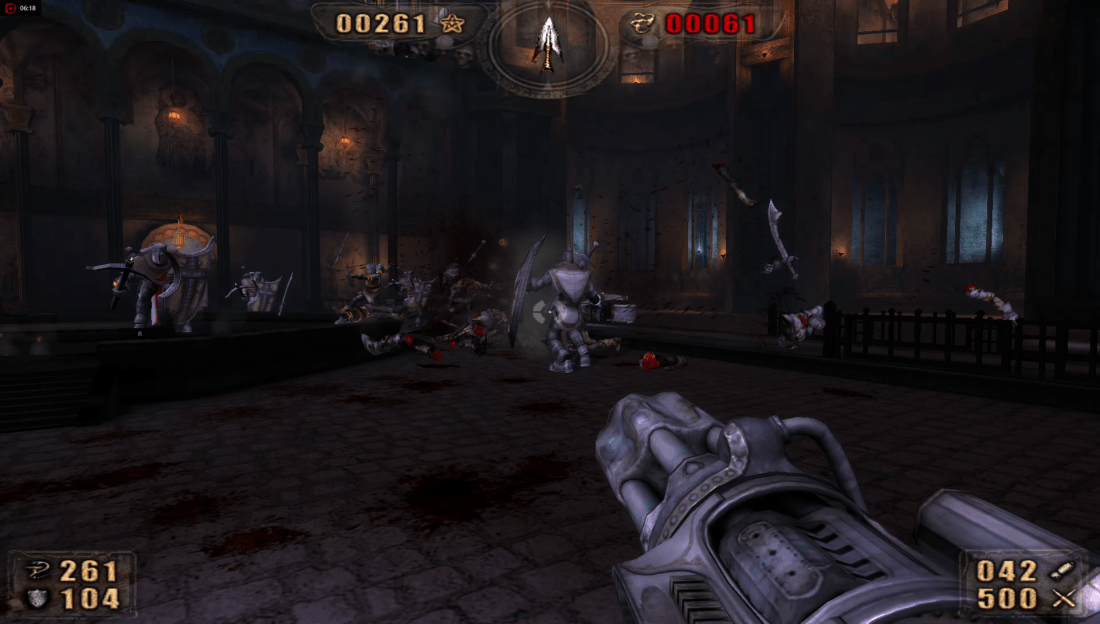
To look at, it’s a thing of beauty. Each level is a master-class in art design and different to the next. Every possible gothic and nightmarish location is explored and it’s done so well – you’re maiming through huge cathedrals where robed figures lob axes, blazing medieval villages under attack from witches on broomsticks, a mental institution where tortured patients still strapped to their electro-shock equipment scream, medieval castles with Executioners. Later levels reflect WW1. It drips with death and despair and that’s what is so anger-inducing; none of the surroundings are reflected in the experience. Purgatory is full of decrepit and wasted places inhabited by victims siding with the Devil in the hopes he’ll lead them to Heaven yet you’re just holding down the shoot button in arena battles. If it felt like you were pushing forward, that you were progressing through the story not a level it would be perfect. Painkiller should work, it should be full of a creeping sense of unease as I hesitantly explore the underworld knowing I’ll have to face off with the devil at some point. But I make no connection, I have no war-stories to tell, no anecdotes of lucky/clever fighting on my part or the baddies, no narrative moments while I’m in control; I don’t personally achieve anything except unlock the exit and my experience would be identical to any other gamer’s.

And it gets more frustrating. Each new level removes your previous ammo and armour disconnecting you from the narrative – It’s Unreal Tournament in a Haunted House; It’s easy to see why PK was chosen as the first World Cyber-Athelete game. Chasing after souls to invoke ‘devil mode’, juggling coin out of dead bodies to unlock one-use power-ups just add to the disconnect; Daniel should be Max Payne, the levels should show me clawing my way back to my wife, I should want to get through this but I just maim until I get to see Eve again in her barely there outfit; I don’t blame Adam for making a mess of things. Painkiller is essentially an arcade game while the cut-scene story is an animated Divine Comedy. Just watch it on YouTube.

2004 | Developer People Can Fly | Publisher DreamCatcher Interactive

Platforms; Win | XBox

The Darkness II

A SECOND WIND REVIEW

FBT is The Darkness. With the lights on.

When The Darkness II came out on PC I didn’t bother, even though it looked cool; why plonk down money when I’d never played the console-only original? Why was it successful enough for a sequel but not a port? Lazy, 2K. But, DII started appearing in the sales and after reading reviews that likened it to Bioshock (DII was from Digital Extremes, who had swam in the Bioshock universe) I decided to give it a go – Plus, The Darkness is voiced by Mike Patton; sold.

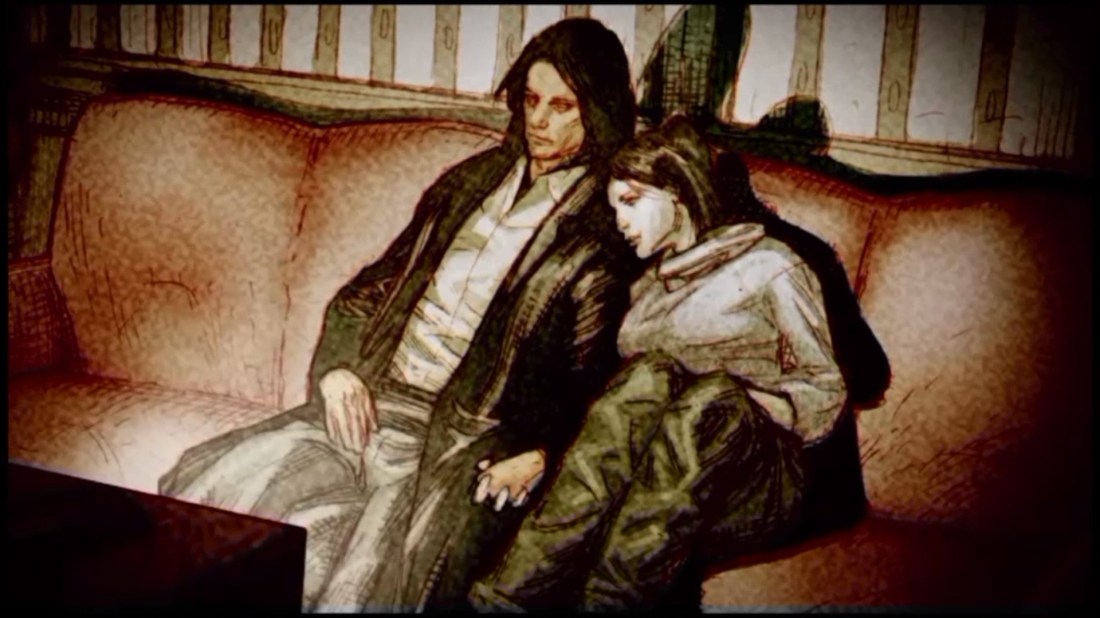
As explained by a manic flashback chap, we learn The Darkness existed (quite happily) in the great nothingness until God decided to let The Angelus (the light) into the universe to help create Earth; The Darkness isn’t happy about this, and The Angelus isn’t a fan of the Darkness either but since they can’t exist simultaneously The Darkness takes advantage of this Earth gaff and inhabits humans to do its dirty work, allowing them free-will knowing it’s powers will corrupt them and plunge the universe into Darkness again. The Angelus meanwhile, takes over humans completely and creates ways to imprison The Darkness and claim earth for itself. Get a room. On his 21st birthday, the only light in mob hitman Jackie’s life is Jenny, his childhood sweetheart. A mob boss murders her but Jackie is unable to stop it – the Darkness, which was passed down from previous generations manifested and held him back. Jackie fully embraces its corrupting nature and rage-driven, slays the entire mafia. Or something like that, it’s hard to keep up with the yammering narrator and it’s based on a comic book, a medium not known for its continuity. With the mafia dead and him the new Mob Boss, Jackie, with the help of our panicky exposition expert Johnny (what’s with all the J-names?), then suppresses The Darkness, until … Darkness II presumably.

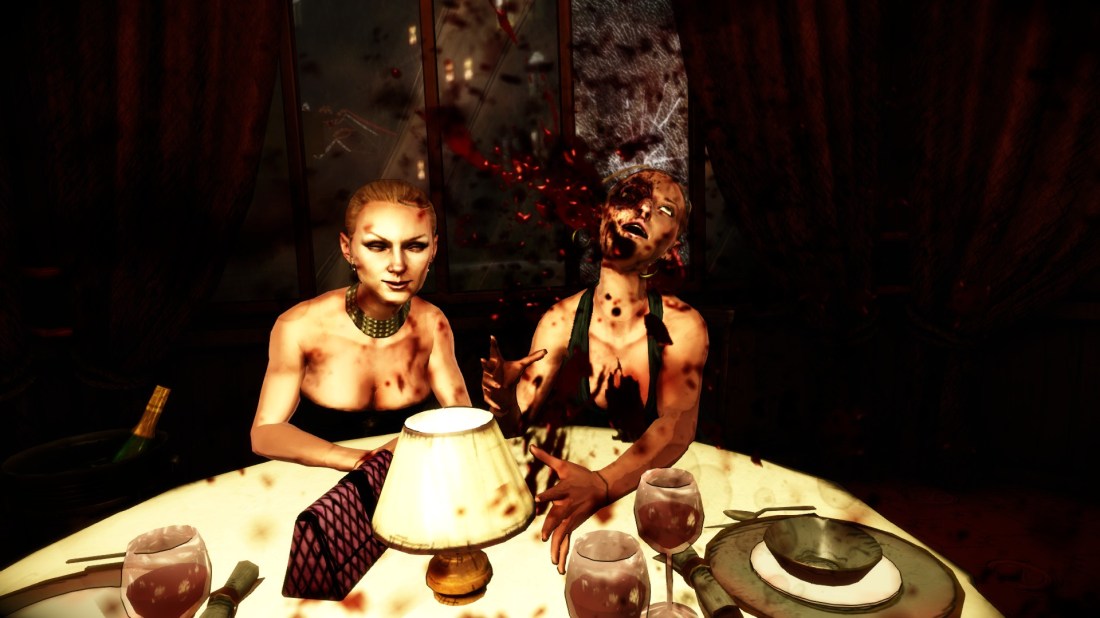
The look of DII is somewhere between XIII and Borderlands – fitting, given it’s based on a comic and from 2K, they must have had some spare Borderlands render knocking about. It gives DII a surreal, saturated comic-book look which helps with the ultra-violence the Darkness has in mind – had this gone for realism I’m not sure I coulda stomached some of the things The D gets up to. We open on Don Jackie being shown to his table by mob friend Vinne. All the Soprano and Italian clichés are here; we know everyone in the joint, someone is complaining about the spaghetti and Don Jackie is seated at his special table with two stripper sisters for the evening’s entertainment. Unfortunately, one entertainment is shot through the eye and the other hit by a van that crashes into the restaurant, delivering a bunch of mobsters intent on whacking Jackie. Badly hurt, Jackie is dragged through the chaos by Vinne, shooting mobsters as we go. One gas explosion later and a burning Jackie hears the Darkness begging to be let out and save him from death. Jackie agrees; then all hell breaks loose as two … appendages sprout out of somewhere over his shoulders and lay graphic waste to the mobsters. I wish I’d picked this up sooner. This is awesome.

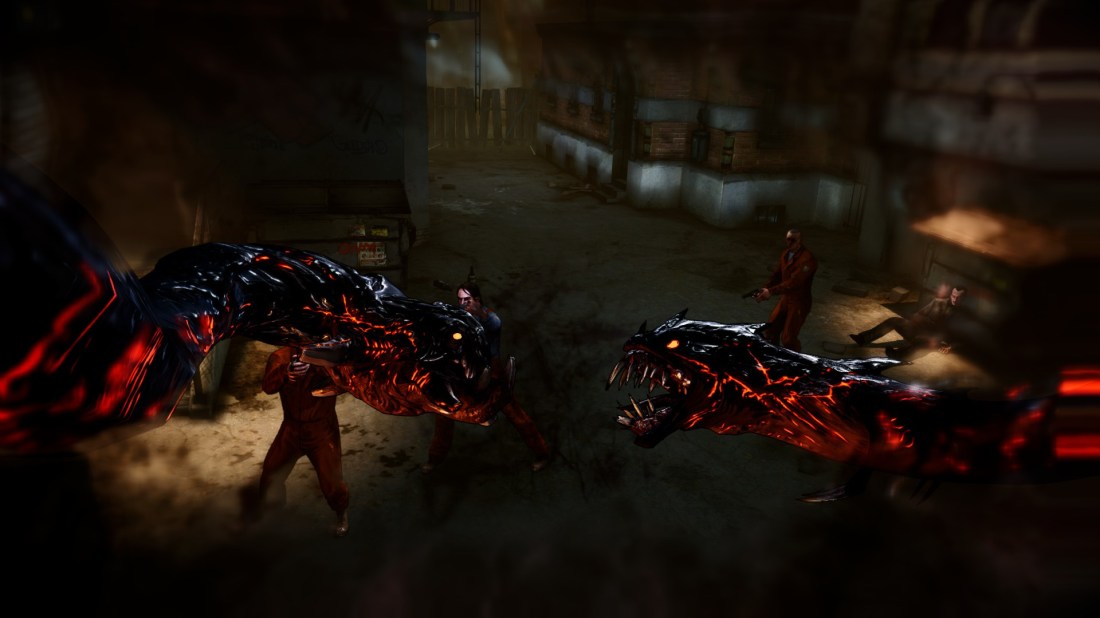
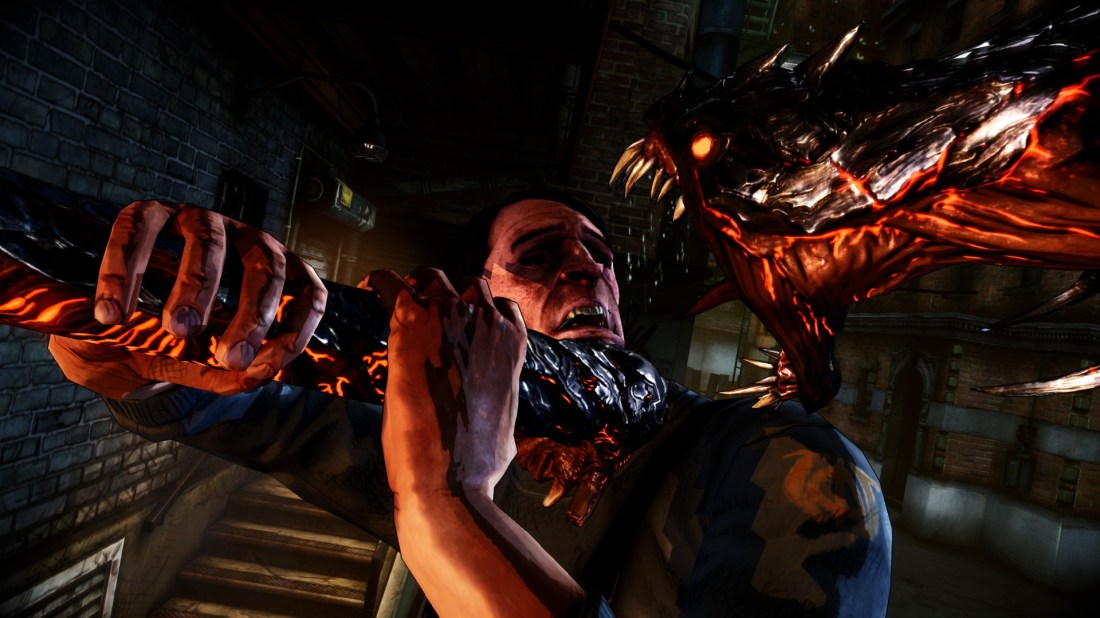
The Darkness’ representation is pure horror. The slithering, snake-like arms end at snarling, jagged spiky teeth and look like the bastard child of a Xenomorph and those nightmarish deep sea fish. They have a life of their own, look around (sometimes at Jackie which is weirdly unnerving), squabble with each other and are deadly. You never really see what Jackie looks like with his extra arms but judging by the reaction of the mobsters (‘what the fuck is that?!’ usually) I look hideous. But who cares, look at those things. One arm, Grabby, picks up and throws things while Whippy slices and dices. Mobsters can be grabbed, thrown, eviscerated or sacrificed in imaginatively disturbing ways, the tendrils can pull out and eat hearts to regain health and smash their way through obstacles. Those moments are so good (one references the Alien John Hurt scene), that I often chose to take a battering just to reach a mobster and watch my arms do their graphically slimy, bloody work, wondering if it’ll be the Alien death, the one where they grab each leg and rip the mobster in two or ‘just’ cut them in half – then use a half to throw at another mobster. The way the mobsters scream when they get grabbed, the slithering sound, the growling, it’s unsettling … and that’s before they start tearing them to pieces. Grabby can also lob things at enemies; the real finds are stuff like poles that can skewer, doors that can be frisbeed to decapitate – sometimes Grabby can miss a gas canister and throw a coffee mug instead, but these things happen. Whippy meanwhile has a fun time belting mobsters into bloody messes like a demonic cat o’nine tails and can be upgraded to grow blades down it’s back – actions that The Darkness likes will gain you xp to unlock its powers like Darkness Armour (which only works in the dark) and pulling ammo, health etc out of the mobster’s viscera once they’ve done their work. As the arms get more powerful you wind up using them as primary weapons while guns are for those hard to reach mobsters and shooting out lights.

Since Light and Dark don’t get on, any light means the Darkness retreats, leaving you exposed. Shooting out the lights brings it back and it’s a great extra dynamic to the game; trying to fight while avoiding light sources or find and remove them in the middle of a firefight is thrilling and the bad guys get wind of this and start setting up traps with flood lights and using high-powered torches, and later light grenades to keep you in check. The Darkness won’t let Jackie die, as without him it’ll be rendered useless, but you have to stay out of the light to gain its rejuvenation powers. Most games have a dynamic to set it apart from others in its genre; Plasmids, bullet-time, power-ups etc., but being afraid of the light is a new – and welcome – one. It’s a nice change to be the monster in the shadows instead of the other way around.

So now The Darkness is back and Jackie’s empire is under attack from another crew, time to figure out what’s going on. Jimmy is brought to the mansion and a long fidgety story later, there’s a group calling themselves The Brotherhood who’ve found ‘the Syphon’, an object created by our old pal The Angelus to contain The Darkness. Problem is, Jackie has to give up The D willingly so they’re all about making his life as horrible as possible, including capturing and crucifying him, killing his friends and family and generally being as despicable as possible; promising to stop if he just lets The D go. To stop Jackie considering it, The D reveals a secret – It kept Jenny’s soul. She’s trapped in Darknessland and since The D really doesn’t want to be given to The Brotherhood, it cuts a new deal; Kill’em all and you’ll get Jenny back. Jackie arms his arms and obliges.

As we shoot and eviscerate more mobsters than Max Payne could dream about, we work through some killer set pieces. An abandoned fair ground, warehouses and whorehouses and even our own house after it’s attacked by The Brotherhood are tense and exciting shootouts, with bullets and bodies being flung every which way. While this blood-letting is going on, it’s clear The D is up to something and maybe a little worried – It’s in a difficult position; It needs Jackie to stop The Brotherhood, but that means Jackie may get the Syphon himself; it begins to taunt him with memories of Jenny and flashes of her in Hell to keep him in line and not get any ideas about using the Syphon himself. Even though I’ve not played DI, I can see why critics often point to their relationship as one of the best in gaming – and Jenny’s death one of the most heart-breaking. Jackie doesn’t care if The D is setting a trap and neither do we. Saving her is the only thing on Jackie’s mind – or maybe it’s all in his mind.

On occasion, Jackie will suddenly find himself in a mental asylum. Here, surrounded by people from his ‘hallucination’ including a kindly nurse called Jenny, Jackie is led to believe The Darkness, his role as a mafia don and The Brotherhood are just figments after a major breakdown. You never really believe the asylum is reality but it does seem more likely – we do have demonic tendrils for shoulders. It’s also more welcoming, as Nurse Jenny begins to warm to her patient. This reality might be a better option for the heartbroken hitman. It’s interesting to have this level of uncertainty – real or not, Jackie might chose it; Jenny’s alive here – and not everything is cleanly laid out – Jackie and The Darkness need each other, but Jackie is a psychotic killer and The Darkness is not exactly trustworthy. There’s just this fatalistic, uneasy sense that pervades DII. It’s all just so horrible. Additionally, each mission is preceded by Jackie describing his life as a Darkness host and a mobster; but who is he confessing to, and in which reality? As a mobbed up criminal or a mental patient describing his delusion? Or somewhere else? He looks how he looks in the main game not the asylum, but is that how he sees himself? Where is this happening?

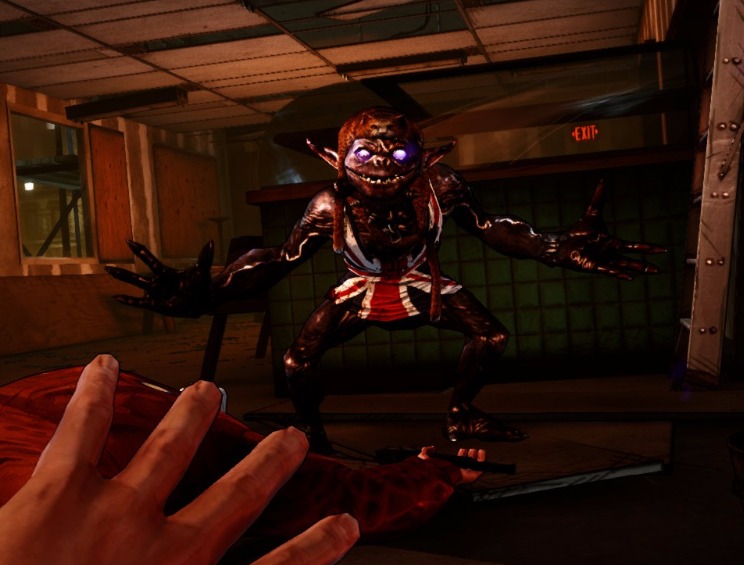
Although Jackie is very much a lone gunman in DII with only The D’s Jenny-taunting for company, he’s not totally alone. In-between missions he can roam his mansion, chat with the other mobsters and reminisce about Jenny –who, thanks to The D, appears on occasion to relive their past life together. But, his only true friend/fiend is his own personal ‘Darkling’ – possibly the best side-kick/follower ever. Wearing an oversized Union Jack vest that makes him look like a gremlin ginger spice (with, inexplicably, a dead cat on his head), Darkling chatters in an Eastenders accent, takes the piss out of Jackie (or Monkey as it calls him) and generally lads about causing trouble. Despite being a servant of The Darkness sent to aid him, he seems to have some measure of self-determination; He knows The D can’t be trusted and tries to make Jackie see beyond his grief, knowing Jackie will do anything to get Jenny back even if it’s a lie. He often suggests they give up and go have some fun. He’s like that friend you know better than to invite out for drinks but do anyway because the fun on the night outweighs the apologies the next day. He’ll rip apart mobsters, distract them, piss on them, point out shortcuts and ammo and can’t be killed. He behaves exactly how a three-foot-tall immortal gremlin from hell would. Grabby can even pick up Darkling and throw him at mobsters, which he’s not very keen on. Several scenes put you in his mind to sneak about and ripping open mobsters’ throats with his fingernails is a whole new grotesque experience. He’s a fun sidekick without falling into comic relief, a great -if maladjusted and deeply disturbed- character and his loyalty to Jackie is oddly touching.

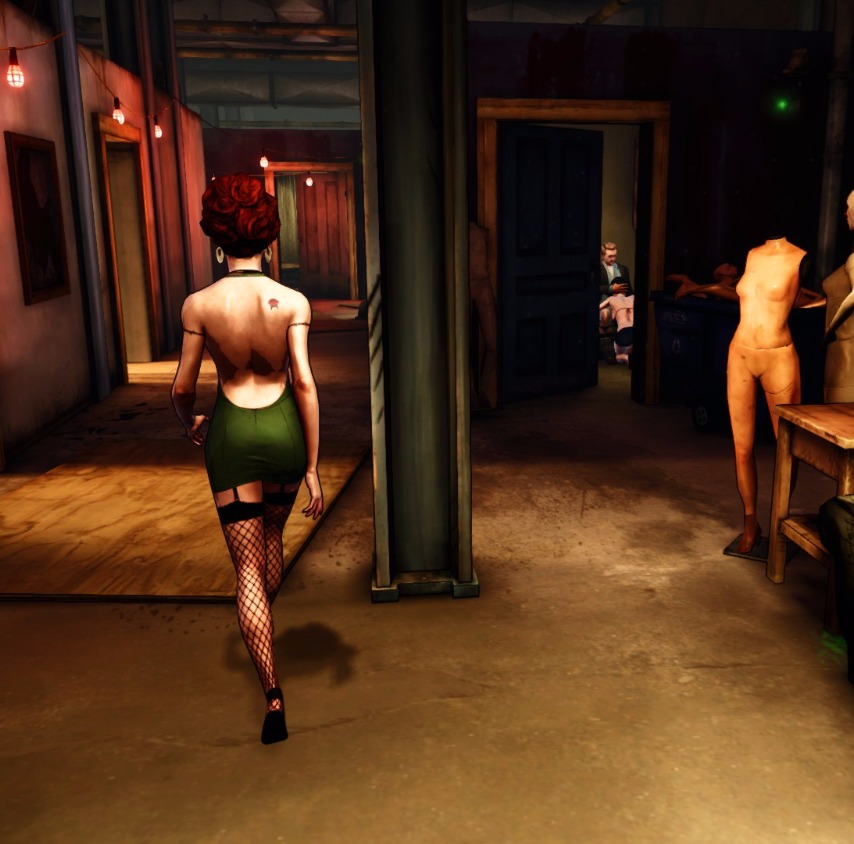
Not quite so touching is the game’s treatment of women. As it’s a mobster fantasy, it’s a strictly male-view cliché game which is fine, but apart from Jenny who’s romanticised to the point of perfection (but since she’s in Jackie’s mind, she would be), the only other women are Jackie’s shrew of an Aunt and a prostitute who helps Jackie sneak into a brothel; her brutalised body is seen later but Jackie doesn’t react and the brothel is an uncomfortable scene – sex slaves kept in plywood rooms, dressed in ragged and dirty clothes as they dance or perform. Jackie does burn the place down but not to free them. It’s a grim moment in an otherwise hyper-real game; we’ve got tendrils sticking out our back and we’re accompanied by a gremlin; is this really the game to offhandedly have us shoot through a sex trafficking location? There’s also the two sister strippers and a gratuitous ass shot followed by bouncing boobs in a scene that would put Elexis from SiN to shame.

As we make the final push towards The Brotherhood’s stronghold (having been crucified, shot in the face, locked in an iron maiden, forced to see Jenny in hell, watch family members murdered then have those family members’ funeral disrupted, chose which friends are killed), the two realities converge and Jackie must make a choice – which one does he believe in; or rather, which he’d rather live in – Stay with Nurse Jenny or descend into Hell and see what The Darkness has been keeping from us; It’s a tough choice.

DII is a short game and has an unforgivable cliff-hanger ending – it ends on such a great ‘awww’ moment, then jumps to ‘ohhh’ and as the credits roll, ‘agggh’. That’s assuming you reject the asylum; that ending is ironically better given there’s no DIII.

Although DII had no DLC to continue the story, there is ‘Vendetta’. A co-op (or solo) set of missions, you pick one of four mob hitmen assigned to aid jittery Johnny in his investigation. You don’t have the arms at your disposal and its basically surviving waves of villains to reach a Darkness artifact so story-wise it’s redundant but they’re good little shoot’em-ups and Johnny has some nice lines (especially if you play as Shoshanna, a no-nonsense ex-MOSSAD agent he develops a crush on) and it provides some background to Johnny’s main-game exposition. Still, I would have preferred an ending. Or a DIII.

Despite it’s shortness, The Darkness II packs a huge amount into that time and it gets you invested. It really shouldn’t work – mobsters, horror, comic-book look, a psychotic gremlin sidekick, murderous tendrils and a demonic voice in your head while a love story plays out in flashback and fantasy? Yet it works because apart from being a really good shooter with those arms brilliantly utilised rather than just being oddities, it’s got heart; we want to see Jackie and Jenny together again. I am so moved by Jackie and Jenny’s love affair, plus the fun of playing with Grabby and Whippy that I’m annoyed I’ll not get to play DI and see how it all began; I’m almost tempted to buy a console just to play it. Almost. Nearly convincing a PC Gamer to buy a console? That’s a good game.

2012 | Developer Digital Extremes | Publisher 2K Games

Platforms; Windows | PS 3 | Xbox 360

Star Trek Elite Force

A Blast from the Past review

FBT goes boldly where no gamer has gone before. To replay a Star Trek game.

The Past

One of my earliest memories is of my Mum turning off the Star Trek episode Arena ‘cos the Gorn scared me. From then, I was a trekkie. But I was never fussed about Star Trek gaming. Most were either adventure stories which I had (and still have) little patience for, strategic games (boring) or were terrible (That’s more my style). The only exception was the 25yr Anniversary Game, and since Star Trek is now 50 years old, I can’t bring myself to go that far back when rediscovering old games. The reason I got Elite Force in 2000 was because it was marketed as a shooter. And it had form – It was from Raven, who gave us Heretic and it’s built on idTech3, back then the best shooter engine around. That it was set in my favourite sci-fi universe was just a bonus. That it was set on Voyager was less of a bonus, being my least favourite trek (other than that one with the Quantum Leap guy but that series doesn’t count). I was stoked to let rip with a phaser.

I can’t recall much about the game now I come to think about it; I know I enjoyed it, but I’ve never really brought it up in gaming conversations and I don’t recall anyone else celebrating it either. Maybe that’s because 2000 had a lot to celebrate; Hitman, NOLF, Deus Ex, Diablo II and, ahem, Daikatana were released, not to mention all the great games knocking about before 2000 that were still resonating (Half Life, take a bow). Not even the marquee value of its namesake could keep Elite Force in gamers’ minds. Maybe gamers were just after something fresh, something they could call their own instead of a dad hand-me-down like Star Trek. To be fair it did well enough for a sequel but Elite Force is long forgotten. I’d completely forgotten about it myself until I went looking through my ‘probably won’t run in windows anymore’ box. It’s not even on Steam.

But, it’s Star Trek and it did run in windows. So, Make It So. No, that’s Captain Picard. I can’t remember if Janeaway had any catchphrases. I recall she loved coffee, and that’s good enough for me. Make It Strong.

Still a Blast?

My first surprise is the menu. It animates like one of the computer screens on the show and it has the ship’s computer voice. It actually has a mildly nostalgic effect on me. Not for Star Trek, but because the menu is immediately involving. Games now go for that minimalist look with their menus, a sleek typeface and nothing of what you’re getting into. But for a time, games wanted you in the zone from the get-go and the menu was part of the world; Medal of Honor Allied Assault’s menu was a radio-set in a bunker; that reboot was all black background and white text. How does that orientate me into the game world? Remember when Doom’s exit choices would goad you into sticking around? The new one doesn’t, it just asks if you’re sure you want to exit (Yes, I am sure). Menus were part of the experience.

The cut scenes look adorably 2000; the external shots of the ship and space are CG animation and everyone’s got that scanned in face stretched across a box look. But it’s the real actor’s faces, Seven of Nine is still hot and rather than thinking this is too old to enjoy, I’m happily going along with it. It’s an old game but no less involving for it. Reporting for duty, stretchy-face Janeway.

So after a quick captain’s log, I’m wandering about a borg cube. While it does look a little Quake 2, movement is fine, the death animations are great and it’s thrilling for a trekkie and challenging for a shooter fan. The interiors of the ship look great and the borg are menacing. Taking their design style from the First Contact movie, they look Hellraiser-ish and have laser sights and make grabs as you pass, aiming to assimilate you once they get past your armour and health. Oddly, both Health and Armour are repowered by single health points dotted about, essentially giving me 200 health since amour gets whittled down first. Nevermind, turns out I need it, this is an unforgiving game in terms of hit damage. I’m really into it, and I’m resisting a resistance is futile comment.

Playing merrily away, I realise the mechanics of shooters really hasn’t changed in over a decade and a half. I spin through a choice of weapons, jump and duck, shoot and get shot, figure out how to unlock doors, get past some obstacle, take mildly non-linear routes to a goal. The only difference between now and here is the pixel count and that doesn’t matter when the game keeps you busy and involved. There’s lots of mini cutscenes during missions that reinforce what we’re up to, chatter between me and the rest of the team and mission parameters update and change regularly; I realise that structurally, it’s set like an episode of the show. This is great!

It’s not so great for Voyager though – unexpectedly transported to a graveyard of derelict ships, some malevolent force with a Reaver-looking ship is intending to turn Voyager into scrap. Well, guess who’s up for stopping it. Me. Or rather, she. Elite Force was the first game I remember playing where I could chose the sex of my arm (Being a FPS, the gun wielding forearm was all you saw save for the cutscenes). Games which allowed a gender choice back then usually plumped for ‘female; faster but weaker’ while Males were stronger but slower. But here the Trek world, everyone is equally capable. What doesn’t make me feel so good is the Elite Force of the title were some kind of Special Ops Red Shirts. Anyway, via an adorably dated cut-scene, we escape the immediate threat and Janeway sets us Spec-Ops Red Shirts up to go sniff around the other derelicts to find what we need to get out of this place before the Reavers are back.

Once free of the cut-scene, I can take a wander about the ship. This is new. Most shooters stick to cut-scene, shooting-scene, but here I’m on my own recognisance until I get called to a mission or breifing. The ship looks good and is well rendered, although I spend most of my time lost. Rather than feeling like padding it’s actually nice to take a break and get a sense of what I’m defending. Later as the story progresses, missions take place on board and you feel invested in protecting it, your home. You get to meet other crew members, hang out in your own quarters or the canteen, get ordered off the bridge, mess about in the holodeck and even develop a relationship with a fellow Red Shirt, Telsia (who consistently gets shot, kidnapped and in-the-way when you try to get through doors). Our flirting is likely down to the male version of my Red Shirt being the default, but regardless it’s amazing to consider a gay relationship in a game this old, with no commentary on it either. Considering how the game industry has portrayed – let alone treated – women through the years, not to mention an almost zero LGBT presence except for titillation, this is a nice moment; we have a cute little relationship to explore as Telsia warms to me and suggests places we can meet to talk more privately. If only I didn’t keep getting lost and forgetting where she is. When I finally found her I busted out my best moves and she told me to get lost. I assumed I’d missed our moment until I realised it wasn’t Telsia, just a similar looking NPC. Telsia was on the other side of the canteen. It’s disappointing then, that in Elite Force 2 a female option is no more. It regresses back to standard cis heroic male (with whom Telsia continues flirting, and likely getting stuck in doors with). So much for progress.

The structure of the game really does mirror an episode of the show and it makes it so much more involving. There’s plot, drama, action, problems to solve, retrospective moments and characterisation – much of which is on your say-so as you wander the ship, fix things and interact, influencing the way NPCs behave. It’s still basic, this is no Mass Effect but in some ways I feel ME owes EF at least a nod. If you swapped Voyager for the Normandy and Telsia for Ash. Or Liara, or Miranda or Tali, Jack or … Just the same. Anyway, point is I hadn’t appreciated the depth or subtlety in Elite Force. It really tried to be something more than a straight shooter although as a shooter EF works well; the weapons are varied and actually work with different baddies rather than lazily getting bigger/outrageous/unuseable the further you get. You can also choose a weapon loadout ranging from just a Phaser to going Commando (I mean like the scene in Commando where he tools up). Plus you’re often shooting trek badguys too. The Klingons, the borg plus a few Voyager villains and some created for the game. They use typical group or cover tactics but rarely miss; run and gun will get you Redshirted quick.

The missions are well paced and much like the show, you’re rarely alone; Elite Force crew accompany you. Aside from Telsia’s headstrong habit of trying to get through doors first, they’re handy to have around. They work well, fight well and are quite chatty, talking about the mission, past events, how they’re feeling about things. It’s nice to not to play the lone gun-woman and their prattling keeps it all tied together. They’re often key to progressing too, splitting up to recon or hack doors, or if Telsia’s involved, triggering a firefight or setting off a trap. You become protective of them, they’re not cannon fodder. If one dies, another NCP doesn’t just beam in and your team is down by one – and mourned by all. This comrade-connection extends to the periods of R&R aboard the ship and several main characters in the game are the TV show’s background or recurring characters – you often overhear comments or references to episodes or trek events. All of this would go over the non-pointy ears of non-trek fans but for those in the know, it’s a lovely touch.
The devs also keep each mission memorable. There’s a great plot twist during a borg mission where you walk into a trap (Telsia…) and instead of assimilation it was a set-up to blackmail you into finishing off an old adversary of theirs from the series. It’s a nice little nod tying it into the show but from a gaming perspective, suddenly you’re span off into a new situation and there’s a different tone to the mission.

One level in particular stands out, for its trek references and great level design; on a recon mission, Redshirt realises the space station they’re on is actually the fused together wreckage of different species’ ships where they co-exist in their own areas with an uneasy truce. It’s a great location and environment. We have a sneak mission past the Klingons who bitch about the untrustworthy humans. Humans? We sneak on, and enter a strangely familiar ship. It’s the original series! But not as we know it, Jim. This is the alternate universe from the classic series episode Mirror, Mirror. There’s no mention, no reference and it has no bearing on the story but it’s a brilliant touch and I had loads of fun walking in and out of the doors to hear that woosh sound. No Telisa to get in the way thankfully – because she’d been kidnapped. The level ends on a cameo (and boss firefight) with a well-regarded species from Voyager too. It’s a great level.

Finally, our hero, our Redshirt, Alex progresses too. Beginning as a hothead disappointment and threatened with being cut from the team, she progresses to team leader by the final quarter, and it actually feels deserved. It’s a nice little character arc within a great storyline, set in a solid game. Plus as part of the command crew, I get to hang out with Seven. Just don’t tell Telsia.

As a retro game, Elite Force is great. Yes, it looks its age but that’s most evident in the blocky representation; It’s got a solid plot, adventure, characterisation and you get invested – You care that Voyager escapes. It’s a shame it was marketed with the line ‘set phasers to frag’ – that’s just going to piss everyone off, trekkies and trek-haters. But it’s a great shooter. There’s few games in this genre that can boast such a well-rounded and considered experience; For me, I’ve rediscovered a rival to Half-Life and that’s not just the Trek talking. I am very happy that Elite Force isn’t going back to the ‘wont run in windows’ box and it won’t be forgotten so quickly. Least there were no Gorns this time around.

2000 | Developer Raven Software | Publisher Activision

Genre FPS, Sci-Fi

Platforms; Win, PS2

Kane & Lynch Dead Men | Dog Days

A SECOND WIND SPECIAL

Kane & Lynch Dead Men | Kane & Lynch Dog Days

FBT takes a walk on the wild, bloody, morally shaky side with this Kane and Lynch double-bill special review

The Kane & Lynch series was polarizing; critics either applauded it or were appalled by it, and for the same reasons; morally ambiguous, ultra-violence, glorification of criminals, bad hair dos. But both sides agreed that beneath the Heat-inspired set-pieces were formulaic shooters and that while Dead Men’s ambitious reach exceeded its graphical grasp, Dog Days was just seedy and unnecessarily brutal. Meh, I wanna play Heat the Video Game.

In Dead Men, we meet grizzled mercenary Kane, composing a letter to estranged daughter Jenny while in a prison van headed for death row. He’s promptly broken out by Lynch, channeling Heat’s Waingro and taken to a warehouse, via an extended tutorial/shootout in which more cops than you can shake a donut at are shot. Kane was on death row because a job went drastically wrong and he lost a ton of money for ‘The7’, a collection of high-end mercs who’ve kidnapped his ex-wife and daughter; get the money back and they live. Kane’s dead either way. Lynch, a low-level thug with some serious psychological issues is looking to get into The7’s crew. If he can babysit Kane and bring the money, they’ll have him aboard.

After another mini tutorial and more cops shot, we infiltrate a bank for Kane’s dirty money, leaving Lynch to control the bank customers. Instead, Lynch panics and suddenly kills most of the hostages; I’ve not even finished the first mission and I reckon the death count is reaching triple figures. I killed two or three security guards just walking in the place. After shooting a ton more, we fight our way out of the bank and along the freeway, eventually escaping on the subway where we fill time waiting for a train by killing more cops.

Dead Men feels pretty good so far; everyone’s a bad guy, the situation is bad, the solution is going to be bad and the ending doesn’t look good either. It feels stripped back like Heat, focused and driven; there’s nothing in this game that we can’t drop in thirty seconds flat and Kane & Lynch are a good, if dysfunctional team. Kane knows how to shoot, he’s Heat’s Coffee House scene come to digital life – He’s boxed in and he’s not hesitating. He isn’t like Tarantino’s cool killers, sporting a Gittes-style nose bandage after getting pistol whipped and a scar across a white eye, we’d never see him jiving in the Jack Rabbit. He’s coolly efficient and pissed at Lynch not for opening up on the hostages but for the police interest it draws. We did just bankrupt the Police Department’s Widows and Orphans fund.

Apparently unhindered by what would be by now the biggest manhunt in US history, K&L pop over to Japan to kidnap the daughter of Japan’s biggest mobster. Kane intends to ransom her for the rest of the money, but first we have to shoot our way out of the nightclub we found her in. Cue innocent lives lost as we try to cut through the panicking crowd in the dark strobe-lit club picking out mobsters scanning the crowds for us. Unfortunately, once clear, Lynch misunderstands Kane’s deal with the mobster and causes the situation to … escalate. Lynch, with his Mr Kidd meets 70s porn-star look is, unlike Kane’s precise coldness, really well balanced considering how unbalanced he is. He’s noted in the game as being a self-medicating psychopath, but he’s more complex than that. He’s quite needy and naive despite his brutality and pessimism and you get the sense there’s a lot more to him. He’s the most interesting thing in the game and it’s a shame we don’t explore Lynch further. He’s apologetic about the hostages and explains he blacks out when stressed, adding a complication and turning Kane into the babysitter instead as Lynch occasionally just races off to murder and when he comes too he often assumes Kane was responsible for the bloodshed. As a follower, Lynch can be directed about (He does get amusingly snippy if you order him about too much or demand he swap out his favourite weapon) and you can revive him – he’ll do the same for you as will other followers, although if it happens too often Kane will die of an overdose. Even health can kill you in DM. Lynch tries to bond with Kane telling him his wife was murdered (it’s implied that he might have done it during a blackout); Kane, of course, stays resolutely distant and grimly points out The7 will kill his family which Lynch didn’t seem to realise. He also sarcastically warns Lynch there’s no way The7 would have a loose cannon like him aboard; they’re just using him.

Sure enough, once they return from Japan (empty handed even after having killed most of Japan) it’s double-cross time and Kane decides the only thing left to do is off The7, while Lynch just wants revenge. The7 being somewhat powerful means K&L first establish a crew of their own, the Dead Men by freeing several other ex-The7s from a high-security prison. And then it’s a simple task of returning to Japan for the money, then Havana for some Che Guevara nonsense and finally Venezuela where The7, who have reached Bond levels of supervillainy, have a hide-out. It’s when we reach Havana that DM takes a dip it never really surfaces from. Away from the intensity and focus of the streets, running around in camo and a beret helping the Cuban army and assaulting a hidden fortress just seems daft – we’re now in Dirty Dozen meets Commando. It’s practically The Expendables.

Believability is a problem in Dead Men. Games are escapism and the key element of a shooter is you’re not required to worry about repercussions – As a Heat homage, DM is missing the Heat – cops have no impact other than bullet impacts. There’s no Vincent closing in and they get away with the most extraordinary crimes; the cops might as well be imps. DM is closer to the infamous North Hollywood Shootout; look how that ended for the robbers. It would have been better to emulate that, make it a death run, stay head of the cops just long enough, not kill enough to trigger the freedom of a cut-scene; it is unforgiving, react or die mayhem within the game, but the plot is draggy drama and catching red-eyes all over the globe at the drop of a clip slows the intensity, loses the fight-or-die tone. Another problem with DM is the environment, or lack of it. The game world feels bare – this was 2007, the year games got immersive but this looks like 2004; blocky cars and buildings, no layers of clutter. There’s a lack of depth and atmosphere – when the screen isn’t turning red from bullets – which undoes some clever level design.

Of the seven hours game play, you only really get about five hours before it gets silly and that’s a shame. DM is nowhere near as slick as it thinks it is and it’s incredibly narcissistic – there’s no one in it doing anything for anyone except themselves. That is until a sudden moral choice near the end which makes zero sense; you expect me to slay hundreds of innocents then pause and make a moral call? Even if Kane catches the feels at the end, why suddenly force me to decide? Kane’s been in control all this time, including more than a few moments I’ve thought “are you sure Kane?” – Now he needs a second opinion? It’s like playing Renegade the entire time then opting for a Paragon ending. What game would offer that choice? You’re not even party to his thinking until after making the call. Ultimately what makes Dead Men interesting is Kane and Lynch themselves. They are refreshingly unapologetic; for all the controversy about Dead Men glamorising violence, it’s not as glamorous as we thought. It’s actually pretty awful being lawless.

Regardless of the ending you chose, Kane & Lynch Dog Days ignores it. It turns out Dog Days means unbearable heat so maybe this time it’ll be a little more Heat-like; but, it also means back luck…

Opening on brief flashes of Kane & Lynch being tortured with box-cutters, it’s pretty clear Dog Days isn’t a watered down, consumer-tested sequel. This is a harsh way to get reacquainted with our ‘heroes’. Rewinding to before the boxcutters, we learn Lynch escaped to Shanghai, settling down with a local girl, Xiu to become a bagman for an ex-pat / Guy Ritchie-extra called Glazer. He needs some muscle to help shift guns to Africa and Lynch has a certain muscle in mind.

But before we get to bless the rains down in Africa, Lynch needs to strong-arm a mob rival on the way to Kane’s hotel. Naturally, it goes pear-shaped and we’re chasing through gang-controlled Shanghai as the mobster uses a naked woman as a shield. Eventually we catch up with him and the girl catches a stray bullet. The guy, realising she’s dead calmly cuts his own throat. Oh-ho.

The first thing that strikes you about Dog Days, aside from the torture, naked chick and throat slitting is we’re in the psychotic shoes of Lynch this time. Fine except Kane takes over as the story-driver in the cut scenes, yet is a mute follower in the game. I’m leading the game but a follower in the cut scenes? Lynch isn’t even unhinged anymore; you’d assume some kind of clichéd psycho bullettime at least, but there’s nothing to differentiate him from every other character you’ve shot as; none of that unpredictability or subtle threat that made him interesting in Dead Men. Lynch was something different, someone you could trust yet not turn your back on but now he’s just the back of a head.

Also, in some sort of comment that doesn’t say anything, the game is presented as found footage. It’s interesting and different at first; when Lynch runs the image wobbles and loses focus, nudity is pixelated as are any head shots and the auto-save is Time Code popping up but you keep asking ‘who’s footage is this?’ The key to found footage is it’s the opposite of a voyeur; they’re part of the event. It really wouldn’t have been that big a leap to add someone – Jenny for example; Kane intending for them to fly to Africa for a new life. It would make sense since all this started during a routine chore; have her mucking about with the camera filming Shanghai while dad goes to deal with something, hears a sound, investigates, throat slitting. Things escalate and it’s too dangerous to leave her alone so have to bring her along. Then Kane would be invested, and he and Lynch would be looking to us, protecting us, drawing us into their violence beyond the usual gamer experience – and we’d be wondering who is reviewing the content, who’s censoring it, what happened to everyone. That would be interesting and a comment on user generated content especially in those increasingly uncomfortable Facebook Live and personal videos-as-news times, and a sly one on gaming violence. Dog Days could have been prophetic now and compellingly original then. But no, there’s no one behind the camera and it’s just a gimmick.

It transpires the girl we shot was the daughter of a rather powerful chap in the government – considering her BF would rather slit his own throat than tell dad the bad news I’m guessing he’s trouble. They agree to go through with the deal but that means killing a lot of everyone to keep the truth hidden from Glazer long enough to reach the shipment. How well does that go? Well this is Kane & Lynch; eventually we have the army after us.

The shootouts are quick and clean, an early fight through traffic protecting Glazer’s limo is a standout, as is a run through a Shanghai slum protecting Xiu as thugs try to reach her on the other side. Cops are fair game again of course, slightly more justified as being described as in the pocket of that government bigwig who’s daughter someone recently shot.

Weaponry is typical; two weapon choices and you’ll use them a lot. The ‘bad guys’ are aggressive and tenacious, they’ll sweep around, react and they’ve got the numbers. As to where you fight them, the neon rundown streets of Shanghai is a step up from Dead Men’s plain environments and sticking to one location keeps the pressure on. There is an air of claustrophobia fighting in such close quarters but eventually it feels repetitive; most of the fights take place in back alleys and seeing variations on the same location makes it seem like they’re running around in circles and fighting their way out of self-contained episodes – If Dead Men took its inspiration from Heat, Dog Days should have been a homage to The Warriors; stuck in an unfamiliar and dangerous place, a cut off and exposed Kane & Lynch are on a relentless run across town – They’re are perfect for that kind of experience; their intensity would have worked so well.

Eventually we catch up with the torture scene, which is horrible and unintentionally (or perhaps intentionally) amusing, because they’re both naked and their bits are pixelated. We escape, catching little pixelated flashes of Lynch’s impressive undercarriage as he runs. The scene seems gratuitous, there to court controversy and live up to the original’s undeserved reputation for being ultra-violent. It wasn’t and we never sympathised with Kane & Lynch so how are we supposed to react to their suffering? It is nice to note though that Kane & Lynch aren’t ripped heroes. Under the blood and cuts there’s love-handles and a paunch.

Kane & Lynch, the tubby little scrappers that they are push on through the set-pieces until they hijack a helicopter and attack the government man’s building. It’s intense but shooting RPGs out of the air and taking down enemy choppers, while not quite on the same scale as Dead Men’s government toppling (we just topple their building this time) is overblown. Of course, once the scene is over they just walk out. Guess there’s no cops left in Shanghai. Kane & Lynch work best down and dirty in the streets, laying down so much gunfire the cops yell “there’s nothing we have that can stop them” not stuff more at home in CoD.

At a generous five hours gameplay (I mean I’m being generous giving it five hours) Dog Days is a fast, lean experience that demands that you play with nothing to lose. Instead of an unexpected and unwelcome moral choice, this ending is bleakly truthful to the characters, but is then followed by a needless escape epilogue that plays like a ‘next episode on Kane & Lynch’ teaser that never happened and seems to be some final Heat nod for old-times sake. It would have been better to end in the building, what they’ve done sinking in. Why did IO Interactive keep fudging the last third of the Kane & Lynch games? Why that insistence that they need to step up rather than double-down? Both games could have been elevated had they stuck to their bleakly fatalistic guns rather than attempted some genre-pleasing final sequence.

The biggest let down in Dog Days is the huge disservice to Lynch. He’s lost almost everything that made him interesting in Dead Men; a heart-breaking scene makes you feel for the guy and you think ‘oh crap, he’s going to kick offffffff’ but he doesn’t. Meanwhile Kane is completely emasculated (and not during the torture); he does have a manipulative moment, when he convinces a distraught Lynch to head for the deal even when it has to be suicidal, but it’s too little too late. At least Lynch finally behaves like himself at the government man meeting. By making things worse.

Ever since Max Payne, memorable shooters are the ones where we care about who’s doing the shooting; the standout element of the Kane & Lynch games is Kane and Lynch. They may be dangerous, unlikable and, well, murderers, but Kane and Lynch are great characters – Dead Men and Dog Days, while having their moments, weren’t the games for those two reprobates. Dog Days looks and plays nicely while Dead Men has more drive and interesting set-pieces, the club and prison breakout are standouts but overall they’re nothing special; standard shooters. I’d like to play Kane and Lynch again, but not in Dog Days or Dead Men. There is a game out there for them, but IO Interactive left them on a mother of a cliff-hanger then ran back to the safety of their other morally ambiguous creation, Hitman. There was talk of a movie but it’s still in development hell. Let’s hope it stays there. Kane & Lynch have suffered enough.

Dead Men 2007 | Dog Days 2010

Developer IO Interactive | Publisher Eidos / Square Enix

Platforms Win, PS3, X360

Frontlines Fuel of War

A SECOND WIND REVIEW

FBT is on the frontline of the fuel war. And he’s not happy about it.

Frontlines, a modern era shooter, didn’t have much competition on release in early 2008 but it was completely missed. Because we were still living in 2007; Bioshock, Halo 3, Witcher, Assassin’s Creed, The Orange Box, Mass Effect – to name a few, but the name on every gamer’s lips was Call of Duty 4 Modern Warfare, the game that rebooted the CoD franchise and pulled it out of the trenches of Normandy and into the now. Pre-release, CoD’s modern setting seemed like a folly but MW destroyed its competitors and made military shooters dangerous again. And that was just the single-player mode. The multi-player changed the way we gamed online, signalled the end to Counter Strike and Smack Talking reached new levels of idiocy. Love or Loathe it, CoD MW was a landmark game that cast a shadow over every other shooter and changed FPS forever. Frontlines could have ridden that wave but instead it drowned after CoD MW atomically dropped, dismissed as a wannabe. Worth a look now CoD is just a clone of CoD?

Set in the 2020’s, the world is on a knife-edge as fossil fuels run dangerously low. After a worldwide plague further destabilises nations, two pacts are formed; the Western Coalition (The U.S., various) and the Red Star Alliance (Russia & China). Relationships deteriorate until RS launches a surprise attack after exposing WC was moving to control Turkmenistan’s oil supplies. WWIII begins – and is documented by Photo-journalist Andrews, embedded with ‘Stray Dogs’ – a WC frontline battalion sent to weaken Russian defences as the WC pushes towards the Motherland. Let’s go.

As we’re set down on the ground we’re overwhelmed by RS forces and Andrews is kidnapped. I’m confused; I’d half expected to play him, given he’s the one in the cutscene rambling on about war is hell. Instead, I’m in the boots of … it doesn’t matter. It turns out, despite an opening where I meet every military cliché since Aliens (Jock jerk, the ‘get some’ marine, humourless commander, cocky kid etc.) I’m playing as non-descript members of the Strays. If I get killed, which happens regularly, I reincarnate as another Stray. This kind of interchangeable character only really works in games where the plot doesn’t matter yet the opening tried very hard to make clear freedom rests on my shoulders. We just sat through the fall of society, starving kids and disease-ridden bodies over Andrews’ speech about the futility of war and the Strays’ impossible odds. Hard to care when I just respawned Solider No.9. Had there been say 10 Strays we met and their deaths reflected in Andrews’ reports, brought home how tough this war was, I might have made more effort to not get killed every five minutes, but instead we battle anonymously through doing Capture the X missions over and over. Frontlines’ cutscenes constantly shows the Jock Stray and Andrews gassing about the state of the world after each mission. Does Jock ever actually fight?

Respawn games like Battlefield and Battlefront at least have compelling locations to fight bots in, but not even Frontlines’ maps are exciting enough to care. Visually, it looks like Counter Strike – a game that got respawning right by dropping the reasons and concentrating on the ways to win. Frontlines tries to be involving and distant at the same time and messes up both shooter approaches. The wonderful 2007 also had Medal of Honor Airborne – another nameless respawner, but each location was very different and difficult but most importantly, you could land where you liked, giving you the option to rethink your approach – I once lost 3 Strays in a row after the game constantly respawned me at the wrong end of a RS tank barrel and while you can chose to respawn at claimed objectives, you have to run your Stray all the way back to the battle again.

And that battle is unfairly tough. It takes the better part of a full clip to take down a RS solider, sometimes you’ll need several headshots even when he’s not in a helmet, but if they clip you it’s red-screen and ‘redeploy’. Each mission gives you a limited amount Strays to sacrifice so rather than care, you’re just careful because you don’t want to Capture the HQ yet again.

The only area that Frontlines distinguishes itself is in some the tech you can find and use. RC helicopters, c4-packed cars and miniguns allow your solider to weaken enemy lines and they’re a great deal of fun even if they only survive for a few moments. We can also signal for air-drops and drive Humvees and Tanks, along with one helicopter which I crashed instantly – I can fly the RC Copter like I’m Stringfellow Hawke but the grown-up version? Crashed in seconds.

Frontlines was developed by Kaos, a studio created by THQ specifically to build shooters. Both Kaos and THQ are now long gone which shows how well that plan went. It never stood a chance against CoD MW but it could have distinguished itself, gone its own way; instead, it’s the worst example of a single-player mission just being a warm up for the multiplayer – a quick knock-off, a Mockbuster (‘you rented Snakes on a Train?’), Frontlines is what you end up with when you send your Mum into Game (“the man said it’s the same as CoD and it only cost a fiver”).

It was tough to develop modern shooters in the face of CoD’s unstoppable cycle of releases, even rival MoH crashed spectacularly when they tried to compete. But Frontlines isn’t even a good throwback to pre-MW days; Andrews’ dispatches would hardly have made prime time CNN. Stray Dogs as a team could have matched CoD’s narrative-switching had we been given the opportunity to get to know them. If we don’t care about our soldiers dying or what they’re dying for, the experience becomes forgettable; Against the 2007 juggernaut Frontlines didn’t have much of a chance but it didn’t even put up a fight. That’s a fatal mistake for a shooter.

Developer Kaos Studios | Publisher THQ | 2008

Win | X360

Genres; FPS, Shooter, Military