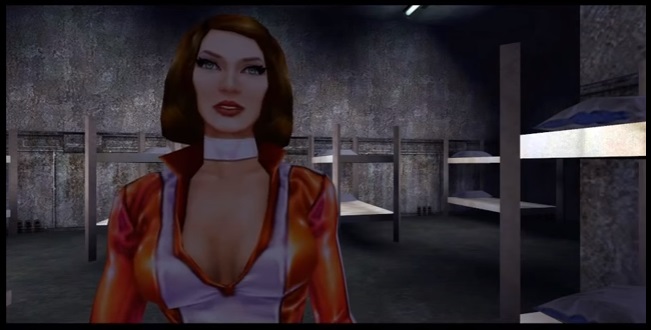
The 7th Guest

A Blast from the Past review

FBT revisits Stauf’s mansion and relives his greatest fear – game music you can’t turn off.

The Past

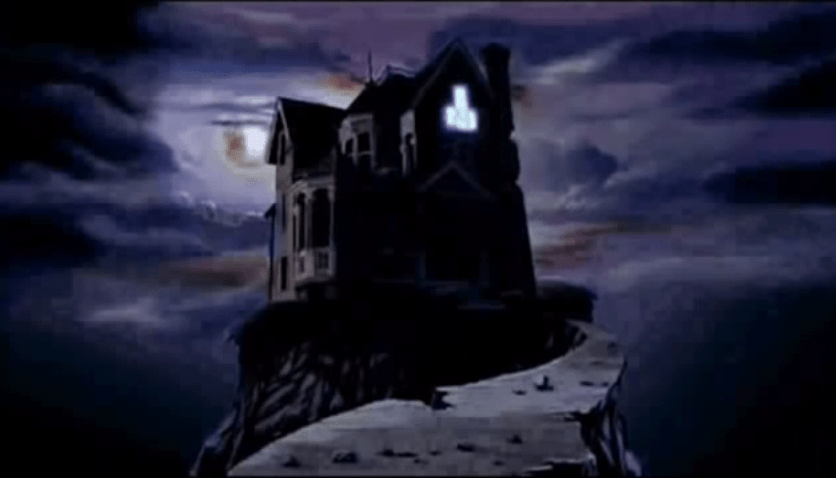
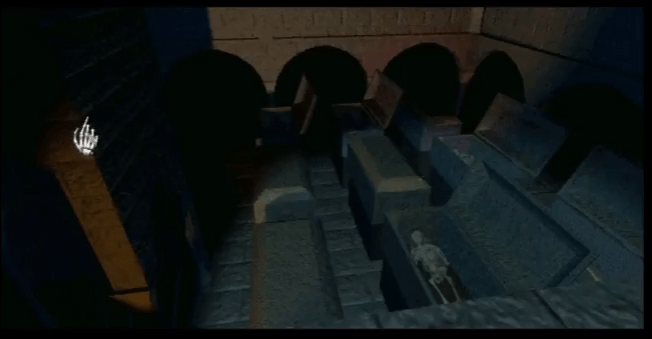
I intensely disliked Myst. It was a vacant slideshow of a game. But Myst had an evil twin; The 7th Guest – it was weird, messed up, with a disembodied villain who taunted you, soul-sucking dolls and dead children all within a house straight out of The Haunting filled with insane puzzles made out of gravestone-decorated cakes, skulls, blood and spiders, while you got to the bottom of a disturbing story that nicked it’s subplot from House on Haunted Hill before going batshit crazy at the end – Who was Tad, what are all those folks up to, where are they now, why am I here? I’m still not sure, but T7G was a macabre, goth-great.

T7G was also watershed moment in gaming; besides being set in a realistic, pre-rendered 3D world, it was one of the first to be released on CD-Rom (a what?) and one of the few games of 1993 not be eclipsed by Doom. It’s the polar opposite of Doom; slow, considered, out of your control. But to me it was a perfect companion – just as dark and innovative, and filled with adult content as its plots unfolded through awesomely cheesy FMV drama while we figured out the kind of puzzles critics like to call ‘fiendish’.

I played it loads but only finished it once. Those puzzles were murder, especially that goddamn microscope. But I just enjoyed being in the house, soaking up the atmosphere and style of it – There was no other game that so perfectly captured the old Hollywood horror feel. It should have been in B&W and narrated by Vincent Price. I’m looking forward to playing T7G again, especially as it’s my retro fave in my bio. I hope it stays there, given my shocking lack of patience and complete idiocy when it comes to even the most basic puzzles – this Blast from the Past may become a Rage Quit…

Still a Blast?

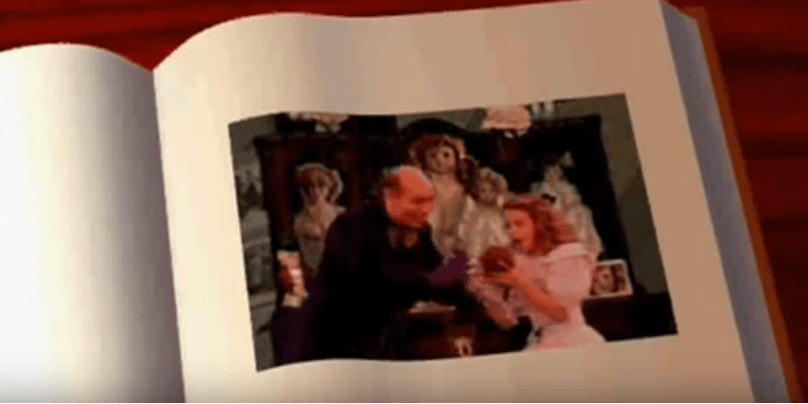
Man that cutscene was long. A drifter called Stauf sees a vision of a doll and is compelled to carve it. He gains a reputation as a toymaker and continues to make his visions, eventually becoming rich and famous until the kids who begged for a Stauf Toy start to get ill and die.

Years later, various folks get invitations to his home and told the puzzles he’s left will lead one of them to their greatest desire.

While it was retro-great to watch, less great to listen to; the music by renowned game composer The Fatman plays consistently through the game, and just hearing it brings back conflicted memories. I suddenly remember staring at puzzles for hours while it played repeatedly, slowly wearing me down like the Barney theme being played endlessly to break terrorists. I still have my original T7G disc and the entire soundtrack is on it.

Continuing the audio torture is our antagonist. Stauf, the now disembodied botherer, is constantly on at you as you explore the mansion. Goading, teasing, mumbling some dad joke every time you do something – anything. He only has one or two comments per puzzle or event so they lose their charm very quickly, and “We’ll all be dead by the time you solve this” every time you get a puzzle wrong becomes a wish not a threat. At first his ghostly voice gives the house an ominous personality but his constant jeering, commenting, cackling as you try to make sense of things gets infuriating. Meanwhile, you’ve got The Fatman going do-do-do, do-do-doddododo do … do do do do. This isn’t a puzzler it’s a test of my patience. I ended up, via some clever chap’s mod, managing to disable the music but Stauf just got louder. ‘feeeeeeeeeling lonelyyyyyyyyyyyyy?’ No, but I wish I was; even I won’t shut up, my character also has some glib comments on the state of play – it’s sometimes a hint but every time I or Stauf crack wise, I lose control until the quote is over – and some aren’t exactly pithy. I thought haunted houses were supposed to be silent and whispery, this is like an episode of Loose Women.

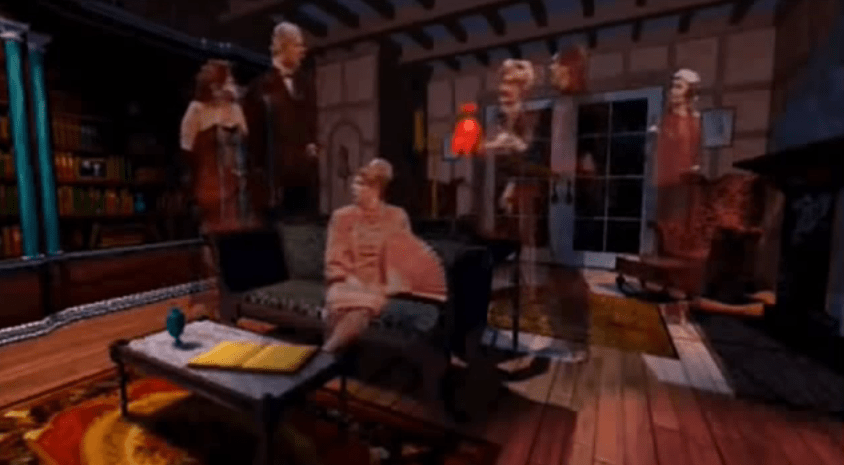
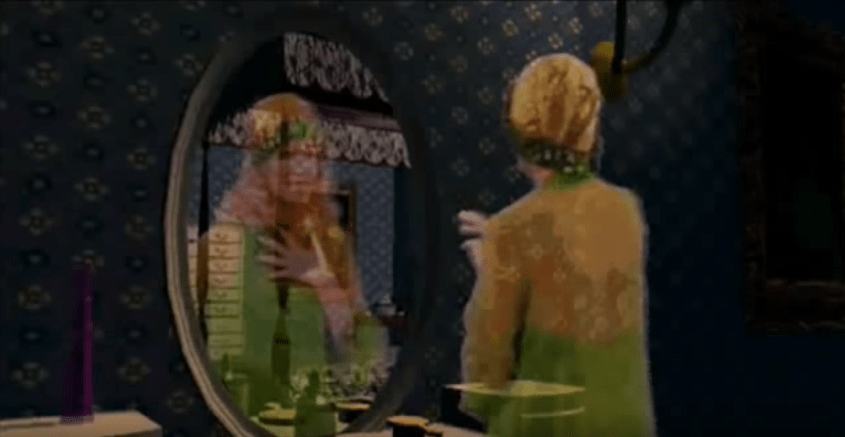
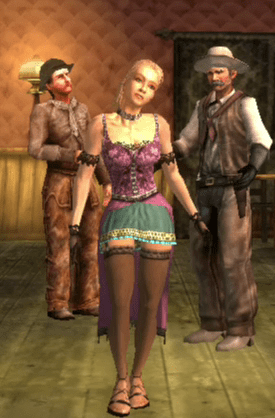
Audio mood spoilers aside, The 7th Guest looks really good – not just good for it’s age, it’s a great looking game, period. The CGI is 90s MTV but it’s solid and shadowy, and the mansion’s layout is great – it’s not a haunted house at the end of the pier, it’s just creepy, eerie and while there’s standard spider webs, blood and ghosts, it’s clear of scare-jumps and rug-pulls, relying instead on corner of the eye movement and interactions with warping pictures and things moving. It’s a classic ghost story as much in the tradition of Blithe Spirit or Dead of Night as The Haunting, almost a love poem to the classic era before CGI and jittery editors forced you to jump. But it’s not all warm and cuddly. You know the folks trapped here turned on each other, is that what’s in store for us? Are we alone? There’s one scene where a Guest picks up a doll and it starts crying for it’s mum … but not in that Chatty Cathy way, it’s a real girl’s voice, really crying for her mother. Shivers. This is a house filled with restless spirits and unease and it has an oppressiveness, you’re trapped there and being toyed with – the game doesn’t pull you out of the moment with a typical cut scene; instead, you wander into a Stone Tape style replay of some horror or event that the house never forgot; FMV fades in over the CGI room and while it’s not very well rendered, it’s effective and a great little story unfolds as each of Stauf’s guests fall victim to their desires and each other. It’s a little ham-acted but that just adds to the ghost-story charm.

While it’s easy to get lost in the game and the story, you’re rarely lost in the house; the layout isn’t maze-like (apart from a maze puzzle) and there’s a map, and unlike most puzzle games, there’s no inventory or random things that become critical later; you’re purely solving Stauf’s conundrums to unlock the secrets. It could be disconnecting, like you’re unlocking a straight-to-video movie, but you never know what’ll happen when the shot glides around and it feels like you’re being drawn further in and become part of it. As a puzzle game, it’s clean and effective; you’re not missing a tiny clue because your character is standing on it or stuck trying to get past a goat. The cursor changes to flag cinematics or puzzles which keeps you focused as you walk the corridors and discover previously locked doors now open … The mansion is split across two main floors for the most part, with a brief journey into the cellar before ascending to the attic for the finale, discovering your own connection to the house and who the 7th Guest is before it all goes FMV-meets-WTF crazy.

The 7th Guest is a real accomplishment; many critics complained it was either a puzzle game with cut-scene filler or a ghost story constantly interrupted by puzzles, but I see it as the puzzles -like Stauf’s toys- were possessed and as the guests played they became corrupted, and lost themselves to the games, so unlocking them revealed the character’s fate and in turn, revealed our own. One, the toy bricks in the playroom, reveals Stauf’s plan – I thought it worked perfectly then, and still do now. It feels aged but not old and just like Doom, playing it now, decades later you feel a sense of achievement, that this is something special – it’s not a flash in the pan or of its time, The 7th Guest is a classic and still packs a punch (to the ear).

For all of T7G’s innovations and progress, its inventors Trilobyte never capitalised. The sequel, 11th Hour was as overdue as it was bad, and they closed in 1999. Good old Night Dive helped Trilobyte resurrect Stauf and his bants though, including an iOS release – which is great and works even better than on PC; mostly because the microscope puzzle is missing – not even Apple could solve it.

Over the years various reboots and second sequels have been rumoured, but nothing’s come of them. It’s a shame but then, a modern-day 7th Guest wouldn’t have the original’s charm or invention. It would be like a crappy modern day shlock-scare, missing the class of a good old horror movie. Sure they’re old, a bit silly in places, but they’re great and The 7th Guest is the gamer’s equivalent. The end …

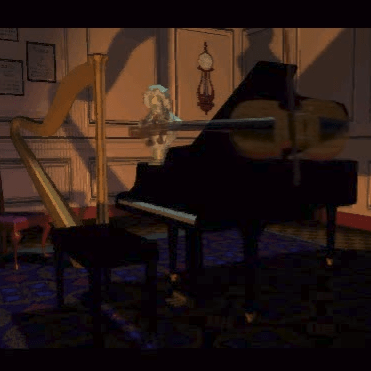
What? Oh yeah, the puzzles. Okay, I admit I might have, on occasion, used YouTube and The Book Of Secrets, a hint app released alongside the iOS version to beat the puzzles. But I had a lot of fun trying. The puzzles work well, you know they’re beatable if you could just concentrate and the Horror-Halloween design makes them interesting, as does the 3D CGI rendering. Once you figure them out they’re satisfying to beat, while others I just blundered into the solution and quickly saved before the game realised I’d got lucky. The cake puzzle, one of the first you encounter is a great warm-up brain-tickler, while others (the Coffins) nearly caused a rage quit. But I stuck with it. There is a cheat; in the sitting room a book will give hints and if used enough the puzzle will be solved although you’ll be denied the cut scene. I never knew what cut-scene happens after solving the Microscope puzzle, and I don’t care. No cutscene is worth that horror but overall I think I did myself proud. It’s a testament to the game that the puzzles rarely drag; infuriate yes (I’m looking at you, piano puzzle, like we needed more noise in this game) but they follow a logic and you know the answer’s there. Do-do-do, do-do-doddododo do … do do do damnit.

1993 | Developer Trilobyte | Publisher Virgin Interactive / Night Dive

platforms; PC | iOS/Android

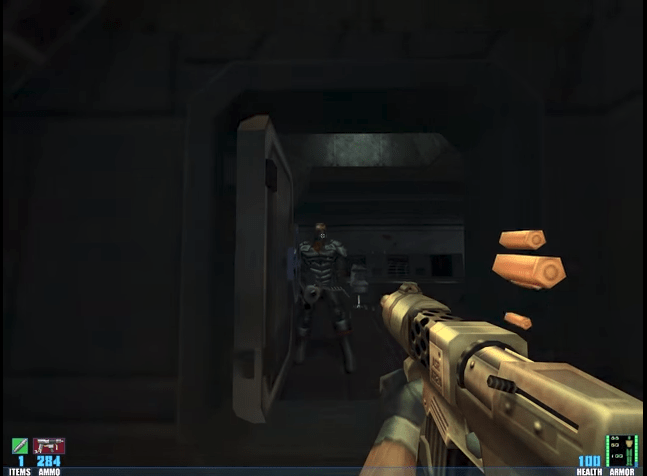
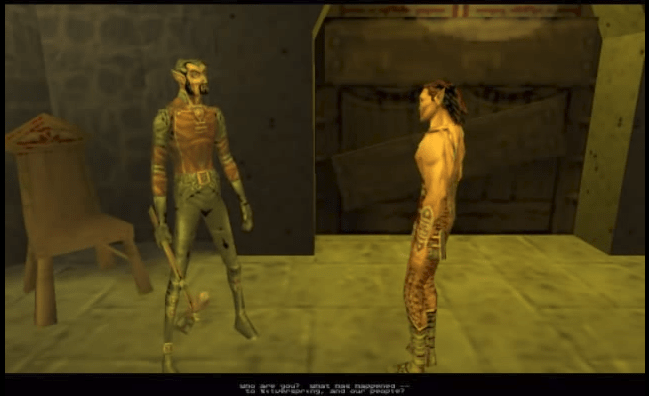
Heretic

A Blast from the Past review

If there was one FPS from the Doom era FBT would call his fave, it would be Blood.

And Heretic.

The Past

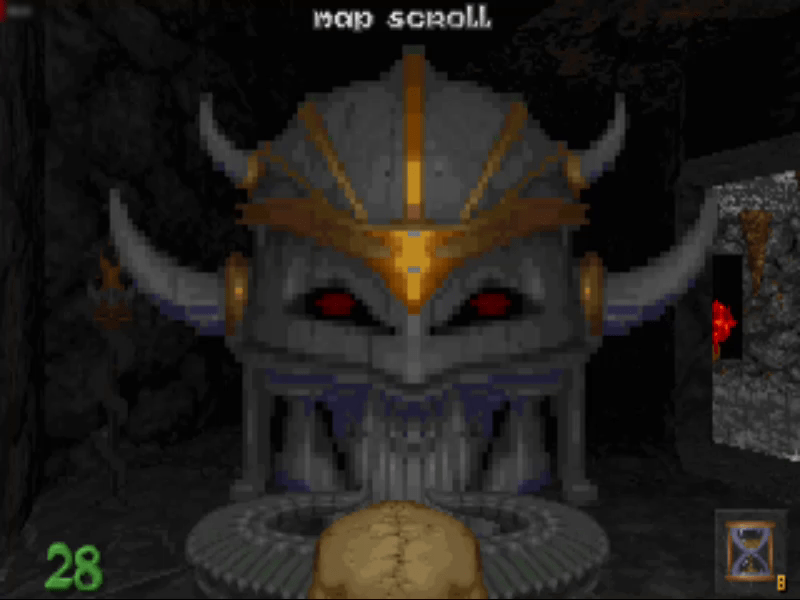
I have hugely fond memories of Heretic. It was part of such a great era of gaming, thanks to id. That half-decade, starting with Wolfenstein and ending with Half-Life, was a grand golden age of familiar, similar fun – Wolf, Doom, Heretic, Rise of the Triad, Duke, Shadow Warrior, Dark Forces, Redneck Rampage, Blake Stone, the mighty Blood; until Quake (and Goldeneye for the N64 crowd) they were interchangeable and all great. I’m sure there’s more games listed under ‘Doom Clone’ on wiki, but back then, with shareware disks traded about and hundreds of magazine CDs filled with demos that piled up in the corner – you could never be sure what you’d played. It was glorious gamer mayhem until Steam ruined it.

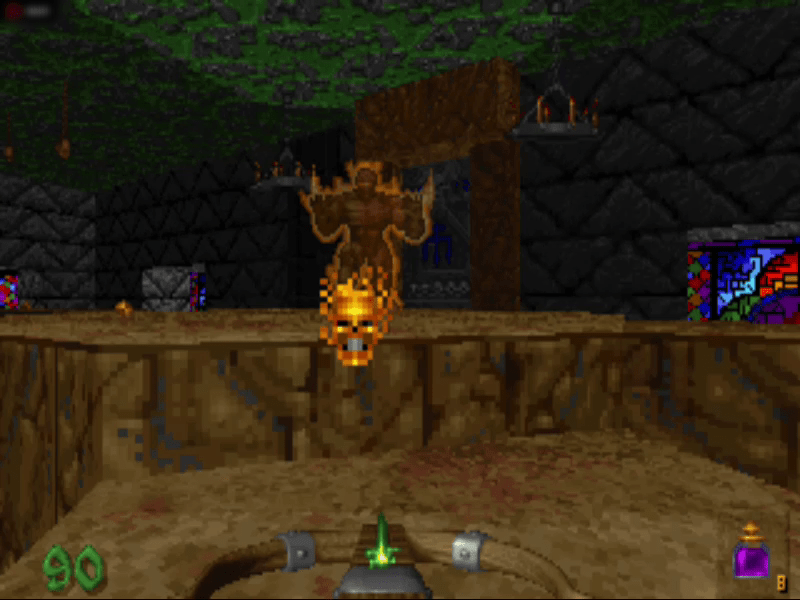
I always liked Heretic’s goth sorcery setting, all medieval villages and castles, filled with flying imps, giant floating skulls that fired tornados and those Alien-a-like rip-offs. It felt like Lord of the Rings if Sauron won. Heretic and Blood are the ones I remember most fondly, being much more fun to play, much more involving than the others; I have no idea why I was shooting or who I was shooting but I remember the creatures I shot, I remember the weapons I used and the magic spells I cast; who forgets turning creatures into chickens?

I’m guessing Heretic hasn’t aged well; it was built on the Doom Engine so it’s going to be basic but it was overseen by Romero and developers Raven were also behind the good Elite Force and the great Jedi Knight II so maybe it’s withstood the test of time. Let’s go to the land of whatever and find out.

Still a Blast?

Heretic is hard to look at. Not just because the pixel count is in double-digits, but because there’s a lot of red and green and brown. It’s like one of those optician tests to see if you’re colour-blind. But, I’m also instantly back to that era, having simple fun blasting away at the tiny little flying imps. I still don’t know why or what I’m doing. There’s a couple of ‘serpent riders’ who have corrupted the kings of various worlds and filled them with their own creatures. I’m an elf (an elf?! I never thought I was an elf, he has a hairy mitt of a shooting arm) who’s taken it upon himself to rid the world of those Riders. I find I don’t really care. I miss this simpler, point and shoot era; of course, if a game was released this basic now I’d whinge about it being shallow, but that’s because expectations have changed. My expectation here is to be handed a gun and shoot it until I see the level stats and realise I still missed secrets. Like how, I space-barred every single wall dagnabbit. If I missed the secret level … This is great. None of the cutscene continuity, mission marker malarkey, moral choice-making; reasons are for losers – just crack on. I’m gonna go to the library and check out the UseNet and find that secret level.

Aside from all looking vaguely the same colour, Heretic is more than playable. The mouse acts as both aiming and moving, causing our elf to fall off everything, and you can’t reassign keys but that’s hardly the end of the playable world. The levels are imaginative and involving rather than Doom’s grim drudge and while you’re only ever looking for keys for doors for exits, it tries to feel creepy and labyrinth without being annoyingly maze-like; it does feel like villages and castles and they’re interesting to explore rather than just shoot through; it’s more early Elder Scrolls than Doom-like.

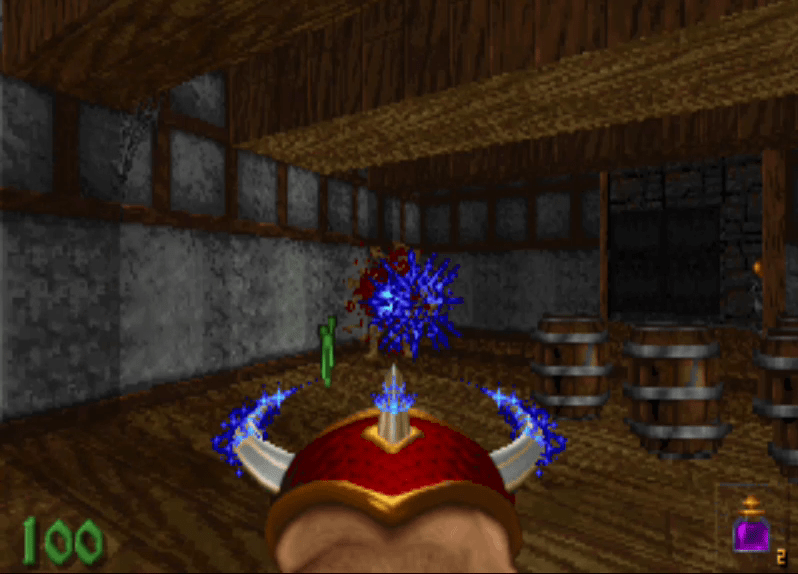
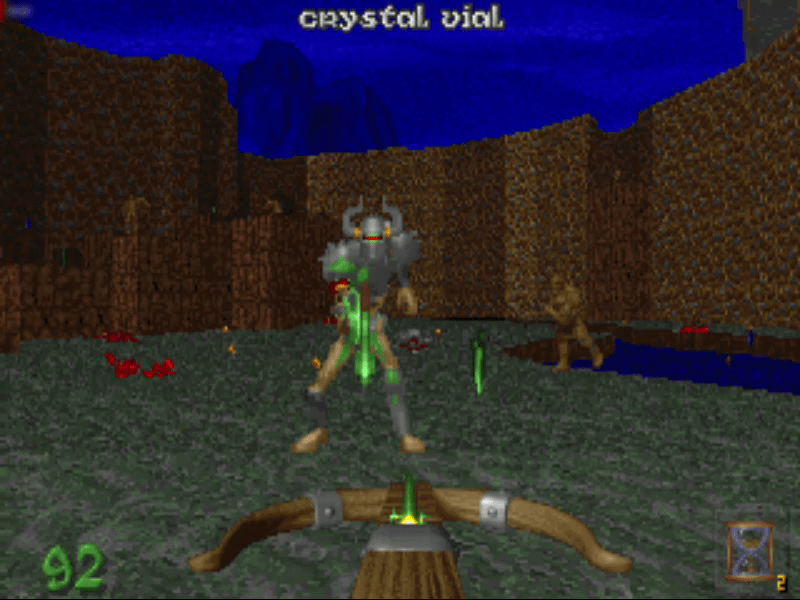
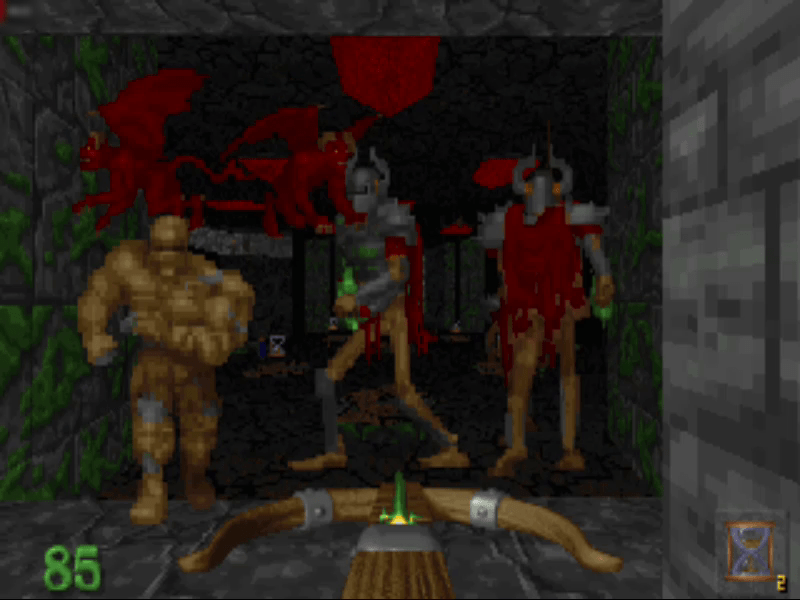
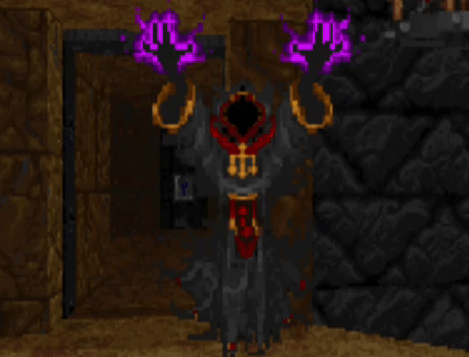
I pick up the bow and later the Dragon Claw which is basically the same as the machine gun from Doom. Doom’s bloody fingers are all over Heretic but it’s no reskin, it is its own game. Fighting is as you’d expect – everything rushes at you but the weapons are fun to fire, and the powerups change things up – spell books to overpower your weapons, invisibility and invincibility, the egg spell and wings of wrath that give you flight – you never used it for fear of needing it but still, a nice little powerup. There’s a few standout creatures too; the flying imps are oddly endearing while the hulking Golems make an amusing ‘guh’ noise when you clobber them – of course, they clobber back and then there’s those huge skulls which are great to look at and a nightmare to fight, the alien rip-off things, the axe-throwing knights, and the Weredragon that looks nothing like a dragon, Were or otherwise while the wizardy blokes with their dashing cloaks and sparkly orbs are simply the most fabulous villains of the era. Their echoing chant joins the other creatures’ calls, moans and growls – The Serpent Riders’ lot are not what you’d call stealthy, I’ve never played a game with so many chatterboxes and their prattling helped me find the exit more than once. Alongside the game’s ambient chain rattling, water drops, moans, cackles and creaks it’s one of the noisiest games I’ve played but it has the feeling of a really good ghost story. If it wasn’t so bright it could be quite a menacing game. I will admit, Heretic is a lot lighter than I remember. I might have merged some of Blood’s gothic atheistic with Heretic. Instead, there is a sense of cuteness about Heretic, almost loveable, maybe less like a Ghost story and more like a ghost train at the end of the pier. Still, Heretic is living up to those great memories. Ahh the nineties, if they ever end we’re in trouble.

In every demonstrable way, Heretic has been surpassed and it would be easy to dismiss it once the initial ‘oh I remember that’ wanes, but once you get into the harder levels it’s not mucking about – it’s not samey or tiring, I’m pushing and being pushed in a perfect balance; it does the job of a Doom-clone very well – there are improvements, such as the menu system, looking up and down etc, but it just feels more complex, more detailed – Raven clearly took their time with the mighty Doom Engine and learnt from Doom’s designs, it feels real not random like a lot of shooters from that era (like why did the villains of Rise of the Triad pepper their castle with trampolines and floating coins?)

Since nothing could compare to Doom, The Exorcist of gaming, even the most shameful Doom Clones had to do something to differentiate themselves. Duke had his extreme masochism and jetpack, Shadow Warrior had interaction and Big Trouble in Little China quotes while Blood had its perfection, but Heretic’s ‘thing’ was familiarity; it’s plot and character motivations were the basis for a hundred D&D games and it was great to see that come to life; it took what we loved about Doom and put it in the fantasy setting we always imagined.

If you’d never played a game from that era then Heretic deserves a go over the others which all outstay their welcome on replays (not Blood though). It’s a pure golden-era shooter; fast, tough and fun. For me, it really is the second best of the Doom Clone Clan which is quite an achievement considering the competition; even my beloved Blood is closer to Doom than Heretic is – We should have more medieval fantasy shooters that aren’t reliant on swords or traditional spell casting. I didn’t know I wanted a spell-casting Gatling gun until Heretic gave me one. Heretic is the best retro game I’ve played for ages.

Recently, the game industry has dusted off the golden era and resurrected, remade, remastered and rebooted pretty much the entire family of Doom-clones, playing off our fond memories and brand awareness, ironically calling them classics now after being dismissed as Clones then. There was Doom’s Dad-dance of a reboot, Duke’s been remastered and re-released multiple times as well as his shocking return with DNF. Wolfenstein’s been returned to and rebooted three times while Quake 4 was an in-name-only sequel as was Prey, which started out as a Doom clone in 1996. Shadow Warrior got remastered as well as rebooted into a new budget series, as did Rise of the Triad. But there was no reboot for Heretic; somehow it’s been forgotten or ignored, and I can’t work out if that’s a good thing or not. Having played it and found it still awesome, I like that we only have the unsullied, pure original, but the gamer in me wants at least a remaster so I can stop flinging my hairy elf arm off walls. To not have a modern Heretic is heresy.

Developer; Raven Software | Publisher; id Software / GTi

Platforms; Win

Half-Life 2

FBT half-returns to half-life with a half-baked conspiracy theory and gets so annoyed he has a psychotic episode or two. But not three.

The Past

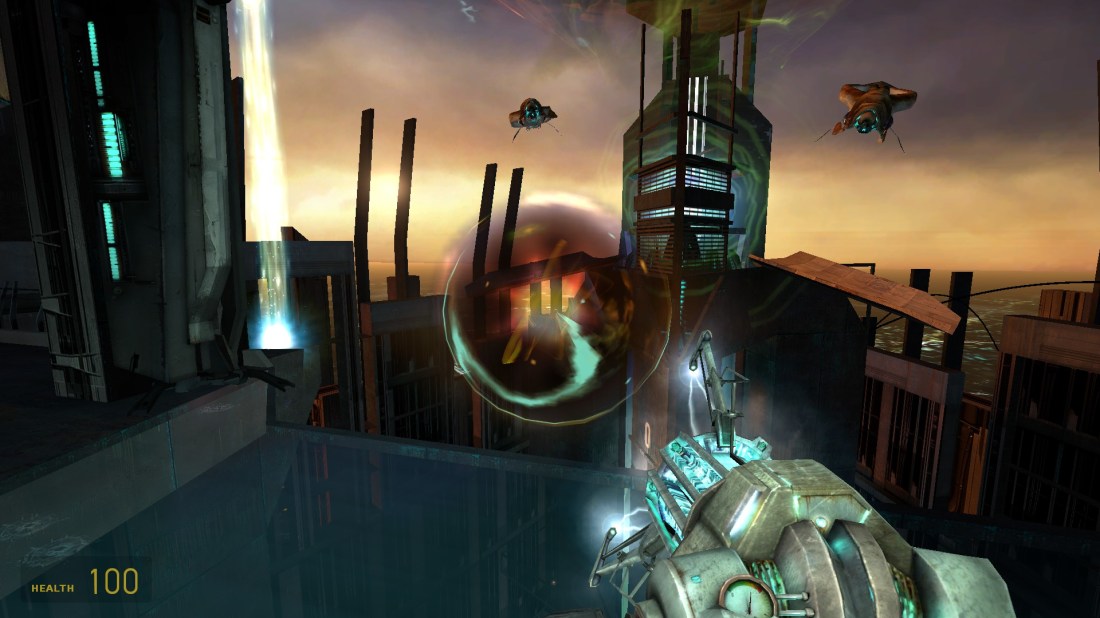
If I’m honest, I always had a nagging doubt that HL2 was the Avatar of gaming. Greeted orgasmicly by critics -Maximum PC gave it ‘11 out of 10’- us gamers were whipped into a rabid fury; we auto-loved it and it was gamer-suicide to say otherwise. Even now, nearly 15 years later HL2 is the God of gaming. But was it really all that?

Part of the appeal was Valve and its emperor, Gabe Newell. He put himself about as a geek like us, claiming Valve is a loose collective of developers; it wasn’t some evil mega-corp like EA or Ubisoft, it was by gamers for gamers. Never mind Valve insisted we install Steam, a more intrusive and invasive DRM platform than anything previously to play HL2; they’re geeks like us. Meanwhile we screamed the place down any time a competitor tried a similar platform. GFWL? Spam! Origin? Malware! Uplay? Ransomware! GOG-Galaxy? … okay, they’re cool. You either accepted Steam or didn’t play HL2. It was emotional blackmail but such was our desperation we sucked it up and Steam has been on our machines ever since.

I was caught up too. Overwhelmed, I contemplated a Crowbar tattoo. But after a few replays, HL2 started to feel contrived. At the time it wasn’t the insidious Steam install that made me suspect Valve’s intentions; HL2 felt like a demo for the Source engine, like playing through a showroom. It was a façade and like the emperor’s new clothes, HL2 hasn’t got anything on.

You just don’t dislike Half-Life 2 though. I kept my doubts quiet and ensured no one suspected me by constantly replaying it, buying the Episodes and looking forward to HL3 like all the other sheeple. Then, the magic bullet; the more successful Steam got, the less HL3 was mentioned, until Valve stopped acknowledging Half-Life at all. It had served its purpose. But Gamers aren’t stupid – and they’re not forgiving either; one wrong sidekick and you’re into Daikatana territory. HL2 must be doing something right. It is more than just hot air?

Still a Blast?

While Xen’s invasion was contained to Black Mesa, the world is now under the control of interplanetary strip-miners the Combine. Turns out Nihilanth, the big baby baddie from HL1 was holding open the portal so the Xen lot could escape them. Instead, killing it drew their attention and the Combine rocked up and took over. Thanks, Gordon.

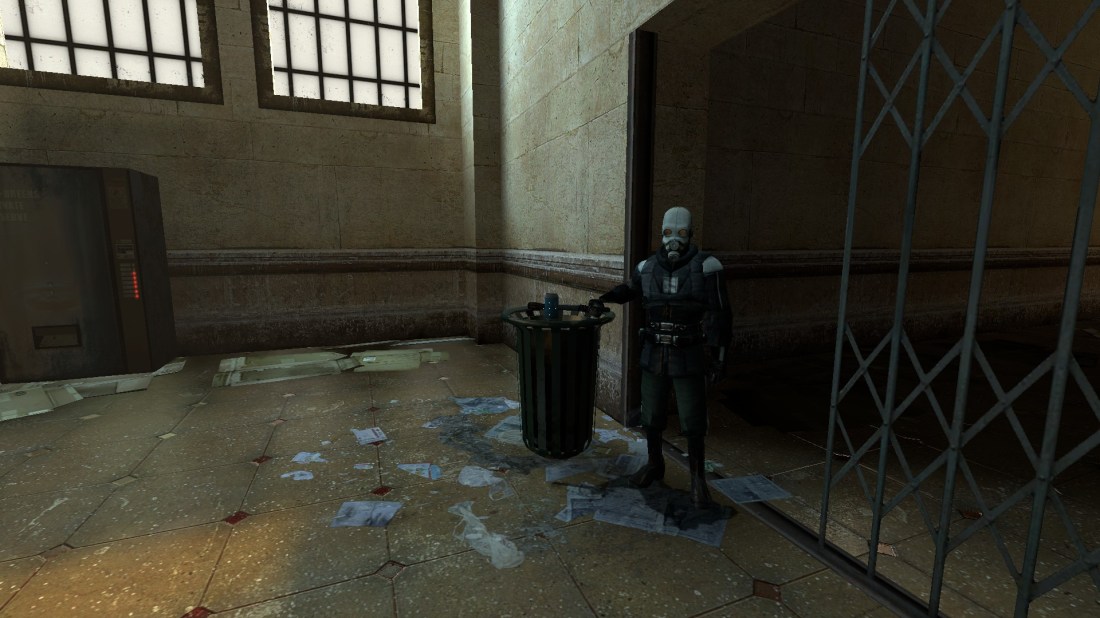
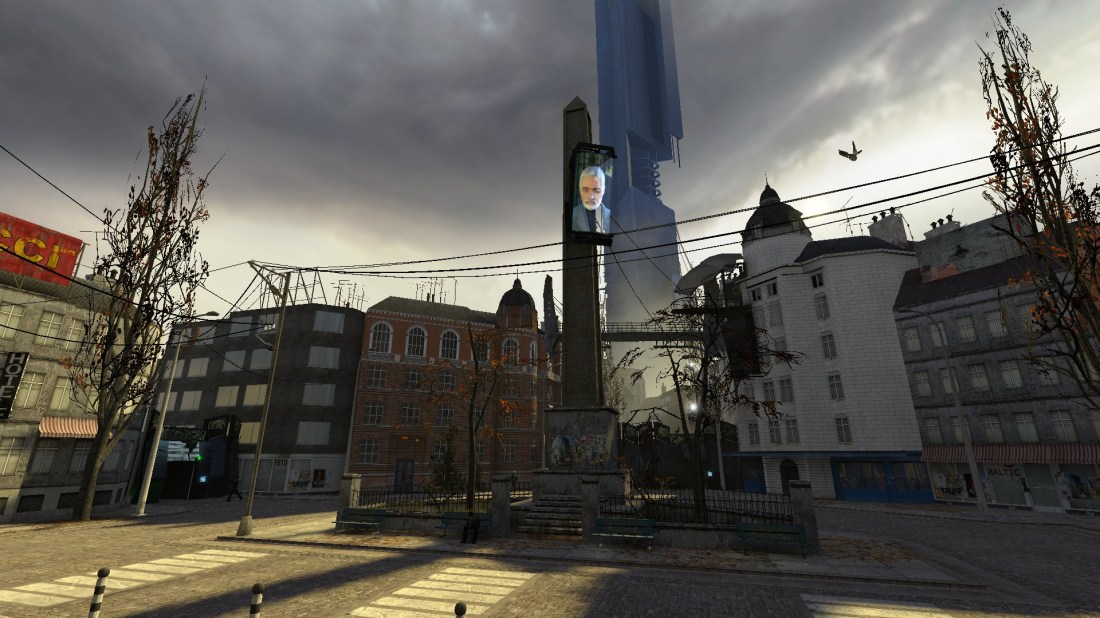
The world does have a grim Orwellian feel to it, with masked cops, screens displaying reassuring messages from earth’s ‘administrator’ (Breen, our unseen boss from HL1), processing areas and propaganda on the walls. This is an occupation, an oppressive hellhole that brings to mind real-world ‘internment’ camps; or at least a glimpse of post-Brexit Passport lines. I’m taken away by a guard – who offers to buy me a beer. Barney! You look a lot more detailed. Although the graphics are over a decade old, HL2 holds up insanely well, although that might be the constant updates and refreshes Source goes through. Can’t complain about that. It’s detailed, rich and real. I like HL2 so far. A solid looking game set in a compelling, tyrannical world. Time to Free it, man. I don’t last long. Trying to quietly pass through a depressed town, I seem to have become Harry Styles; we constantly hear ‘It’s Freeman!’ – that’s not helping. I get tasered, then I come around and fall in love.

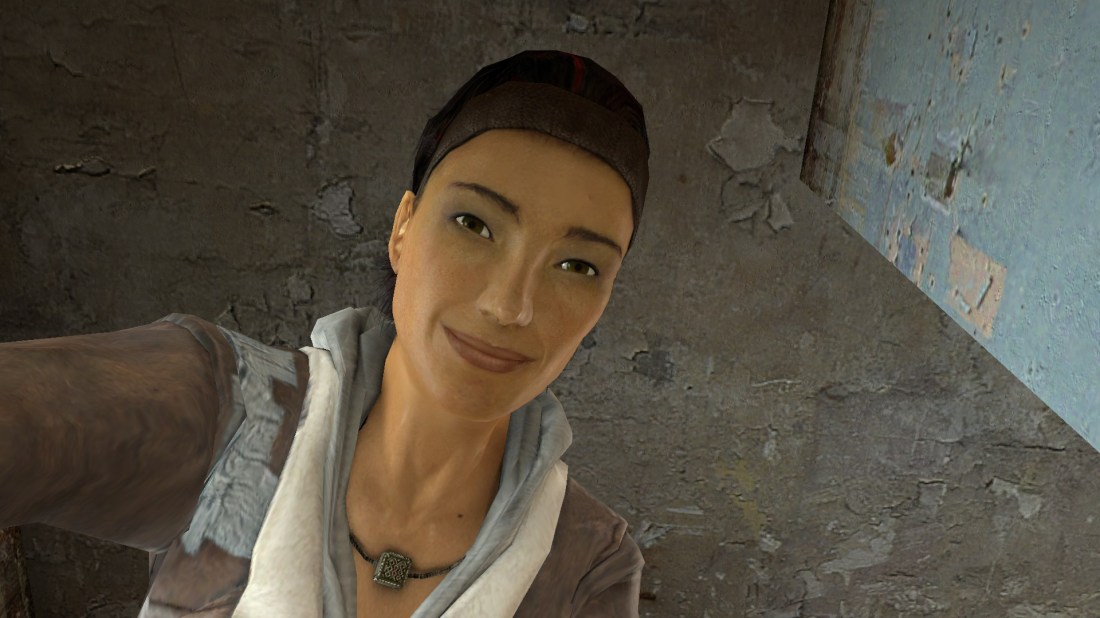
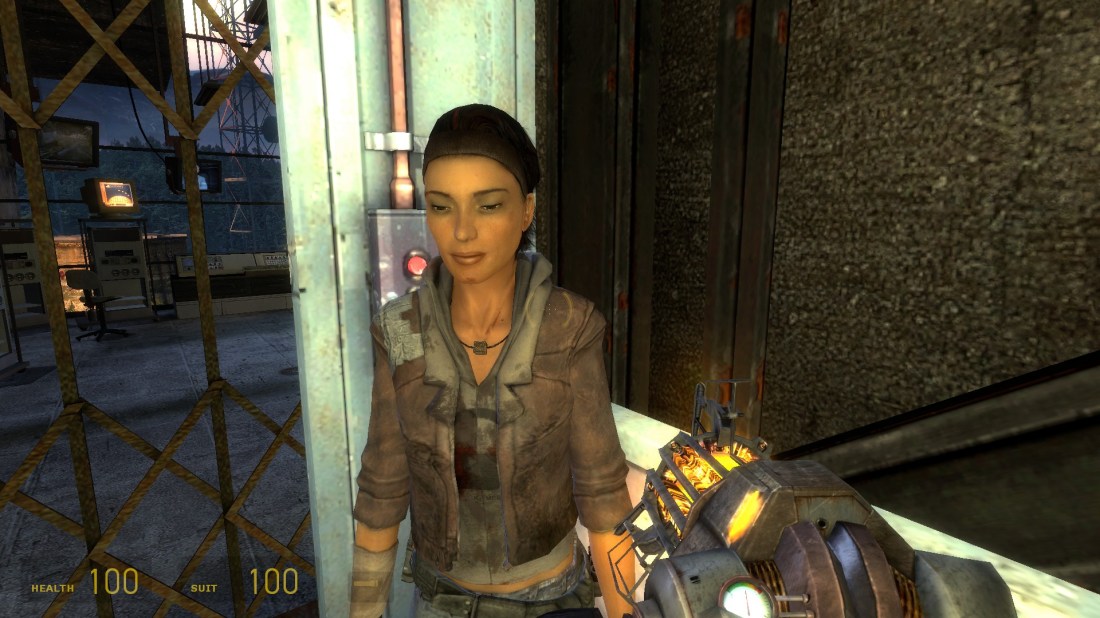
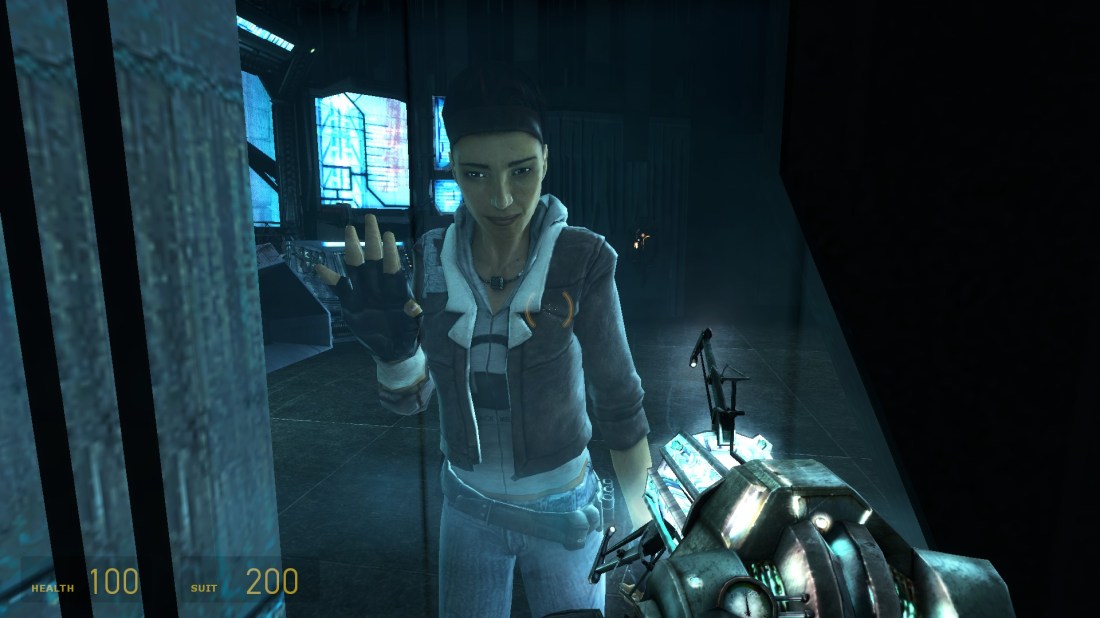
Alyx Vance, daughter of a scientist we saved, has returned the favour. Alyx is both in awe of Freeman and way cooler than him. To be fair to HL2, Alex did change sidekicks and female characters in games. She’s not wearing an armoured bikini for starters and isn’t a Vasquez-clone either. She’s just a capable character and half the time we’re her sidekick. Having grown up during the occupation she’s excited to have found the man everyone expects to save the day. Freeman however, doesn’t even say thanks.

In the original, it made sense to have a silent hero; not a lot to talk about, or talk to other than the headcrabs, but HL1 did occasionally imply he spoke or at least gestured; NCPs would respond with ‘yes lets go’. But in HL2 it seems odd Freeman isn’t talking; it’s cleverly done, people chat in a way that his silence can be taken as an answer but why doesn’t he tell them where he’s been, about the G-Man? Instead, characterisation is filled in by the support cast. Besides Alyx and Barney, who has a nice line in cynical backchat, there’s absent-minded professor Kiener, who keeps Lamar, a ‘debeaked’ headcrab as a pet (“she’ll try to copulate with your head, fruitlessly”), Alyx’s dad Eli and Dr Mossman, who Alyx dislikes so we do too. They’re kind of a rebellion Gordon joins – well, he never agrees to it. But first, I’ll need a HEV suit. Wait a second, am I naked? Why did G-Man strip Gordon before placing him in status? That explains why Alyx keeps making small talk and glancing down.

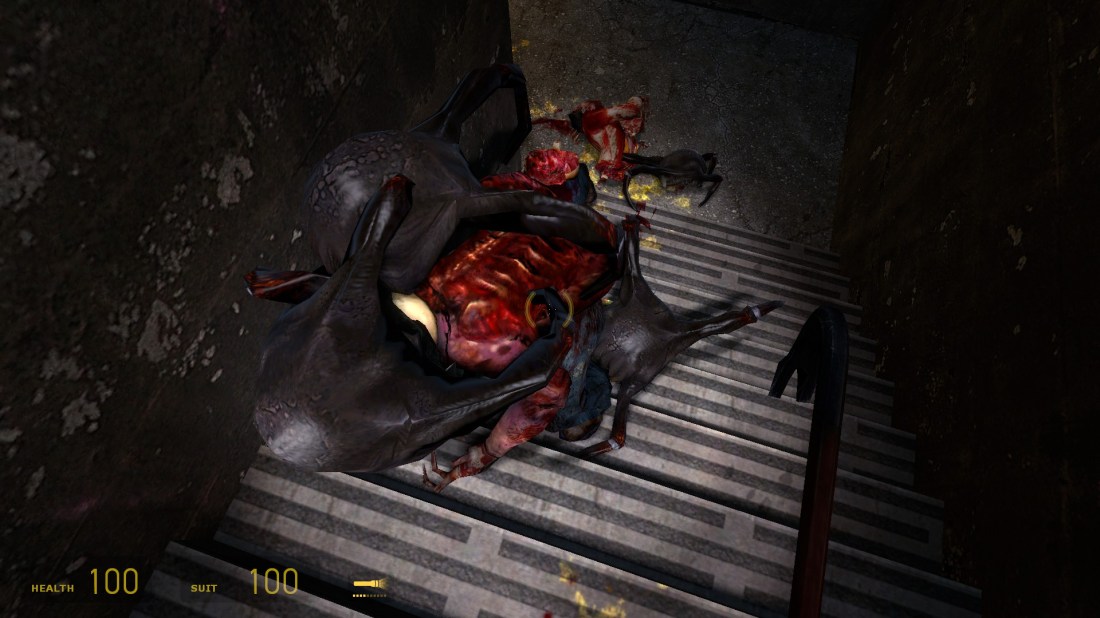
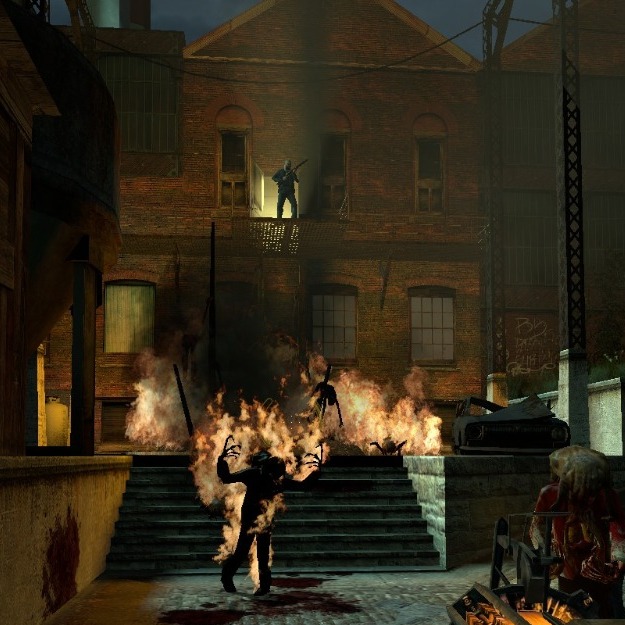
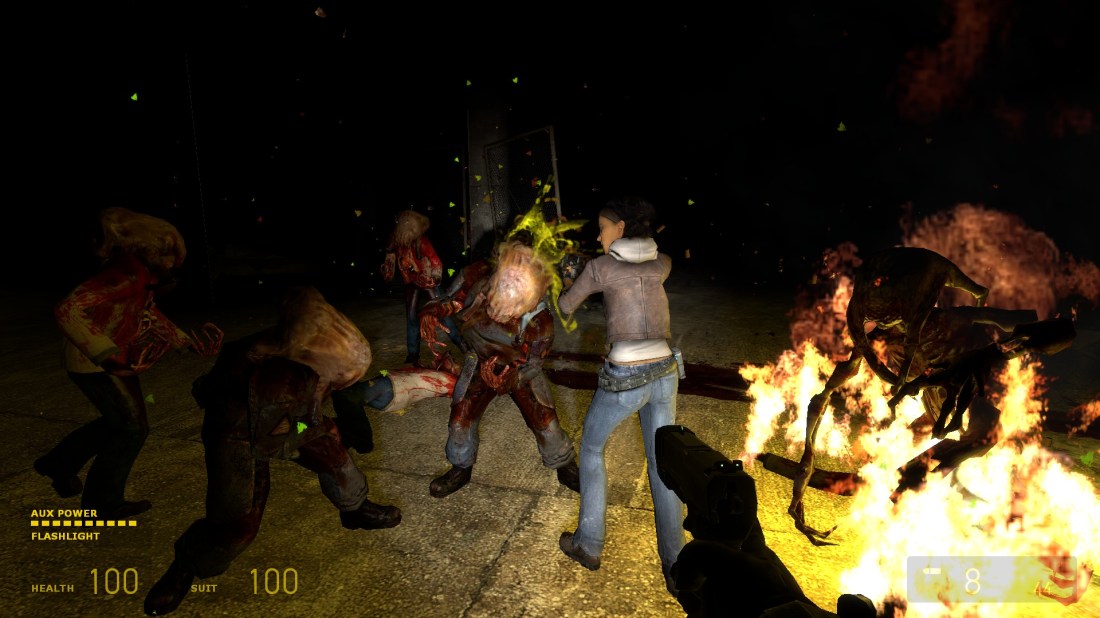
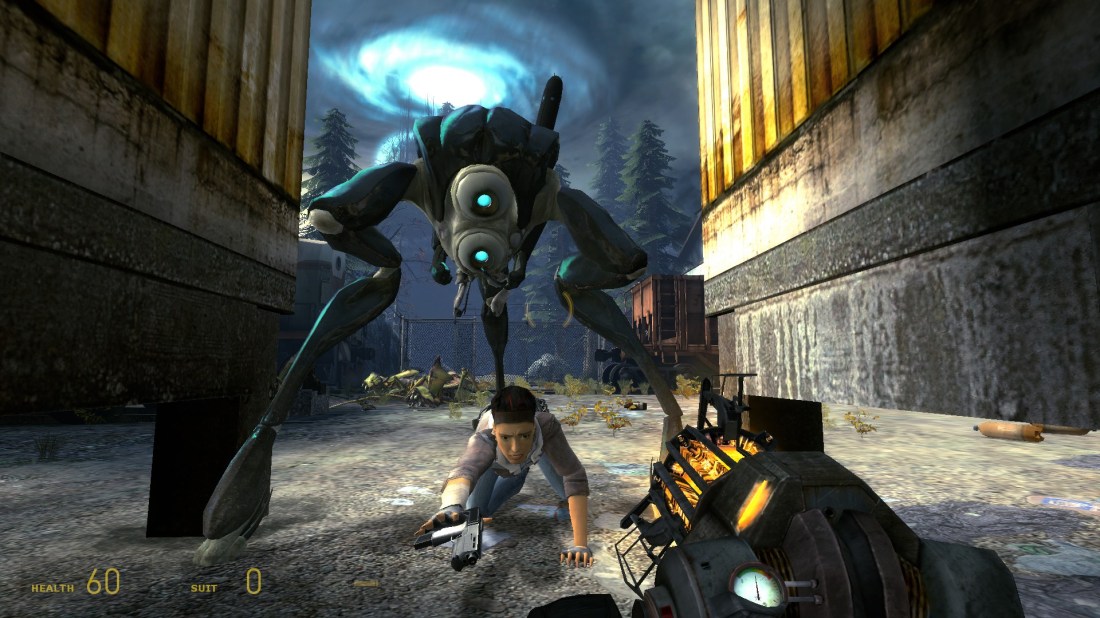
Now suited up and set free, I’m off to reach Eli and help take down the Combine using a mix of shooter and adventure experiences. We make our way through decrepit buildings and sewers which give way to a barren countryside and receding seas, all of it layered with Combine machinery and industry as they tear apart earth for resources. It all looks very real. Between us and Eli are dozens of Headcrabs, now a Combine bio-weapon. There’s a more skittish version that grows into the Xenomorph-like Fast-Zombie, or as Alyx might say, a Fambie. Those spindly things go. Spotting them leaping across buildings headed for you is exhilarating stuff. Then there’s their poisonous siblings – the rattle-hiss signifying one’s about is so terrifying; a bite reduces your health to 1, which is a brilliant/evil trick. We also meet poor, horrible, groaning victims who are covered in them. Those things really get under my skin with their pitiful, pained calls as they’re eaten alive and I waste valuable grenades making sure they’re out of their misery as soon as possible.

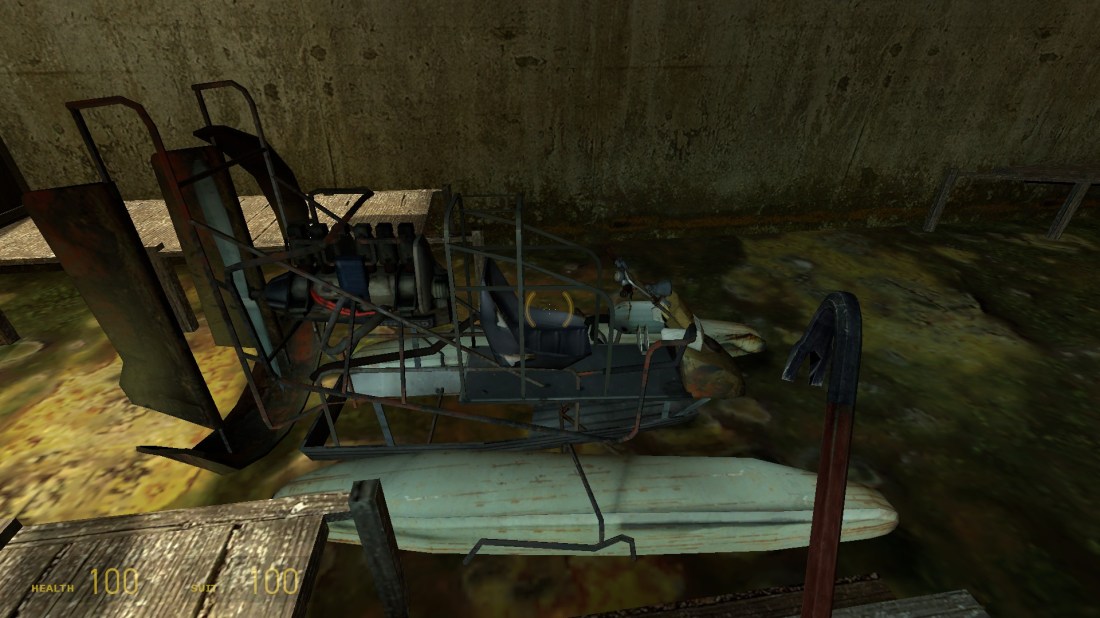
The Combine are out in force looking for Freeman – they are scripted and samey but as far as human-type villains go, they do the job. They also have machinery-infused creatures, including a gunship that can shoot your missiles out of the sky – being tactical with an RPG is a nice touch – and Striders, War of the Worlds Tripods. We also deal with ‘Antlions’, the bugs from Starship Troopers which are swarming pains. So HL2 looks good and fights well; what was I bitching about? After we escape the slums, Freeman gets an airboat to cut across country. This is what I was bitching about.

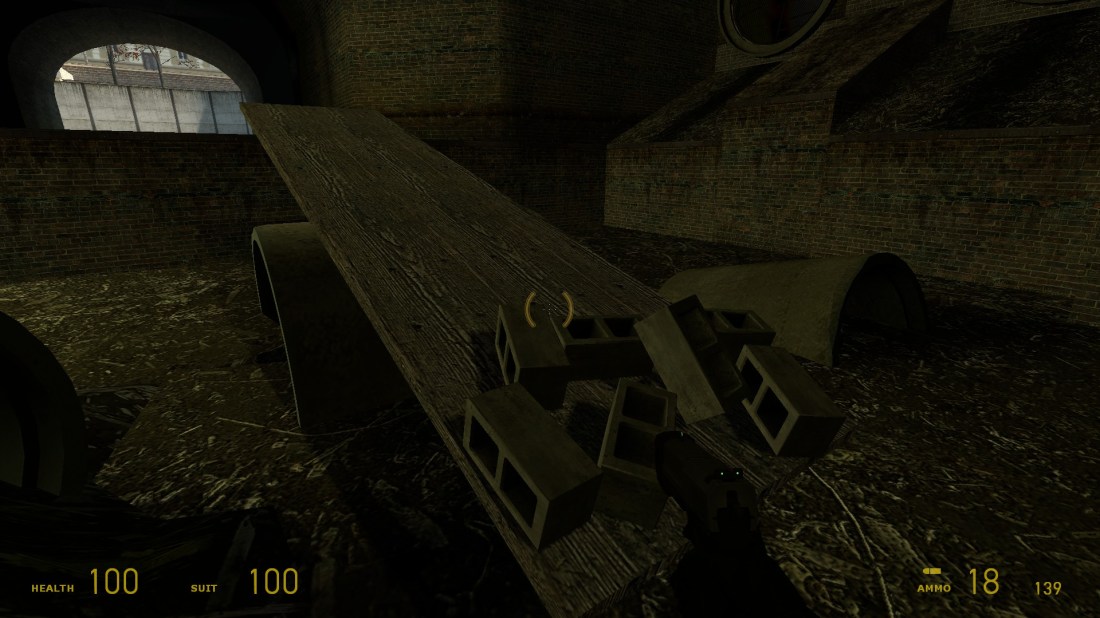
The boat sequence is all fine and dandy, but it fast becomes filler. It goes on for ages, and we only have Source’s rendering for company. It just feels like it’s showing off, demonstrating different abilities; I have to dive into a pond and place a load of floating barrels to make a ramp so I can jump a wall. It’s just a Source buoyancy showcase. Later I have to swing a girder to knock open a floodgate. During the similar go-kart level, I stop to use a magnet crane to move the kart. It works, but it just feels like I’m playing a demo. And it’s incredibly linear, so those moments feel like I’m at some tech-convention moving between booths; pause to get harassed by magnetic beach-balls that don’t do anything, try to balance cinder-blocks to reach higher levels, look at this magnifying glass; the puzzles, the physics, the locations – those are key to any game but in HL2 it just somehow feels like we’re pausing for a word from our sponsors.

There are standouts to be sure –Ravenholm is still a creepy, horrible, brilliant place while Nova Prospekt, the prison we try to recover Eli from and a suspension bridge we need to clear are great set-pieces, as is the final push to the Citadel, guarded by the huge Striders. There are more subtle elements worth applauding too; Alyx, who is a work of art in every way possible isn’t the only notable character; Ravenholm’s last (human) resident, Father Gregori is an insane change from the usual support acts and his presumed fate is horrible and brings home what’s happening to earth. We get to turn the Antlions into manic soldiers we can order about too, they’re great fun and like Gregori, should have been around for a lot longer. The lolloping Vortigaunts are our pals now, having been oppressed by the giant baby it turns out, while the Human resistance is very believable. But the real stand-out is D0g.

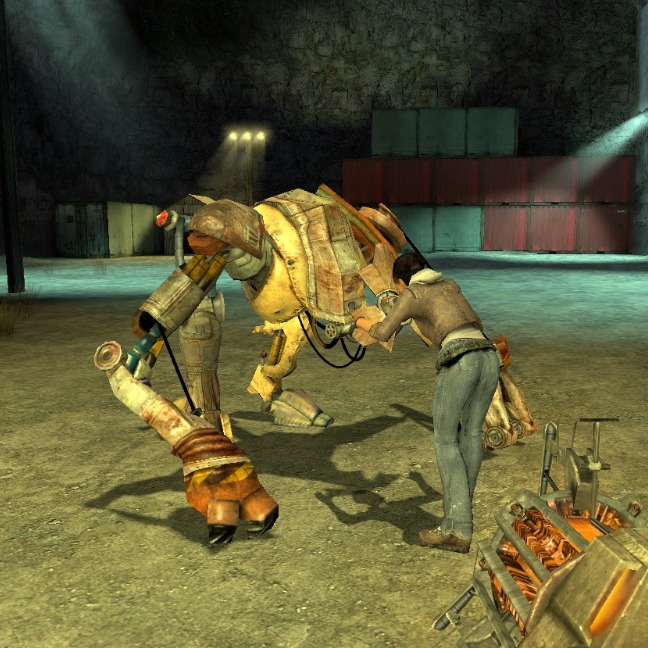
D0g is a great side-kick’s side-kick. Scripted to be adorable and heroic, it’s a huge Gorilla-like mech bodyguard for Alyx and even better than I remembered. The scene where we get the gravity gun and ‘play’ with D0g is the best hidden tutorial of all time. His scripted sequences, leaping onto Combine vehicles and knocking the shit out of the troops are great, but it’s his undying love for Alyx and somehow emotive face that stays with you. Good boy.

But as always, every time HL2 convinces me it’s all that, I see through the lies. For every drainpipe ominously rattling in Ravenholm there’s a moment that feels forced. The gravity gun; critics wet themselves over it, like it was gamer sliced bread. It’s shit. I barely used it first time and this time I’m determined to unlock its secrets. Still shit. The amount of times I try to attract a Buzzsaw blade to eviscerate a zombie only to grab a coffee mug instead. It’s great, if you’re looking to showcase your physics engine; lots of smugly-clever physics puzzles pop up once you get it. Man, Source is cool yeah?

Eventually, we’re inside the Citadel gunning for Breen. Except we had all our guns taken off us. But the G-Gun can now grab and fling Combine soldiers about like ragdolls – all right I get it, Source can ace physics. And to ensure we don’t Skip the Ad, the Citadel vaporises the Combines weapons too. What happens if a soldier puts theirs down? It’s just too convenient. When we finally reach Breen, we stop him escaping by … playing Pong. What the hell is this? This is heroic, flinging balls at a tower? I miss the giant floating baby of HL1. But it’s not over, Freeman’s about to have an episode or two.

Episode One picks up as the Citadel explodes – and it’s about to explode more. So Freeman caused an invasion that decimated humankind and then triggered a blast large enough to finish the rest? Why is this guy our hero?

Hang on, the Combine’s guns are still dissolving, why doesn’t Alyx’s gun? While escaping the Citadel and the G-Gun shenanigans, Alyx uncovers a message about Combine reinforcements leading them into a running firefight with Combine as well as a Ravenholm-style sequence with Zombies, Xen critters and Antlions as we try to escape the city. Ep1 is a quick and clean race once we’re out of the Citadel and a nice little set up Episode Two, where we rejoin Alyx and Freeman freed of the city and lost the countryside. And it does look beautiful. But then Alyx is maimed by new villain, the imaginatively titled ‘hunter’. It’s basically an evil D0g. Thankfully a Vortigaunt is on hand to react more emotionally than Freeman does. We’re then sent into an Antlion nest to evade a marauding Antlion solider until we can reach their ambrosia, which the Vortigaunts need to resuscitate Alyx. It is a beautiful underground labyrinth and a refreshing change in both look and play-style, playing hide and seek with the solider, but it’s followed by a wave battle against now pissed off Antlion drones that feels really dated (there was a similar one at the end of E1). Never fear though, G-Man appears to imply some greater galaxy-wide conspiracy without explaining anything. It’s like one of those middle-management meetings where you realise nothing’s getting done and everyone’s just saying stuff to justify the meeting.

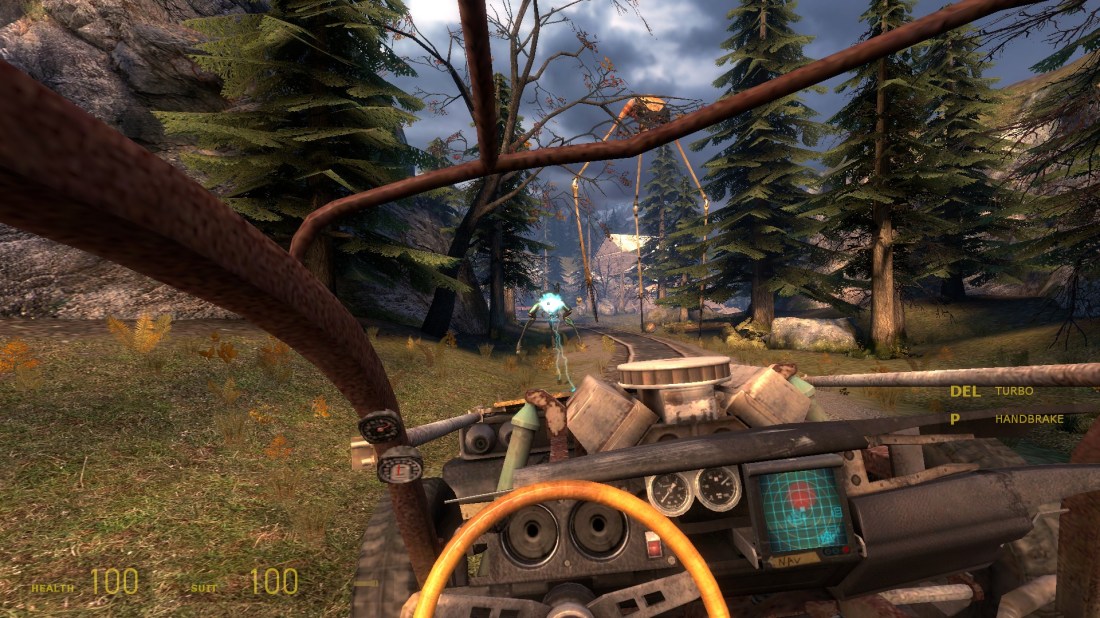
After using the gravity gun to rebalance a swaying bridge (‘Sponsored by Source, for all your gaming needs’) we’re in what looks like the car from Driver. Alyx and I go on a lovely tour of Source’s environmental rendering and blunder into Combine traps before a fantastic scripted moment when D0g puts in a surprise appearance just as we’re about to get stomped on. Finally we reach Eli and the resistance and it all gets really annoying. Hot on our heels are the Hunters and they brought their dads; Striders. Now this should be exhilarating but … it’s an irritating chore.

In order to take down the Striders we have to use a ‘Magnusson Device’ which requires you to drive to Device points, get out, grab it with the G-Gun, load it in the boot, drive to the Strider, get out, pick it up with the G-Gun, fire, swap to weapon, hit and explode the Strider. Now, repeat. If you miss or a Hunter hits the device you start again, while keeping up with the Striders before they reach the base. It’s not a race against time it’s a race against the save button, incrementally improving your odds as you watch in awe at all the physics going on. And why has Alex decided to stay behind? Now she chooses to catch up with Dad?

So we discover Episode 3 (slated for a December 2007 release date, can’t wait!) is going to take place in the Artic, but a Combine Advisor (another steal from Starship Troopers) rocks up and leaves us on a heart-breaking cliff-hanger. I may have been largely unimpressed with the game, but I loved the characters and that is affecting. I want to see it through. I want Episode Three. Goddamn Valve. Good guys my ass.

I’m conflicted. HL2 does have some genuinely great moments. D0g, the headcrab victims, the decaying world and misery of those surviving in it but Freeman’s silent act dates it and it all feels at arms-length because he’s not involved. I feel like an observer and it’s frustrating, because it’s a believable world you want to save from the Combine. It’s like having Star Wars toys you don’t take out of the packaging. Alyx is a quantum leap in companions; she’s not a follower – we’re a team. And she’s such a fangirl. Anything remotely heroic triggers a coo’ing comment and you often catch her glancing at you, smiling. But why? Who is Freeman really? He’s not much of a hero in HL2 – In HL1 he was a regular guy but why did G-Man defrost Freeman for this? He doesn’t do anything in HL2 that required a theoretical scientist and he has no personal part to play. G-Man should have unleashed Shepard. Plus there’s the confusion between HL1 and 2, the neatness of it all, that feeling that HL2 just kinda sails along. Nothing actually happens, nothing is resolved, the Combine aren’t exposed and we don’t get anywhere. It’s a really vague game that at best is setting up for a finale we didn’t get. Arguably it doesn’t even really get going until the end of Episode 2, where we prepare to take the fight to the Combine. Let’s do this! Oh.

I’m not conflicted. HL2 is style over substance and all about Source. It’s as epic as it is empty and it doesn’t stand up to scrutiny. But I’m still desperate to know how it ends and it’s insanely frustrating that Valve couldn’t see their way to ending it. It’s a huge betrayal of the fans that made Valve what it is. HL2 certainly made enough money to justify HL3 or at least Ep3 (or both, given Gabe occasionally claims the Episodes are HL3; he just wants shot of it). Come on Gabe -the G-Man- give us back our Freeman. Just one more moment with Alyx.

But it won’t happen. The lack of Ep3/HL3 despite HL2’s success proves Valve just didn’t care – if ever. It might have been all about Source, but in the end it’s all about Steam. I’ll never get over the way Steam was forced on us but now I live on it, and until I and the millions of other gamers log off, until we stop Steam accounting for 75% of all digital gaming, Valve will have no reason to resurrect Freeman. But we won’t. I can begrudgingly live without Freeman but I can’t live without Steam. It keeps prices low(ish), there’s support and links and forums; it’s a gamer community. I have over 250 games knocking about in there; I don’t have that kind of shelf space. The best thing about Half-Life 2 was Steam.

Half-Life 2 – 2004 | Episode One – 2006 | Episode Two – 2007

Developer/Publisher Valve Corporation
Win/Steam, PS3, X360

Half-Life

A Blast from the Past review

A teary-eyed FBT returns to one of his favourite games. Crowbars at the ready.

The Past

Half-Life re-established my game love after years of samey gaming caused me to turn away from my faith and venture outside. I remember the world of HL1 being perfect; isolated and pressurised, facing creatures that were nightmarish without falling into cheap shlock-horror, you were escaping a disaster not causing one. And it was all wrapped up in a story you could dig into or ignore because there were no cut-scenes, it all just happened around you. I remember it petering out once we reached Xen, and final bosses betrayed HL’s Doom roots but otherwise it was brilliant, and it turned FPS into an adventure, an experience. I’ve not been outside since.

It even had good value Add-Ons, back when they weren’t money-grubbing wastes of time like hour-long b-side distractions, Horse Armour or weapons you instantly outgrew – and they weren’t already built into the game, just waiting for a code to unlock. They were real. The first, Opposing Force with its hero Shephard was almost as good as HL, and Blue Shift, where we played Barney the security guard was a welcome if short return. There was also Half-Life Decay, a co-op for the PSOne; I loved Half-Life so much I bought it and forced a PS-owning pal to play it with me, even though he had no idea what was going on and got shushed every time he asked. It wasn’t great, but it was Half-Life, it was home.

It’s incredible that Half-Life sprung from a nothing company founded by Gabe Newell, an ex-Microsoft employee who cut his developer teeth making Doom Windows-friendly. At the time, shooters were owned by id. But Valve pulled it off; while id kept remaking Doom with better graphics, Valve evolved FPS, set a new (crow)bar for shooters to reach for. In the same way Die Hard and Lethal Weapon made Cobra and Commando pompous and unrealistic, Half-Life blew away the Doom Clones that had squandered what id invented and paved the way for immersive, relatable shooters. We weren’t Doomguy or Duke in HL, we were a science geek, an everyman which led to damaged heroes like Max Payne and complex experiences like FEAR. A new era began with Half-Life; FPS was now an art-form, not a shooting gallery.

Could Valve do no wrong? Yes, yes they could. Just look at Half Life 3. Valve can pretend Half-Life never happened but I’ve been waiting patiently. Until now; it’s been so long I’ve started wondering; is Half-Life really as influential as I’ve always argued? Has it aged into insignificance, maybe even its impact overstated? 2018 is the 20th anniversary of Half-Life, time for a reunion at Black Mesa.

Still a Blast?

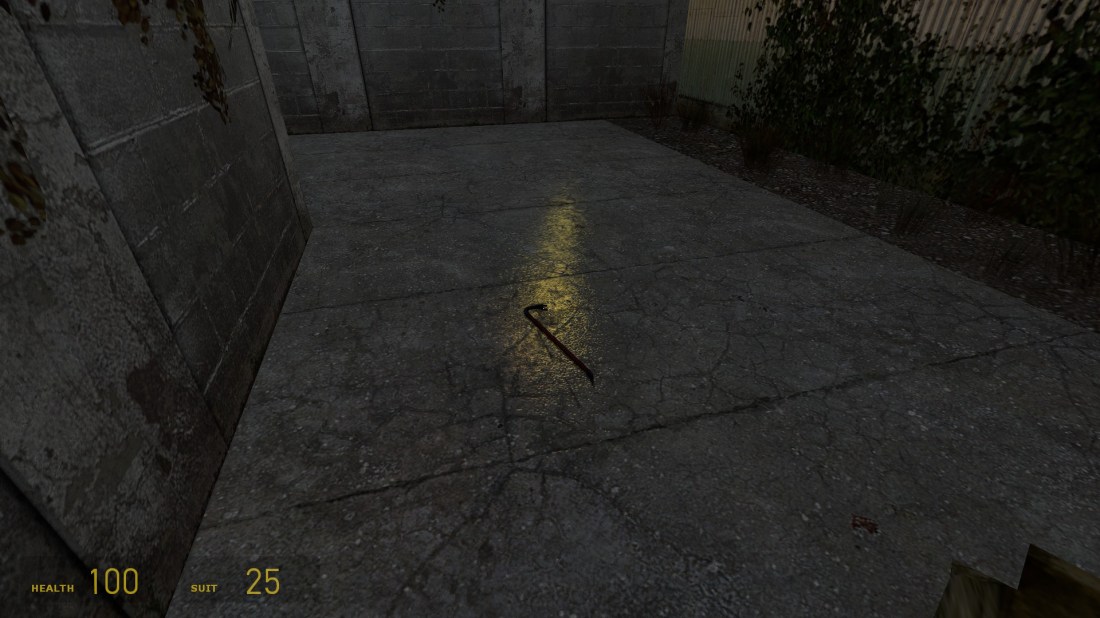
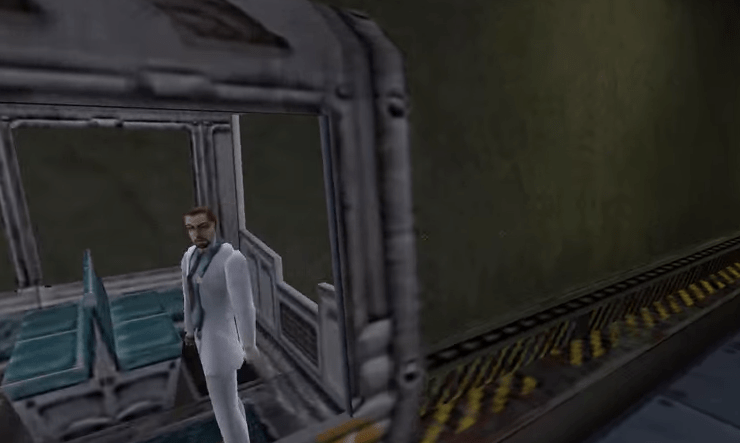
I’d forgotten how long the opening scene is. I loved the fact that HL had no cutscenes, but this commute through Black Mesa, the Area51-a-like base our hero, theoretical physicist Gordon Freeman works at is a drag. But at the same time I kinda like it. I’m impatient to get me a crowbar but it sets the scene, lets you realise how big this place is, how isolated I am, what we have to escape once everything goes south.

It doesn’t look too bad either. I originally loaded up Half Life:Source, a rebuild on the HL2 engine but while the water looks a bit better, the edges a bit more refined, it’s a pointless do-over that just makes Black Mesa more Murky Mesa. I reload the original. This is more like it. Weird that I’d prefer the blockier version, but this is the HL I remember, and you can see that under the hood is id’s Quake engine. The irony. This feels classic.

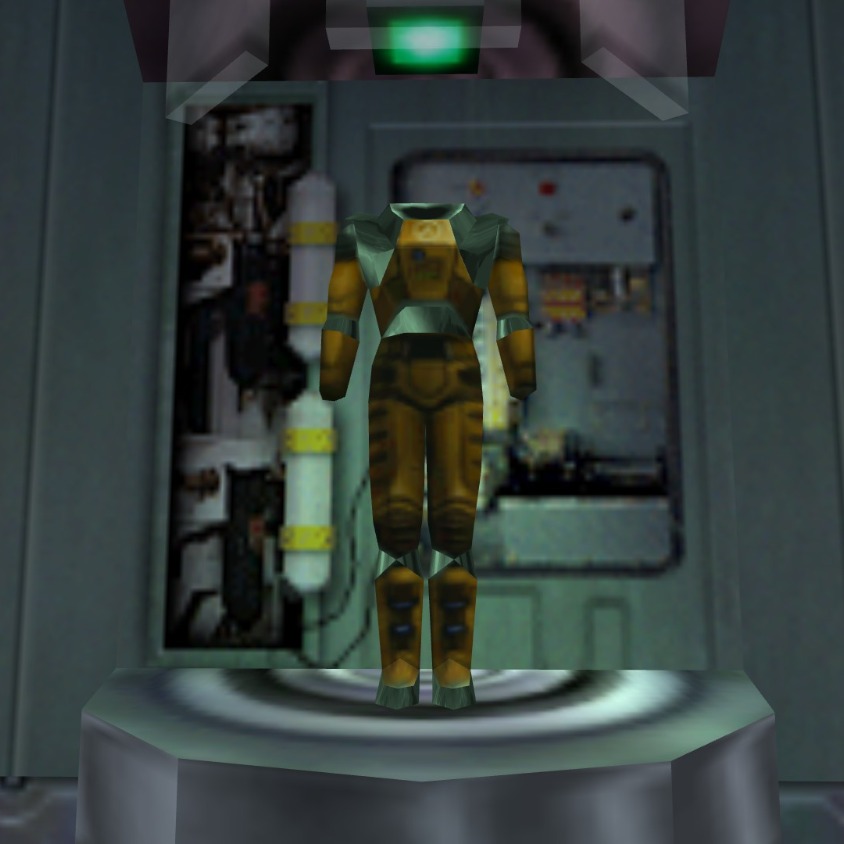
So, after wandering the base and getting told off for being late, I’m off to go trigger the “resonance cascade” that opens portals everywhere and collapses the base; time to get busy with the crowbar. Of course, that’s after I get the infamous HEV suit. Although we never see Freeman in-game, the suit looks like an Orange wetsuit/spacesuit and provides him with shields, and an audio monitoring system that scolds you for taking hits. It’s a nice little logic nod, telling Freeman he’s being injected with morphine after falling off a ledge and losing half-his-life. The music also kicks in when Freeman puts the suit on. Guess it comes with an MP3 player too.

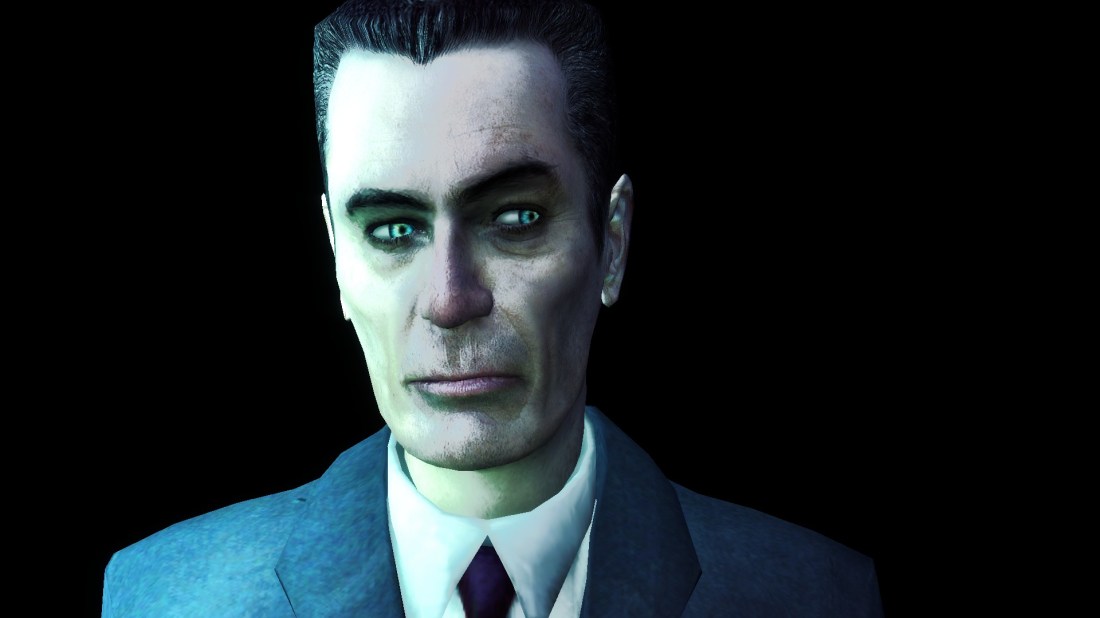
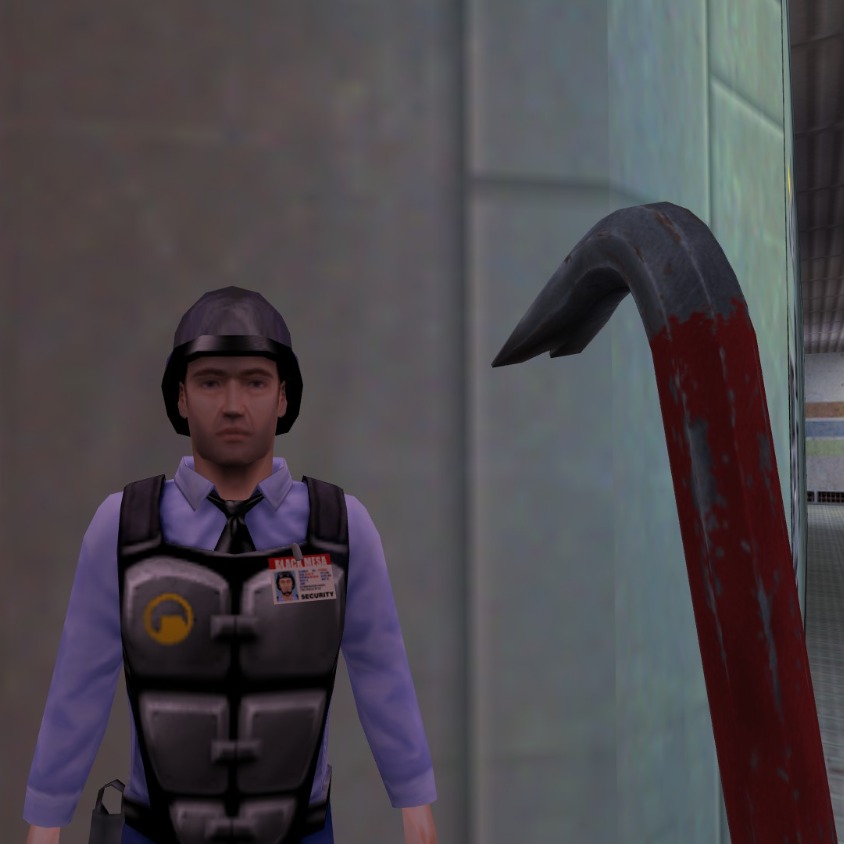
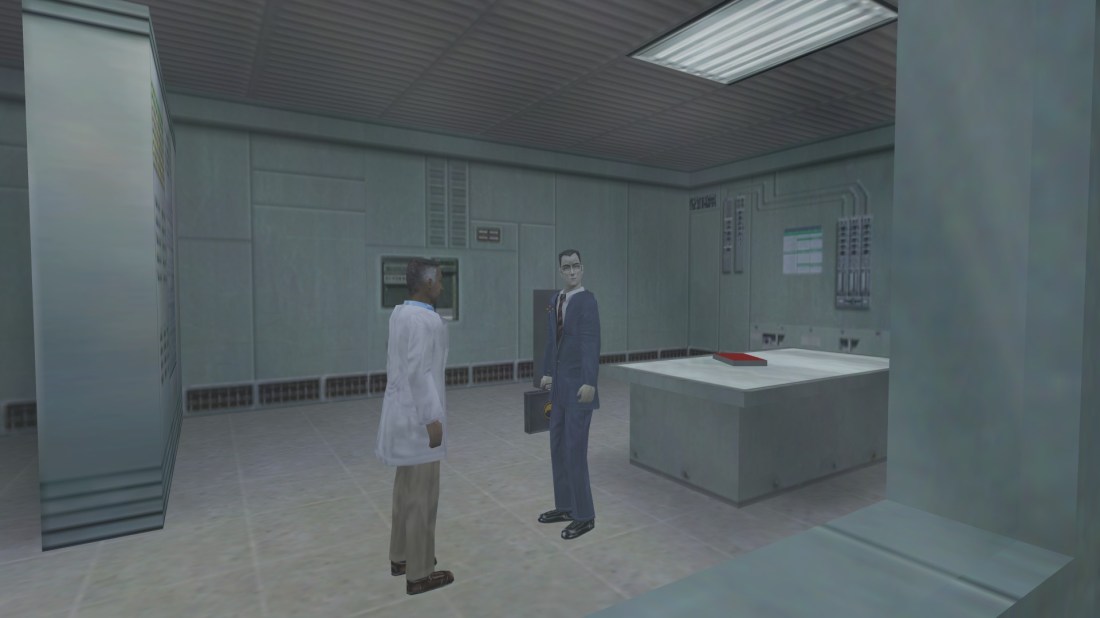
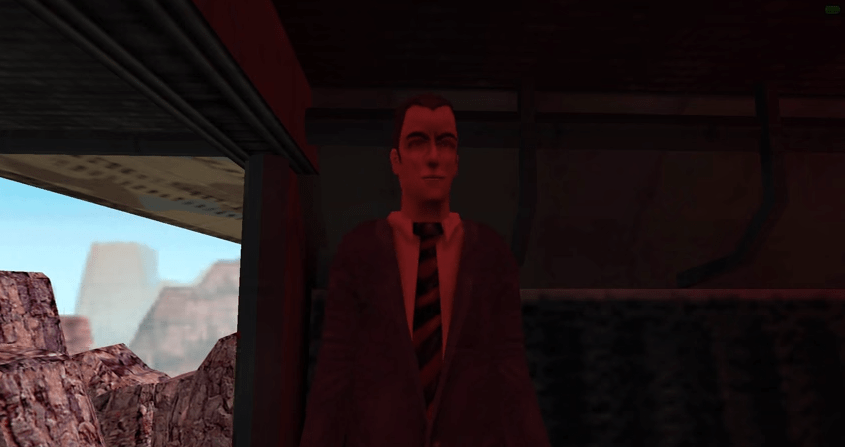
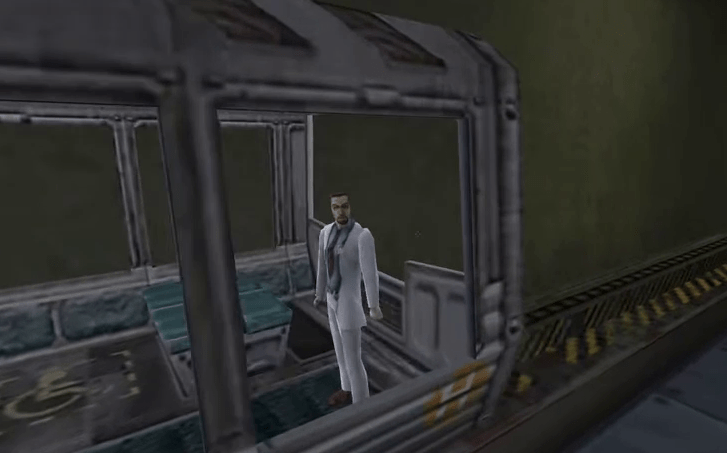
I find two of four scientists that populate the base. There’s only a couple of NCP designs but it’s not distracting and they have nice little personalities and reactions to what’s going on, ranging from terror to over-analysing. One has a nice line in shrieking. They can provide health boosts and open doors and distract the bloody headcrabs. You also encounter Security guards who will shoot alongside you – since there’s no moral choices or XP to be had, Freeman may have on occasion clobbered security guards for their bullets once we’ve reached a spot they can’t follow. Who’s gonna know? One person who might witness my severe survival instinct is the G-Man. You spot him at various times, and he even helps on occasion, but usually he just watches what you’re up then adjusts his tie and walks into a portal. He has an X-Files’ Smoking Man meets Men in Black vibe to him and I’d forgotten how often he pops up, if you spot him.

Anyways, we have more to worry about than distant stalkers; making our way through the crumbling Black Mesa lab is a lot more subtle and ingenious than I remembered. Tasked with reaching the surface and getting help for the hundreds of four scientists trapped inside, Freeman doesn’t spend all his time shooting. Maybe a quarter of HL is exploring and figuring out puzzles. Yet it’s not boring, it doesn’t feel like padding. It feels realistic, like Gordon’s finding his way not just clearing a path with a rocket-launcher. Had it been a Doom-style shoot-a-thon I don’t think HL would have had half the impact; it’s more a disaster-movie struggle to reach the surface and the obstructions don’t feel contrived or deliberate. Of course, this wouldn’t be a shooter without some shootable obstructions.

The Headcrabs, which became something of a mascot for the series, are even more annoying that I remember. Their scratchy cry as they launch at you, hoping to eat your brain and control your body is more of an annoyance than a scare, while the crabbed scientists stumble toward you like classic era zombies – their muffled screams stay with you as their bodies change and alter, turning into something horrible. HL isn’t a horror game though; the soldiers of Xen, later known as Vortigaunts are fast and nasty, but their lolloping run looks like a silent movie star sneaking up on someone – scares isn’t HL’s gig, it’s more about the sheer scale of the event and escaping it. Something can kill you at any moment, but it’s always logical, fair; if Freeman dies, it’s because you weren’t smart enough, didn’t consider that a radioactive spot is favoured by the Bullsquids with their sniper-accurate acid-spitting, or water is where the Barnacles hang out to grab you as you pass by. Later creatures such as the Alien Grunt do feel more Quake-like, but the game’s AI holds up quite well alongside some great scripting to create movie-like moments of them jumping through windows and breaking down doors. It really is a thinking-man’s shooter rather than a reactionary one.

The weapons are also something to think about. While there’s Doom-based pistol, shotgun, machinegun standards, we also get a cross-bow which is as slow as it is incredibly powerful, a revolver and a couple of Black Mesa prototypes to muck about with, as well as some Alien tech and some explosives. While we have a lot of choice, it takes some working out to figure what kills what quickest, and many of them are also used by enemies; Gordon never has the upper hand, there’s no BFG in sight.

As we get closer to the surface, away from the portals, the aliens give way to a Marines unit, sent down to contain the outbreak. And, it turns out, us. They add a more typical shooter element, but they are a refreshing change from the stumbling zombies and galloping Vortigaunts and as the invaders catch up, they and the marines take each other out too and Gordon gets caught in their skirmishes, choosing whether to skirt around or get stuck in. It still all makes sense though (How many times in a shooter do you stop to wonder how the hell an enemy NCP got there or knew you were coming?) Outmatched, the Marines start to pull out, and those stranded get picked off not just by the Xen creatures, but Black Ops who have infiltrated to ensure what happens in Black Mesa stays in Black Mesa. Best get out of Black Mesa then.

Next stop Xen – after passing through Mesa’s dirty little secret; test subjects of Xen creatures, confirming this isn’t our first encounter. Making sure this is our last encounter, something on the other side is holding the portals open and guess who’s the only guy in a HEV suit capable of surviving Xen? I kinda wish I wasn’t. Not out of fear about what I’ll find but wondering if the memory of finding Xen a let-down is still accurate. It kinda is. There’s just something a little more generic about the Xen world and it’s bare look shows the engine’s age and basic rendering. It’s imaginitive but vacant. Most of the same Xen creatures are knocking about, along with new annoyances like trees that spike you, and the infuriating mini-boss Gonarch, a huge headcrab. After all the careful narrative, reducing HL to a Quake-like alien world and boss battles just stumbles HL a little, while the platforming puzzles seem contrived. I’d forgotten all about the final boss, Nihilanth, a weird giant baby and a bullet-sucking annoyance. Although Xen is still a stumble, its fun and G-Man’s final scene is straight out of The Outer Limits. I’m proud to have saved the world. Geeks rule!

Half-Life is still one of the best shooters of all time – even more so those days, given how samey and CoD-clone FPS has got. I’d also not appreciated just how ‘normal’ Freeman was. He’s late at the beginning, implying he’s just a regular joe, dragging his heels to work. He’s dismissed by most of the scientists and given grunt work. In fact, he seems pallier with the security guards than his peers. But as he progresses, Gordon becomes respected and admired by the scientists. He did nothing sciencey to deserve their adulation, but still, it’s nice that Gordon gains their respect by the time he jumps into Xen, and it’s one of many, many ways that Half-Life is pure class.

After this, the series could have gone off in any direction, but instead Valve had then-new developers Gearbox cook up the same experience but from different perspectives. I remember liking that in the first Add-On, Opposing Force we were the bad guy. Corporal Adrian Shephard, reporting for duty. Sent as part of the force tasked with putting down the invasion, Shep’s air carrier is shot down by a passing Xen bomber thingie. This means Shep never gets the order to kill Freeman. Hey, I’m a good guy again. Playing now, it would have been more fun for the focus to be kill all the scientists and not forget about Freeman, make all about stopping him but instead it quickly falls into Half-Life lite territory, finding a way to escape the base but there’s a few things keep your attention. Four, to be exact.

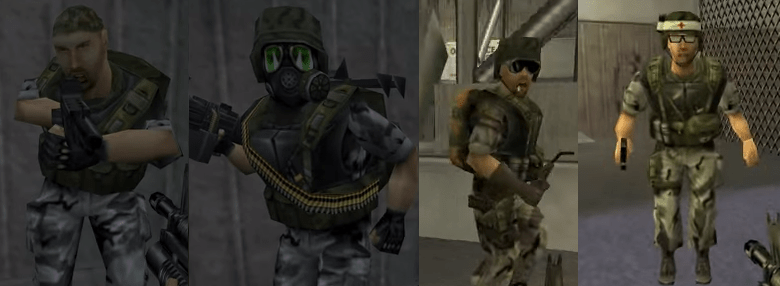
Although scientists will (rather naively) help Shep, the real MVP NCPs of HL:OP are the other marines lost or cut off from their units. None of them seem concerned about Freeman either, so they merrily follow Shep looking for a way out. They have a great way about them, kinda like the Colonial Marines of Aliens (maybe not mention Colonial Marines and Gearbox together), switching between Hooah machismo and ‘its game over man!’ panic attacks. There’s standard grunts, a medic, and an engineer who lights his Oxy-cutter with his cigarette. They can die, and do often, but rather than get replaced by magically dropping from the sky, new troopers must be found or freed so Shep does still spend time on his own. It’s fun to try to get through with all the soldiers intact, and disheartening to see one of the vets down or hobbling after a firefight. Noooo he was one day away from retirement.

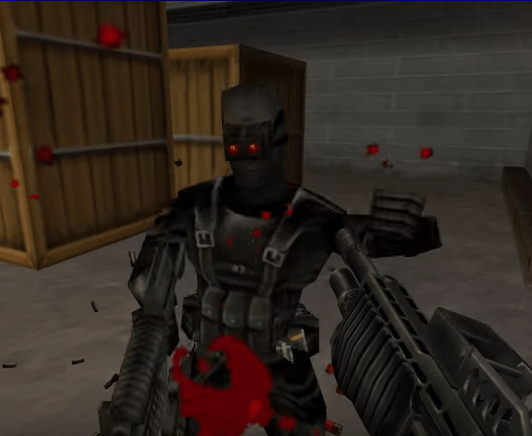
Whittling down my dirty quarter-dozen is stalwarts the Vorts, Headcrabs and Zombies, but also the Black Ops we saw briefly in HL. Whereas in HL they were backflipping female ninjas, most of OP’s opposing force is male, who aren’t as agile as the females, but are still sneaky little so-and-so’s and tougher than the marines. They intend to explode a nuclear device to seal Mesa and its secrets, so that becomes Shep’s priority, since it’ll explode before he can reach topside.

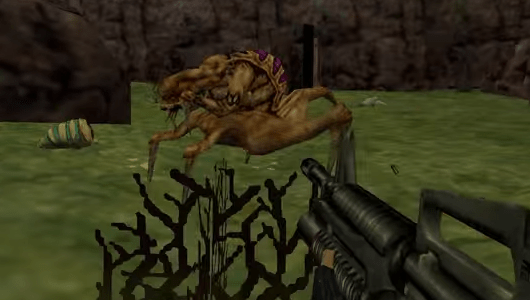
It’s not just the Black-ops and Xens we have to contend with though. There’s also ‘Race X’, random aliens that used the portals to invade. Those creatures are more aggressive than the Xen lot; large electric-bolt firing grunts, small scrappy little drones that fire darts and rip you to pieces, and the ‘Voltigore’, an elephant-sized pain that inhabits a dark tunnel system Shep has to navigate, and appears in a mini anti-petting zoo he works his way through.

OP does little to expand the HL story, although Shep’s diary implies the whole event was planned by the G-Man; it’s much more of a pure shooter and does suffer for it. When I first played it, I was happy to be back in the HL world, but now it feels like filler, especially with the no-mark Race X creatures. Least there’s no Xen to speak of though, only a brief detour. But, it is true to HL, there’s some nice locations and set-pieces, and we get a brief glimpse of Gordon as he departs for Xen. I tried to stop him but just created a temporal paradox. I’d rather that than be in Xen to be honest.

Despite being a Half-Life lite, OP is a solid little game. The grunts are fun to kick around with, the Black-Ops a worthy foe and the progress through the base is never boring. Shep has even more weaponry to play with, including a sort-of Portal gun that’ll transport him about, occasionally with unforeseen consequences and we get a sniper rifle; Shep also decides to carry around a Barnacle to reach areas and objects, lets a shock-firing parasite attach itself to him and adopts a tadpole creature, which purrs at him when he strokes it and fires explosive oranges. Shep is weird. G-Man takes a liking to him though and he’s been a fan fave ever since, despite never actually accomplishing anything – he saves no one and Black Mesa still explodes at the end.

The second Add-On, Blue Shift was slated on release, offering nothing new and being too short to enjoy what it did have. That is true, it’s practically a demo-sized game centred around Barney, a security guard and drinking buddy of Freeman. Barney does fight his way through the same Xen creatures and marines in Black Mesa yet again and it is all starting to feel a bit repetitive.

I enjoyed it at the time, and having replayed, still have a guilty love for it. Barney’s mission feels more personal – let’s get the hell out of here. It’s his job to do the grunt work for a couple of scientists trying to reactivate a prototype transporter that’ll get them to the surface. It just works for a bunch of nerds and a bloke on minimum wage with a clip-on tie.

There’s not much to say about Blue Shift’s FPS experience that’s not already covered by HL and OP. It’s the same but with a blue arm instead. Oddly though, I enjoyed Barney’s brief trip to Xen, where he does something science-related to activate the transporter – it’s a surprisingly enjoyable, tense run-through instead of Freeman’s overstay. The rest of it is familiar and there’s not much in the way of standouts, but I liked Blue Shift; most of the time we’re just running errands for the scientists and I’m okay with that. It’s an alternative take on the event, shows that the scientists and security guards weren’t all helpless or hopeless, and given Barney is a key player in Half-Life 2, it’s nice to see where his heroics and closeness to the scientists comes from. In some ways I preferred it to OP; it’s less typical of FPS to be playing the support act rather than the hero.

And then there was Decay. But without a friend to co-play it with (I mean a friend with a PS, I have lots of friends obviously) I’m going off faded memories and Decay has been equally forgotten; which is a shame as it’s the only HL game with female leads. The plot followed them attempting to call for army support, explaining the marine’s appearance (even though according to OP, it was pre-planned) and from memory, it’s another run through Black Mesa, but this time puzzles and enemies are more suited to coop rather than solo play. Enterprising Modders have found ways to convert it to PC, but I have no PC friends either…

HL does look a little creaky now, but as with any great game, that aged feel disappears when you disappear into a game this good. Half-Life it turns out, is ageless and still relevant; yes, it was an important game, a shooter that lead to story-driven, immersive experiences but under all that adulation and influence, the battles, environments, puzzles, subtle scripting, events and story boils down to one element modern games forget; the player. HL was a game that respected the player; I really felt like the game wanted me to have a good time, get lost in its world. And now we’re lost without Half-Life 3; Valve are a very different company now, but back in 1998 they created something truly amazing. And it still is. Apart from Xen.

Half-Life 1998 | Developer Valve | Publisher Sierra Studios/Valve

Opposing Force 1999 / Blue Shift 2001 / Decay 2001 | Developer Gearbox | Publisher Valve

genres; shooter, FPS, Horror, Adventure

platforms; Win/Steam, PS2

No One Lives Forever 2

A Blast from the Past review

FBT reviews the return of Cate Archer. That’s if he can see her all the way up on that pedestal.

The Past

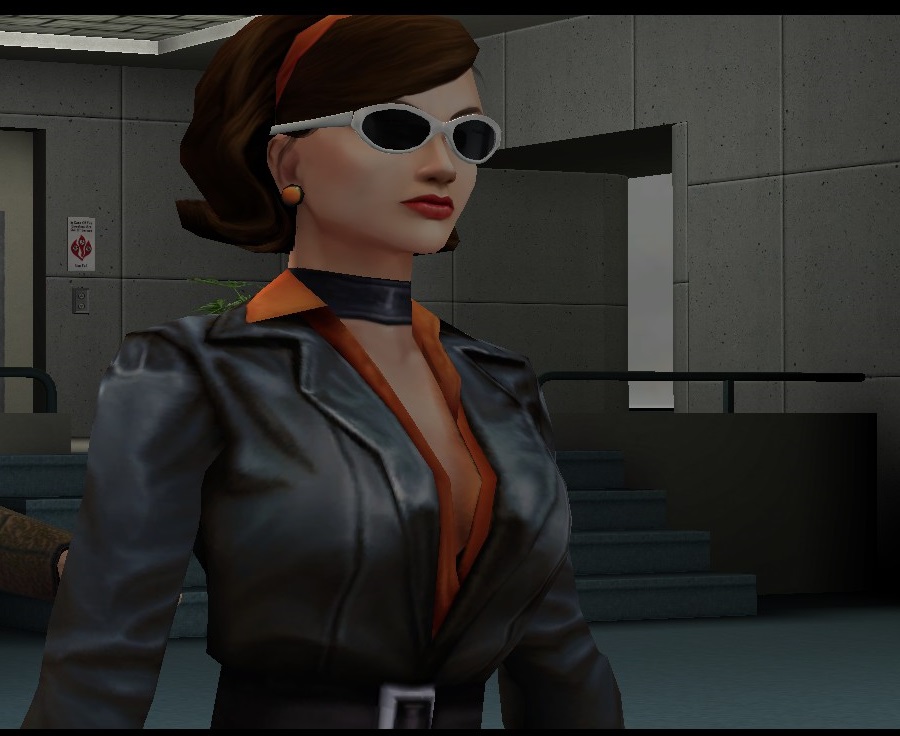
The best thing about discovering games released on budget labels was you didn’t have to wait forever for the sequel. When I picked up Xplosiv’s NOLF release, A Spy In HARMs Way was only a few months behind so I didn’t have to wait too long before slipping into Cate’s kinky boots again. I loved Cate. I mean, NOLF.

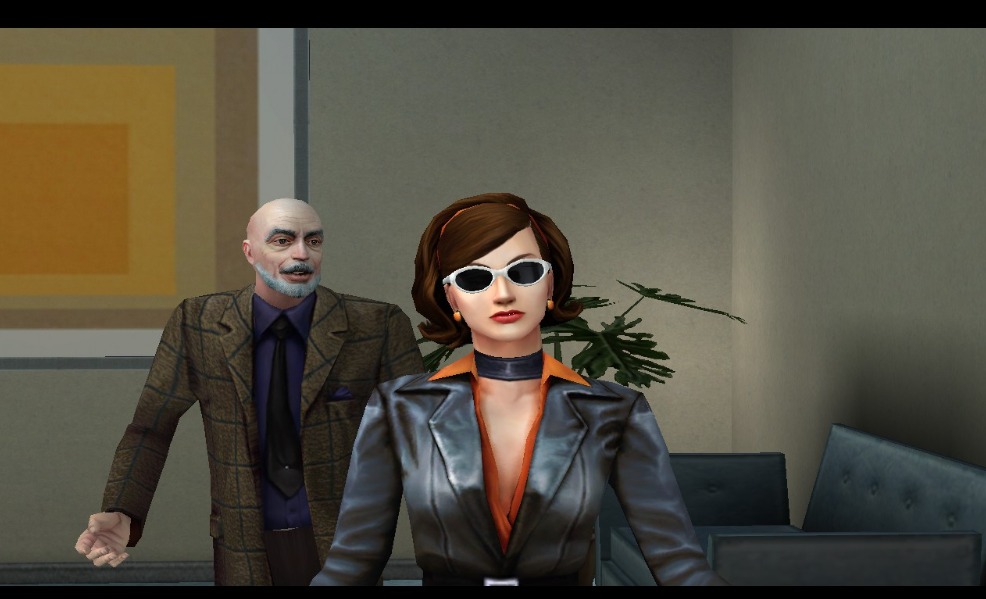
I remember NOLF2 being a huge leap from the first. Graphically it looked amazing as Cate continent-hopped trying to avert a Bay of Pigs event. Great baddies including the mime assassins (who doesn’t want to shoot a mime?), a huge amount of comedy and some commentary on the Cold War. And Cate, being Cate. Lovely Cate. It was just really good; a great shooter with a solid story and good characters; a rarity for any sequel, in any media. It was more of the same without being samey; more outlandish than the original, with hulking super-soldiers to take down – but then the original was all about people mysteriously exploding so where do you go from there? I remembered playing it so much the two games merged into one beloved game. But as I prise them apart in my head, I realise my best remembered moments were from the first and remember NOLF2 getting repetitive and spending way too long in India, like they’d run out of money and just shoe-horned narrative reasons for everything to take place in one or two locations. But it was still a great game, its Cate and it’s still the swinging sixties. I’m excited to go back and see if those Kinky Boots still fit. Everybody’s going for those kinky boots, kinky boots (boop-boop) kinky boots.

Still a Blast?

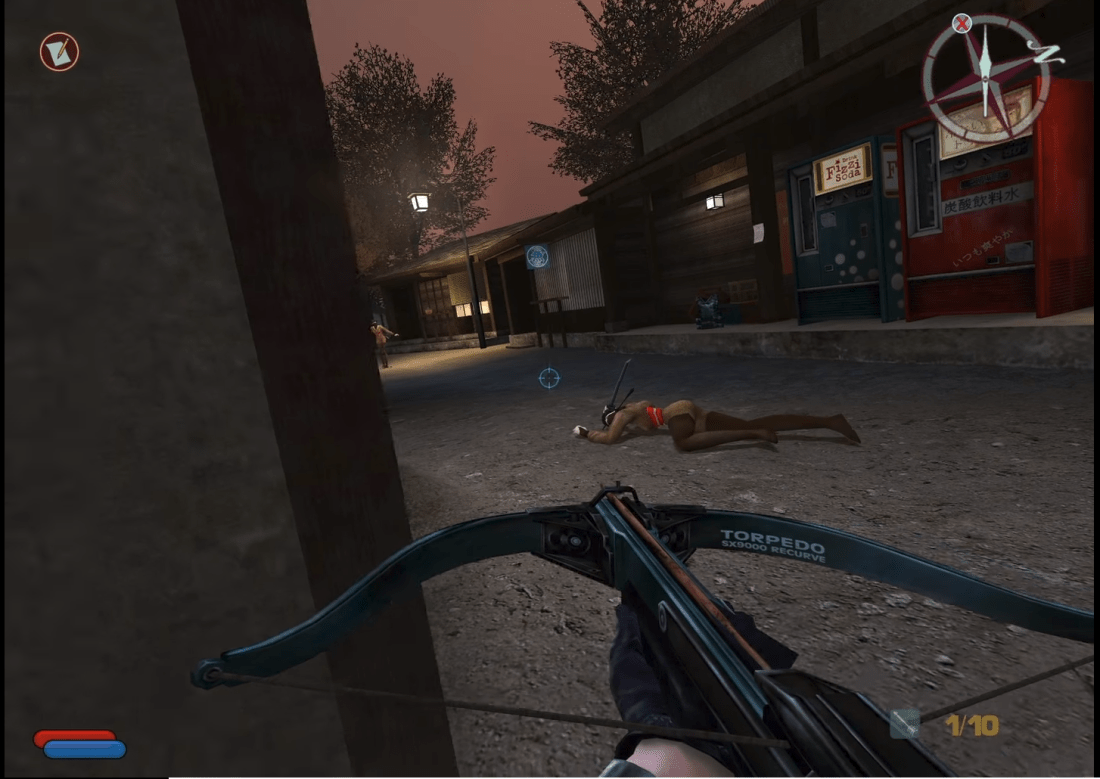
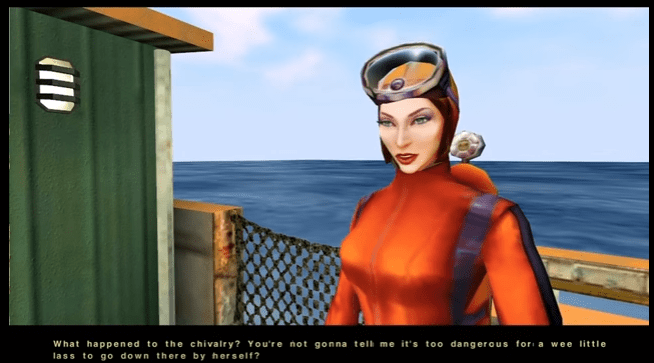
Our first mission as Cate, looking as lovely and acting as cool as ever, is to infiltrate a super villain convention being held at a Ninja Village. It’s largely a tutorial as we learn the ropes of this more seasoned – but no less perfect – Cate. It’s a great little mission where we learn a few new tricks like stealth-hiding, moving bodies and searching for goodies, and relearn awesome distractions like listening to hilarious conversations and daft moments, and soon enough we’ve lost ourselves in Cate. I mean World, Cate’s world. It’s good to be back, I’m grinning and enjoying it way too much and that’s not just ‘cos Cate’s back and she hasn’t aged a bit. Cate’s back because HARM is up to something with an island called Khios. A speck in the ocean to most, its strategic worth has become a lynchpin in the cold war build-up and HARM offers to help the USSR take it – in return for building the world’s first ‘5star Communist Hotel’ on the island. Stopping WWIII and all-inclusive holidays? Cate has her work cut out for her.

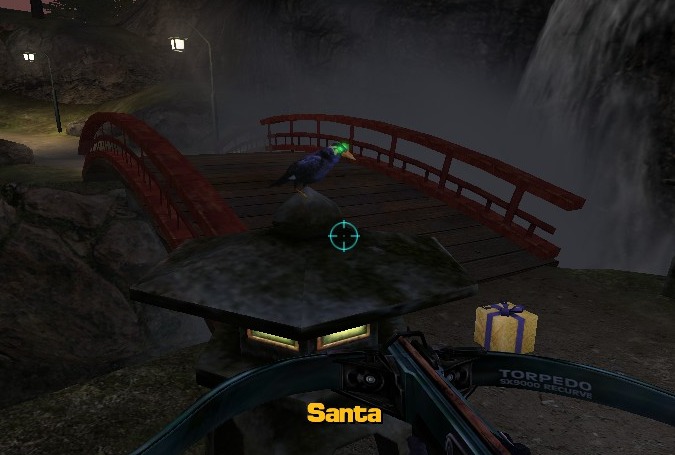
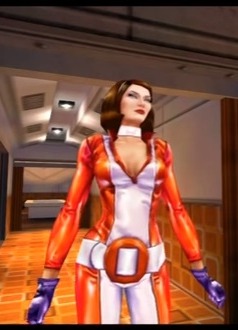
NOLF2 is technically better looking than its predecessor and it’s a good shooter, the goons are quick and hard to pin down, while stealthing is actually fun for the most part, especially when you’ve got the camera disabler and tracker darts – new and improved presents from her Q, Santa; while Cate no longer does runs through his Workshop, Santa is still here, advising via a robotic bird that unnervingly knows where to perch when Cate needs info on the mission and monitors how she’s doing (‘don’t shoot the bloody bird…’). He also leaves dainty little presents for Cate to find, filled with lethal and fun goodies. Cate also gains intel from rifling desks and can trigger side-goals, both of which give xp to upgrade; better weapon handling, health etc., but also how quickly she can hide and use gadgets. We also don’t have the loadout screen anymore, Cate defaults to basic weapons and everything she needs, not that she needs anything, being perfect n’all. I can see why gadget picking was dropped from the first one, anything that was required for the mission you’d find nearby or were default carried anyway and the optionals are now always available. But it does mean your approach is dictated; you can’t pick a sniper rifle if you intend to stealth or the Corrector if you wanted to be anti-stealth. The weapons and the multiple ammo makes a return but there’s new gadgets like a hair-spray that doubles as a welder, nail-clipper lock-picks, a phone bug that looks like a ladybug (which Cate plays with while idle) and a cute little robo-kitty that will attract baddies with explosive results. Not quite as good as the fluffy slippers and belt-buckle grappling hook but still silly yet practical ways UNITY, Cate’s spy organisation, found to equip their first female agent. But Cate’s not a ‘female agent’ anymore, she’s Agent Archer, UNITY Spy; less eager newbie and more company man now.

Being a company man means practically none of the sexism Cate endured in the first. There’s references, comments but she’s accepted and respected. She has a reputation after the events of the first and that’s what they comment on, not her dress sense. Although the catsuits are gone, she’s not been sexed up either; Cate’s no less stylish but she is refreshingly functional. When in Siberia she’s in a parka rather than some barely there outfit (there are some fetching white gloves clutching the gun), around the office she’s in a stylish little V-neck dress and leather jacket, but there’s no cleavage on display. The closest she gets to baring flesh is in India, and she’s only showing a midriff. She still has her charm and playfulness (‘can you stop fidgeting?’ / ‘no’ ) but less of the sharp putdowns because she’s no longer enduring the sexist passcodes or fending off security guards belittling her for being on the shooting range and then asking her out on dates.

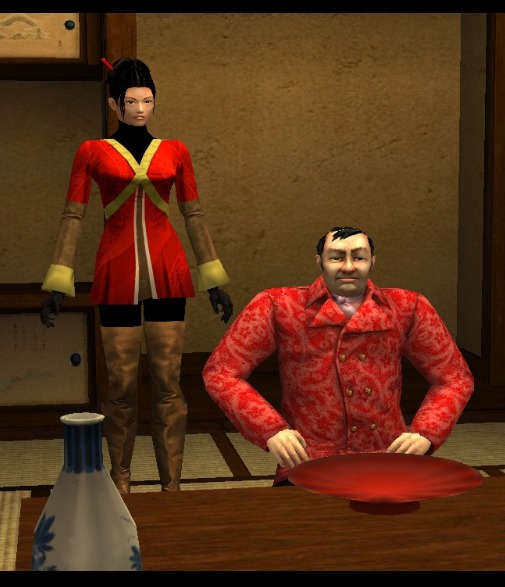
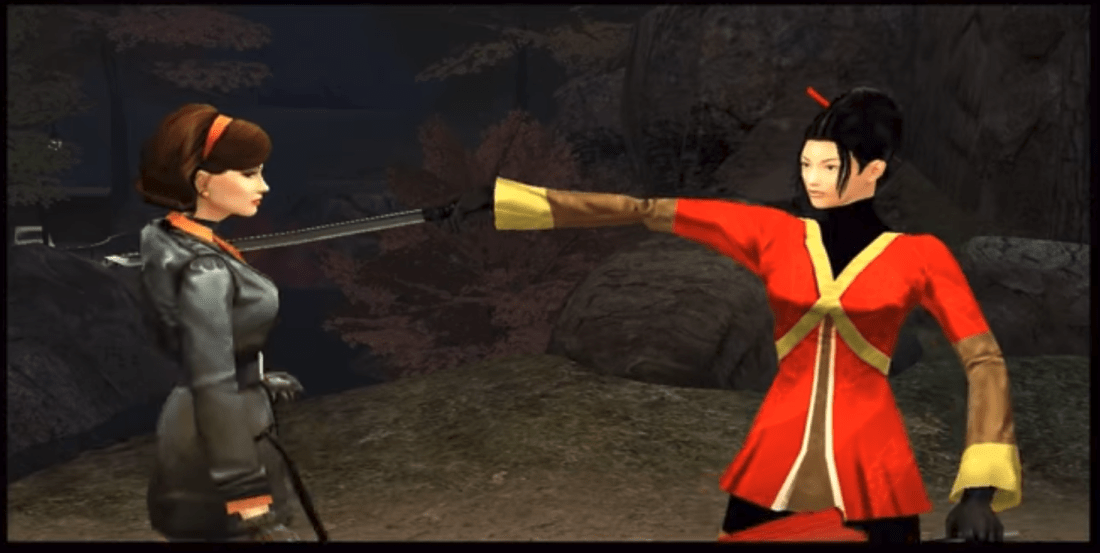
But then, what looks like NOLF2 topping NOLF’s sexism and misogyny by exploring feminism and patriarchy is actually a missed opportunity in the form of Isako, a female Nina Master whom Cate spends much of the game battling. Isako’s indebted to the HARM Director who toys with her, promising Isako freedom if she brings him Cate’s head then says she is his and he’ll never let her go. That’s the kind of thing Cate would not have taken kindly to. Isako is the only non-jokey mini-boss of the entire series and Cate’s equal; recognising Isako’s predicament, Cate tries to reason with her even after Isako puts her in the hospital -twice- and it feels like their relationship and Cate’s influence was intended to weave into the plot as if Cate, having won her personal battle must now step up and fight for other women but it doesn’t really happen. While their resolution technically works, it’s solving the problem not the issue and it’s a let down after the searing commentary on sexisim in the original.

NOLF2 just doesn’t explore empowerment as it should have, like Cate ‘proved’ herself in NOLF1 and that’s enough but being capable isn’t the same as equal and I expected NOLF2 to satirise the fact that Cate had to save the world to get respect. There’s none of that in NOLF2, but it’s good to see Cate simply treated as an Agent rather than judged as a woman, even if it’s ironic that she’s accepted as an equal and that feels like a fantasy.

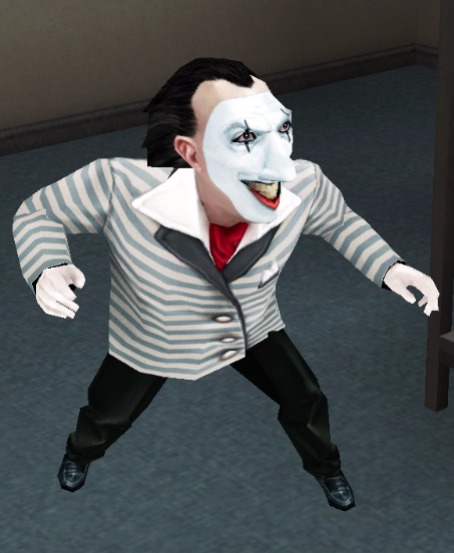
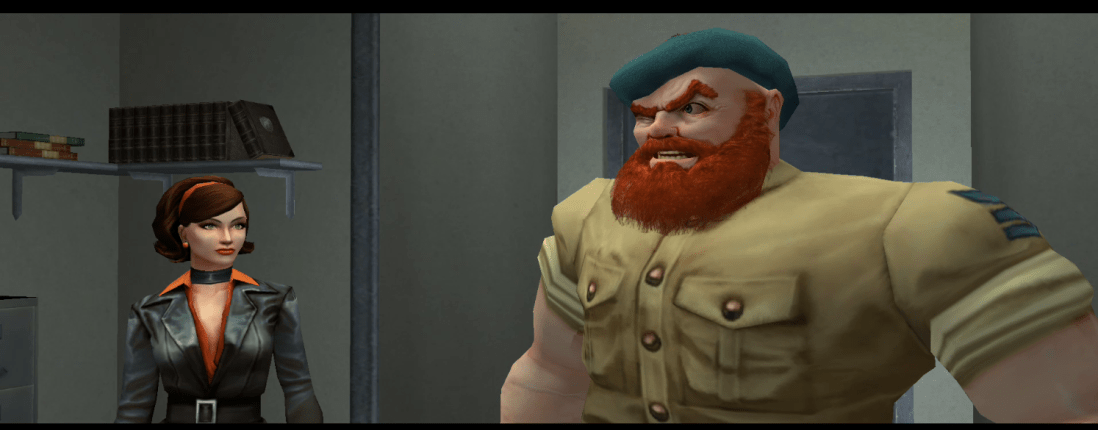
The biggest (well, smallest) foe of Cate’s adventure is an assassin called Pierre the Mime King. The little theatrical brat has been tasked with stopping Cate from interfering with HARM’s plans, and he unleashes a group of mimes on her trail. Who are a work of genius. They hunt you down, invisible walls notwithstanding, tip-toeing despite their huge size, yelling in ‘Allo-‘Allo accents. You never get tired of them – it’s really saying something when you’re pleased to see more of an enemy. Less welcome are the Russians you battle, who aren’t quite on the same scale as the original HARM goons – they’re a lot more shooter-typical, although they have their fair share of comments (‘This is the Union of the Soviet Socialist Republics – People don’t just disappear without a trace!’) and at one sneaky stage I caught them dancing to an evil capitalist radio station, but overall there’s a lot less of the conversations going on; NOLF2 feels shorter than NOLF1 because you’re not wasting hours listening to them complain about mothers-in-law or discussing the moral implications of providing beer to HARM’s ranks. Volkov is back too, spending the entire game in a head-to-foot plaster cast and not in the best of moods, while Armstrong returns as an ally. Drafted in for his intel on HARM, Cate and Armstrong constantly bicker and argue to cover their mutual respect; that there’s zero implication of an attraction makes it even better. The big lunk is one of the best things in the game, constantly pissing and moaning before doing something hugely heroic, or really dumb. He was always an ambiguous character in the first game and in NOLF2 those flashes of a moral code come to the fore. But, he’s not above winding Cate up – and she responds by making him hold her handbag. They’re great.

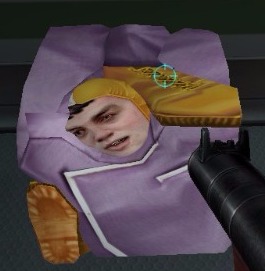
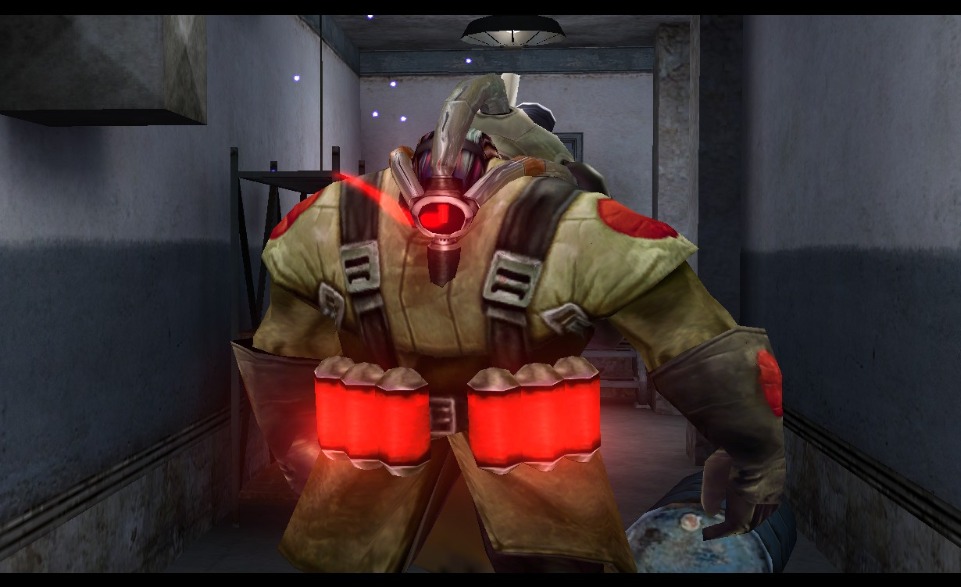
We also fight HARM’s soldiers, who are somewhere between the Mimes and the Russians and do have some awesomely inane conversations or spend time practicing their evil laughs, and perhaps the most surreal baddie of any shooter is the ‘Man-Crates’ – Volkov punishes HARM thugs by turning them into crates who remain committed to the HARM cause, rolling towards you trying to get in a bite. There is one absolutely beautiful moment when, if you’re quick and sneaky, you can hear two HARM goons discussing something (‘Like all quantities, horror has its ultimate. And I am that.’ / ‘Hey! That’s from The Brain that wouldn’t Die, I love that movie!’) and it turns out one of the goons is actually just sitting on his crate-friend as they chat. Nobody does it better than NOLF. But the real big bads of NOLF2 are the Super-soldiers. Genetically engineered hulk-meets-Big Daddy, they are HARM’s present to the USSR to secure Khios and not to be messed with.

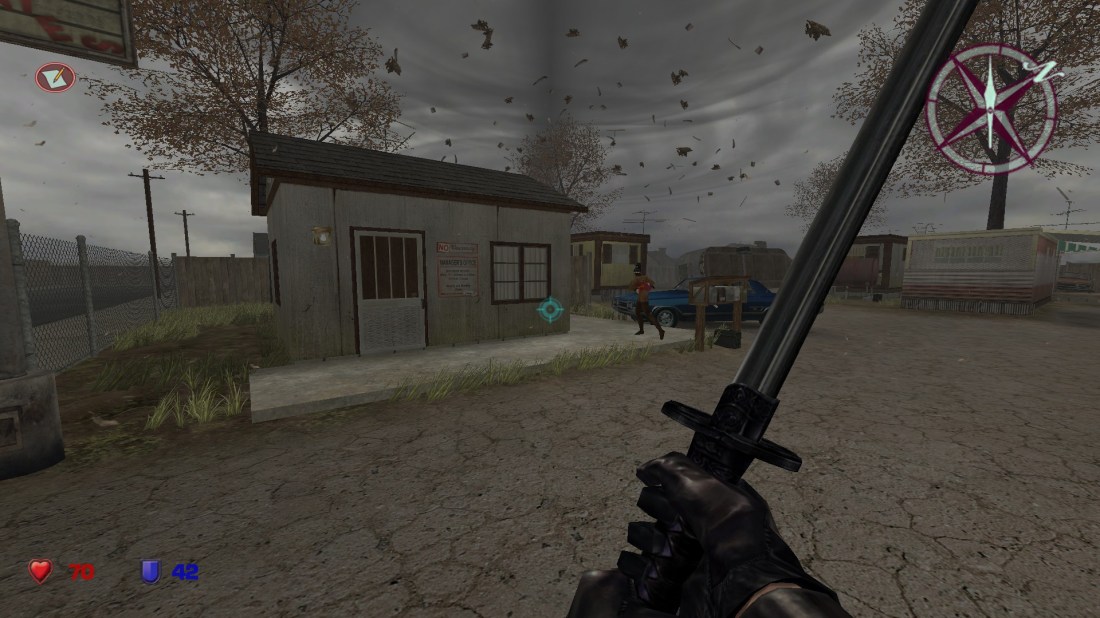
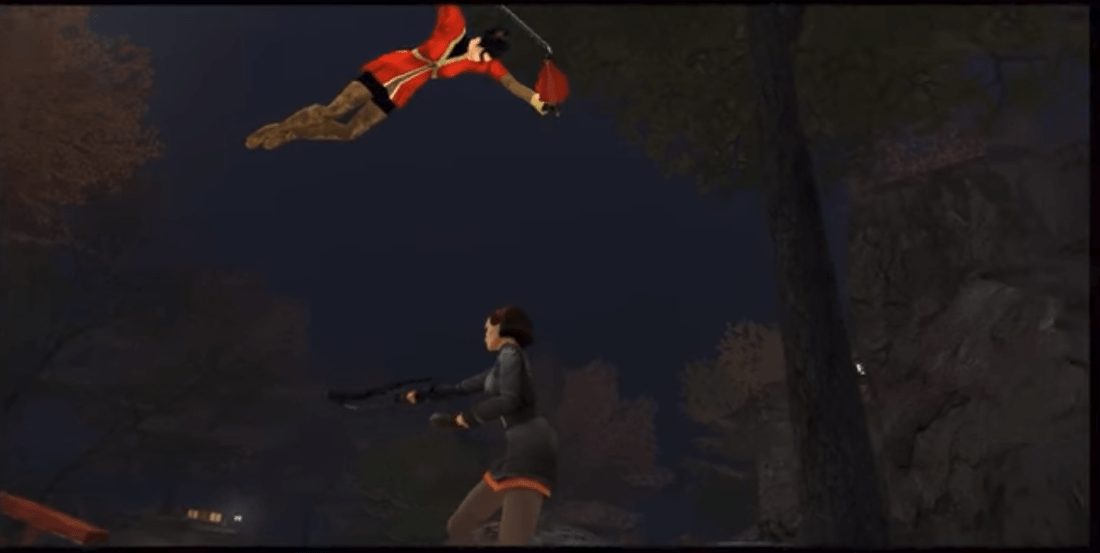
After Cate survives the Ninja Village and her first encounter with Isako, it’s off to Siberia where we learn more of the Soviet’s plans. It’s a huge and mostly fun mission, with lots of infiltration, skimobiles and explosions. And save our drunk pilot twice. Later we investigate double-agent Tom from the first game, learning how he’d been conditioned by HARM. What follows is a running fight with the Ninjas, spilling out into a nearby trailer park as we try to outrun an approaching Tornado. Until Isako blocks our exit. Cate asks if we can possibly postpone considering the tornado is ripping up trailers all around us, but Isako thinks the storm adds a level of excitement to their duel. We wind up fighting with Katanas inside a trailer spinning in mid-air inside the storm. Although Isako uses flashbangs to stealth attack, it’s one intense, close-quarter scrap (and maybe a Kill Bill reference) and the game’s standout. Only the graphical limitations stop this from being heart-attack thrilling as the trailer disintegrates and Cate has to avoid the swirling winds and Isako’s attacks. Awesome stuff. And I’m sure there’s a Mary Poppins – Wizard of Oz reference in there.

NOLF2 does run out of steam a little after the trailer park fight; the extended stay in India is even longer than I remember and it’s a bit of a slog; infiltrating HARM twice, putting down a HARM rival (Unlike HARM and UNITY, they don’t have an acronym, they’re just called Evil Alliance …) It also hits the same beats as the original – a rescue mission, a sneak mission that’s mission-fail if you get spotted, it starts to feel a little familiar. Things pick up with a ‘The Thing’-like exploration mission in Antarctica to discover HARM’s ace in the hole – the Super-soldiers – then it drops again when HARM field-tests them (in India, again) and it’s a ‘save the population while avoiding death’ mission which just feels forced. But we’re back in the saddle when the mimes attack UNITY and Cate goes on a rescue mission inside HARM’s underwater base. While it’s always fun, NOLF2 is mostly Cate just playing catch up, whereas in the first she foiled plans and was a thorn in HARM’s side.

There’s nothing wrong with NOLF2’s middle section, there’s tons of gags, in-jokes and bullets flying about but it’s largely padding – Tom’s house and The Thing base are essentially the same for instance – find enough clues to trigger the next scene – while India outstays it’s welcome. You get this feeling we’re just kicking our heels until the final mission which slowly builds during the cut-scenes, as a warmongering US general pushes for war – and straight into HARM’s hands.

The finale, escaping HARM’s (amusingly fake) volcano base, resolving Cate’s differences with Isako and stopping the Super-soldiers on Khios is all good fun – and there’s even time for a touching moment with one of the super-soldiers, who retained some memory and thinks Cate is its daughter – but NOLF2 doesn’t quite have that warmth of the original, that love for its sixties TV inspiration. Instead it ramps up the humour, almost reaching screwball comedy; I’m not saying Cate jumps the shark here, but it’s definitely going for the silly. I have nothing against chasing a three-foot-tall unicycle-riding mime through the backstreets of Calcutta while riding on Armstrong’s back as he peddles a kid’s tricycle, who can argue with that, but NOLF2 is more an absurdist experience compared to the subversive tone of the first. Okay, so NOLF1 had an opera-warbling mini-boss you bested by turning off her radio so she walked into electrified puddles, but NOLF2 is The Monkeys to NOLF1’s The Beatles.

The unrealised potential of Isako and Cate’s relationship does sour things a little, and the subplot of the Super-solider searching for his daughter is another aspect that could have been explored instead of more India shenanigans, but NOLF2 is still a far better realised game than most. It’s not NOLF1 but few games are (almost none to be honest) and pacing and plotting aside, there’s a lot of fun to be had in the world. Around HARM bases there’s constant reminders to the staff ‘remember what HARM stands for’ – even though no one knows (Unless you play Monolith’s FEAR…) Games could learn a lot from Cate; they don’t all have to build social or gender commentary into their narratives or feature men turned into crates, but the NOLF games show it’s possible to deliver so much more than a reskin. The energy, excitement, wit and fun on display in NOLF2 reminds you why you love gaming so much; this is a game that loves to be played. Cate is lovely too.

The real heartbreaker here though isn’t the unobtainable, perfect Cate, it’s that the NOLF franchise is so mired in copyright issues it’ll never see the light of day or manage a re-release let alone a third game. And so, the NOLF games remain the very definition of a Blast from the Past – a real, genuine contender for the ‘they don’t make them like that anymore’ crown. Cate would look great in a crown, but only if it had a grappling hook hidden in it.

2002 | Developer Monolith | Publisher Sierra

Platforms; Win

No One Lives Forever

A Blast from the Past review

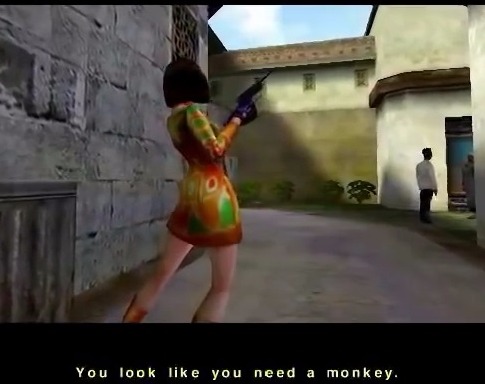
FBT looks like he needs a monkey.

The Past

I bought ‘NOLF’ on a budget label re-release. Back then, a combination of a wheezing PC and asthmatic bank account meant I could only play cheap or old. Budget resell labels like Xplosiv or SoldOut catered for both requirements. Their carousels in PC World and Game were my domain, not those chart shelves with their snazzy new releases. Pah … Anyways, budget browsing is easy in this digital world, you’ve got gamer’s reviews, trailers, gameplay examples, previousweapon.com … but doing it back then in a real shop meant going by the back cover; If I counted all the £4.99’s I spent on budget games that I regretted buying, I could have afforded Doom 2016 on release day and had all that disappointment in one go. But then I would have missed NOLF. Based solely on Monolith’s logo, the creators of Blood, and not at all the cat-suited Cate Archer cover, £4.99 was blindly spent.

NOLF was a hidden gem. It changed my gamer life and influenced every purchase since. Monolith had done it again. Why this wasn’t up there with the heavy hitters I never understood; why wasn’t Angelina playing Cate in a movie version? Where were the Cate Cosplayers? What happened? It often appears in best retro game lists, and a quick google shows the love for Cate is still going strong. I don’t like to think of others crushing on Cate … She was whip-smart, fantastic to look at and had a mischievous streak; the kind of girl who could get away with anything. She looked like Emma Peel but wasn’t the sidekick. She wasn’t dressed like a stripper or a fantasy image; Cate didn’t slay beasts while wearing Victoria’s Secret.

I played it endlessly, until some sort of tech fallout between Windows and the Lithtech engine meant all I saw of Cate was a fleeting glance then a MFC error. Sad days. I eventually accepted it was over and said goodbye to Cate, the love of my digital life, briefly rekindled with the equally ace sequel. It turned out Copyright issues kept Cate from being rediscovered on Steam or GOG, and so Cate and I slowly drifted apart. Sniff. I blame the patriarchy. I still remember Cate very fondly and she … I mean NOLF, is still in my top five games despite having not played it for nearly a decade. Such was Cate’s influence that given the choice in modern games, I always play female, hoping to see Cate reincarnated. She’s never been equaled. And to think I got NOLF on the cheap. It’s been a while Cate, but thanks to the internet and fan patches, I’m back. I hope I still have what it takes.

Still a Blast?

It took some serious googling and dodgy downloads from sites written in Chinese, but after some yelling, I managed to crank NOLF into life and my life suddenly gets better. The menu looks like the set of The Monkeys, the music like the soundtrack to The Avengers. I’m so happy to be back. Influenced by just about every sight and sound from the sixties, it looks great and its retro without seeming like a parody. This is a homage, a loving nod to when we were kids and watched once prime-time stuff on Saturday afternoon repeats. Why don’t they make stuff this classy anymore? On TV and in games.

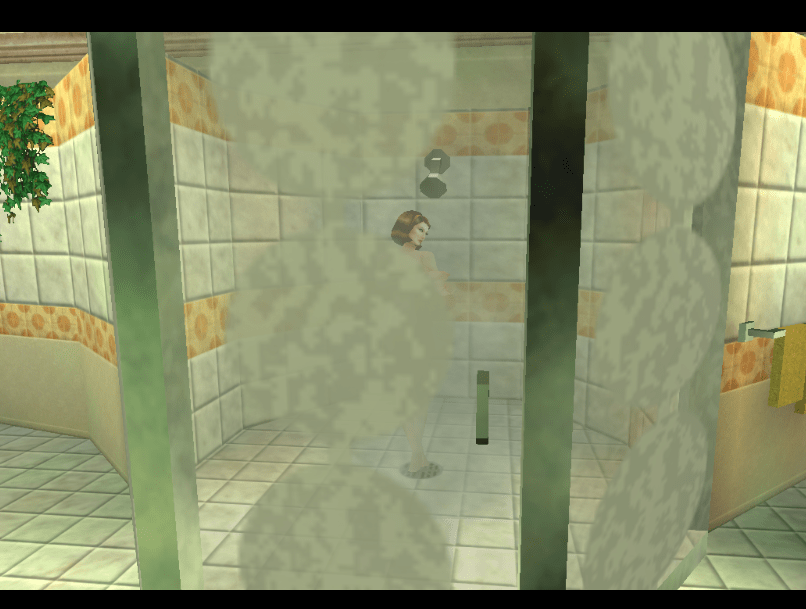
We meet Cate stepping out of the shower, but there are no longing shots of her body. She’s hidden, tantalisingly, as she talks on the phone with her mentor Bruno and teases him about what she’s up to. We think we’re about to meet some femme fatale super-spy, but Cate, a kind of Modesty Blaise, is a newbie; an eager ex-Cat Burglar retrained by ‘UNITY’ as an infiltration spy only to be stuck with menial jobs, a victim of her gender and positive discrimination so the bosses can say they’re progressive. With her English-Scot accent spouting sly comments, Cate is finally let off the leash by her misogynistic bosses after all the male spies are killed while investigating mysterious exploding people and discovers ‘HARM’, a super-villain agency. And so, we battle and giggle our way through a wacko episode of Avengers, The Saint, U.N.C.L.E, Bond, Matt Helm and … I could go on, and NOLF does. I never feel like I’m actually in the sixties, instead I’m in all the sixties shows and movies and that’s way more fun.

NOLF is still brilliant to play. Graphically it’s been surpassed but this is a real gaming experience. They don’t make them like this anymore. To get the most out of it you need to be sneaky and aware, but it doesn’t punish you for slipping up and getting spotted. Likewise, going in shooting is fine too, they’re not drastically different experiences but it’s up to you how Cate behaves. NOLF is an adventure, a shooter at its core with stealth elements but that’s a simplistic description. It’s an old TV episode with bursts of action, story, changes in pace and location, pathos and plot-twists. And it’s not all style; there’s substance under the disco balls and kinky boots, a lot of commentary and observation and it’s strange to think NOLF was ahead of its time then, and regrettably, still is now.

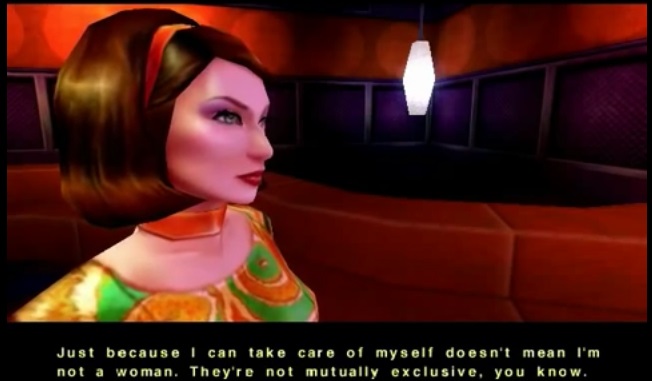
As she shoots and quips her way through the plot, Cate contends with sexism more damaging than the bullets she faces. From the condescension and dismissive attitude of her superiors, the sexist behaviour of the muscled American spy she’s teamed with, to even the people she saves who express amusement that a ‘girl’ is saving them, Cate classily proves she’s more than a match for them all. In one of the more wicked nods to misogyny, every time Cate meets a contact, they are forced to use terrible pickup lines to confirm her identity. You can imagine the ‘lads’ back at base giggling over making her go through this and thinking it’s just a bit of harmless slap and tickle. Cate rises above it but doesn’t accept it – she even expresses discomfort for the poor contact who has to say the lines. That’s class. I don’t know what’s worse, that it took until 2000 to have a female character who’s sexuality isn’t a key element of her capabilities or that we’ve not had one since. And no, Lara in the TR reboot doesn’t count; resisting rape attempts and avoiding graphic deaths via button-mashing is not an expression of strength; she’s a manipulative character in the reboot – manipulating us into caring that is, as she sits helpless and crying at a campfire, unlike the original Tomb Raider who DGAF what we thought. She may have looked like a sex-doll but that Lara was more than her looks, more of a feminist character than the reboot can dream about and no way OG Lara sprang from that wishy-washy brat. Maybe Fem-Shep comes close to a modern female hero, but that’s just reskinning and why is it Femshep? It’s just Shepard. But Cate revels in the danger while taking it seriously; she is consistently smarter, wittier that those around her and a capable hero; the he/she identifier doesn’t matter. Yes she’s feminine, but in moments where gender means nothing, it doesn’t come up unless it’s making that very point.

The villains are great fun to fight. The AI was advanced then and still holds up well now thanks to their clever scripting – both in actions and words. They investigate sounds or evidence of you being there, can be led into areas away from others and leap about, look for cover, run and retreat when you whittle them down. But I’ve never played a game that encouraged sneaking so successfully; not to get the drop on them but to listen to the goons moaning. They whinge about the health and safety aspects of being a henchman, the perks, bitch about their bosses, discuss other supervillain groups they may join, complain about their mother in law. And when the shooting starts, they throw out some genius lines – ‘I do not like getting shot at!’, ‘watch out for the bullets!’ and a personal favourite ‘I should definitely stop ingesting hallucinogens’ when they give up looking for you.

You get to choose which weapons you load out each mission with, and there’s lot to choose from as Cate will add any weapons she picks up to her next loadout inventory. Within the usual groups – pistols, machine guns etc – they’re mostly variations on a theme making it as much an aesthetic choice as a practical one but you also get different ammo choices, including dum-dums (the stupidest name ever for a bullet) and ones that are coated with poison or phosphorous; the goons have those too and the effects bypass your bullet-proof vest. Cate can’t gain health while on the mission so just diving in gun first is a riskier option if you want her to make it to the end. Cate is also furnished with an array of sixties inspired gadgets by ‘Santa’, her version of Bond’s Q, allowing Cate to go into the field with fluffy bunny slippers to quieten her footsteps, a belt-buckle grappling hook, perfume that knocks people out, lipstick grenades and a robotic poodle to distract the guard dogs. It’s a nice touch in the way Santa’s Little Helpers find appropriate ways for a girl to hide grenades and not raise suspicion. Plus, they all have a great sixties look.

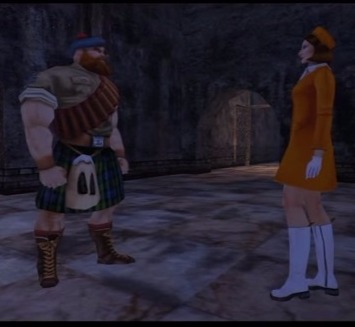
Of course, no Bond film would be complete without supervillains and NOLF has some and then some. The brilliant mini boss, Wagner who warbles terrible operas and provides a fun mini-boss battle, the creepy Volkov who becomes Cate’s arch enemy and a Scottish vagabond called Magnus who appreciates Cate for her abilities – and that she’s a Scot. When she goads the hulk into a brawl to prove she’s better than him is one of the best moments in the game (least in the cutscenes, scuffling with the lug is a nightmare and the only time I wish Cate would just use her feminine wiles to get around someone instead. Damned equality.) Plus there’s three slinky female assassins who spend most of their time lounging about in a classic Our Man Flint-style apartment waiting for the call to kill Cate. Those ladies are not to be messed with, although it’s a shame it’s not more hands on – not that I wanted a cat fight for any titillation, just that the build up to them appearing is actually let down by it being an explosive firefight rather than a roustabout or an opportunity to further the equality issue which would have been more fun.

The levels are nicely done too, full of little interactions and areas to explore, and they’re epic-sized, but rarely drag and it’s well balanced for the most part. Only a few camera-avoiding stealth-only scenes grate. It’s not strictly linear and you can take various routes or approaches, sometimes dictated by the gadgets you brought along. The NCPs wandering about slow the action down because you can’t help but stop to listen to their conversations too. Some areas do drag a little, especially where Stealth is insisted on, and there’s an interrogation mission where you have to listen to a rich old duffer blather on about his life – Cate is posing as a journalist – but I like to think it’s a commentary on sexism, that a man would assume a woman would be delighted to listen at length to obvious fibs about his manly life rather than just talk to her as an equal. Mansplaining in a shooter?

This being an espionage thriller, the plot takes you all over the world stopping off in nightclubs, a shark infested sunken ship (which Cate previously sank), a mid-air shootout after a plane explosion, and in space – What spy thriller doesn’t feature a space station, brilliantly including a Go-Go club? As Cate investigates H.A.R.M a real plot emerges, not just a cut-scene to justify the next shoot-em-up; Problems, double-crosses and unexpected events play out and it’s not until the credits are rolling you realise you played what could have passed as a classic TV spy-caper. Instead we got a classic game. And if you’re lucky enough to have the GotY edition, there’s a full post-credits level where Cate, enjoying some R&R on an island getaway has her gun stolen by a monkey…

Being over 15 years old, NOLF has aged. It looks very Half-Life 1 era, but only if you’re a real fan of environmental design or screen clutter. NOLF’s art design is so well done, the story so compelling, the gameplay so tight it’s just brilliant to be a part of, not to mention the characters, the humour and of course Cate herself. In short, all the stuff they add nowadays to make games look cool is missing and NOLF makes you realise it’s not needed. Peal that away from a lot of today’s games and you’d realise how empty they are. NOLF is missing that shine and yet it’s incredibly polished. It’s more than a shooter, it’s an adventure, a battle-of-the-sexes comedy-homage to a great-looking era all through the eyes of one of the very best heroes of modern gaming. It was one of my all-time favourite games when I first played it, and now it might be my favourite game. It’s certainly one of the best games of all time.

It’s a shame that NOLF is so mired in rights issues and big business indifference that Cate won’t get to adventure for a third time, let alone the classic originals see the legal light of day. I’m not ashamed to admit that when my original disk went MFC Error on me and Windows was no help, I wound up pirating NOLF from a site that just wants to keep Cate alive, keeping it playable as Windows updates threaten to leave her behind – that’s hero worship. Night Dive Studios tried to re-release it as did GOG.com, but both got so entangled they gave up. It’s a masterclass in mergers and acquisitions of mega-corps; Vivendi, Activision Blizzard, Fox and WB all possibly own a slice; some of them aren’t even sure themselves, having either owned, sold or absorbed companies that might have had a stake, and they all seem to have owned each other at some point. If they could all just get in a room, agree to share and let Monolith do what they do best, we’d all win. Of course, we could wind up with an unpleasant TR reboot but I’d love to see Cate save the world again. For now, there is something about how no one gets to ‘own’ Cate in the end. It seems oddly fitting.

2000 | Developer Monolith | Publisher Fox Interactive

platforms; the internet

Gun

A Blast from the Past review

FBT saddles up and other clichés as he rides out to tame the wild west.

The Past

When it comes to free-roam, the wild west is perfect for making your own trails; if the buffalos roam why not gamers? But if you say ‘Western free-roam’ aloud, tumbleweeds pass by. Westerns had always been an underdog in gaming, mashed into other genres while pure Westerns usually fall into caricature-driven silliness. Red Dead Redemption was perfect yet still failed to spur a serious resurgence in the genre. Western games just never got over Custer’s Revenge. And then there was Gun.

Released dead-centre of the free-roam explosion of the mid-00’s, Gun was set in the vile west of revisionist western cinema; its brutality earned Gun a BBFC 18 and it exemplified Leone’s description of a western; “where life has no value”. It was a proper wild west experience, William Munny not Roy Rogers and I loved it. I think. I can’t remember much about it other than the violence and a lot of riding but I’d swear Gun was the real west while still hitting all the western beats. Time to yeehaw through the wild west again.

Still a Blast?

Gun’s menu is so western I expect ‘Technicolor’ and ‘Panavision’ to appear while someone yells ‘Rawhide!’ Sweeping plains, buffalos roaming, a stirring score; open and vast, it immediately looks epic. So does the voice cast. Any star who can pull off a moustache is in this – Ron Perlman, Lance Henriksen, Kris Kristofferson, Tom Skerritt, Brad Dourif; all of them at their Marlboro Man best (No Sam Elliott? How’d they miss him?!), while our hero is earthily voiced by Thomas Jane. I’m excited to be a cowboy! Rollin’ rollin’ rollin’.

We are tracker Cole, who, along with his grizzled Pa, boards a Steamboat to collect payment for the animals we shot during a tutorial mission. Once aboard, a prostitute pal of Pa’s gets an axe in the head and the boat is overrun. With the men closing in, Pa tells Cole he’s not his Pa after all and then ignores a chance to escape in favour of making Cole promise to reach Dodge City and visit a prostitute. Pa had his priorities right to the end.

After saving Pa’s back-up prostitute from some impatient types in a gunfight, Cole honours Pa’s memory and sleeps with her. In return, she tells us to reach Empire City, but first we have to defend bowing, rice-hat wearing Chinese workers from howling pissed-off in’juns while they finish a bridge connecting Dodge to Empire. This being a free-roamer, I ignore their plight in favour of getting to know Dodge.

Well that didn’t take long. There’s not much to know really, a saloon where you can get battered at poker (you can cheat, but it doesn’t help this greenhorn) and side-distractions like Wanted posters; capturing the renegades Alive nets more gold than Dead but it’s not easy and they often have cohorts making it hard to not kill them during the fight. Elsewhere there’s the Pony Express where you deliver goods within a set time, but those I quickly give up on thanks to my untrusty steed. Horses in Gun are quite hardy and fast in a straight-line, but they turn like a cruise ship and can get disorientating when you’re swivelling Cole one way and the horse turns another. You can also work with the Marshall to take care of various trouble-makers in town. All those give you gold and add to your reputation, making Cole better at riding, quick-draw etc., so they’re worth doing. Except the Pony Express.

Having exhausted all to do in Dodge I go help secure the bridge. As I fight off waves of American Indians I use quick-draw to shoot dynamite out of the air, stop them tomahawking the workers, generally live out my cowboys vs Indians childhood fantasy, if I’d been born in a time when cultural sensitives weren’t a thing. The game did generate a fair bit of controversy around its depiction of American Indians and Activision’s (Not An) Apology was insulting; “we apologize to any who might have been offended by the game’s depiction of historical events which have been conveyed not only through video games but through films, television programming, books and other media”. To deflect it as nothing we’ve not seen before is the EXACT problem; you’re perpetuating an outdated view from a simplistic and one-sided viewpoint – even in 2005 we knew that image was grossly inaccurate and offensive, and it’s inexcusable because a character comments they’re attacking because the bridge is in their territory; so … they’re right to defend themselves then? The bridge stays with me for the rest of the game, hoping it’ll be justified later but it isn’t, and when you consider the clichéd appearance of the Chinese railway workers, Gun takes on an unpleasant, outdated tone.

Equally unpleasant and outdated is the portrayal of women. There’s only one which has a more than incidental appearance, a prostitute who’s gratuitously murdered. Elsewhere there’s Pa’s prostitute with the axe in her head, a prostitute on wanted posters (who will be ‘castrated’ on capture) and most female NCPs are prostitutes, pacing around in their underwear. We do meet two home-maker wifey types – both of whom get shot – and interact with a couple of nagging Southern-Belle types. That’s it. The male characters though are richly characterised and most were based on real-world cowboys (in name only, their real-life exploits were far more entertaining than Gun’s interpretation) – there have been a few notable women in the old west, just ask Doris Day. There’s no reason they couldn’t have found a place for an equal-footed female, yet not one plot-related woman survives.

The game itself has aged about as well as its treatment of women. The world just isn’t as vast as I recalled – there’s convenient cliffs and less convenient invisible borders stopping you roaming the bare and basic environment and there’s no real exploration; only two or three routes between the two cities which feel like a TV backlot rather than the old west, and there’s nothing in-between them. You can work as a ranch-hand for a local farmer, corralling cattle and the like – it’s a nice little side-mission and a great example of RPG that Gun could have done with more of. It’s just a whole lot of nothing. The game also constantly reminds you to go finish the main mission, like you were otherwise distracted. There’s also an American Indian who asks us to kill local wildlife pestering his tribe, but about the only other thing to do is annoy the locals; running over townsfolk with your horse or shooting/stabbing them causes the town to lose patience (Literally, you get a patience meter) and assemble a posse to go after you; for which there’s quick-draw, an old-west bullet-time. Gunfights are fairly straightforward but a macabre element is Cole can also scalp wounded enemies. Originally, he’d sell scalps to the Apaches, but it was removed pre-release (wouldn’t want to appear insensitive). So it just remains a compulsion of Cole’s. Who has other problems.

The biggest problem with Gun is Cole himself. He’s not for or against the American Indians, he’s indifferent towards them. They’re just between him and his revenge so it’s okay? Later Cole is excused for the bridge scene after saving some American Indians from slavery – which he did utterly by accident. Besides that, he’s boring to play; he never instigates or drives anything, just reacts. He’s not the man with no name, he’s the man with no idea. Less Shane, more lame. Not Josey Wales, it’s Josey fails. He’s not even Woody. When we first meet Cole, he’s napping; our hero, ladies and gentlemen.

Anyway, turns out a railroad boss is searching for a lost city of gold. Pa had a clue to the city hence his murder, so it’s off to avenge Pa, find the gold and help the Apaches regain their land. Well, that bit just happens by accident again. Along the way Cole finds out he has a little Indian in him – bet you feel bad about the bridge now, dontcha. No? No reaction; it’s frustrating that mid-way through Cole goes Dances With Wolves for the wrong reasons; he ends up working with the Indians by accident, not because of his heritage, or any deeper understanding of their plight but because they are looking to bring down the Rail Baron too (and need a white saviour to do it). All that to explore and we’re concerned with a city of gold? We’re playing the plot to Lone Ranger and the Lost City of Gold (1958) and it has the same dated red-in’jun killin’ and misogyny.

It’s hard to render an incredibly contentious period in America’s history comfortably, but because cowboys vs Indians has been normalised and the image trivialised, it somehow still seems okay; you’d not get a game where a Slave owner puts down thirty slaves for revolting and I’m sure in years to come, more than a few games and a lot of movies featuring ‘the middle east’ as an enemy will start to feel a little uncomfortable on retro-revisits; yet I bet we’re still shootin’ in’juns. I’m beginning to see why most westerns are something else-terns; sci-fi westerns, cyber-punk westerns, horror-westerns; no one gets offended by the misrepresentation of a zombie.

I hadn’t realised how small Gun really is; small in scale and small-minded. It’s not the game I recall on any level; I think my memory of disappearing into a western is because there wasn’t anything else like this then. To be fair, almost all the missions – as far as a game experience goes, are fun – the Bridge battle included; shooting dynamite out of the air, charging a fort, doing train robberies, quickdraws, defending stagecoaches is going to awaken the little cowboy in anyone. As to its tone – the voice cast, the violence, set-pieces and plotting, it’s clear Gun intended to be a mature, serious game and those were the politics and realities of the time – that a tracker from the mountains isn’t going to view the American Indians as anything but a threat and women were second class citizens. The characters can have those opinions, but the game can’t, not when we’re the hero; playing it is a lot different to excusing some old western as ‘of its time’. Gun’s heart might be in the right place but its head was scalped.

2005 | Developer Neversoft | Publisher Activision

platforms; Win | PS2 | X360

Doom, Clones & Killers Pt4

Finally, FBT reaches the end of his quest to find the Doom Killer. Or does he?

Let’s hope so, he’s not doing a part five.

Part Four: Black Mesa Inbound

By now the vultures are circling, watching as Doom breathes it’s last. It’s faced inventories, 3D, character classes, cut-scenes and storylines. Sacrilege. It’s been backstabbed by Quake, bullied by Build and had strips ripped off it by clone after clone. Yet it’s not only survived, Doom’s seen off all pretenders – even LucasArts no less. Doom keeps on killing it – and while 1997’s games have done everything they can to topple it, we’re yet to play a PC game that stands on its own. And that’s because we didn’t have an N64.

Shooter. First Person, Shooter; GoldenEye 007 (Aug 1997) is further away from Doom than any FPS so far; it was a huge leap and is the Doom killer. But it’s let off on a technicality; being N64-only limited Goldeneye’s chances of influencing the FPS genre the way Doom did – PC was safe in its vacuum. But, N64 players got a taste of the future. It seems every genre was stepping up; behind the wheel we had Carmageddon, Gran Turismo and Grand Theft Auto, f fight!-fans were about to get Tekken 3, RPG had the first Fallout and Lara was back in the seminal Tomb Raider II. The most amazing thing about the 1996-97 period is how many of those franchises continue today. Midsomer Murders premiered in 1997 and even that’s still on, what happened to Doom?

While the N64 was changing everything, all we in PC-Land had were sequels. Hexen II (Aug 1997) continues to move further away from Heretic – this time we have 4 classes and a sort of XP system; but as I replay Quake-powered HII I realise Quake was even more boring than I thought. While it has some stuff going on (sheep on catapults for one thing) HII actually looks and plays just like Quake; it’s an incredibly restrictive engine – Here is the world id have provided; play through it quietly, please. Hexen II might be fantasy-based, but it’s striking how distant it all feels after Build’s close-quarter world. But it’s not just the environment. Quake is like Dad’s Army to N64’s Bond; nonthreatening, almost comfortable. This is depressing. No mayhem, no trouble, no edge or dirt to it; Where’s the energy, the risk, the breathless deathrun for the exit? Hexen II does look good, and feels good but it never gets going and it’s hard to keep going, it’s all so flatline constant. At the risk of labouring the point, I would have loved to see it in the Build engine. Yes, I am blaming Quake for Hexen II. If it had been built in a more fluid, freeing engine, it might have been a lot more involving. I’m also blaming Quake for something worse; indifference – after Quake, FPS became more than what we’d settled for. We could forgive Doom for its simplicity because it was so raucous, but Quake’s lack of heart exposed that simplicity without stepping up the mayhem and it’s made FPS meh. Quake is so horrific it ruined Heretic too. Maybe Quake killed Doom by embarrassment. God, I hate Quake.

Luckily, the other sequel we got in 1997 was closer to Goldeneye than Quake; Star Wars Dark Forces II: Jedi Knight: (Sept 1997). Proving how far the FPS genre has come, JK is miles away from Dark Forces and therefore, Doom. There’s a cracking plot; Kyle Katarn, the arm we played in DF is on the hunt for his father’s murderer. Along the way he discovers he can use a lightsaber and that dark forces are looking for a place that focuses force powers. As we shoot and saber our way through every Star Wars reference, Kyle gains force powers and wrestles with revenge vs the Jedi path; and how we wrestle dictates the ending. The plot, much like Blood is told through cutscenes but this time they’re in glorious FMV, complete with panto actors having no idea what they’re doing, fuzzy rotoscoping and cheesy dialogue only George Lucas could approve. It’s an incredibly good game, epic yet focused with good shootouts and set-pieces; it’s as close as a PC gamer is going to get to Goldeneye, and the furthest we’ve gotten from Doom so far; a story, choices, subtle advancements and technically dual-wielding with weapons and force-powers – this is good. It has aged, the force-powers are clunky, the lightsaber is just button-mashing, it’s blocky to the point of being blinding and the FMV is hilarious, but it sets a new bar. All we need now is for id to lower it again.

Quake II (December 1997). This is a new id engine so I’m going to give id the benefit of the doubt and assume they loosened some of Quake’s vacuum-sealed grip and really put us in the boots of whoever the hell the Quake character is; it does actually have a storyline, so I’m sensing a change in the air. Is id actually going to kill Doom?

The oddest thing about Quake II is it has nothing to do with Quake. It’s rumoured QII wasn’t even a Quake game during development, id just couldn’t come up with a better name. Just how unimaginative were id by this point? Quake II is set in a sci-fi environment where a Space Marine named Bitterman (Bitterman would have made a better title) is split up from his company when they’re deployed on the home-world of the Strogg, an invading force attempting to take over earth. A blazing opening scene sets the story in motion, unlike anything we’ve experienced before and exactly what I was looking for. This is epic, against the odds stuff! Finally, a war-movie shooter; tight, claustrophobic, brutal … wait. Goddamnit. The game is nothing like the setup; no desperation, no frantic firefights, no overwhelming odds, no ‘oh shit’ moments. The corridors are better looking than before, and the bad guys move with a fluidity we’ve not seen before, but it’s plain, straight shooting. QII doesn’t add anything to the experience, there’s nothing wild or unexpected; Bitterman is Doomguy with a name tag and while being more cohesive than Quake, having a singular forward-pushing level design, against Goldeneye and Dark Forces II, QII offers nothing; it’s a throwback on a shinier engine. It was hailed on release, but again that’s just the Multiplayer talking; at first I thought id were timid – unwilling to step away from their comfort zone, but no more excuses; QII, actually, is arrogant. id – you thought this would do? At least Doom II turned it up to 11, made you work for it; this is just filler. That’s it. id, you’re dead to me.

So that was 1997, a year where IBM’s Deep Blue beat chess master Kasparov. Afterwards he claimed the machine made imaginative moves, implying human interference but considering IBM dismantled Deep Blue immediately, I think it become self-aware and they shut it down before it could launch missiles against Russia. They should have given Deep Blue a job at id.

Once, someone (me) likened id to Nirvana and said Doom was their Nevermind. Now they’re corporate MOR, the kind of thing you’d find on Jeremy Clarkson’s Driving Anthems CD, given away free with the Daily Express. But thankfully, we had our Foo Fighters; Epic. Unreal (April 1998) follows JKDF II’s form and gave PC gamers their Goldeneye. This could be the Doom killer – just when I thought Doom died of old age.

You play an unnamed prisoner enroute to space-jail when the ship crashes, leaving you the sole survivor with a legion of baddies between you and freedom – but there’s another layer; the planet’s peaceful inhabitants are subjugated by the baddies, forcing them to mine a valuable ore abundant on their planet. Our hero fights through the invaders as per standard, but saves the locals in the process. Or not. As an escaped prisoner, it’s your (moral) choice.

Unreal seems to understand what’s been missing; it draws you in as much as you draw your pistol; this is a FPS that feels exciting but rather than Doom’s pure ‘oh shit’ mentality, you’re playing with a sense of curiosity and against a subtle threat. This is the most compelling world we’ve seen yet. You feel like you’re on an alien planet; it’s full of odd, weird but logical things, spread across a world you progress through. Diaries and notes left by the aliens and other survivors fill in the background of a world filled with puzzles, interaction and situations – Unreal gives you an exploratory feel as you find your way, and how you make your way is dictated by various power-ups and improvements you can make to yourself. Helping the aliens feels good, not just level-up friendly, while the slavers are brutal and varied enough to keep things interesting. It looks dated of course, but you don’t notice; you have a world to save. This is how it’s done; Unreal is real. But did it kill Doom?

Unreal wasn’t a Doom killer, it was an id killer. They never recovered after being roundly punched off their pedestal. Instead of striking back with something new, they dropped all pretence and returned with Quake III – as multiplayer only. They’re going backwards. But Epic were ready for them. Unreal Tournament and Quake III battered each other Oasis vs Blur style but that was the beginning of the end for id. Carmack once dismissed the Unreal engine with “you’re just never as big when you’re second in line”, and I could just end on that quote, leaving it to linger like a Redneck fart, but I can’t let it go; what did id do to justify their first-in-line status? Doom 3. Like I said, backwards.

Meanwhile, Epic’s Unreal engine became the industry standard, powering not only hundreds of games, but exploited in non-game applications too; the FBI use it for crime scene training and the US Army for IED defusing tactics. It’s been used in Hollywood for pre-vis work (by Spielberg amongst others) and it did real-time, on-set rendering of ‘Kay-Tuesso’ on Star Wars Rogue One. And it generated the virtual sets on Lazy Town; now that’s cool. id? id who? You mean the guys who followed Doom 3 with … Doom 3 remastered? Then Rage, aka Doom in the Desert? Least they came up with a new title. Then followed that with … Doom 4 – which was so bad it didn’t even get a release. id, get second in line.

There’s no denying id’s influence. They are gods. Carmack changed the world with his engines, but game wise, id couldn’t even get cloning right; the King of Clones, Call of Duty has been punting out a reskin for nine games in a row yet it’s huge, primarily for the multiplayer – which id pioneered. Somehow, id forgot how to game.

Knowing what’s coming, Unreal could be argued as the new Wolfenstein. Which makes SiN (Oct 1998) Blake Stone … Set in some not too distant future, our beefy hero, Blade (the last of the classic era hero names) is head of some security firm investigating a super drug which turns folks into mutants. The Sinclaire Megacorp, headed by the unnaturally sexy Elexis Sinclaire is behind it so Blade shoots through various locations to find her and the antidote.

Elexis is one of those characters you’re not quite sure how to take. Either a parody of sexism or just an incredibly sexist fantasy figure, she’s Jessica Rabbit meets Anna Nicole Smith at a Motley Crewe video shoot; so sexualised it’s difficult to watch without blushing. But she has her smarts. It’s a shame SiN didn’t do better, let us *ehem* explore her further as Elexis is not only a great boob-hiss villain, but has the opportunity to be a parody or celebration of feminism or sexism; the ending, a nod to Basic Instinct’s favourite moment is amusingly intercut with Blades utterly transfixed face; female empowerment using physicality to manipulate the male sex-driven psyche or just smut? I dunno, I’m gonna play it again to be sure – and there is a hidden scene where you catch Elexis masturbating in a hot tub. Not sure that helps the satire argument. Thank god we’re not playing as Lo-Wang.

Problem is, Blade’s world is as under-developed as Elexis isn’t. The AI, once out of scripted moments is idiotic and the level designs are hugely lacking, sparse and unfocused; you wander rather than push forward and worst of all, we’re playing someone we’ve already played; Blade is a muscled tough-guy with a dislike for orders and a huge weapon compensating for something; but unlike Duke, Blade is a strictly straight-to-video star; I’ve never played a game where the hero is so completely upstaged by the villain – I’d rather be working for Elexis.

There are some advances to be fair. Blade is also aided by a hacker called JC who works nicely to set the scenes, damage you deal relates to the body-part you hit, there’s a (not very good) interactive computer element, tons of destructive environments and some hairy non-linear moments; choices can make later events easy or a right pain.

SiN could have worked as a satire/throwback had it been a bit more polished, but what really sinks SiN is it just wasn’t quite ready to leave behind classic FPS; sticking to the kind of stuff that would amuse Lo-Wang is half its downfall – the other half was life; SiN was rushed to beat Half-Life to the shelves, and suffers for it.

With Unreal and Goldeneye out there, you can see exactly what needs to happen to deliver the killing blow, and SiN misses the mark. I’m kinda sad about it really, there is a game to be had, but it’s frustratingly out of reach. SiN did manage a not-quite sequel; intended to be split across DLC episodes, Emergence was the only one released and that showed some promise, a nice mix between solid gunplay and Elexis in a bikini.

Just coming in under the wire, the original clone closes out the era. Heretic II (Oct 1998) deserves a mention just because I love Heretic. HII gives our Heretic arm an entire body called Corvus (The genus for Ravens, geddit?) and puts him on the hunt to cure a plague that’s turned everyone conveniently into targets. Built on the Quake II engine and looking pristine yet vacant as only the Quake II engine can, HII isn’t remotely connected to Heretic OG; Ovum spell returns though. Still a classic. Rather than being a Doom Clone, HII is a Tomb Raider clone, an action-adventure-puzzler. In fact, Heretic II doesn’t even belong in a FPS review – it’s 3rd person for a start but I couldn’t miss an excuse to play in Heretic again. Raven, give up the CoD grunt work. I’ll even play Singularity if it helps.

And then, Valve released a game that during early demos, was as seen as an ego-piece. What was this Microsoft Millionaire Gage Newell doing, playing in our shooter sandbox? Stick to MS Minesweeper, leave the gaming to id. But somehow, Valve’s Half-Life (Nov 1998) got it exactly right; instead of a killing machine we were an unwilling lead – a scientist, a geek, one of us, finding a way out of this mess unlike every other shooter where you were looking for a way in. I’m no scientist but career choices don’t matter when there’s headcrabs on the loose. The story was as simple as it was effective; our science project goes wrong, opening portals from which all manner of nasties spill out. Armed with a crowbar, Gordon Freeman (Gordon; even the name is normal. No Duke or Blade here) begins a brilliant trek through the lab to get help, aided by less-able scientists and security guards all called Barney. Meanwhile, the army are making their way in, making sure we don’t escape and tell id this is how you make a next-gen shooter. Freaky creatures, a mysterious G-Man watching our progress, great AI from the soldiers, Half-Life is perfect start to near finish (The ending in Xen still grates) and despite Gordo being silent, you develop a strong desire to get him out of this mess. We’re invested. Best thing is, Half-Life was built on a jury-rigged Quake engine. This could have been id, they could have killed Doom. After Goldeneye, Jedi Knight and Unreal, Half-Life ironed out all the kinks and with SiN proving old-school is out, Half-Life’s wasn’t the exception; this was the standard. Doom doesn’t come to mind once.

Doom; 1993-1998 RIP

What a decade that was. It wasn’t the 60s – it was better. The 60s, the decade of change? Everything and anyone that was a vanguard of change got shot. The Sixties as an idea for the future failed. The nineties saw huge disruption in music, movies, art and gaming, plus changes in politics, equality and society that no decade has been able to top – Plus the nineties gave birth to the internet. Top that yer hippies.

As I mourn for Doom I realise now it couldn’t have gone any other way; I began this journey on the hunt for where it all went wrong, where FPS drifted from Doom’s pure experience but what went wrong was us; we killed Doom, the moment we deathmatched – once we were into Quake’s reign, and Deathmatch went Online, Multiplayer became the driver and the single player mode was just offline mode. It took Half-Life to convince us to save the day not the flag. Turns out I killed Doom?

There’s some who argue that Doom’s influence and impact is overstated, that it’s innovations would have happened naturally. I’m guessing they never played Doom in 1993. Its brilliance wasn’t the technical leaps, it was id’s capturing excitement and turning it into pixels; that joy is missing from games now and that came from a mutual understanding; the developers and gamers never met but we were mates – all those games I played; there’s love in every pixel programmed and we loved every pixel we played. That’s why Doom was incendiary, why it’s one of the best games of all time. Nowadays, I don’t imagine a developer I’d have a beer with, I see corporate nonsense; marketing, research. Games like Doom and it’s Clones are gone forever; gaming is worth over 90 billion dollars a year (compared to Hollywood’s 40 billion) and the mega-corps that run those empires don’t take chances. Those publishers wouldn’t have given Doom a second look.

But maybe, with GOG.com’s commitment to indie titles and Steam’s Greenlight, the Shareware era isn’t over. One day another Doom may slip by and make us go ‘the fuck just happened’. Until then, we still have Duke, Doomguy, Caleb and all the other arms sticking out the bottom of the screen. Come get some.

Dark Forces Jedi Knight

A Blast from the Past review

FBT remembers playing on the carpet with plastic toys.

The Past

The Star Wars Dark Forces/Jedi Knight series might be my favourite franchise of all time. Unlike most series’, JK just got better as it went; Dark Forces might have been just a Doom clone and Jedi Knight a serviceable shooter with some cringey FMV, but Jedi Outcast was a tour-de-force; a solid FPS with a brilliant story, great villain (a T-Rex with a lightsaber, come on!), lightsaber battles and force-powers turned up to 11. I recall realising I’d largely stopped using blasters and thermal detonators and was prancing about like a fully-fledged Jedi. The final entry, Jedi Knight: Jedi Academy was a little more uneven, dropping series regular Kyle Katarn for a Padawan sent on milk-runs, but the Lightsaber had been perfected. DF/JK knew what SW meant to you as a kid, playing as either Luke or Han – the series let you be both, it was childhood re-enactments come to digital life (dictated by which toys you got for Christmas. Still waiting on that Death Star with working trash compactor, Santa).

The JK series also pioneered moral choices; it was up to you how light or dark you became but it wasn’t sign-posted. You only found out after each level how light or dark you’d been, and each game refreshed and refined your descent or ascent. I always wound up being a goody goody, but Emperor Katarn had a ring to it … even if the next game always assumed you’d followed the Light path. Going back to replay them all has Blast(er) written all over it. May the fond memories be with us.

Still a Blast?
The rumour was that Dark Forces began when Lucas heard about the Doom mod StarDoom, and saw a chance at even more of our pocket-money. Lucasarts were ordered to reverse-engineer Doom and the result was Star Wars Dark Forces (1995).

Kyle Katarn, an ex-Empire officer turned Han Solo stan, is hired to recover the Death Star plans then discover the truth behind the rumours of ‘Dark Troopers’, shooting his way through various movie and extended universe (sorry, Legends) locations. It’s a standard Doom era experience, and while there’s some improvements over Doom that’s not what we want. I don’t care I can look up or down, I care that I’m not terrified, exhilarated. I do feel Star Wars-ey but I’m jonesing for Doom or Duke – it feels like a kid’s game; Doom was shared around the playground like rumours about the Faces of Death video – Dark Forces is clean, safe and your parents would approve; no demons or bleeding Imp anuses in sight.
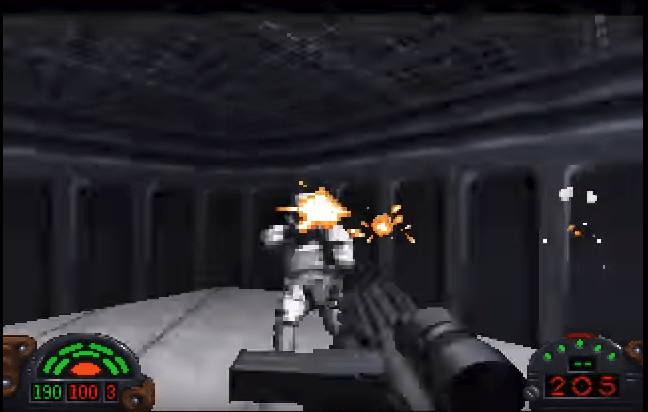
Besides the blandness in attitude, DF is a bland game to look at for the most part. It’s very muted, claustrophobic and blocky as hell. Whereas Doom, Blood or Duke work well enough to see past the bad graphics and basic controls, DF isn’t Star Wars enough or Doom enough to get past how bloodlessly derivative it is. It tries to be Star Wars, giving us digitised clips from the movies, but once we’re past the kind of cut scenes that make you want to replay Monkey Island, its back to FPS-lite; it feels designed by someone who’s played Doom, but didn’t get Doom. By not being SW or Doom, it winds up being a bit nothing, trading on my memories of Star Wars as a kid – if it had set on a 1970s carpet it would have been a classic.

The series isn’t off to the best start and while I wasn’t expecting much, I expected more than this. Up next though is where things got real. Like FMV real.
Thankfully, DF was a huge success and Lucasarts listened to the fan feedback, dumping the Doom-cloning and let the series find its own voice. Dark Forces II: Jedi Knight (1997) gave us what we wanted and FMV, which we didn’t. Fantastic in principle, Full Motion Video was intended to side-step the still basic graphics of the era, replace them with real actors. It was shocking, like 80s 3D bad and the problems weren’t just down to how they worked within video games – the budget, acting and scenes were classic Acorn Antiques; nowadays actors are used to being convincing during a greenscreen scene but back then, their lack of faith was disturbing. No even Lucasarts could crack it and it drains most of the drama when you’re watching actors looking slightly off-centre.
Our villain, Dark Jedi Jerec (who would be chewing scenery if there were any) murdered Kyle’s Pa while searching for the lost Valley of the Jedi, hoping it’ll imbue him with enough force power to kickstart the Empire (while Dark Forces was pre-Star Wars, the Jedi Knight series was Post-Jedi, no idea what Kyle got up to during those years). Kyle discovers he has force powers and must balance his new-found abilities with his desire for revenge.
JK is actually a cracking FPS. Way better than I remembered. I’d avoided it in favour of Jedi Outcast on replays, but I missed out. The first third is largely battling the extras from the Mos Eisley cantina, and no longer constrained by DF’s flat maze-runs, the levels are complex, with a huge amount of height and depth – scum and villainy are everywhere, alongside peaceful NCPs. We’re running through cities, cantinas, space-ports, warehouses; then later racing across parapets while tie-bombers take off, dealing with Stormtroopers, Officers, Interrogation and Probe droids in Imperial Bases with patrolling AT-ST. Some areas do drag, like Kyle’s family home which is largely platforming while being harassed by giant mozzies, and later levels aboard a Star Destroyer fall into linear run n’ gun, but for the most part, JKDFII is exactly what we want from a SW shooter – it’s perfectly balanced, ramping up the difficultly yet maintains the sheer fun of being in Star Wars. It’s great how purely exciting a twenty-year-old game can still be; CoD WWII takes up an eye-watering 90gb of disk space; JK is … 730mb and it’s 100 times a more enthralling, involving experience; volumetric dynamic shading whatevers don’t matter when you have a trusty blaster at your side, kid. And we had more than that this time.
The biggest change is the lightsaber. While it makes short work of the stormtroopers you are leaving yourself open; Kyle can deflect the occasional laser bolt but getting close enough to a Stormtrooper to cut him down usually means sacrificing your shield and since they’re rarely alone, it’s a dangerous tactic. Realistically, the saber is only for Jerec’s mini bosses and you’ll need more than a Lightsaber to take them out. You need the patience of a Yoda.

After a FMV cutscene hyping the mini-boss, we’re into a stand-off; who can button-mash the most. It’s not quite the balletic parry-riposte you’d hope for, besting the Dark Jedi is luck – but in my experience there’s no such thing as luck. Just a lot of reloading. But they’re all pretty cool opponents, using force powers as well as sabers and a standout is a MasterBlaster-like duo that’s harder than fighting with the blast shield down. Alongside the lightsaber, the force powers are also a little clunky; you have to chose to use force jump for example, but it’s not long before you’re force choking Stormtroopers, pulling their weapons away or shoving them about. Of course, all the fun stuff comes at a price.
Using dark Jedi powers increases your leaning toward the Dark side while not attacking NCPs and using light side powers keeps things Light. It’s a well done dynamic and the dark side is indeed quicker, easier. It’s inevitable that the more destructive powers are the ones you use the most, this is a shooter after all – no one’s going to use the Jedi mindtrick when you have force lightning at your fingertips and to be fair, the game focuses more on the consciously good/bad things Kyle does to decide if you’re Luke or Anakin. A meter at the end of each level tells you which way Kyle is leaning but no hint what caused it; it a really nice way of leaving it up to you to figure out.

For all its the distracting FMV panto, basic force use, wonky Lightsaber and age, you’re completely swept up in Kyle’s vengeance vs becoming a Jedi. When his choice comes, it’s Kyle’s not yours and the repercussions are pretty extreme; it’s worth a replay just to see how good/bad Kyle gets. It may look old and creaky, but all this bickering is pointless; JKDFII is a classic, and even better than I remembered.
Not long after JK, Lucasarts released Mysteries of the Sith (1998). The first quarter follows Kyle, now training fan favourite Mara Jade. When Kyle disappears while investigating a new Dark Side threat, Mara abandons her Jedi chores and sets out to discover her teacher’s fate.

I only played MotS once, having nicked it off a mate who nicked it back. But now I realise I should have bought it (Or hidden my mate’s copy better); MotS is a great, tightly-wound little Add-On and as much fun as JKDFII. It’s the same build and look but the best thing is what’s missing – no FMV this time. Instead, Kyle and co are animated and while it really shows the game’s age, MotS is cleaner and more detailed than JKDFII.
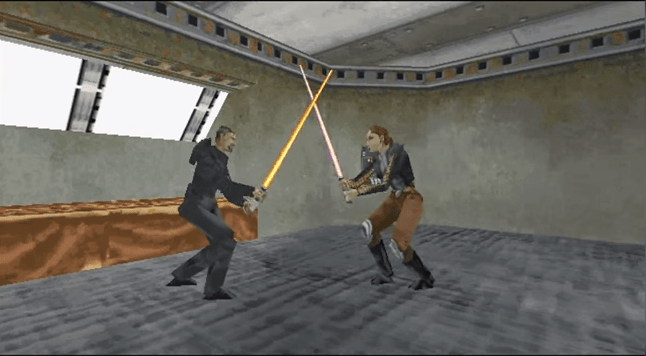
Mara gains additional weapons, including one that fires Carbonite with mixed results and a sniper scope, and she faces off against more nerfherders than Kyle did, including a Rancor. She has essentially the same Lightsaber and Force abilities and they’re more critical this time, but not a light vs dark path which is a shame; Mara originated in the Zahn series as an Empire Spec Ops looking to avenge the Emperor so she’d have been perfect for Dark side swaying.
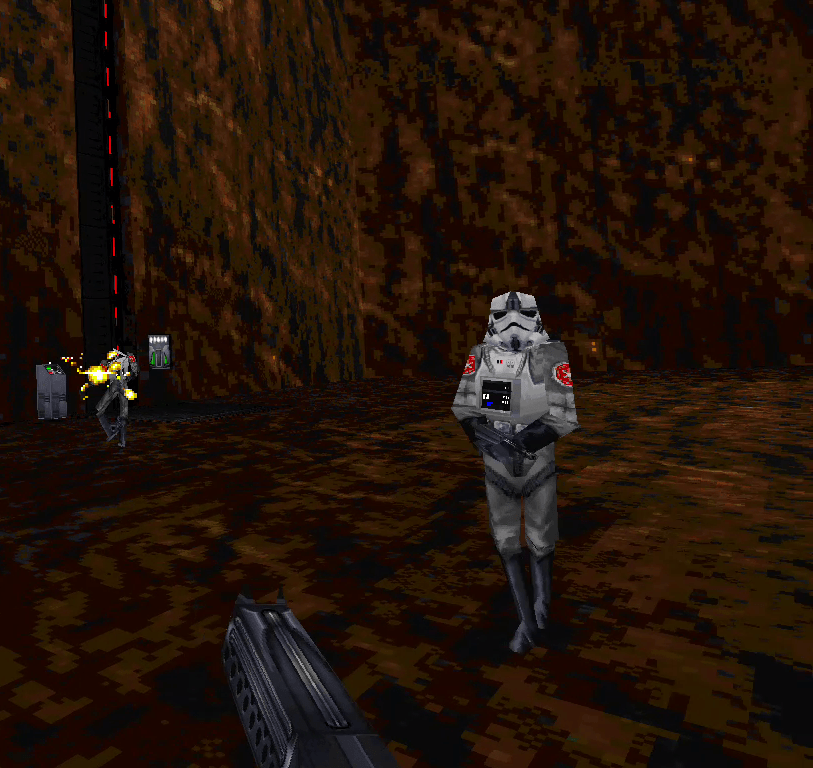
One random thing that stops MotS being brilliant is the feet-tapping. It wasn’t this noticeable in JKDFII but it seems Kyle and Mara have a one-foot stride and wear tap-shoes. All you can hear is ‘tippy tappy tippy tappy’ and it’s so distracting I constantly jumped to avoid their feet on the floor – but instead you get ‘guh, huh, gah’ every leap; even when drowning they’re being dramatic, choking is a gurgle mixed with swallowing followed by throat clearing. Audio annoyances aside, MotS is a solid if dated game and there’s more than a few well-pitched levels – including a series-standout where Mara faces herself in a Dagobah-style greatest fear test. MotS can sit comfortably alongside the main games, not just as an Add-On. I’m really happy to honestly own MotS, it’s a great little game.

Star Wars Jedi Knight II: Jedi Outcast (2002)
The gloves were off with Outcast. Before I even load it up I’m excited, refusing to even consider it might not have aged well or not be as good as I remember. This is one of my all-time greats. Come on Kyle old buddy, don’t let me down.
Kyle has renounced the Jedi way and returned to his Han Solo cosplaying, doing Senate odd-jobs with pilot-pal Jan. They uncover a new Empire-like force, the Remnant led by an ex-Empire General, Fyyar and a very evil Dark Jedi called Desann – a huge Komodo dragon looking dude who was a student of Luke’s before he turned to the Dark side. Desann and Fyyar have amassed an army but it’s not just the usual Stormtroopers and folks who like to party at Jabbas. Desann found a way to infuse people with the force, turning them into Dark Jedi – as well as force and saber-resistant Troopers. Great. Picked a hell of a day to give up Jedi-ing Kyle. Somewhat repeating JKDFII’s plot, Desann’s acts force Kyle to rediscover his Jedi faith and set him off on a personal mission to take the lizard down.

JO is one of the best FPS, best Star Wars adventures, one of the best games of all time. And that’s not just the force talking. Once Kyle’s force powers are high enough he auto-deflects basic attacks, and there’s just something so cool about swaggering along flinging laser bolts back at hapless Stormtroopers like it’s nothing. The force powers are refined and intuitive, and Kyle quickly becomes an absolute badass Jedi Knight, to the point you barely use your blaster. Using force grip, pushing stormtroopers off cliffs, directing your Lightsaber, flinging force-lightning about, it’s great. Stormtroopers are quick off the draw and they’re coming at you from all angles, keeping you on your now quiet toes, and when a Dark Jedi gets thrown into the mix, it’s a furious battle. You can pull weapons away from Troopers but whereas in JKDFII they would stand around, in JO they either surrender or take off running; they’ll even recover fallen weapons.
The level design is detailed and complex, and on occasion we’re helped by Luke and Lando in extended cameos, plus we even get to stomp troopers with an AT-ST. It really is thrilling stuff, but it’s not all fanboy beauty; battling the Dark Jedi and the Dark Troopers is more of a bind that I recall, and my Jedi training still seems to consist of frantic mashing. But it’s worth it with the Dark Jedi, who are all arrogant and excited about killing a Jedi; their slow-mo death scenes are very satisfying as is pushing them off a cliff mid-taunt.

The biggest surprise is the lack of light-dark options. I thought that was a constant, but like MotS, Kyle is a straight-shooter throughout. While Luke bangs on about Kyle being driven by hate (and he cheated by stopping by JK’s Valley of the Jedi to superpower his force ability), as well as Kyle’s acts being deliberately manipulated by Desann, there’s no slow lean toward the Light or Dark. Other disappointments include the story starting to fall into fairly standard Star Wars sequel territory (ex-military/sith looking to restart the Empire; the bread-and-butter of all post Return of the Jedi stories) and it’s very similar to MotS but still, JO is an absolute joy to play, one of those great early to mid-Noughties games like Max Payne 2, FEAR and NOLF that got everything right. I actually preferred JK for the story, but JO has the Jedi stuff down perfect. JO isn’t just a great Star Wars game, it’s a great game period. I am a Jedi.
Star Wars Jedi Academy (2003)
Jedi Academy is perhaps the bravest of the Dark Forces series. It relegated Kyle to sidekick NCP and sent us all the way back to the beginning, as a Padawan learner.

Enroute to Luke’s Jedi Academy, we pick our gender and species, what they look like, even what kind of Saber they have. The only thing you can’t change is the name – I’m a unisex Jaden. There’s no back story to Jaden, and although she’s the first Padawan to have built her own Lightsaber, it’s all left unspoken. Given the light/dark moral choice is sort-of back, guess this is to let you decide on her background, and what kind of Jedi she’ll grow up to be.
How we reach that moment is a departure too. Rather than a constant story, we’re given a choice of self-contained Jedi odd-jobs – do enough and you unlock a story mission, like a fenced in free-roamer. This time, the Dark side is The Disciples of Ragnos, a dark Jedi cult somehow draining power from Force-sensitive places (maybe they got the idea from JK and JO …) The chores are a Star Wars geek’s bucket list; helping Chewie escape a lockdown on Tatooine, exploring Hoth while battling Wampas and riding Tauntauns, investigating a Sand Crawler (including Jawas; utinni! Which means Wow, I just found out. Thanks Wookieepedia), helping Wedge take out a Bespin-like gas mine, a speeder-bike run, face off Boba Fett, distracting a Rancor so it’s ‘game’ can escape, repairing your ship while avoiding a Graboid, and a standout mission where you battle on top of an out-of-control train rocketing through skyscrapers. There’s even a mission to Vader’s weekend retreat; an acid-rain hellhole where Darth stewed in peace. He even had a statue of himself in the lounge, the narcissistic emo.
If there’s a downside, JA is JO reskinned. The story is starting to feel very reheated while the look and level layout is the same. Force powers are roughly the same too, but they’re a lot more powerful; fully powering up lightning can clear an entire room while grip means Dark Jedi are flung willy-nilly. Enemies are largely the same as in JO, but there’s some Super-Jedi that take a beating and they’re all good fun to battle with.
The biggest and best change though is Jaden herself; wickedly acrobatic, she leaps, somersaults and backflips through fights; I force jumped across an exploding bridge then electrocuted two dark Jedi off a cliff; ran up a wall, backflipped over a stormtrooper then cut him to pieces in slo-mo; I roll and stab, do leaping swings down on villains, sliding sabre tackles cutting them off at the knees (and hands, in a nice little movie nod) – JA is pure Jedi wish-fulfilment and the saber is equally awesome to use. You have three different attack styles and they do seem to make a difference; best thing though, Jaden has three types of sabers to pick from – the standard single sabre which maximises ability, two sabres which looks incredibly cool and the Darth Maul staff. The Dark Jedi have the same abilities, and use them effectively; choking is a favourite of theirs, but they never fling you off a cliff. That’s unsportsmanlike even for a Sith.
Although we’ve been nagged at by both Luke and Kyle for favouring the Dark side (again, I’m not going to use Mind Trick when I can force choke a Dark Jedi and drop him off a bridge), the Light vs Dark path hasn’t really shown itself during the game; instead, after a sudden but inevitable betrayal we’re given a moral choice. Unlike JK where my acts dictate if I fall to the Dark side, I just have the choice to calm my anger or let rip. It’s a bit of a letdown, but you barely have time to grumble because the final quarter is a near-endless battle with Dark Jedi and a huge, bordering on unfair final boss. Two bosses, if the betraying NCP pissed you off and you went Dark side on their ass.

JK is another classic. The short missions do make it feel a bit less epic and the main mission is too familiar, but JK is even more of a fanboy game than JO and all the better for it. If JO made me feel like a Jedi, then like Yoda JA makes me feel.
It’s time for the Jedi to end. Just like Jedi Knight span off from Dark Forces, Jedi Academy could have span off into a whole another series of Padawns being sent on adventures, but it was not to be. But at least the series ended on a high note. Kyle is one of those Legend characters that fans adore – there was outrage he didn’t appear in Rogue One and that says a lot about how much those games mean to the Star Wars fans.

The Dark Forces series still stands as one of my faves – it may have begun as a clone but it carved its own path and each is worth a replay; despite the wobbly FMV, Jedi Knight wins it, as it’s closer to Star Wars than the others, especially with the light vs dark plot. But Jedi Outcast and Jedi Academy are the adventures we imagined while lying on the carpet surrounded by toys; you can’t play them and not feel like you’re IN Star Wars. Even if the reheated storyline makes you feel like you’re in VII-VIII. Maybe pass on Dark Forces, but the force is strong with the Jedi series still. Those are the games you’re looking for.
Dark Forces (1995) | Jedi Knight Dark Forces II (1997) | Mysteries of the Sith (1998)

Developer, LucasArts | Publisher, LucasArts

Platforms; Win, PS

Jedi Knight II Jedi Outcast (2002) | Jedi Knight Jedi Academy (2003)

Developer, Raven Software | Publisher LucasArts/Activision

Platforms; Win, XBox
Doom’s Clones & Killers – Pt3

FBT survived Doom and Hailed the Build engine, baby. With Quake first on the list, is FBT’s quest to find the Doom Killer at an end? (Clue; there’s a part four)

Part Three: and I don’t love Jesus

It’s 1996, and- shut up, TFI Friday’s on. I can’t hear it over all your zigazig-ha’ing. And doesn’t Tony Blair seem nice? When we weren’t distracted by Loaded Magazine or giggling at Viz, we were cheering Cocker ruining Michael Jackson’s Earth Song at the BRITs and watching Oasis make history at Knebworth. Twice. We fell in love with the Spice Girls (well, their Say You’ll Be There video) and cried when Gabby left Big Breakfast. And cried again as mums kept buying Robson & Jerome singles. Just get back on Solider Solider. Or was it London’s Burning? We had Trainspotting, The Girlie Show, Dennis Pennis, Katie Puckrik in Pyjama party, Bizarre magazine, Kate Moss was Heroin Chic and amidst all this creativity and change the only Clone was Dolly the sheep?! Who, weirdly, has a twitter account (@dollyat20) and we still hadn’t had a Doom Killer, now three years old. The only FPS game to gain any momentum wasn’t found in your local Our Price, it was at the bottom of cereal packets. id had gone on a licensing frenzy, milking the Doom engine before it became obsolete and Chex Quest turned the best game of the decade into a commercial for a breakfast cereal and copies are still traded today.
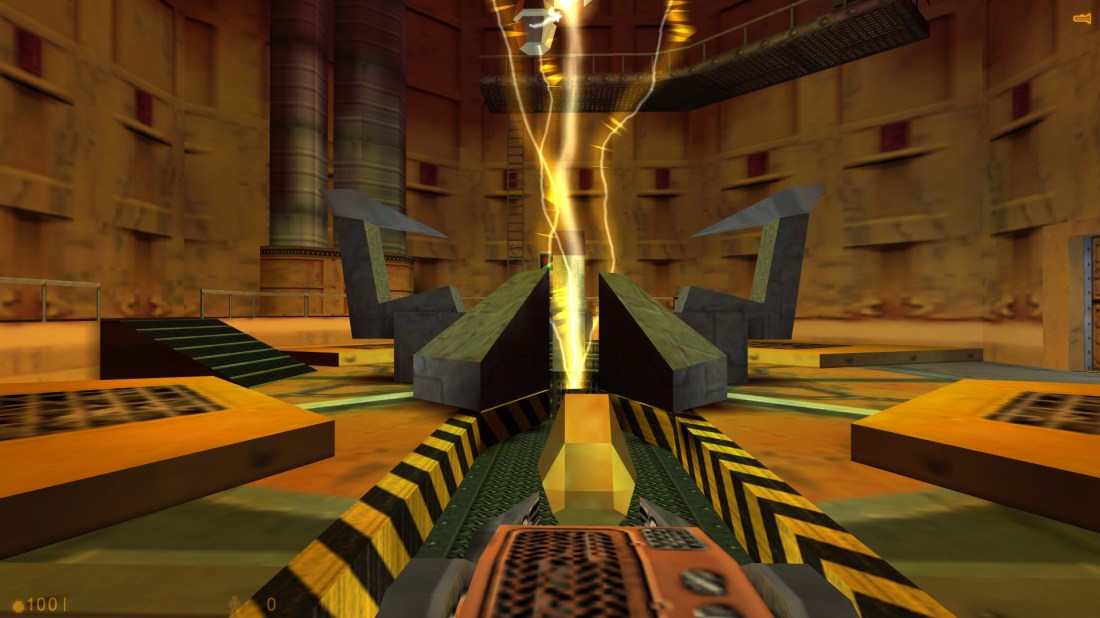
Finally, in June 1996 we had something that kept us up so late we missed breakfast. I disliked Quake intensely on release – all the technological achievements were lost on me; I didn’t care about polygons and 3D, I wanted – expected, demanded – the shock and awe of Doom. Only id could do that, reclaim the FPS mantle after so many clones but to me, their return felt clinical and clean – It might have been a giant leap for game engines but it was small step for shooters; Quake was half the game Doom was.

When I restart Quake with a massive clip on my shoulder, I realise it is a thing of beauty. After all those minimal pixels, the similar environments, Quake is incredible, nothing short of genius at work. You can’t exist in this world and go back to Doom and think it’s better. But then, after a few hours play … I was right the first time. Quake is so polished, so perfect, so boring. You never feel like you won a level, that you pulled off a fast-one, a lucky streak, dragged a bloodied Doomguy to the exit hoping the next level has health at the start.

There’s four different worlds to fight through, but that’s not as refreshing as it might seem. It creates a disconnect – Doom had no real plot but you descended deeper into hell as you went, whereas four different worlds feels like starting over and over, relearning the world. It’s four mini-games not one epic gun-fest. The creatures move in realistic ways, the weapons are more varied and the world is full of stuff but you’re never really there. Quake feels at arms-length; Doom reached through the monitor and grabbed you by the scruff.

A key element to Doom was that feeling you were outnumbered, that you weren’t going to survive this; Quake may not have been able to replicate that original experience but it could easily have bettered the against-the-odds, breathless victory you got after beating a Cyberdemon. Quake is Blink-182 to Doom’s The Pistols; I don’t see how it’s considered one of the most influential games of all time. The Quake engine yes, but not the experience. Yet again I find new appreciation for what Doom did.

Quake didn’t kill Doom, it killed the single player. Quake’s multiplayer was an undeniable quantum leap – towards Single Player missions being little more than a five-hour tutorial for the online experience. There’s nothing wrong with Multiplayer – clearly that’s what id thought, given Quake III was MP only and it was done right in Quake – but Single Player was compromised. This is where the rot set in.

Meanwhile, genres other than FPS were stepping up their games. The Elder Scrolls proved they weren’t just a dungeon crawler with Daggerfall while Tomb Raider kicked off in October of ’96. If Doom was the King then the Queen was Lara Croft, easily the most iconic image of 90s gaming – but it didn’t change things in the way it should; we didn’t see a sudden shift to female leads, women treated any more equally or non-sexually in games. For all of Tomb Raider’s advancements it was Lara’s pixelated adolescent dream-figure that everyone remembered. 1996 also saw the beginning of the Resident Evil series and some company called Valve. It was a hell of a digital year, and what was FPS up to? Chasing a pig called Bessie. What, you too nervous about Y2K to build games?

I remember mucking about in Redneck Rampage (April 1997) and not really getting it; two brothers looking for their pig, stolen by aliens who have cloned their neighbours? Now I’m rescuing a pig? How far are those Doom Clones going to push their luck? Back then I found it too silly, sacked it off as undermining a genre that was just starting to get interesting. But after the deathly dullness of Quake, when I load up RR and hear a ‘yeehaw’ I think ‘Let’s do this’.

The opening level, where you cross a road while avoiding a car zipping around running over chickens, gives you an idea of what you’re up against and while I watch the car I get shotgunned by a Bubba in overalls screeching something in Redneck. I start again, trying to work out where the Redneck came from, and get run over. Man, being a redneck is hard.

Soon though, I get my eye in – which isn’t easy as RR is set at night and the blocky graphics of Build are grating after Quake’s smoothness, but there’s something to RR I hadn’t previously got wind of (not the fart-o-meter) – actual fun; we had Duke’s bluster, but otherwise FPS is a very serious affair; what we needed was pure nutso insanity and that’s what RR is; out of nowhere I discover a game I didn’t expect – a really good one. What in tarnation? I’m yeehawing like a good ol’boy.

There’s loads going on, to look at, to press and break, and instead of regular level layout we’re stumbling through farms, shacks, grain stores and trailers – it isn’t nonlinear but there’s a nice open world feel to it, something Duke also touched on and a further step from Doom’s corridors – later levels start to feel familiar once you’re in the towns but it maintains a quirky feel; a little unhinged level-design is refreshing and the enemies – classic rednecks alongside the aliens, including a dominatrix are great fun. Take heed RotT, this is how you do daft.
There’s the in-jokes too, and not all are aimed at the redneck caricature; while we’re somewhere between Deliverance and The Beverley Hillbillies, there’s a poster for a Troma movie, references to the artists on the soundtrack and typical alien tropes like crop circles and cows being mutilated – and tons of deep-south wisecracking from the heroes and the rednecks you gun down. The weapons are typical but there’s some homemade, jury-rigged backwoods style changes to the usual line-up, while a new trick is the burp and fart meters. Not exactly classy but they’re a fun way to add a penalty to using health powerups – drinking gets you drunk and impossible to control, eating makes you fart, giving you away. Redneck is really starting to stand out as something else; you can call it a hillbilly Duke but I’m having fun ya varmint – but not too much; it’s a subtly strong game, a lot more unforgiving than earlier FPS. Its psychobilly soundtrack (‘You Can’t Kill Me’ by Mojo Nixon is a standout as is Beat Farmers’ ‘Gettin’ Drunk’, proper psychobilly stuff not yer Cotton’Eye Joe, although now I have that stuck in my head) adds a new level too – instead of Doom’s dirge you merrily sing-along, to the point you don’t end a level ‘till the song’s finished. And you end levels by finding your dozy bro and clobbering him with a crowbar … it’s great to have a hero who instead of being heroic, complains ‘Ma head hurts, ma feet stank and I don’t love Jesus’.

You get the sense developers Xatrix had fun and it’s infectious – Saints Row and Borderlands owe RR a nod; it paved the way for the ridiculous to slip into shooters. It had sequels but RR was perhaps too silly to be remembered; I was equally guilty of dismissing it, but I missed out; open a can of whoopass and get ready to don’t love Jesus. It’s a great Doom-era shooter. Just remember those rednecks pack a punch; it’s not all banjo playing.

Redneck Rampage reminded me of another thing missing from modern games – extras. Games used to include entire Windows themes, screensavers, audio clips, pictures, all sorts. You just don’t get that kind of thing anymore, but I still have the ‘Cuss pack’ from RR; and now I have “I’m on you like flies on shee-it” as my ringtone.

Now, who want-a som Wang?

I recall Lo-Wang and Duke as buddies, equal in their abilities, including getting girls to show them their boobies. I’ve been looking forward to Shadow Warrior (May 1997) as I think I preferred Lo-Wang to Duke; he was a bit more mischievous, less Jock more Mock. SW was a straight-faced comedy, like a game based on some 1980s Ninja flick from Cannon Films. An Asian character – the kind created by a bunch of people who are not Asian – Lo-Wang revels in the innuendo of his name and doesn’t take anything seriously. Even when his old boss, Zilla, sends hordes of underworld forces to stop him, LW still treats it all like shit and giggles.

Much like Duke, Lo-Wang inhabits a world that’s fast leaving Doomguy’s behind – Build’s interactivity is at the fore in SW; LW can find repair kits to chug around in tanks, forklifts and boats, there’s puzzles and secrets that require some figuring out and he can muck about with little RC cars – we’re in the world more than ever before. It’s interesting that Quake far exceeds Build in terms of capability and environment, but SW just feels alive, immersive. The art design, which is Japanese influenced is detailed and like DN3D there’s loads going on. But Shadow Warrior starts to wear thin and one of the most important parts, one I previously loved, is to blame – Lo-Wang. Once he gets tiring, the game does. When he’s not making groan-worthy jokes about his name/manhood, he’s commenting on everything – ‘ohhh sticky bomb likes you’, ‘You are tiny grasshopper’, ‘You move like-a pregnant yak’ – he just goes on and on; an Eraser-inspired railgun is ruined by LW saying ‘you got Erased’ Every. Single. Time. And when he’s not commentating, he’s making Bruce Lee noises or giggling to himself. Super-health comes in the form of Chinese fortune cookies, which are puns like ‘man who farts in church sits in his own pew’. Okay I sniggered too and after nothing but ‘Ger, gah, uuugh’ sounds from my heroes, I should be happy to have a Chatty-Cathy for company but Lo-Wang is sidekick elevated to annoying hero.

Shadow Warrior is a case of diminishing returns – this is from 3DR again and like Duke, level design isn’t their forte. There’s a lot in it but it doesn’t go anywhere; it’s too reliant on the novelties but whereas Duke saved DN3D, once Lo-Wang grates some misgivings start to creep in. 3DR just cloned Duke thinking that would be enough, amping up his juvenile antics but Lo-Wang perpetuates the Asian stereotype with his ‘Engrish’ accent, Fu-Manchu moustache and kung-fu bants, and his Duke-lite persona falls into misogyny; Lo-Wang just accosts random girls – ‘Lo Wang drop soap,’ he says to a girl he corners in a shower, ‘you bend over and get it’ or telling a girl mechanic ‘chicky, you tighten my nuts’ – Plus, the girls all seem to love his attention, including one he interrupts on the toilet. In one secret area he comes across Sailor Moon on a bed – and asks ‘peaches’ if she’d consider Mooning him. Dick. Duke had an old spice swagger that justified his ladykiller ways and, politically correct or not, he paid strippers for a flash in a strip club; he didn’t sleaze.

I haven’t been this disappointed since my Tamagotchi died. I’m saddened Lo-Wang turned out to be Lo-rent, but it really is the weakest of the ‘Big Four’ Build games; and it’s 3DR’s fault again. They should have just licensed the Build engine and left the design to those who knew what they were doing. It bleeds the Build engine dry, making SW the most interactive, touchy-feely (Sailor’s Moon aside) game so far. But the only one really enjoying himself is Lo-Wang.

Stand back ladies and gents, we’re about to play the game that, if asked, I would have accused of killing Doom. Blood (May 1997) was the last notable game on the Build engine. Because nothing could top it, obviously. Blood’s Caleb was the Snake Plisskin of the gaming world; pissed-off, dangerous and with a singular purpose. He was awesome – the bleaker, darker anti-hero of the era who sounded a bit unhinged, muttering Evil Dead references and singing Frank Sinatra as he killed indiscriminately. I’ve been looking forward to this. Don’t let me down Caleb.

Blood has something all the others didn’t – a reason. This is where FPS actually got a story, a motive to maim your way to the end; The CGI opening sets the scene in a horribly morbid and cool way; Caleb, a brutal wild-west killer-for-hire was initiated into a dark cabal by his wife. Inexplicably, their dark god punishes them for some slight, and Caleb is buried alive after witnessing his beloved maimed by a demon. Escaping, Caleb goes on a rampage in the most imaginative levels we’ve blasted through so far.

One minute you’re in Camp Crystal Lake, the next fighting through a moving train, the mazes of the overlooked hotel, a fairground-circus, a remake of Dawn of the Dead; each level is a world we recognise from our VHS collection not Doom – Every other FPS you’d struggle to recognise one level from another if they were in a line-up; But Blood’s levels are all unique and fantastic to maim through. You never get bored in Blood – the story, level design, references, there’s so much going on yet it isn’t a distraction from some killer action; Blood is relentless, and the boss-fights for the first time are not OTT arena fights – they take some strategic foot-work and weapon-picking. The weapons too are nicely macabre – voodoo dolls, tommy-guns, his melee weapon is a pitchfork. When he lobbed dynamite with bloody results, Caleb cackles maniacally. Now that’s a hero sound, not Lo-Wang’s ehehehehe kid-being-tickled gurgle. Elsewhere Caleb’s rasping voice quotes everything from The Crow to a Harrison Ford The Fugitive/Air Force One mash-up … and he’s got sarcastic putdowns; upon finding a dead Duke Nukem, he double zings with ‘looks like I got time to play with you’ followed by ‘shake it baby’. If Shadow Warrior was an ill-conceived nod to Big Trouble in Little China, then this is John Carpenter’s The Thing with a nice sideline in They Live.

What is interesting though, is Blood’s story; something we’d not needed or wanted before. But Caleb had his reasons, and each episode ended with his avenging his wife and friends, headed towards a finale -with a god no less- only to leave empty-but-bloody-handed.

Of all the Build developers, Monolith is the one to really make the engine sing; sitting perfectly between SW’s novelty distractions and Duke’s outrageous set-pieces, Blood is brilliant and should be played just see how a shooter should work. Mindless killing and a mindful plot, it’s a perfectly balanced FPS and one of the best shooters of all time.

Blood didn’t kill Doom, the story-driver concept only really exists in the cutscenes and it still owes a debt to Doom but it provided that little edge as the endless blasting of FPS starts to get a little tiring. Blood is the first to seriously wound Doom.

There were Build games after Blood; TNT Team released Nam in July 1998, a reskin/mod of Duke with RotT-style scanned photos and flat environments. It did have some nice touches, like picking up orders from NCPs and having followers. Oddly, I didn’t see a heads-up display. But it had a semi-sequel in ’99, WWII GI. There was also Extreme Paintbrawl in 1998; let’s not talk about that. One thing to talk about though, is the argument that Build weakened the sincerity of FPS; that as soon as we were able to ask strippers to shake it baby, it became a battle of novelties and distractions; the visceral experience got watered down. I don’t think Build is to blame for that, indeed Blood’s bare-bones plotting makes it the best of the bunch – but 3DR were to blame; they just weren’t natural level designers like Romero – instead of using Build to enrich the Doom experience, they made theme parks; Romero raised level design to an art form, able to imagine not just the world, but you in it and then make it exciting to fight your way out. 3DR settled for boobs.

And that was it for Build, which really disappoints me; besides the technical marvels, Build games made you feel like anyone Kurt Russell played in the 80s; they were filled with refs to Evil Dead, John Carpenter, Sly & Arnie’s best 80s characters, even Elvira; so much was threaded through Build’s games that you felt as if the developers were mates; they were into what we were into – this was back when being a gamer was looked down on by Jocks and their new extreme sports like surfing on snow – Build let us know we weren’t alone. Build let us be heroes.

It’s a shame 3DR decided to spend all of their cash and good-will on the twelve-year development of Duke Nukem Forever; to piss away Duke Nukem was one (upsetting) thing, but to ignore what they’d achieved with Ken Silverman was unforgivable; just imagine what could have come next. Instead, Silverman stepped away from the gaming industry and became “CTO of Ardfry Imaging, responsible for the PNG Compression tool PNGOUT” which doesn’t sound like something Duke or Caleb would say. But I’m sure it’s had an effect on my digital life. He only made one engine, yet Silverman’s contribution was massive and it entertained and impacted beyond the games it powered; All hail the real king, baby.

So, Build was a shot across the bow, but no Doom-killing cigar. Onward. Maybe Elexis Sinclair has something to do with it. I’d better frisk her.

In Part Four of this increasingly indulgent look at the classic FPS era, FBT trades in his Portable CD player for a MP3, invents conspiracy theories to explain Doom’s death and spends most if the review trying to get in an Anna Nicole Smith reference.

#FPS #Shooter #blastfromthepast #playthrough #FBT #extendedplay #Doomera