Blood

A Blast from the Past review

FBT goes back to when FPS spoke to him on a spiritual, personal level. The weirdo.
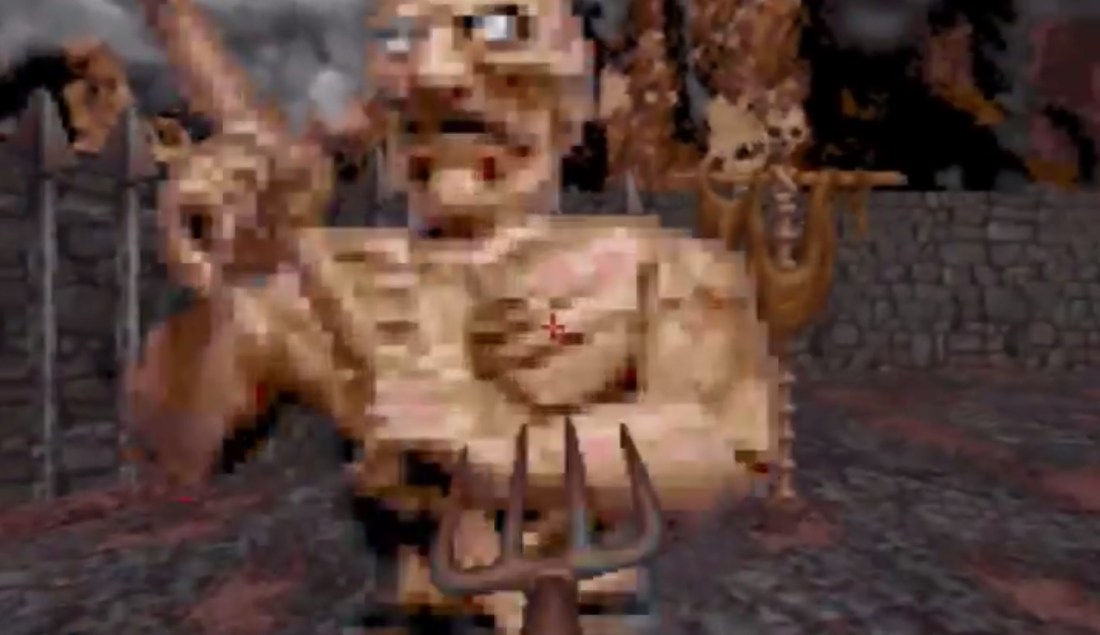
The Past

Should I ever get into a discussion about the best shooter from the “Post Doom – Pre Half Life” era I tend to turn the conversation bloody real quick. Folks go for Doom because it was a quantum leap; Doom wasn’t released; it was unleashed they cry, claiming it was the Jaws of the game world. They are right. But while Doom was gaming’s We’re Gonna Need A Bigger Boat moment, for me it was when I saw Elvira’s calendar in ‘Blood’ -the same calendar on the wall of my bedroom– and I knew, Blood and I got each other.

Like anyone else staggered by Doom’s release, I played everything and anything similar; Wolf3D, Duke, Shadow Warrior, RotT, Heretic, Dark Forces, Jedi Knight, Blake Stone, Redneck Rampage, Quake. I bought them, played them, loved them and eventually lost them. All but Blood; I still have the CD. It’s burnt into my memory so deeply that in my advanced years I may begin to confuse its levels with actual memories. That should make the old folks’ home interesting.

Thinking about it now, I recall that Blood was made up of everything I was into. Packed with references and nods to my VHS collection, my posters and film quotes, everything I thought was the coolest thing ever was in there. And, Blood had a plot. A real, on-screen story and reason why everyone in my eye-line had to go, not some vague background written in the manual. And Blood’s storyline was explored by an equally perfect lead character; Caleb, a wild-west era killer-for-hire who worshipped a Dark God which inexplicably has Caleb, his beloved wife and friends murdered for an unknown failing. Reborn (‘I live…again!’), Caleb was the perfect antihero to inhabit as I waded through a thousand bodies in a dark gothic setting, looking for revenge and reasons. Caleb wasn’t a jokey celebration of macho like Duke and he wasn’t just an arm like Doomguy; Caleb was every dubious hero you adored while watching straight-to-video films in those big puffy WB cases. He was Snake Plissken meets Eric Draven with a dash of Ash. Ultimately I loved Blood for its ‘soul’ despite Caleb not having one; It’s so fatalistic, the tone so foreboding it could have been a John Carpenter film. Blood is one of my best gaming experiences and I’d defend it with my boomstick. But I admit now, my love for Blood is based on it matching my bedroom walls, not it’s comparison to other shooters, its graphics or whether it’s actually any good. So, at the risk of losing a 20yr long argument (Blood is better than GoldenEye), time to see if Blood still courses through my veins.

Still a Blast?

The opening menu is satisfyingly gothic, blood drips down the screen and demos play, instantly taking me back. Okay so I ignore that it’s looking blocky, that maybe the menu is Doom Clone, but that’s no reason to mark it down. So far, so top ten.
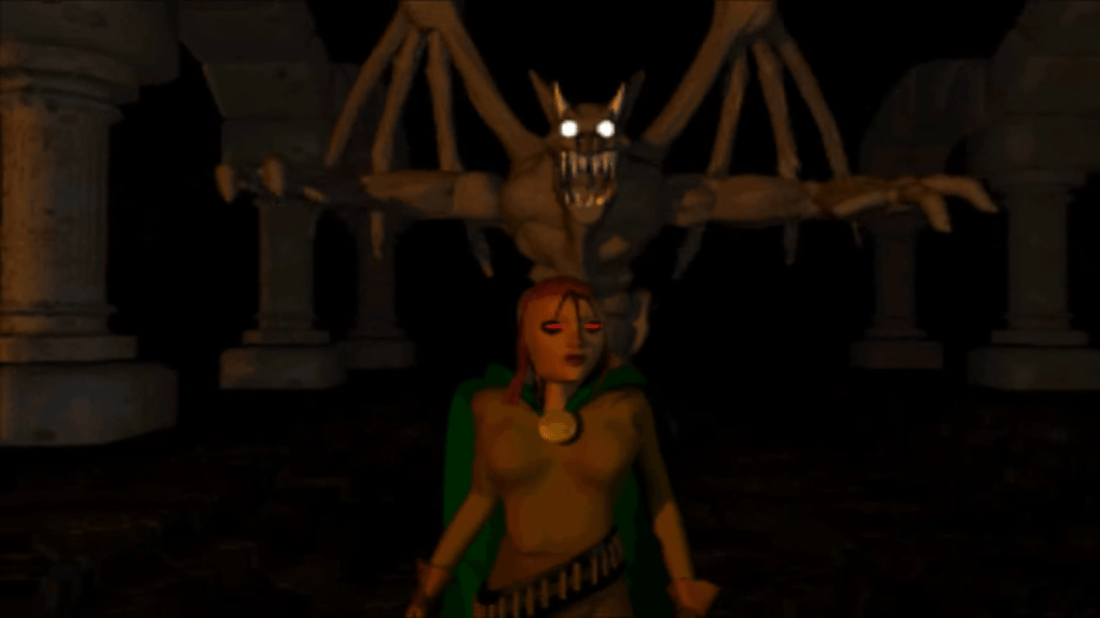
the guy she told you not to worry about

I kick into the level and … the opening cutscene. I watch Caleb, his wife and friends summoned by their dark god, talking through an acolyte who disintegrates as he speaks, seared apart by the power of his Lord’s voice. Which isn’t happy. Caleb demands to know what they’ve done to earn his ire, but he can only watch helplessly as his wife and friends are attacked by monstrous creatures and he is sealed alive in a grave. Now that’s an opening. There was nothing like this back then (or since). Okay so now it’s graphically on a par with that Dire Straits video about MTV but it’s bleak, gothic and I’m taken by it; It reinforces that it’s not graphics that make a game; Blood’s opening would have been as effective in any gaming age. When Caleb fails to reach his beloved before she’s taken away I’m moved. I have a reason to live… again.

I emerge from the ground armed with only a pitchfork and Army of Darkness quotes. The zombies come running and once it’s over I’ve forgotten I’m playing something 20yrs old. I had at them and the excitement, the frantic killing and the thrill are still there. Yes, I have problems with mouse doing the movement instead of looking but I soon get used to it. Sort of. I still lob Caleb off cliffs and into pits when subconsciously trying to look up but at least I can quick save.

What happened to quick saves? AutoSave in a shooter encourages you either play ultra-safe or to mow mindlessly hoping you reach one before being offed. You’re scared not by the game but of being respawned at a checkpoint miles away; it’s not a genius level design or a carefully constructed battle that bested me and it’s a lazy way to add tension. Worst of all, AutoSave icons spoil the moment – you just got told something bad is about to happen. Just add a quicksave and leave me to fire a rocket-launcher at point blank range cos I panicked and span the mouse wheel too quick, don’t punish me by making me trawl through all that crap again.

I’m seriously getting my ass kicked. My reload (thank you quicksave) is higher than my bodycount. I can’t keep blaming the mouse. Is it the game? Is it me, am I too old, is Blood something I can grumble about to kids of today telling them, hunched over the latest COD reskin that they don’t know how easy they have it? I just needed time to adjust, this era of shooters wasn’t as forgiving. I have less options, I can’t hide in tall grass or go invisible. And quickly I realise it’s all on me, I have to win this situation not manage it, and that’s actually really exciting, more exciting than any recent shooter that practically encourages cowardice. I just gotta shut up and man up.

Finally able to survive a level or two, it all comes back to me and lost in the world again, grinning like Caleb when he gets the shotgun (‘Good, bad, I’m the one with the gun’), I’ve got this. I’m enjoying this. It’s like meeting up with an old friend and instead of realising how far apart you’ve grown, you actually have a ton of fun and stuff to share.
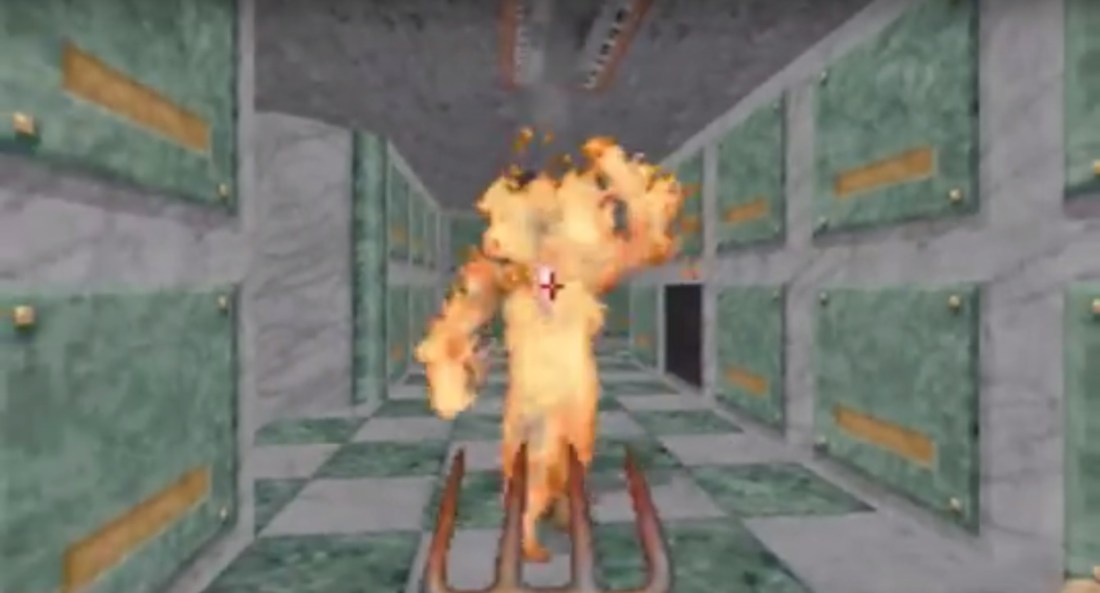
i ain't got nobody

Blood squeezes every drop out of the Build engine. The graphics aren’t hard on the eye; in fact they hold up incredibly well and I don’t feel like I’m playing an old game. Levels are cleverly constructed to draw you in and then spring a trap, they encourage exploration even when you know better; they reward and double-cross you in equal measure. Best of all, you always feel like you’re pushing forward and you’re getting somewhere rather than Doom’s drudge towards whatever. 20 yrs on and I’m still amazed at the sheer inventiveness of the locations; frozen mazes, moving trains, disused fairgrounds, Haunted Houses, Crystal Lake complete with the ki ki ki, ma ma ma sound in the woods, a Meat packing factory, it’s like playing through every horror film I watched when I was too young to watch them; Lovecraft, Poe, Tolkien and Sinatra refs are thrown in too. Modern games, better by every technical yardstick, don’t have this inventiveness. Why are modern games so samey? Within Blood’s levels, buried deep are multiple references to … well pretty much everything you ever thought was cool but your mum would have taken off you if she found it. But Blood doesn’t go for the Duke cheap shots. There’s no strippers who show their pixel-nipples for a dollar, In Blood you have to know your stuff; Dismembered hands scream “I’ll swallow your soul!”,
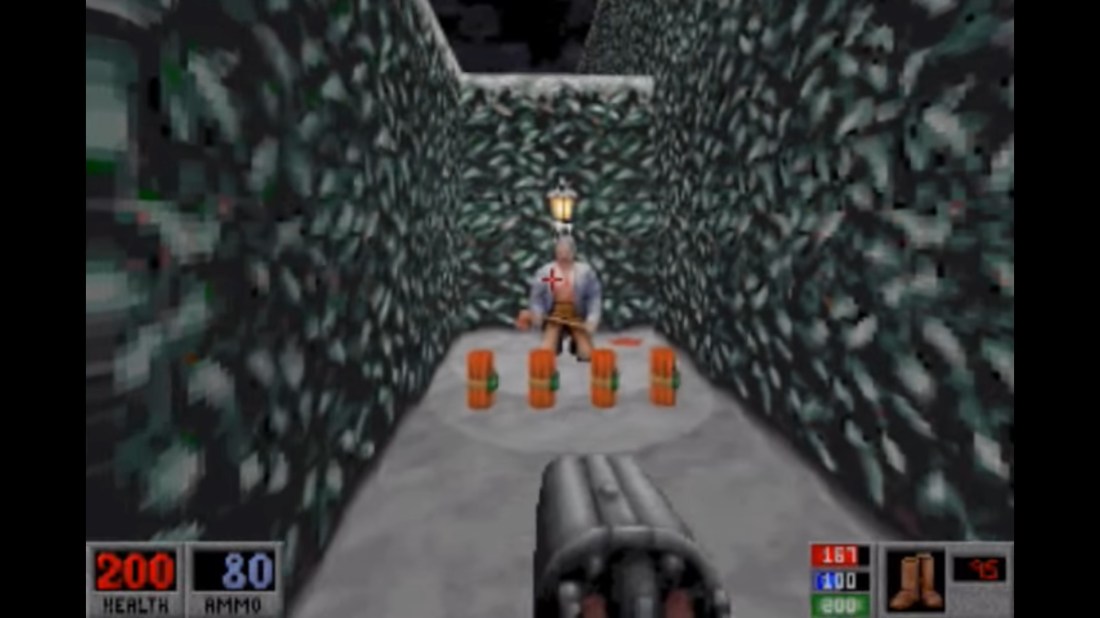
all work and no play...

Caleb growls “Son of a bitch must pay”, “Are you gonna just stand there and bleed?”, “Victims. Aren’t we all?”. There’s an orange jumpsuit with Kimble on it during the train level, a room filled with magic-tree air fresheners and a body strapped to a bed, a reference to the Flukeman. They are absolutely everywhere and 20yrs later they’re still gloriously retro and I’m still finding them; I heard a dog barking and Caleb muttered ‘Cujo?’ Blood was built for the kind of folks who’d get the zombie in a bath in room 237 of the Overlooked Hotel. Borderlands, Far Cry Blood Dragon and Saints Row owe Blood a debt and still didn’t do it as Rat Pack cool. And this attention to cool, in its clever locations and level design, its references and quotes go a long way to forgiving any of its graphical limitations, it’s playability or its age. Which I honestly don’t find confining.

Like all games of the era, the limitations of the engine also extended to the monsters and the weapons. The monsters head towards your muzzle with little more thought than zig-zagging and the weaponry is just a variation on Doom’s, but they’re as inventive and macabre as you’d expect. A flare gun is a personal fave, just to clip a distant zombie and watch him burst into flames feet from you. There’s the bloody butcher lobbing cleavers, a tommy gun, the cultists mumbling what’s likely some film ref I’ve still not figured out, the voodoo doll. And the zombies with heads you can kick off. Still fun. It’s a shame games grew up, COD could do with some kickable heads and have shooters really progressed any further than dressing up Doom’s gameplay anyway? When they do try something different, we moan about it. We still want to run and gun. That’s what we’re here for and when I battle in Blood I’m having a better experience than most recent games because it gets me; it’s as much fun as freak.
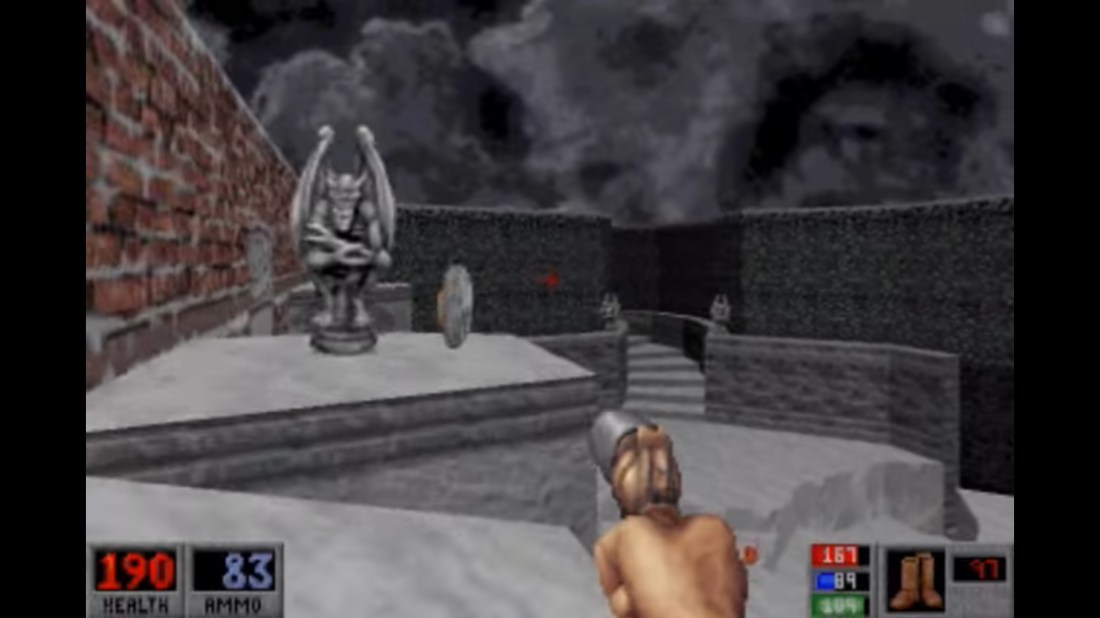
it's stone, it's stone, it's stone

The level design is way above Blood’s peers too. I’d forgotten how much your survival and fun depended on using the environment – which can’t be trusted. The haunted house has some great secret passageways letting you get the jump on creatures waiting in rooms, but the ghosts found there screech and scare you back into the open; Outside, jumping into swimming pools or lakes to escape gunfire is not always a good idea – there’s often a gill monster thing lurking and worse, it can get out the water to chase you, so you just added to the monster count. Clambering on top of buildings keeps you out of range but watch those stone gargoyles … Blood is not for cowards. It’s for explorers ready for a fight. I found myself exhilarated the entire time and when I’d cleared a level, I’d happily wander taking in the style and the references. It’s not lost anything and anyone who grew up on today’s shooters would find this more rewarding an experience if they could see past the graphic limitations.

So involved was I, that when I finally reached the Dark God and demanded a reason for all this, I was speaking alongside Caleb; and the answer didn’t disappoint. Neither did our response. The mystery solved, my wife sadly avenged and the day saved, the game was played and I am no less a Blood fan than I was 20yrs ago. Quite possibly more so because it showed me how placid and safe shooters have become. Once in the zone I forgot it’s age; it’s exciting and so engrossing you don’t care the world isn’t photo-realistic.

Subtly subversive and rewarding, there’s few games even now that can offer Blood’s depth and that transcends any advancements the genre has made; against its peers, Blood still reigns down; Doom has not aged well, Duke is best remembered and not replayed, and the others? I can’t remember what Quake was about at all. Technology may have improved immeasurably, but mo-cap and pseudo-moral choices don’t hold a candle to a game that gets you. Blood still gets me, and it still sits proudly in my top ten.
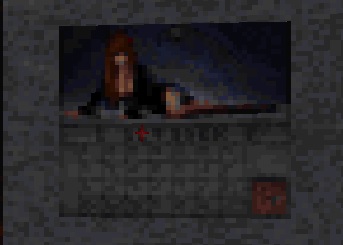
Elvira. Still got it

Spoiler alert, aka that ending.

I remember the ending being hysterical. Like a real Snake Plissken exit. But this time something different struck me. Call it age, over analysis, maybe I’ve become used to moral choices and my actions having an impact but Blood’s finale was dark. Really dark; even for a shooter, which usually ends with the hero’s murderous mayhem at least justified. I remembered Caleb, having killed the God (He kills a god!), walking into the night victorious; the lone hero. But now, in my later years, I see a man who leaves with nothing; his faith shattered and the society he belonged to gone, Caleb is left with no friends and no future – all by his own hand. Other heroes got their reward; Duke and his babes for example. Calab got nothing but blood on him. So far, so dramatic. But then, his work done, he outright murders someone; someone innocent who was thanking him for their liberation. Games don’t portray real bastards generally. Indifferent maybe, narcissistic perhaps, but typical anti-heroes on the side of right if not the law, sitting comfortably in the ‘he’s bad but they’re worse’ camp. What actually shocked me was the realisation I’d played Caleb just how he was. He was a murderer before and he’s a murderer still. So many games sit on a contradictory fence where the cutscene character is behaving one way, but me inhabiting them sure isn’t. They lament the murder, the horror, then let you take control to enjoy doing just that. You as the player ignore whatever’s troubling that cutscene character; I recall killing endless pedestrians from the outset in GTA SA, just to get some money. That’s not the behaviour of cutscene CJ who desires to rise above the mindless violence of the streets. I wasn’t true to him; your character may be a goody goody, but you aren’t and what caught me was Blood’s Caleb was as true as I was playing him – a cold murderous villain. He was who he was.

20 yrs on and Blood still had one impression left to make; The cutscenes did not justify or ignore the death I’d wrought, they showed Caleb intended to do exactly what I did. For all of Bioshock’s Rescue or Harvest, Mass Effect’s Paragon vs Renegade or whatever the hell Far Cry 4 was trying to say, I’d always do what was best for me the player, not me the character. But Blood knew both of us; it is a brilliant game.

1997 | Developer Monolith Productions | Publisher GT Interactive Software / Atari

Platform; Win
Painkiller

A Blast from the Past review

FBT relives a painful memory.

The Past

My memories of Painkiller are vague yet vibrant. It stayed with me somehow, despite playing once and never going back. I recall the best ‘melee’ weapon of any shooter (The eponymous weapon) as I fought through the lost and pissed off souls of Purgatory to re-join my wife in Heaven, assisted by none other than Eve, looking typically seductive. What really stuck with me, my first thought when I recalled Painkiller is endlessly battering baddies; that’s the point of any shooter, but it was such a consistent onslaught and not in a frenetic, frantic or exhilarating way. I remember them in their hundreds plodding towards me as I plodded towards them, Painkiller akimbo. I think I enjoyed it but didn’t want to be stuck in purgatory again.

Painkiller was released in 2004 – a big year for gaming, starting with Rockstar’s GTA San Andreas. It finally cracked what we’d been after since the beginning; an immersive shooter experience. Along with 2004’s other open world release, Far Cry, games that would have been traditionally linear shooters changed – Now we could choose how and when we shot it. Shooters began to absorb more Role-Playing tropes; xp, level ups, choices and side missions and eventually games like Borderlands became the modern shooter, only CoD laboured lineally on. Meanwhile, 2004’s Doom 3 had one thing going for it – it’s iDTech4 engine; Doom 3’s guts and GTA:SA’s heart meant games were going to get interesting again.

And in the middle of this revolution was Painkiller, in its own kind of purgatory. It’s ‘shut up and shoot’ approach seemed dated, a year too late like Daikatana or SiN, steamrolled by their contemporaries. But somehow Painkiller held on, kept coming like its monsters. A steady stream of add-ons, DLC, odd remakes, and a sequel – Painkiller was one of those games most gamers had played but didn’t really talk about, like living through ‘Nam.

So, my expectations for Painkiller are mixed. Would it play like a refreshingly clean game, a change to the overly complicated shooters of today? Why did I play it once and never go back?

Still a Blast?

Despite it being all about Hell, Purgatory, Regret, Loss and all that, I wasn’t prepared for how Gothic it is in here. An opening cut scene shows a car on the road at night, our hero Daniel (What kind of name is that for a hero? I’ll assume some biblical reference that I can’t be bothered to google) looking lovingly at his wife instead of the road and ploughing their car into a truck. She goes to Heaven while Daniel, in purgatory is left to his own device. The Painkiller. Easily one of my favourite Melee weapons, beating the Grav-Gun from HL2 or Duke’s foot, PK is a bladed fan that slices through enemies like one of those Dicers that cuts anything on a teleshopping channel. But wait, that’s not all! If you order now you’ll also get an alt fire that sends a tracer firing out creating a laser that eviscerates anything walking through it, while the tracer also grabs an enemy and pulls them towards the blades. Plus it can rip open anything destructible. It’s the multipurpose tool of any Purgatory survivor and one of those early weapons you keep going back to because it shakes things up a bit. I’m in a graveyard and looking forward to letting loose.

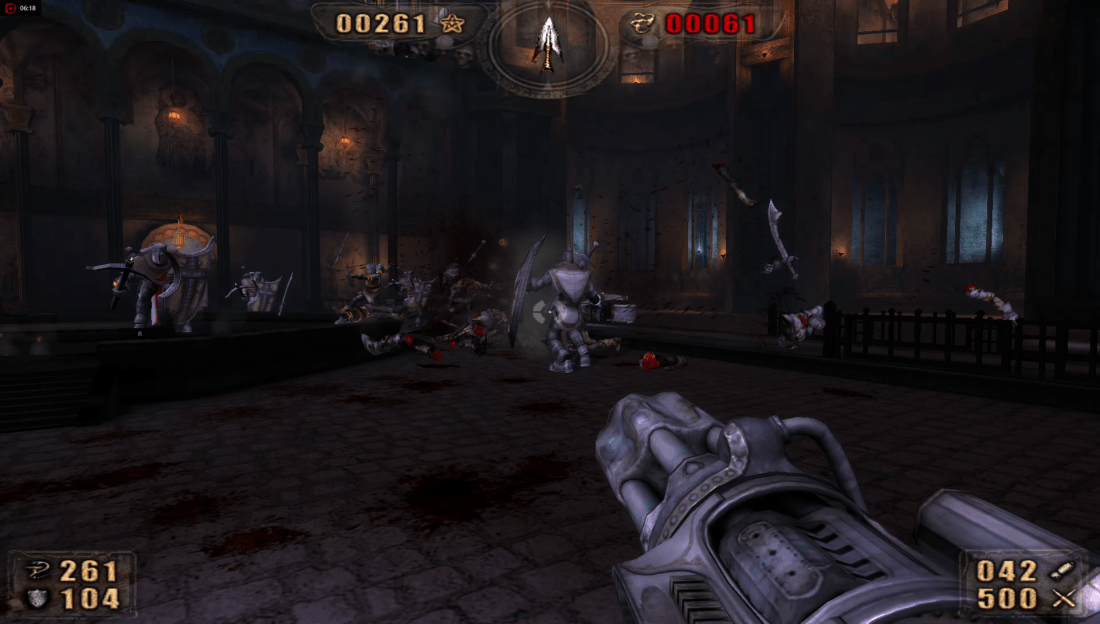
But two steps of exploration later and I’m battling through pretty much an endless roll-call of Gothic, horror nightmare-ish villains. Crone Witches, Skeletons in armour wielding swords. Fine, this is a shooter afterall and it’s a strong start. But after this happens two or three times, I sense a trend. For no real reason, I’m locked or forced into battles, trapping me into what really are mini arenas; walk into an area and a door locks and off I go, spinning and shotgunning until it opens again. I’m just corralled and set upon. But that’s what a shooter is surely? I justify this as Hell’s punishment for me, to eternally wander into firefights, fighting for my non-life. A dozen baddies pop up, I dispatch and continue. And keep doing it.

Eventually my smiting is over and the entire graveyard smote, my stats are revealed like a deathmatch game and on we go. For levels and levels I repeat this until Eve appears, who along with an angel (who looks like the keyboardist from a ‘80s Swedish pop band) explain Lucifer is on the march to claim Heaven via Purgatory and all I have to do to join my wife is stop him. That’s … big. That’s a big boss battle, the devil. And then it’s back to killing groups in areas in levels, with no real sense of moving forward, of getting anywhere because each level is it’s own part of Purgatory – that makes sense thematically, it just doesn’t work narratively, when in the game itself. When I die I expect it to ask me to insert more coins.

Painkiller is schizophrenic. The cutscenes do all the telling, I do all the shooting. They could be different games if it wasn’t for the backgrounds. Sure, that’s the basic structure of any FPS, but the stages, the stats completely remove me from any personal involvement. I just wander looking for traps to spring waiting for the exit to open. I have no investment; This feels like a bot-controlled deathmatch, like I have no friends to play with online. There’s no story elements to the parts I control, no reveals, no curiosity to be had. Just shoot.

Daniel, in a pleather jacket and frowny face, doesn’t seem too concerned about it. He’s like a Max Payne knock-off. Had Daniel been a bit more of a Maxalike, constantly doubting himself in-game, it could have been interesting but once you’re back in control, Daniel is silent (except for those annoying ‘huh, haa, oof’ noises first person heroes used to make every time they jumped.); All the apprehension and seemingly unwinnable situation carefully woven into the cutscene’s narrative is swept aside in favour of literally hundreds of creatures who take the quickest route towards Painkiller’s blades. Zero AI, zero challenge. All I got from this was RSI from clicking fire. You could mod the backgrounds into anything (Serious Sam springs to mind) and it would have no effect on your experience; Your purpose is to clear out the baddies and start the next battle.

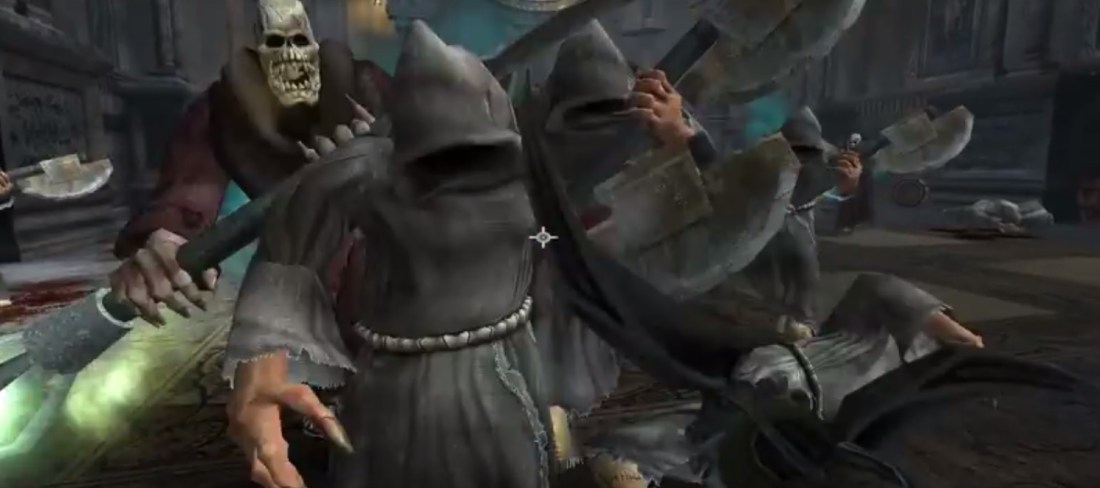
To look at, it’s a thing of beauty. Each level is a master-class in art design and different to the next. Every possible gothic and nightmarish location is explored and it’s done so well – you’re maiming through huge cathedrals where robed figures lob axes, blazing medieval villages under attack from witches on broomsticks, a mental institution where tortured patients still strapped to their electro-shock equipment scream, medieval castles with Executioners. Later levels reflect WW1. It drips with death and despair and that’s what is so anger-inducing; none of the surroundings are reflected in the experience. Purgatory is full of decrepit and wasted places inhabited by victims siding with the Devil in the hopes he’ll lead them to Heaven yet you’re just holding down the shoot button in arena battles. If it felt like you were pushing forward, that you were progressing through the story not a level it would be perfect. Painkiller should work, it should be full of a creeping sense of unease as I hesitantly explore the underworld knowing I’ll have to face off with the devil at some point. But I make no connection, I have no war-stories to tell, no anecdotes of lucky/clever fighting on my part or the baddies, no narrative moments while I’m in control; I don’t personally achieve anything except unlock the exit and my experience would be identical to any other gamer’s.

And it gets more frustrating. Each new level removes your previous ammo and armour disconnecting you from the narrative – It’s Unreal Tournament in a Haunted House; It’s easy to see why PK was chosen as the first World Cyber-Athelete game. Chasing after souls to invoke ‘devil mode’, juggling coin out of dead bodies to unlock one-use power-ups just add to the disconnect; Daniel should be Max Payne, the levels should show me clawing my way back to my wife, I should want to get through this but I just maim until I get to see Eve again in her barely there outfit; I don’t blame Adam for making a mess of things. Painkiller is essentially an arcade game while the cut-scene story is an animated Divine Comedy. Just watch it on YouTube.

2004 | Developer People Can Fly | Publisher DreamCatcher Interactive

Platforms; Win | XBox

Star Trek Elite Force

A Blast from the Past review

FBT goes boldly where no gamer has gone before. To replay a Star Trek game.

The Past

One of my earliest memories is of my Mum turning off the Star Trek episode Arena ‘cos the Gorn scared me. From then, I was a trekkie. But I was never fussed about Star Trek gaming. Most were either adventure stories which I had (and still have) little patience for, strategic games (boring) or were terrible (That’s more my style). The only exception was the 25yr Anniversary Game, and since Star Trek is now 50 years old, I can’t bring myself to go that far back when rediscovering old games. The reason I got Elite Force in 2000 was because it was marketed as a shooter. And it had form – It was from Raven, who gave us Heretic and it’s built on idTech3, back then the best shooter engine around. That it was set in my favourite sci-fi universe was just a bonus. That it was set on Voyager was less of a bonus, being my least favourite trek (other than that one with the Quantum Leap guy but that series doesn’t count). I was stoked to let rip with a phaser.

I can’t recall much about the game now I come to think about it; I know I enjoyed it, but I’ve never really brought it up in gaming conversations and I don’t recall anyone else celebrating it either. Maybe that’s because 2000 had a lot to celebrate; Hitman, NOLF, Deus Ex, Diablo II and, ahem, Daikatana were released, not to mention all the great games knocking about before 2000 that were still resonating (Half Life, take a bow). Not even the marquee value of its namesake could keep Elite Force in gamers’ minds. Maybe gamers were just after something fresh, something they could call their own instead of a dad hand-me-down like Star Trek. To be fair it did well enough for a sequel but Elite Force is long forgotten. I’d completely forgotten about it myself until I went looking through my ‘probably won’t run in windows anymore’ box. It’s not even on Steam.

But, it’s Star Trek and it did run in windows. So, Make It So. No, that’s Captain Picard. I can’t remember if Janeaway had any catchphrases. I recall she loved coffee, and that’s good enough for me. Make It Strong.

Still a Blast?

My first surprise is the menu. It animates like one of the computer screens on the show and it has the ship’s computer voice. It actually has a mildly nostalgic effect on me. Not for Star Trek, but because the menu is immediately involving. Games now go for that minimalist look with their menus, a sleek typeface and nothing of what you’re getting into. But for a time, games wanted you in the zone from the get-go and the menu was part of the world; Medal of Honor Allied Assault’s menu was a radio-set in a bunker; that reboot was all black background and white text. How does that orientate me into the game world? Remember when Doom’s exit choices would goad you into sticking around? The new one doesn’t, it just asks if you’re sure you want to exit (Yes, I am sure). Menus were part of the experience.

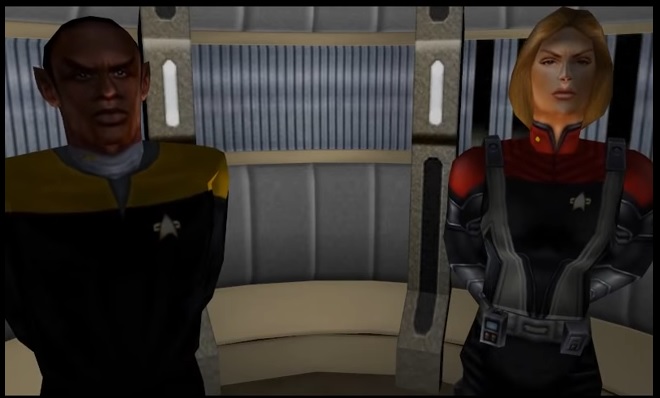
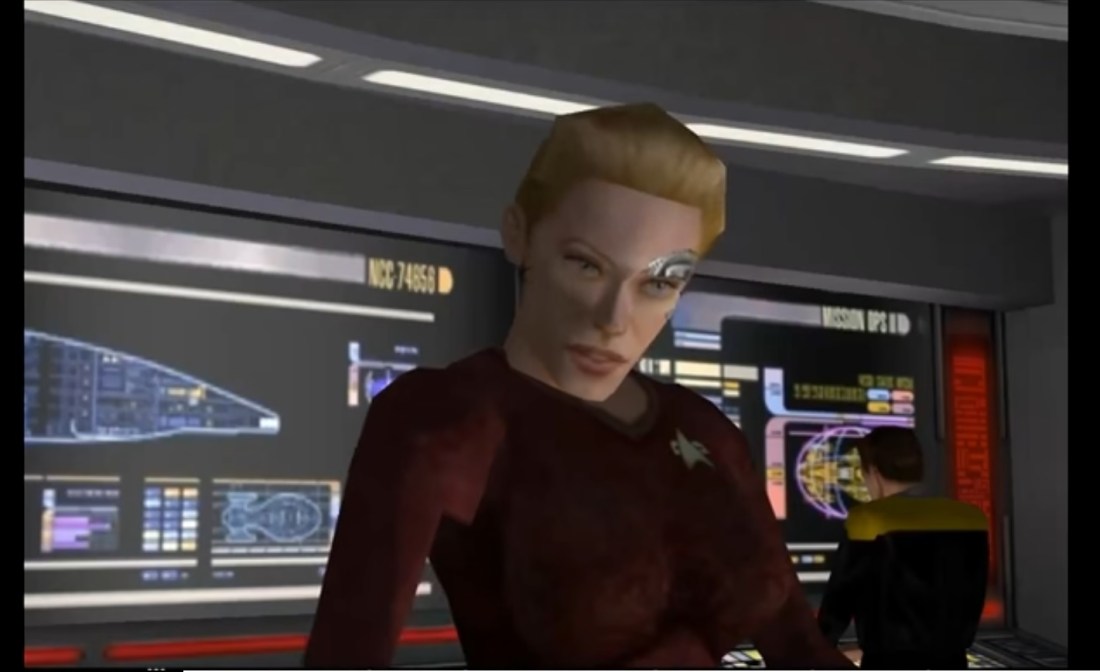
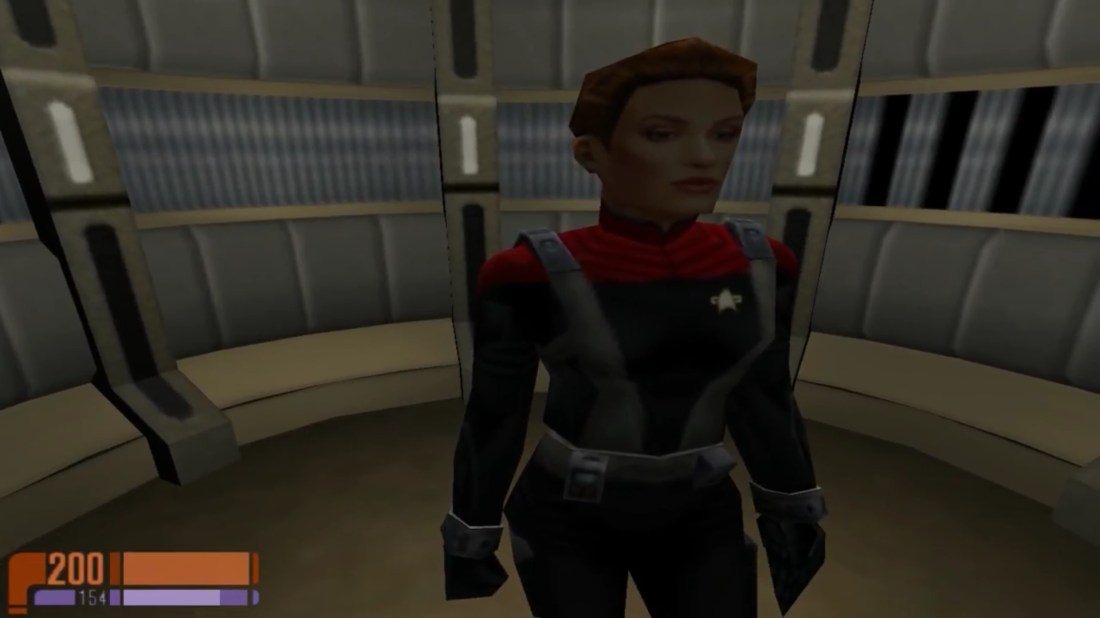
The cut scenes look adorably 2000; the external shots of the ship and space are CG animation and everyone’s got that scanned in face stretched across a box look. But it’s the real actor’s faces, Seven of Nine is still hot and rather than thinking this is too old to enjoy, I’m happily going along with it. It’s an old game but no less involving for it. Reporting for duty, stretchy-face Janeway.

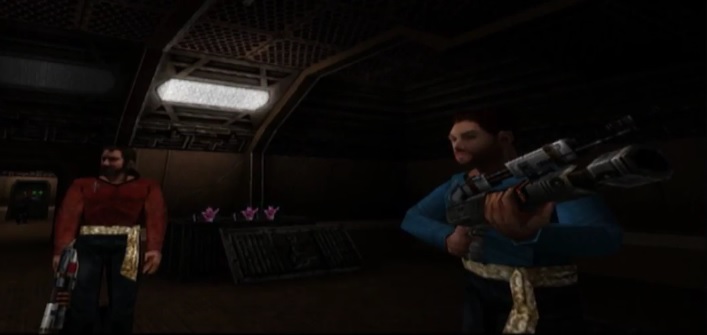
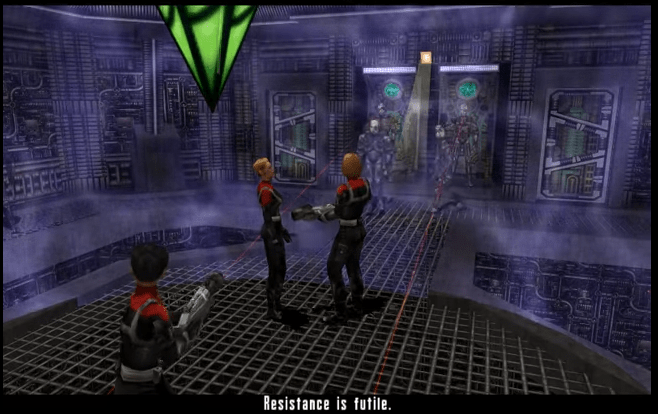
So after a quick captain’s log, I’m wandering about a borg cube. While it does look a little Quake 2, movement is fine, the death animations are great and it’s thrilling for a trekkie and challenging for a shooter fan. The interiors of the ship look great and the borg are menacing. Taking their design style from the First Contact movie, they look Hellraiser-ish and have laser sights and make grabs as you pass, aiming to assimilate you once they get past your armour and health. Oddly, both Health and Armour are repowered by single health points dotted about, essentially giving me 200 health since amour gets whittled down first. Nevermind, turns out I need it, this is an unforgiving game in terms of hit damage. I’m really into it, and I’m resisting a resistance is futile comment.

Playing merrily away, I realise the mechanics of shooters really hasn’t changed in over a decade and a half. I spin through a choice of weapons, jump and duck, shoot and get shot, figure out how to unlock doors, get past some obstacle, take mildly non-linear routes to a goal. The only difference between now and here is the pixel count and that doesn’t matter when the game keeps you busy and involved. There’s lots of mini cutscenes during missions that reinforce what we’re up to, chatter between me and the rest of the team and mission parameters update and change regularly; I realise that structurally, it’s set like an episode of the show. This is great!

It’s not so great for Voyager though – unexpectedly transported to a graveyard of derelict ships, some malevolent force with a Reaver-looking ship is intending to turn Voyager into scrap. Well, guess who’s up for stopping it. Me. Or rather, she. Elite Force was the first game I remember playing where I could chose the sex of my arm (Being a FPS, the gun wielding forearm was all you saw save for the cutscenes). Games which allowed a gender choice back then usually plumped for ‘female; faster but weaker’ while Males were stronger but slower. But here the Trek world, everyone is equally capable. What doesn’t make me feel so good is the Elite Force of the title were some kind of Special Ops Red Shirts. Anyway, via an adorably dated cut-scene, we escape the immediate threat and Janeway sets us Spec-Ops Red Shirts up to go sniff around the other derelicts to find what we need to get out of this place before the Reavers are back.

Once free of the cut-scene, I can take a wander about the ship. This is new. Most shooters stick to cut-scene, shooting-scene, but here I’m on my own recognisance until I get called to a mission or breifing. The ship looks good and is well rendered, although I spend most of my time lost. Rather than feeling like padding it’s actually nice to take a break and get a sense of what I’m defending. Later as the story progresses, missions take place on board and you feel invested in protecting it, your home. You get to meet other crew members, hang out in your own quarters or the canteen, get ordered off the bridge, mess about in the holodeck and even develop a relationship with a fellow Red Shirt, Telsia (who consistently gets shot, kidnapped and in-the-way when you try to get through doors). Our flirting is likely down to the male version of my Red Shirt being the default, but regardless it’s amazing to consider a gay relationship in a game this old, with no commentary on it either. Considering how the game industry has portrayed – let alone treated – women through the years, not to mention an almost zero LGBT presence except for titillation, this is a nice moment; we have a cute little relationship to explore as Telsia warms to me and suggests places we can meet to talk more privately. If only I didn’t keep getting lost and forgetting where she is. When I finally found her I busted out my best moves and she told me to get lost. I assumed I’d missed our moment until I realised it wasn’t Telsia, just a similar looking NPC. Telsia was on the other side of the canteen. It’s disappointing then, that in Elite Force 2 a female option is no more. It regresses back to standard cis heroic male (with whom Telsia continues flirting, and likely getting stuck in doors with). So much for progress.

The structure of the game really does mirror an episode of the show and it makes it so much more involving. There’s plot, drama, action, problems to solve, retrospective moments and characterisation – much of which is on your say-so as you wander the ship, fix things and interact, influencing the way NPCs behave. It’s still basic, this is no Mass Effect but in some ways I feel ME owes EF at least a nod. If you swapped Voyager for the Normandy and Telsia for Ash. Or Liara, or Miranda or Tali, Jack or … Just the same. Anyway, point is I hadn’t appreciated the depth or subtlety in Elite Force. It really tried to be something more than a straight shooter although as a shooter EF works well; the weapons are varied and actually work with different baddies rather than lazily getting bigger/outrageous/unuseable the further you get. You can also choose a weapon loadout ranging from just a Phaser to going Commando (I mean like the scene in Commando where he tools up). Plus you’re often shooting trek badguys too. The Klingons, the borg plus a few Voyager villains and some created for the game. They use typical group or cover tactics but rarely miss; run and gun will get you Redshirted quick.

The missions are well paced and much like the show, you’re rarely alone; Elite Force crew accompany you. Aside from Telsia’s headstrong habit of trying to get through doors first, they’re handy to have around. They work well, fight well and are quite chatty, talking about the mission, past events, how they’re feeling about things. It’s nice to not to play the lone gun-woman and their prattling keeps it all tied together. They’re often key to progressing too, splitting up to recon or hack doors, or if Telsia’s involved, triggering a firefight or setting off a trap. You become protective of them, they’re not cannon fodder. If one dies, another NCP doesn’t just beam in and your team is down by one – and mourned by all. This comrade-connection extends to the periods of R&R aboard the ship and several main characters in the game are the TV show’s background or recurring characters – you often overhear comments or references to episodes or trek events. All of this would go over the non-pointy ears of non-trek fans but for those in the know, it’s a lovely touch.
The devs also keep each mission memorable. There’s a great plot twist during a borg mission where you walk into a trap (Telsia…) and instead of assimilation it was a set-up to blackmail you into finishing off an old adversary of theirs from the series. It’s a nice little nod tying it into the show but from a gaming perspective, suddenly you’re span off into a new situation and there’s a different tone to the mission.

One level in particular stands out, for its trek references and great level design; on a recon mission, Redshirt realises the space station they’re on is actually the fused together wreckage of different species’ ships where they co-exist in their own areas with an uneasy truce. It’s a great location and environment. We have a sneak mission past the Klingons who bitch about the untrustworthy humans. Humans? We sneak on, and enter a strangely familiar ship. It’s the original series! But not as we know it, Jim. This is the alternate universe from the classic series episode Mirror, Mirror. There’s no mention, no reference and it has no bearing on the story but it’s a brilliant touch and I had loads of fun walking in and out of the doors to hear that woosh sound. No Telisa to get in the way thankfully – because she’d been kidnapped. The level ends on a cameo (and boss firefight) with a well-regarded species from Voyager too. It’s a great level.

Finally, our hero, our Redshirt, Alex progresses too. Beginning as a hothead disappointment and threatened with being cut from the team, she progresses to team leader by the final quarter, and it actually feels deserved. It’s a nice little character arc within a great storyline, set in a solid game. Plus as part of the command crew, I get to hang out with Seven. Just don’t tell Telsia.

As a retro game, Elite Force is great. Yes, it looks its age but that’s most evident in the blocky representation; It’s got a solid plot, adventure, characterisation and you get invested – You care that Voyager escapes. It’s a shame it was marketed with the line ‘set phasers to frag’ – that’s just going to piss everyone off, trekkies and trek-haters. But it’s a great shooter. There’s few games in this genre that can boast such a well-rounded and considered experience; For me, I’ve rediscovered a rival to Half-Life and that’s not just the Trek talking. I am very happy that Elite Force isn’t going back to the ‘wont run in windows’ box and it won’t be forgotten so quickly. Least there were no Gorns this time around.

2000 | Developer Raven Software | Publisher Activision

Genre FPS, Sci-Fi

Platforms; Win, PS2

Road Rash

a Blast from the Past review

For saying FBT claims he hates racing games, here’s another one he won’t shut up about.

The Past

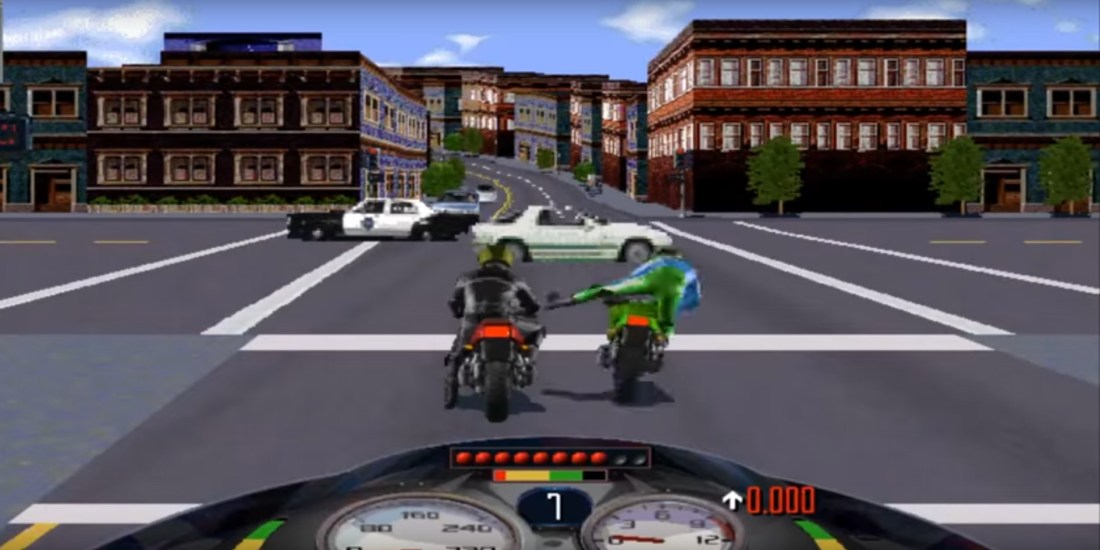
Ahh, Road Rash. RR was basically the DGAF of racing games back in the 90s. Before mayhem had to have repercussions, games like RR quietly got on with being really unethical for fun’s sake. You were one of eight or so bikers competing in illegal street races, but this wasn’t cannonball run with some friendly joshing mid trip, there was no Captain Chaos to help; RR contestants hated each other. If you got too close, they’d give you a kick or a punch to send you off and that was if they were being nice. Chains and pipes would often come into play, while CHiPs on Riceburners would clobber you with truncheons and arrest you after you fell off. And it wasn’t just the racers you had to contend with. The tracks which wound their way through close-quarter city streets and open highways were chock-a-block with cars, pedestrians (which you could mow through at the risk of getting knocked off) and other obstacles. It was one of those games you played with mates not against them, all of you going nuts at the screen as you tried to survive a race let alone win it.

I’m going to be in for a rough ride – it’s 25yrs old and all my memories are of moments spent playing it not the game itself. I can’t remember a thing about it beyond crashing and laughing.

Still a Blast?

Yeah, this looks old even though it’s the updated CD version. But the menus are actually kinda cool, someone in the dev team must have got a trial version of that new-fangled Photoshop thingie, as all the screens are morphed and amusingly stretched faces to represent the riders while FMV cutscenes of bikes doing donuts and wheelies set the scene and in no way represent the gameplay.

I enter the bikers clubhouse, pick a race and chat to the other bikers who give comments and advice on how to race. It’s not interactive, they’re all pictures and text but there’s a sense of fun to it, like it knows it’s a joker. I pop into the bike shack and discover a ‘rat’ bike is the best I’ll afford for a while. The superbikes are way beyond my Bad MoFo wallet. Best get some races won then.

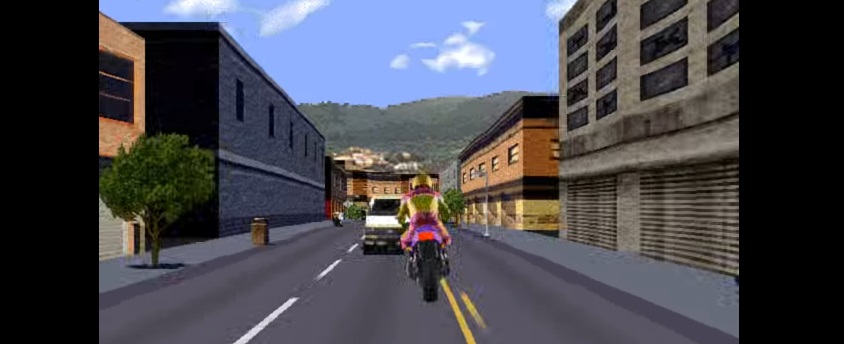
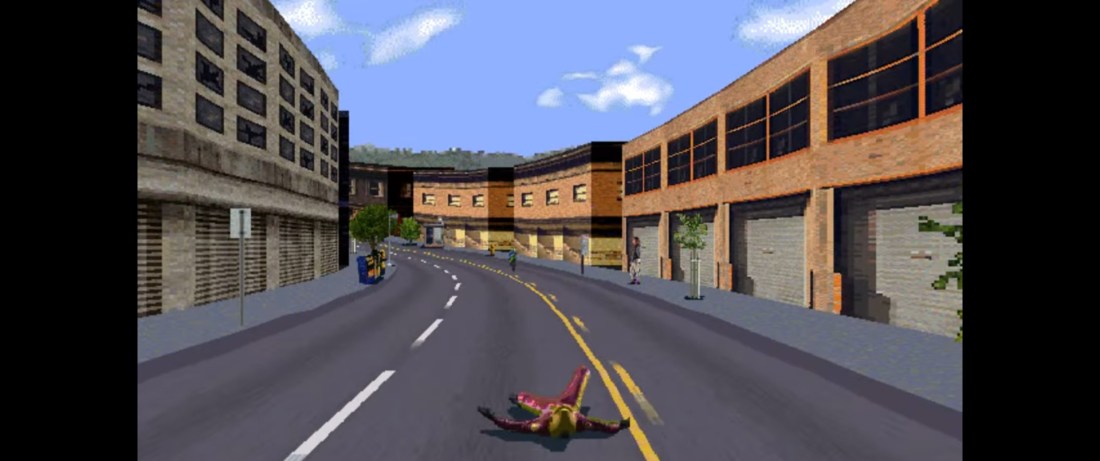
Lined up on the blocky road I see my character out ahead of me and the usual heads-up display. A tiny roar of engines and we’re off. And I’m off my bike already. Damn car came right at me. The controls are terrible; it’s largely left or right to get around obstacles that come towards you, a little like a rail-shooter, but I don’t know what else I was expecting.

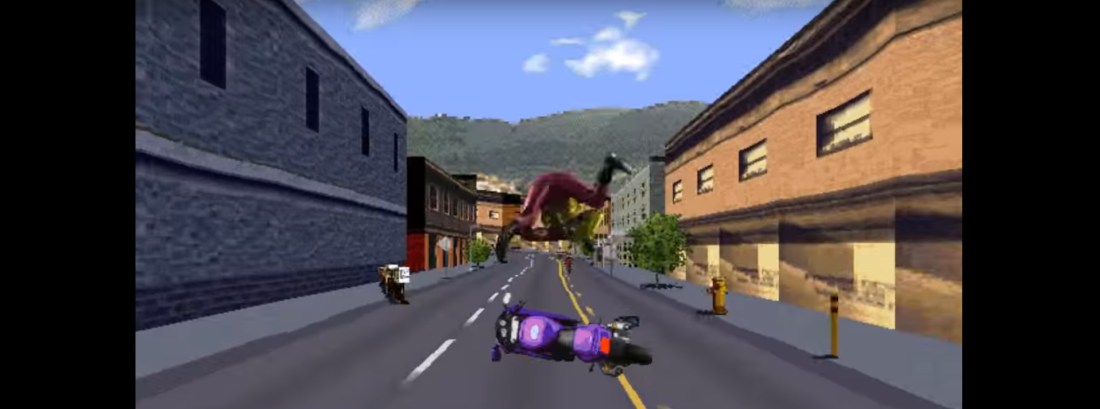
Back on the bike I race after my rivals and soon catch up and get my eye into it. You can’t really gauge distance or gaps and it moves at such a hectic pace staying on becomes the main source of excitement. Pedestrians hurry across the road and get splattered in a bloodless, basic way and make my bike bounce and I have to recover, but it’s easier than going around them; one touch too far and the bike takes a sharp turn and you’re off again. I do that a lot but always find it amusing. If he hits a car, the rider flies off for quite the distance or slides until a passing car stops him. Once recovered, the rider gets up and trots back to his fallen steed, sounding much like he’s wearing clogs. Another problem / amusement is he’s not very traffic-aware, so will simply run into passing cars or other bikes and get clobbered again. And again. Back on the bike I chase and catch up only to get kicked, punched and smacked with a pipe by my fellow bikers. I respond and fall off again. Kicking tends to throw off the balance when riding at 100miles an hour. But I persevere and amazingly I time a punch as someone swings a pipe and get it off him! Now armed, I take out several riders, watching them fall or go airborne then position myself to run them over as they clog back to their bikes. I also get brave enough to start aiming for pedestrians and timing kicks to send riders into passing cars. It’s mayhem and within seconds I’m off again and I’ve lost my pipe. Good while it lasted. I actually manage to finish Second and think that’s really not bad for a first time in two decades. I’m grinning at how mad that was, the hilarious ‘clonk’ sound the pipe made, the leather-bound punches and yells from riders I kicked, the screams from the pedestrians… It’s all in good sniggering fun. I wanna go again, and chose a longer race, find secret shortcuts and have a really good time being lawless, actively seeking out fights and folks to run over, caring less about winning. I even manage to take out Poncho during one race, kicking him into an approaching car. Such fun.

RR isn’t really a very good game, even for its time. It’s basic arcade level with digitised pictures for car sprites, pixelated messes for pedestrians and basic animation for the riders. The controls are terrible and the physics make no sense; I sent a rider off his bike and watched him sail into the distance until he disappeared. I’d forgotten about him until I saw him still running back for his bike (as in I swerved and ran him over) miles later. But the game really doesn’t care it’s not immersive or refined. That’s not its spirit, not what it’s trying to achieve. This is not a realistic depiction of bike racing or a game for winners, it’s for sinners. What RR wants to achieve is exactly what I’m doing now; Grinning like an idiot.

RR managed 6 games between 1991 and 2000 and there’s been unofficial/inspired-by reboots since, with Road Rage by Maximum Games and Road Redemption from Pixel Dash which was funded by Kickstarter (both 2017) showing it’s a popular underground franchise, and this the original was clearly aimed at the early console era when only one mate had a PS and everyone went ‘round for a laugh. It was the perfect beer and belly-laughs game where a controller would be passed around and everyone gets involved. It was a game for yelling at the screen, accusing it of cheating, watching your mates fail and creasing up at running over a granny.

RR is another one of those games waiting to be rediscovered but only if you discovered it originally, and are tired of moralistic criminal games (GTA5) – it’ll take you back to the time when flattening a granny was okay. For blocky, daft enjoyment, RR hasn’t aged – if you’re willing to go back to that age.

1991 | Developer Electronic Arts | Publisher Electronic Arts

Genre; Racing

Platforms;

Day of the Tentacle

A Blast from the Past review

Well, what possible harm could one insane, mutant tentacle do?

The Past

You can’t seriously call yourself a gamer if you’re yet to embark on a LucasArts adventure. Experimenting without fear of failure, the team behind Indiana Jones and the Last Crusade revolutionised DOS gaming back in the late 80s and early 90s, creating signature point-and-click titles that would go on to inspire generations of developers. George’s development arm wasn’t the flashiest, nor was it the wealthiest but it singlehandedly defined the Adventure genre of games producing expertly written comedy and highly addictive titles that had kids across the world breaking bedtime and gaming curfews for that extra fix. Be it taking down the Nazis, guiding a dead soul to the afterlife or solving crimes as a wacky Rabbit and Dog, the imaginative creators have always been ahead of the curve with their inventive plot ideas. While the classics are often nostalgically the best, I was determined to discover whether their adventure set across 400 years in the home of Fred, Ted, Red, Ved, Zed, Weird Ed and any other rhyming member of the Edison family would hold up as I had so sentimentally remembered; as the craziest and best of the lot.

Still a Blast?

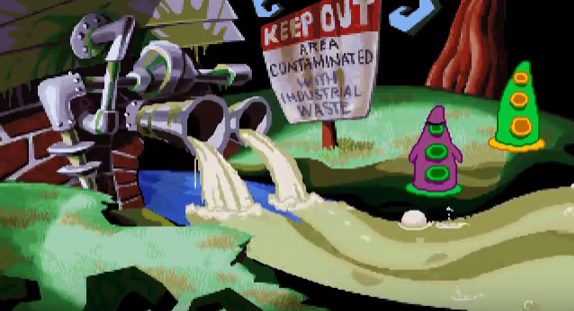
As the MIDI version of Ranz de Vaches from the William Tell Overture sounds irritatingly from my tinny inbuilt PC speaker, I’m greeted with a wonderful life lesson – Don’t drink water that’s been contaminated by industrial waste if you don’t want to turn evil and attempt to take over the world! Alas, Purple Tentacle (that’s right, the games antagonist is a life-size reptilian appendage of a violet blush) didn’t heed the written warnings and is now malevolently intent on enslaving all Earthlings.

While most heroes would crumble at the thought, our three stooge-protagonists are hapless in their pursuit of punishment and need no invite to stick their schnoz exactly where it isn’t wanted. So, when a pet hamster arrives at your door with a note for Bernard from his old pal Green Tentacle (Obviously, because Purple tentacle must have holier-than-thou a brother), nerdy Bernie misinterprets the note and believes Dr Fred is going to kill them both. As Bernard and his band of intellectually challenged helpers head back to the Mansion to save the tentacles from their impending doom, little do we know that Bernard’s act of heroism is about to right, royally balls everything up…

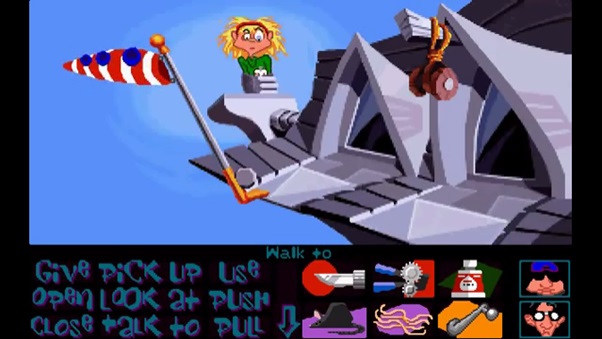
Daft opening cut scene aside, the game holds up well and there’s a real sense of familiarity in operating the point-and-click controls that were synonymous with adventure games in simpler times. While incredibly unsophisticated in style (text based options of Look At, Pick Up, Push etc…) the controls maintain a moderate level of complexity. There’s no modern-day cop-out of just pressing ‘X’ whenever you get near to an object of interest, instead you’ve got to choose your interaction. Millennials may hate it and at first even seasoned gamers might think this is going to get tedious very quickly, but after a while you realise this serves as an excellent vehicle for a major part of the games comedy. I mean, in the real world if you go to pull a door and it doesn’t open, would you just abandon it and walk away or would you try pushing it? In Day of the Tentacle (DoTT from here on out to save the R.S.I.), getting it wrong often rewards you with a condescending one-liner kin to “I’m pretty sure it doesn’t swing that way”, making you want to get more things wrong on purpose in future before you attempt to get it right.

Another aspect of the games controls that has aged very well is the character selection. Over 20 years before the “revolutionary” GTA V was released, we have an original switching mechanism that allows you to shift between 3 very different, insanely funny and unstable characters as you try to work together and get individual aspects of the job done. Prior to Trevor, Franklin and Michael, you have Hoagie the Metal-head, Bernard the computer nerd and Laverne the ditzy student and each are as hilariously stupid as their designs suggest.

After you’ve gotten used to the controls, had a wander around the foyer of Dr. Fred’s mansion and finally discovered the secret passage to the hidden laboratory, Bernard frees the tentacles and the mischievous Purple sets out to try and conquer the planet. Now, you might think there’s a very easy solution to this. Purple Tentacle is very slow, has T-Rex sized arms and no legs. So, we can just run after him, tie him up again and be done with it. Problem solved…. Right? Well no, because obviously the only logical way to fix this is to go back in time and turn off the Sludge O’Matic and stop Purple Tentacle from drinking the raw sewage in the first place. Not my preferred method, but I guess there wouldn’t be much of a game without it. Crazed inventor Dr. Fred has just the thing to help us bend the space and time continuum…

As Back to the Future had the iconic DeLorean and Bill & Ted had the distinguishable San Dimas Phone Booth, DoTT has opted rather hilariously for The Chron o’John – a time-travelling toilet. This game is getting sillier by the minute and I’m beginning to remember just why I recalled it so fondly. The terrible plan goes exactly as expected – terribly wrong! Leaving the three characters stranded in completely different eras. Hoagie 200 years in the past, Laverne 200 years in the future and typically for hapless Bernard – back exactly where he started. Their only method of communication is by shouting into the Port-a-Loo’s bowl and by flushing small, inanimate objects down the pan. So now we have two goals – stopping the tentacle and bringing back our friends! So, with the characters established, the tasks defined and the raw comedy blasting you in the face like the salesman’s exploding cigar, the fun can really begin…

Bernard sets out on his quest to find a new diamond to power the Chron o’John and bring back his friends to the present. As with any adventure game, we set out by exploring our surroundings. In this case, we have the Edison mansion – mind, mansion is a bit of an exaggeration. It’s pretty much just a 5-bedroom Victorian Townhouse, but I’m no snob, so mansion will do. We enter a few rooms and do exactly what any good adventure game tells us – click on everything and pick up any seemingly useless item you can find – even if it is just chewed bubble-gum or fake barf. After doing the rounds and chatting to a few of the games comic acquaintances a hidden gem appears. We stumble upon a room with a big oaf behind a desk – it’s Weird Ed, Dr. Fred and Edna’s son. Weird Ed’s a former member of the Army and is clearly suffering from a severe case of PTSD. He now has two passions in life – his hamster and his stamp collecting (whatever you do, make sure you’re fully prepared for the consequences if you damage his precious stamps!)

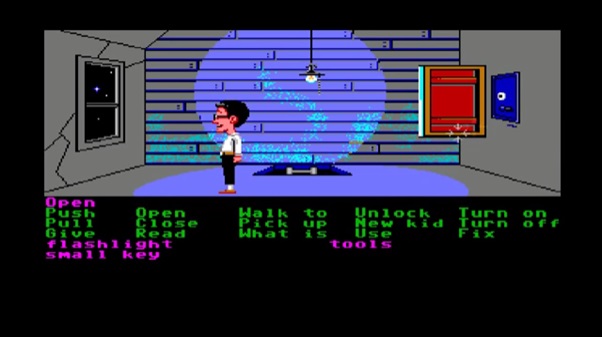
In Ed’s room, there’s a computer in the corner and, if used, you can find a neat little Easter Egg. His Desktop contains the fully loaded and original prequel to the game we’re in – 1987’s ‘Maniac Mansion’. It’s such a brilliant and unique moment of in-game inception, as you find yourself playing a game within a game where all the characters are the same. It makes purchasing DoTT almost like a buy-one-get-one-free offer as this delightful throwback allows you to get completely lost and forget exactly what you were playing in the first place. If it wasn’t for the distinguishingly terrible 8-bit graphics, you’d be crying out for Dom Cobb and his totem to know what the hell is and isn’t real. It’s completely opt-in, but you could easily spend hours in this sublime surprise which helps you understand the character backstories – most importantly why Bernard is so painfully untrusting of Dr. Fred.

Now, the difference between Maniac Mansion and DoTT goes deeper than just the aged quality and lack of voice-artistry. The former is brutally unforgiving and a wrong move could be a game ender, so while it’s good fun, you may need to quit out and come back a few times if you want to try and complete it – I learned this the hard way the first time I played wasting 30 minutes in a futile attempt to bust all three of my characters out of an inescapable jail! While the game ending nature can be annoying, playing it gives you a nice reality check and makes you appreciate just how much adventure gaming has improved in such a short space of time. The sequel can be equally frustrating but for the opposite reason – you can’t die. Unlike the remastered Broken Sword, Double Fine have elected not to have an in-game hint system, so if you’re playing the iOS or PSN version – be prepared to be wandering around until that lightbulb moment hits you (or until you lose patience and look up the walkthrough on YouTube).

Unlike other time-travelling games, such as Quantum Break or Bioshock Infinite, there is no deadly Butterfly Effect. If Hoagie steps on a cockroach, then instantly the present isn’t transformed into a ‘planet of the roaches’ where Bernard must lead an uprising against his 10-foot tall insectoid overlords. There are also no worries about meeting your younger selves, your parents or your ancestors and disappearing from existence as the game adopts a less thought-intensive approach to travel where only minor details of each puzzle change through time. Laverne needs a disguise to help her break out of a futuristic prison? Easy. Steal the Doctors tentacle chart, flush it to Hoagie and get him to switch it with the plans for the American flag – hey presto – the star-spangled banner 400 years later is tentacle shaped and perfect to aid Laverne in her escape. While it’s hilarious, the keen sci-fi nerd or historian playing would have to put aside their logic and accept that this has all happened without changing any of the history that would come with such a careless distortion to the fabric of time.

Another thing that I’d forgotten is how purposefully inaccurate the antiquity of the game is. So, don’t play this game directly before a school exam because the game will undoubtedly cloud and reduce your knowledge of history and culture of 1700s America. What… you mean, George Washington didn’t cut down a Kumquat tree by mistake because someone had painted the fruit red with lead paint found in Ned Edison’s bedroom? You must forget the history books and just switch off and enjoy the ride. It’s the fashion in gaming now to see interactions with historical figures – something we see constantly in the Assassins Creed series – and you can never be too sure how well these references have been researched or how true to life the games are that are portraying them. Unlike Connor’s battlefield run in with the 1st President of the United States, Hoagies meeting is so satirical that it wouldn’t be out of place in a stand-up routine. Would Benjamin Franklin have discovered electricity without you? Who knows, but helping you save the world from an Evil Purple appendage was certainly something left out of the American History books. Either way, it’s a brilliant mechanism to fuse familiarity with the creator’s wit and drive the plot forward.

The entire game doesn’t take itself seriously in this respect and the more I switched between the characters the more I remembered just how fun it was solving puzzles through time. Cryogenically freezing a hamster in an ice box and tumble drying a jumper for 200 years to help it thaw was a nice little touch on my quest to gather electricity and as the game progresses, the level of invention in the puzzles increased. However, the game’s greatest strength is also its biggest weakness. I found that it was so enjoyable first time around that most of the solutions were as memorable now as the day of the original playthrough. I remembered the Dirty Harry/Travis Bickle monologue with the inflatable clown and laughing at how Bernard eventually got so annoyed at being bested that he had to stab it in anger. So, when I saw Laverne had the opportunity to collect the scalpel in the futuristic doctor’s office, I instantly remembered its purpose. Not counting the Maniac Mansion Easter Egg, I nailed this playthrough in just over 2 hours which might not be bad value for the price of a pint, but I certainly wouldn’t be rushing back to play it again any time soon. The game has such limited re-play value particularly when you compare it to other remastered adventure games, such as Broken Sword, Monkey Island or Grim Fandango, where after a month or two you could dive back in and enjoy it all over again.

Playthrough value aside, the comedy alone is well worth a punt for first timers or those longing for childhood nostalgia – I mean, which other set of writers would predict an evil genius ready to take over the world would make this their first act of evil…

…Hey, I guess even Hitler had to start somewhere! With complex puzzles, a satisfying ending and the original prequel embedded, this personality exuding, time-travelling title still holds up today as one of the best adventure games on the market. It hands down beats other remastered games of the same genre and for any LucasFilm fan, you can spend hours upon hours picking our Star Wars or Indiana Jones References.

Comedy, simplicity and even a great pause value (where you can make a coffee or smoke a cig without the world ending or being robbed blind) are things sorely missed in the modern, multiplayer generation of gaming. With a re-mastered version available on the market for less than a fiver, it’s well worth getting your tentacles on!

1993 | Developer LucasArts | Remastered by Double Fine Productions

Platforms; Win | PS4 | iOS

Prey 2006

A Blast from the Past review

No, not that Prey, the original Prey. FBT replays the 2006 classic like it’s 1996.

The Past

I have no recollection of Prey, beyond anti-gravity and aliens. I’m not even sure I finished it. That it was finished at all was a miracle. Announced in 1995 by 3D Realms, the shareware publisher who unleashed id’s Doom, Prey was at the very epicentre of the FPS explosion. 3DR had cut their shooter teeth on 1994’s Rise of the Triad and their forthcoming Duke Nukem 3D had everyone frothing but it was Prey, developed by ex-id founder Tom Hall on a ground-breaking engine that seemed to be a serious contender for the ‘Doom Killer’ title. But instead, Hall, frustrated by the engine’s slow progress, left to create Ion Storm with ex-id cohort Romero. 3DR brought in the legendary Corrinne Yu to get the engine started but three development teams later and despite acclaimed appearances at E3, by 1999 Prey still wasn’t released and as the golden era of FPS waned, it joined stablemate Duke Nukem Forever as Vapourware. Finally 3DR called old pals id; Prey was restarted on Doom 3’s idT4 engine at Human Head Studios. It took them five more years. Eventually Prey was released in 2006, 11 years after the announcement. Doom was long dead.

You’d have expected Prey to be at best a throwback; at worst, another Diakatana. But Prey was critically well received – and successful enough for a sequel to be announced; which true to form, went through an even more painful development than its predecessor, while Prey was eventually overwhelmed by other heavy hitters released in 2006 and disappeared. It wasn’t until the 2017 Reboot trailer was released I even thought about the original Prey. I couldn’t recall anything which seemed unfair to a game born in those halcyon days. It may have been released in 2006 but its a nineties game; it was from 3DR, built by ex-Raven developers (Heretic, Jedi Knight II) and conceived by Tom Hall. That’s classic FPS pedigree. Time to jump back to 1995 meets 2006 and see what took them so long.

Still a Blast?

As the menu and opening load up, I suddenly remember Prey’s lead was a clichéd Native American called Tommy. I wonder how well that’s aged. I also recalled his reason for blasting through levels; a girlfriend who was abducted by aliens. The loading screen of a giant malevolent-looking globe, which looked like Pinhead’s holiday home recalled horrible twisted levels to battle through. And that’s it. But what more did I expect from what’s in reality a Doom-era shooter?

There was a lot more it turns out. The opening shows Tommy having a word with himself in a mirror. He looks more like Billy from Predator, just a regular dude who happens to be Native American. Guess that was just my memory playing racist tricks. The mirror is in the toilet in a bar in the reservation, which Tommy hopes Jen his girlfriend will leave with him. I spend a bit of time trying to trick the mirror, turning Tommy away then back but it’s an almost perfect reflection. Even modern games avoid reflective surfaces, showing mirrors as broken or misty – odd considering they often popped up in mid-nineties games; Duke, Wang and Caleb admired themselves in mirrors and it’s interesting to ponder why modern games avoid it, what graphical shortcut denied us our gamer narcissism? Anyway, Tommy dosses about in the toilet for a bit then heads into the bar.

Prey looks really good, it’s detailed and interactive. I can select songs from a jukebox, switch TV channels and play video games (including Runeman, a play on a previous HHS game) before eventually being cornered by the clichéd ‘Red Indian’ I remember.

when's bonanza on

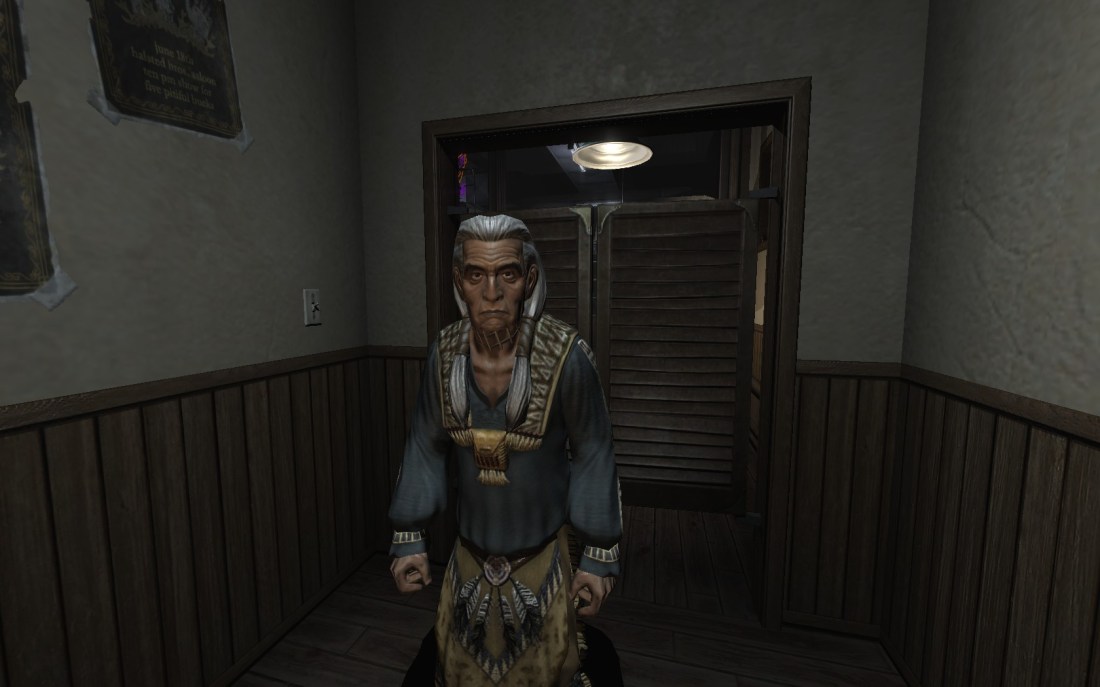
It’s my Gramps, dressed and behaving so typically I’m surprised he doesn’t have one of those huge feather headsets. We have a little argument about my lack of respect for their culture and desire to get off the reservation, then I find Jen and have the same argument with her. Angered, I take it out on two biker boys, beating them with a handy wrench which becomes my melee weapon. Before Gramps or Jen can be react to this expression of just how much Tommy wants to leave the reservation, he gets his wish; aliens arrive and beam us into space. This far enough away from the reservation, Tommy?

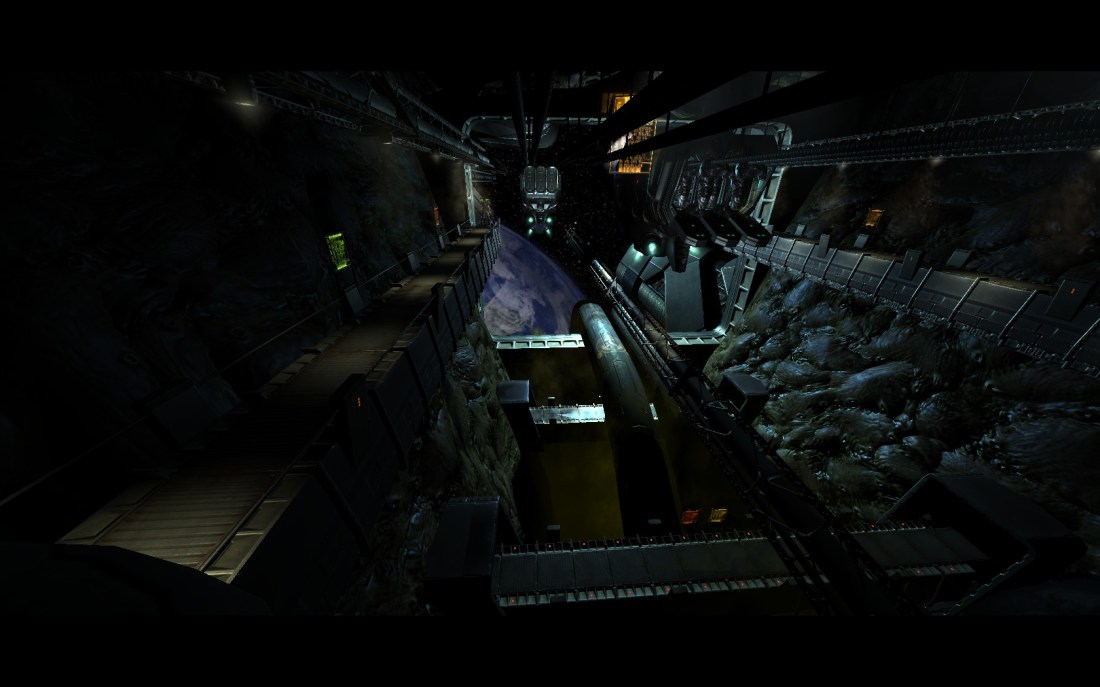
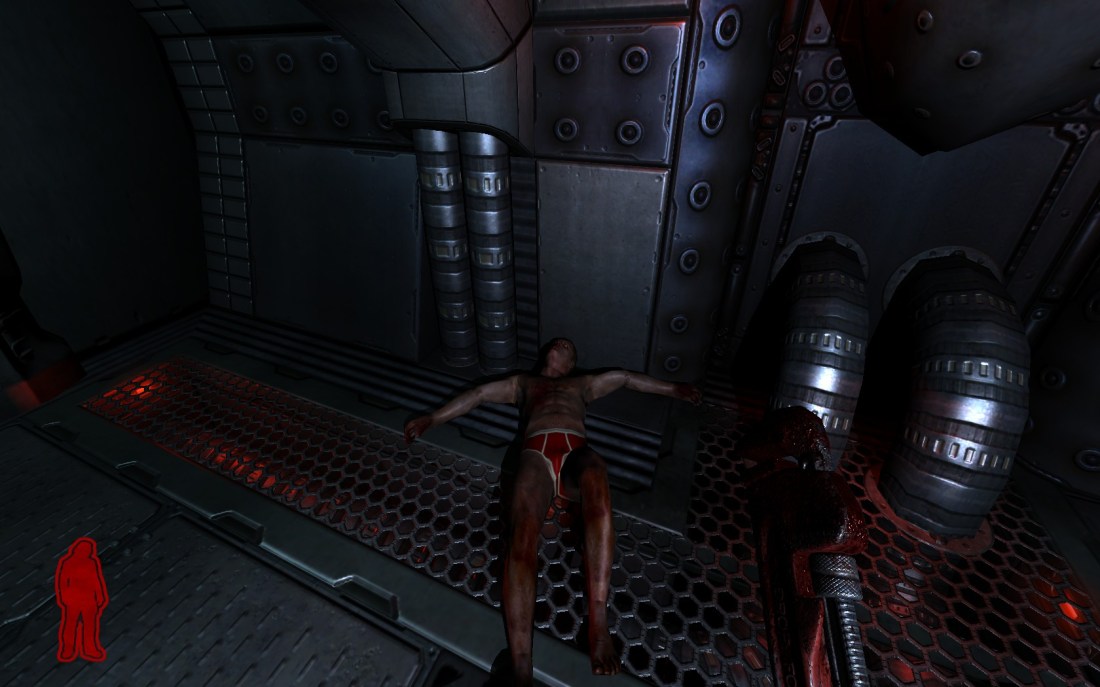
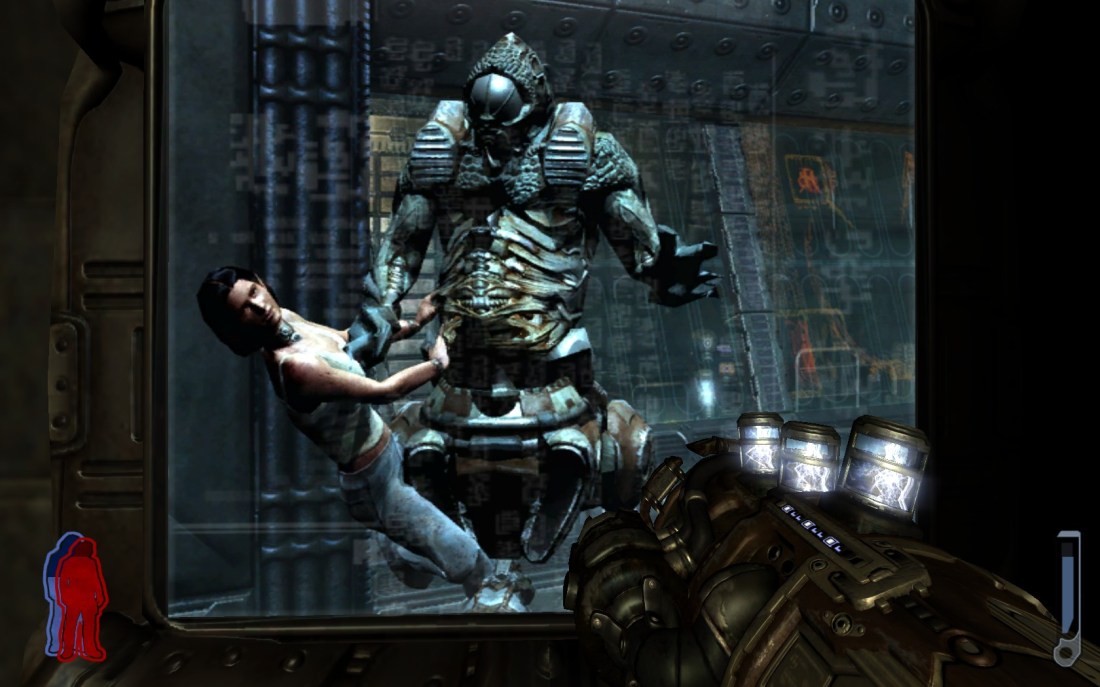
We don’t get to see much of the Sphere from the outside but inside, Jen, Gramps and I are stuck in a Clive Barker wet dream. We can hear screams and shouts, and then see what they’re screaming and shouting about. We’re being processed through an abattoir; Machines are rending and mangling abductees, reforming them into the very sphere itself. The sphere is people! Hey look, there’s the two bikers. At least they surviv-oh. Huge bulging tubes process the meat, the walls are skin sown together, there’s flesh and blood everywhere and all around us bikers scream. Quake 4 had some similar nastiness to it, but this really is a sickening place. Helpless and terrified as I approach a machine I just saw suck out someone’s innards, I’m mysteriously set free but it’s too late for Gramps. I watch him turned into mincemeat then chase after Jen, deeper into the bowels of the sphere. Or it might be the lower intestines. I hope the exit isn’t where I think it is.

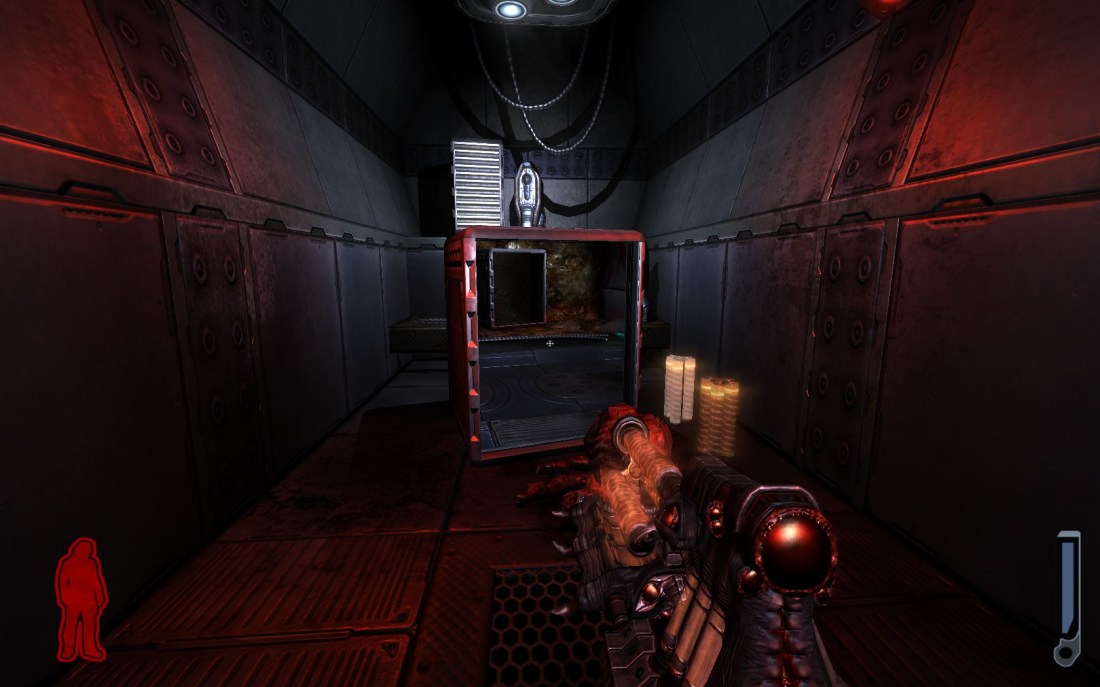
Prey really does look good, in its horrible way and I’m deeply, unsettlingly immersed in the world. You can imagine the stench, the squelch under foot; idT4 was built for Doom 3’s spookiness but HHS wrangled and mangled a ton of horror and gore out of it. I’d best find my barings.

No sooner have I got my barings than Tommy dies. But instead of a load screen, we’re transported to the ‘land of the ancients’. Seems the afterlife is real and we meet a pre-mangled Gramps, who now makes like a Jedi Spirit and explains I have a special power; Tommy can shadow-walk, which allows him to sneak unseen but also be corporal enough to fire spirit arrows and interact with the tech found around the ship. We also get Talon, Tommy’s childhood pet, a spirit hawk that accompanies him back to the Sphere. Talon comes in handy, distracting the bad guys and perching on things we should take a look at. He flies in the direction you need to take, so he’s a handy mission marker too. We are returned to Tommy’s body and press onwards. And upside down.

Within the sphere, gravity isn’t a hindrance. Throughout there’s tracks that allow Tommy to walk on ceilings and walls and around obstacles, while gravity wells reverse the room and portals allow him to transport around. Those, combined with Tommy’s spirit walk all add up to an alternative take on the shooter genre, and it’s easy to see why 3DR were so keen to crack this element back in 1995; this would have been Doom-killingly cool.

sorry

As I go, I find various other folks from earth who’ve also got free but unlike Tommy, they’re cowering and terrified. Especially after I accidently clobber one with my wrench. Will you put that thing down, Tommy. I do this a lot, anything interactive is triggered with your trigger finger and if you’re off by a pixel you’ll shoot it instead. And you have a lot to shoot with. There are five main weapons each with an alt. fire, they’re half hardware and half some unfortunate reconstituted creature; they move, quiver and breathe as I go. The rifle has a leech-like appendage that leaps out and sticks to my eye for a zoom and when idle, it takes an interest in what’s going on around us, sometimes unnervingly looking back at me. The other weapons are similarly icky; I’m pretty sure the grenade launcher is an anus but I’m not looking at that in a mirror. You can imagine what they feel like to hold.

The creatures you can fire at are plentiful too. You’re never far from a firefight and they’re aggressive, fast and have no sense of humour; Appropriately grotesque, the main bullet-catchers are the Hunters, designed to track any creature that escapes the processing but elsewhere we encounter Harvesters which leap in and out of fleshy pockets in the walls to grab wanderers; If you shoot one they’ll jump back in and you can hear them clattering around between openings and it’s panic-inducing trying to guess which it’ll leap back out of. Reconstituted humans do drone work, skinned wolf-like creatures stalk you, the list goes horribly on and you never feel safe. Mini-bosses like the Centurion and Creature X become new high-end opponents – there’s a lot here that can and will kill you. But dying is no big deal. Just before death, Tommy is transported back to the land of the ancients to fight his evil spirts. Tommy has a short amount of time to use his spirit bow and the more you kill the better your heath once back in your body. A little like Borderlands’ second wind, it’s a nice little way to stay in the game rather than reload or get checkpointed.

After a while though, those gravity dynamics, which seemed exhilarating at first are revealed as typically 90s linear – they’re scripted and always necessary; if there’s a walkway you’ll need to use it, the Portals are basically just doors and the gravity wells are rarely used to upend the bad guys or gain an edge, they’re there to get past an obstacle or puzzle. By 2006 you’d have expected to have those at your disposal and use them to turn battles to your advantage – or expose yourself – but they’re pre-planned events that quickly turn into gimmicks. When you’re not excited about walking upside down you know something’s up. Another aspect betraying Prey’s 1990s DNA is the level design. While an incredible setting, it doesn’t evolve or change in any great way; there’s only so long I can stay uncomfortable sneaking through Sphere’s guts; later levels are industrial and bleak but they’re very samey and unoriginal; it feels like Doom 3 or as if they just ran out of ideas. The one exception is when we pilot an anti-grav moped for some zero-g aerial fighting. The biggest let down though is Spirit-walk. Spirit-walking should be like Max Payne’s bulletime; a superpower you utilise but it’s just a puzzle-solver. Got stuck? There will be a convenient ghost-only route and it’s a shame you don’t really use it to get an edge. All of that would have been accepted in a 1990s game and that’s where Prey is firmly planted at its core; but this was released in 2006 and it should have some of that decade’s sensibility, that freedom. It’s also ironic that those innovations were a key reason for Prey’s delays yet now date it, and it’s truly compelling aspects – a great main character, setting, storyline and a solid goal were lacking in Prey’s 90s contemporaries. Maybe they came along later, but Prey could have been a Doom Killer on an emotional level rather than wow factor.

The game is stuffed with nice touches to break through the monotony though; there’s beautiful vistas of earth and the stars when you pass open areas and there are some knockout mini-moments; Tommy spots a display cabinet holding a mini asteroid. The next portal leads us to a barren area and then a giant Hunter looms over us, peering in at tiny Tommy on the surface of that mini asteroid. Occasionally you’ll pick up DJ Art Bell on Coast to Coast AM, a real-life paranormal radio show, discussing the recent reports of UFOs and chatting with callers describing weird things going on (One caller claims this has been planned since 1995; touché.). During one trek past the edges of the Sphere a jetliner, caught in their transporter beam flies in – Later we find the wreckage. There is a lot going on and Tommy is never at a loss on what to say about it; he’s seen some shit. He’s not Duke, cracking wise, but he’s got that fatalistic, John Carpenter tone to him; in fact, Prey could be a 2000’s remake of a 90s game based on a 80s Carpenter movie and the mash up very nearly works. You can almost pick out which decade aspects of the game were born in; it feels inspired by 80s horror and sci-fi and while the shooting, the levels, the monsters are all prime 90s, the characterisation and immersive plot wouldn’t be out of place in mid-2000 games like Mass Effect and Bioshock.

Hi, I've been living in squallor for decades.

And of course, we have that story to entertain us; We run into a group of humans who escaped the meat grinder after its last visit and survive hidden within Sphere’s own living walls, while Tommy is goaded about the futility of trying to escape by the disembodied voice of its controller, The Keeper (who at one point calls Art Bell to give its deranged view which is awesome). Plus, we have Gramps occasionally prodding us about our heritage and destiny. It’s like an X-Files episode as we uncover hints about the Sphere and its previous visits to earth, the Keeper’s true purpose and what the Land of the Ancients and Tommy’s spirt-walk power really are – at least it’s hinted at, we (horribly) see little children sacrificed until one develops Spirt Walk and becomes a mini-boss from hell and later, Tommy is tricked into revealing the location of the Land of the Ancients and the Keeper’s forces attack. I’m sure it’ll be explained in the sequel, currently slated for a 2012 release.

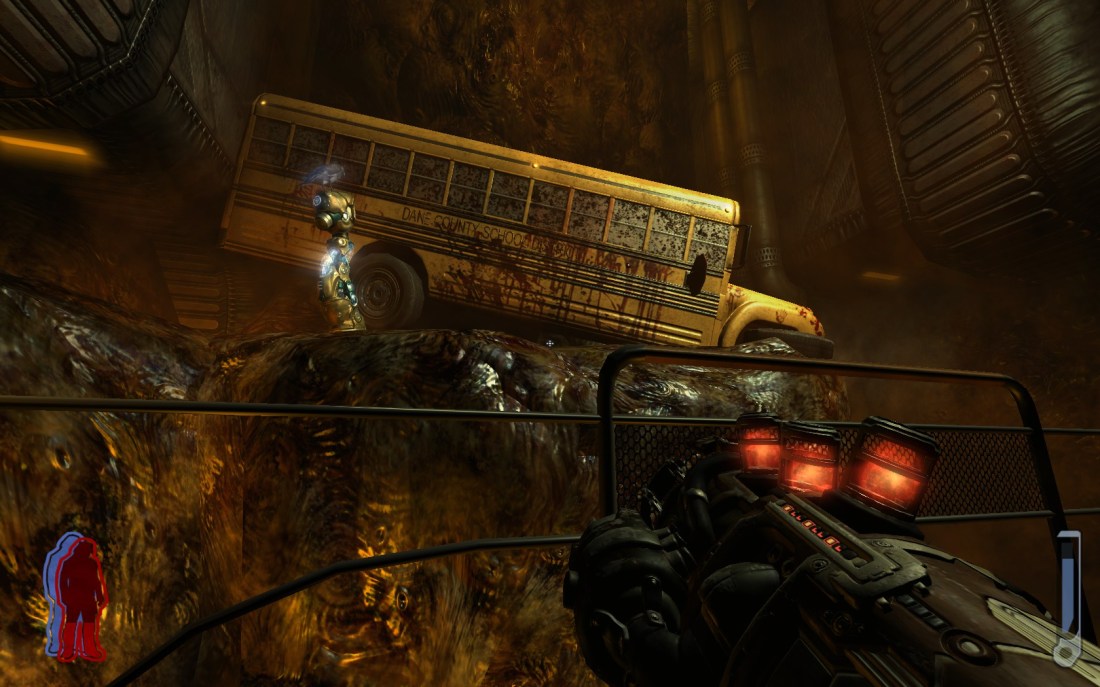
oh crap a bus load of kids

Finally rescuing Jen, Tommy reluctantly agrees to kill the Keeper so the humans can activate a portal out of this place. After a monumental battle where I spend as much time in the Spirit world regaining health as I do fighting, the Keeper goes down. Except, turns out it wasn’t the boss. There’s tons of those Keepers knocking about. Dagnamit. Another interminable slog and some genuinely painful plot-twists later and we finally we reach the centre of the Sphere. It’s a great moment, partly because Tommy is driven by rage now and we feel for him, but mostly because it’s been toying with Tommy the entire time, testing and manipulating him to reach this moment – giving Tommy a compelling choice to make. If this had truly been a 2006 game, we’d have had to make the choice and trigger a good/bad ending, but this is the 90s; Tommy just readies his grenade anus. Spirit world, here I come again.

Once that’s done, we get a surprisingly dark and emotional ending and as I watch the credits roll, a little shell-shocked, I’m about to congratulate Prey on a brave and honest ending when a franchise-starting twist pops up. In a final scene that in no actionable way rips off Half-Life, Tommy is suddenly and inexplicably placed back in the bar at the beginning, where he’s visited by the leader of those Sphere humans. While earth has dismissed the events as an natural disaster (except Art Bell, he knows the truth), the human explains ‘others’ would like to meet Tommy and opens a portal to the words ‘prey will continue’. And oh boy did it.

If Prey 1 had a tortuous development then Prey 2 was treated worse than Gramps in the Sphere. HHS began work on Prey 2 under the direction of Radar Group, an IP Management company from 3DR’s Scott Miller. Announced as a direct sequel that picks up directly after Prey 1, it went nowhere and was eventually offloaded to Bethesda – who have a habit of grabbing waning IPs and rebooting them (Fallout, Doom, Wolfenstein) and they stuck to what they know best; P2 was announced as an open-world non-linear game with a morality system set on a Blade Runner style planet controlled by various warring factions. Exactly how I envisioned Prey would continue. It even got as far as a (clearly not game-play) trailer. Then things went quiet until 2014 when Bethesda finally admitted P2 was cancelled before uncancelling and parking Prey at their Arkane Studios; Who in 2017 turned out a Bioshock meets Dishonoured reboot. It’s Prey in name only now, which is a shame because there is so much to recommend in the original, be it the 1995 half or the 2006 half. It’s schizophrenic, like a great remake of a game you never played and it does drag, but it’s aged well (twice) and considering its torturous development, Prey is a solid, enjoyable game; Duke Nukem Forever had no excuses. Ultimately Prey feels old-school familiar, new-school absorbing. I enjoyed it, but I would have preferred to play the 1995 version and rediscover it now. Then all my gripes would be put down to age and forgiven. It would have been a great Doom Clone.

2006 | Developer Human Head Studios | Publisher 2K Games / Take-Two Interactive

platforms; Win | X360