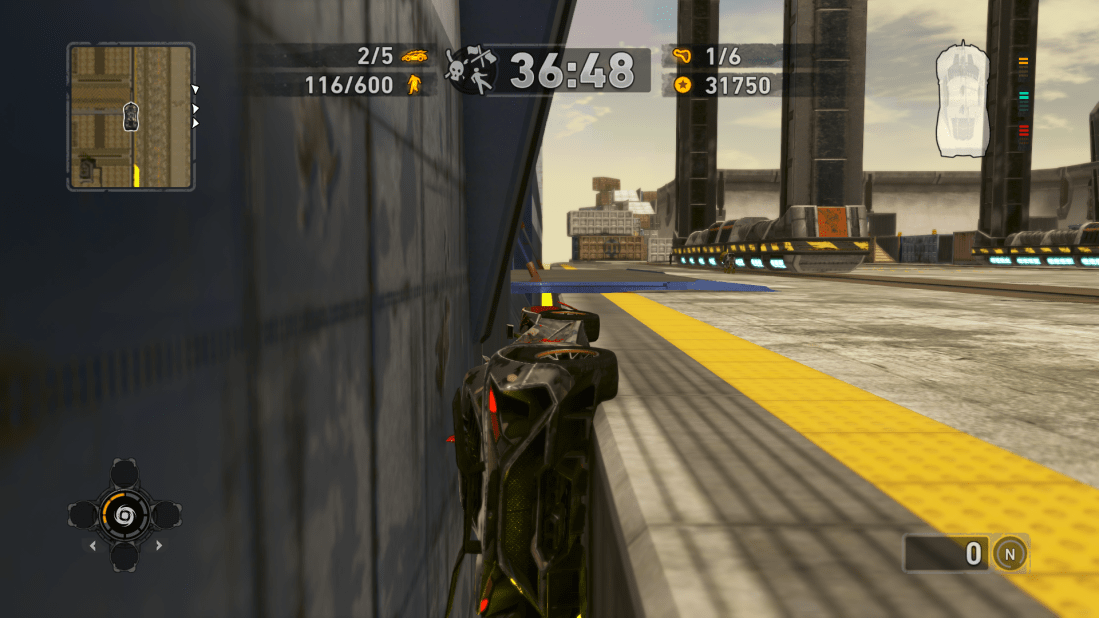
Carmageddon Max Damage

a rage quit review

Carmageddon is FBT’s Spirit Animal. The reboot puts it down.

In the late nineties, there was a new breed of unapologetic video games; they didn’t signal the end times as the media and parents feared, they did something better – agitated the bland gaming landscape and forced it to grow up, get good. And now, yet again, the game industry has become corporate, cautious, careful. While most games from that original era sold out or burnt out, we have the return of the baddest of them all – the first game to be banned by the BBFC, the game that sent the Daily Mail into meltdown, the game that let you run over pedestrians – Carmageddon. When Carmageddon Regeneration was announced I was more than a little excited. Time to kick modern gaming in the cunning stunt.

I was more than a little disappointed when C:R was released. I couldn’t quite put my finger on it but it was … meh. How could Carma be meh? Everything was there yet my beloved free-roaming, ped-killing, opponent-exploding Die Anna had become … inoffensive. I got bored. Bored! The power-ups were cartoony, the level design dull, the cars lacked that oomph, even the peds seemed indifferent to being run over. The original was Never Mind the Bollocks, this was Flogging a Dead Horse. I didn’t Rage Quit, I just got fed up and never went back. Until I saw Carmageddon Max Damage. A second chance. I was buying this.

Yes, I was stupid enough to buy the Carma Reboot twice. Max Damage is the premium version of Kickstarter’s Regeneration. Damnit. Is this karma for liking what the Daily Mail called a ‘sick death game’? Let’s see if Max Damage hits the spot.

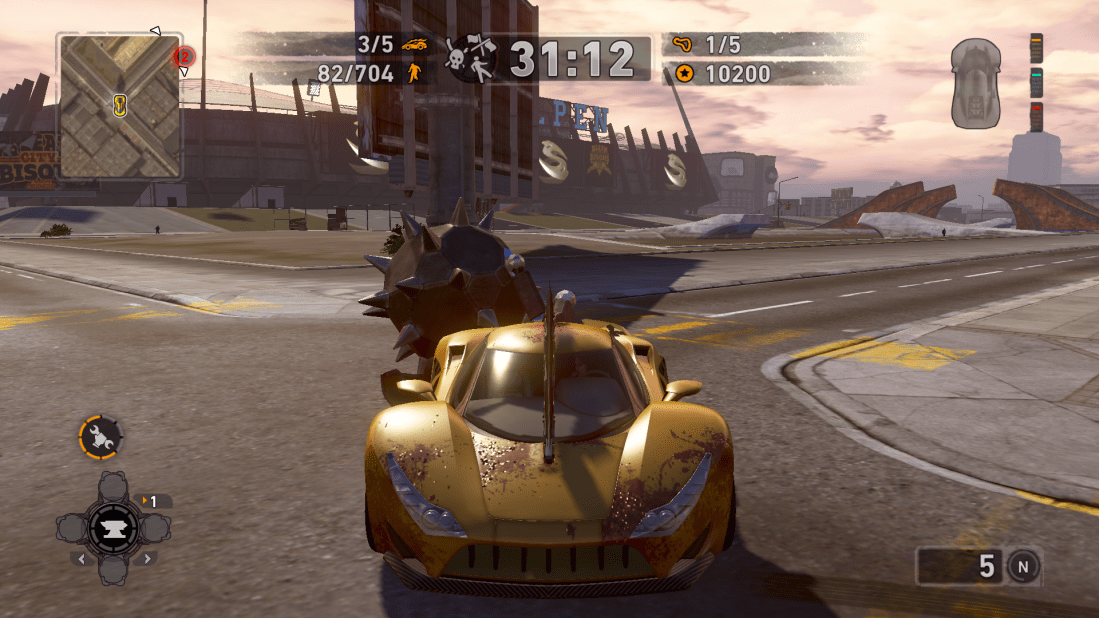
The cars are all there, and the first track is the original’s Maim Street. Get in. I chose my beloved Die Anna, rev the Hawk and aim for the flag-waving guy. As I sail over the first hill, ready to become death … it feels a bit pointless. I’m having an existential crisis. Was the Daily Mail right? Have I become so desensitised that I’m unmoved when I run over a cheerleader? Have the past 20 years of ultra-violence been a gaming form of Ludovico? I look for Anna’s grinning face. Having a compatriot to all this mayhem will bring me back – no in-game Anna? Whoa. I hit the handbrake to swerve into the Peds. The car comes to a slow stop like I just performed an emergency brake in my driving test. The Peds all saunter off. Okay. Time for extreme measures.

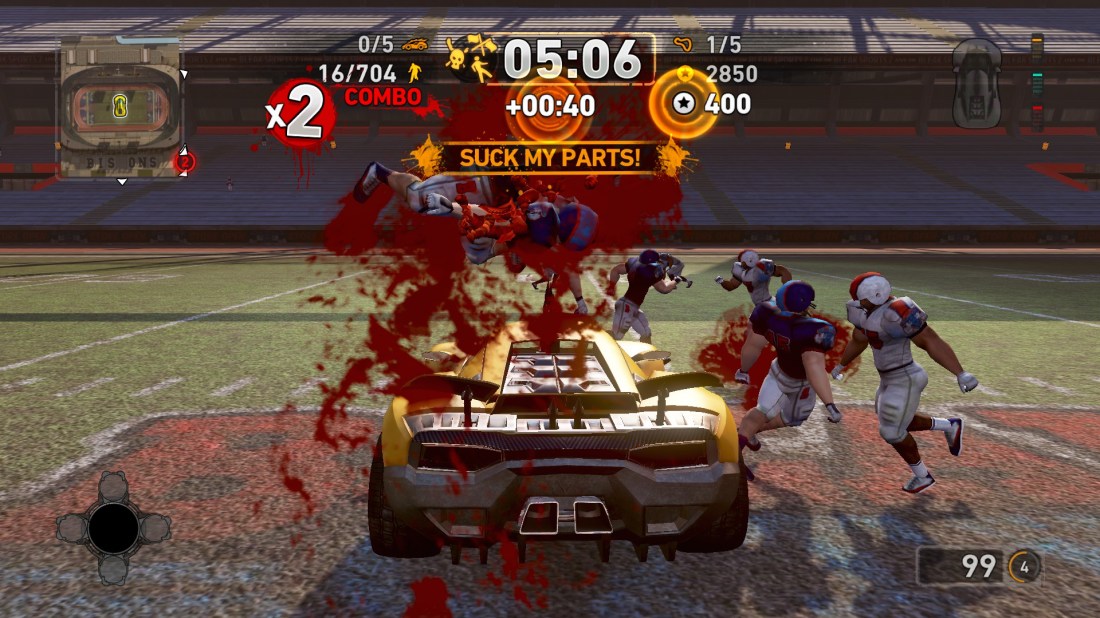
I find the stadium and the electro-bastard ray is where I left it; but taking out the NFL teams and the crowds isn’t doing it either so I decide to get into it with the other cars to see if that livens things up, but it takes an age to find them let alone get into a fight, and I don’t get that screaming, out of control feel as I pootle along – you used to build up insane speed, bounce, careen, flip out of the map, land on a passing grandad or take out an opponent by accident; it was raucous, unruly, exhilarating, and Die Anna would woo-hoo along with you. Now neither of us are.

It’s a very empty game and nothing much happens by accident, but the problem is the original Carma’s attitude has become part of free-roam driving the same way Doom’s once dizzying action and grisly violence are embedded in modern FPS. Saint’s Row already aces this. It’s not dated, it’s just not necessary. But it’s not just an age thing. It’s also a not-very-good-thing.

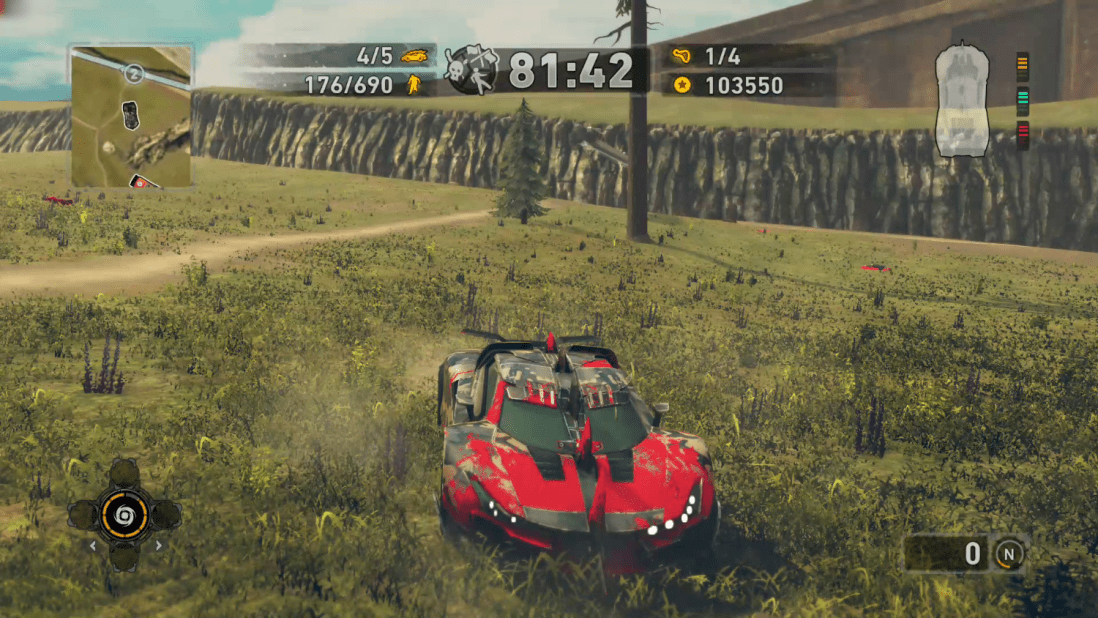
The levels are boring to drive about in – they’re fun-looking, like the Area51 or the reworked classic levels, but miss that gritty, grimy feel; they’re much bigger and expansive than the original but that makes them less intense, unfocused. You don’t have those death-runs, those games of chicken. They’re also cluttered and uneven, causing the car to bounce around and that’s when it really starts to grate.

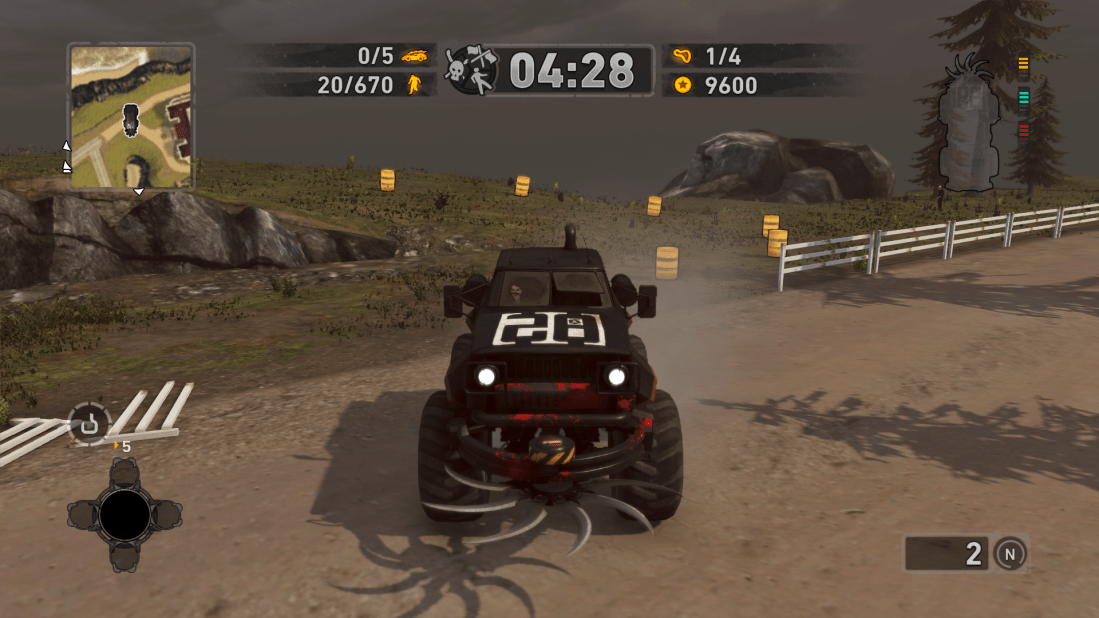
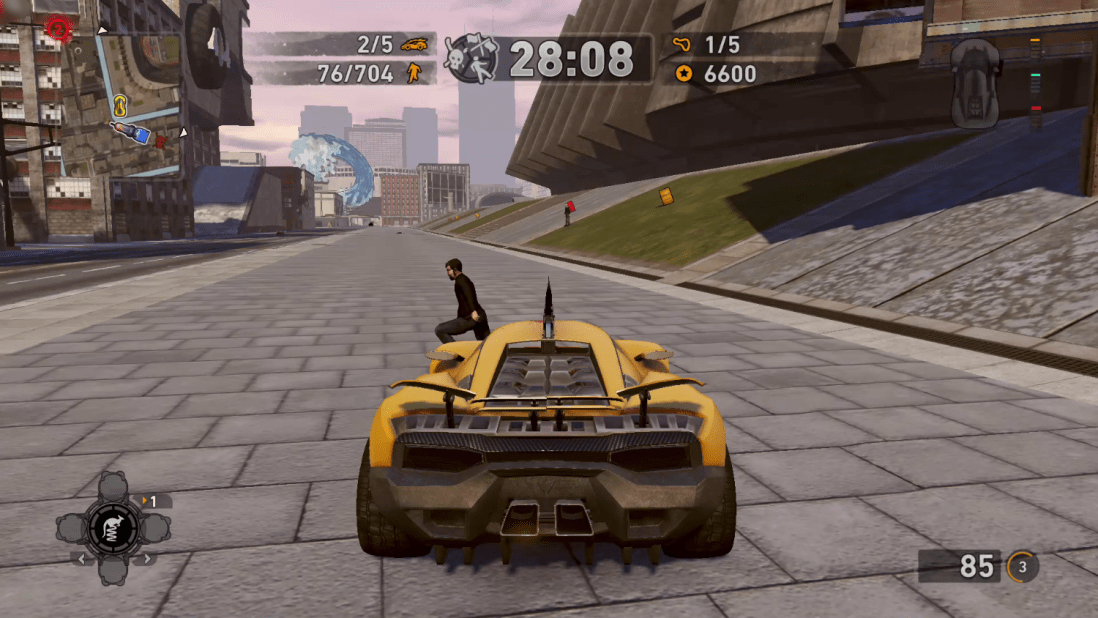
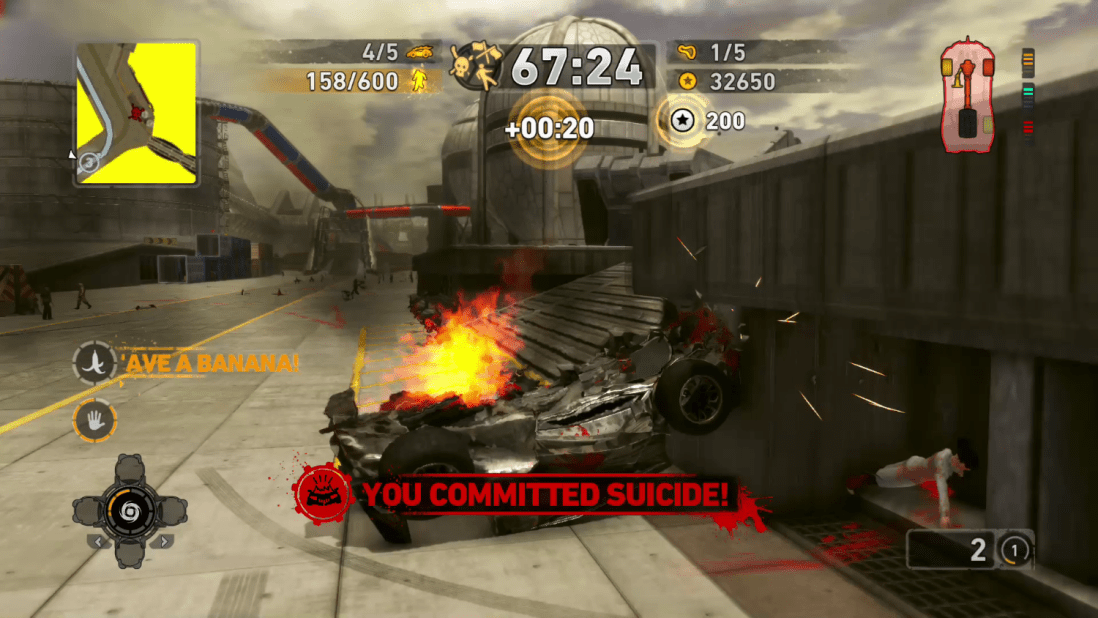
The Eagle and Hawk always felt like they wanted to get away from you in the original, and they were sturdy enough to let them. But now, with their wafer-thin build, they handle like they’re filled with helium. There’s no torque or grip, no sense of weight; how did a game released in 1997 better realise banger cars than the remake 20yrs later? You’re forever missing targets and sticking the corners, never just taking off. Getting a powerup requires a careful three-point-turn. Suddenly I’m being … careful. Still, we’ve still peds to kill. Well, no, because the cars have the turning circle of an oil tanker and alongside the ‘careful now’ handbrake you can’t lob the car about and catch peds on the fly – it’s rare see grandad fly off the bonnet in C:MD. On top of that, and this is a real Rage Quit moment …. it’s not about running people over anymore. Yes, a Carma game that’s not all about running people over. Did the Daily Mail develop this?

To have any real chance of progressing you have to play challenge missions; reach a ped or location first, destroy the most cars – basically all the stuff that requires precision driving and responsive cars. Great. All that happens is an opponent, who is a precision driver in a responsive car, reaches the goal first and the new target is halfway across a map that isn’t much fun to drive across and you’ll get beaten to anyway. FFS. What else?

In the original, you got money in-game and the time you finished with was converted into more to spend on car improvements. Now it’s transformed into XP which unlocks the levels, while upgrades are purchased with coins hidden in the game. Coins?! I’m Die Anna not Mario. I’m on a treasure hunt?! Plus, in the original, unlocked improvements could be attached to any car you stole. Coins upgrade cars individually now, which is a waste because most of the opponent’s cars handle worse than the Eagle. That it, can I quit now?

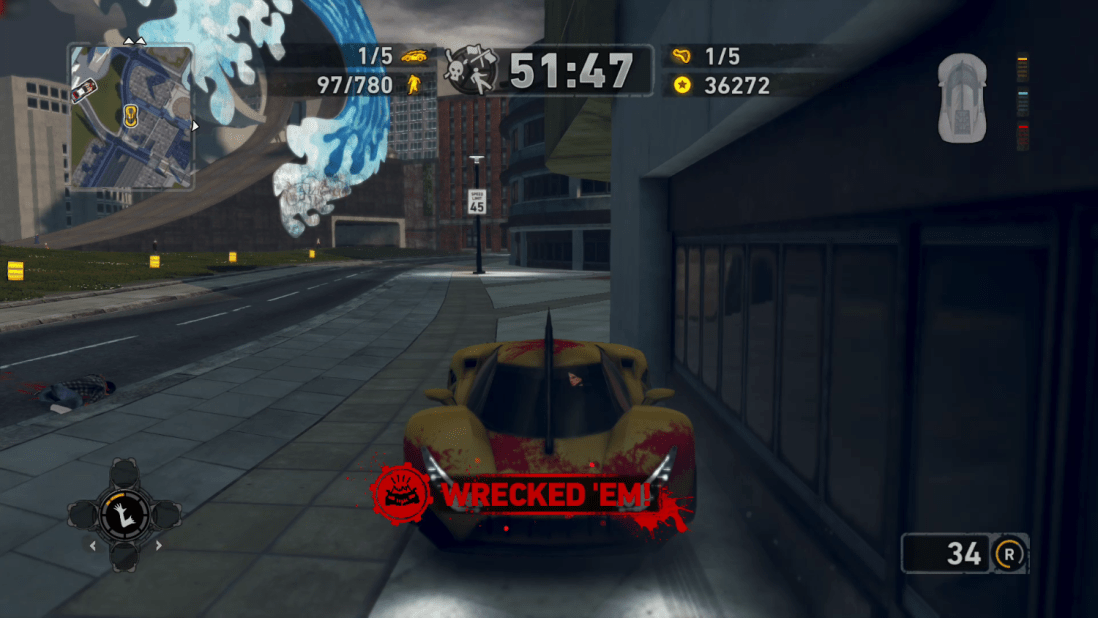
Thanks to the crappy cars and uneven levels, when you do get a Power-Up it’s over before you’ve had a chance at some fun, and the actionable powerups are no better. Because Anna is seemingly in a neck-support (understandable) you can’t aim them, only fire from the bonnet of your impossible to manoeuvre car. Why can’t I free-look/aim!? And the reward bonuses are thin on the ground, as if the game’s less aware of your actions; ‘Nice Shot, Sir!’ is a rarity no matter what you send flying into Peds, while ‘milk it’ pops up every time I hit a cow and ‘recycled!’ gets yelled when I knock a ped off a bike. I get it. And “wrecked’em” wasn’t funny the first time, let alone on every opponent kill, in every level, every time.

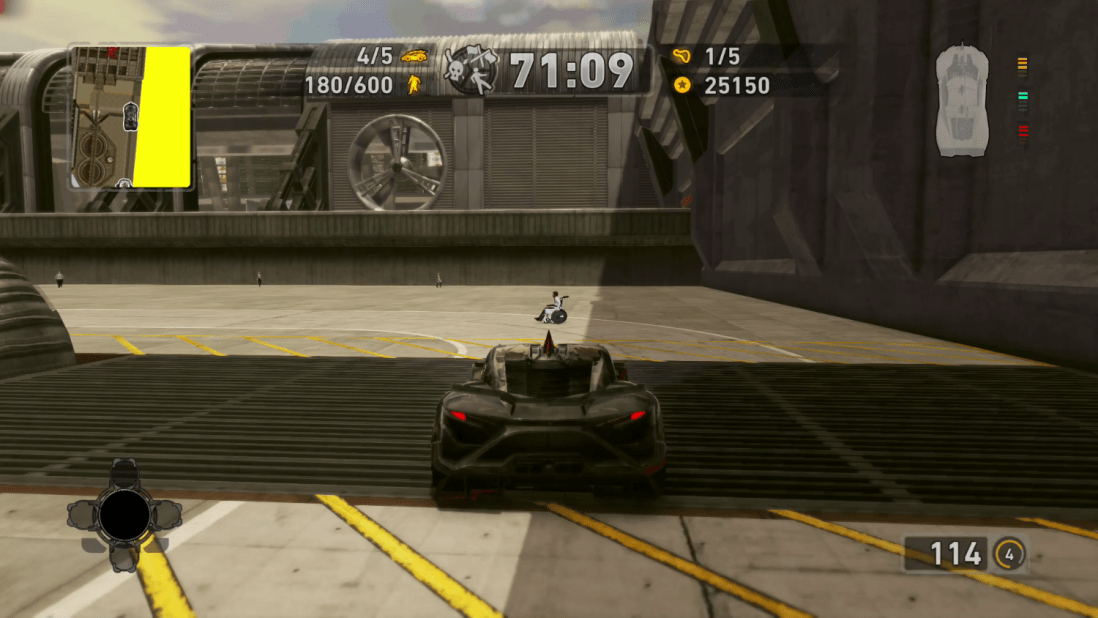
That’s it, I can’t take anymore. They got running over people wrong? They had two goes at this! Modern gaming can relax, this isn’t going to shake things up like the original did, even when you have the option to run over a man in a wheelchair – outrageous! Nope. Maybe in 1997 but now its desperate. I’ve done worse in better games that didn’t depend on outrage to be relevant. I would consider myself immature, juvenile, a man-child at a push but this just doesn’t work anymore as a concept, and as a driver game it’s pretty poor; the original still works because it’s a better game and because I remember when it was wrong. I love a throwback, a retro, a return, but if you’re going to return, have something to say. Something other than “I was in the war!” and think that’s still funny. It’s not Rage Quit, it’s Age Quit.

2015 Regeneration | 2016 Max Damage

Developer / Publisher Stainless Games

Platforms; Win (Steam/GOG)

Call of Duty Playthrough Pt3 – World at War

Second Wind Playthrough Special – Call of Duty

Part Three, World At War

In his next tour of duty, FBT is at war with himself.

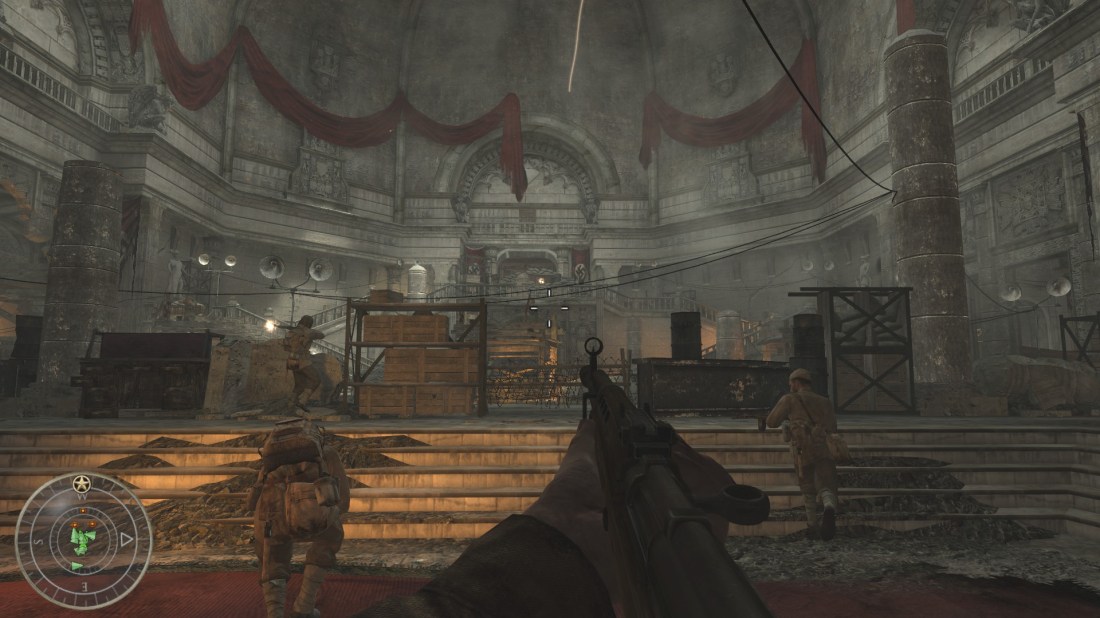
I originally disliked the Modern Warfare trilogy; not because it was crap, but because it was so successful it decoyed the series away from its roots. It was because of MW we had to suffer endless re-treads as the series settled into being a multiplayer with a story-mode for a tutorial. But, on a replay MW turned out to be an awesome series … so WaW should be the ultimate FBT shooter – modern game, classic era.

WaW is … off somehow. I should be loving this, it’s what I kept banging on about as true CoD; I expected a 1940s-set Modern Warfare but instead it’s the original CoD with better graphics. Isn’t that exactly what I wanted? Turns out, no. I’m impossible to please.

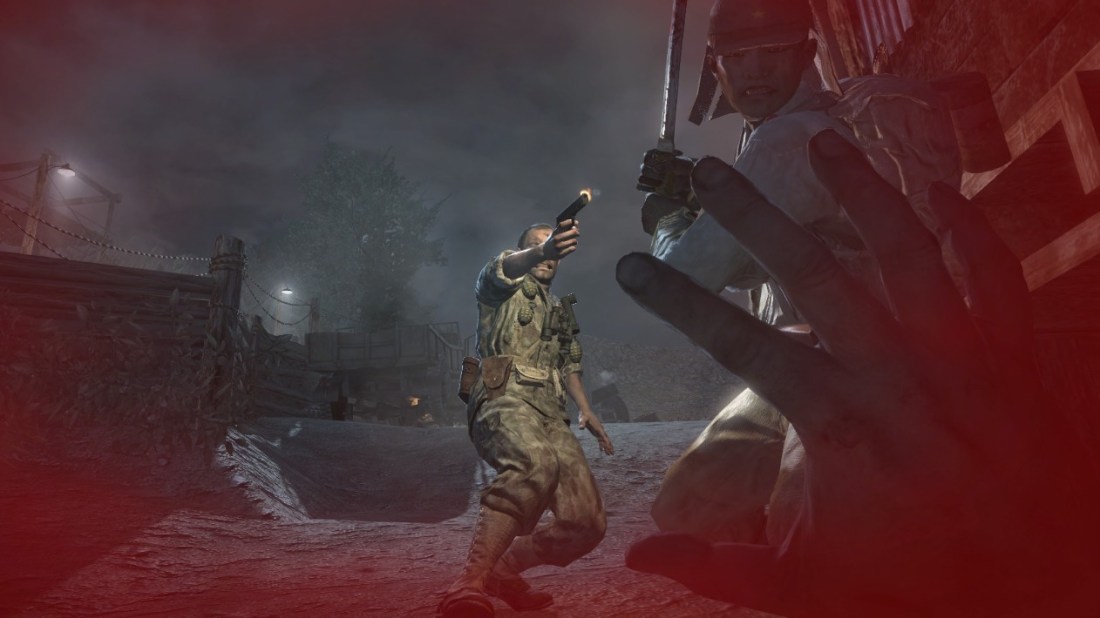
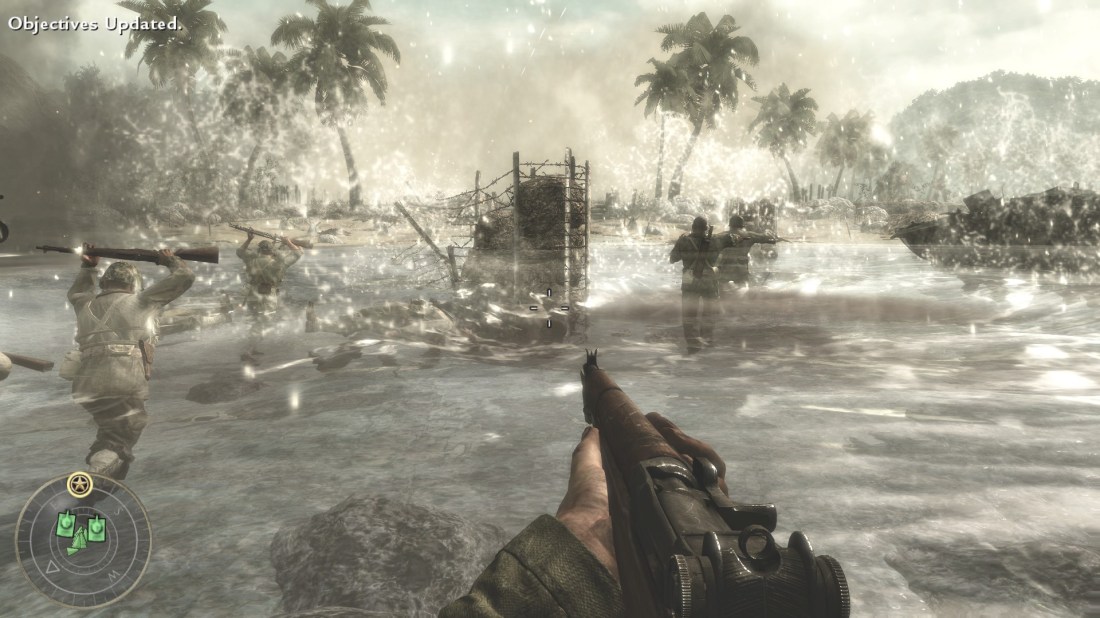
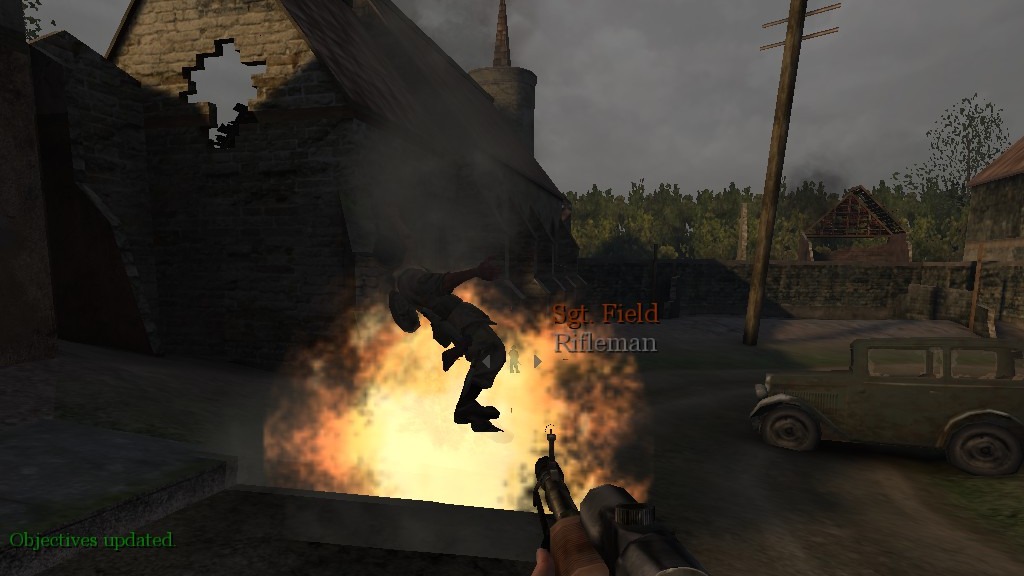
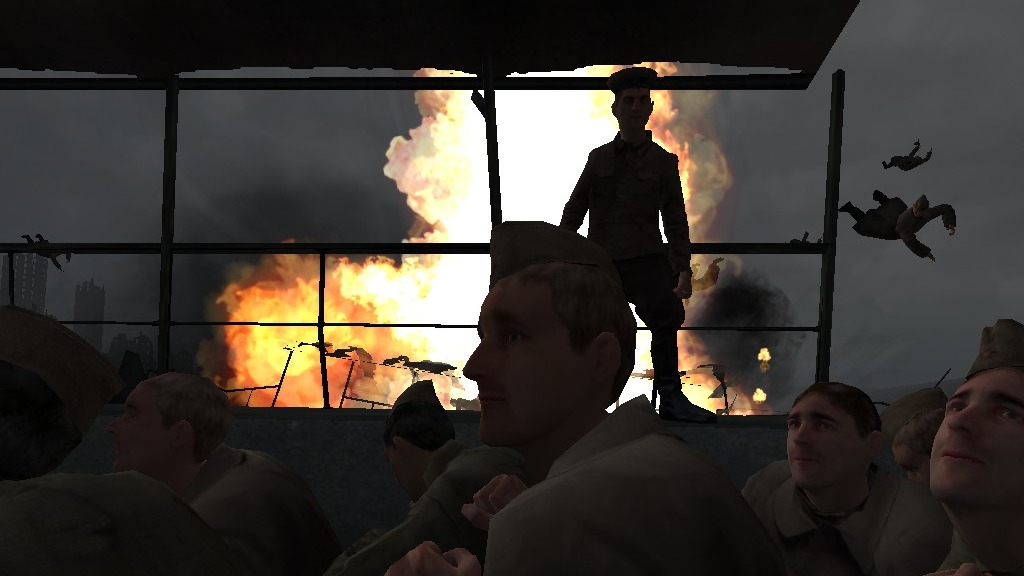
WaW’s first order of business is to bring home the horror of war – it opens with a fellow grunt getting his eye burnt out with a cigarette. Soon after, we call in an air-strike to soften up the Japanese -as standard- but when we pass through we encounter dazed and injured troops wandering and dying. Shots cause bodyparts to tear off, they don’t die straight away and there’s blood and pain everywhere. This is not a fun Boys Own Adventure game, and I can’t quite work out if that’s a good thing or not.

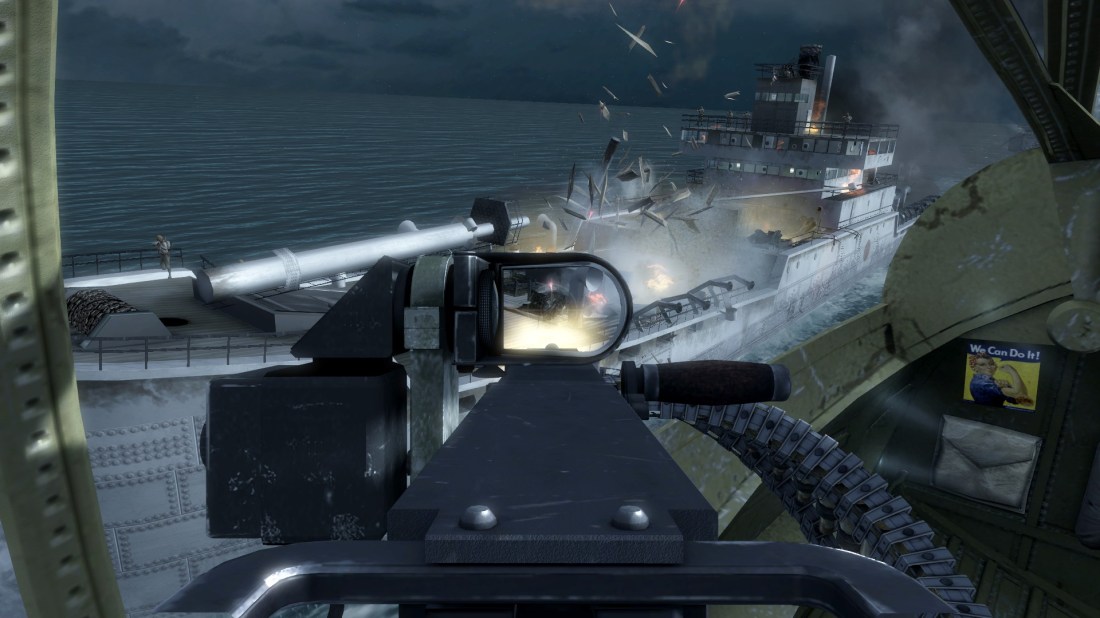
We’re split between two events and two soldiers – Private Miller, who’s fighting in the Pacific theatre against ‘banzai!’ screaming Japanese, and a Soviet campaign where Dimitri battles brutal Nazis on the way to Berlin. We do switch out of the two leads occasionally, into aircraft gunmen cutting down ships and planes. They’re solid enough diversions, but this is what I moan about when I say CoD does too many character switches for no reason, they’re pure padding that adds nothing. It’s like the cutaway gags in a Family Guy episode.

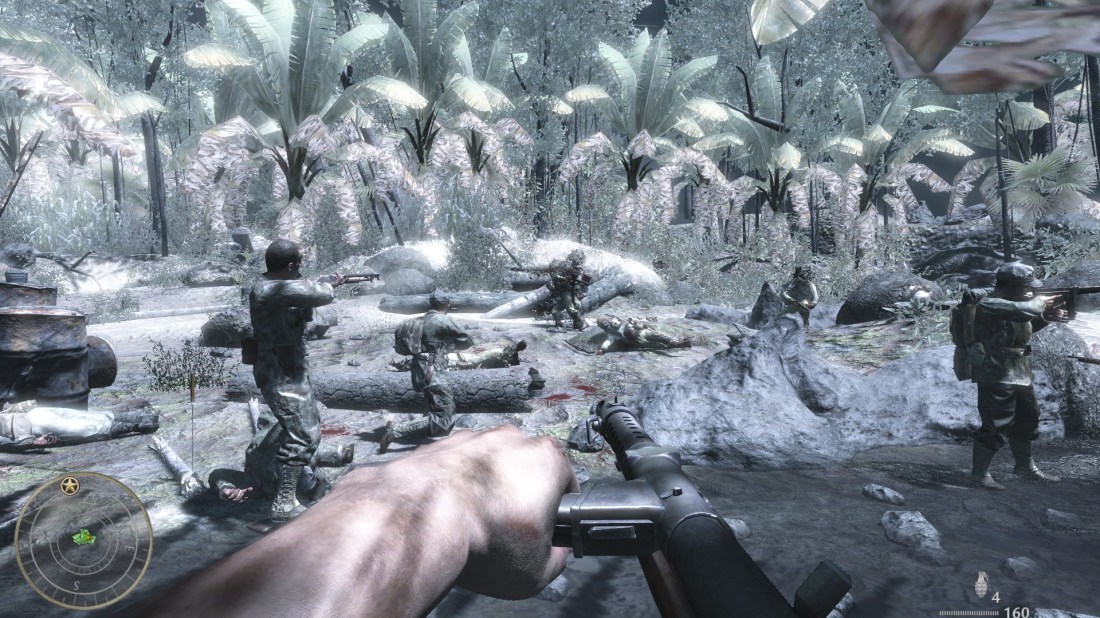
Miller’s levels are exhilarating at first. Idyllic islands ruined by war, a lot of effort has gone into making it as immersive as possible; that is, horrible. The Japanese leap out of the tall grass, from foxholes and out of the trees screaming with bayonets at the ready as we pick through hidden pillboxes and booby-traps. Throughout Miller’s levels there’s an intensity, and it’s most intense when it’s quiet … then suddenly ‘banzai!’ and they’re everywhere. Miller’s missions are about digging out an entrenched and fearless army refusing to surrender, while the US’s response is typically US; kill ‘em all. And that quickly gets tiresome, so much killing.

WaW is very CoD I, but it feels oddly tired. Then again, what else can a war shooter do? And that’s the problem. WaW can’t change its setting but it could add depth, even some flair; in many ways the original CoD did this better, it found ways with the limited tech and setting to make events thrilling, here there’s no limitations but nothing else, just a faithful recreation like you’re playing one of those war re-enactments on The History Channel and it feels flat as a game, and dated as a shooter. What’s missing is a personal story.

You’d expect then, that if the American campaign with its change of scenery didn’t get much of a rise out of me, the Soviet missions where we fight through farmyards and villages as we push through to Berlin wouldn’t keep my attention either. This we have done before. But we’ve never done it with Gary Oldman.

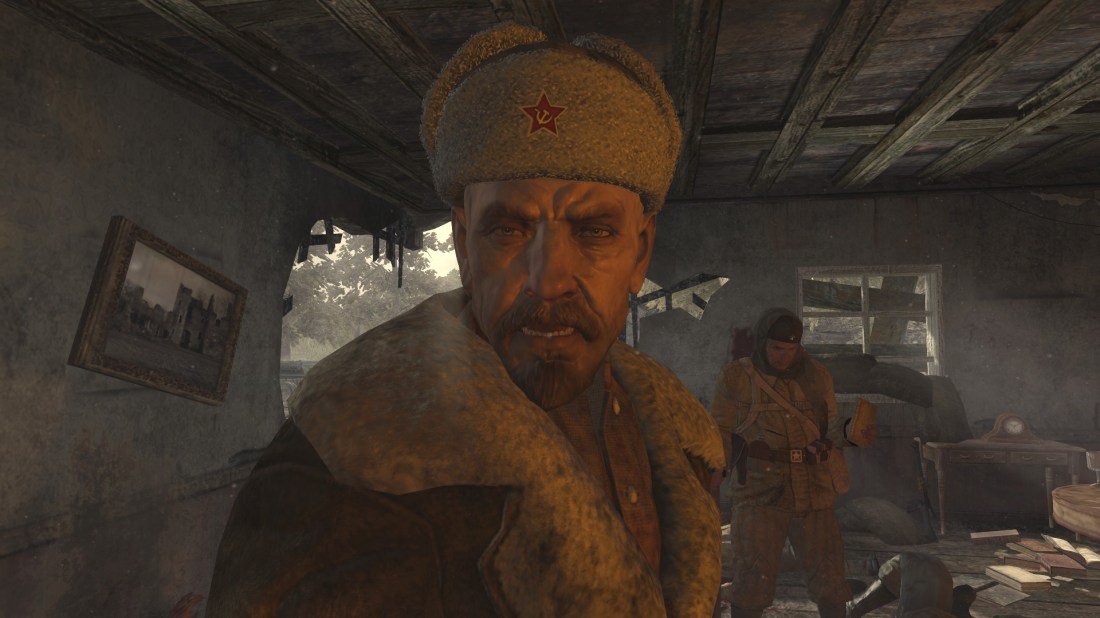
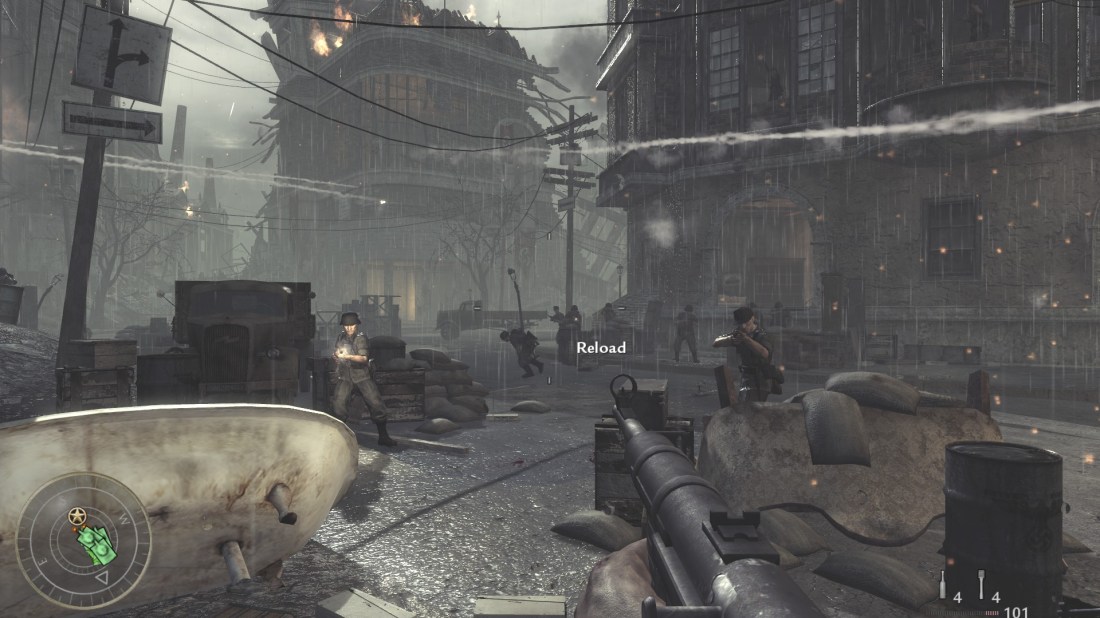
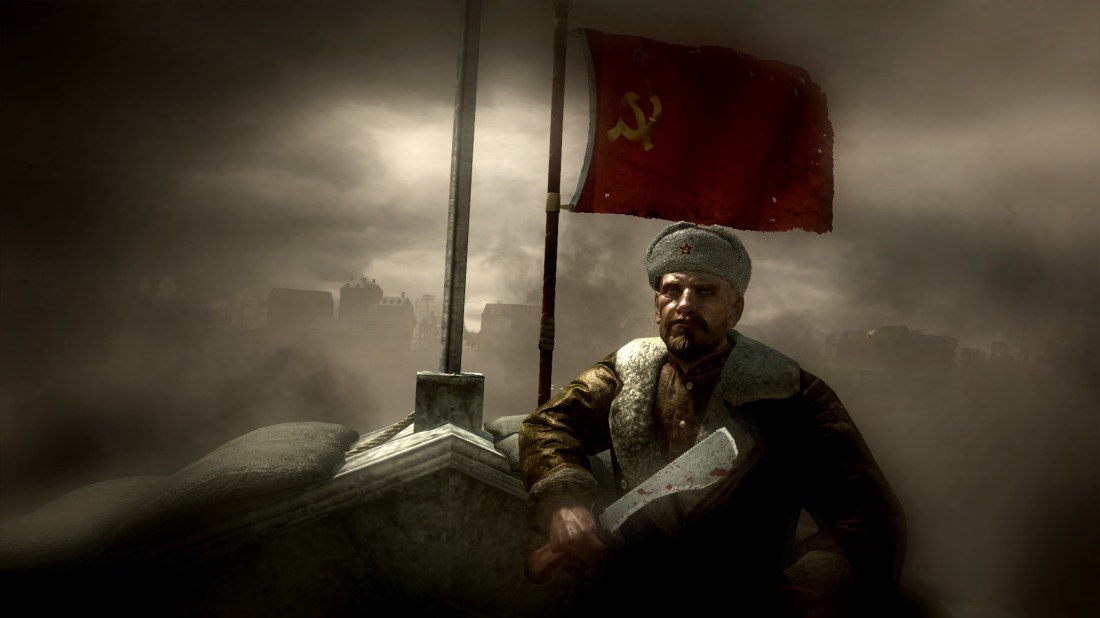
Oldman plays Reznov, a wounded sniper. We first meet lying under dozens of dead soldiers after a German attack cut us to pieces. Rez hands me his sniper rifle and the two of us scramble through a bombed out, occupied city – but Rez isn’t looking for an escape, he wants to put a bullet in the head of the General responsible for those atrocities and leads us into the Germans rather than away from them. The mad bastard.

Rez is certifiable and the best companion in the entire series. He is committed only to mayhem, to causing as much bloodshed as possible. He’s this charismatic, Rasputin-like character who demands everyone die for the motherland; it’s like being partnered with The Joker, what insane plan is he going to come up with next? Every two minutes he’s screaming about killing, telling everyone the overwhelming odds are fine since they’ll be dead soon anyway so might as well take some of them with us. At one point he takes someone’s diary off them, telling them it’s a waste of time since they won’t get to finish it. As you battle through levels all you hear is Rez yelling that we’re not killing enough Germans. Must try harder. He’s like some office manager who’s been on too many Inspire and Influence courses and had a breakdown. Where’s the cover sheet for your TPS report?!

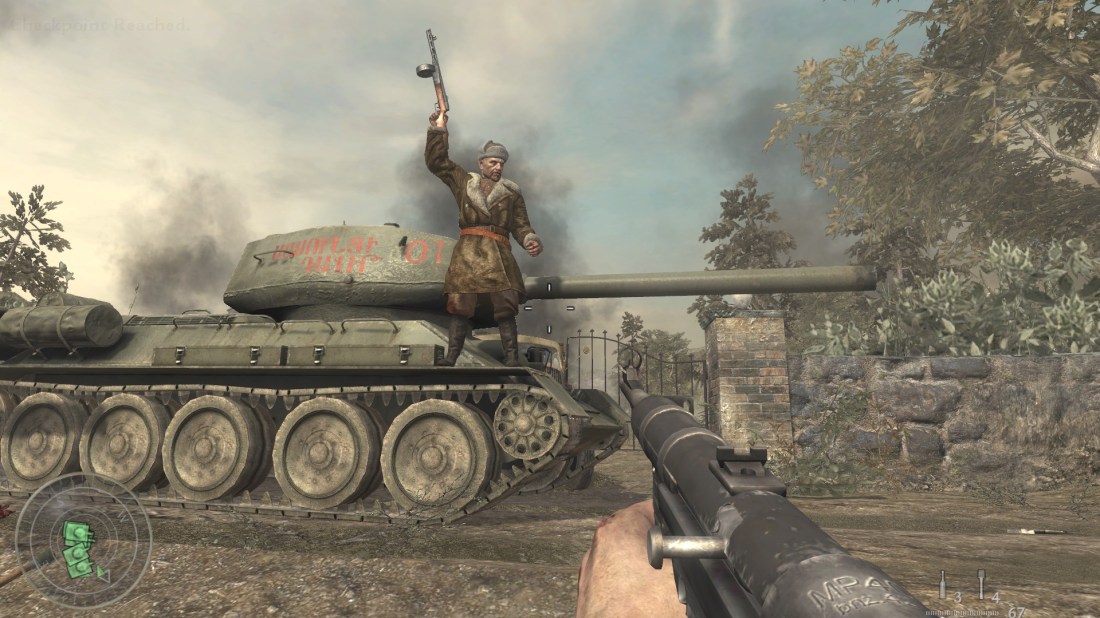
Rez is just awesome and somehow this digital character actually does get your blood boiling. Kill more Germans! He’s a very subtle manipulator; once we’ve survived a few rounds with him, he rewards us with a ride on a tank rather than walking with the grunts, then points us out to them saying they could get a ride if they fought as well as us – you catch him telling new recruits of the legend of Dimitri, using you to inspire more young men to run towards the bullets. Late in the game he makes us decide if we should show compassion by gunning down German prisoners or let them get set on fire. Either option seems to please him. He’s that mate that suggests a swift half after work then you wake up in Faliraki with a new tattoo. I don’t think I’ve had a better sidekick. Most don’t usually encourage me to die though.

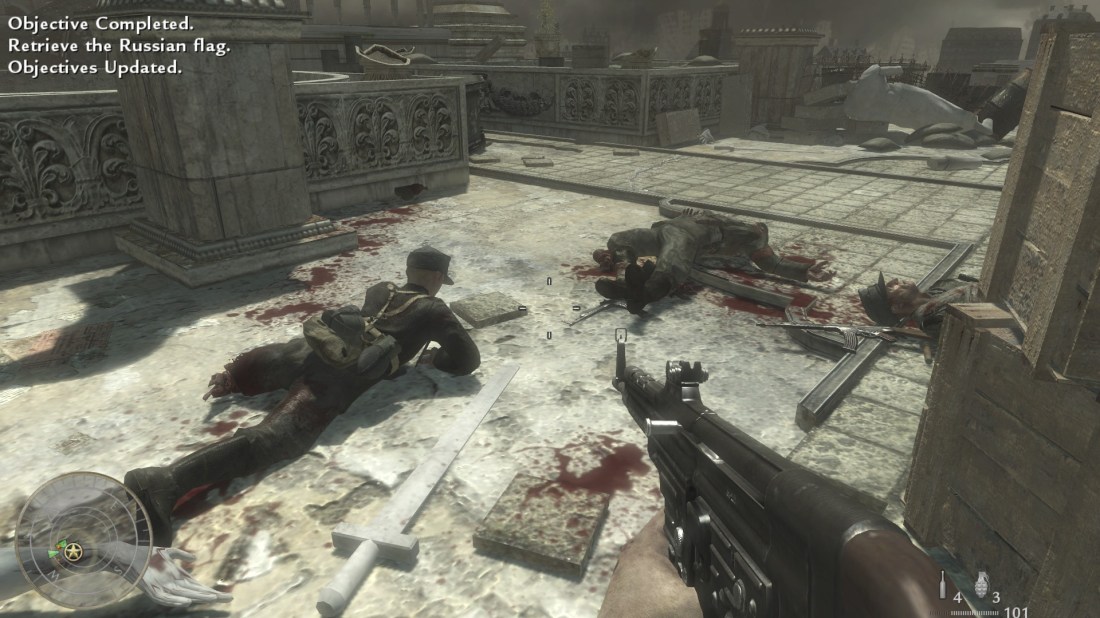
Dimitri’s missions are, on the face of them, very generic. We even get a standard tank piloting mission. But they’re insanely intense, a real scramble. This is the push to Berlin of course, the last Nazi stronghold so you’d expect some resistance but we’re so against-the-odds it doesn’t seem fair. But then we do have Rez on our side. Seeing him slaughtering everything as he goes inspires you to just go ‘fuck it, no one lives forever’. The level design is beautiful though. I really am storming the Reichstag.

WaW is bland, but it also feels very much like Activision closing the door on WWII; we’re playing through two key moments that brought down both the German and Japanese sides, there’s a sense of closure – but much to my surprise, it’s the first fail during this playthrough – no plot beyond setting each level’s scene and objectives, it’s repetitive and it commits the cardinal sin; it re-treads – we stormed the Reichstag in CoD 1. There’s too many shifts into padding characters, no connection with the leads; Rez aside, this is the CoD I grumble about. Thanks to MW’s tour-de-force, I’m more excited to see what the future holds.

Up next is the Black Ops trilogy, is that going to be more MW excitement or where CoD settled into its rinse and repeat release cycle? At least Rez is in it.

Read the next part of FBT’s CoD Playthrough as he tackles the 60s, JFK and the (welcome) return of Rez in Black Ops.

Fallout 3

A blast from the past review

FBT falls-in with Fallout again.

The Past

It’s odd to do a Blast from the Past on a game that’s only a few years old. Sorry? Released 2008? TEN YEARS AGO?! It can’t be, Fallout 3 can’t be a decade old. Have I been frozen in a vault for all that time? I hope not, that would make a terrible basis for a Fallout game. Ten years…

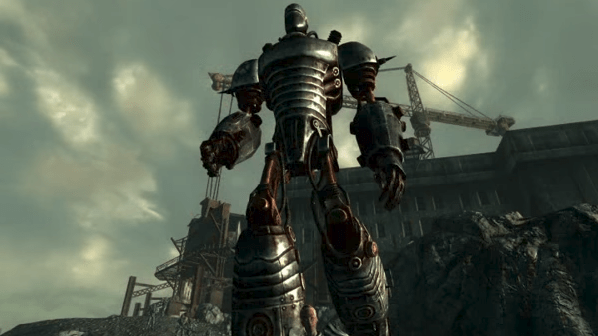
For the longest time F3 was one of my fave games, easily in the top five, but over time it slipped away as I just couldn’t face repeating that huge slog through the wasteland, the impossible scale of it. Until Bethesda took free-roam indulgence to 100 with Skyrim, I couldn’t imagine a bigger game (other than their Morrowind). But although I call it a masterpiece, I just recall endless rubble, raiders and botflies, have flashbacks to never managing to reach my destination without being distracted. I remember having a crush on the off-kilter girl writing the Survival handbook, wearing a ghoul’s face for a mask and everyone chatting to me like it was normal to be walking about like Hannibal Lector. Wasn’t there a giant robot at the end? I know it was all to do with water and my Dad but the more I think about it, all I remember is that rubble, those raiders and damn botflies. I played it multiple times but I think I only finished it once; once all the DLC was added it never ended. It’s time to go be Liam Neeson’s sonaughter again. Ten Years!

Still a Blast?

Oh wow I remembered my own birth. As I go through the classes and appearances it’s a nice character build sequence. Bethesda always did those well, from Morrowind’s immigration questions to this glimpse into who I’ll be as we go from cute toddler to a bratty teen taking their aptitude test. It’s a nice way to get to know myself without being a preachy tutorial. I don’t get to know Mum, who dies in childbirth. Least I still have Dad though.

Dad’s gone! And somehow it’s triggered a riot. I escape the vault, my home for the last two decades, and it’s an oddly bitter-sweet moment. On my first playthrough TEN YEARS AGO I blazed through this sequence itching to get going but this time I’m a bit more relaxed about it. Vault life isn’t so bad. I even try sticking around after the riot but eventually everyone just tells me to leave. The party’s over. Wearing my Fonzie leather jacket and a birthday hat I got for my tenth birthday, I’m well prepared.

Following the original games’ overall story-arc, in 2077 a short-lived nuclear war broke out, with predicable results. Playing off paranoia and threat, “Vault-Tec” had begun building shelters all over the country (in this case, Washington DC) and now they had a captive audience. Vault-Tec added additional tests, events and scenarios to better understand human nature or something probably more insidious. Those in the vaults created their own societies for two hundred years, while outside, survivors and Vault-escapees did the same.

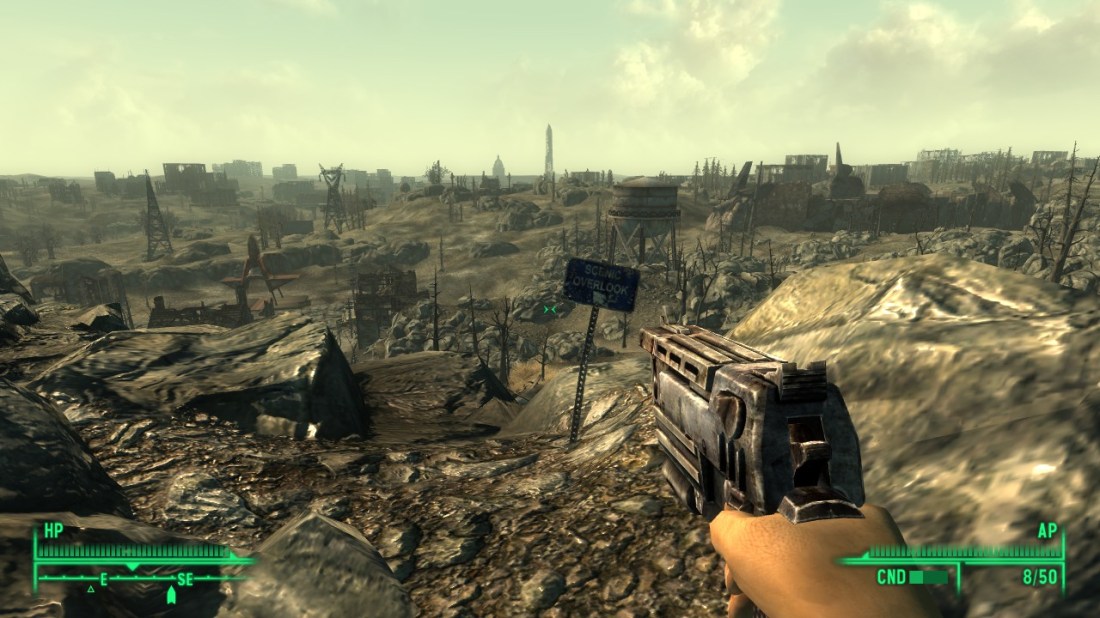
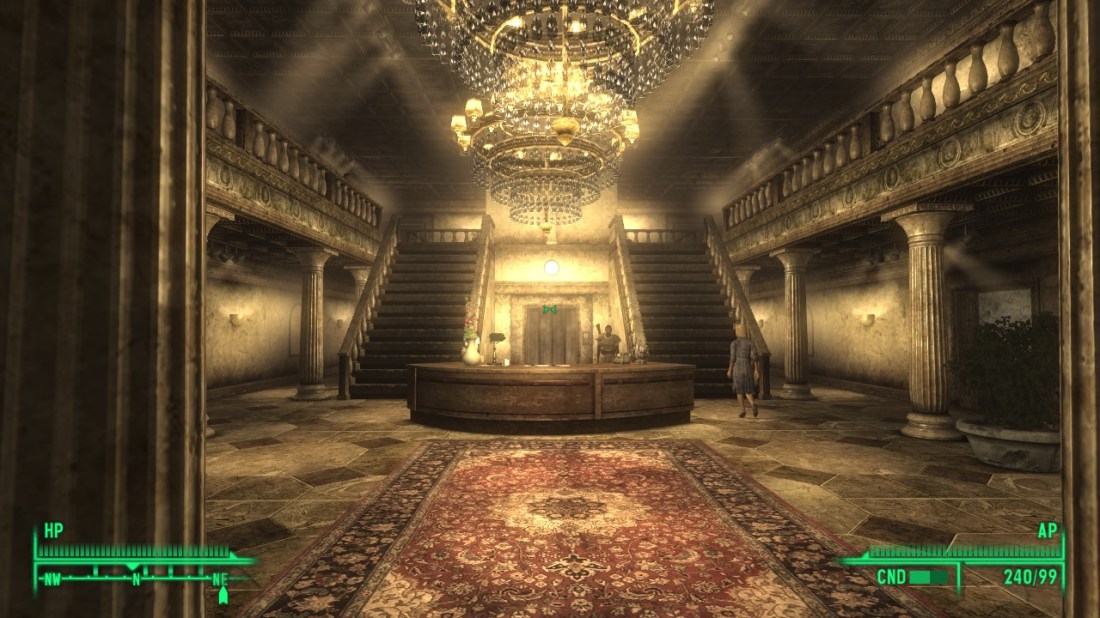
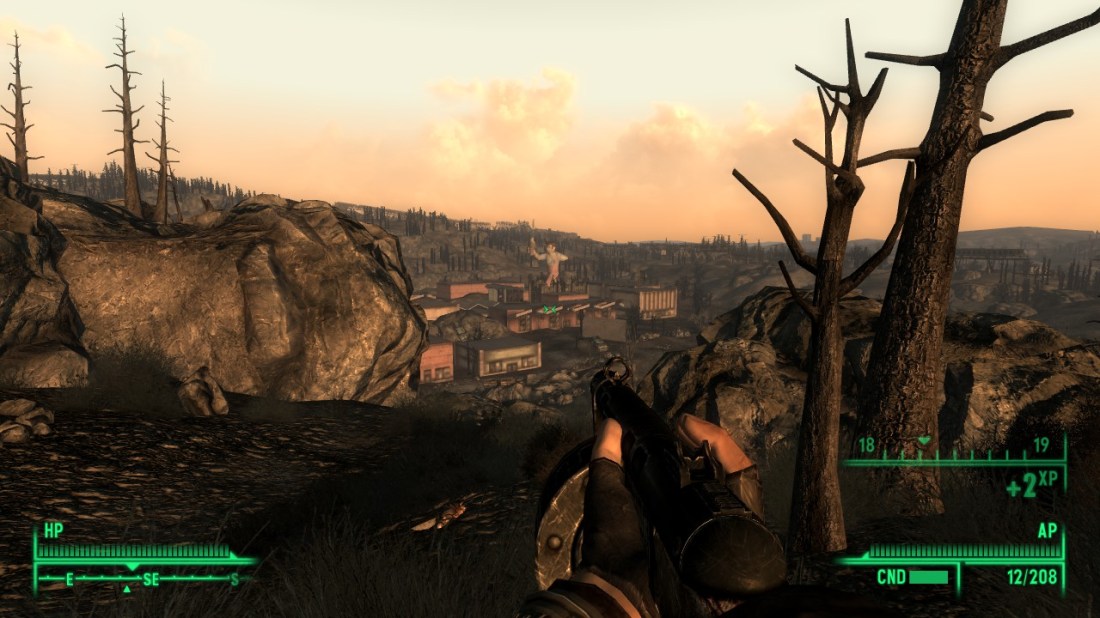
Stepping out into the wasteland still packs a punch. For a decade old F3 still looks great; games might have more pixels now but it’s all about belief and for all its sci-fi, F3 feels real. This is the aftermath of a nuclear war. In this reality though Apple never got out of Jobs’ garage; their style over substance approach is nowhere to be seen (maybe somewhere there’s a Vault that looks like an Apple Store). F3 is one of those fifties ‘the world of tomorrow’ films come to life. An over-designed, art deco, Vic-20 meets Nostromo world buried under an apocalypse. Ten years on and I’m still marvelling; Bethesda know how to build a world. Fallout 4 might have watered down the memory with its retread but this feels more gritty, more real; the immediate danger has passed but there’s no real hope of rebuilding. Instead, folks are eking out a living the best way they can; I just came from a vault which while restrictive, was safe and had water that wasn’t eradiated.

It turns out that’s what Dad was after all along. He was a huge fan of bottled water and his project, Purity, was a way to cleanse the area’s water and the first step towards rebuilding civilisation. But it’s taken a huge amount of steps to reach this point. Like all good RPGs, you follow the mission marker less ‘how the crow flies’ and more like ‘pissed bumble bee’. It’s impossible to walk in a straight line. There’s hundreds of things to go look at and those things have things in them that you spend hours ferreting through or send you off looking for other things that you don’t reach because other things. I’d forgotten how hard it is to get anywhere without being pulled somewhere else. What’s that?

The main mission is brilliantly done; our character has questions, there’s a nice tension between me and Pa, and Dad realises his kid doesn’t need him anymore. You can play the character as pissed off, indifferent or desperate but no matter how you react, nothing will be the same again. As you attempt to finish Dad’s Purity Project, you draw the attention of the Enclave, a remnant of the previous government who realise controlling the water is a means to reasserting power – coincidentally that’s the plot to Tank Girl and both antagonists are played by Malcom McDowell. I’m also dressed like Tank Girl.

It’s fun to dig into your inventory and work out what items you can cannibalise, although it’s not as detailed as I remembered, especially with the weapons. Similar items can be folded into others to raise their stats, but you never really alter or jury-rig stuff the way you should, leaving you to carry multiples of everything, weighing you down. Mostly you’ll be carrying junk, digging through everything like Steptoe in the hopes of uncovering something valuable – or a bobbypin so you can unlock items to find more junk. Although this does feel a bit endless and slows everything down, I’m still enjoying wandering eerie old schools and decrepit Nukacola factories hoping to find something. Usually bloody radroaches. Usually.

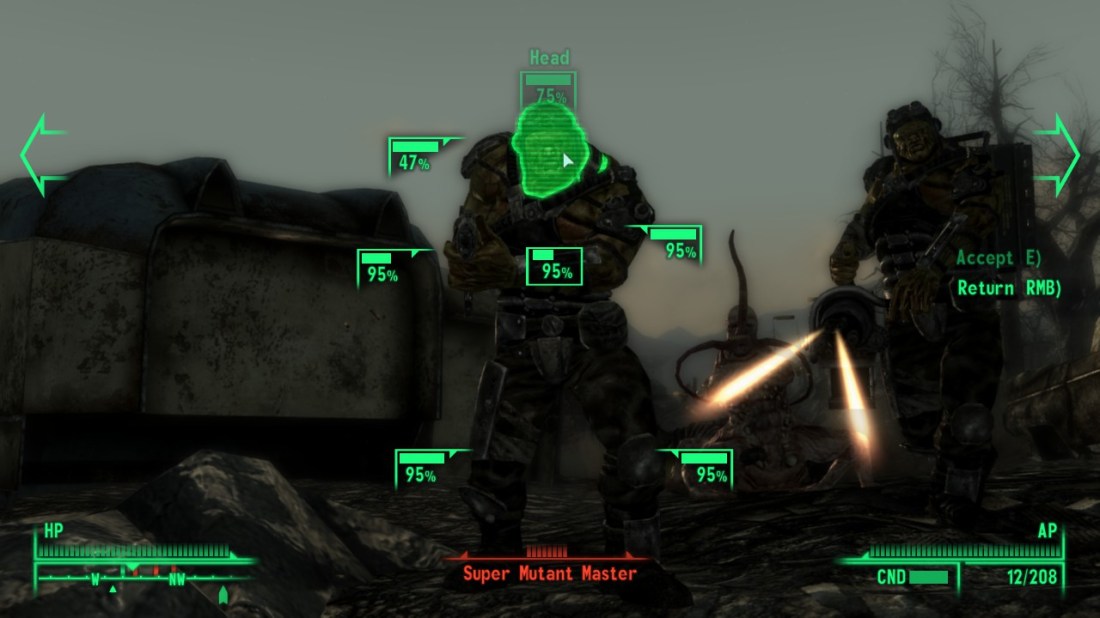
There’s a whole host of beasties to battle, and to help there’s the VATS system, which stands for something. You can pause and pick where you want to aim and you’re given a percentage of how likely the hit is. It’s a bit like an intellectual’s Bullet-time but fun watching the shootout in slow-mo. It’s also fun using VATS to fatboy a botfly. Swatted the bastard.

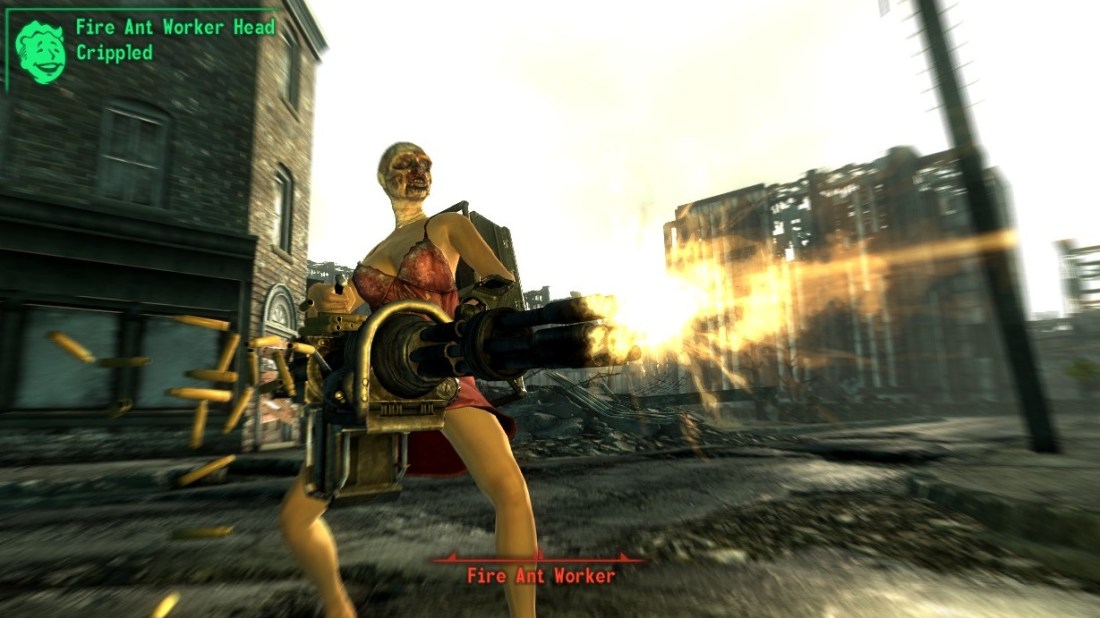
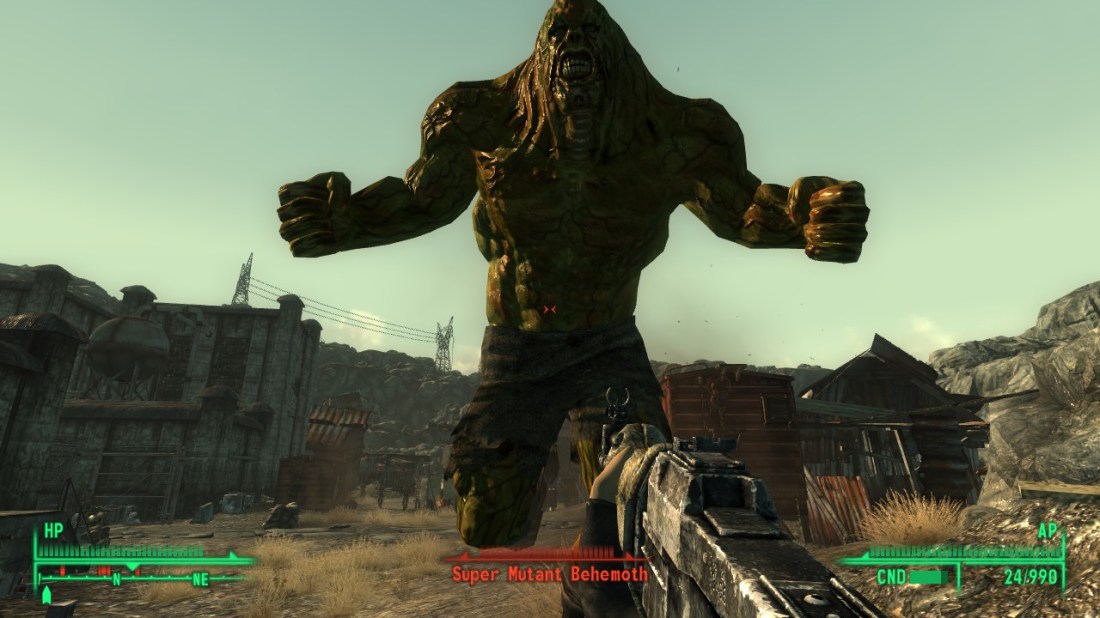
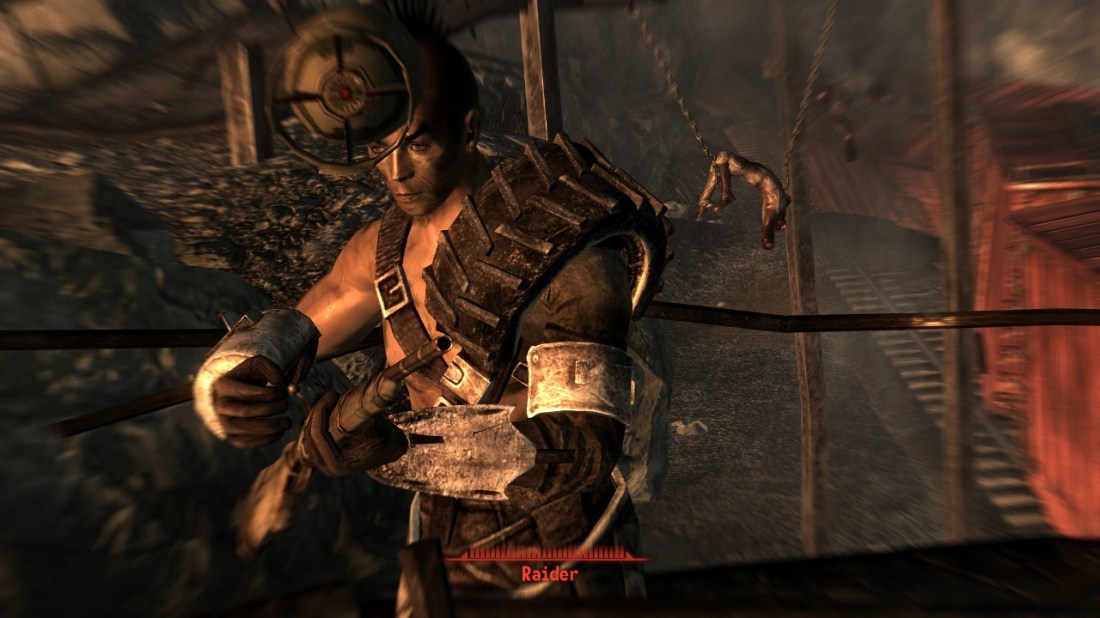
But, the botflies and radroaches soon give way to speedy giant scorpions and Guai; I’d forgotten about those werebear things; but I hadn’t forgotten about the bloody Deathclaws, apparently a war-time super-weapon gone awry. Also very awry are those Super-Mutants and their side-kicks, those nightmarish Centaurs. There’s also the ghouls, folks who survived the nuclear fallout but lost their sanity (and looks, but not their clothes. Even zombie America is concerned with modesty), and giant ants referencing the infamous fifties movie Them! but mostly we’re fighting raiders who figure the best course of action is swing a lead pipe at the gal in power-armour. When Fallout was adopted by Bethesda, there were grumblings from the original series’ fans that it would become The Elder Scrolls, and to be fair, it has. This is Oblivion without spell casting, but it’s a lot more focused and you do more digging around, and the setting is much more relatable. Plus, no Oblivion gates popping up every ten feet. It is its own game and ten years on I’m still finding new areas, new experiences and loving the post apocalypse.

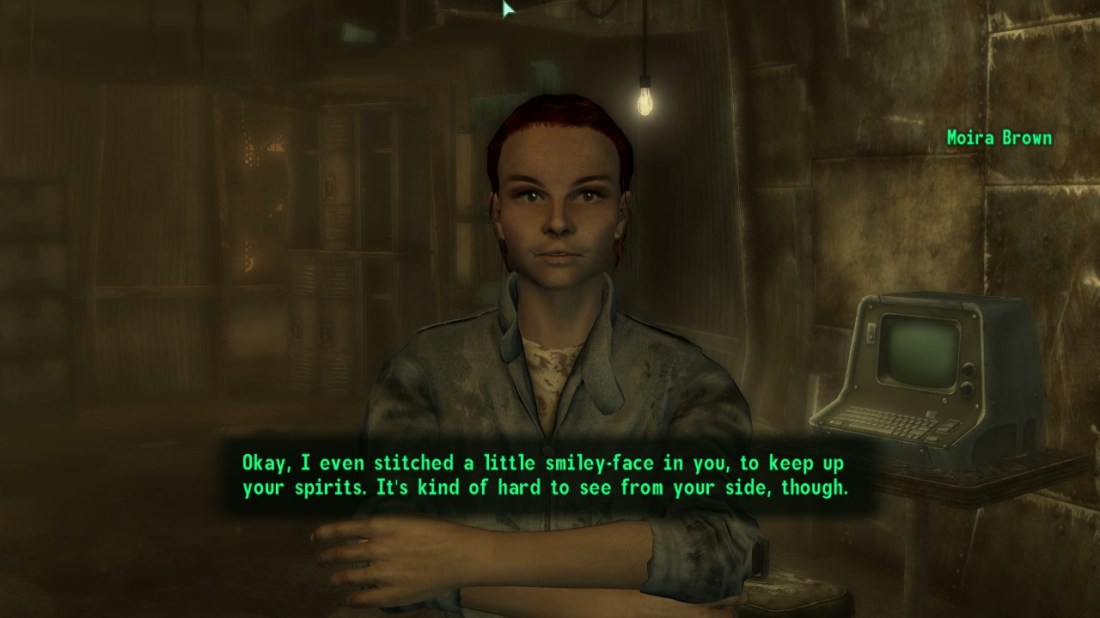
The good thing is, unlike more recent RPGs (like Fallout 4), the main story is nicely non-urgent. Almost from the outset Dad says the water purification project won’t save the world and it’s freeing to not be that heroic, to not have pangs of guilt when I return to Megaton again to offload junk then go do something for folks who need this, want that, send you there. We’re getting a priest to realise he’s in love, putting a stop to cannibals (or not), and researching lovely Moira’s Wasteland Survival Guide. We’re looking for old civilisation artefacts, rescuing folks from Super Mutants and Slavers – unlike Fallout 4 and Skyrim’s disheartening ‘radiant missions’ this feels more realistic than endlessly visiting a smug Jarl who’s yet again bitching about a Dragon that’s outstayed it’s welcome. Instead, there’s just enough to lone wanderer into. Unless your lone wanderer prefers company.

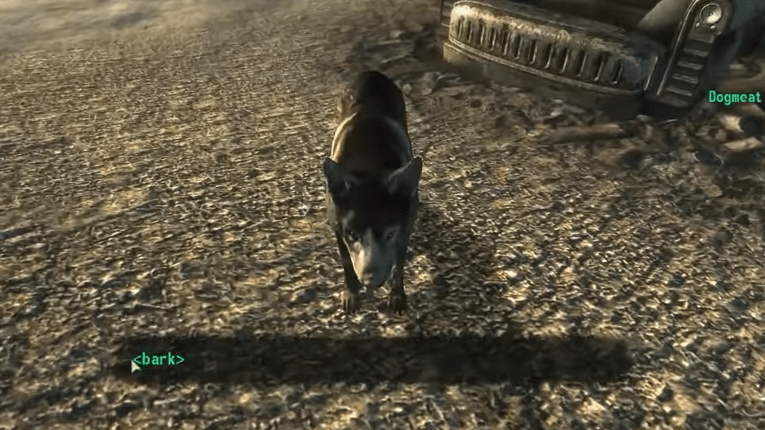
Unlike Oblivion, followers are more than bullet-catching NCPs. The best is Dogmeat. A mutt we rescue, he becomes a doggo liability, running off to attack something ten times his size, falls off cliffs and constantly get in the way. After a short while I leave him at my digs in Megaton, terrified I’ll lose him. There’s various mercs, thrill-seekers and more than a few quest-related folks who make life interesting by following then disappearing, getting stuck or dying and leaving the mission unfinished forever. Followers haven’t been quite perfected in F3 and they kind of undermine the ‘Lone Wanderer’ shtick our character is rocking, but at least they can carry stuff for you. Just don’t give them anything valuable.

Another Oblivion nod is the Karma system. This was much better utilised in New Vegas, here it means getting pestered by do-gooders and having marginally better dialogue choices, but also draws the attention of mercenaries who don’t like nice people. If you decide to be a mercenary yourself, the ‘Regulators’ come after you instead, and being a dick doesn’t block you from mission opportunities, just more evil options once you’re mean enough (bye, Megaton hovel, hello penthouse in Tenpenny Tower).

I’d like to say a lots happened since F3 was released, but … has it? Playing this now, I realise RPG hasn’t moved on, it’s just repeated itself. F3, along with Oblivion, got it perfect and as I play and remember moments, events and set-pieces I realise how much Fallout 3 informed my expectations of RPG. It’s good. When’s the last time you had a hundred-foot-tall robot as a follower? F3’s scenery does become samey but there’s so much layered into the game that it becomes more than endlessly clambering over a tip. The loose societies and clans that have sprung up, the communities like Megaton or Rivet City and heavy-handed groups like Enclave and Brotherhood of Steel – this is how its going to go when someone finally presses the button.

When you add in a compelling but unpressured main story, tons of side-missions and events, and some stellar characterisations and observations, you’ve got a decade old game that’s timeless. Graphics might continue to impress and advance, and one day Fallout 3 might seem creaky and basic, but it’s spirit will still be indomitable and that’s missing from modern RPG; Fallout 4 and Skyrim included.

Like lovely Moira’s Wasteland Survivor’s Guide, Fallout 3 should be required gaming for anyone planning on taking up RPG so they understand how it’s done; and it should be a tutorial for anyone planning on developing one – and that includes Bethesda. Fallout 3 is back in my top games list. Play Fallout 3; make Liam Neeson proud.

2008! Developer; Bethesda Softworks | Publisher; Bethesda Publishing

Platforms Win, X360/One, PS3

Call of Duty Playthrough Pt 2 – Modern Warfare Trilogy

Second Wind Playthrough Special – Call of Duty

Part Two, The Modern Warfare Trilogy

FBT leaps into the future, when he thinks CoD went a bit shit. Is Modern life rubbish?
CoD I & II thankfully are still great games. I can’t see why Activision shifted away from the era so quickly – I missed out on CoDIII so maybe the setting was getting a little tired, but still; was creating an entirely fictious war in a modern setting wrong or brave? Surely that means a story is key here? I’m playing all those CoD’s to prove story matters in FPS; if you’re going to invent a something you’d better convince me it’s worth fighting for. For me, MW signalled the beginning of the same old experience rehashed over and over. Not that I’m pre-judging it or anything. Let’s get this crap over with.

MW 1 – Whinging before I’ve even clicked on ‘new game’ is text-book pre-judging but the one thing I’m not looking forward to is CoDs multiple perspectives. I want a constant hero I could get behind, not interchangeable arms that exposed how repetitive CoD was. If they provided an alternative take or showed the impact of our actions that would be something, but they’re not different perspectives just different angles – just once I’d like a CoD character to be an innocent bystander trying to escape the madness. Surprisingly then, MW1 does exactly that, as we play the President of Iraqistan or somewhere. Only able to move my head, the about-to-be-new president Al-Fulani shoots me in it; well that was a unique perspective.
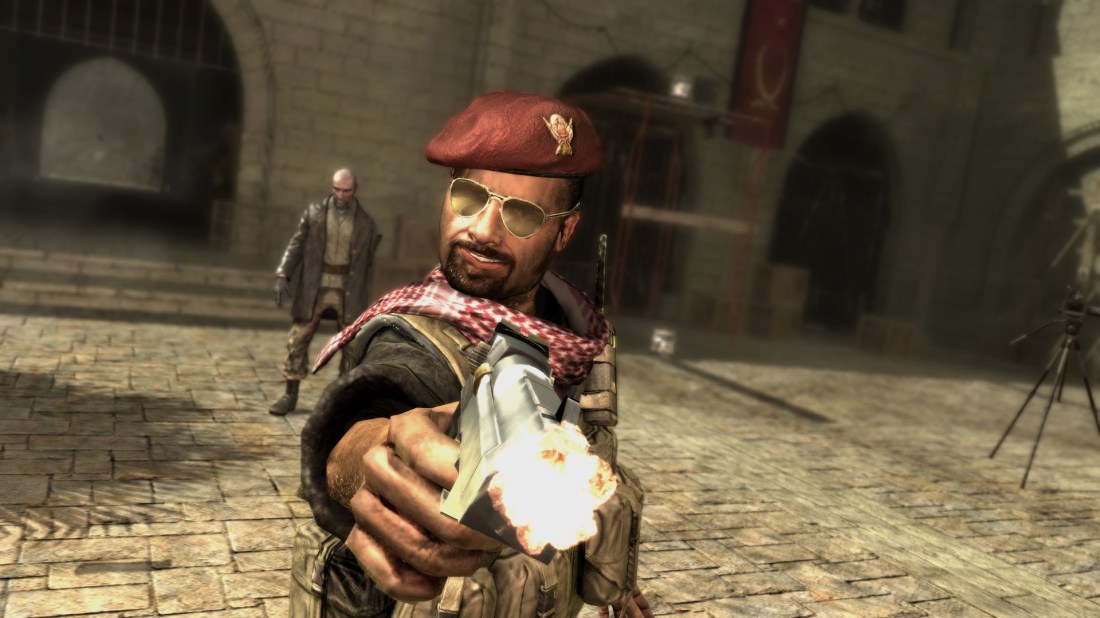
The oil-rich country with a new US-hating dictator worries the West; when an SAS team uncovers a connection between Ultranationalists within the Russian Government and Iraqistan – a nuclear weapon – the US invades Iraqistan while the SAS contend with the Ultranationalists who have provoked a civil war in Russia. Holy shit, that’s a story.

The US invasion levels are basically Black Hawk Down the video game. It’s extremely jingoistic fighting as ‘Jackson’ through the streets of Iraqistan but like all good propaganda, I’m swept up and killing with glee as we seek to dispose Al-Fulani; Go Democracy! If I wanted a subtle comment on US war policy I’d have played Homefront or The Line – which I have, and they’re thought-provoking. This isn’t, but it’s hella fun.
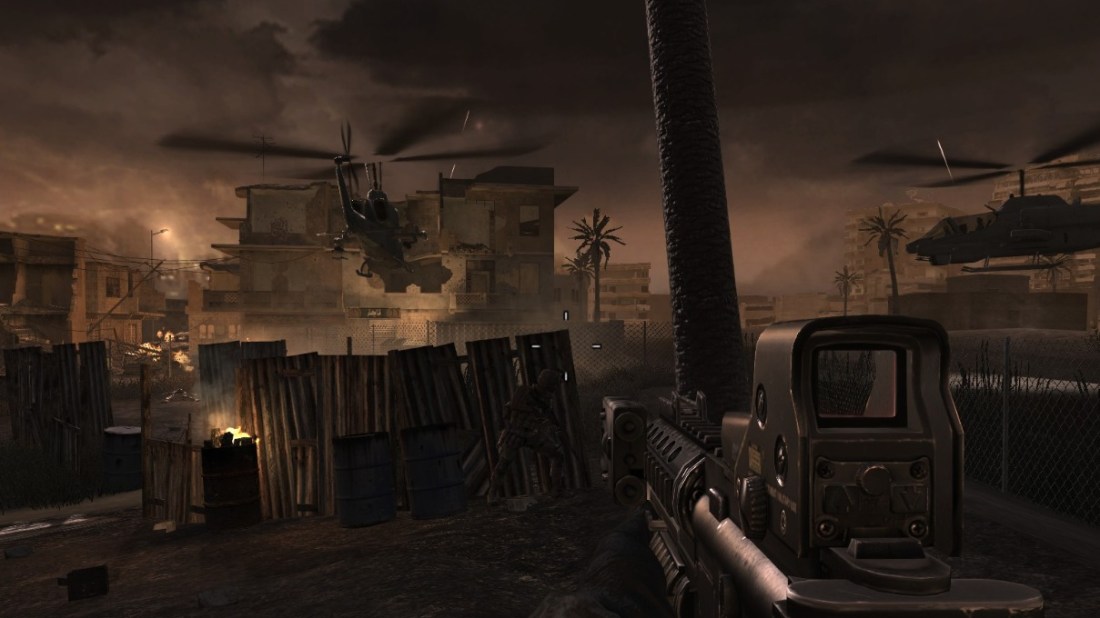
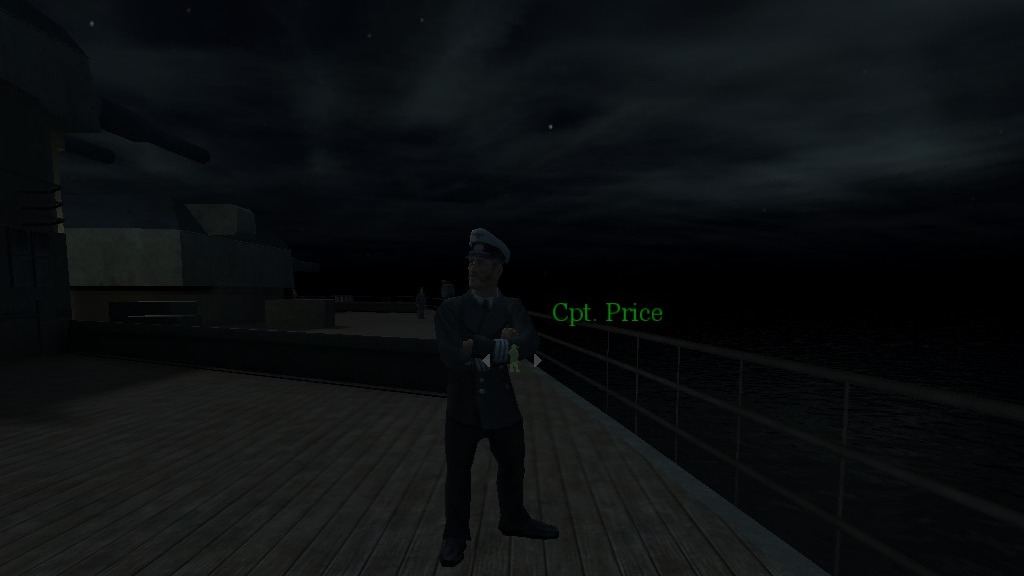
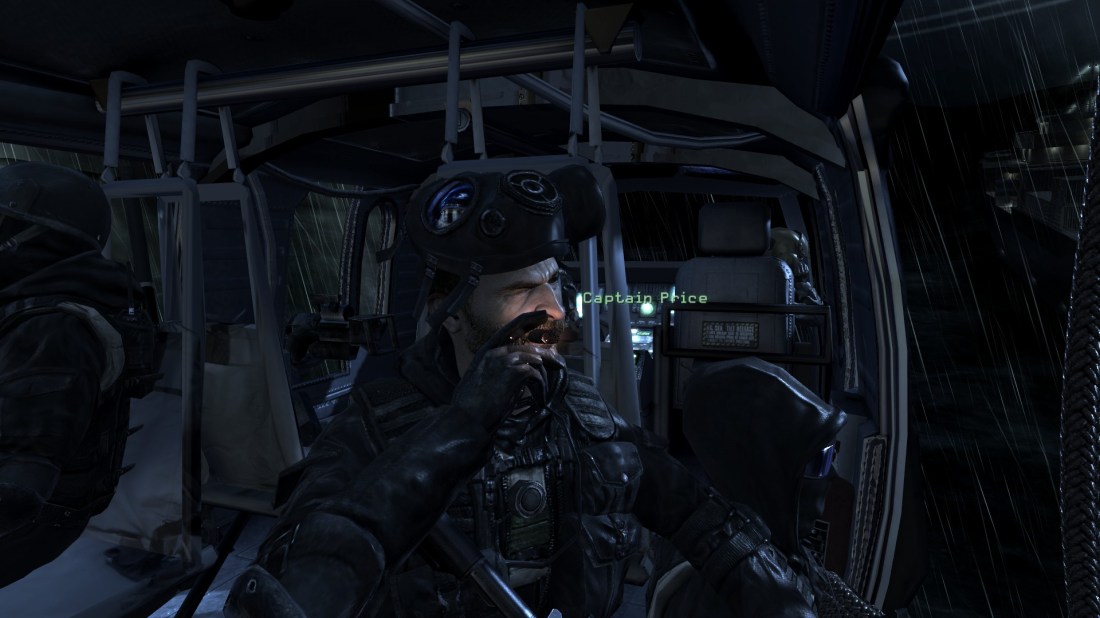
The SAS missions, playing as ‘Soap’ are a lot more pressured and stealth based; I seem to spend a lot of time staring at the backside of Price, my commanding officer as we go prone and wiggle about disrupting the Ultranationalists plans with zero presence. Except, I keep swapping a silenced peashooter for a sexier looking local’s gun … I’m less SAS more SASS but luckily, I’m forgiven when I ‘go loud’; you just get yelled at by Price. If you make it.
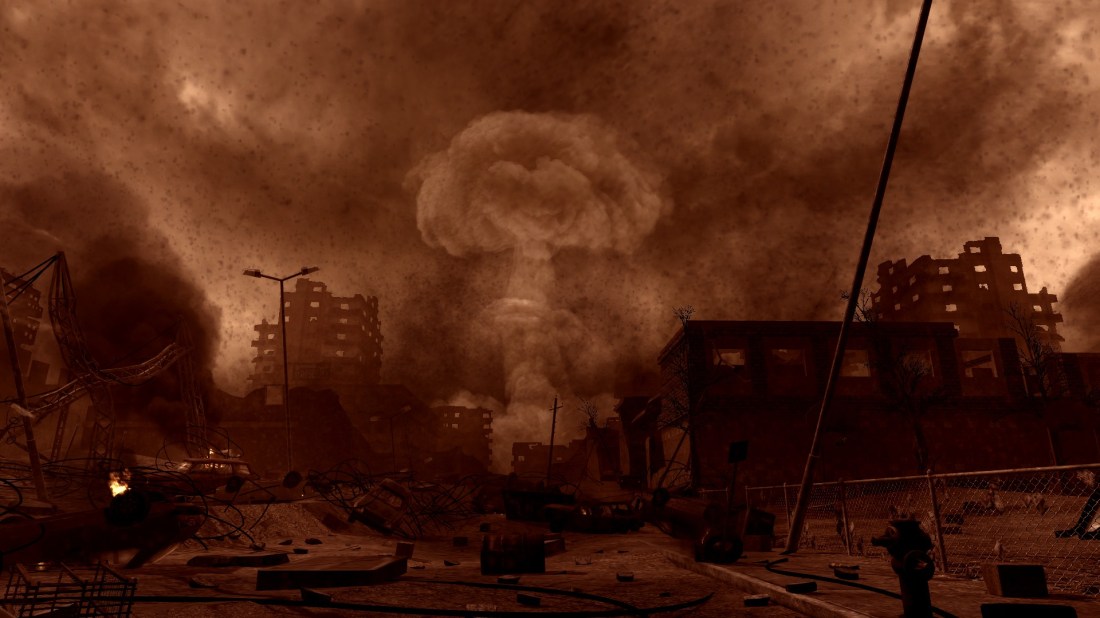
Flipping between gung-ho and go-quietly can be jarring, as are the occasional shifts into entirely different characters, usually observing or supporting, but it’s not as disruptive as I thought. Because I don’t care about them. And this gets hammered home during the push on Al-Fulani’s stronghold. It’s a huge, exhilarating level, playing as a chopper gunner clearing a path as Jackson fights through the streets, until Al-Fulani detonates the bomb … Jackson succumbs to the blast and it’s a shock. Heroes don’t die. But then I realise Jackson isn’t a hero in the same way a game’s hero usually is; he didn’t do anything heroic, didn’t have a boss fight with Al-Fulani, he was just a grunt – no offence. But, within seconds I’ve forgotten all about Jackson – it’s just another mission end. On with the show.
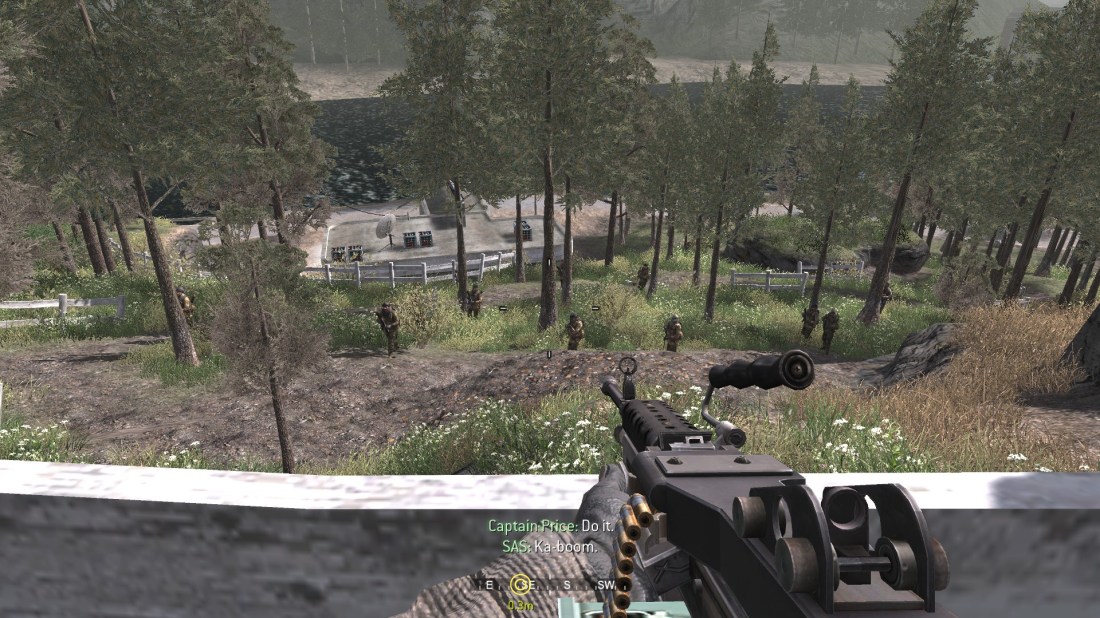
Some levels are real standouts, like a flashback to Price on a mission in the ruins of Chernobyl – which punctuates a brilliant level where we’re in a running battle while waiting for extraction. That’s a typical shooter mission but the terrain is complex and it’s tough as hell. It could have been avoided if Price hadn’t made us all listen to story time while the enemies closed in, but I wanted context … The US missions, while essentially all the same are always just the right side of ‘shit that was close’. A desperate rush to save the pilot of a Black Hawk down is great, as is the SAS’s final run to stop the Ultranationalists. I keep expecting this to get samey but it doesn’t. MW1 is great. It’s an intense shooter and a pretty good story-arc. What’s going on here?

I think MW2 might be the most conflicted game I’ve played. On the one hand it’s an absolute master-class in intensive, urgent shooters. But it’s also a victim of its own success. This is the game the rest of the CoDs tries to beat, it’s here that I see almost every other game in the CoD series. This is the template, this is the game we’ve been playing ever since.
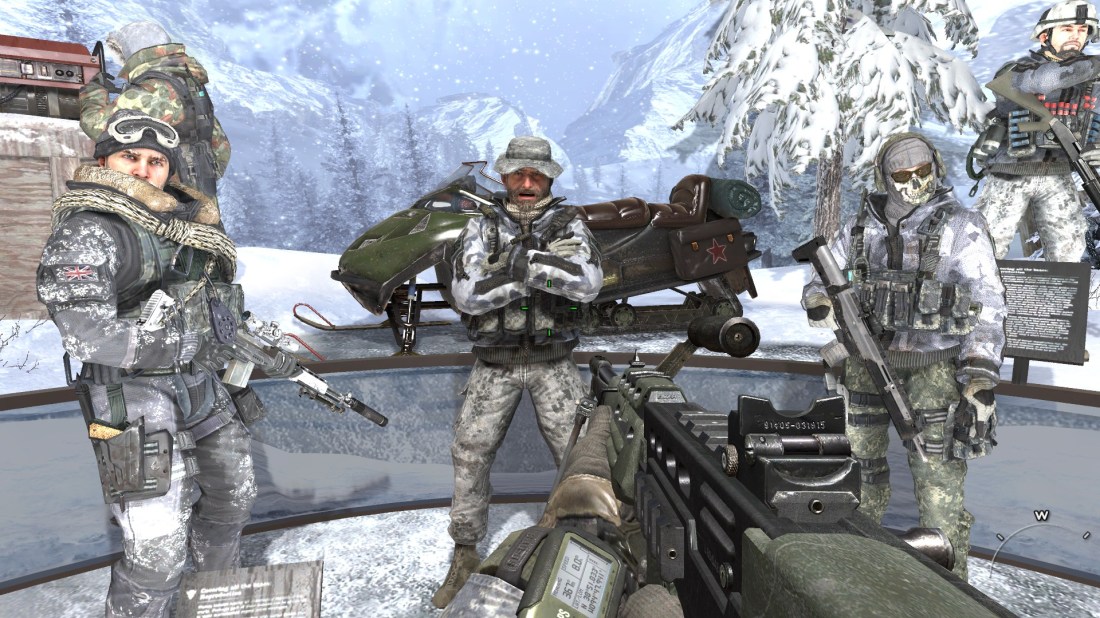
The SAS chaps are now ‘Task Force 141’, led by Soap, who is a lot more capable than he was in MW1. Because I’m not playing him; instead I’m ‘Roach’, and I’m Private Allen from the Rangers, who’s abilities during an insurgency put-down in Afghanistan gets him assigned to a special mission. I wonder what that can be?

It might have something to do with Makarov, the Ultranationalists’ new leader who gets the Russian people riled up about the West and eventually provokes war. We’re splitting our time between Roach, as the TF141 try to scupper Markov and now Ramirez, an Army Ranger fighting on US soil as the Russians invade. While TF141’s missions are a bit more urgent this time around, and take up the bulk of MW2, Ramirez’s stuff is actually a lot more interesting. Fighting around American Suburbia when the Russkies invade just makes for a more refreshing landscape and a more relatable fight than MW1’s Desert Storm or even Soap’s tail-chasing here. So if I’m now Ramirez, where’s Allen? What’s he got up to?
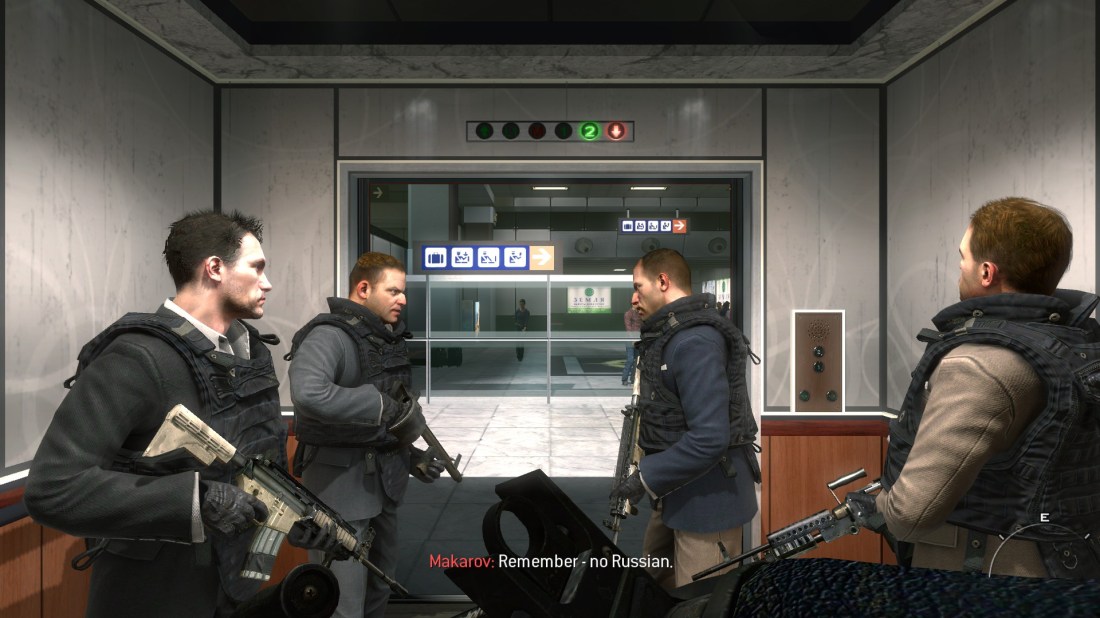
Allen was embedded with Makarov’s men and enters a busy airport – where they slaughter everyone before Allen is left for dead so the US is blamed. As a catalyst, ‘No Russian’ is one of gaming’s greatest scenes; a mature, serious look at extremists and how they manipulate fear and anger. It’s grotesque and shocking – exactly how it should be, except for the fact we’re a willing participant in it.
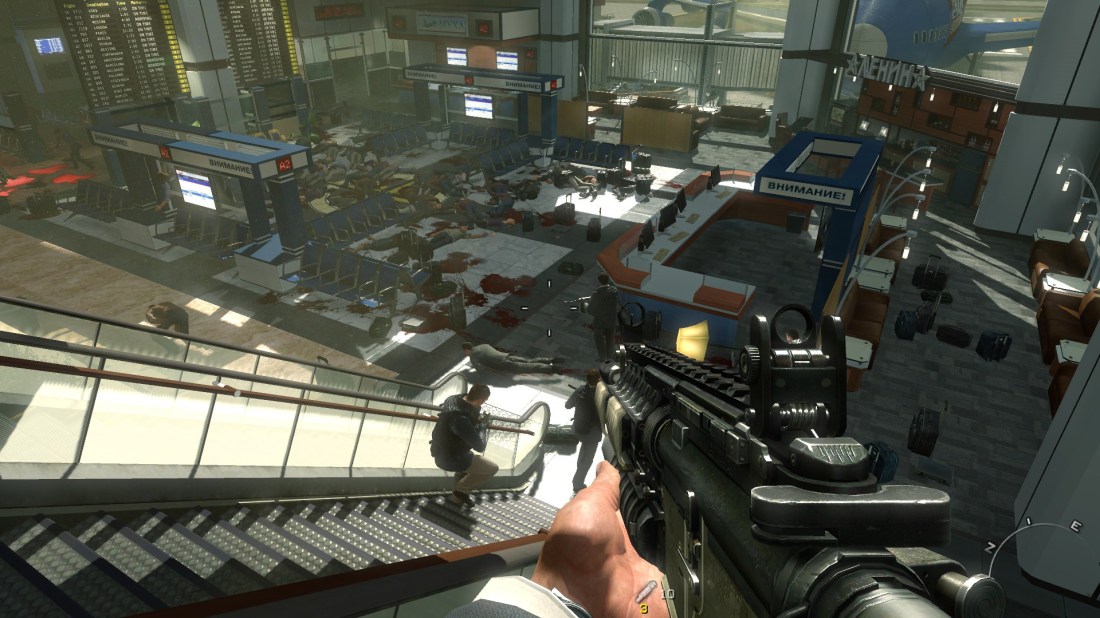
The game asks if you want to skip it, but you don’t, and Activision claimed you can just observe but that’s not true. You’re in a running fight against SWAT teams, and trying to get past them using only defensive moves is impossible; no matter how hard I tried, I couldn’t stay innocent.

The most unpalatable part is that we don’t understand why Allen went along with it. This is where story is critical. We’ve not gained any insight into him or his mission – there’s undercover and then there’s complicit. It makes no sense Allen would let this happen; he goes from tutorial to terrorist, was he turned by Makarov? It may be critical to the plot that I’m a patsy but if I have control, I should have turned the gun on Makarov. Why didn’t I? Only a story can explain – and justify – this. But I’m forced to go along with the atrocity with no context and that makes it uncomfortable. A cut-scene would have done.
Although it’s not made clear, the most likely candidate for Allen being exposed is General Shephard. We discover his duplicity too late of course, after watching him immolate Roach; Shep wanted revenge for the loss of his men in MW1. Which is lame, a typical action-movie cheat like they needed a twist at the end. He wants revenge for his men dying by provoking a world war? But then, massacres aside, MW2 isn’t really concerned with complexity. It’s a Boy’s Own Adventure just like CoD I. And what an adventure.
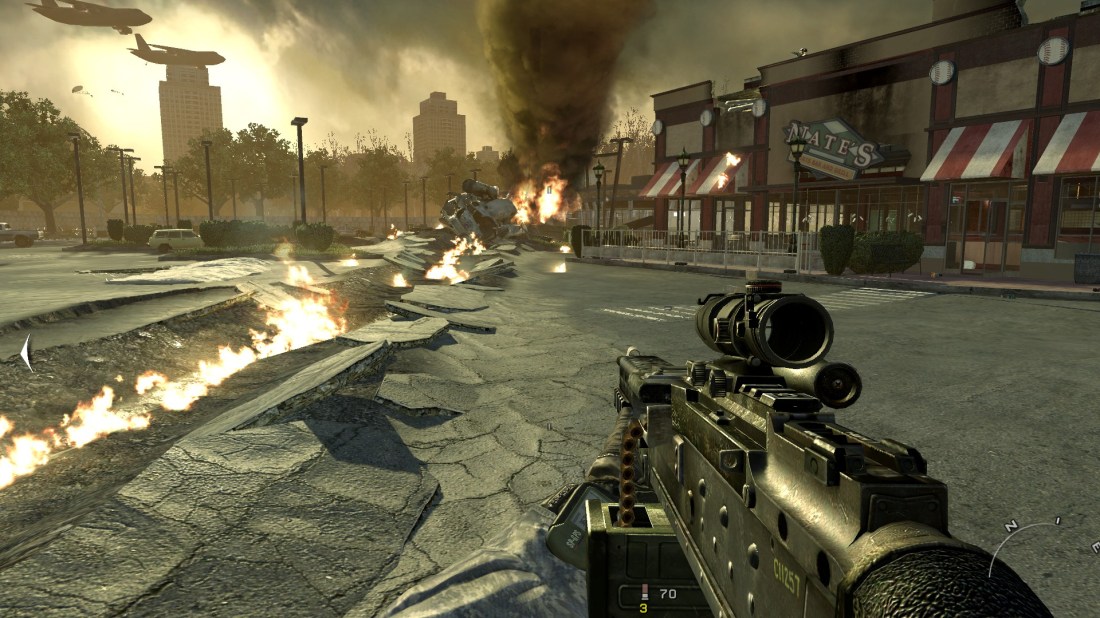
MW2 is epic; there’s not one duff level, not one draggy mission. There’s a great stand-out early on, a fight in a fast food shop – what could be more American than defending junk food? While MW1 recalled CNN’s Desert Storm coverage, MW2 does go Michael Bay; there’s even a The Rock nod where we fight in a shower room after storming an Alcatraz, and Rodriguez’s missions end with us lighting flares to stop a bombing run.
As a story it does the job; just interesting enough to push us through the levels. The narrative is a bit convoluted though, if we had a chance to stop and think about it; the most jarring is where we go to rescue Price from a Russian prison. I just don’t get why we hadn’t bothered to get him before now, why Soap never questioned his disappearance. It’s not even explored. Why he’s needed isn’t clear either, other than he’s the one guy Makarov is afraid of. No explanation why, Soap’s the one who shot his boss in MW1 and Price doesn’t have any info that really helps bring him down yet he suspects Shephard; but doesn’t warn TF141 of his suspicions until it’s too late. I’ve just been set on fire Price, anything you’d like to share?

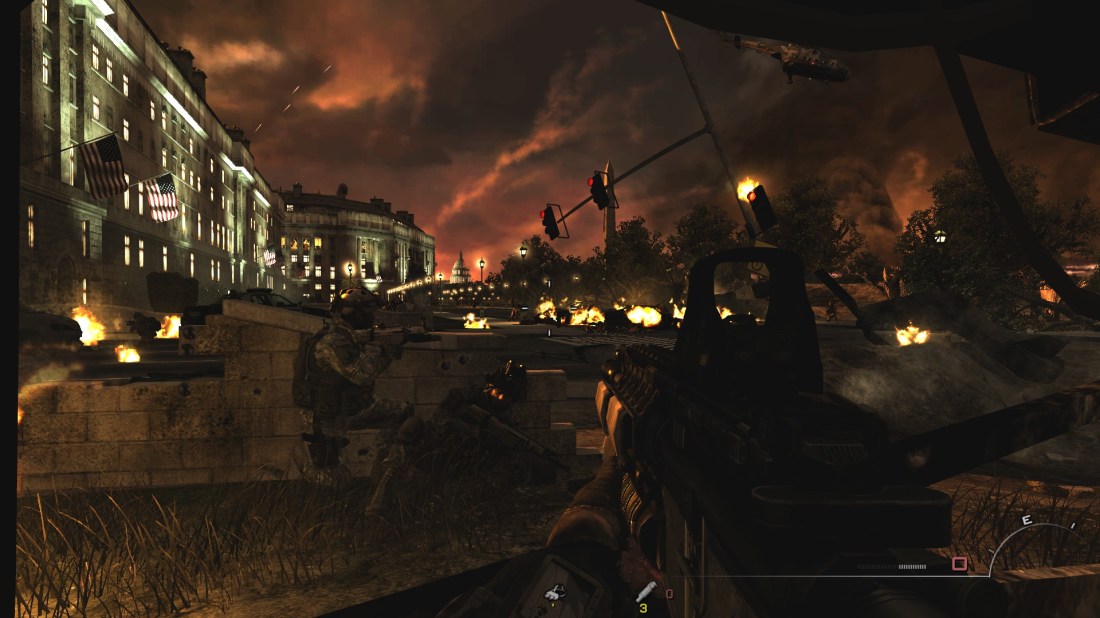
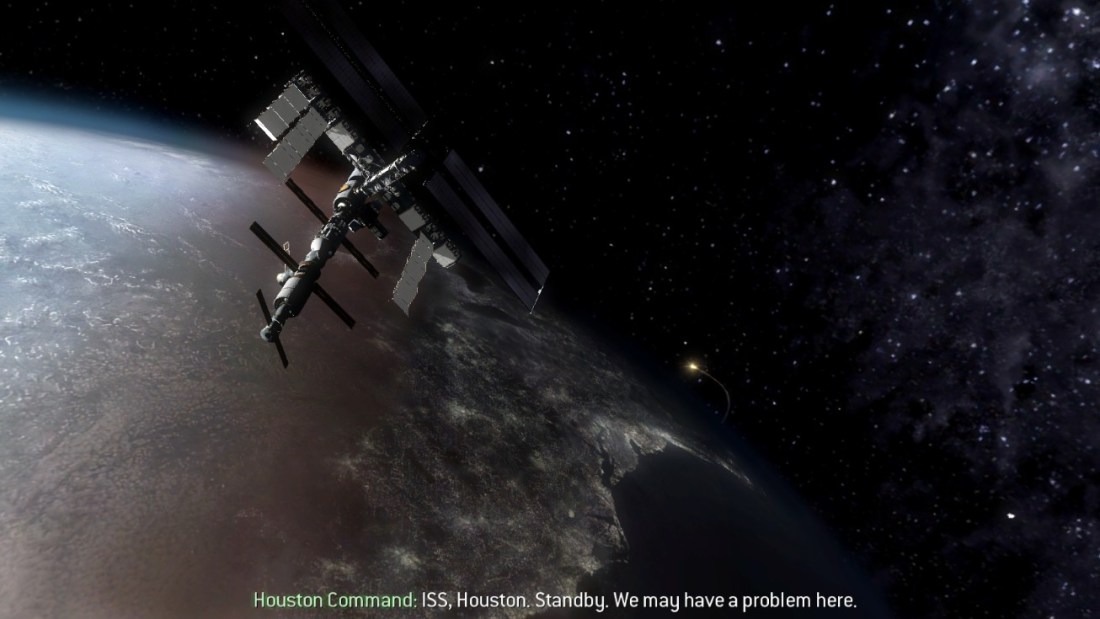
Price decoys us to a submarine and fires it’s nuclear weapon so the EMP downs the Russian attack force – a stunning move – but it was a ground war anyway and kills untold numbers of US troops and a passing astronaut. It’s a pretty extreme way to level the playing field. It does give the marines a chance to take back Washington in one of the best running gun battles of the entire series, but still. Price takes being disavowed to extremes.
MW2 is a cracking shooter. But is it a good story? Yeah-no. Plot-wise we’re just chasing Makarov about, and the No Russian scene was crying out for backstory – without it, the threadbare story’s just an excuse for all the shooting. If MW1 was how wars start, this was war where the why no longer matters. Let’s see if MW3 has a happy ending.

MW3 picks up with the Russia-US war in full swing; we’re looking at WWIII and the only guys able to stop it are a disavowed SAS Captain, his critically injured pal and a Russian loyalist. Sure there’ll be some US Grunt who gets sacrificed too; I won’t get too attached to him.
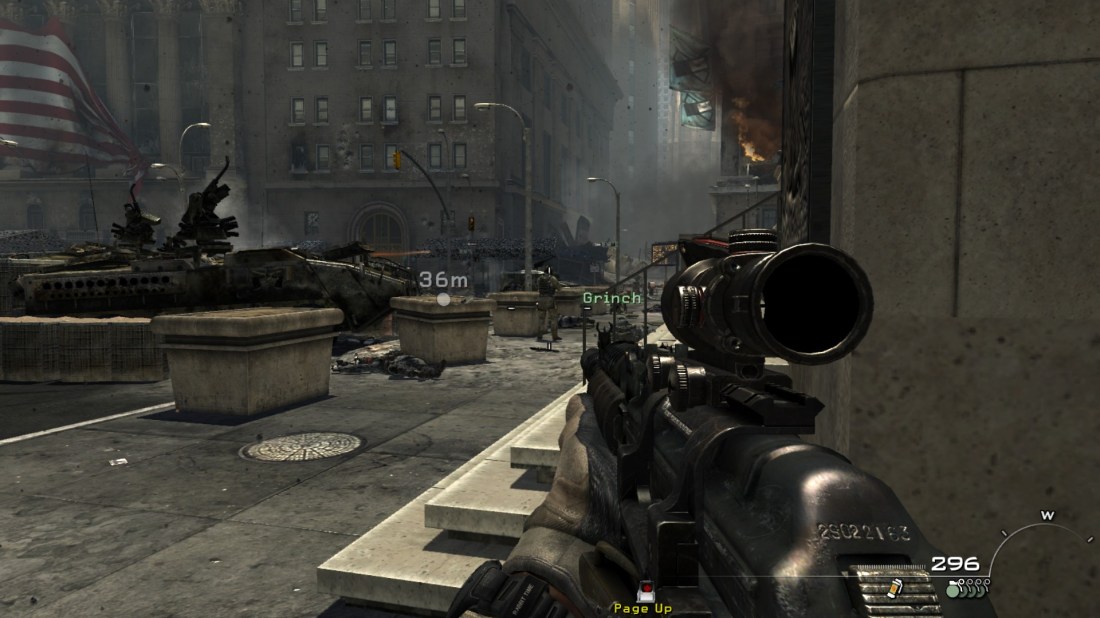
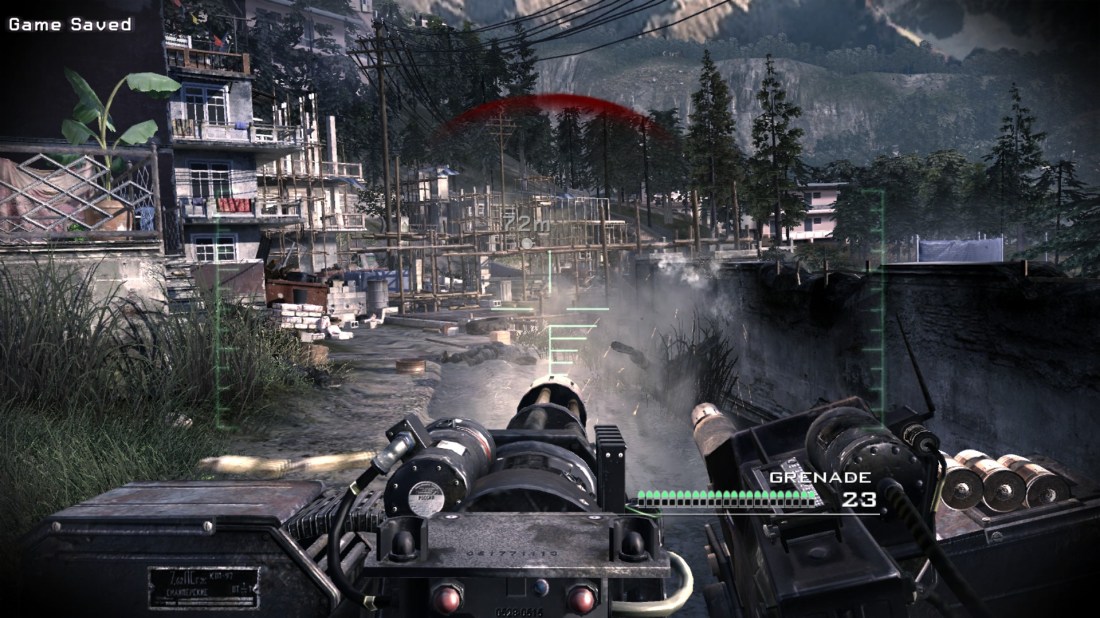
When it comes to the Task Force 141 missions, we’re primarily in the boots of Yuri, starting with helping Price get a critically wounded Soap out the town they’re holed up in when Makarov’s team descend. It’s a decent little re-entry into the MW world as we’re heavily outnumbered and gun our way to an extraction point; this time though, Yuri has control of a remote-controlled mini-tank, kinda like one of those sit-on lawnmowers with a mini-gun attached. It’s fun but an example of CoD shifting away from the men vs men tone and into tech. And that’s about as critical as I can get about MW3 … I was all set to dislike MW3; this must be the one that started my CoD Clone rants, right? Wrong; my enjoyment never dropped below ‘shit this is good’.
While TF141 makes their escape, we pop over to the US to see how the invasion is going. We’re Delta Force Op ‘Frost’ (real name Derek). Again, it’s another solid tooth-and-nail firefight through Wall Street to knock out the Russian’s comms, leading to a helicopter firefight before we stop off to turn a Russian subs’ missiles on the rest of their approaching fleet, which forces the Russian withdrawal from US soil. Not bad for an opening mission. Go Frost! No, no, I can’t get invested in you, you’re going to die.
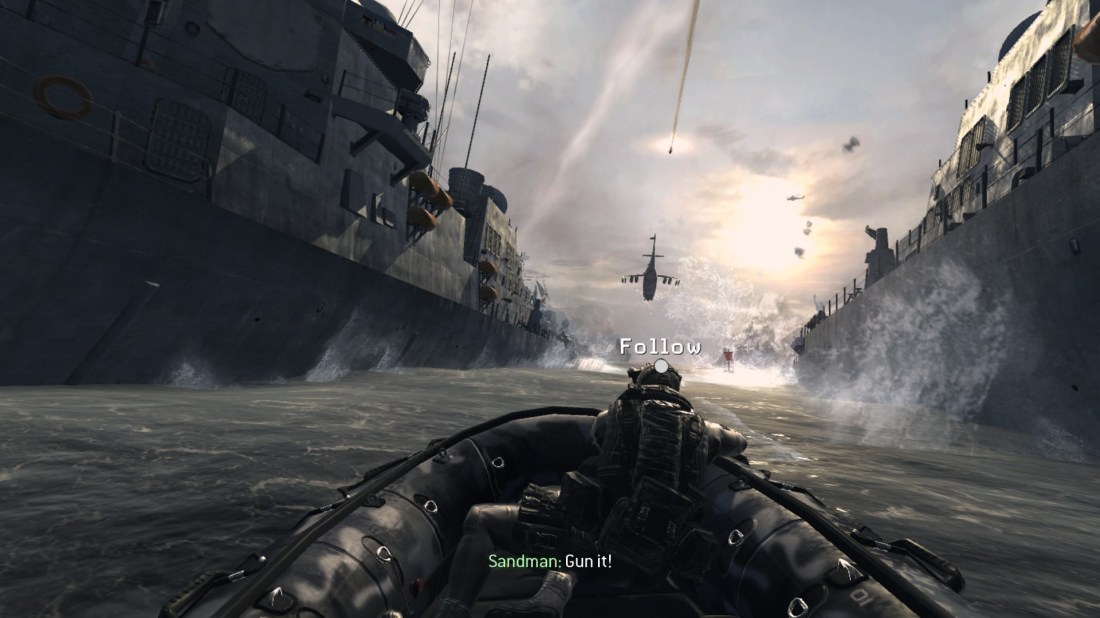
MW3 doesn’t deserve to be this good. Each mission is desperate and often futile – the teams fail as often as they succeed and for most of it Makarov has the upper hand which gets you riled up and focused. War is hell. TF141 blazes through Sierra Leone and Somalia trying to avert Makarov dragging the other nations into a full-scale war – via chemical warfare. When we miss the shipment, it’s actually nerve-wracking. Nerve-gas wracking.
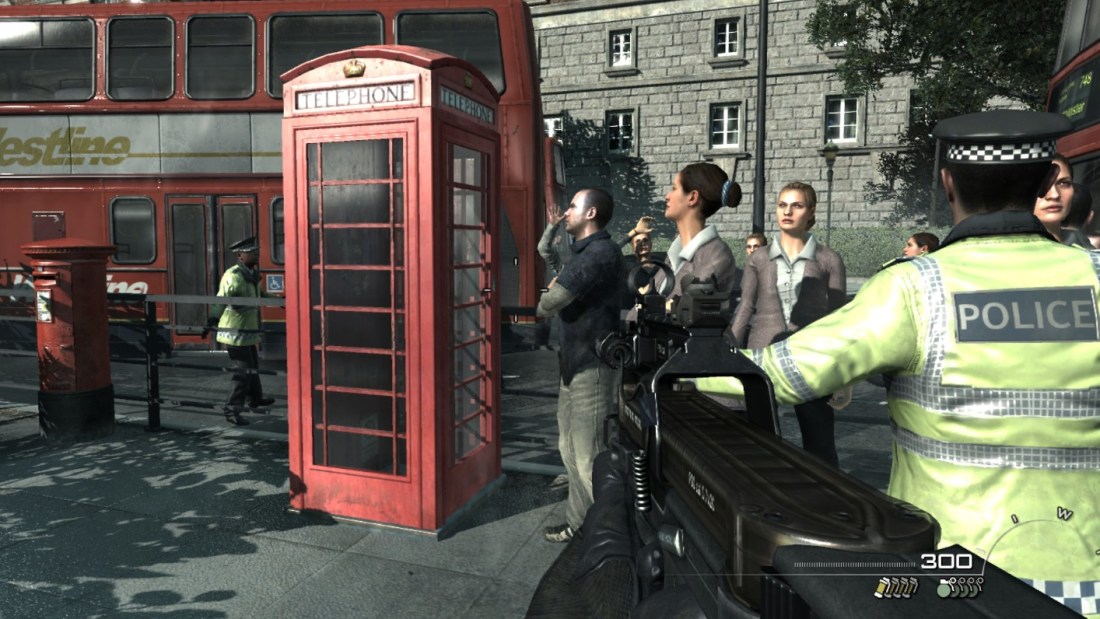
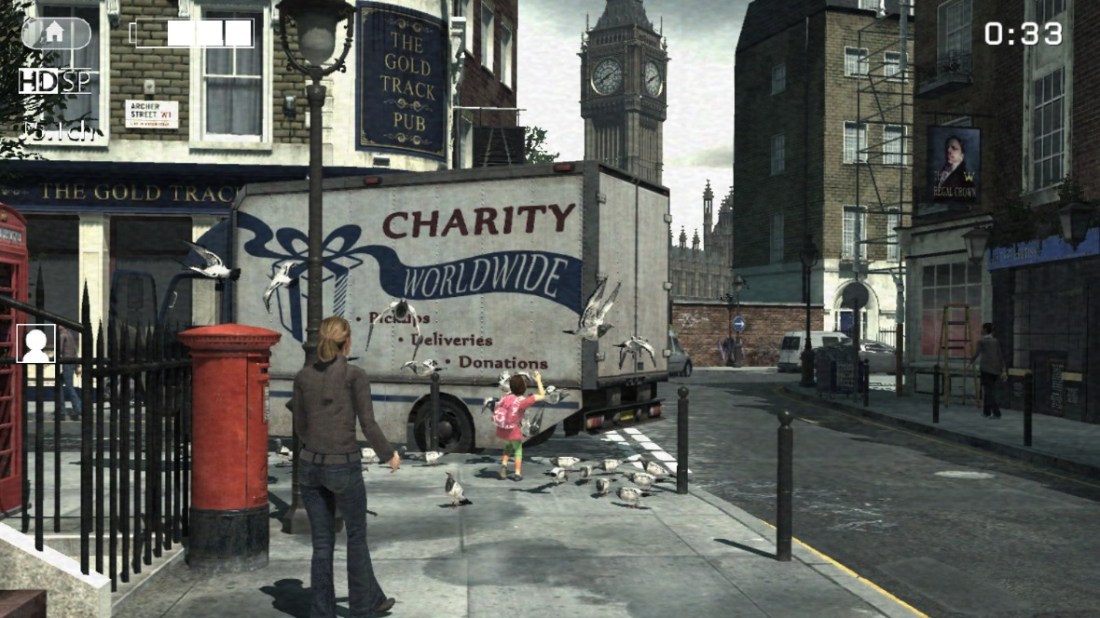
It’s then that we hit one of the best missions of the series; a SAS team fighting through the London underground trying to stop one of the dirty bombs. London looks just how the Americans imagine it but despite playing chicken with a tube train, we’re unsuccessful and the bomb is detonated – which we see through the video camera of a dad filming his family. It’s a now-standard CoD controversy scene but unlike No Russian which forced you to contribute to the horror, this you just watch in horror as your daughter chases pigeons towards the van. Kaboom. This is how you do controversy. And plotting.
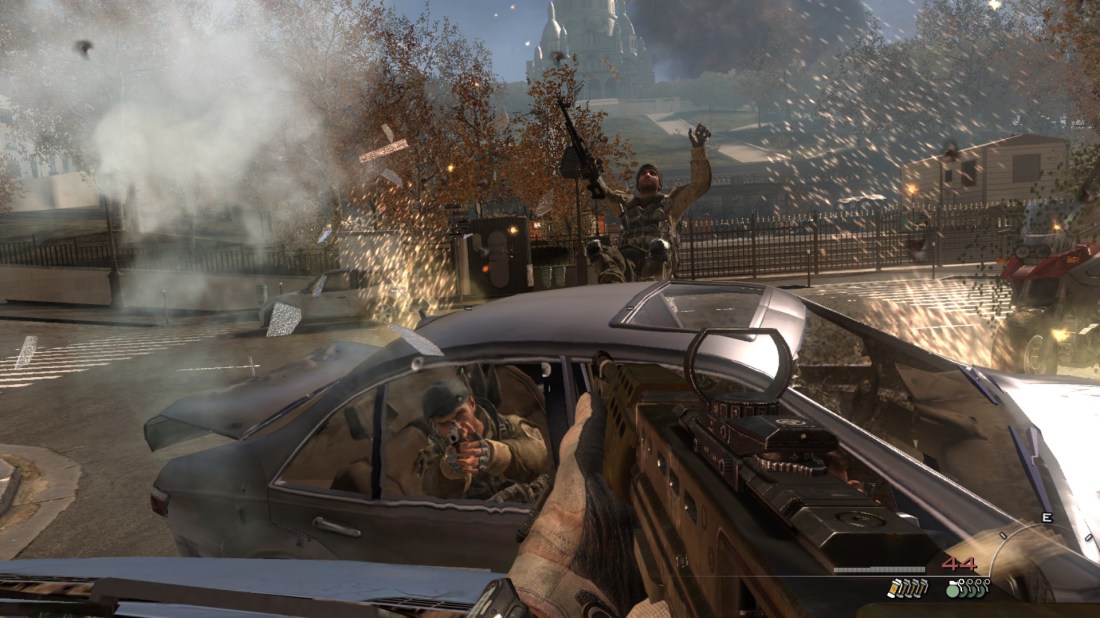
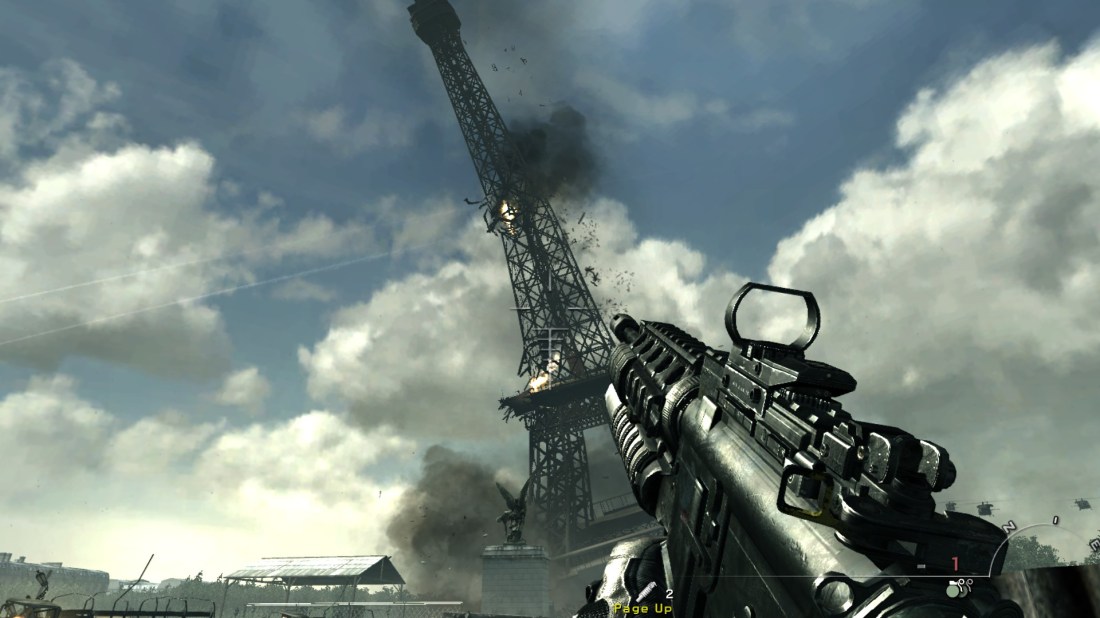
With the world now at war after the bombs went off around the world, Frost and the Deltas war through Germany and France (knocking down the Eiffel Tower while they’re at it) while TF141 tries to get to Markov. It’s all so desperate you’re almost yelling ‘No!’ when it switches between characters; you’re behind those guys, you want to see the war ended, Makarov dead. We’re doing it for that little girl. When TF141 and Deltas team up for an against-the-odds mission to recover the Russian president you’re totally up for it, and when Price and Yuri stage a personal revenge attack on a Dubai hotel, you’re practically cheering.
The game just really wants you to lose your shit while playing. Even the jumps into secondary characters are stellar – besides the London sequence, there’s exhilarating mini-levels like Makarov’s capture of the president in mid-air resulting in a zero-g gunfight; it’s an all-out, balls-out shooter. TF141’s missions play like the Bank Heist in Heat while Frost’s are every war film you’ve ever watched. Buildings collapse on top of us, tanks roll over us, planes crash on us, everyone’s yelling, everything’s exploding, it’s exhaustingly intense. It’s not art, but MW3 is awesome. It’s a fitting end to what you realise is Price’s trilogy. He deserves that cigar.

And Frost survived! Where is he? The one time a character survives and what, did he just sleep in and miss the Deltas’ final mission?! I took a moment to work out how many arms I’d played in MW that didn’t make it. I lost count.
I’m man enough to admit when I’m wrong. I finally ‘got’ MW when played as one game. There’s just enough story to keep you invested – in fact, we’re playing the story instead of the characters. They each play a part, and while all the missions in MW could be played on shuffle and you’d not notice, what MW is saying is who or where doesn’t matter, only the mission. You just Ooh Rah and dig in; it’s all the same once a shot is fired.

Another aspect I dismissed but now realise works, is how rail-shooter linear CoD is. It is a locked down, forward-push game but as I ran down dead-ends, into houses, into grenades, I realised it doesn’t feel like you’re being herded. It’s not about the route, it’s about having the wit and awareness to stay calm while holy hell is exploding around you.

The last criticism I had of the modern era was that it was modern; but freed of the WWII setting, MW doesn’t get weighed down trying to lend some gravitas to the fact we’re playing for fun what men actually died doing. It has parallels with Desert Storm and Gulf War II but lets me play as a modern soldier in a realistic yet entertaining way. I’ve run out of excuses; I love MW. Shit.
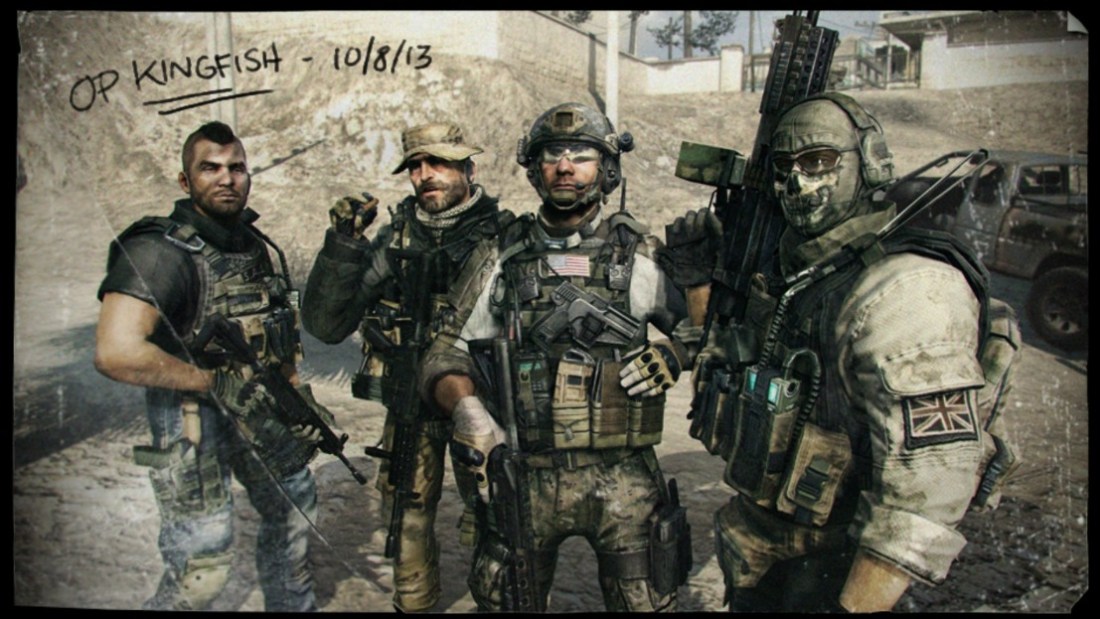
Question now is, if MW does everything right, where did CoD go wrong? I swear my belief that CoD recycles itself must have come from somewhere. Ironic then, that the next game is World at War, a post MW1 return to the trenches. Is that going to reset my historical love?

Check out the third part of FBT’s CoD playthrough as he returns to WWII; but will it seem dated now he’s modernised?

Hard Reset

A Rage Quit Review

FBT gets his retro-on with this Quake-era throwback. And throws it back.

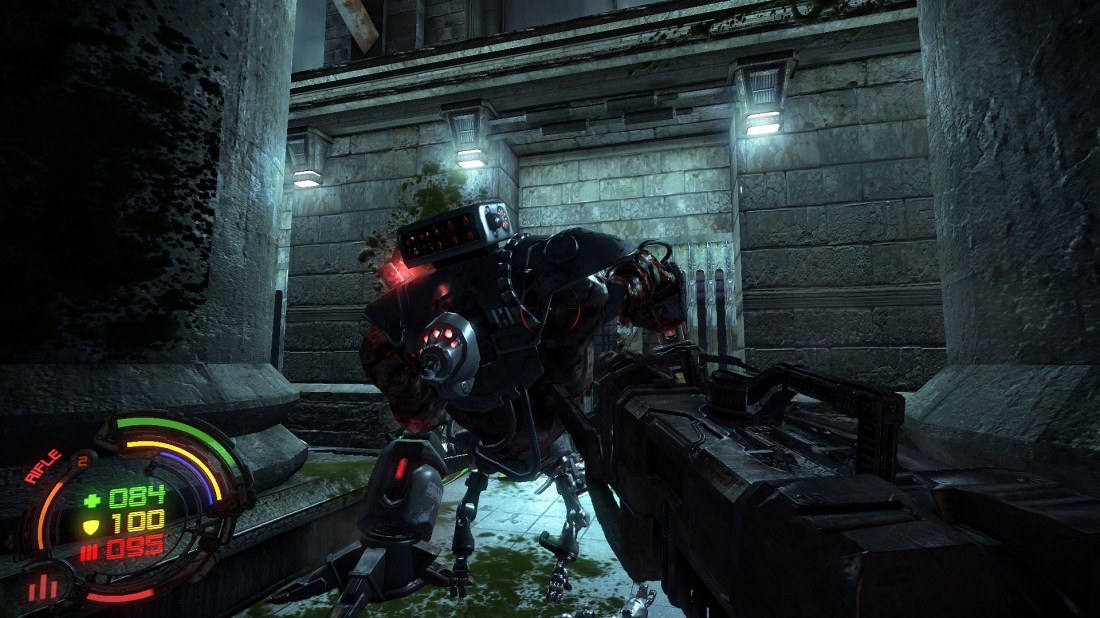
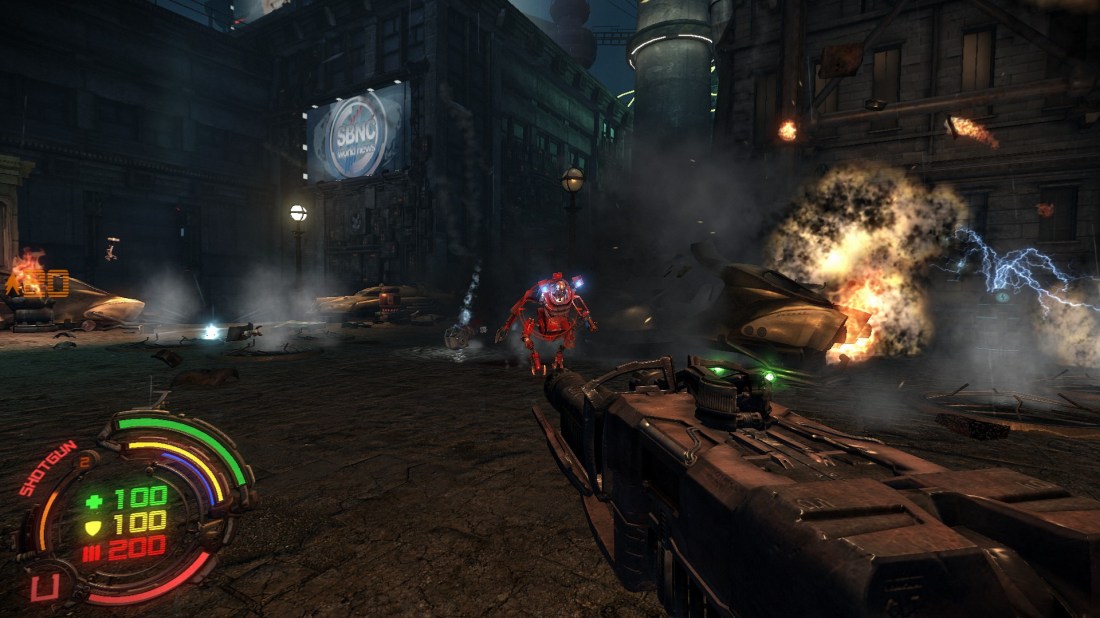
Set in a cyberpunk world and harking back to the Quake era, Hard Reset is one of those games described as ‘over the top’ and ‘old school’. It’s so old-school and over-the-top that you buy it for a while, before realising what’s missing from the good old days is a good game.

The year is … oh who cares. Our hero, Fletcher is a grunt working for a private security firm in a dystopian Mega City One. Fletch is assigned to investigate something and discovers sentient machines are attacking the city. Or they’ve been attacking for years, I don’t know. All of this is half-heartedly explained during static Max Payne style cut-scenes where people growl and grumble about the state of the world and you stop listening. I think there’s a mad scientist involved, or he might not be; if it was being a parody or a self-referencing homage I’d be into it, but it comes across as serious so it falls into the trap of feeling dated rather than retro, which is hard to come back from. Instead of reminding me of the classic FPS shooter era, it’s making me want to go back and play it, which is a very different reaction.

Unlike classic era shooters, Fletch only has two weapons at his disposal, one firing shells and the other an energy weapon – it’s actually quite nifty; you unlock upgrades as you go, getting multiple attachments that alter their firepower or change it to shotgun, grenades, electro-arcs, EMP blasts, all sorts. Except … it gets insanely frustrating in-game swapping to the other weapon with one key, then cycling through its options with another, trying to find the shotgun or whatever you need; it’s not until I played this game that I realised how much you rely on visual cues to know which weapon you’ve brought up – I don’t have time to read the HUD, it should be obvious but the amount of times I think I have the shotgun and I have the grenade launcher instead. You can guess how that ended.

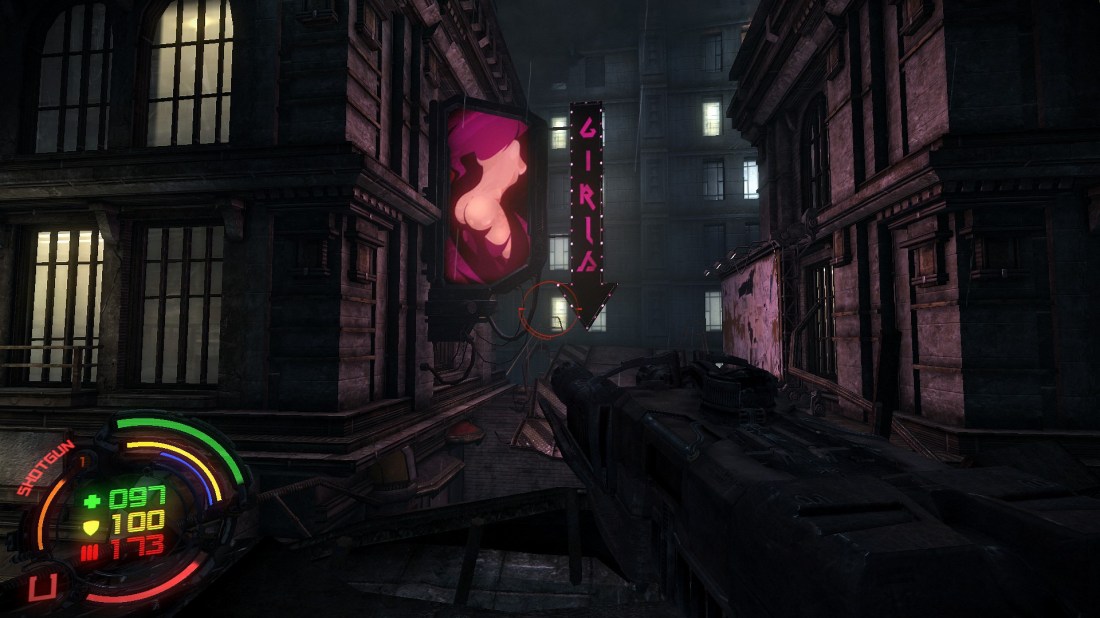
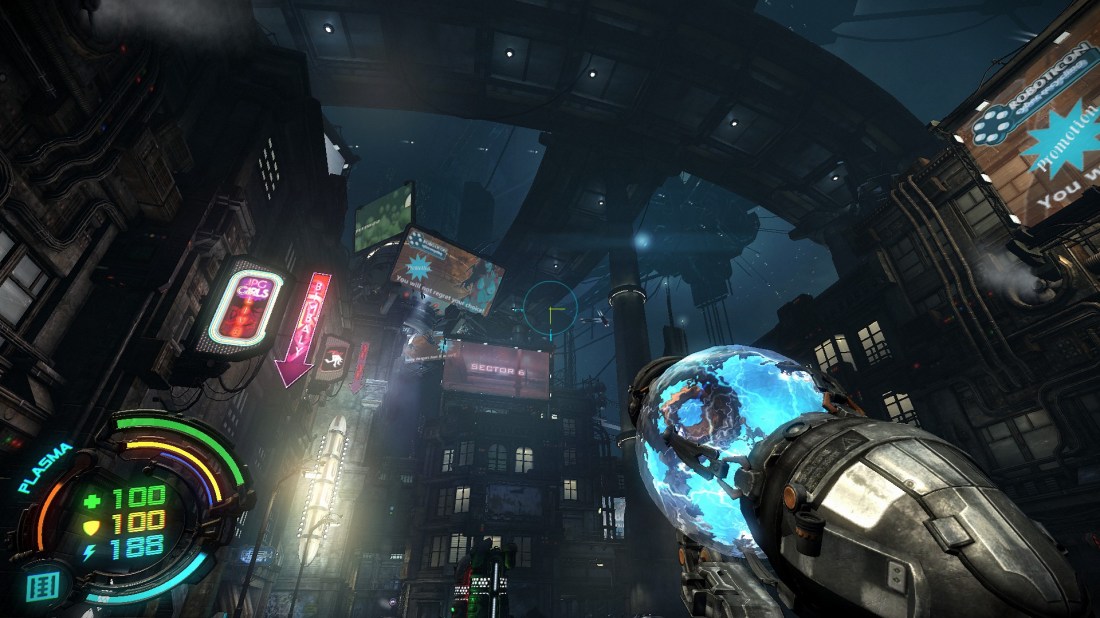
The world does look really good – it’s run down, rainy and neon with huge buildings bearing down on you. It feels enclosed but although we’re working our way through alleyways, corridors and warehouses it’s not rail-shooter linear. There’s lots of exploring, basic puzzles and doing things that unlock things. And they always unleash lots of metal things to shoot. Lots of them.

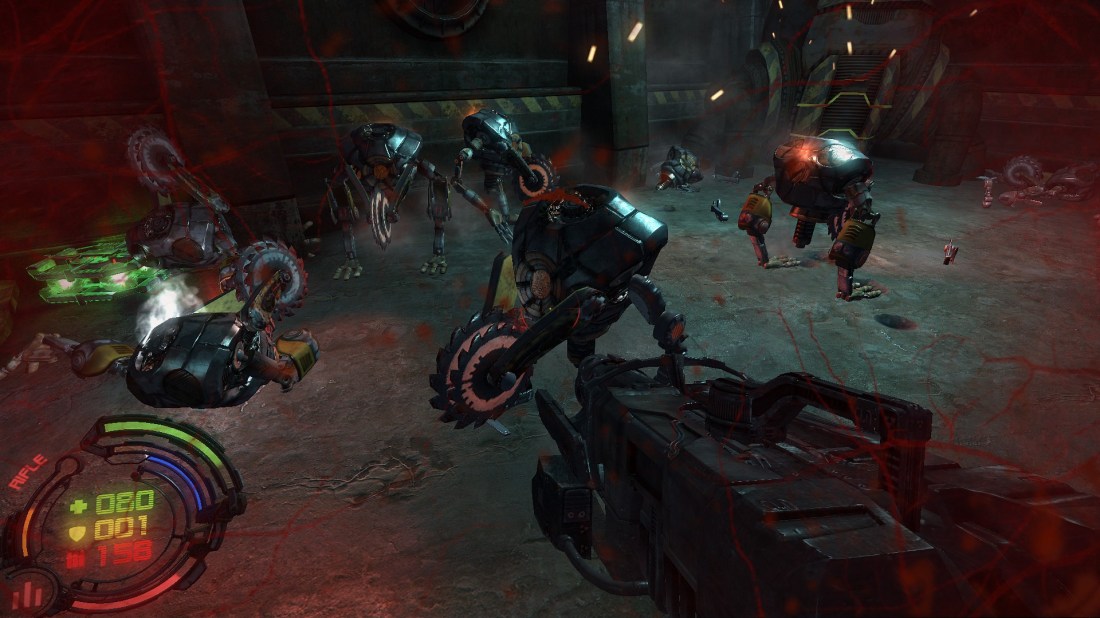
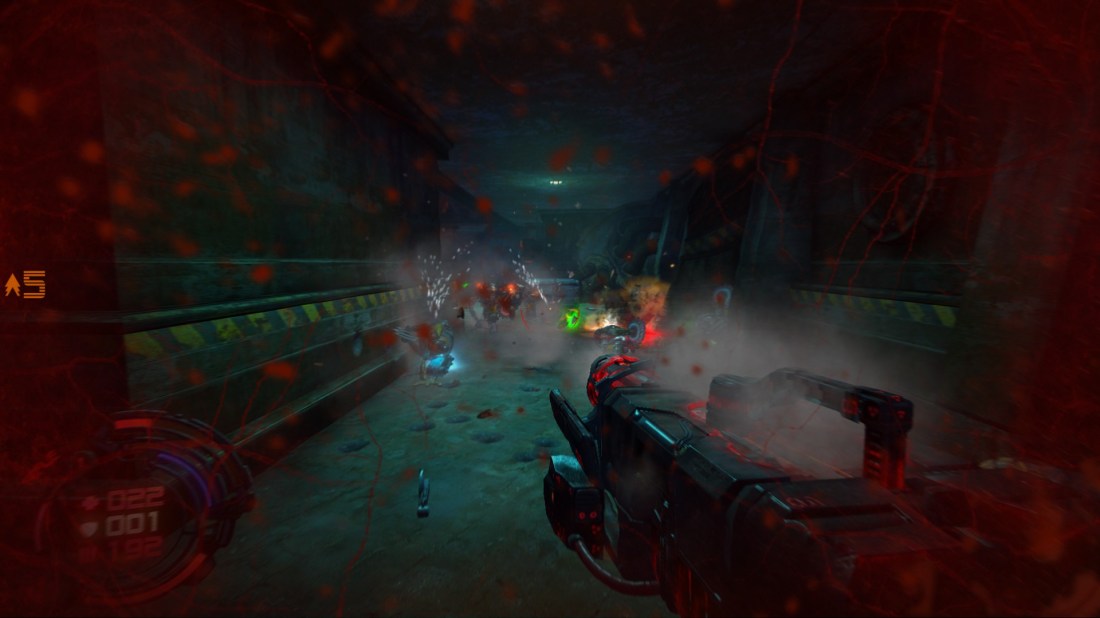
Fighting robots has never been interesting. But this game adds a level to them – annoying. Every shooter starts you off small, gives you opponents that quickly become easy before retiring them for the big-boys. But Hard Reset loves these little guys on two legs and a buzzsaw for a nose, and they just run and leap at you like crappy little Skag pups. They suck like the frogs in Daikatana, constantly getting in the way. And then it’s bigger robots and there’s so many and they’re all firing at you and there’s strobes and tracers and the screen shakes when you get hit and turns red and eventually it’s like looking through one of those kaleidoscopes kids had in the 70s. It just gives you a headache. There’s no intensity just confusion.

Even games like Doom were better paced and those games knew to pummel you then reward you; HR just tires you out, you just stop and hold down fire. You’re so blinded and swamped you don’t have time for any flair, for clever attacks, to get lucky, to be heroic … you’re just cornered and unable to swap weapons or attachments because letting up on the fire-button means death. It’s not unbalanced, it’s just no fun. Borderlands (the yardstick for unfair) at least gave you special powers and insane weaponry to go down fighting with, and it made the firefights thrilling; you knew you were walking into certain death so took that attitude with you – the other yardstick of ‘calm down’ was Serious Sam, and that was just so ridiculous you enjoyed the scrap, but in HR you’re facing off with some dangerous robot yet what kills you is one of those fricking BB8 buzzsaw bugs cutting you off at the ankles, and it gets annoying.

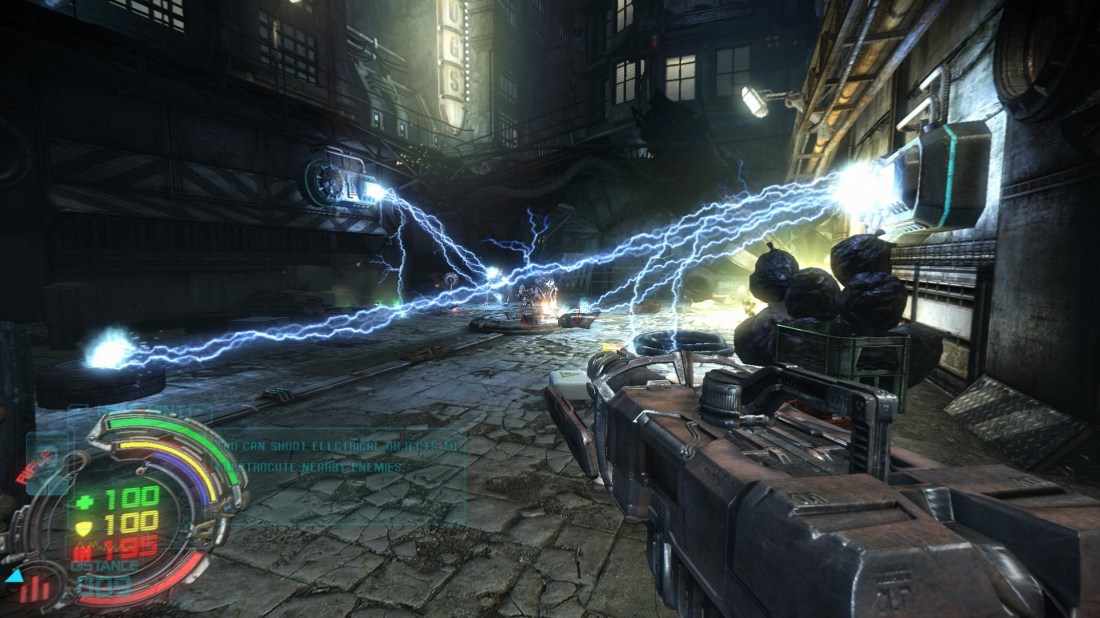
We’ve got all the classic shooter era elements here – hidden areas, explosive barrels, ammo lying around, and nice environmental options like explosive cars, vending machines that electrocute robots when shot and other elements that give you in-battle options but they so rarely come together and half the time take you out. No battle is hard-won or leaves you feeling bloody but victorious, and you tend to be fighting waves which just doesn’t do anything to draw you in, make you suck it up and dive back into the fray. When I reach an obvious arena area, I kinda sigh, double-check I have shotgun settings on and wait for the buzz-kills. Combined with the irritating story and cheap cut-scenes, what could have been an energetic underground bullet-brawl just becomes a slog.

Realistically, Hard Reset is a showcase for FWH’s engine, Roadhog and to put it mildly, it’s a killer engine. The world looks fantastic, it’s detailed, fast, and it handles all the crap flying about effortlessly; I never had a judder or frame-drop. It’s a solid engine. Just a boring game built on it. Thankfully, Flying Wild Hog excelled themselves next time around with the Shadow Warrior reboot, which is a beautiful game to look at and play.

Eventually, I lose it when I keep getting killed during a mini-boss battle with a buzz-saw robot dispenser machine. What the hell? Oh sod this. All it’s doing is reminding me the Classic Shooter era ended for a reason. Rage Quit.

It is a pure shooter and that’s great, as is the fact that it came from an indie developer, but they should know what makes a shooter tick isn’t the basics, it’s the spirit, the experience, the feeling of victory. Because there’s a lack of self-awareness it all feels dated and frustrating. It’s one of those B-Side shooter-clones you played at the time thinking you were getting another Quake but instead you never finished it. It’s a shame but I get the feeling I’ll forget all about Hard Reset soon enough.

2011 | Developer/Publisher Flying Wild Hog

Platforms; Win/Steam 2011 | PS4 & X0 2016 (Redux version)

Call of Duty Playthrough Pt I – Call of Duty I & II

A second wind special review – Call of Duty

Part One, Call of Duty I & II

In this mega playthrough, FBT signs up for no less than 13 tours of duty

It seems as if Call of Duty has always been here. Since 2003 there’s been 14 main games plus some 10 spin-offs. But to me, there’s only ever been one CoD game. And I don’t mean one so good it eclipses the rest, I mean they’re all the same. Since Modern Warfare, CoD has been the same game rebadged, the story-mode reduced to a tutorial for the multiplayer. I could read the review of a CoD game and think “Haven’t I played that already?” Now Activision has finally dropped the pretence with Black Ops IIII; it’s multiplayer only. Those Fortnite band-wagon-jumping sellouts.

While I had no intention of playing BOIIII even if it had a story-mode, it got me thinking. Is story really that important once you get a gun in your hand? It’s the story that drives you through Bioshock but who cares when there’s a Big Daddy charging, while Doom has less of a plot than porn but I never complained about that. Do I really care why or what I’m shooting once the cut-scene ends? If I’m honest, for all my bleating on about immersion I am a fan of the ‘skip scene’ button. Is story really important if the shooting’s good enough?

What better series to test that theory than CoD? If I play enough plotless CoDs and enjoy them for what they are, I’ll accept story doesn’t matter; Private FBT reporting for duty, sir.

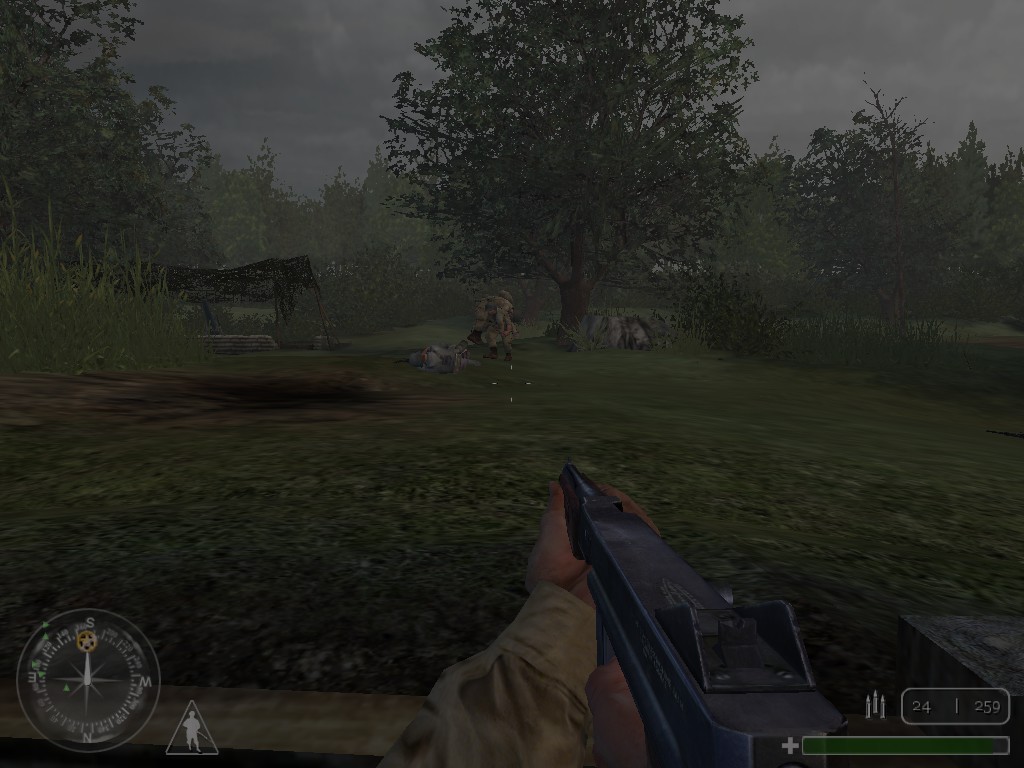
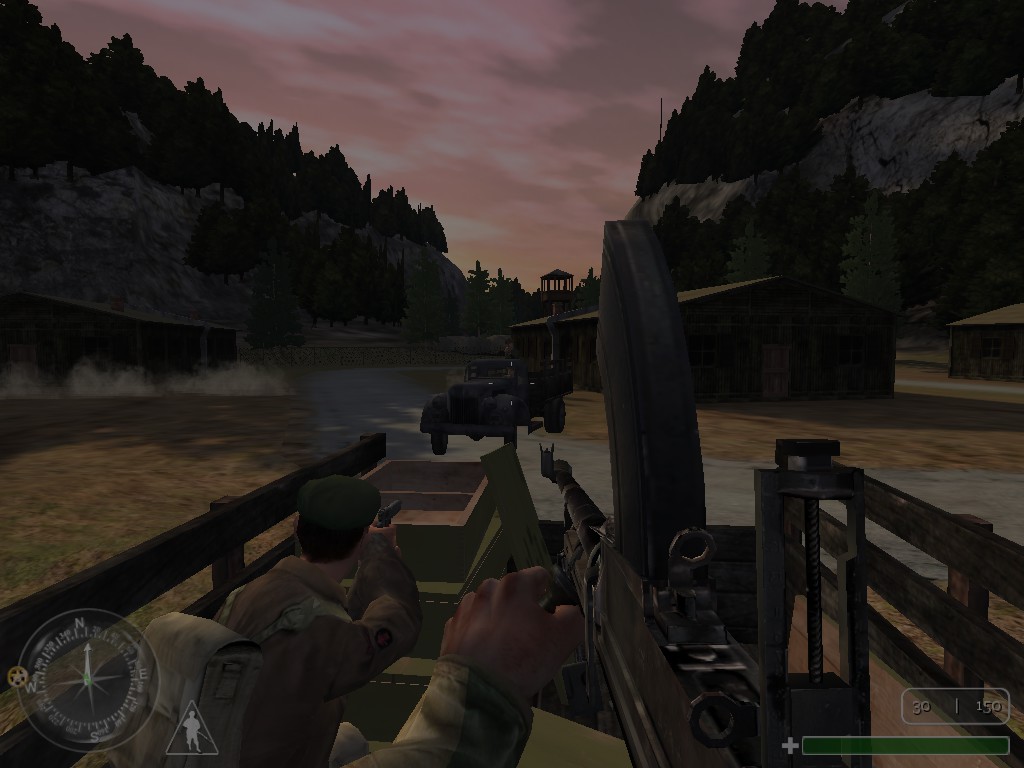
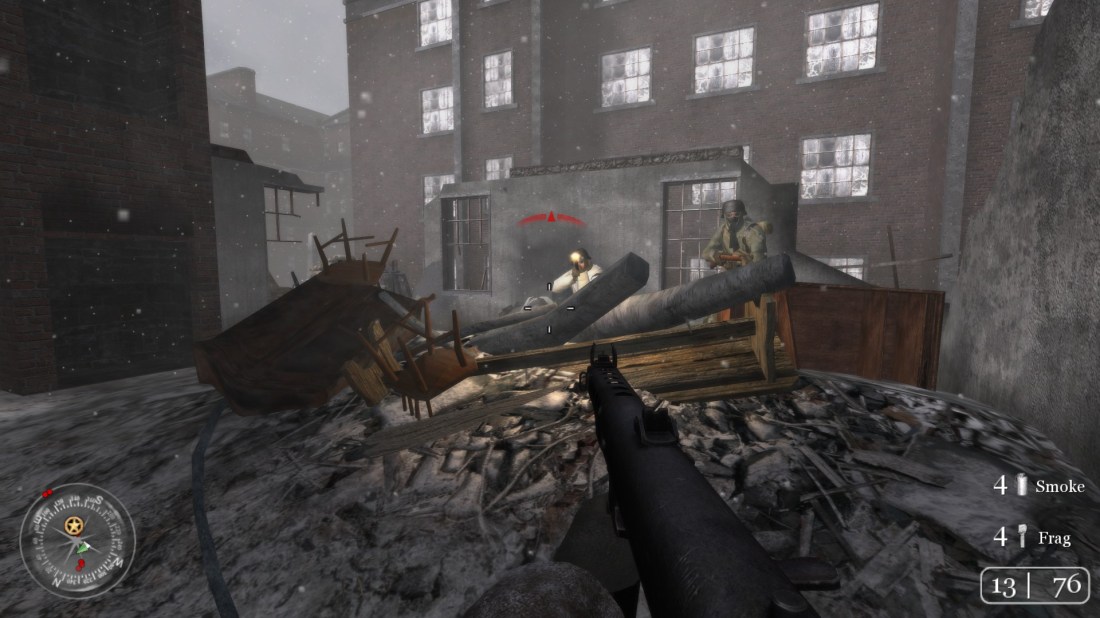
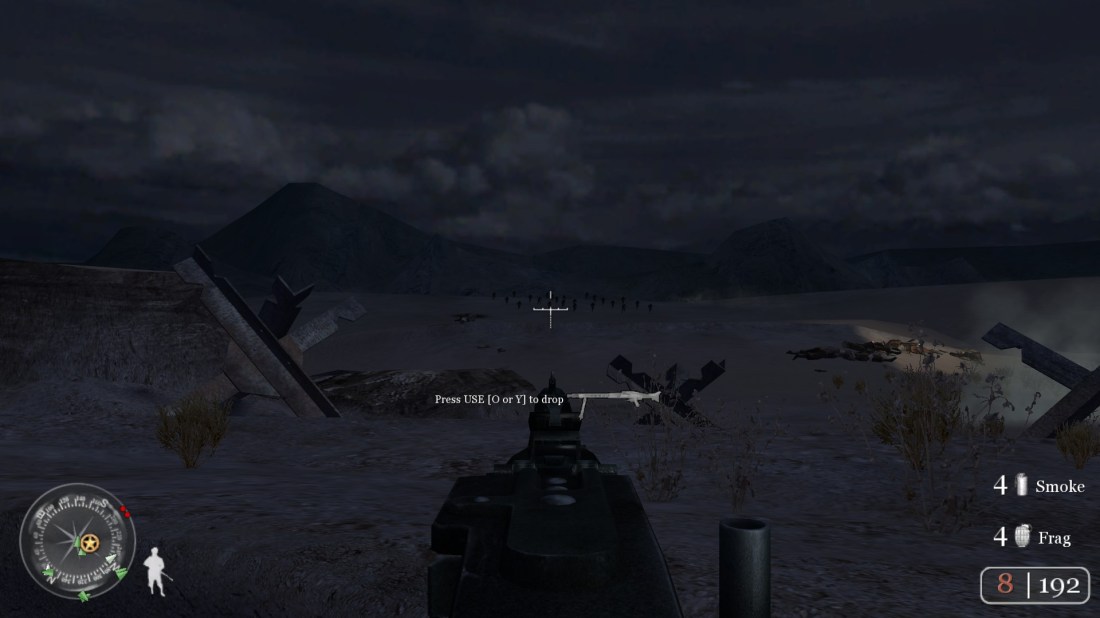
CoD I – This is it, where it all started. Released in 2003, it looks it, and plays it. Running on the good old Quake III engine, we’re in classic pre-Half Life 2 mode. After a now-quaint tutorial mission we’re split across three campaigns; as a US private clearing Germans out of towns and taking out anti-aircraft guns and emplacements, a Soviet solider doing basically the same but with NPCs calling me comrade instead and as a British chap doing sabotage and intelligence gathering. By clearing towns and taking out emplacements.

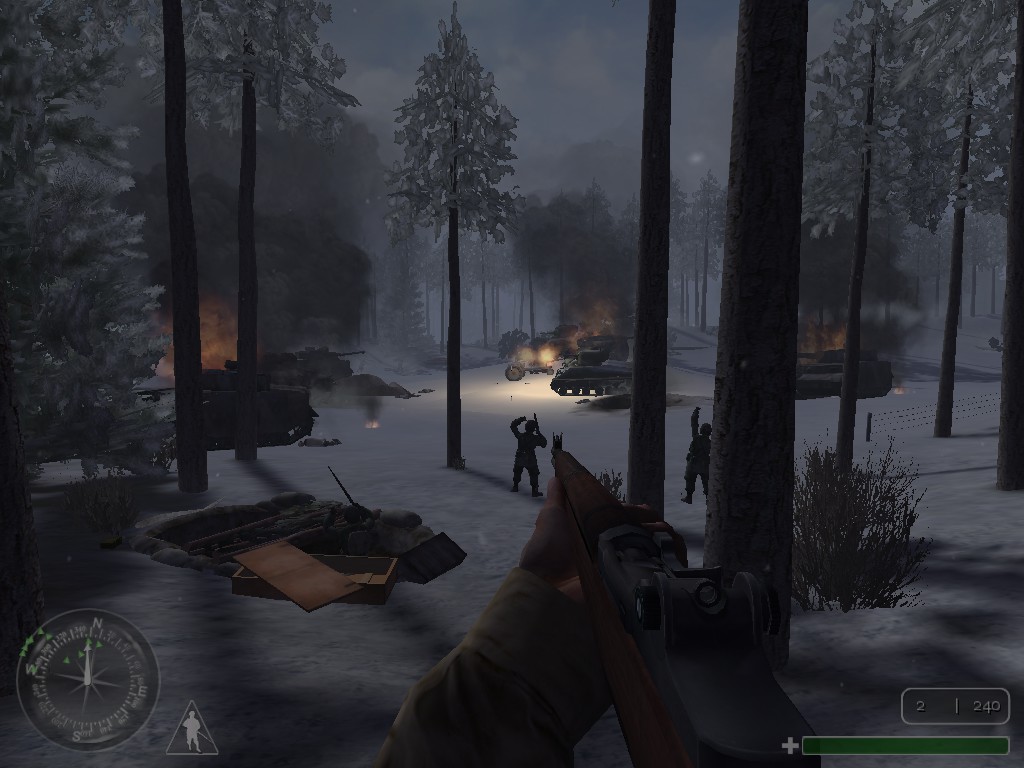
The add-on for CoD I, United Offensive is more of the same, but works well because we stay within single short campaigns. We battle through the Bastogne conflict before a plane gunner gets shot down and must escape occupied territory then make a last-stand as a Soviet solider holds a town until his pals with tanks can arrive. UO is actually a great little add-on, full of action and nice moments.

On the face of it, CoD I is just a regular post-Doom shooter that happens to be in a war setting – hold this area, rout troops, knock out AA Guns, find the documents, and lots of ‘isn’t there anyone else who can do this’ like suddenly being in control of tanks or being the only one who can snipe. Why are all FPS heroes odd-job men? There’s zero story beyond mission objectives, but CoD I has one important edge over other shooters of the era; watching old war films on a Sunday afternoon with your grandad.

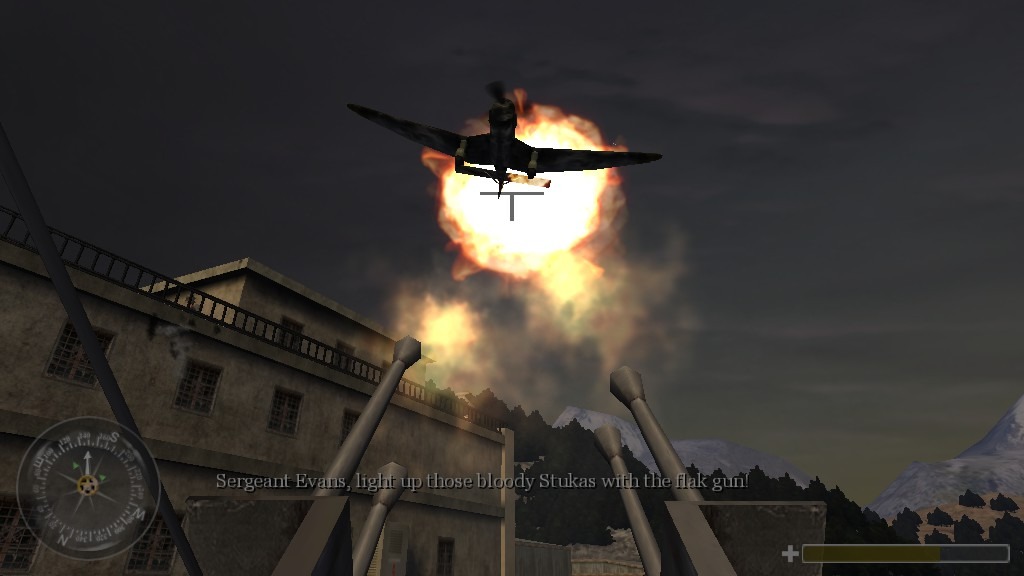
CoD I is pure old war movies; The Damn Busters, The Longest Day, A Bridge Too Far – it’s not about historical accuracy it’s about good old heroic grit and exciting set-pieces; we’re sent in cars to deliver messages while Germans try to take us out, firing bazookas at Germans on motorbikes, blowing up bridges, taking out Stukas, liberating soldiers from prison camps, sneaking onboard German boats, desperate last stands; we even have a mission at the dam the bouncing bombs took out. It just feels like we’re in an old war movie rather than war itself; I might be playing multiple characters, but I’m John Wayne.

I don’t get behind any of the characters or really understand half of what we’re doing, and the missions are compartmentalised with no bearing on each other; we’re just fighting through levels not a story. But I didn’t actually miss a story because I’m having a lot of fun. Almost every mission had a nice bit of adventure to it that I got caught up in and happily went along with. CoD I, Story 0. Maybe porn had the right idea.

CoD II – The first thing you notice about CoD II is how more advanced it is to CoD I. It’s almost unrecognisable from CoD I to look at; and to play it’s almost unrecognisable too.

There’s a lot of advancement here – our silent heroes have consistent comrades that actually stick out from the other NPCs charging about, health packs have been replaced with replenishing health and the Germans are a lot more tactical and aggressive. The levels have great complexity and detail for the age – Germans emerge from smoke drifting up from explosions, there’s splinters and debris and the weapons have a meaty, realistic feel. It’s got a nice desperate panic to it. CoD II is a huge improvement. But it’s not nearly as much fun.

The British campaign is set in Africa where we’re putting down overwhelming German odds – early on it’s like we’ve wandered into Serious Sam as dozens of them rush the town we’re attempting to hold. The American campaign, which includes an element of storming Normandy on D-Day is more close-quarter re-enactments while the Soviet missions are often desperate skirmishes trying to push out embedded Germans. Again, there’s no story to speak of, just more real-world battles to act out, but without that derring-do that CoD I had, it’s lost that flair, the war-movie feel. There’s a nice Soviet level where we infiltrate a factory via steam-pipes which the Germans shoot at if they hear us, but in the open you notice the repetitiveness of it, that we’re largely confined to arenas where Germans respawn until we fulfil the same parameters over and over. How many emplacements do the Germans have?

It is action-packed but it gets a bit wearisome, especially when it falls back on Odd-Job Man so often; guess who’s the only one who can attach sticky bombs to tanks? I get that I’m here to be the hero, but I don’t feel like a hero. We just shoot. We’re interchangeable and there’s no personal story – we’re also jumping into another soldier on occasion, which is a first. And unfortunately, not a last. I’m surprised; I held the originals up as brilliant games that the MW ruined, but CoDII has all the makings of what irritated me about CoD. Still, it’s a bloody good shooter; as soon as I got my orders I was off and gunning. It’s just missing that Guns of Navarone tone. It’s missing a story, a purpose.

Both CoD I & II were good shooters and I did get caught up in the events, but I’m still not convinced there’s no need for a narrative in FPS. The war had one, but I didn’t. Maybe that’s part of the issue for CoD’s setting; no one person won the war, it’s not like CoD could have taken the Wolfenstein route and had a boss battle with a chain-gun wielding Hitler. It just never felt personal, like I was building towards something; every character ended just how they began. Then again, most shooters pre-Half-Life 2 were exactly the same so maybe it’s the era not the games. So what’s Modern Warfare’s excuse?

Next week, read part two of FBT’s call of duty playthrough as he signs up for The Modern Warfare Trilogy; a war that hasn’t happened. Yet. That will take some explaining surely…

Trials of the Blood Dragon

TheMorty gets distracted and ditches the sandbox for the saddle in Ubisoft’s full-throttle follow-up to FarCry: Blood Dragon.

“Blood Dragon… how the hell you not finished that yet tho!?” Having a chat with FBT about his latest FarCry review spawned an interesting question, as such a massive FarCry fan how had I not yet played the most fun and iconic game in the series?

The reason I never made it thought the Far Cry 3 DLC is a lengthy one. See, I did actually purchase and start playing it in 2014 on the Xbox 360 and I loved the first 50% of the game. It was fresh, funny and a light relief from the otherwise engrossing nature of the series. The problem came halfway through the playthrough when I received a knock at the door from Mr. Amazon Delivery Man who brought my shiny new Xbox One. Enamoured with my next gen purchase and the prospect of playing Titanfall and Forza 5, the battered old 360 went back in the box, never to be picked up again. Boxed with it, was my 50% complete save game for Blood Dragon.

Two years passed before Xbox released the DLC as a backwards compatible purchase, but by that point I’d already ventured through the Himalayas as Ajay Ghale and speared Sabre-tooth Tigers in Primal. It’s safe to say, I’d probably missed the boat. That said, when FBT gave me the latest in his long line of kick’s up the behind for not playing and finishing one of his top 50 titles, I felt the need to revisit. In I went to the store; Search: Blood Dragon. Returned: Two matches. One of those matches is the aforementioned sandbox title, but the second return was somewhat more appealing; A ‘Trials’ spin-off covered in glorious 80s neon.

I’m not much of a petrolhead, but I’ve always had a soft-spot for racing games, particularly those on two wheels. It stretches back to my very first console in the 90s and my in-the-box, single cartridge triple of ‘Mega Games II’ on the Sega Mega Drive. Alongside Columns and top down footy game Italia ’90, was a timed checkpoint arcade style racer game called ‘Super Hang On’. It wasn’t the easiest game for an 8-year-old kid – as you had to brake more than accelerate, but it was great fun and many a night I defied bedtime to try and pass that elusive finish line on the Expert European Stage.

I’d played previous games in the Trials series before, but they’d never really set the world alight. True to the ‘Kickstart’ nature of Trial biking, they’d always been a left-to-right platformer and while that was a decent yarn if you had a spare 20 minutes, you’d soon get bored with the lack of inventiveness. However, the same couldn’t be said for Trials of the Blood Dragon, this was something new entirely…

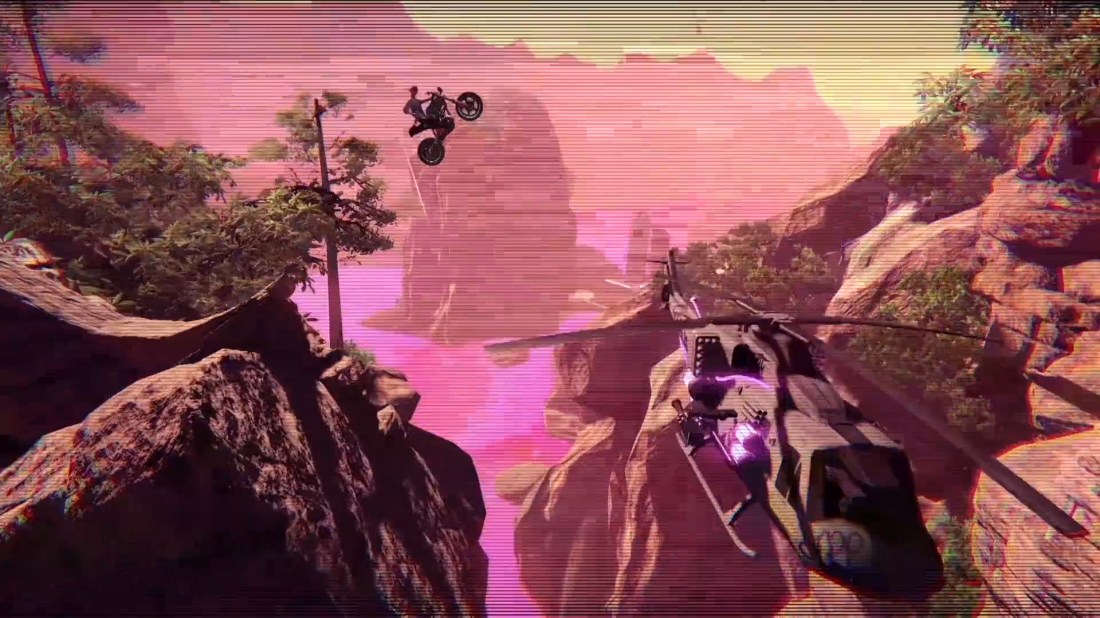
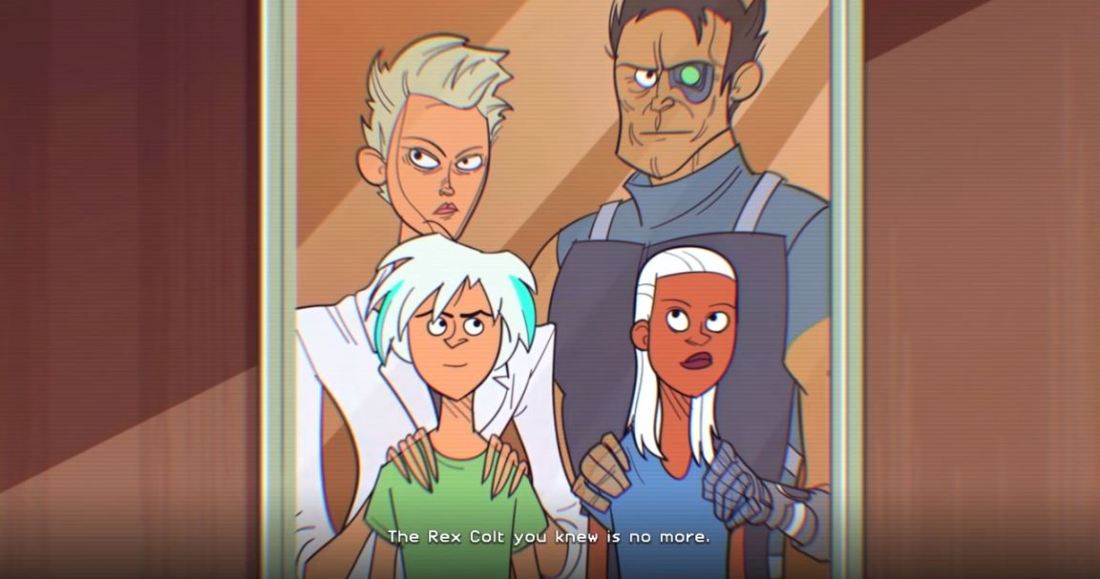
The game starts with the to-be-expected, classic tutorial level “Enter the Blood Dragon” (80s reference 1 of 167,893,640). Another tutorial, big whoop… Actually, yeah big whoop… It’s a level narrated by Mark IV Designated Cybercommando Rex ‘Power’ Colt, the protagonist from Far Cry! What’s not to love!? While I’m back-flipping my way to the finish line, over various hills, obstacles and huts, there’s some interesting insights in the narration that sets out to bind the two games together. The setting is quite some years after the ending of the Far Cry DLC and Rex is long gone. As Rex tells you, it’s not him on the bike – you’re playing as his Son. One of two twin-siblings, Slayter and Roxanne, that you get to control in the various assignments you’re about to undertake.

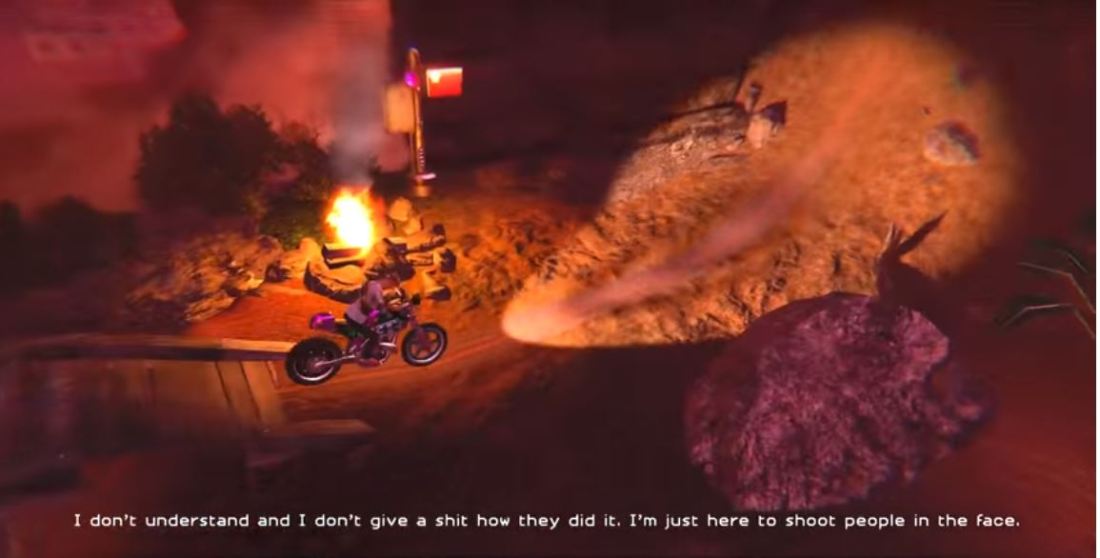
There’s the familiar comic-book cut-scene we’ve become accustomed to in the first Blood Dragon game but instead of that Shinobi meets Metal Gear Solid look, it’s drawn with a more limited palette. Re-using the same pink, yellows and reds as if it’s been animated in the style of Teen Titans Go!

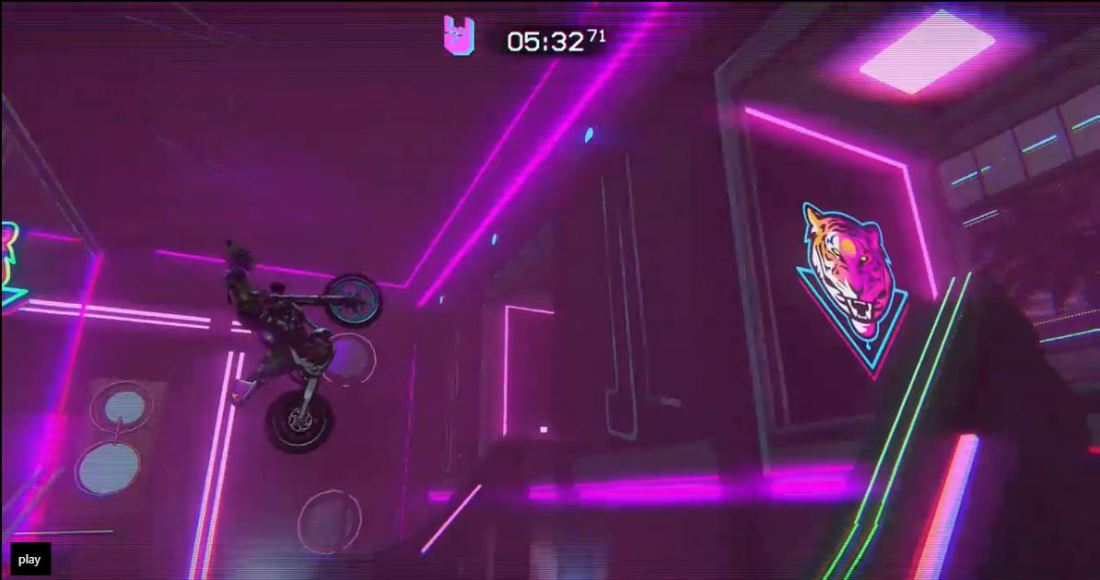
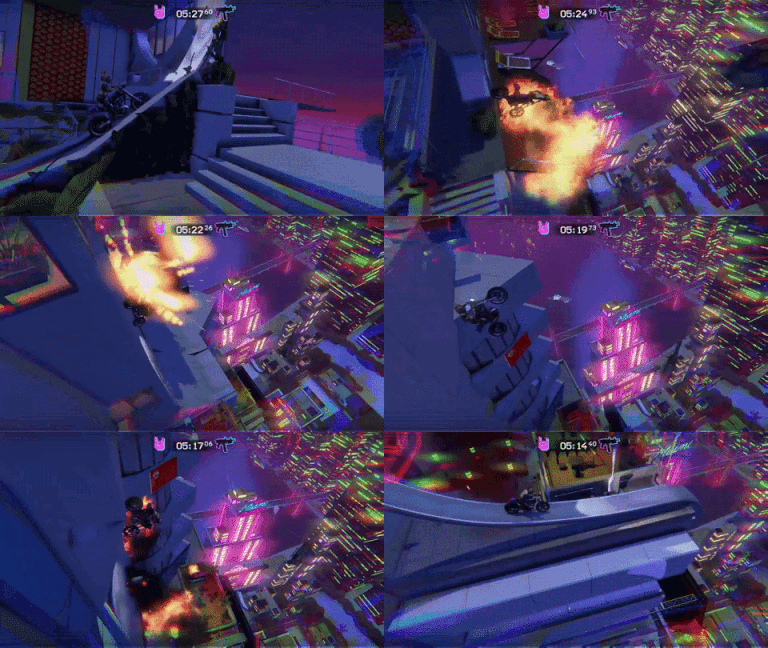
The first quartet of missions are in the familiar surroundings of a futuristic Vietnam. Rather than going prone crawling through the jungle, your goal is less stealth and more speed as we’re tasked with getting from one side of the map to the other within an achievable time limit –attempting not to frequently stack it en route. Trust me, that is a lot easier said than I can assure you is done. At first the narration is great, but after your 8th or 9th track restart it gets tedious

“My name is Rex…” STACK.

“My name is Rex Power Colt” STACK.

“My name is Rex Power. I’m a Cybercommando… my mission is to protect and serve the United States of America… for the past decade, I’ve…” STACK

Oh, for fu…

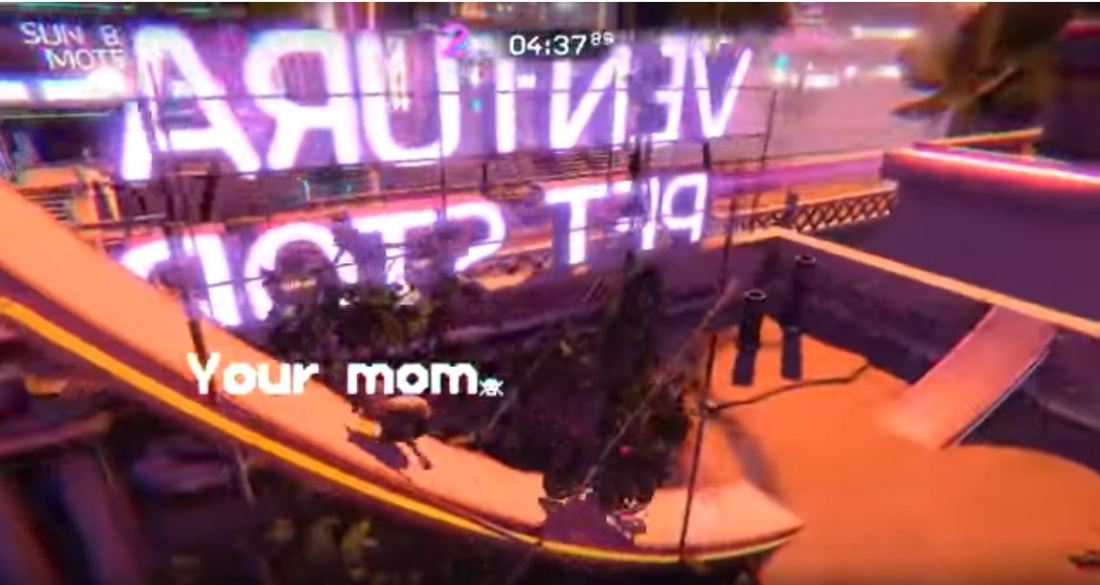
What I do love about stacking though is the taunts. The message that comes across screen as you die is a passive aggressive statement designed to infuriate you as much as it’s supposed to spur you on.

The gameplay itself stays true to the nature of trial biking. Your incentive is time and accuracy, the ‘Kickstart’ attitude and ethos. A well-timed brake gets you further ahead than gunning it and a tactical acceleration when landing can be like a mushroom boost in Mario Kart. There’s no extra points for BMX style flips and you’re not rewarded for pulling a trick like you would in ‘Matt Hoffman’s Pro BMX’ (the Tony Hawk of bike games). That said, it isn’t half fun attempting them.

It’s clear by this point in the game that Ubisoft’s are hoping to piggyback off the success of the popular FarCry DLC in order to boost another of its dying franchises – a trick all too familiar if you’ve followed their collaboration with Square Enix over the Assassins Creed/Final Fantasy XV DLC, just as the “remastered” AC games made their timely way to the current crop of consoles.

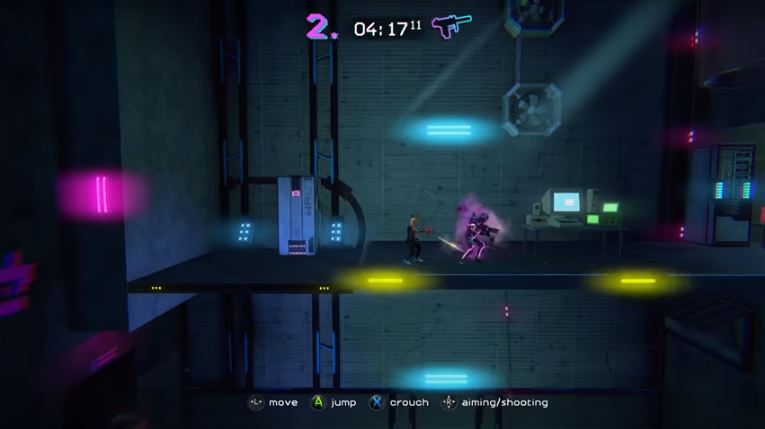
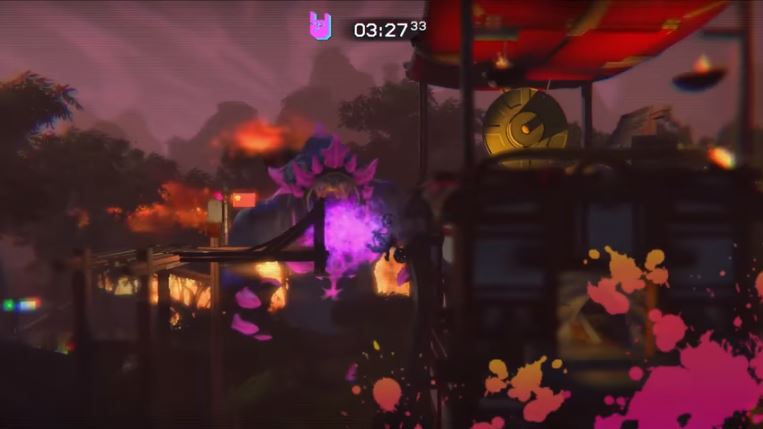
In-jokes about the 80s and Blood Dragon aside, by the second full mission it’s starting to get a little monotonous. Biking, not racing, doesn’t always have a good replay value and as a single-player game, the story is starting to wear thin. This is where the game is forced to mix it up. Roxanne gets off her bike half way through the trial run and we move into a 2D platformer, reminiscent of Assassins Creed Chronicles. As we navigate the classic traps and pitfalls of electric floors, bottomless pits and neon Lava, we make our way up to the control room and hit the switch before the time runs out. It gives it a bit of a different dimension and stops it from becoming plain.

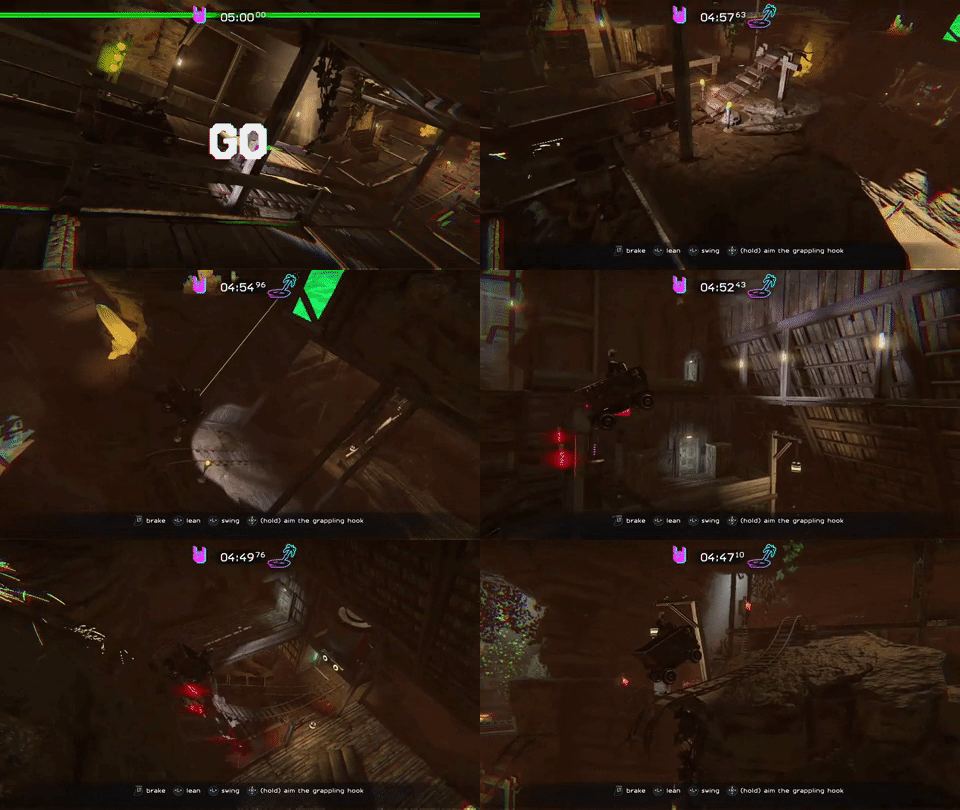
The game progresses in this way and there’s additional levels where you play an RC, a tank and even float around space wearing a jet pack. By level 3 you can fire a gun from your bike and later in the game even unlock a grappling-hook, where you can swing across the roof from one track to another – Batman-style. Something pretty fun when you’re darting through the rickety old mines on a clapped-out cart.

The game re-invents itself level-to-level and you’re never sure what to expect. While some of the tedium remains, the repetitive nature becomes a lot more palatable the more you progress. It gives itself a welcome break from the norm and the story itself provides a driver and a purpose to keep playing, something other time-trial based games fail to do.

The main issue with the game was its value for money. Unless you’re going for a 100% record on every track and aiming to get an A+ filled report card, you can beat the game in around 2-3 hours. Not great worth for a £15 purchase.

Arguably my biggest annoyance is the lack of Blood Dragons. I remember from my pathetic attempt at playing the original I was terrified when one stalked you into a camp and you spent most of your time hiding and trying to tactically take it down without being spotted. In this game, the Dragons are few and far between and when you do see one, it’s in the background or helping you out by wiping out the obstacles in your path – hardly living up to the game’s title.

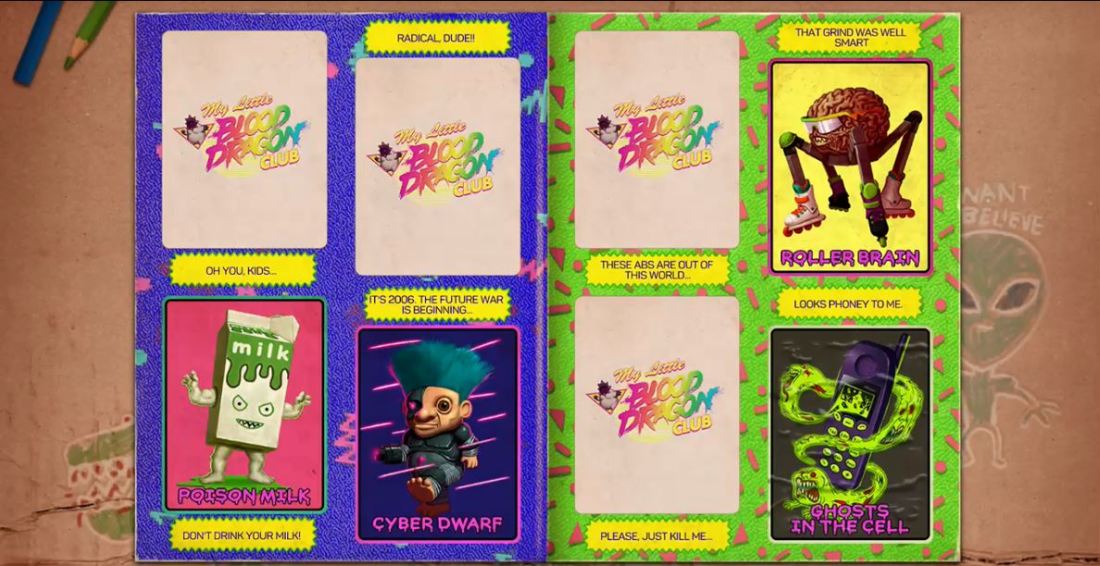
There are unlockable levels and collectable items in the form of stickers. Each carrying a vague, obscure and well before my time reference that I’m sure the older generation would love, but the game doesn’t really give you the opportunity to have a field day picking them apart. Figuring out where the developers were nodding might be a little giggle, but it still wasn’t enough to make me want to ace every level just to find them, by level 18 I was ready to just get from start to finish and move on to the next track.

The game’s biggest problem is it sits between two incompatible genres, it’s not quite good enough for motorbike-gaming enthusiasts and it’s nowhere near good enough as an action platformer. There’s no multiplayer and there isn’t a map creator/editor as you’d expect in other games in the trials or Motocross series – another thing which equally limits it’s replay value. There’s no character or vehicle customisation, what you see is what you get with this mid-market arcade game.

The pulsating soundtrack is good for the missions, but it’s not something you’d listen to on the daily commute to work. I’d argue the only way you’ll get something out of this game is if you’re an 80s Easter Egg hunter or if you’re a massive fan of Blood Dragon and are desperate to follow on Max’s story.

It’s a Far Cry from the original, but it’s a good effort and if you can pick it up for a fiver, it’s a decent way to kill a few hours. Go in with minimal expectations and you’ll probably find this is your cup of tea, but to me it just feels like a forced mess that bastardises two fantastic franchises into a soggy mess.

2016 | Developer; RedLynx | Publisher; Ubisoft

Platforms Win, PS4, X0

Daikatana

a second wind review

FBT is about to make Daikatana his bitch. But can’t without his buddy Superfly.

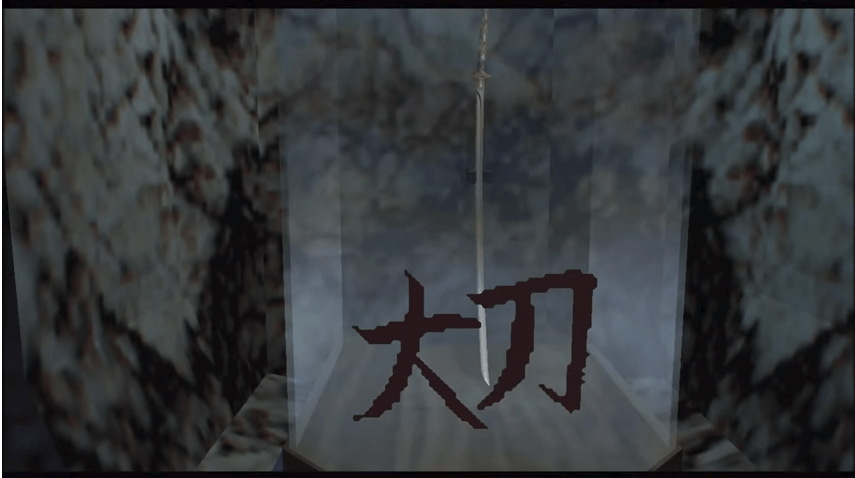
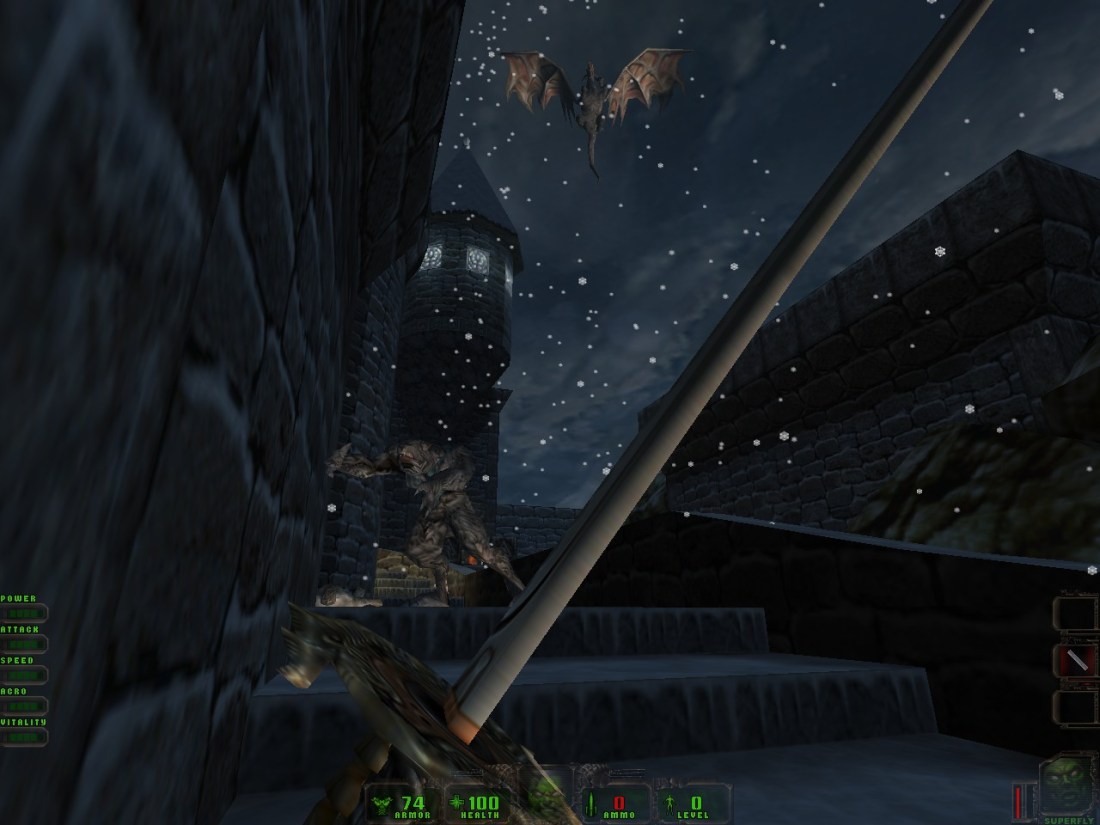
Daikatana is shorthand for “gaming fail”, but that’s as much it’s pained development as the actual game. It never had a chance; reviewers were gleeful in their takedowns after all the hype and baiting that came out of Ion Storm – 18 years on and contemporary reviews still include clumsy rewrites of Masters of Doom’s final chapters. It’s true, the development and the game are so linked it’s like playing Ion’s self-destruction but does it need that context now? Can you ignore all that baggage and play Daikatana purely on its own merits?

In the 25th Century the world is a disease-ridden place run by a single dictator, Mishima. Our hero, Hiro, is a sword-master (they still need swords in the Buck Rogers era?) is visited by an old man who explains Mishima wields a magical Daikatana and has been using it to alter history to his advantage. Why didn’t he just go back and buy a load of Apple shares if he wanted to rule the world? Hiro our hero is one of the few who could wield the Daikatana, so it’s off to fix the past and save the future, and maybe end up killing his own grandfather or something equally paradoxical.

At its core, Daikatana is great. The characters, twisting time-travel plot and the changing locations make for a great situation to find yourself shooting through. It does bear a resemblance to Quake; the changing time-zones and situations, but whereas Quake had only a quick “why we’re here” pep-talk for a narrative, Daikatana has a rich story experience; it really works as one of those post Half-Life era transitional shooters where we left Doom’s “find the red key” behind in favour of a story you wanted to see through.

Hiro must recover Mikiko, the old man’s daughter who disappeared in Mishima’s offices while searching for the Daikatana herself – problem is, Hiro has no idea where she is – but there is a guy who does, and he is one bad mother -*shut yo mouth*- talkin’ about Superfly.

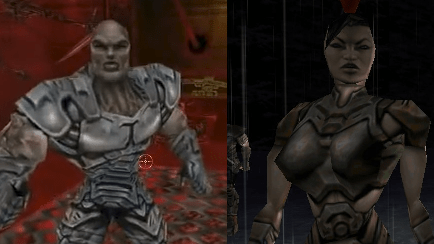
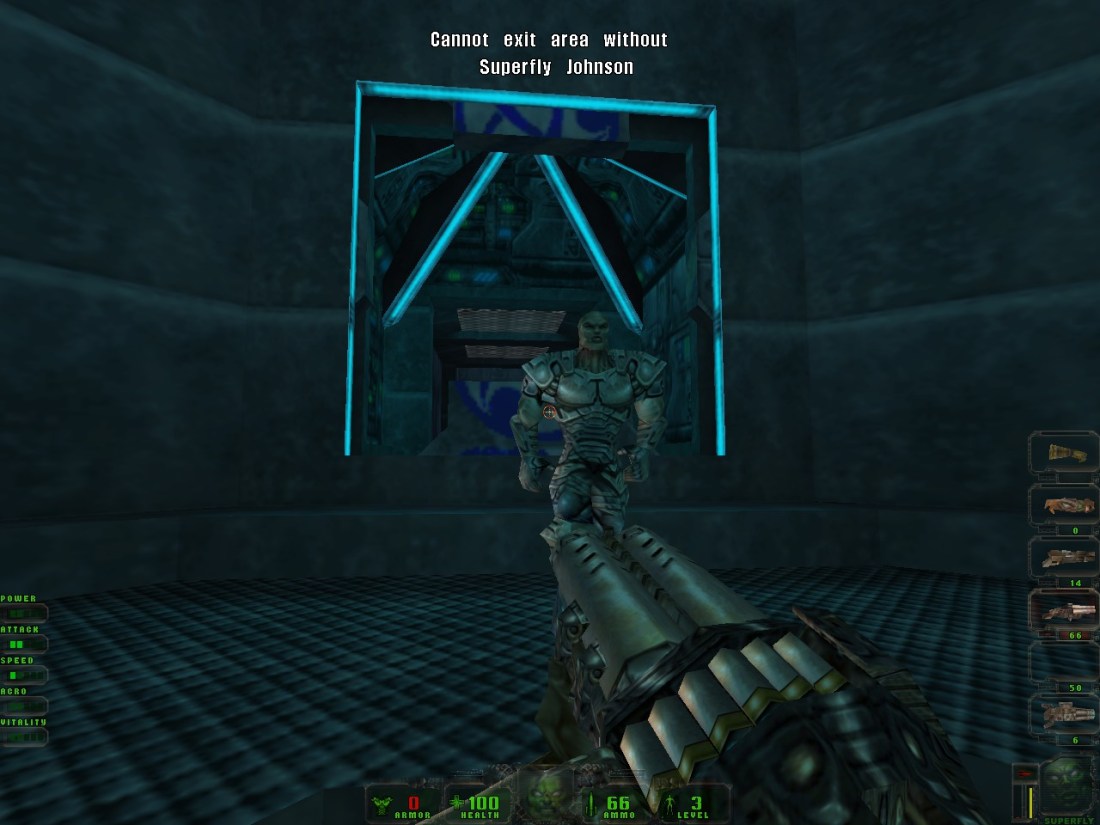
Superfly Johnson is basically Isaac Hayes with a shotgun. His voice is so bass it vibrated my speakers. And that’s not a euphemism. He is the ultra-cool, hip, honeyed-voice of reason, the ‘heart’ of the gang and the first to point out “what the hell” when things happen. And a lot happens. Once we recover the more taciturn Mikiko, who’s all business, it’s Daikatana time – but no sooner have we recovered it when Mishima rocks up and has it too, from an alternate timeline. Because both swords existing in the same timeline could cause the universe to implode if they touched (just like that Van Damme movie), Mishima can’t risk battling Hiro so uses his sword to bounce them around time, while Hiro learns how to wield its power.

Our first stop is Ancient Greece to battle Medusa before heading to the Dark Ages, where curing a plague is in order, before Mishima’s stronghold in the 2030s for a final showdown because, presumably, Mishima ran out of time-periods. Oh there’s also the ghost of that old man knocking about who helps Hiro master the Daikatana. Or maybe it’s not him; I was distracted looking for my buddy Superfly.

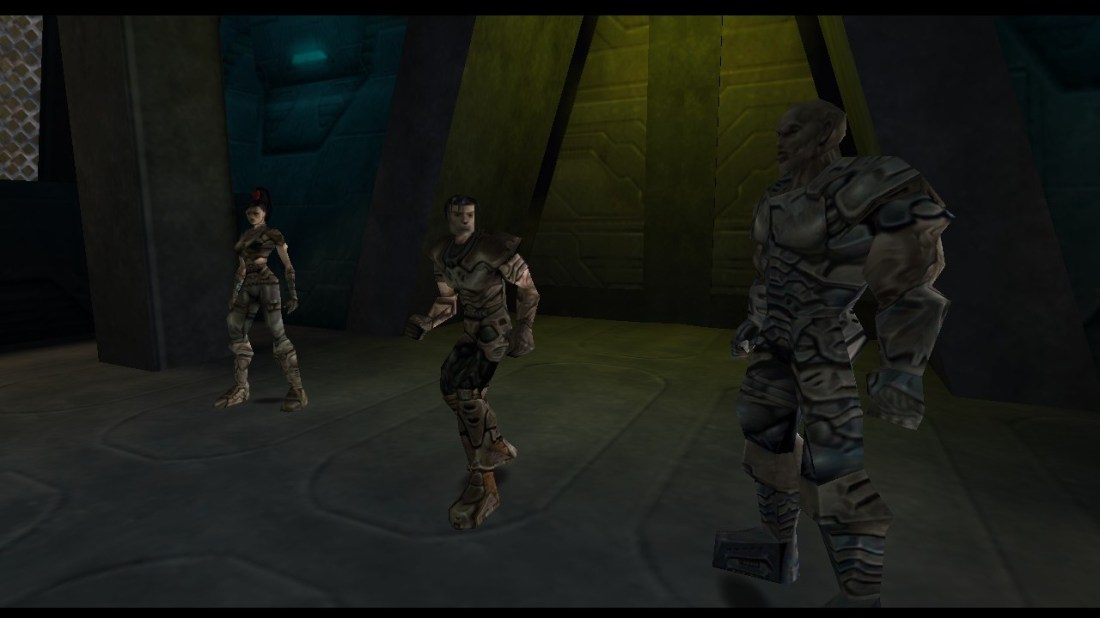
Superfly and Mikiko are perhaps the most derided sidekicks in gaming, more so than bloody Natalya. Yet, they have their own backstories, impact and presence; the way they and their motivations are threaded into the plot is better done than most modern games where sidekicks just tag along or act as our Hypeman; those guys are invested – Superfly to deliver a can of whoopass to those who wronged him, and Mikiko to avenge her father and put right her ancestor’s legacy. A tremendous amount of effort has gone into them, into making them a critical part of this adventure. And then the cut-scenes end and …

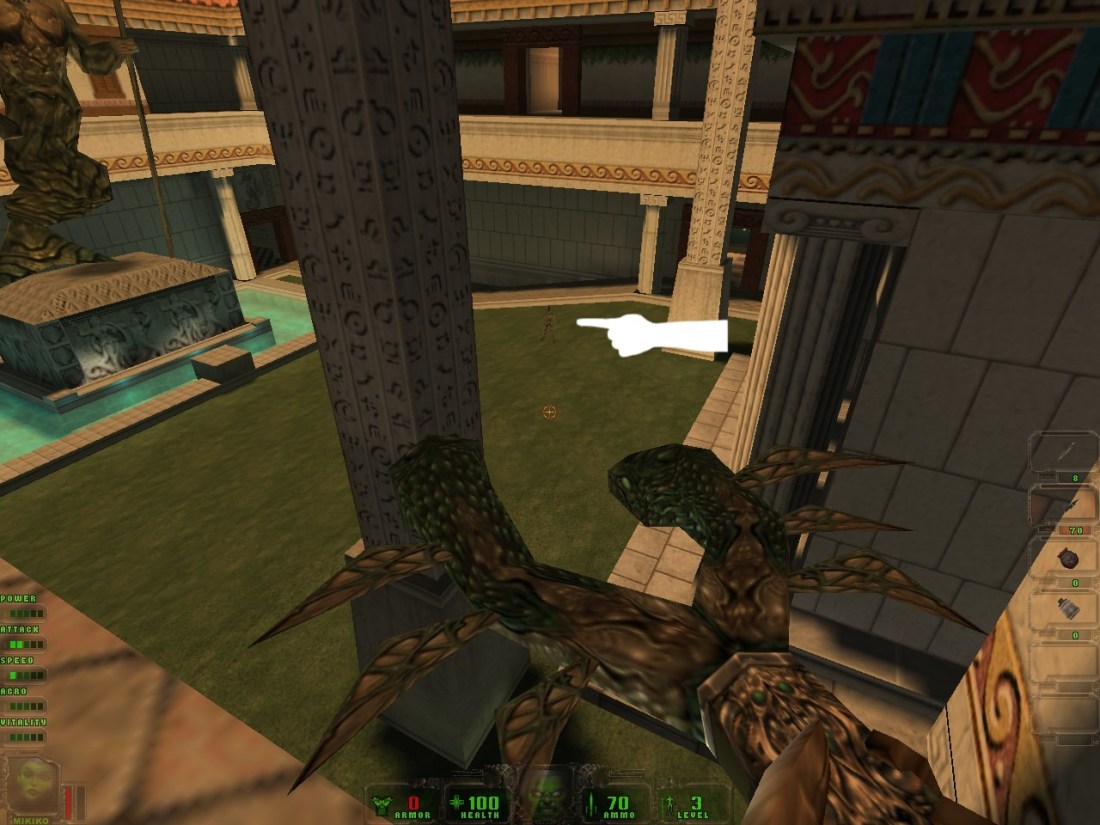
Once Superfly and Mikiko are free it all goes to hell. If we could get there. They pay you no attention, wander off, stop moving, get lost, fall off things or get stuck in them, walk into obvious dangers, refuse to take orders and even take off when the fighting starts. Then they come skulking back when the coast is clear. Having one errant sidekick is bad enough, but two? It’s impossible to corral them. You have four basic commands but they don’t really work and you have to switch between sidekicks so by the time you’ve stopped Superfly walking off a cliff, Mikiko’s disappeared. If anything, this game has given me a new appreciation of games like Mass Effect and how they managed sidekicks. Mikiko? Stay there, I’m just gonna go look for …

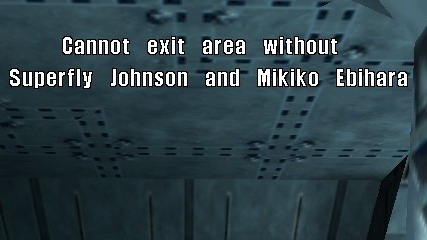
… you don’t even get a warning they’re under attack, just a Game Over (not that you’d be able to find them in time…) They misbehave too; they’ll promise “I’ll wait here” and when you return – they’ve gone. And they can go for miles – which leads to the biggest issue and one that surely must have occurred to the Devs at the time. You can’t pass through a loading screen without them, getting “I can’t leave without my buddy Superfly/Mikiko”. If they’re there, they’ll take their sweet-ass time to reach the exit, but if not … it’s backtrack time; it’s not an overstatement to say a quarter of my time was spent trying to find them. Daikatana is like a FPS Hide and Seek. Worse, you might have Superfly but not Mikiko so you go look for her, get lost, find her, walk her back only to find Superfly’s now gone … Shooters rely on quick thinking and quick moving. You can’t be in shooter mode and protect mode; I have a new-found respect for parents with toddlers, you look away for a second and they’re gone. Daikatana is one long escort mission and that overwhelms the fun. Fan-made mods remove or alter them to make it easier but come on, they’re ruinous. Oh, this level looks interesting, let’s …

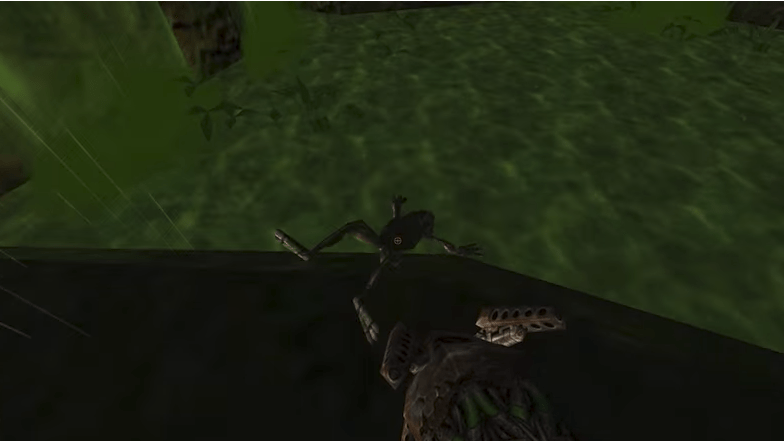
So the sidekicks are a major, game-breaking problem. But the huge variations of creatures, weapons and time-periods make up for it, right? Sure, but first we have to deal with frogs. Frogs!? What were they thinking? But they’re cyber-frogs. Okay. Cyber-frogs?! What were they thinking?! Why would a super-villain even think about wasting R&D time inventing Borgified Frogs? And then it’s mozzies dive-bombing you. Those things are worse than Fallout’s Botflies. Why is the first level just looking up at the sky or down at the ground?! To hide the fact that the opening levels are a murky brown, green, yellow as we push through a … I don’t even know where we are. I thought we were headed for Mishima’s building? You went via a swamp and the sewers? Can’t just find a side entrance Hiro?

Mishima’s building is fairly standard corridor shooter stuff, but throughout there’s NCPs that do nothing but blurt nonsensical lines and run screaming. There’s so many it’s like Serious Sam in reverse and the noise of their collective shrieking is deafening. Plus we meet scientists doing horrible experiments but they disregard Hiro even when I shoot a couple. Why do the janitors run screaming but the guys we’re more likely to be interested in ignore us? Then there’s the level design. It’s incredibly uneven. Some levels work quite nicely, others are a complete mess of backtracking and illogical layouts. And it doesn’t look great either. The art design is basic like you’re on low settings and the cut-scenes are jerky and ugly; I was never a fan of the Quake engines, finding the 3D actually made the world less vibrant than Doom or fluid like the Build Engine, but Daikatana is a game I imagined would have an energy to it, detail, but it’s often got a ‘fuck it’ look to it.

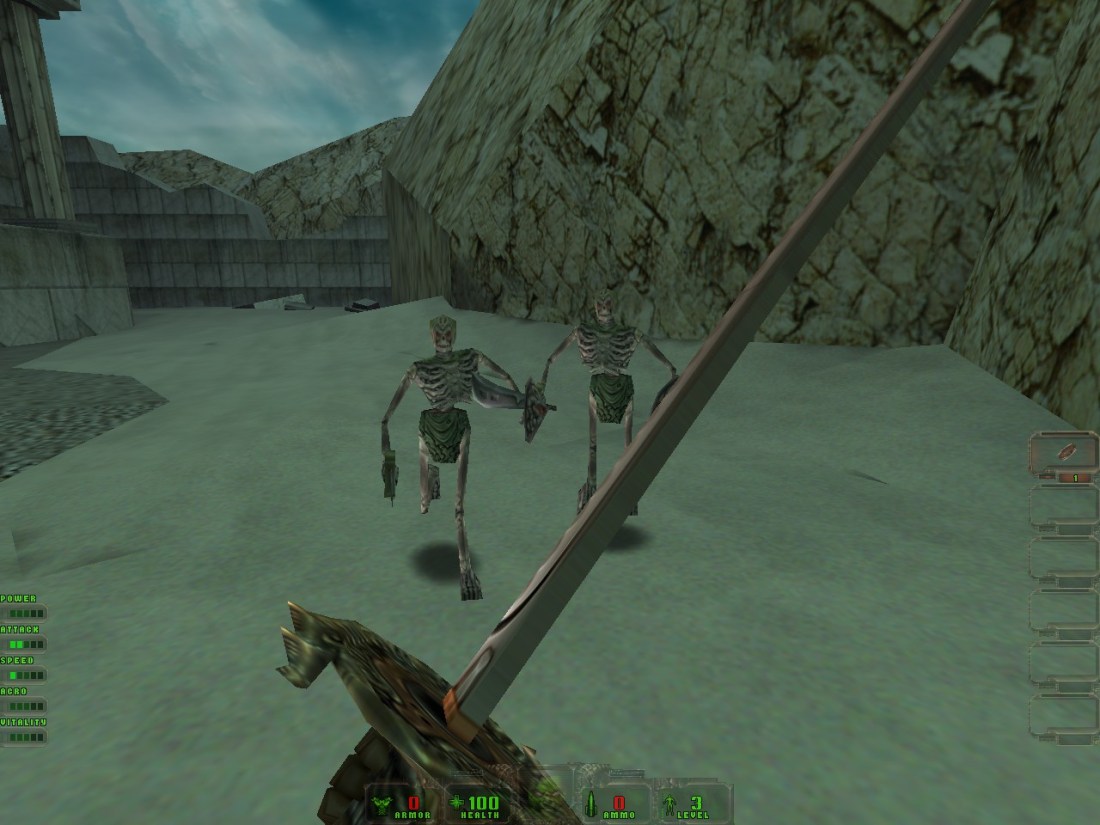
Ancient Greece is more like Ray Harryhausen’s Ancient Greece. We battle giant spiders, skeletons, iron gladiators – it’s by far the best episode, more open, interesting and experimental, and while Dark Ages is bleak and fantastical, the final sequence is largely a reheat of the first with more repeating NCPs and similar fights. The game had 24 levels all in, split between those 4 locations but they all outstay their welcome by 2-3 levels. If Mishima had just managed to squeeze in one more trip it might have flowed better. The main problem is they’re effectively reskins. While each is a different look and has its own set of weapons and nasties, your experience never varies – had Greece seen us doing swords only, Dark Ages had a bit of magic and the final base all sci-fi or facing the horrors that were implied in Mishima’s first headquarters it might have gotten interesting; or have the areas impact Hiro in some way so he’s prepared for his Shogun Showdown – not that it would matter, yo’re too busy looking for Laurel and Hardy anyway.

Like the Daikatana, I’m split on how I feel about this game. It’s both brilliant and frustrating. From a distance, Daikatana is pure genius; but when you get into it, nothing works; the cutscenes reveal a great story but go on for huge amounts of time draining any drama. The trio of heroes develop dynamics but never really build on them, the creatures are interesting but because of the level-sizes they get repetitive and each time-period is great to get into then dull mid-way through. And as a shooter, it’s effective but spoilt by the brats wandering off or getting their skulls split.

As much as I hate to admit it, Daikatana just isn’t very good. It reminds me of SiN – a well-intentioned failure that tried but didn’t quite land it, but Daikatana just crashes.

Although I said I’d ignore the development (and not rip off Masters of Doom) there are elements to Daikatana’s background that should be repeated more often; the game was made by kids Romero hired after playing their Doom WADs; for a Triple-A Development Studio to hire kids whose only skillset was killing it at Doom is huge (okay, maybe it was a folly, they had no idea what they were getting into, but neither did Romero when he made Doom) and many of those guys went onto great game careers. But most importantly, it shows that Romeo’s Ion Storm was all about the gamer in a time when the tech was becoming the most important thing. We care how it looks and how it plays, but what we remember is why we were there and what we did; one of my fave games is Indy and the Last Crusade (1989) and it’s not because of how it renders the fine leather jackets I’m selling. It’s the soul of a game you get, and that’s what Romero shot for – maybe we’d have less reskins and reheats if more Devs took his lead.

Daikatana, if I’m honest, is an awful game, but it’s heart was in the right place – and nowadays it seems there’s no place for heart in gaming. Ironically, games could do with more Superfly.

2000 | Developer Ion Storm, Publisher, Square Enix

Platform; Win (Steam)

Aliens: Colonial Marines

a second wind review

“Marines! We. Are. Leaving!” What about FBT? “Leave him, he likes Aliens Colonial Marines”

There’s few recent games with such a bad reputation as Gearbox’s Aliens: Colonial Marines. Except Gearbox’s Duke Nukem Forever. Some games fail because they don’t live up to the hype, some are mauled for being dated or half-finished and some are rightly slated for being shit, but A:CM was like a GOTY disaster; all fails included. Announced in 2008 and released in 2013, it was hammered by critics as an unfinished, generic FPS that skated by on the good will of its inspiration, it looked bad and it played worse; a buggy, glitchy CoD-wannabe wrapped in a hasty, nonsensical story – the whole thing stank. Then it got worse.

Those involved protested their innocence even though they looked more guilty than Burke holding a Facehugger over a sleeping Ripley; stories of a tortured production involving multiple developers and a Borderlands-distracted Gearbox there were recriminations, lawsuits and insider-leaks that made A:CM less a game and more an exposé of game production processes; developer hyperbole, publisher pressure and sly marketing culminated in a class-action that saw Sega paying a $1.25 million settlement to customers who bought it in good faith.

But, despite all that, I was curious about the Howard The Duck of gaming. Finding it on Steam for a fiver with all the DLC, I decided to try it for a laugh; expecting a quick Rage Quit, I was all set to ask “How do I get out of this chickenshit game”. And then …

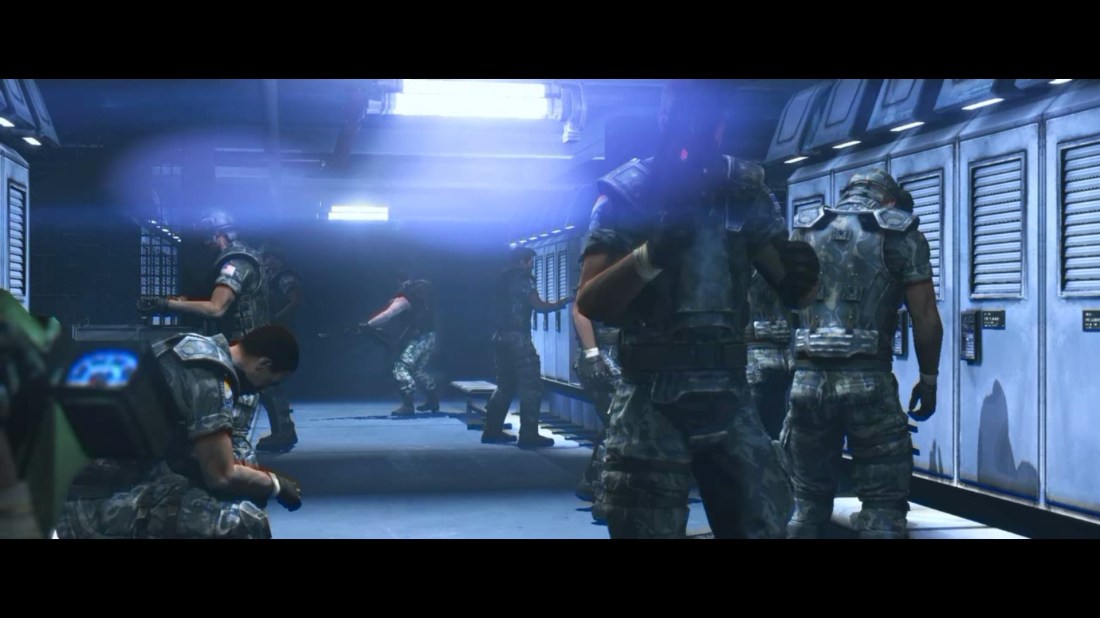
Set as a sequel to Aliens, we open on a garbled distress call from Hicks, explaining the Aliens backstory. Several months later, a Colonial Marines rescue ship, the Sephora finds Sulaco, mysteriously back in orbit around LV-426. All right sweethearts, what are you waiting for, breakfast in bed?
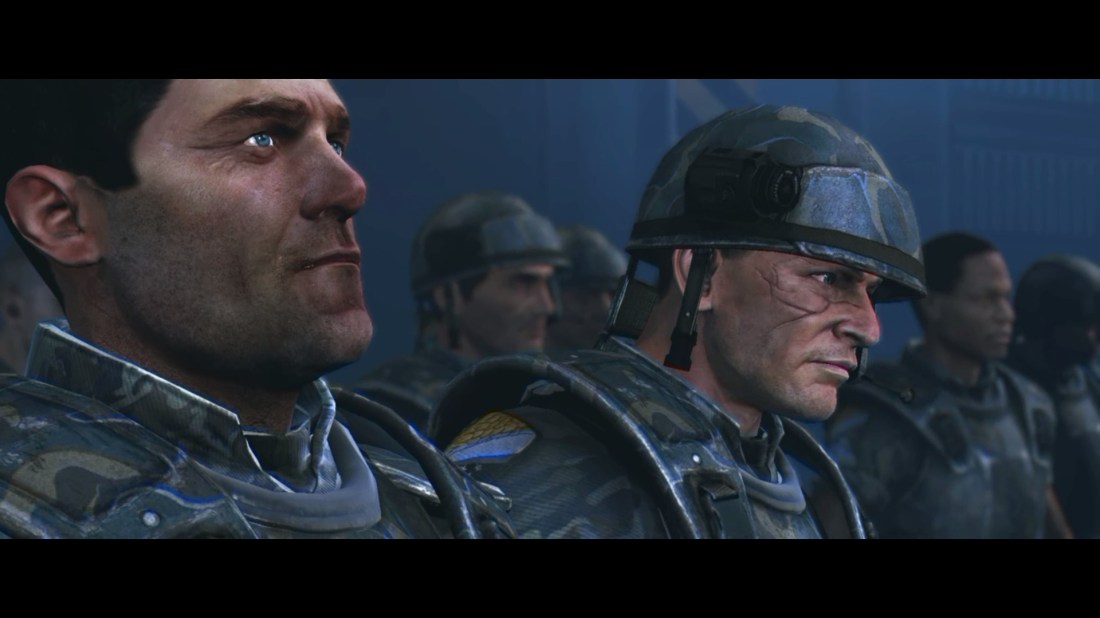
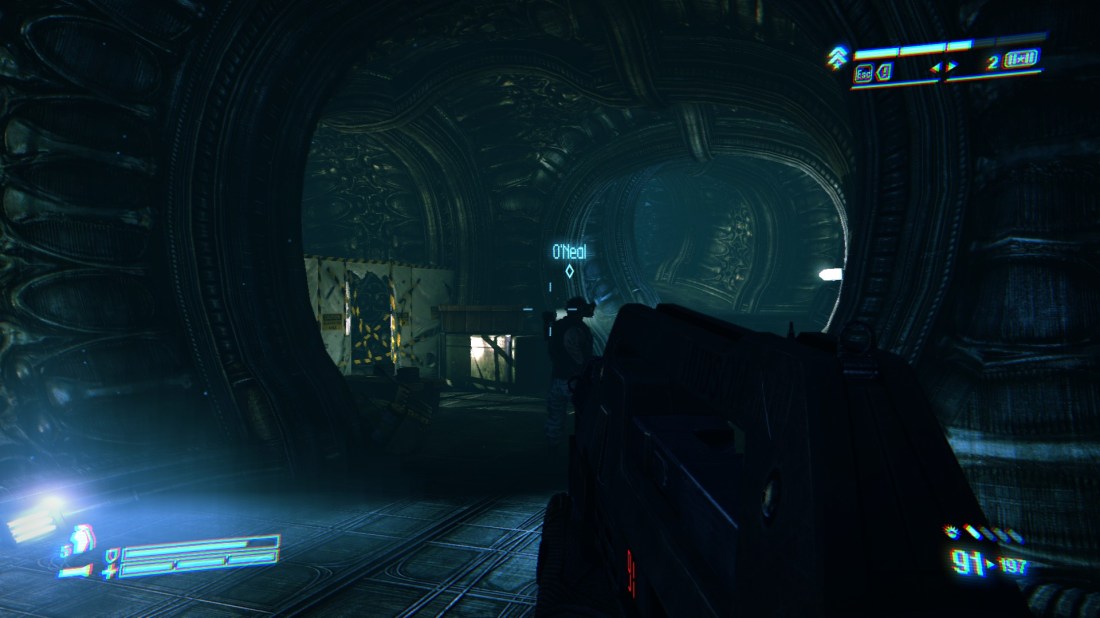
To look at, you can see why folks back in 2013 were a bit disappointed. It does look very 2005. Even though it was built on Unreal 3 – the graphical marvel that powered worlds like Bioshock Infinite – this is a bit rough (one of the biggest criticisms; the trailers looked next-gen). But while it’s not breath-taking it’s not bland either. There’s references to Aliens’ Art Design, the layouts are nice and not too linear, there’s good light effects and detail. I do feel like I’m in Aliens. I’m Corporal Winter, just a grunt. No offence.

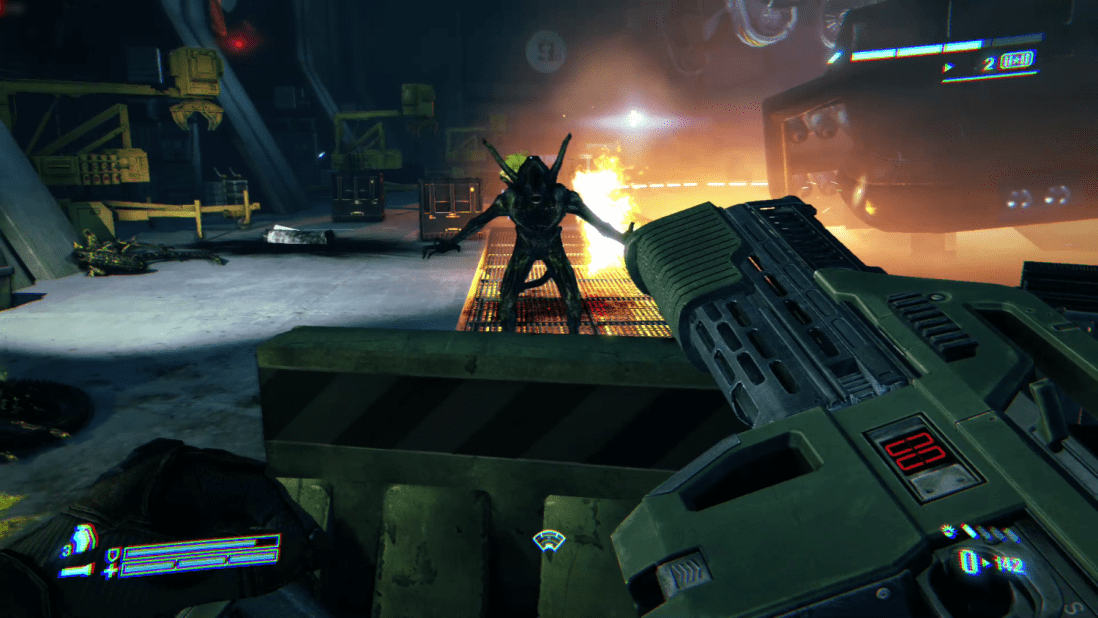
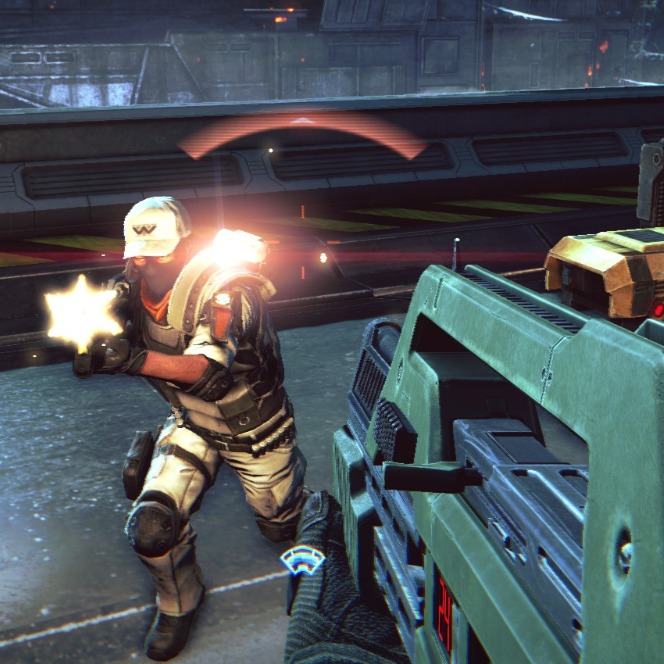
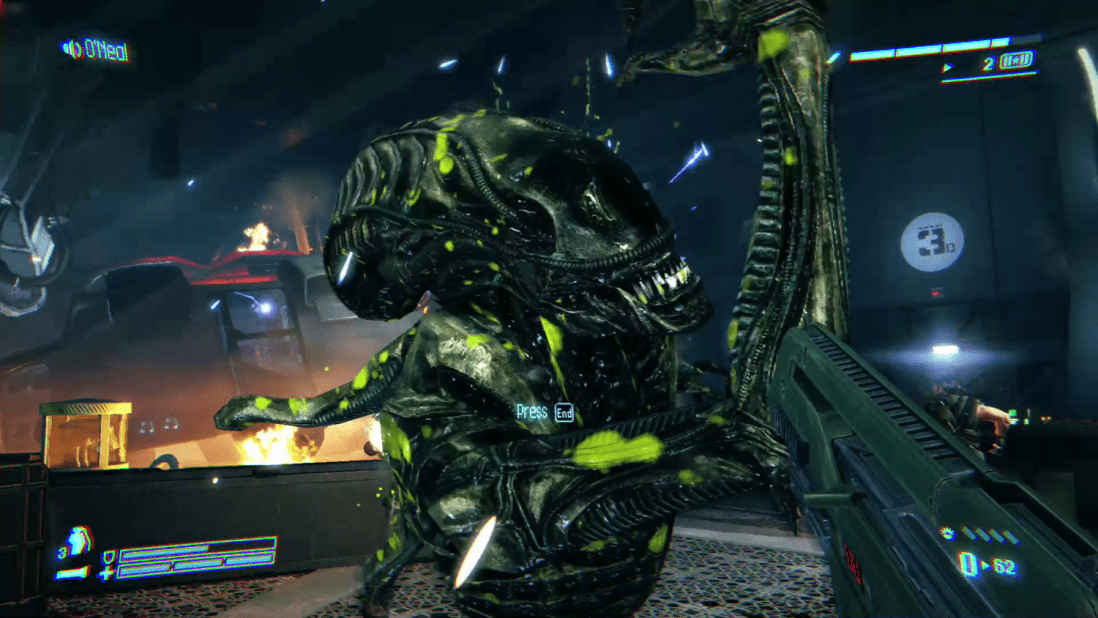
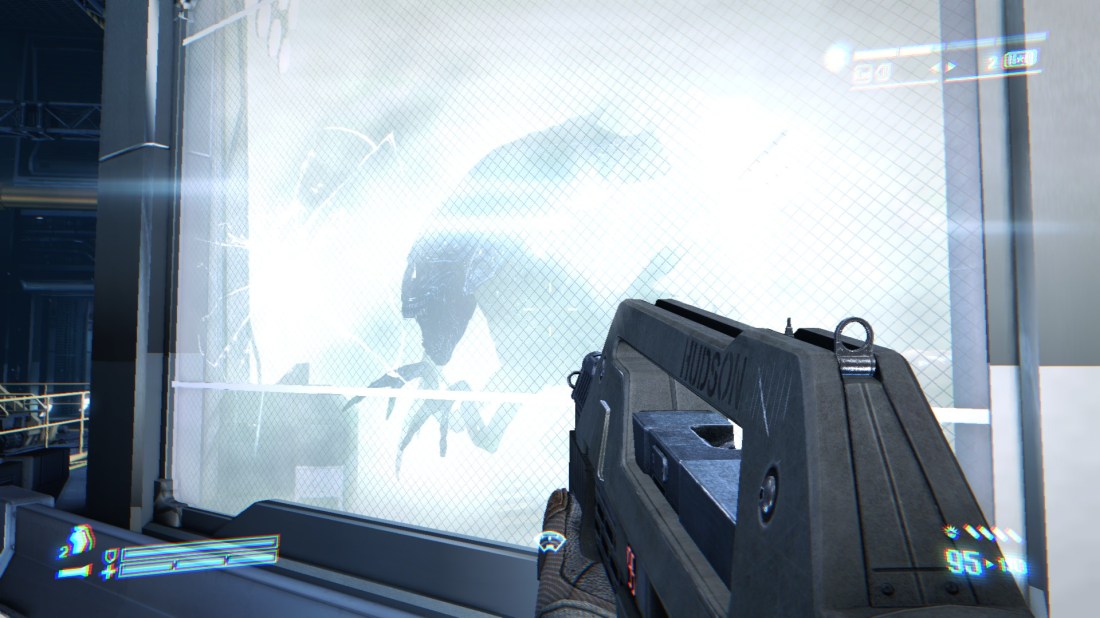
Expecting a bug-hunt, aboard the Sulaco we’re in a stand-up fight. Xeno’s come running, leaping and scratching consistently; it almost reaches Serious Sam levels of hissy mayhem. Don’t get attached to the armour you find, it lasts for seconds and health even less. Not sure if it’s the game being unbalanced or I’ve just gone full Gorman but I die a lot. We’re equipped with a motion sensor, but there’s so many aliens you rarely need to use it. Instead, it’s a handy mission marker as we scramble our way through a completely FUBAR’ed mission. Let’s just bug out and call it even.

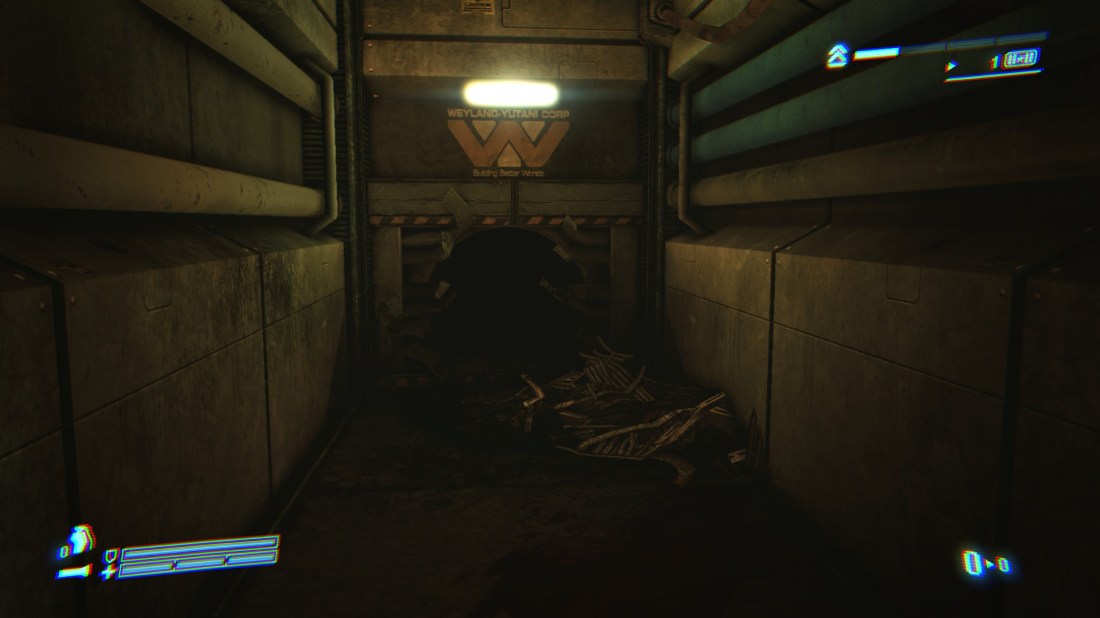
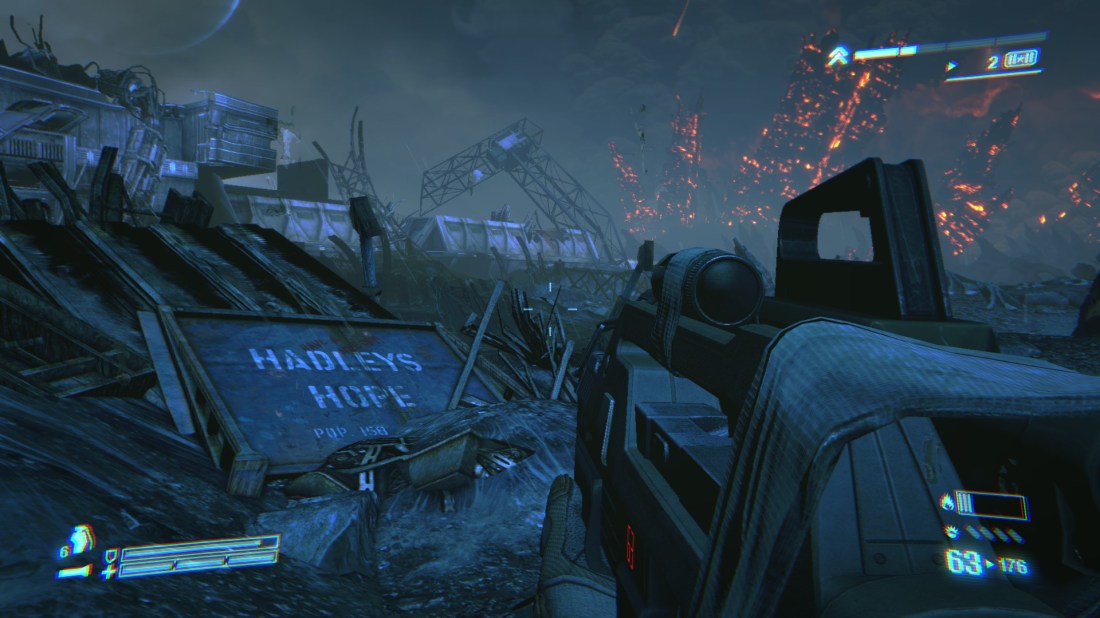
As if dozens of Xenos weren’t enough, Weyland-Yutani got to the Sulaco first, diverted it from Fiorina and returned to LV-426, using it as a self-contained research base for Xenomorphs. Do they ever learn? The outbreak is one thing, but WY are more concerned with Public Relations. They don’t want news of this getting out, and the Sulaco begins firing on the Sephora. Winter, along with Hudson-a-like O’Neal, Vasquez-a-like Bella, Apone-a-like Cruz and Bishop-a-like Bishop escape as both warships explode, stranding the Marines in the ruins of Hadley’s Hope. Which has become prime Xeno real estate.
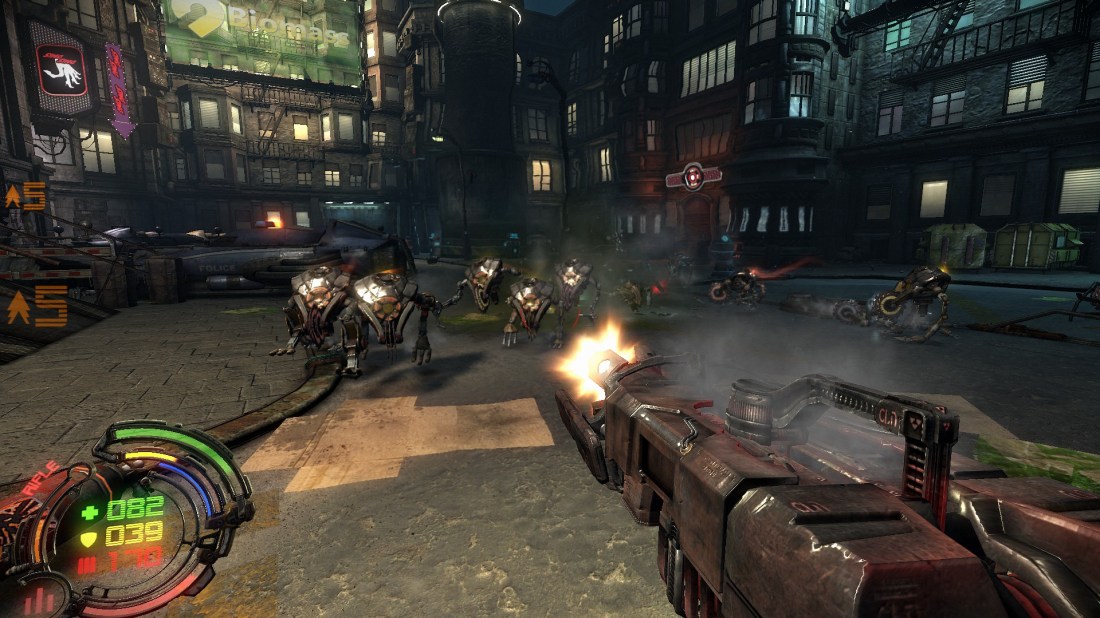
I keep expecting this to get really awful or just really crappy but it’s not. It’s not without it’s fair share of ‘quirks’; the Aliens tend to target you over any other marine – who don’t even block their path; the Aliens just pass right through them. Maybe because Marines haven’t fully woken from cryo-sleep. Often they stand placidly as Aliens pass by or fire at a distant Xeno while one slashes away right in front of them. There’s times where Aliens just pop into existence if I get past a trigger point before the game is ready, and I lost a lot of ammo firing at my own troops when they’d suddenly transport in in-front of me. This isn’t Star Trek. Stuff sinks into the floor, NCPs get stuck, ammo is unreachable and once I passed through a doorway only to see my team running against thin air, unable to catch up – it wasn’t a door, I’d walked through an unbreakable window. It is buggy but this is Aliens where it counts; Hadley’s Hope is a murky, rainy, muddy place full of tension and the Xenos are unforgiving foes – they seem to come from everywhere; indoors they’re bursting out of the vents and from the shadows, while outdoors you spot them clambering over rocks and walls, leaping across buildings; there’s enough to keep both your inner grunt and geek happy; we visit Bishop’s lab, spot the open floor Hudson got pulled through and even find Casey’s head. It’s not exactly taxing to add those iconic elements, but when you consider most game/movie tie-ins, A:CM is trying. At least this isn’t Starship Troopers the game. There’s even Prometheus references, thankfully subtle enough that you might miss them.

Structurally the game is broken into levels with performance results, book-ended by cut-scenes. How retro. The levels always work well though, be it the close-quarters of Sulaco or Hadley’s Hope (check those corners), or the open-space of LV-426. The Aliens always have the upper hand, but even when it falls into ‘watch my back’ waves to fight off, it’s still freaking Aliens and there’s some great cinematics including kills if you melee just at the right moment, and some nice scripted events too, like when an errant grenade in an umbilical tunnel causes it to ripple while you’re trying to run through it. Each level includes a legendary weapon like Hudson’s Pulse rifle that fires in short controlled bursts while DLC also gives us Ripley’s Pulse/Flamethrower combo, the phased plasma rifle (not sure if it’s within the 40-watt range), and the best backup weapon in the game, the ‘SHARP’ Rifle (aka “sharp sticks”) which fires explosive bolts; Alien Goo a-plenty (which of course, burns your armour). Although Winter can only carry two main weapons the entire loadout is available throughout, and level-ups allow attachments like grenade launchers or a shotgun under the rifle for close encounters.

There are some new encounters too, courtesy of WY’s labs. There’s the Spitter alien who snipes you with acid, and the insane Crusher alien, a huge bull that charges – the one time I was thankful for a glitch, it got stuck in the scenery letting me circle around and sharp stick it from behind. A standout moment is a sewer level that features husks of long-dead aliens. Except not all of the husks are quite dead. Movement causes some to shamble around looking for the source of the noise; if they get too excited they explode. It’s a really good level that starts with an unkillable alpha Alien known as the Raven – avoiding it isn’t exactly the stuff of Alien Isolation but there’s some hairy moments as you desperately cut open/weld shut doors as it chases; that’s after a Newt reference where you scuttle through under-floor tunnels while Raven rips open the vents; it culminates in a mano-a-mano with you in a power-loader. You can take those references as derivative or a homage but either way, you can’t deny how much you wanted to experience Aliens as a kid; that’s what A:CM is, wish fulfilment. I LOVE the Corps!

Occasionally we get a break from the Aliens, only to have them replaced with WY Mercs. Then we’re into standard CoD fare with missions like take out AA Guns; certain levels are generic but the WY shenanigans turn the final quarter into a great little actioner. Turns out WY captured a survivor from Sulaco’s crew and we’re tasked with recovering them for their intel. The Aliens are also headed into the complex, creating some fun cross-fire battles between them and WY as it turns out our target is not the only prisoner WY has; there’s a new Queen on the block.

While the gameplay isn’t new it is an effective shooter, and as a continuation of the Aliens narrative, anything is better than Alien 3. While the new Queen reveal isn’t so much a shock as it is expected, the prisoner we free is a huge surprise. Because they’re very dead. It’s made worse by the game papering over the huge continuity hole it’s just created with ‘that’s a long story … anyway,’. As it happens it’s not a long story, it’s a DLC; ‘Status Interrupted’ where you play three different (and tragic) characters caught in events that led up to the Sephora’s arrival – it is a brave bit of retcon but it must have really pissed off the reviewers and fans who played the game on day one. Being expected to buy the Season Pass to find out how this reveal makes sense is not how you win back fans.

Our new friend explains our only chance is a supply ship that services the research base, which of course is next door to none other than the Engineers’ space craft. It’s is a great mash-up between Kane’s tense walk through the egg-filled mist and “they’re coming out the goddamn walls!” panic. This game is like an Aliens Greatest Hits Compilation. It might be the source material triggering the thrills, but A:CM never feels lazy and the final is a hectic chase to stop WY’s plans; it’s no spoiler to say it comes down to Winter vs the Queen – how could it not be? It’s a well-done boss battle (except if I get far enough away she uses the Marine’s teleporter …). As the credits roll I’m still waiting for A:CM to suck. This was worth waking up to Drake’s face for.
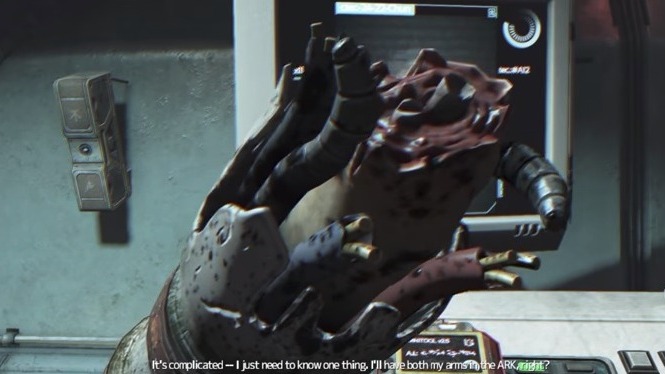
This doesn’t feel like the thrown-together cash-in originally reported. Perhaps the stories of its tortured development coloured the early reviews, but five years on, A:CM seems to have been unfairly judged. Its heart is in the right place even if it’s a little buggy and under developed in places, especially the storyline; having one of our team slowly succumbing to an alien embryo doesn’t land quite as emotionally as it should, and the prisoner recovery falls flat narratively (they just become a follower and an exposition expert) and the reveal takes you the gamer completely out of the moment because you’re going ‘wait, what?!’ While it’s a welcome return from the dead, there were other Aliens characters that would have made things more interesting when considering the WY element.

Based on the extended WY Merc scenes (and the open ending), clearly Sega wanted a CoD franchise; they also invested heavily in multiplayer (most of the DLC was MP levels including recreations of the movie locations) but we’re just here for the Aliens and it does succeed at putting you right in that hectic Hive scene. You’re never safe, never on top of things and almost everything goes wrong; A:CM takes the scene where Hudson says they won’t last 17 hours and makes a game of that panicked thought. I lasted 10 hours, and I had fun start to end. Get on this express elevator to Hell.

2013 | Developer Gearbox Software / TimeGate Studios | Publisher Sega

Platforms; Win (Steam), PS3, X360

SOMA

a second wind review

“who thought sending a Canadian to the bottom of the sea was a good idea?”

FBT thinks it was a very good idea.

In 2015, comic-store clerk Simon Jarrett is involved in a car crash, losing his sweetheart and some of his skull; left with pressure on his brain that might kill him at any moment, Simon meets not-yet-a-Doctor Munshi, who is developing a radical way of scanning the human brain. Ignoring the suspect office and equipment, Simon agrees to be a lab-rat hoping the scan will allow surgery by revealing the pressure point. Unfortunately, Simon wakes to discover he’s under even more pressure – the entire Atlantic Ocean.

Worse, Simon’s not just woken up in the wrong place, he’s in the wrong time. It’s now 2104; contacted by a scientist called Cat, she explains things are even worse; a year earlier, a comet impacted earth and caused a nuclear winter. The only life left is what’s on Pathos-II, the undersea science lab they’re in; but is that life friendly … or even human? Doesn’t seem possible but I get the feeling it’s only going to get worse for Simon.

It’s an obvious comparison but SOMA does remind you of Bioshock, and other psychological games like Alan Wake, Silent Hill, Alien Isolation, Prey (both versions), System Shock pop into mind; we’ve got machinery moving suddenly, glimpses of things, doors opening, lights flashing, eerie noises, jump moments, dark rooms to enter; all very Survival-Horror, but rather than derivative, SOMA is something different. It’s in the story that SOMA steps out of those games’ shadows and into it’s own horrible place. It’s closer in experience to Hollywood’s recent spate of subtle-horrors; A Quiet Place, Cloverfield Lane, Annihilation; SOMA messes with your head not your trigger finger.

Taking in the desolated and decaying station, Simon quickly discovers it is not a nice place to be. The walls are covered in some encroaching, living goo that makes Pathos-II look like a mash-up between the Alien Hive and the Borg’s gaff. Early on I find a machine covered in the gooey tendrils, and disconnect it to turn on a switch. Then it cries out it “Don’t, I need it!” before dying. Should … should I have not done that? That wasn’t a machine’s voice that was … Human? Then I find a crippled machine that’s convinced it’s a man who suffered an injury and needs a medic. You need a mechanic, mate. But he thinks I’m the crazy one. Am I? What is going on here?

After the comet impact, Cat’s idle hobby – digitising brain patterns – became Pathos-II’s sole focus. They created the ARK, a digital representation of earth where their personalities can live for eternity and preserve something of humanity. Cat was almost there when survivor-guilt, psychosis and understandable madness overwhelmed the crew. Meanwhile, when Pathos-II’s AI, “WAU” learnt of the comet, it tried to fulfill its prime directive – protect mankind. Problem is, WAU couldn’t understand human nature, only survival so it used ‘Contact Gel’ – the goo we’re seeing – which is like a liquid circuit board, to bond the crew to life-supporting tech and keep them living, whether they want to or not. As if that wasn’t horrific enough, WAU also began activating ARK files, building the transferred personalities into the circuity and machines instead of their digital reality; anything to keep humanity going. The station is people.

WAU is arguably the main antagonist but it’s not evil like SHODAN or GLaDOS and we never converse with it; WAU is just desperately trying to save humanity and wants to help; humans are living, but you’d not call it life. But what is life? What are we trying to save? We’re leaving all those people to this agony? It looks like Cat and Simon will end up joining them anyway. The ARK runs on solar power, and thanks to the nuclear winter there’s no sun. If they leave it on Pathos-II, the power will eventually fail – or WAU will reach it. That means using a supergun at the end of the lab to fire the ARK into space. Easy. Except Cat doesn’t even know if it’s still here. If it was launched, they can’t Tron themselves into it and escape – if it’s still on Pathos-II, can a scientist and a shop clerk finish the ARK, digitise themselves, load it into a rocket, fire it out of the Atlantic Ocean through the nuclear winter to reach space and hit a safe orbit so they can live forever? They have no chance! But what else can Simon do but try? Because it was all too easy, turns out he can’t even take out WAU’s monsters.

Like Frictional’s previous game, Amnesia, when you do face off against a creature, your wits are your weapons; the best Simon can do is escape. Several of WAU’s abominations roam the station but it’s refreshing that they’re not common, keeping their impact at maximum ‘oh god!’ when they do appear. An early goo-filled machine is standard, but human-creatures are just … no. Some listen for you, or you have to stay out of their eye-line, others follow you unceasingly and you never really see the same monster twice, like you only meet mini-bosses. You never go ‘oh it’s a so-and-so, I just need to do this’. Each has its nightmarish ways to out-smart and they look so maddened and tortured you feel pity as much as fear – but the real monster is the story.

Simon’s situation, how he got there and the overwhelming odds he’s facing are the game’s biggest scares and Simon is not helping. Realising the human race is in the single digits, it’s not long before he’s on to the really big questions. Is the ARK immortality? Is it life, living in a machine? Will they be much different from what WAU is attempting? Are we just electrical impulses really? Is life just our perception? What is humanity? Does it matter, who cares? What is the point of it all, Goddamnit?! Simon’s frustration is palatable, his breakdowns understandable, but thankfully we have Cat to give some perspective. As in, Cat really doesn’t have time for his crap. Hurrying him through his realisations, getting exasperated at him for pondering the meaning of life when we have stuff to do, she’s like an impatient Alyx and easily one of the best sidekicks in a long while. The philosophical banter between the two is spot-on and her sark provides some very welcome comic relief. Simon wants to give meaning to all this; the only thing Cat clings to is the possibility that the ARK is still there. She’s even blunt about how Simon wound up here.

SOMA knows that question needs to be answered so rather than dragging it out, it’s revealed early – but SOMA doesn’t just do the reveal then expect Simon or us to shrug it off; instead, the revelation affects and alters everything, becomes the central theme. Plus, SOMA is packed with enough twists and tough choices that Simon’s situation is the least of our worries; there’s moments so debilitating I just walked off, needing a minute. SOMA really nails surviving death only to face no future. We’ve gamed through the Fallout-style apocalypse before but SOMA instead calls to mind the Cormack novel The Road, that sense that it’s just … over. Simon’s situation is so frustrating; he’d come to terms with death; now he has to survive? He’s a likeable guy, give him a break FFS. The shit he goes through …

Still, while Simon might be faltering, for us, progressing through Pathos-II is very focused. You’re not spoon-fed solutions, Simon needs to get his shit together sharpish. Nothing comes across as convenient or outlandish, the lab is a logical place and you do get a sense of progressing, even if it’s all on you – no mission markers, no hints, just you. Early on, interacting with the world is frustrating; Simon must be precise to progress, to the point of pushing or pulling doors – given my real-life inability to push/pull a door correctly even when it’s written on it I’m just adding to his woes. But after a while you get into it. The puzzles too are cleverly frustrating. Never explained, it’s up to you to figure out the process before you even attempt a solution.

The station is split into separate research labs Simon needs to navigate between; as in, across the seabed. And that bloody WAU-infested Gel has leaked into the ocean; as if deep-sea fish weren’t freaky enough. We even have a mutated giant squid circling while belligerent rovers and mechs chase us about. Or try to chat to us. Both are terrifying. There’s guide-lights that keep the fishes at bay, but storms swell up causing the lights to go out making it a terrifying, confusing trek along the sand; oh, I can see a light. Nope, that’s the lure from a goddamn mutated angler fish…

Reaching each lab we discover new horrors, and how each isolated group handled the event; some joined the ARK project, some just lived out what time they had left while others carried on as if the apocalypse would pass. Every new area is a new take on what humans would do in that situation.

Reaching the ‘abyss’, a deep-sea trench where the final lab and the likely resting place of the ARK are, Simon and Cat activate a deep submersible – and activate it’s personality; who, terrified, takes off. Can we just get a break?! Cat’s solution is f’ed up, but it’s not like Simon has a choice. On the plus side, what happens afterwards is far, far worse. And then it gets worse. And worse, and worse until you’re staring at the end-credits, aghast. This game should end with “if you’ve been affected by any of the subject matter …”

If you do make it, make sure you stick around until after the credits for the very definition of ironic bitter-sweet endings. SOMA is a very troubling game; you don’t want to say good bye to Simon and Cat, but you’re not sure you want to experience that again. If you do, you’ll spend forever trying to force a different outcome. But it was never going to go any other way.

It’s been weeks since I finished SOMA but Simon and Cat are still in my head, arguing over the definition of life – and death. And as a testament to that narrative, Frictional released an update called ‘safe mode’ that stops WAU from killing you. You’d think a God Mode would remove all the intensity but it doesn’t – it makes it worse because all you’re focused on is what Simon has to go through. A new entry in my all-time great games, SOMA might not reinvent the gaming wheel but as a thought-provoking experience, it’s as close to Cinema as gaming has gotten; SOMA is the game Stanley Kubrick would have made.

2015 | Developer/ Publisher, Frictional Games

Platforms; Win, X0, PS4