Day of the Tentacle

A Blast from the Past review

Well, what possible harm could one insane, mutant tentacle do?
The Past

You can’t seriously call yourself a gamer if you’re yet to embark on a LucasArts adventure. Experimenting without fear of failure, the team behind Indiana Jones and the Last Crusade revolutionised DOS gaming back in the late 80s and early 90s, creating signature point-and-click titles that would go on to inspire generations of developers. George’s development arm wasn’t the flashiest, nor was it the wealthiest but it singlehandedly defined the Adventure genre of games producing expertly written comedy and highly addictive titles that had kids across the world breaking bedtime and gaming curfews for that extra fix. Be it taking down the Nazis, guiding a dead soul to the afterlife or solving crimes as a wacky Rabbit and Dog, the imaginative creators have always been ahead of the curve with their inventive plot ideas. While the classics are often nostalgically the best, I was determined to discover whether their adventure set across 400 years in the home of Fred, Ted, Red, Ved, Zed, Weird Ed and any other rhyming member of the Edison family would hold up as I had so sentimentally remembered; as the craziest and best of the lot.

Still a Blast?

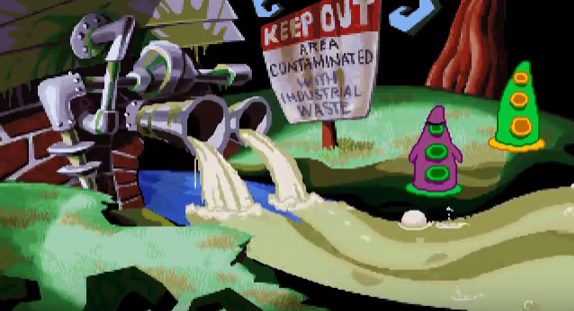
As the MIDI version of Ranz de Vaches from the William Tell Overture sounds irritatingly from my tinny inbuilt PC speaker, I’m greeted with a wonderful life lesson – Don’t drink water that’s been contaminated by industrial waste if you don’t want to turn evil and attempt to take over the world! Alas, Purple Tentacle (that’s right, the games antagonist is a life-size reptilian appendage of a violet blush) didn’t heed the written warnings and is now malevolently intent on enslaving all Earthlings.

While most heroes would crumble at the thought, our three stooge-protagonists are hapless in their pursuit of punishment and need no invite to stick their schnoz exactly where it isn’t wanted. So, when a pet hamster arrives at your door with a note for Bernard from his old pal Green Tentacle (Obviously, because Purple tentacle must have holier-than-thou a brother), nerdy Bernie misinterprets the note and believes Dr Fred is going to kill them both. As Bernard and his band of intellectually challenged helpers head back to the Mansion to save the tentacles from their impending doom, little do we know that Bernard’s act of heroism is about to right, royally balls everything up…

Daft opening cut scene aside, the game holds up well and there’s a real sense of familiarity in operating the point-and-click controls that were synonymous with adventure games in simpler times. While incredibly unsophisticated in style (text based options of Look At, Pick Up, Push etc…) the controls maintain a moderate level of complexity. There’s no modern-day cop-out of just pressing ‘X’ whenever you get near to an object of interest, instead you’ve got to choose your interaction. Millennials may hate it and at first even seasoned gamers might think this is going to get tedious very quickly, but after a while you realise this serves as an excellent vehicle for a major part of the games comedy. I mean, in the real world if you go to pull a door and it doesn’t open, would you just abandon it and walk away or would you try pushing it? In Day of the Tentacle (DoTT from here on out to save the R.S.I.), getting it wrong often rewards you with a condescending one-liner kin to “I’m pretty sure it doesn’t swing that way”, making you want to get more things wrong on purpose in future before you attempt to get it right.

Another aspect of the games controls that has aged very well is the character selection. Over 20 years before the “revolutionary” GTA V was released, we have an original switching mechanism that allows you to shift between 3 very different, insanely funny and unstable characters as you try to work together and get individual aspects of the job done. Prior to Trevor, Franklin and Michael, you have Hoagie the Metal-head, Bernard the computer nerd and Laverne the ditzy student and each are as hilariously stupid as their designs suggest.

After you’ve gotten used to the controls, had a wander around the foyer of Dr. Fred’s mansion and finally discovered the secret passage to the hidden laboratory, Bernard frees the tentacles and the mischievous Purple sets out to try and conquer the planet. Now, you might think there’s a very easy solution to this. Purple Tentacle is very slow, has T-Rex sized arms and no legs. So, we can just run after him, tie him up again and be done with it. Problem solved…. Right? Well no, because obviously the only logical way to fix this is to go back in time and turn off the Sludge O’Matic and stop Purple Tentacle from drinking the raw sewage in the first place. Not my preferred method, but I guess there wouldn’t be much of a game without it. Crazed inventor Dr. Fred has just the thing to help us bend the space and time continuum…

As Back to the Future had the iconic DeLorean and Bill & Ted had the distinguishable San Dimas Phone Booth, DoTT has opted rather hilariously for The Chron o’John – a time-travelling toilet. This game is getting sillier by the minute and I’m beginning to remember just why I recalled it so fondly. The terrible plan goes exactly as expected – terribly wrong! Leaving the three characters stranded in completely different eras. Hoagie 200 years in the past, Laverne 200 years in the future and typically for hapless Bernard – back exactly where he started. Their only method of communication is by shouting into the Port-a-Loo’s bowl and by flushing small, inanimate objects down the pan. So now we have two goals – stopping the tentacle and bringing back our friends! So, with the characters established, the tasks defined and the raw comedy blasting you in the face like the salesman’s exploding cigar, the fun can really begin…

Bernard sets out on his quest to find a new diamond to power the Chron o’John and bring back his friends to the present. As with any adventure game, we set out by exploring our surroundings. In this case, we have the Edison mansion – mind, mansion is a bit of an exaggeration. It’s pretty much just a 5-bedroom Victorian Townhouse, but I’m no snob, so mansion will do. We enter a few rooms and do exactly what any good adventure game tells us – click on everything and pick up any seemingly useless item you can find – even if it is just chewed bubble-gum or fake barf. After doing the rounds and chatting to a few of the games comic acquaintances a hidden gem appears. We stumble upon a room with a big oaf behind a desk – it’s Weird Ed, Dr. Fred and Edna’s son. Weird Ed’s a former member of the Army and is clearly suffering from a severe case of PTSD. He now has two passions in life – his hamster and his stamp collecting (whatever you do, make sure you’re fully prepared for the consequences if you damage his precious stamps!)

In Ed’s room, there’s a computer in the corner and, if used, you can find a neat little Easter Egg. His Desktop contains the fully loaded and original prequel to the game we’re in – 1987’s ‘Maniac Mansion’. It’s such a brilliant and unique moment of in-game inception, as you find yourself playing a game within a game where all the characters are the same. It makes purchasing DoTT almost like a buy-one-get-one-free offer as this delightful throwback allows you to get completely lost and forget exactly what you were playing in the first place. If it wasn’t for the distinguishingly terrible 8-bit graphics, you’d be crying out for Dom Cobb and his totem to know what the hell is and isn’t real. It’s completely opt-in, but you could easily spend hours in this sublime surprise which helps you understand the character backstories – most importantly why Bernard is so painfully untrusting of Dr. Fred.
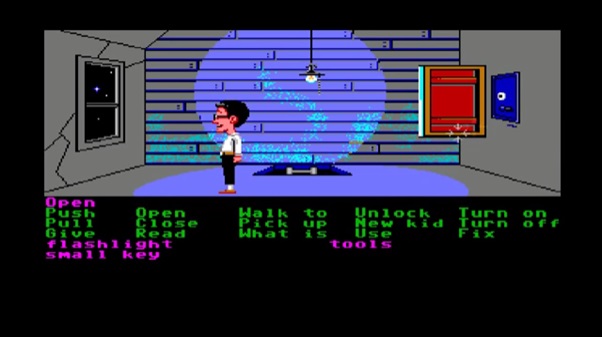
Now, the difference between Maniac Mansion and DoTT goes deeper than just the aged quality and lack of voice-artistry. The former is brutally unforgiving and a wrong move could be a game ender, so while it’s good fun, you may need to quit out and come back a few times if you want to try and complete it – I learned this the hard way the first time I played wasting 30 minutes in a futile attempt to bust all three of my characters out of an inescapable jail! While the game ending nature can be annoying, playing it gives you a nice reality check and makes you appreciate just how much adventure gaming has improved in such a short space of time. The sequel can be equally frustrating but for the opposite reason – you can’t die. Unlike the remastered Broken Sword, Double Fine have elected not to have an in-game hint system, so if you’re playing the iOS or PSN version – be prepared to be wandering around until that lightbulb moment hits you (or until you lose patience and look up the walkthrough on YouTube).

Unlike other time-travelling games, such as Quantum Break or Bioshock Infinite, there is no deadly Butterfly Effect. If Hoagie steps on a cockroach, then instantly the present isn’t transformed into a ‘planet of the roaches’ where Bernard must lead an uprising against his 10-foot tall insectoid overlords. There are also no worries about meeting your younger selves, your parents or your ancestors and disappearing from existence as the game adopts a less thought-intensive approach to travel where only minor details of each puzzle change through time. Laverne needs a disguise to help her break out of a futuristic prison? Easy. Steal the Doctors tentacle chart, flush it to Hoagie and get him to switch it with the plans for the American flag – hey presto – the star-spangled banner 400 years later is tentacle shaped and perfect to aid Laverne in her escape. While it’s hilarious, the keen sci-fi nerd or historian playing would have to put aside their logic and accept that this has all happened without changing any of the history that would come with such a careless distortion to the fabric of time.
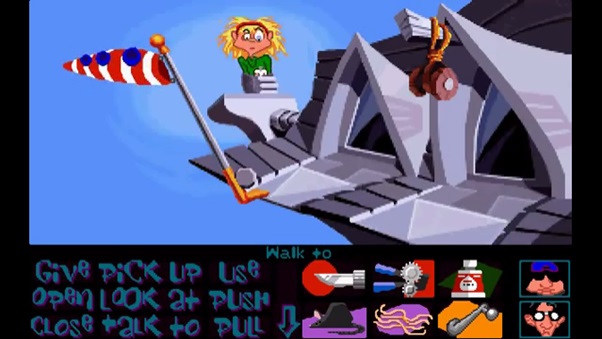
Another thing that I’d forgotten is how purposefully inaccurate the antiquity of the game is. So, don’t play this game directly before a school exam because the game will undoubtedly cloud and reduce your knowledge of history and culture of 1700s America. What… you mean, George Washington didn’t cut down a Kumquat tree by mistake because someone had painted the fruit red with lead paint found in Ned Edison’s bedroom? You must forget the history books and just switch off and enjoy the ride. It’s the fashion in gaming now to see interactions with historical figures – something we see constantly in the Assassins Creed series – and you can never be too sure how well these references have been researched or how true to life the games are that are portraying them. Unlike Connor’s battlefield run in with the 1st President of the United States, Hoagies meeting is so satirical that it wouldn’t be out of place in a stand-up routine. Would Benjamin Franklin have discovered electricity without you? Who knows, but helping you save the world from an Evil Purple appendage was certainly something left out of the American History books. Either way, it’s a brilliant mechanism to fuse familiarity with the creator’s wit and drive the plot forward.

The entire game doesn’t take itself seriously in this respect and the more I switched between the characters the more I remembered just how fun it was solving puzzles through time. Cryogenically freezing a hamster in an ice box and tumble drying a jumper for 200 years to help it thaw was a nice little touch on my quest to gather electricity and as the game progresses, the level of invention in the puzzles increased. However, the game’s greatest strength is also its biggest weakness. I found that it was so enjoyable first time around that most of the solutions were as memorable now as the day of the original playthrough. I remembered the Dirty Harry/Travis Bickle monologue with the inflatable clown and laughing at how Bernard eventually got so annoyed at being bested that he had to stab it in anger. So, when I saw Laverne had the opportunity to collect the scalpel in the futuristic doctor’s office, I instantly remembered its purpose. Not counting the Maniac Mansion Easter Egg, I nailed this playthrough in just over 2 hours which might not be bad value for the price of a pint, but I certainly wouldn’t be rushing back to play it again any time soon. The game has such limited re-play value particularly when you compare it to other remastered adventure games, such as Broken Sword, Monkey Island or Grim Fandango, where after a month or two you could dive back in and enjoy it all over again.

Playthrough value aside, the comedy alone is well worth a punt for first timers or those longing for childhood nostalgia – I mean, which other set of writers would predict an evil genius ready to take over the world would make this their first act of evil…
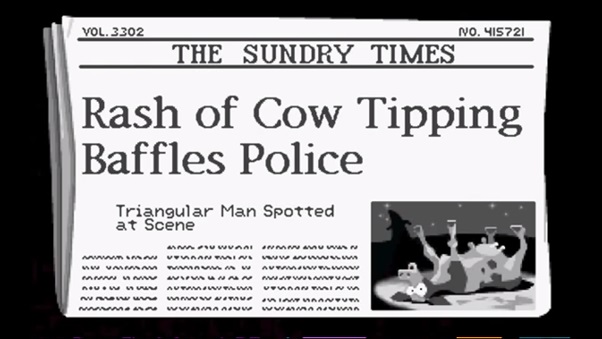
…Hey, I guess even Hitler had to start somewhere! With complex puzzles, a satisfying ending and the original prequel embedded, this personality exuding, time-travelling title still holds up today as one of the best adventure games on the market. It hands down beats other remastered games of the same genre and for any LucasFilm fan, you can spend hours upon hours picking our Star Wars or Indiana Jones References.

Comedy, simplicity and even a great pause value (where you can make a coffee or smoke a cig without the world ending or being robbed blind) are things sorely missed in the modern, multiplayer generation of gaming. With a re-mastered version available on the market for less than a fiver, it’s well worth getting your tentacles on!

1993 | Developer LucasArts | Remastered by Double Fine Productions

Platforms; Win | PS4 | iOS

Prey 2006

A Blast from the Past review

No, not that Prey, the original Prey. FBT replays the 2006 classic like it’s 1996.

The Past

I have no recollection of Prey, beyond anti-gravity and aliens. I’m not even sure I finished it. That it was finished at all was a miracle. Announced in 1995 by 3D Realms, the shareware publisher who unleashed id’s Doom, Prey was at the very epicentre of the FPS explosion. 3DR had cut their shooter teeth on 1994’s Rise of the Triad and their forthcoming Duke Nukem 3D had everyone frothing but it was Prey, developed by ex-id founder Tom Hall on a ground-breaking engine that seemed to be a serious contender for the ‘Doom Killer’ title. But instead, Hall, frustrated by the engine’s slow progress, left to create Ion Storm with ex-id cohort Romero. 3DR brought in the legendary Corrinne Yu to get the engine started but three development teams later and despite acclaimed appearances at E3, by 1999 Prey still wasn’t released and as the golden era of FPS waned, it joined stablemate Duke Nukem Forever as Vapourware. Finally 3DR called old pals id; Prey was restarted on Doom 3’s idT4 engine at Human Head Studios. It took them five more years. Eventually Prey was released in 2006, 11 years after the announcement. Doom was long dead.

You’d have expected Prey to be at best a throwback; at worst, another Diakatana. But Prey was critically well received – and successful enough for a sequel to be announced; which true to form, went through an even more painful development than its predecessor, while Prey was eventually overwhelmed by other heavy hitters released in 2006 and disappeared. It wasn’t until the 2017 Reboot trailer was released I even thought about the original Prey. I couldn’t recall anything which seemed unfair to a game born in those halcyon days. It may have been released in 2006 but its a nineties game; it was from 3DR, built by ex-Raven developers (Heretic, Jedi Knight II) and conceived by Tom Hall. That’s classic FPS pedigree. Time to jump back to 1995 meets 2006 and see what took them so long.

Still a Blast?

As the menu and opening load up, I suddenly remember Prey’s lead was a clichéd Native American called Tommy. I wonder how well that’s aged. I also recalled his reason for blasting through levels; a girlfriend who was abducted by aliens. The loading screen of a giant malevolent-looking globe, which looked like Pinhead’s holiday home recalled horrible twisted levels to battle through. And that’s it. But what more did I expect from what’s in reality a Doom-era shooter?

There was a lot more it turns out. The opening shows Tommy having a word with himself in a mirror. He looks more like Billy from Predator, just a regular dude who happens to be Native American. Guess that was just my memory playing racist tricks. The mirror is in the toilet in a bar in the reservation, which Tommy hopes Jen his girlfriend will leave with him. I spend a bit of time trying to trick the mirror, turning Tommy away then back but it’s an almost perfect reflection. Even modern games avoid reflective surfaces, showing mirrors as broken or misty – odd considering they often popped up in mid-nineties games; Duke, Wang and Caleb admired themselves in mirrors and it’s interesting to ponder why modern games avoid it, what graphical shortcut denied us our gamer narcissism? Anyway, Tommy dosses about in the toilet for a bit then heads into the bar.

Prey looks really good, it’s detailed and interactive. I can select songs from a jukebox, switch TV channels and play video games (including Runeman, a play on a previous HHS game) before eventually being cornered by the clichéd ‘Red Indian’ I remember.

when's bonanza on

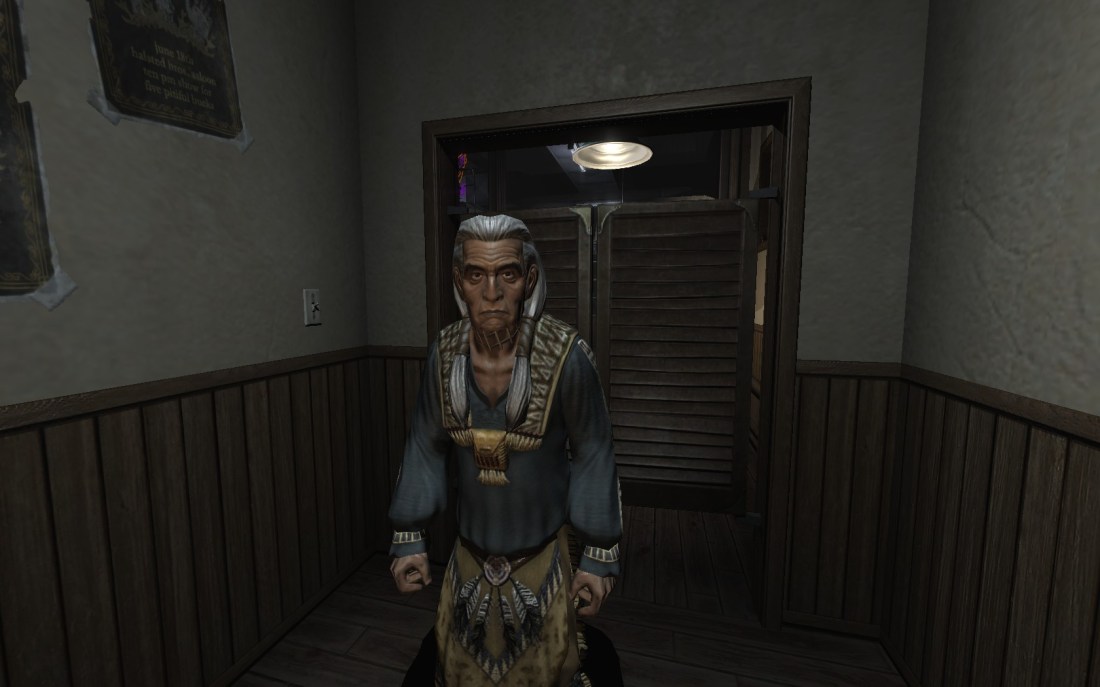
It’s my Gramps, dressed and behaving so typically I’m surprised he doesn’t have one of those huge feather headsets. We have a little argument about my lack of respect for their culture and desire to get off the reservation, then I find Jen and have the same argument with her. Angered, I take it out on two biker boys, beating them with a handy wrench which becomes my melee weapon. Before Gramps or Jen can be react to this expression of just how much Tommy wants to leave the reservation, he gets his wish; aliens arrive and beam us into space. This far enough away from the reservation, Tommy?

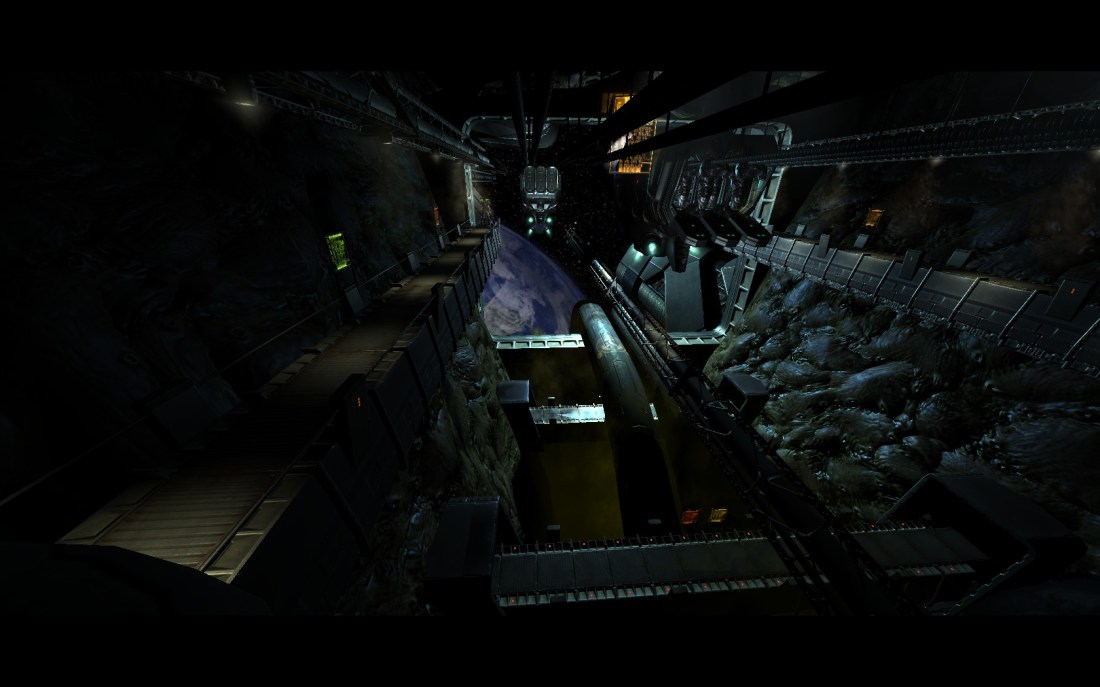
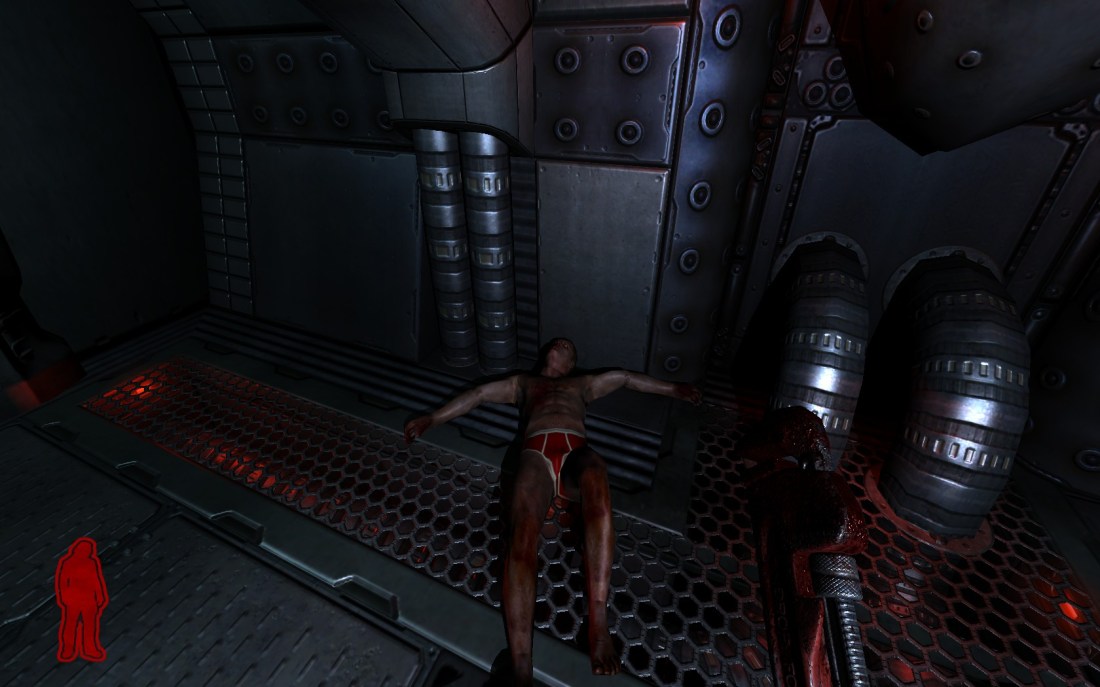
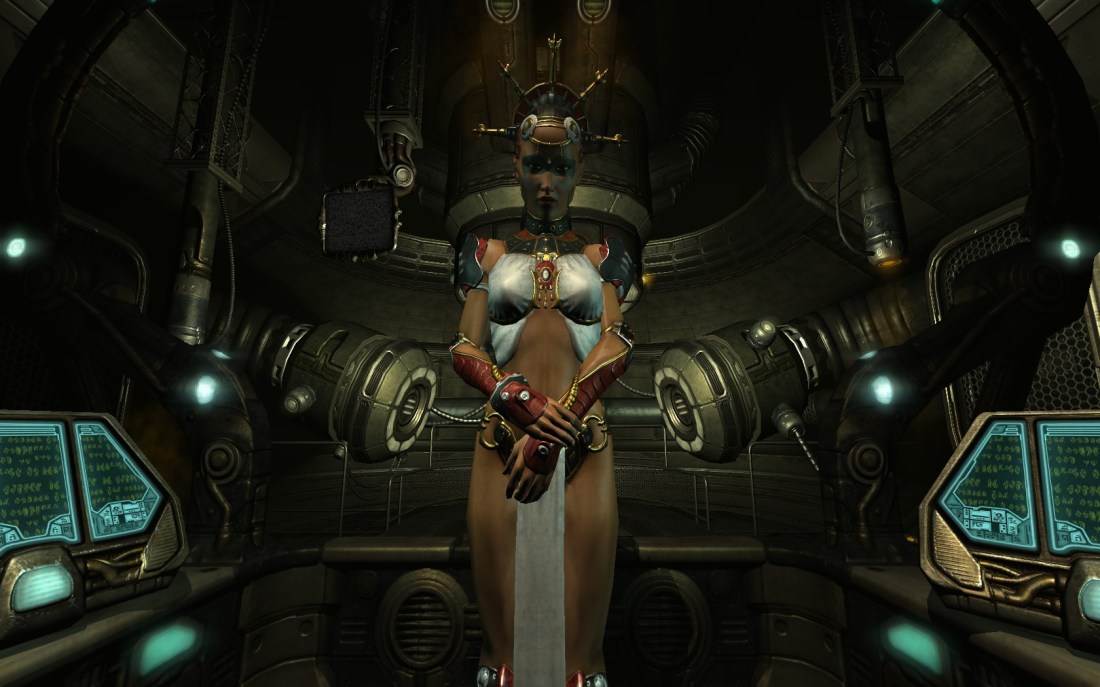
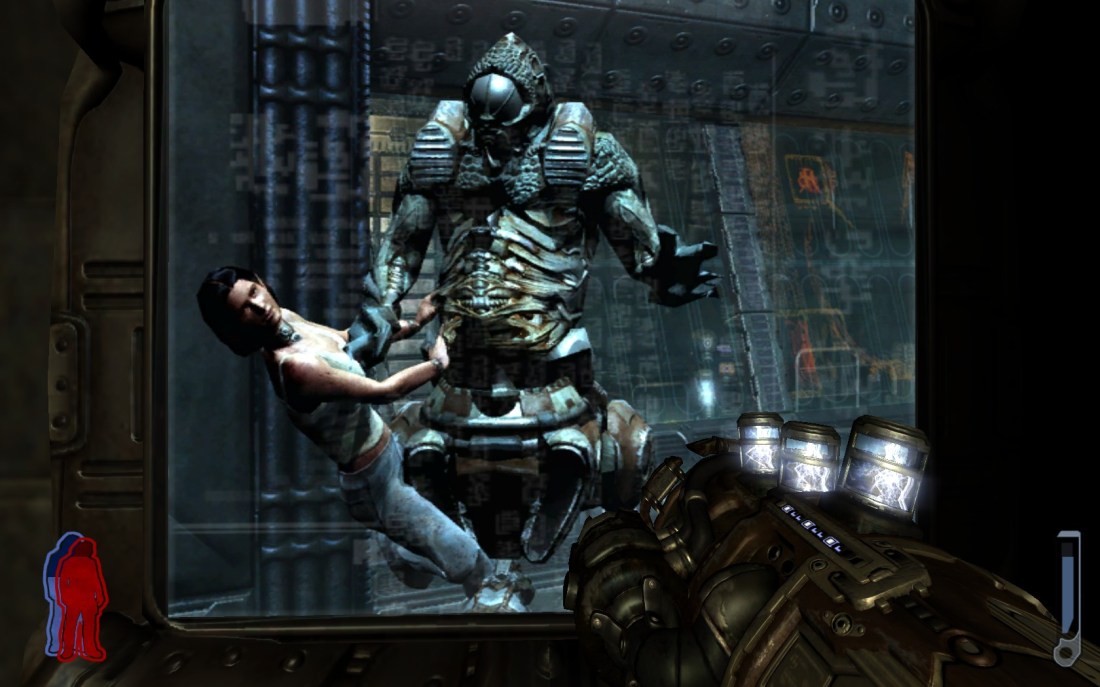
We don’t get to see much of the Sphere from the outside but inside, Jen, Gramps and I are stuck in a Clive Barker wet dream. We can hear screams and shouts, and then see what they’re screaming and shouting about. We’re being processed through an abattoir; Machines are rending and mangling abductees, reforming them into the very sphere itself. The sphere is people! Hey look, there’s the two bikers. At least they surviv-oh. Huge bulging tubes process the meat, the walls are skin sown together, there’s flesh and blood everywhere and all around us bikers scream. Quake 4 had some similar nastiness to it, but this really is a sickening place. Helpless and terrified as I approach a machine I just saw suck out someone’s innards, I’m mysteriously set free but it’s too late for Gramps. I watch him turned into mincemeat then chase after Jen, deeper into the bowels of the sphere. Or it might be the lower intestines. I hope the exit isn’t where I think it is.

Prey really does look good, in its horrible way and I’m deeply, unsettlingly immersed in the world. You can imagine the stench, the squelch under foot; idT4 was built for Doom 3’s spookiness but HHS wrangled and mangled a ton of horror and gore out of it. I’d best find my barings.

No sooner have I got my barings than Tommy dies. But instead of a load screen, we’re transported to the ‘land of the ancients’. Seems the afterlife is real and we meet a pre-mangled Gramps, who now makes like a Jedi Spirit and explains I have a special power; Tommy can shadow-walk, which allows him to sneak unseen but also be corporal enough to fire spirit arrows and interact with the tech found around the ship. We also get Talon, Tommy’s childhood pet, a spirit hawk that accompanies him back to the Sphere. Talon comes in handy, distracting the bad guys and perching on things we should take a look at. He flies in the direction you need to take, so he’s a handy mission marker too. We are returned to Tommy’s body and press onwards. And upside down.

Within the sphere, gravity isn’t a hindrance. Throughout there’s tracks that allow Tommy to walk on ceilings and walls and around obstacles, while gravity wells reverse the room and portals allow him to transport around. Those, combined with Tommy’s spirit walk all add up to an alternative take on the shooter genre, and it’s easy to see why 3DR were so keen to crack this element back in 1995; this would have been Doom-killingly cool.

sorry

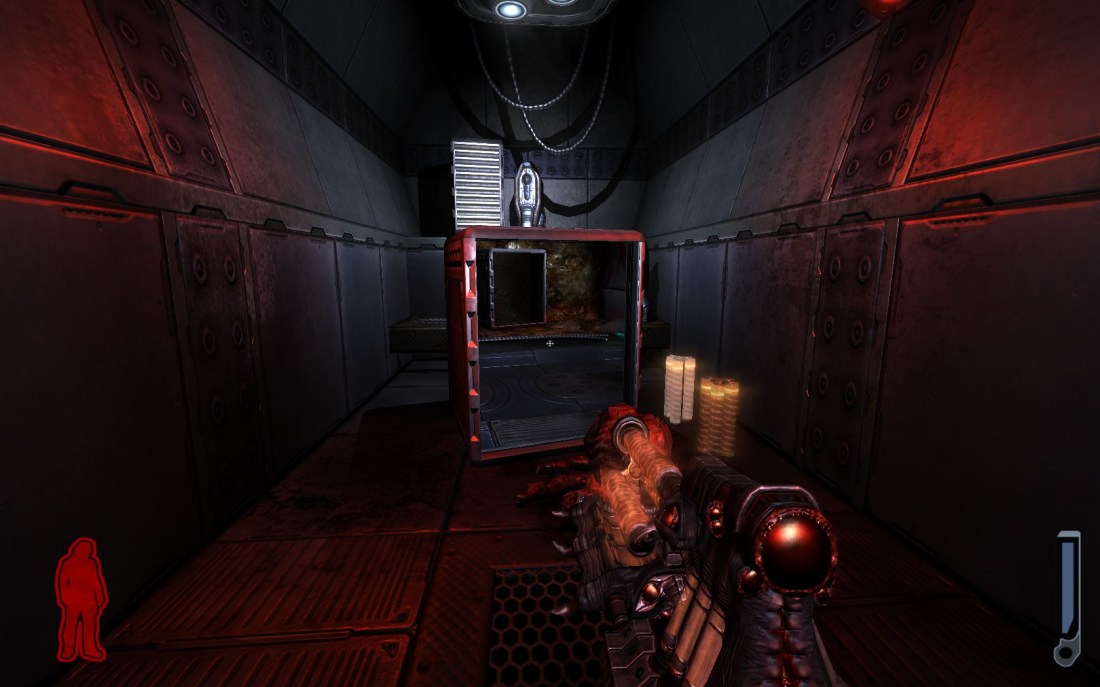
As I go, I find various other folks from earth who’ve also got free but unlike Tommy, they’re cowering and terrified. Especially after I accidently clobber one with my wrench. Will you put that thing down, Tommy. I do this a lot, anything interactive is triggered with your trigger finger and if you’re off by a pixel you’ll shoot it instead. And you have a lot to shoot with. There are five main weapons each with an alt. fire, they’re half hardware and half some unfortunate reconstituted creature; they move, quiver and breathe as I go. The rifle has a leech-like appendage that leaps out and sticks to my eye for a zoom and when idle, it takes an interest in what’s going on around us, sometimes unnervingly looking back at me. The other weapons are similarly icky; I’m pretty sure the grenade launcher is an anus but I’m not looking at that in a mirror. You can imagine what they feel like to hold.

The creatures you can fire at are plentiful too. You’re never far from a firefight and they’re aggressive, fast and have no sense of humour; Appropriately grotesque, the main bullet-catchers are the Hunters, designed to track any creature that escapes the processing but elsewhere we encounter Harvesters which leap in and out of fleshy pockets in the walls to grab wanderers; If you shoot one they’ll jump back in and you can hear them clattering around between openings and it’s panic-inducing trying to guess which it’ll leap back out of. Reconstituted humans do drone work, skinned wolf-like creatures stalk you, the list goes horribly on and you never feel safe. Mini-bosses like the Centurion and Creature X become new high-end opponents – there’s a lot here that can and will kill you. But dying is no big deal. Just before death, Tommy is transported back to the land of the ancients to fight his evil spirts. Tommy has a short amount of time to use his spirit bow and the more you kill the better your heath once back in your body. A little like Borderlands’ second wind, it’s a nice little way to stay in the game rather than reload or get checkpointed.

After a while though, those gravity dynamics, which seemed exhilarating at first are revealed as typically 90s linear – they’re scripted and always necessary; if there’s a walkway you’ll need to use it, the Portals are basically just doors and the gravity wells are rarely used to upend the bad guys or gain an edge, they’re there to get past an obstacle or puzzle. By 2006 you’d have expected to have those at your disposal and use them to turn battles to your advantage – or expose yourself – but they’re pre-planned events that quickly turn into gimmicks. When you’re not excited about walking upside down you know something’s up. Another aspect betraying Prey’s 1990s DNA is the level design. While an incredible setting, it doesn’t evolve or change in any great way; there’s only so long I can stay uncomfortable sneaking through Sphere’s guts; later levels are industrial and bleak but they’re very samey and unoriginal; it feels like Doom 3 or as if they just ran out of ideas. The one exception is when we pilot an anti-grav moped for some zero-g aerial fighting. The biggest let down though is Spirit-walk. Spirit-walking should be like Max Payne’s bulletime; a superpower you utilise but it’s just a puzzle-solver. Got stuck? There will be a convenient ghost-only route and it’s a shame you don’t really use it to get an edge. All of that would have been accepted in a 1990s game and that’s where Prey is firmly planted at its core; but this was released in 2006 and it should have some of that decade’s sensibility, that freedom. It’s also ironic that those innovations were a key reason for Prey’s delays yet now date it, and it’s truly compelling aspects – a great main character, setting, storyline and a solid goal were lacking in Prey’s 90s contemporaries. Maybe they came along later, but Prey could have been a Doom Killer on an emotional level rather than wow factor.

The game is stuffed with nice touches to break through the monotony though; there’s beautiful vistas of earth and the stars when you pass open areas and there are some knockout mini-moments; Tommy spots a display cabinet holding a mini asteroid. The next portal leads us to a barren area and then a giant Hunter looms over us, peering in at tiny Tommy on the surface of that mini asteroid. Occasionally you’ll pick up DJ Art Bell on Coast to Coast AM, a real-life paranormal radio show, discussing the recent reports of UFOs and chatting with callers describing weird things going on (One caller claims this has been planned since 1995; touché.). During one trek past the edges of the Sphere a jetliner, caught in their transporter beam flies in – Later we find the wreckage. There is a lot going on and Tommy is never at a loss on what to say about it; he’s seen some shit. He’s not Duke, cracking wise, but he’s got that fatalistic, John Carpenter tone to him; in fact, Prey could be a 2000’s remake of a 90s game based on a 80s Carpenter movie and the mash up very nearly works. You can almost pick out which decade aspects of the game were born in; it feels inspired by 80s horror and sci-fi and while the shooting, the levels, the monsters are all prime 90s, the characterisation and immersive plot wouldn’t be out of place in mid-2000 games like Mass Effect and Bioshock.

Hi, I've been living in squallor for decades.

And of course, we have that story to entertain us; We run into a group of humans who escaped the meat grinder after its last visit and survive hidden within Sphere’s own living walls, while Tommy is goaded about the futility of trying to escape by the disembodied voice of its controller, The Keeper (who at one point calls Art Bell to give its deranged view which is awesome). Plus, we have Gramps occasionally prodding us about our heritage and destiny. It’s like an X-Files episode as we uncover hints about the Sphere and its previous visits to earth, the Keeper’s true purpose and what the Land of the Ancients and Tommy’s spirt-walk power really are – at least it’s hinted at, we (horribly) see little children sacrificed until one develops Spirt Walk and becomes a mini-boss from hell and later, Tommy is tricked into revealing the location of the Land of the Ancients and the Keeper’s forces attack. I’m sure it’ll be explained in the sequel, currently slated for a 2012 release.

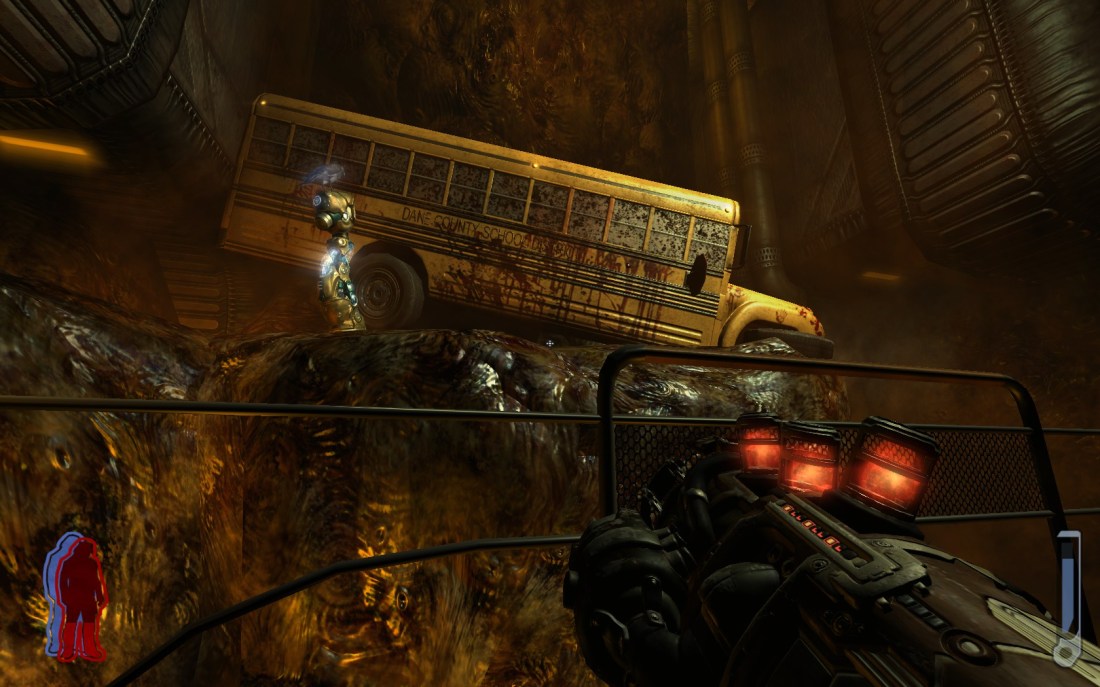
oh crap a bus load of kids

Finally rescuing Jen, Tommy reluctantly agrees to kill the Keeper so the humans can activate a portal out of this place. After a monumental battle where I spend as much time in the Spirit world regaining health as I do fighting, the Keeper goes down. Except, turns out it wasn’t the boss. There’s tons of those Keepers knocking about. Dagnamit. Another interminable slog and some genuinely painful plot-twists later and we finally we reach the centre of the Sphere. It’s a great moment, partly because Tommy is driven by rage now and we feel for him, but mostly because it’s been toying with Tommy the entire time, testing and manipulating him to reach this moment – giving Tommy a compelling choice to make. If this had truly been a 2006 game, we’d have had to make the choice and trigger a good/bad ending, but this is the 90s; Tommy just readies his grenade anus. Spirit world, here I come again.

Once that’s done, we get a surprisingly dark and emotional ending and as I watch the credits roll, a little shell-shocked, I’m about to congratulate Prey on a brave and honest ending when a franchise-starting twist pops up. In a final scene that in no actionable way rips off Half-Life, Tommy is suddenly and inexplicably placed back in the bar at the beginning, where he’s visited by the leader of those Sphere humans. While earth has dismissed the events as an natural disaster (except Art Bell, he knows the truth), the human explains ‘others’ would like to meet Tommy and opens a portal to the words ‘prey will continue’. And oh boy did it.

If Prey 1 had a tortuous development then Prey 2 was treated worse than Gramps in the Sphere. HHS began work on Prey 2 under the direction of Radar Group, an IP Management company from 3DR’s Scott Miller. Announced as a direct sequel that picks up directly after Prey 1, it went nowhere and was eventually offloaded to Bethesda – who have a habit of grabbing waning IPs and rebooting them (Fallout, Doom, Wolfenstein) and they stuck to what they know best; P2 was announced as an open-world non-linear game with a morality system set on a Blade Runner style planet controlled by various warring factions. Exactly how I envisioned Prey would continue. It even got as far as a (clearly not game-play) trailer. Then things went quiet until 2014 when Bethesda finally admitted P2 was cancelled before uncancelling and parking Prey at their Arkane Studios; Who in 2017 turned out a Bioshock meets Dishonoured reboot. It’s Prey in name only now, which is a shame because there is so much to recommend in the original, be it the 1995 half or the 2006 half. It’s schizophrenic, like a great remake of a game you never played and it does drag, but it’s aged well (twice) and considering its torturous development, Prey is a solid, enjoyable game; Duke Nukem Forever had no excuses. Ultimately Prey feels old-school familiar, new-school absorbing. I enjoyed it, but I would have preferred to play the 1995 version and rediscover it now. Then all my gripes would be put down to age and forgiven. It would have been a great Doom Clone.

2006 | Developer Human Head Studios | Publisher 2K Games / Take-Two Interactive

platforms; Win | X360