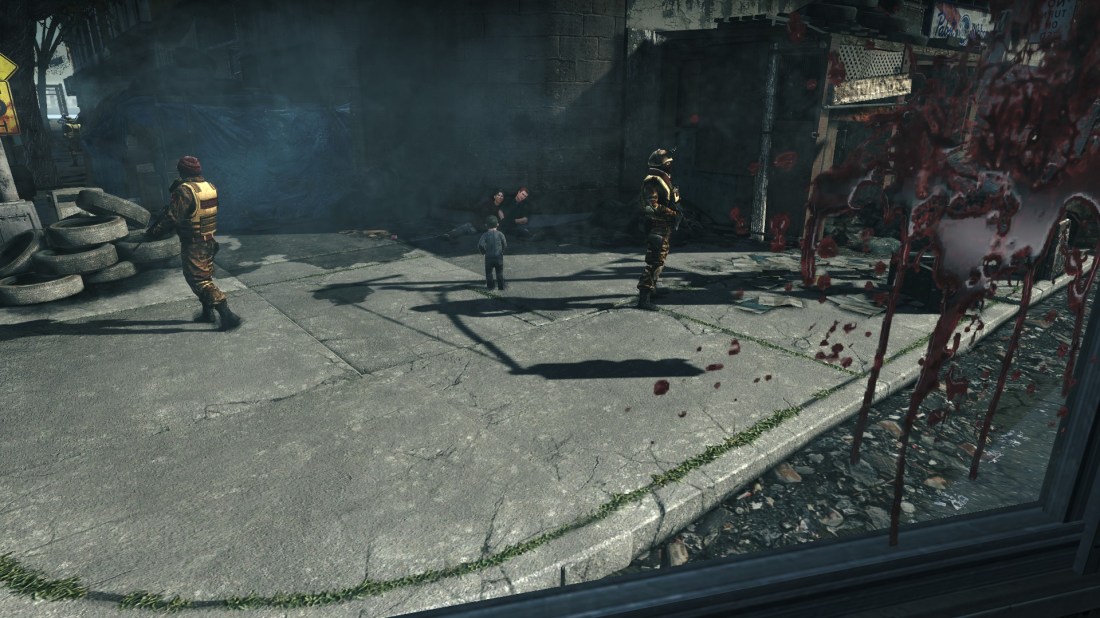
Far Cry

Blast from the Past

FBT goes back to where the Cry began. And gets reduced to tears

The Past

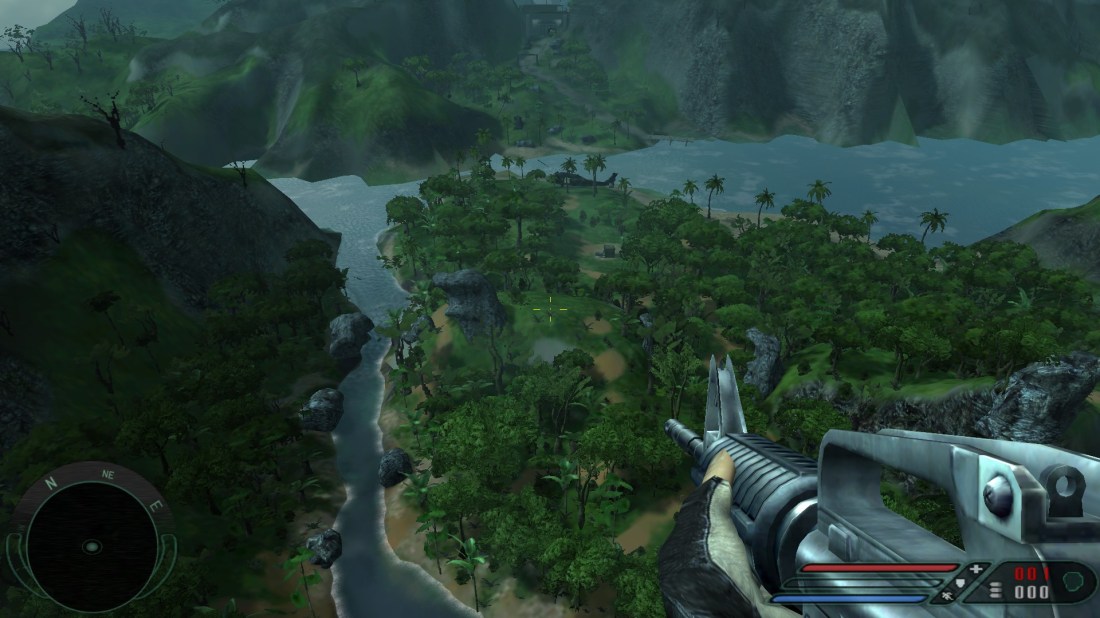
I remember raving and raging about the original FC. I bought it thinking it was a regular FPS, and faced with this open, up-to-me approach after so many Doom-a-like corridors I was … terrified. It was like the first day of school, and very quickly I wanted my mummy.

It was beyond anything I’d played; there’d not been a shooter world like this before, but it wasn’t just the astonishing graphics and brilliantly realised world that felt like a shooter-heavy GTA VC – the hero even had a Hawaiian shirt on – this time it felt like it really was me being the hero rather than playing one; I was deciding how to get things done … and it turned out I was crap at being a hero.

Nowadays, extreme open-world shooters are no big thing. I laugh in the face of Borderlands. Was FC really that tough or was I just unprepared for the non-linear shooter world? Will it have mellowed? Have I toughed up?

With the FC series reskinning since FC3, I’m looking forward to playing the game that started all this open-world shooter mayhem.

Still a Blast?

We’re Carver, the classic hero; ex-military now a hard-drinking loner. Running a boat charter in a remote part of paradise, Carver’s hired by journalist Val to take her to a nearby atoll to investigate something; Carver gets to see the something up-close when he and his boat are blown sky-high by an RPG. Washed ashore, Carver is contacted by someone called Doyle who explains the island is a secret facility guarded by mercs, and Val has been taken prisoner. Tooling up, Carver needs to rescue Val and get himself a new boat.

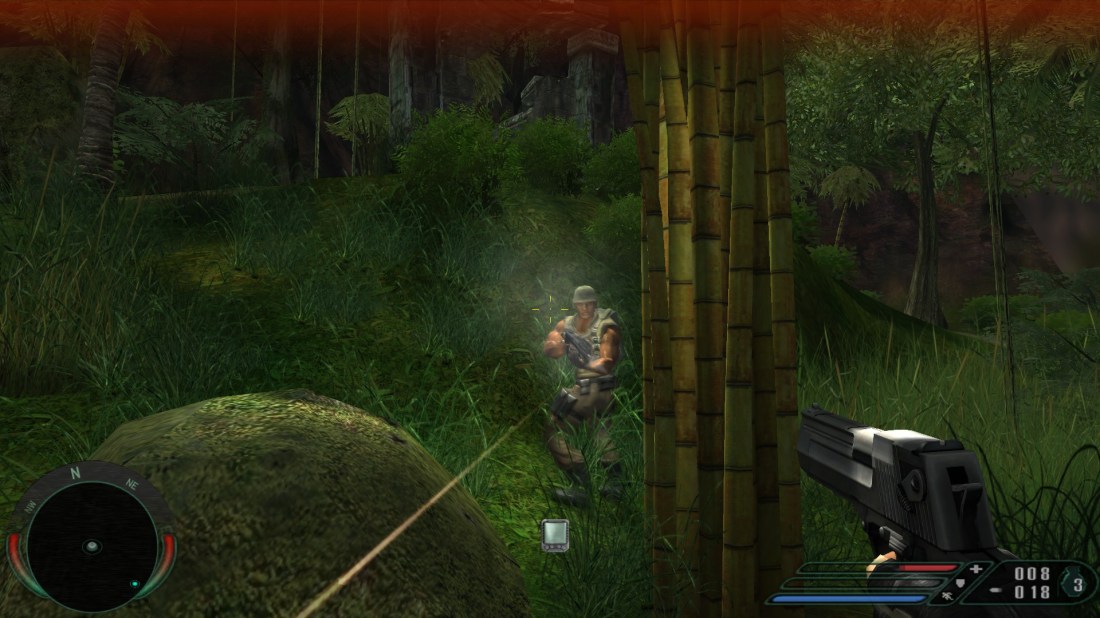
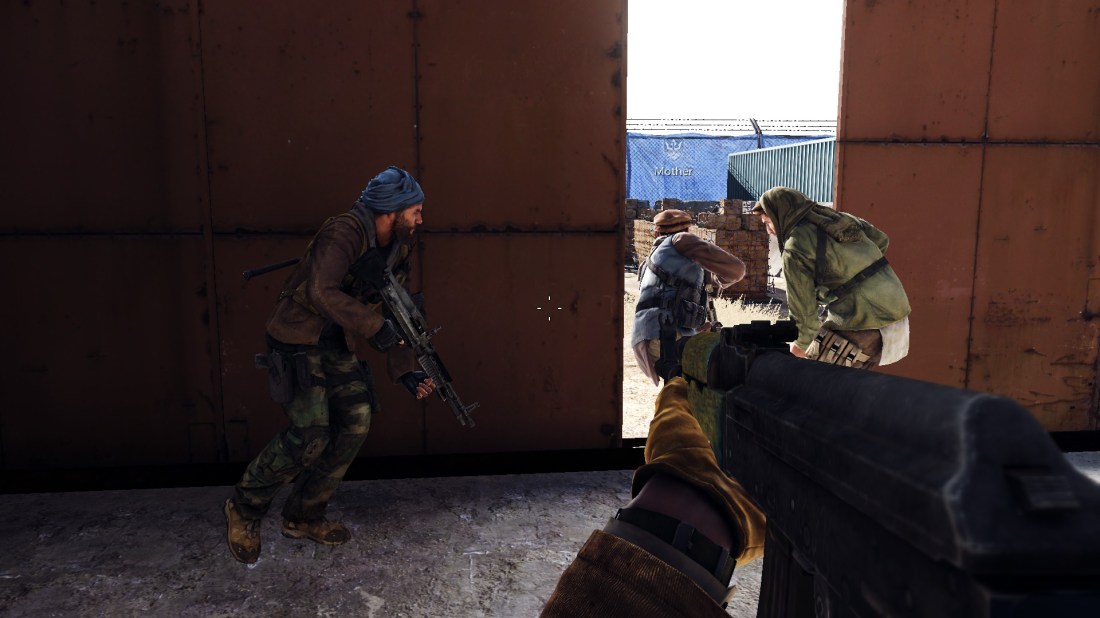
I’d say maybe a third of this game is staring at the load screen. Not just because it takes a good minute to get the game reloaded, but because of how often I get killed. I just keep dying. The AI of the mercs is good, they wander aimlessly and have little auto-actions like chatting or milling about, but if you get spotted it’s go-time. They’ll run for cover, work around you, keep you pinned down while others flank, and they’re are brutally accurate. Carver can only take three or four shots before he’s down, and he always gets hit three or four times. And there’s no quick-save. Paradise this isn’t.

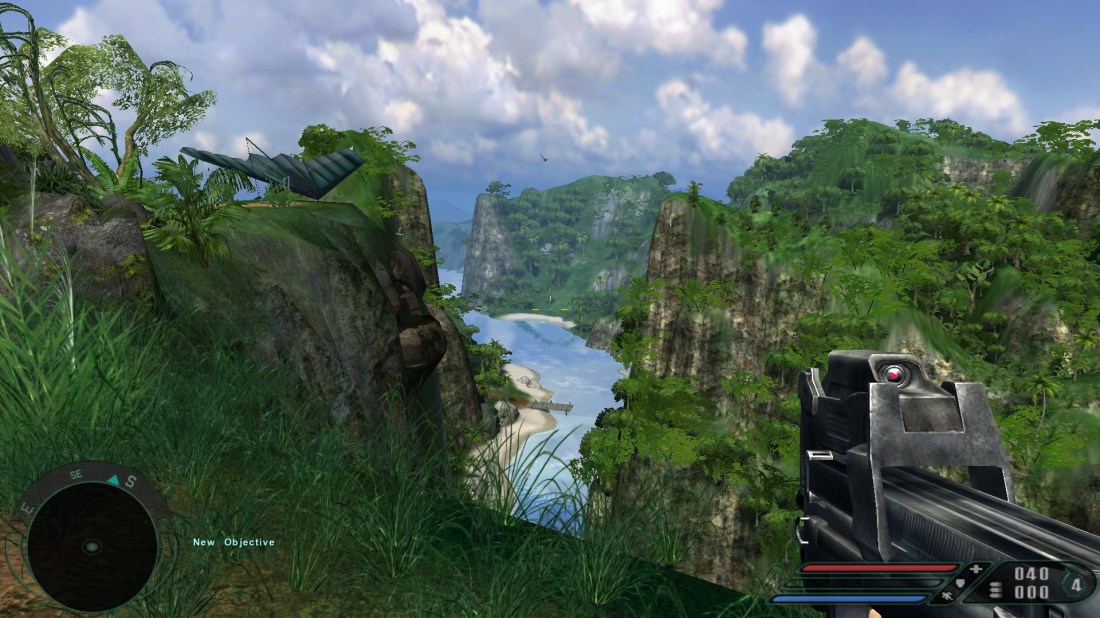
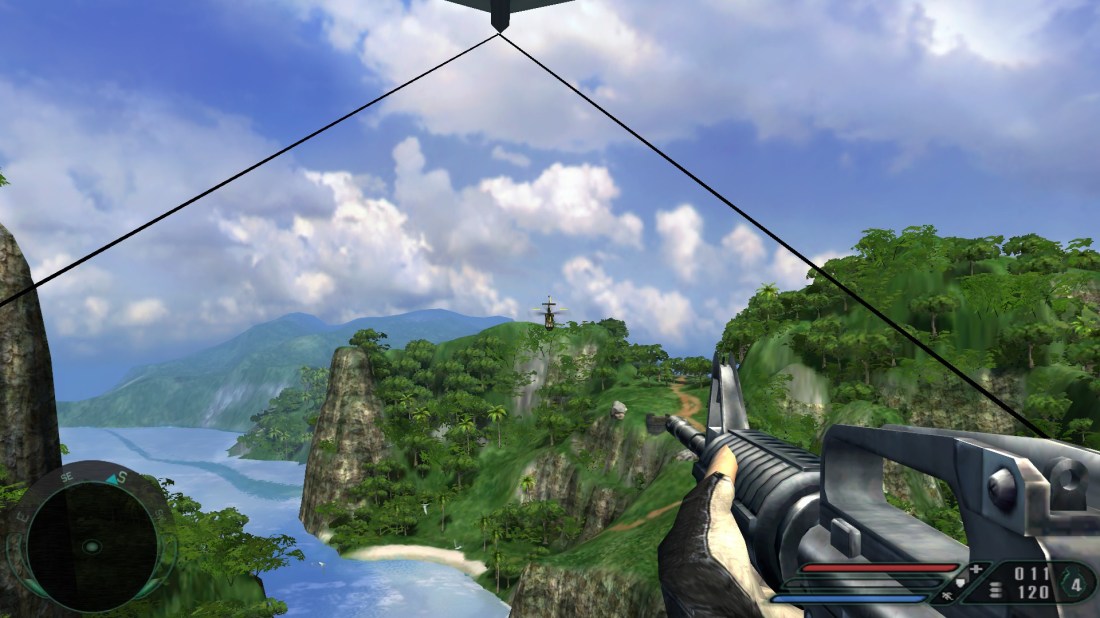
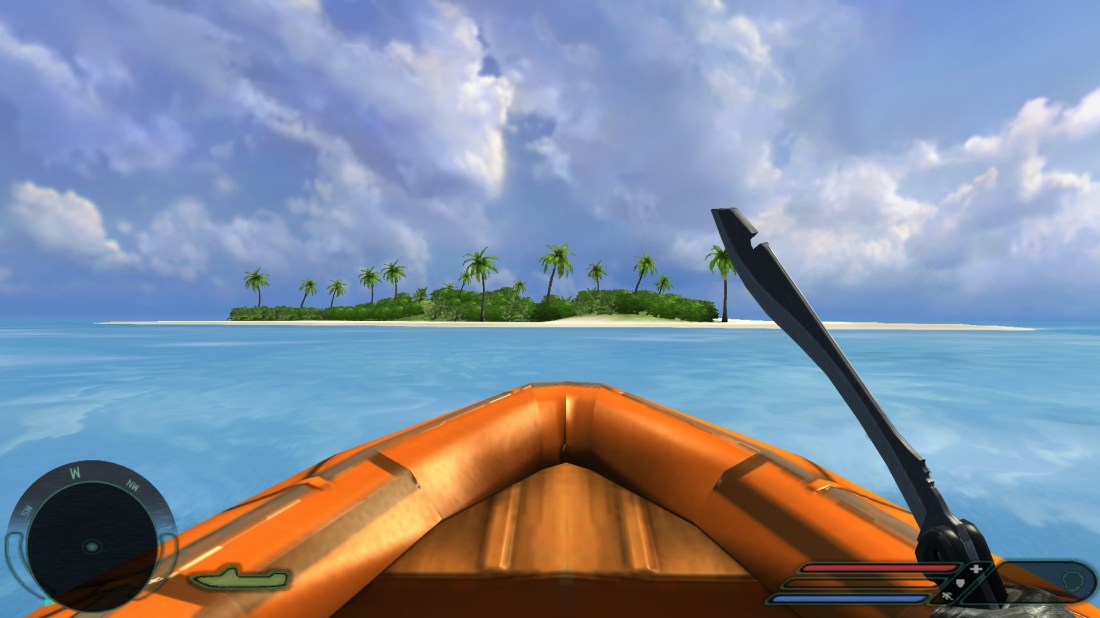
But it is paradise to look at. I can’t believe this is over 15 years old. While FC is showing its age, it’s still astoundingly beautiful. It may not have the minute detail but the design, the look and feel, it’s real. Palm tree-lined beaches with clear water filled with fish and turtles, rainforests with encampments and old ruins to navigate, huge open valleys and rivers, it’s great. Until someone spots you and ruins the moment. Most of the time we’re just given a marker and make our way there; even when the game’s being cheekily linear about the approach such as bottle-necking you in a crevasse or just killing you when you stray too far, like I needed more ways to die, it still feels very open. And you need that open space. To run screaming.

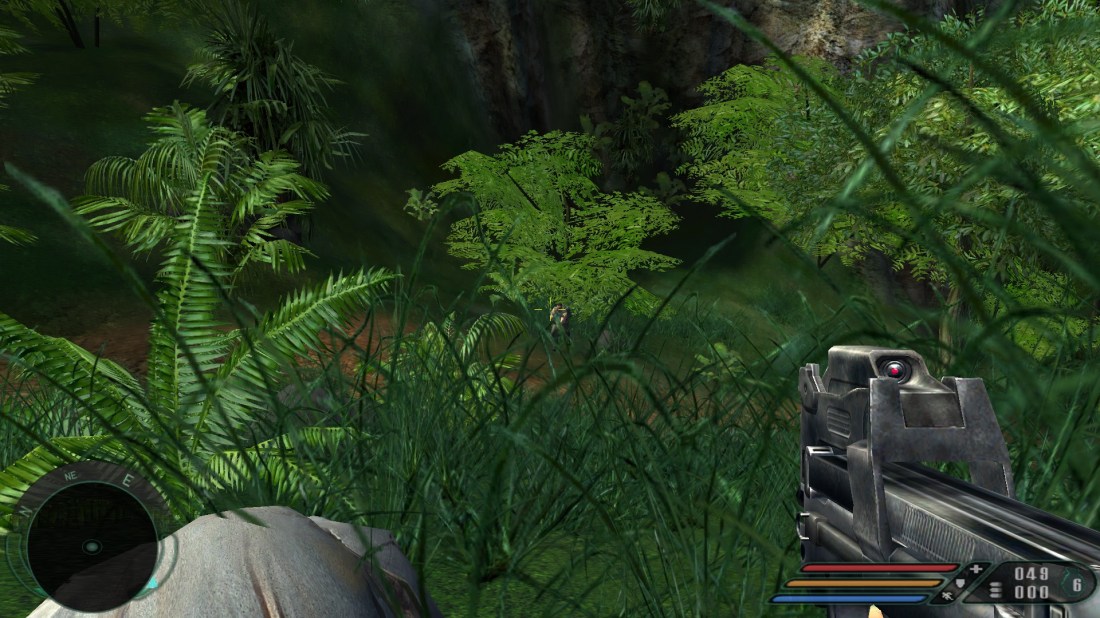
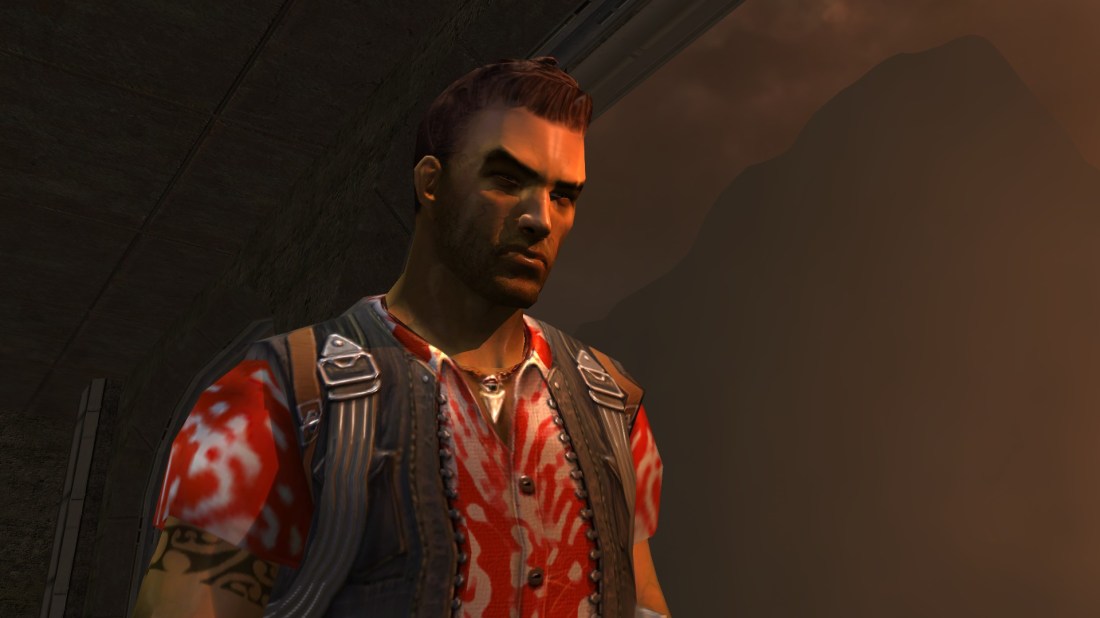
I can try to sneak around the mercs, swim between islands, stay hidden in bushes or thickets (whatever one of those are) but if you get spotted you’re pretty much dead. You can stay hidden but it takes a lot of work and they don’t give up once they’re onto you – they’ll investigate and keep investigating, making logical assumptions about where you might have moved to. In short, the AI is smarter than I am. At least change out of the bright red Hawaiian shirt Carver! I must stick out a mile.

Carver is part of the problem though. He’s supposed to be ex-special forces but this only seems to extend to knowing how to reload. The only edge we have is previous FPS experience which is no good here. Carver doesn’t have any special abilities, traits or tricks besides tag n’ track binoculars, which later get upgraded to heat-sensors letting you go Predator on the Mercs. But not a very good Predator. The odds are already heavily stacked against him; even something as cool as using a hand-glider to silently zip over their heads tends to attract a helicopter with a mini-gun, and it just becomes frustrating

Even when you’re facing an already large group they’ll still call in reinforcements – which include the Choppers with mini-guns, VTOLs filled with more troops, rocket-armed dinghies. Eventually though, I start to figure things out. This is a realistic shooter; I can’t just go Doomguy on the mercs, I need to work around them, pick them off, watch their routines, or just go full-coward and walk for miles to get around camps. Whatever they’re guarding must be valuable. Or dangerous.

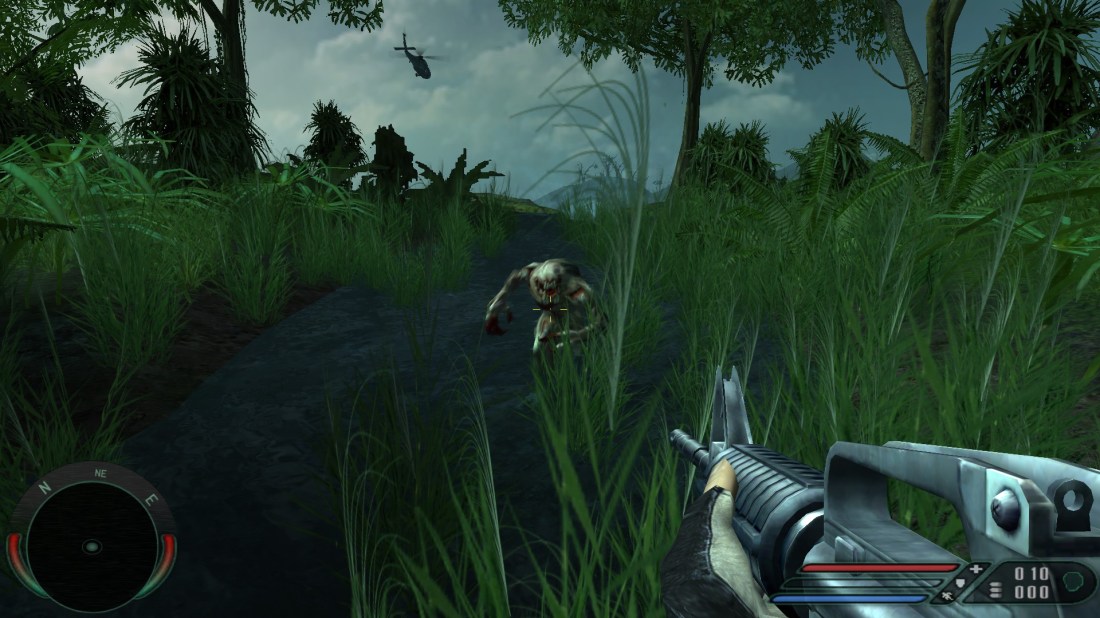
It’s dangerous. Of course. Turns out the island is a testing ground for mutants. I’d forgotten about this, and how terrible they are. Naturally those things, the ‘Trigens’ break lose and are running rampant. By now I had my eye in, but the Trigens have none of the merc’s AI or wit. They just spot you from a mile off and come running. Mostly it’s gorilla-type slashers, but later we’re contending with borgified mercs with guns and rockets sewn into them and all the subtlety I’d started to get into goes out the window turning it into a murky barroom brawl.

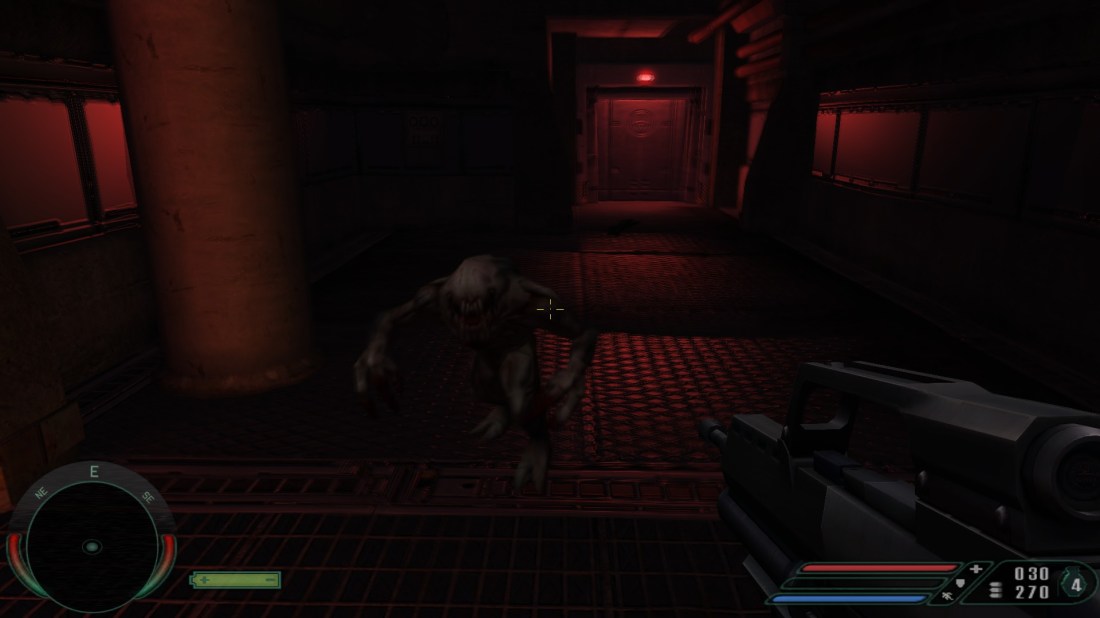
It’s disappointing too that we start to leave the island for the confines of the labs; it just becomes a typical FPS with corridors and caves, and although a standout is a zoo-like holding pen with Trigens and Mercs fighting it out below us as we navigate tension bridges, leaving behind the beaches and mercs for monsters and corridors just makes it samey.

That seems to be a constant with CryTek; ‘spiritual sequel’ Crysis is essentially FC with a weaponised wetsuit until the squiddies rock up and ruin it, and both FC3 and 4 continued the concept with the second, tougher location you reached. I guess the Trigen third was added because it was felt FC needed to change up, but blasting the hell out of Paradise was a great deal more fun, and still felt fairly unique. Shame. I was actually enjoying it; well, surviving.

Far Cry is an odd game to play now. It’s been far surpassed and replaying it seems redundant – there’s nothing here that’s not been done better since but it’s got a nice simplicity to it; I’m not farting about hunting skins or helping islanders, it’s a pure shooter that requires you to really get dug in and find a way to survive on your own wits. Carver is a solid reluctant hero type and his observations on the situation work really well; it’s a shame he was never seen again, and Val’s ‘project far cry’ could have seen the two of them going off on other adventures. Instead, Ubisoft just kept remaking this one.

FC is absolutely worth a replay, if you like loading screens, and if you kick it in the head after the zoo level it’s still a cracking free-range FPS that deserves recognition for turning linear shooters into a free-for-all. If we hadn’t had this we’d not have had Borderlands and for that, I think, I thank it. Still, if I was Carver, I woulda just shacked up on one of the little islands with a Wilson Volleyball and left the Trigens to run rampant like the ending to Jurassic Park.

2004 | Developer; Crytek | Publisher; Ubisoft

Platforms; Win, PS3, X360

Why We Game – 2018 re-review

why we game

a year in review. sort of.

Previous Weapon doing a year review is a bit redundant. We’re all about games of yesteryear and in sales. Technically our game of the year was Dusk, the awesome Quake-era throwback, because it was the only game we reviewed that was actually released in 2018. And it wasn’t even finished when we reviewed it, so no 2018 GOTY awards from PW. We’ll need to do a GITS award; Game in the Sales …

Previous Weapon is all about rediscovery and replay, and we did a lot of both in 2018, hitting our 100th review in December. We also continued our spoiler-ridden playthroughs with 2018’s first review, Fallout 4, FBT’s emotional Mass Effect trip, and TheMorty took us through an epic season in Championship Manager 01/02. And then there was the Call of Duty playthrough in search of a story. PW had a busy year gaming when we should have been doing something more constructive. Let’s let TheMorty and FBT look back on a year of playing the previous year’s games …

FBT – Let me get my failures out the way first. I have 47 games I’ve half-started or half-finished. Damn Steam Sales. In my defence I haven’t finished those because I had others to play, I wasn’t distracted by real life or anything.

It’s interesting that my fave games of this year have been from small developers making games for gamers – SOMA, Ion Maiden, Dusk; they ran rings around the Triple-A games. And the most fun I had was replaying old games; not for the memory but for the simple fact that they were better – maybe not as realistic, or as complex, but just … better. I fell in love with gaming when devs like id and 3DR were doing it for themselves, for fun and it seems as if that’s happening again. Long live the indies.

TheMorty – Well, I lost nearly a year of my life re-playing a childhood classic. Championship Manager 2001/2002 gained cult status with football aficionados – and it had aged like a fine wine. My play-through took months, I truly lived it. At times, the game had me in fits of rage, tears of joy and regularly biting my fingernails. Guiding, quite literally, the team of my childhood to a pair of cups was a refreshing break from the disappointment of being a Newcastle Fan IRL and it offered a simplistic gaming experience in contrast to the prolonged, overcomplicated sports management games of today – it had me nostalgically longing for more. The epic 8-part review also marked a rare foray into non-Xbox gaming. It was a welcome retro break to swap to 4.3 from my usual 50-inch cinematic experience.

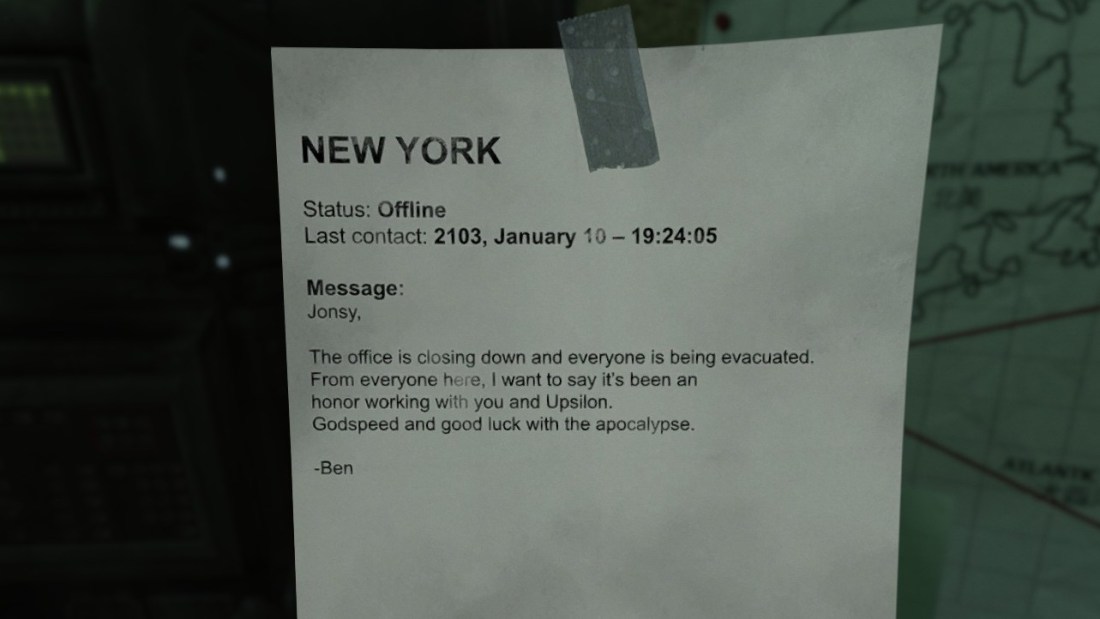
FBT – Other than CM, the one game that TheMorty wouldn’t shut up about was Witcher III. Another I still haven’t played. And why? To annoy TheMorty? Yes, but also Keys. Different key sets for the horse? What, am I riding and walking at the same time? Multiple one-use keys instead of a multiple-use key, what is this, 2005? I don’t care how good WIII is, I rage quit at the key menu. Key assignments piss me off. It’s what stopped me playing Watchdogs, made Assassin’s Creed Odyssey harder than it needed to be; Witcher II had its key assignments outside the game – I have to quit to reassign?! Deadpool and Sleeping Dogs won’t even allow key reassignment; Lazy ports piss me off. I am not a console.

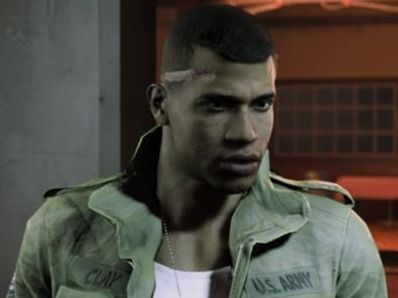
TheMorty – FBT can use keys to excuse his Witcher failings all he likes. You’ve got opposable thumbs, use them. Get a controller. For me, looking back on 2018 I’m reminded that my Mafia III Rage Quit review is still the highest read article on the site, hanging around the top spot 18 months since I ejected the disk in disgust. But the review’s success made me think – was I too harsh…? Maybe I Whacked the game before it had chance to become Made. I Rage Quit in 2017, but I’m both a year older and wiser. Surely I’m a more patient man. Instead of reminiscing like FBT, maybe I’ll give it another go…

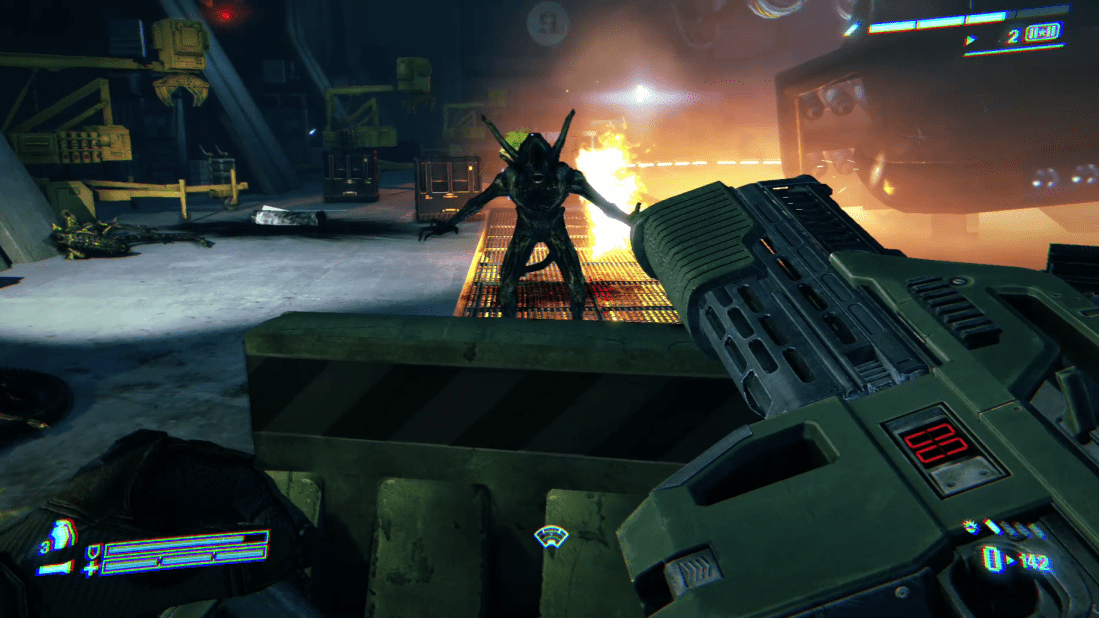
FBT – While TheMorty tortures himself yet again, I’m reminded that the one that surprised me the most this year was Aliens Colonial Marines. How is a game this badly-reviewed actually this good? To be honest, it’s not that good. But it is great fun. It’s a b-movie game, filled with scrappy fun; we’ve got Aliens leaping about, pulse rifles, Queens, a Bishop, Weyland-Yutani, LV-426, the Sulaco; what’s not to like? It’s good but is it a GITS?

TheMorty – while FBT is arguing for a bad game to be awarded a GITS, I’m just playing a git of a game. After I got through that rage-quitting mission, I ran through a few tedious side missions – nothing too exciting, but enough to get back into the swing of being Clay, who now works for not-at-all cliched drunken Irish mobster Burke, who wants me to steal cars.

Not just any cars, but three limited-edition orange coloured Samson Richmond-Luxes. Rare, but fortunately three are marked on the map for me – albeit, quite some distance away …

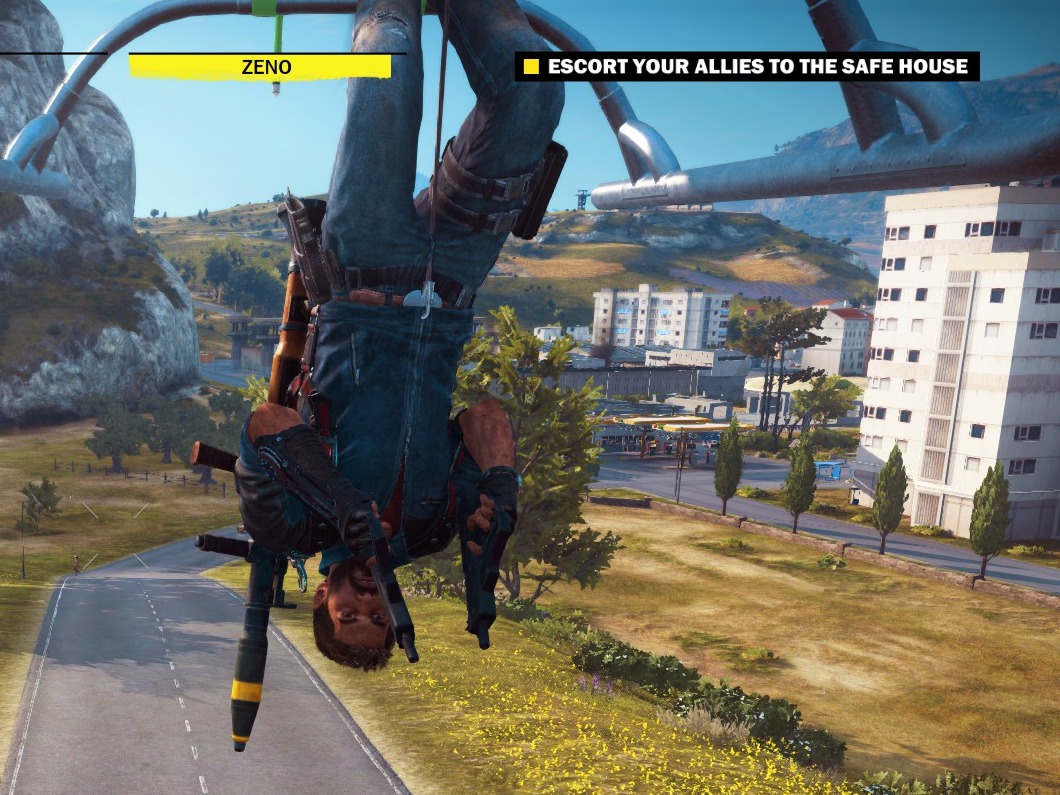
FBT – Since MIII doesn’t allow fast-travel in main missions, let’s leave TheMorty to negotiate the mean streets of Mafia III and instead take a moment to appreciate the mad streets of Just Cause 3; I think I did JC3 a disservice when I reviewed it early in 2018. I talked at length about Rico’s double-denim outfit, but I didn’t really get into it. Yet I kept going back to JC3, just for the laughs. I did rave about the madness of it, but not the sheer unbridled joy of being the one to cause all the madness. JC3 is a looney tunes cartoon, it’s pre-schoolers at lunch break after too much lemonade, it’s my state of mind when a Steam sale comes up. The JC series seems to be leaning towards Saints Row with its ‘just go muck about’ mentality. It’s because of JC and SR that I can’t get on with GTAV and for that I thank them.

TheMorty – still driving.

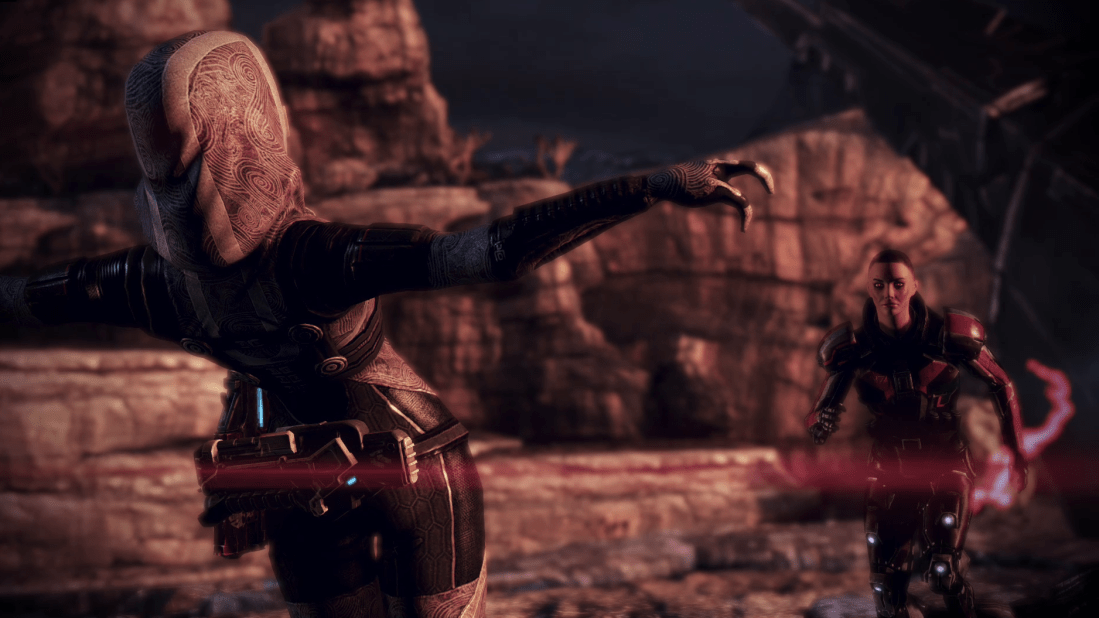
FBT – Perhaps the most emotional playthrough of 2018 was my Mass Effect DGAF. Playing Shepard as only out for themselves, avoiding all friendship and relationships, dealing only with what needed to be done was tough, and also amazing; it was like playing a new game. I still hate myself for what happened to Tali. I am so sorry. The ME series is one of the best of all time – and I’m including ME3 in that assessment.

TheMorty – if I wasn’t busy I’d remind FBT of the time I owned him for claiming Mass Effect 1 is better than Mass Effect 2 in an Agree to Disagree. And now he forgives ME3 as well? Idiot. Anyway, I’ve aced the first car and after a little cop-trouble, nabbed the second. This isn’t so bad. As I leave the scrap yard, imagine my delight when I see one of these rare orange coloured Samson Richmond-Luxes drive right past me; I don’t have to do the annoying drive halfway across the map – the car is right here. Perfect. Perhaps this is the game’s way of trying to make it up to me, serving up the perfect apology.

FBT – While TheMorty’s busy thinking MIII will even let him get away with that, I’ll refute his ME comment by pointing out I put him in his place with our Borderlands agree to disagree review. Who admits to being scared of a Skag? He should stick to footie. Let’s see how he’s getting on with the Mafia III car heist. As well as he does in Borderlands I’m betting.

TheMorty – Whatever. After a bit of trouble I steal the car and there’s flashing lights everywhere but I’m so close to the mission marker, if I can just get inside the scrap yard the mission will end. I drive up, expecting the car to be crushed but nothing. What’s going on? I’m reversing back, driving forward trying to find that sweet spot but nothing’s happening. No cut-scene, no mission complete. You’re joking?! Please don’t let FBT be right.

FBT – Let’s give TheMorty a moment. For me, of everything I discovered and replayed in 2018, the one that stuck with me was SOMA. That game ruined me. It’s in my top five now, and I’m not even sure I’ll ever play it again. Just play it with the lights off and no one home. You’ll never look at an electrical appliance the same way again. My GITS for 2018, SOMA.

TheMorty – Hang on, pausing MIII for a minute here. SOMA for GITS of the year? Previous Weapon’s inaugural award goes to SOMA? I struggled to get past the tutorial level – yes, the Xbox version is a clunky, glitch-filled port but what I did play was … well it’s not a rage quit, but as soon as I finish MIII I am agreeing to disagree on that one. So anyway, there I am …

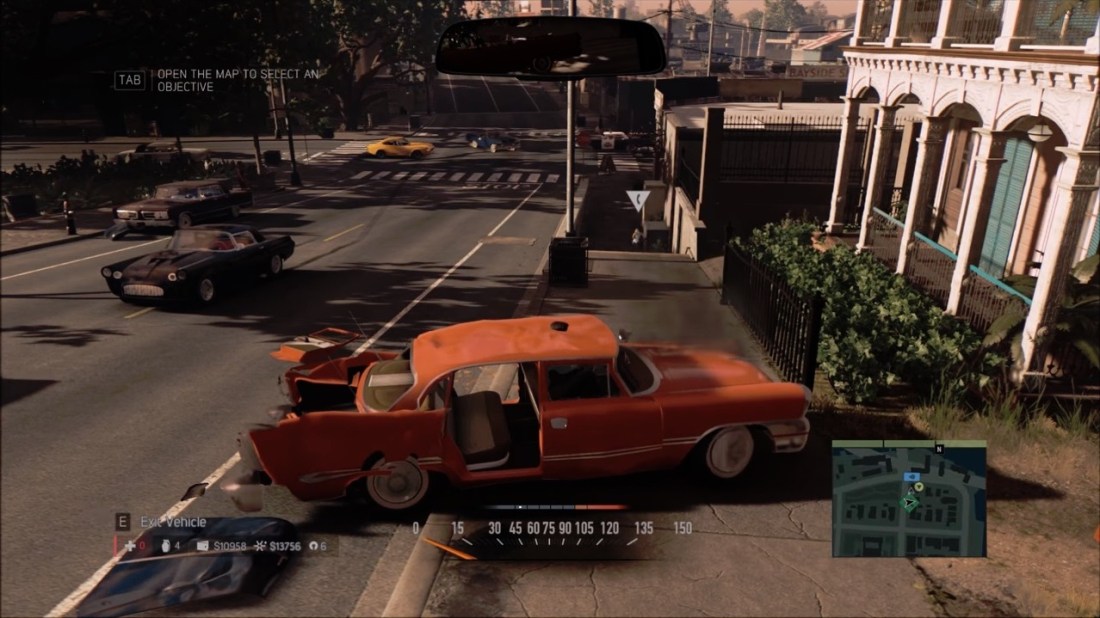
I’m surrounded by cops and I’m getting shot to bits. I leave the coveted motor to take them all out. I’m losing health rapidly and haemorrhaging bullets. The firefight eventually gets too much as wave after wave of cops descend on my personal Alamo and it’s fast becoming a futile last stand. As the car takes too much damage and bursts into flames, I die, respawning at the safe house.

So after all that, I must start the whole mission from scratch, losing a chunk of money and all my ammo? I knew there was a reason I hated this game! It turns out that Burke’s crusher is picky and will only accept the exact cars pinpointed on the map. Doesn’t matter if you can find closer cars in better nick, the mission marker won’t recognise them. What a stupid, stupid game. That’s it, this time it’s over. Mafia III is staying in 2018 never to be installed again (or will it…?).

FBT – this is a Previous Weapon first; a double rage quit. Didn’t see that coming … I posted a lot of rage quits, but begrudgingly, thanks to my CoD replay I have to remove ‘Call of Duty Modern Era’ from my most hated games list because the MW trilogy was awesome when played as one epic run-n-gun; and Advanced Warfare was bloody brilliant. Question now is, what replaces Modern CoD as a new most hated? CoD WWII? Mass Effect Andromeda has earned a place – at the very least, it was most disappointing game of the sales.

TheMorty – I took a lot of inspiration this year from reading FBTs reviews and got an itch to replay some of his much-loved games for the fun of it. His Far Cry review inspired me to re-view Trails of the Blood Dragon, which was an uncharacteristic delve into the Trail-bike gaming. His Fallout 3 write-up made me keen to get back into the wasteland, so I replayed its sequel ‘Fallout: New Vegas’. His disappointment at Volition’s SR spin-off, Agent of Mayhem, made me long for some vintage Johnny Gat – so I pulled out my original copy of ‘Saints Row’ – both reviews are coming early 2019.

FBT – for me, it’s great to hear some of my rambles inspired TheMorty to ignore real life in favour of the digital one. That’s the point of Previous Weapon, honest chats about games and why they’re great – or not. Next year I’ll be posting a mix of reviews; I even found an excuse to replay Morrowind, Oblivion and Skyrim again. If they do those in VR I’ll never go outdoors again.

So, that was our not-2018 review. GITS is off to a flying start … Only Previous Weapon could create an award then its contributors refuse to award it. Here’s to 2019 and all the 2018 games we’ll play. So long as they keep making games, there’ll always be games we missed the first time around, and that’s what PW is for.

We’d also like to thank you for reading. We’ve had thousands of reads, likes and shares from almost every country in the world, so thank you. If there’s a game out there you’d like us to blast, let us know. Any excuse to game. See you in the sales.

Call of Duty Playthrough Pt7 – Infinite Warfare

A second wind special review – Call of Duty

Part seven, infinite warfare

FBT is in space, in the future and infuriated. In space no one can hear you rage quit

So far we’ve beaten Germans, Russians, Japanese, Koreans, Chinese, South and Latin America, Africa and the Middle East plus an AI, technophobes, traitors and miscellaneous; now we’re at war with people who are just unsociable. Getting desperate aren’t we.

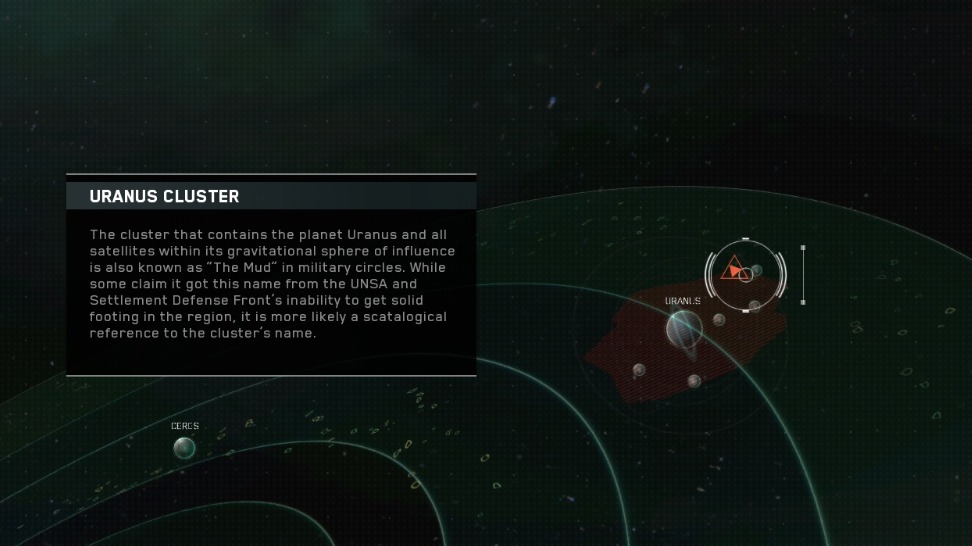
In some future or other, humans have colonised the solar system. But the outer planets secede, forming the Settlement Defence Front and become isolationists before declaring war on Earth. I can’t wait for the Battle of Uranus. So who’s going to stop the SDF? Captain Nick Reyes of the United Nations Space Alliance. Unfortunately.

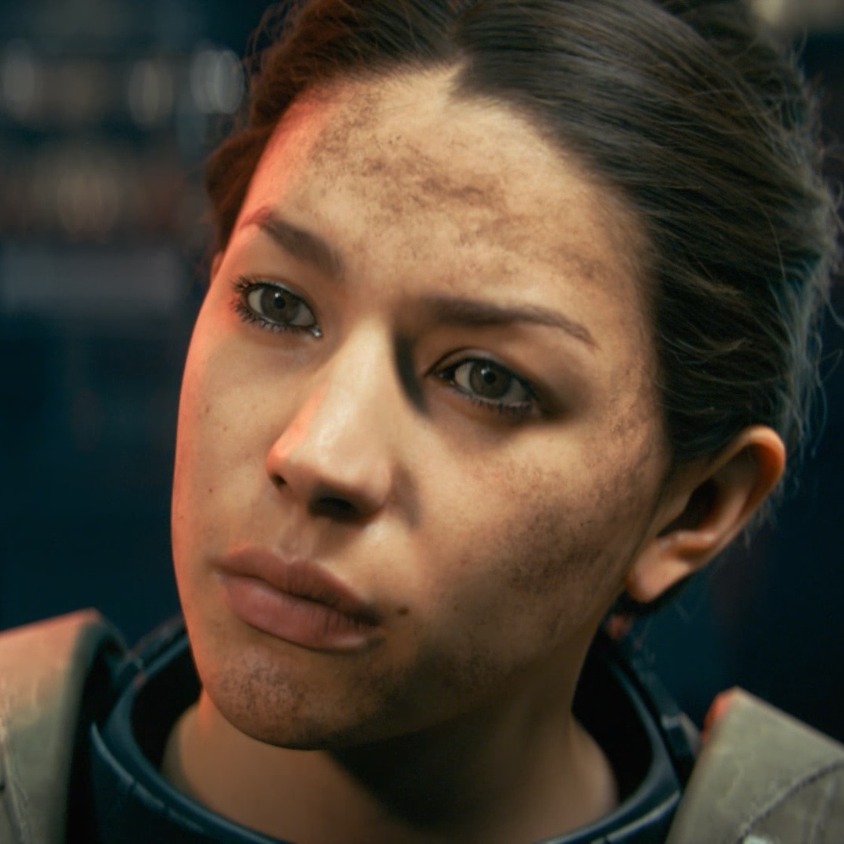
At a 4th July-style celebration, the UNSA decides to put ALL their navy on display. The SDF launches a surprise attack – surprising to everyone but us – and Reyes is forced to assume command of the last Battlestar or something. Dutifully followed about by the far more interesting Lt. Nora Salter, Reyes is a Poundland Shepard; he worries about choices, about losing men, about Earth yet isn’t decisive or a leader; he refuses to accept sacrifice, which surely is the basic understanding of any soldier, even though he’s reminded of it constantly; Nora claims he’s changed since he became captain but literally nothing about him changes. There’s no moral choices that would help Reyes understand and the game removes any responsibility anyway, so anyone who gets killed is someone else’s fault.

If there was ever a CoD crying out for character shifting it’s this one – and not just because of how boring Reyes is; it would make sense for once. We should command as Reyes to get intel and pick missions then play who he sends, letting you decide the tone of the mission and have to accept the risk of sending them. That’s the burden of command. Instead, he insists on leading missions so men don’t die for him – except all the NPCs that is – which makes no sense. Come on, you’re already ripping off Mass Effect 2, just build on it, make it logical. Nora is an Ash knock-off anyway, and we have a Legion.

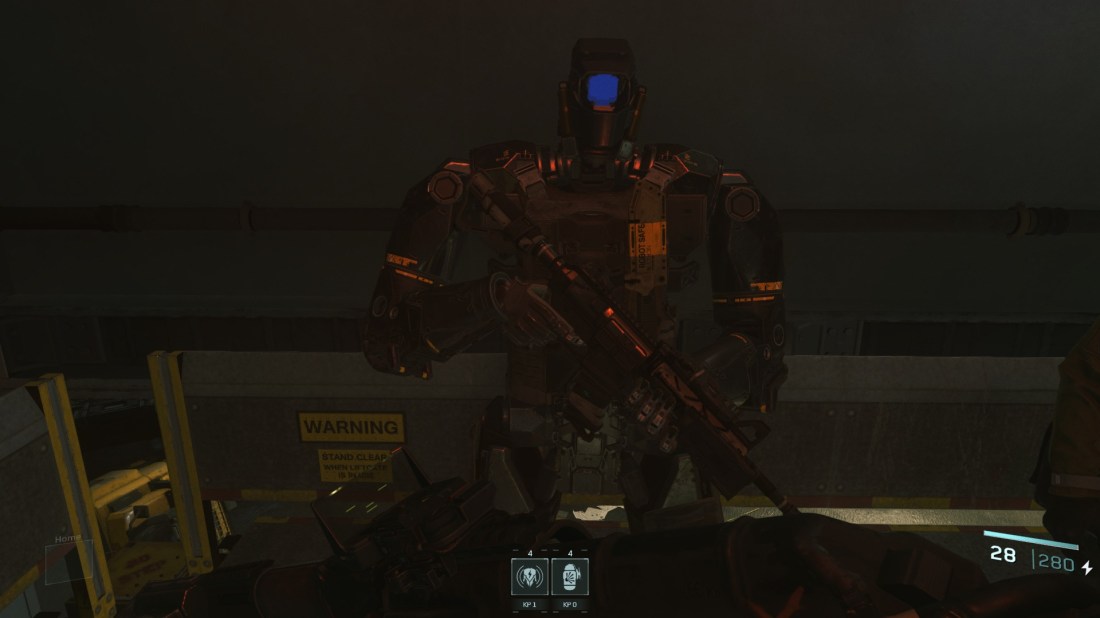
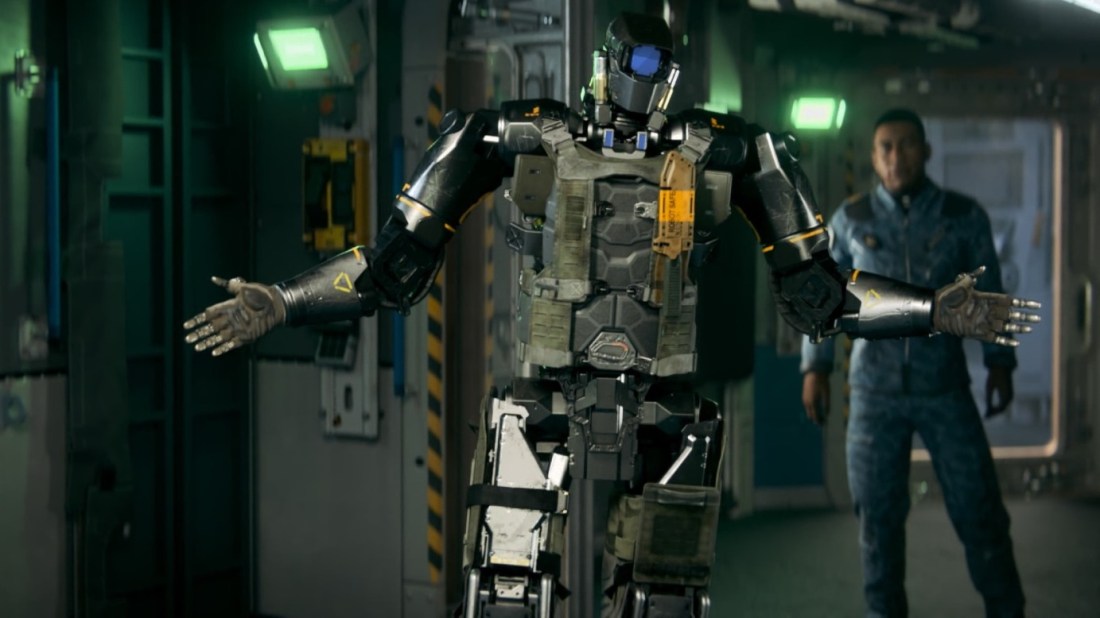
Ethan, an AI Robot with a mischievous streak; conning Nora into thinking he has a human brain (a simple farmer’s brain at that), convincing Marines he’ll overthrow humanity one day, he’s beyond the call of duty brilliant and the one bright spot in this otherwise dour, dull game; a scene where he and Reyes are ‘spaced’ and there’s no hope for survival is affecting – that I’m sad to see the robot go and not Reyes says everything. I’m gonna be Nora now? Nope, they’re saved! Wait, how?! Anyway, there’s a great recovery in a comment that Ethan had to be prised off Reyes’ body, having protected his captain until he shut down – but Ethan’s only awesome in the cut-scenes and in-game dialogue. He’s criminally underused within the gameplay, just another NPC – at one point he gets described as a ‘stiff metal motherfucker’ but we never see him motherfucking. Half the time I don’t even notice him. How do you rip off every other awesome metal motherfucker in gaming then not utilise them? D0g took down a strider in Episode Two, what does Ethan do in-game? Nothing. I’m joining the geth.

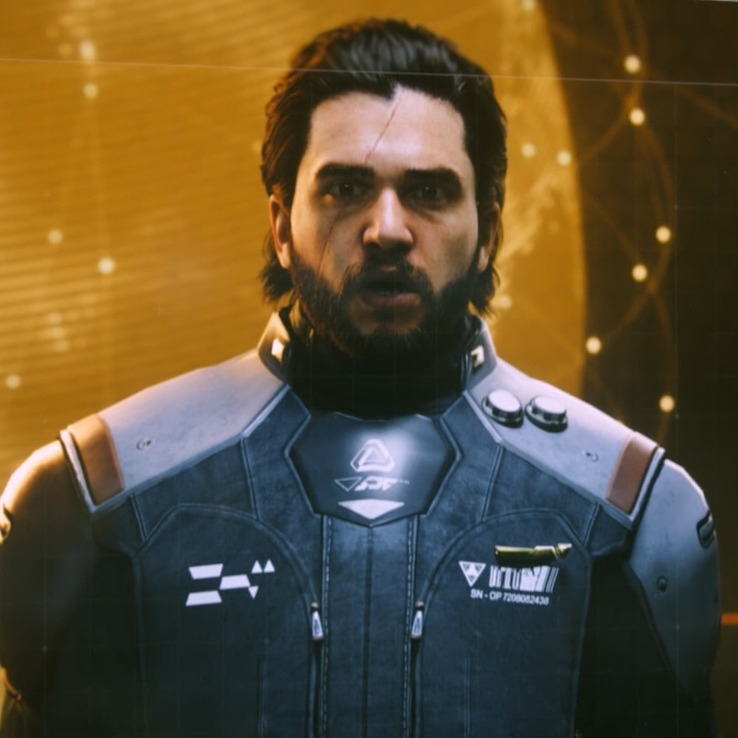
Actually, that’s an insult to the Geth. At least they were sentient. Here, more often than not we’re fighting bland robots programmed by a CoD Zombie. Boring. But then, look who they have for a boss. The SFD is led by a general who is so panto evil he makes Lord Dark Helmet look like a credible threat. Spewing lines like “it’s not enough we break free, we must break them!” it’s hard to imagine the outer planets take him seriously let alone us; he’s played by Kit Harrington so on top of his tantrums, he constantly looks like he’s about to burst into tears. If the SDF are extremists then that needs to be explored, why must they break us? All we get is a laughable, boo-hiss kids tv villain?

So, not wanting to upset anyone, Reyes instigates lots of small, forgettable campaigns; I’m sure they’re effective but I’m bored. Although there’s multiple approaches within the levels, SDF always have all the exits covered so you never feel like you’ve outsmarted them. You’re just going through the motions. Where’s the hail-mary passes, the desperate chances? I thought this was a losing war, most of the time it feels like business as usual. There’s no pressure, no momentum and we have side-missions to further dilute the desperation plus loads of zero-g and flying missions which somehow the game makes mundane. I only do one side mission and that’s because it was set on Uranus. Most of this game feels like padding, and the rest is just watching.

We endlessly watch Reyes open and close doors, get in and out of space ships, travel up and down in elevators; anything to avoid a decision. There’s hours of cut-scenes. The biggest irony here is I wanted a story, and this time I’ve got too much story. The writing, especially around Ethan and Reyes is good but there’s no connection; it falls into the same trap as ME Andromeda, which it’s clearly trying to ape; interesting set-up but no follow-through, missions that don’t mean anything, personal drama you can’t connect to. It does feel like a pilot episode, leaving a lot unsaid so new games can pick up the threads, but there’s nothing to do here, in the now.

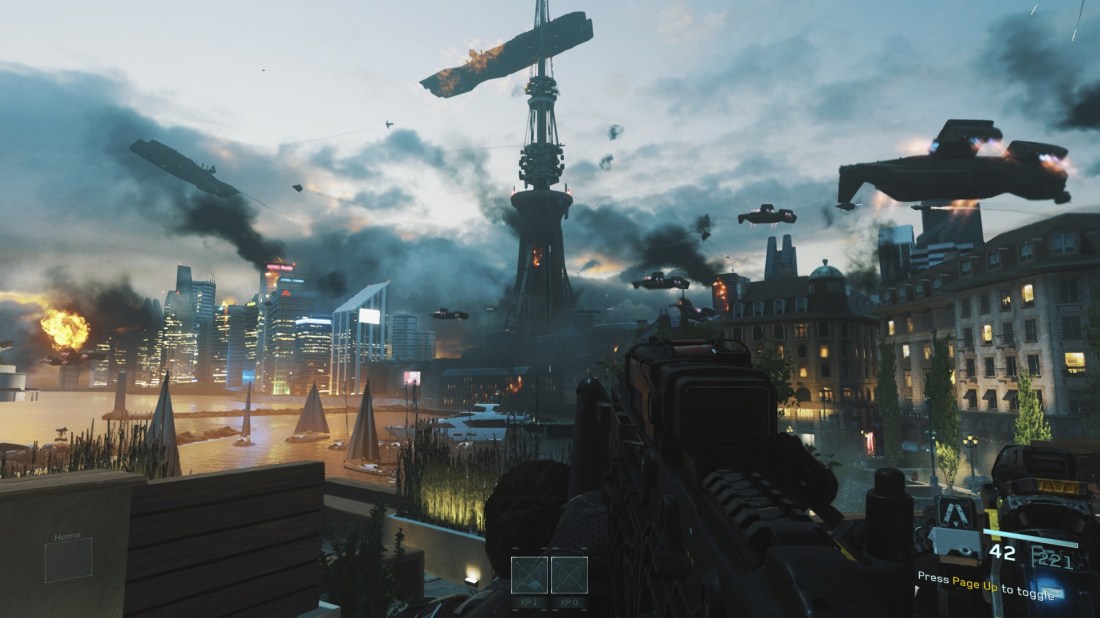
There’s huge action moments but they’re all background noise or so derivative you’re taken out of it, shocked at how shameless it is … there is a sequence on an robot-controlled asteroid that’s headed for the sun which is dizzily spinning above our heads. Cool, but … you can only move in the shadows or the sun will burn you … I’m here for Tali, right?

When it’s not ripping off better games it’s stealing from stable-mates. It lifts so much from earlier CoD entries I keep expecting to see Riley float by. This is not how you start a franchise, by cannibalising your own games and stealing from others, and it feels budget and technologically old; NCPs salute the door when I’m already 20 feet into the room, they talk to nothing, get trapped in doorways or ignore enemies in front of them. Reyes often gets stuck or blocked and it crashed regularly, which just made playing it more laborious.

Finally, Reyes puts in motion a plan that fails spectacularly and gets loads more people killed; still, wasn’t his fault and it all worked out so mission accomplished. What a hero. Reyes then watches Rogue One and gets an idea for a one-way mission; problem is we’re not invested in any of the characters – save Ethan – so when Reyes does a sub-Shepard speech about how they have no way out but must succeed for Earth, we’re relieved instead of worried; that means it’s ending soon. As the crew dwindles (mostly via less than subtle examples of sacrifice; will you just learn it already?!) I realise I got all the way through without rage quitting. But I get my moment when it ends on a survivor staring at a memorial wall with all our lost crew names on it. Skip scene, rage quit.

This should be called Derivative Warfare. But the real issue is we’re a spaceman not a soldier and by focusing on command, CoD lost its niche – it’s brilliance wasn’t in the epic setting that a space drama requires or the burden of command, it was the regular grunt in the shit, doing his bit. CoD is a genre unto itself, and this isn’t a CoD game.

It’s almost sad that IW completely failed; this much-vaunted new era of CoD was quietly dropped and the series returned to its roots with WWII. It’s sad because no one else was doing modern warfare anywhere near as well – even games I despised like Black Ops III were still cracking shooters ultimately. Infinite Warfare ruined Modern CoD for everyone.

So the only way forward now is back. With all those advancements, a return to a WWII setting could be the best CoD game since CoD. They can’t mess up WWII can they?

Read FBT’s final CoD review as he plays WWII and ends this mega playthrough.

Daikatana

a second wind review

FBT is about to make Daikatana his bitch. But can’t without his buddy Superfly.

Daikatana is shorthand for “gaming fail”, but that’s as much it’s pained development as the actual game. It never had a chance; reviewers were gleeful in their takedowns after all the hype and baiting that came out of Ion Storm – 18 years on and contemporary reviews still include clumsy rewrites of Masters of Doom’s final chapters. It’s true, the development and the game are so linked it’s like playing Ion’s self-destruction but does it need that context now? Can you ignore all that baggage and play Daikatana purely on its own merits?

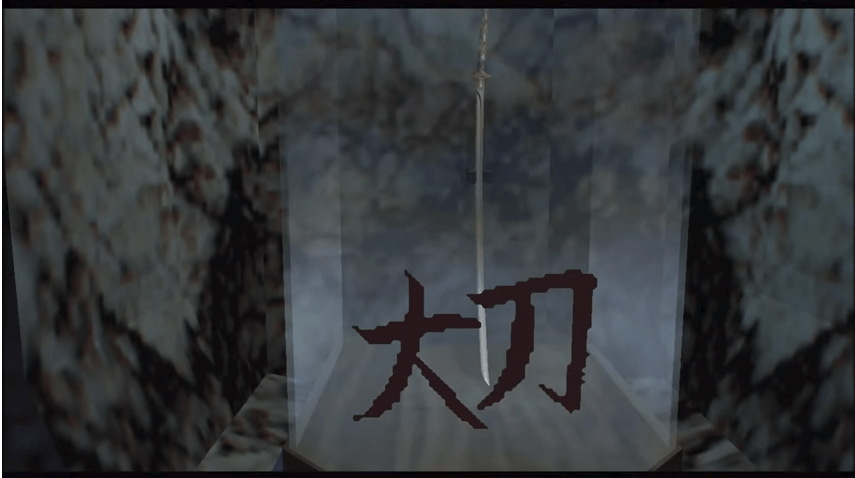
In the 25th Century the world is a disease-ridden place run by a single dictator, Mishima. Our hero, Hiro, is a sword-master (they still need swords in the Buck Rogers era?) is visited by an old man who explains Mishima wields a magical Daikatana and has been using it to alter history to his advantage. Why didn’t he just go back and buy a load of Apple shares if he wanted to rule the world? Hiro our hero is one of the few who could wield the Daikatana, so it’s off to fix the past and save the future, and maybe end up killing his own grandfather or something equally paradoxical.

At its core, Daikatana is great. The characters, twisting time-travel plot and the changing locations make for a great situation to find yourself shooting through. It does bear a resemblance to Quake; the changing time-zones and situations, but whereas Quake had only a quick “why we’re here” pep-talk for a narrative, Daikatana has a rich story experience; it really works as one of those post Half-Life era transitional shooters where we left Doom’s “find the red key” behind in favour of a story you wanted to see through.

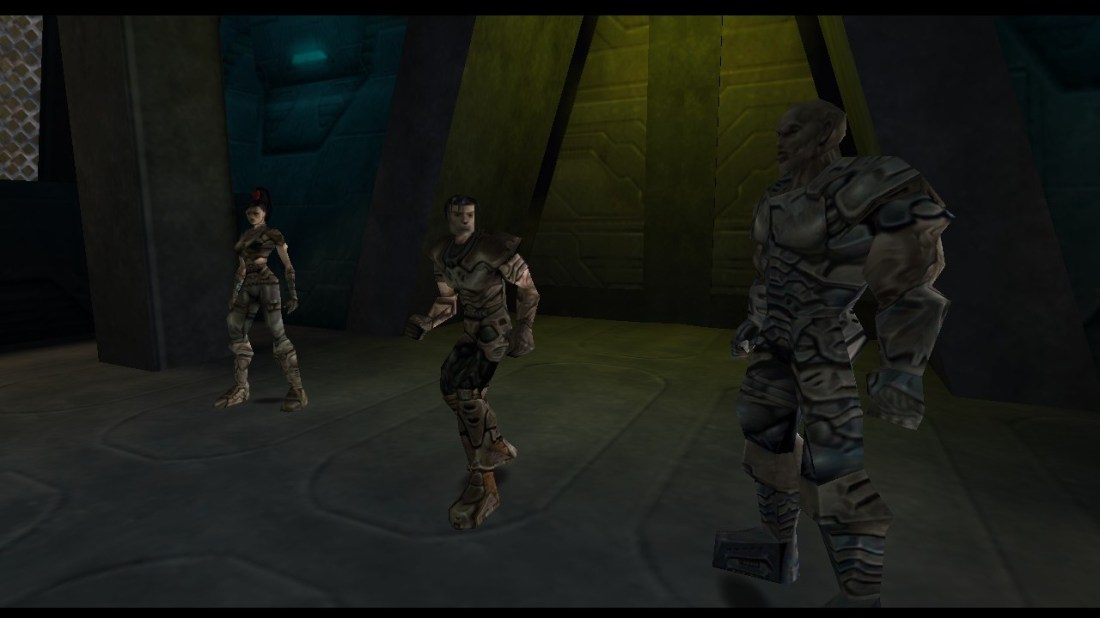
Hiro must recover Mikiko, the old man’s daughter who disappeared in Mishima’s offices while searching for the Daikatana herself – problem is, Hiro has no idea where she is – but there is a guy who does, and he is one bad mother -*shut yo mouth*- talkin’ about Superfly.

Superfly Johnson is basically Isaac Hayes with a shotgun. His voice is so bass it vibrated my speakers. And that’s not a euphemism. He is the ultra-cool, hip, honeyed-voice of reason, the ‘heart’ of the gang and the first to point out “what the hell” when things happen. And a lot happens. Once we recover the more taciturn Mikiko, who’s all business, it’s Daikatana time – but no sooner have we recovered it when Mishima rocks up and has it too, from an alternate timeline. Because both swords existing in the same timeline could cause the universe to implode if they touched (just like that Van Damme movie), Mishima can’t risk battling Hiro so uses his sword to bounce them around time, while Hiro learns how to wield its power.

Our first stop is Ancient Greece to battle Medusa before heading to the Dark Ages, where curing a plague is in order, before Mishima’s stronghold in the 2030s for a final showdown because, presumably, Mishima ran out of time-periods. Oh there’s also the ghost of that old man knocking about who helps Hiro master the Daikatana. Or maybe it’s not him; I was distracted looking for my buddy Superfly.

Superfly and Mikiko are perhaps the most derided sidekicks in gaming, more so than bloody Natalya. Yet, they have their own backstories, impact and presence; the way they and their motivations are threaded into the plot is better done than most modern games where sidekicks just tag along or act as our Hypeman; those guys are invested – Superfly to deliver a can of whoopass to those who wronged him, and Mikiko to avenge her father and put right her ancestor’s legacy. A tremendous amount of effort has gone into them, into making them a critical part of this adventure. And then the cut-scenes end and …

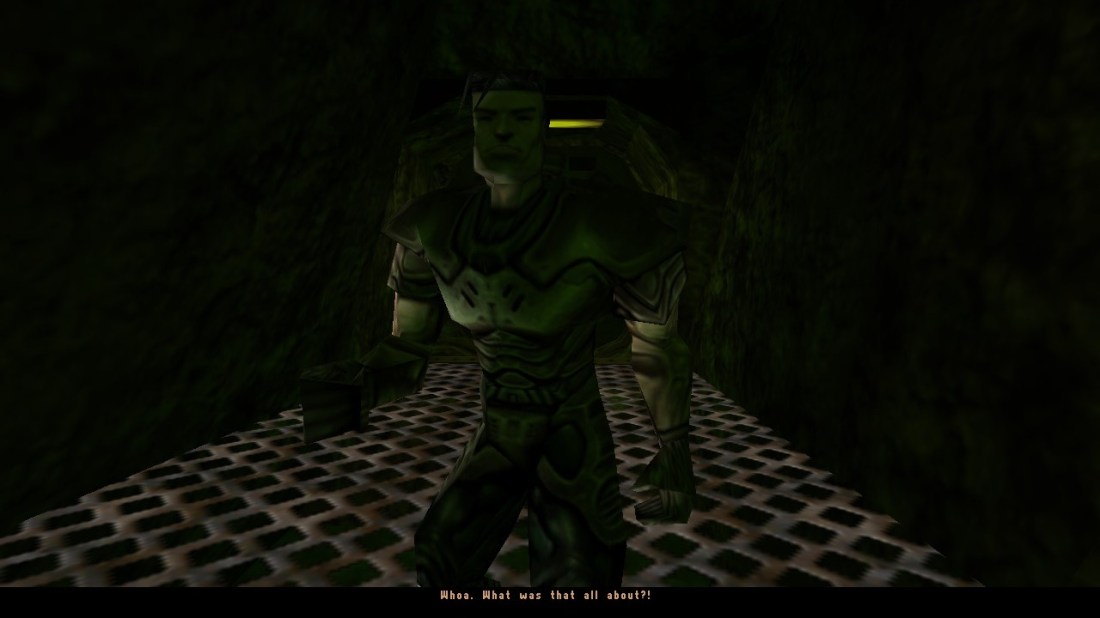
Once Superfly and Mikiko are free it all goes to hell. If we could get there. They pay you no attention, wander off, stop moving, get lost, fall off things or get stuck in them, walk into obvious dangers, refuse to take orders and even take off when the fighting starts. Then they come skulking back when the coast is clear. Having one errant sidekick is bad enough, but two? It’s impossible to corral them. You have four basic commands but they don’t really work and you have to switch between sidekicks so by the time you’ve stopped Superfly walking off a cliff, Mikiko’s disappeared. If anything, this game has given me a new appreciation of games like Mass Effect and how they managed sidekicks. Mikiko? Stay there, I’m just gonna go look for …

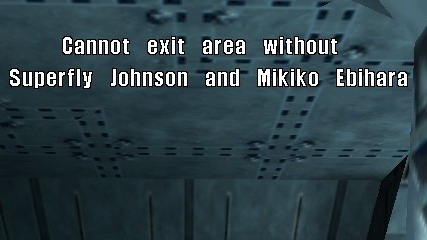
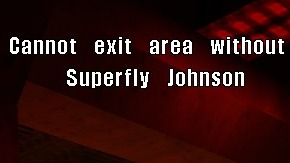
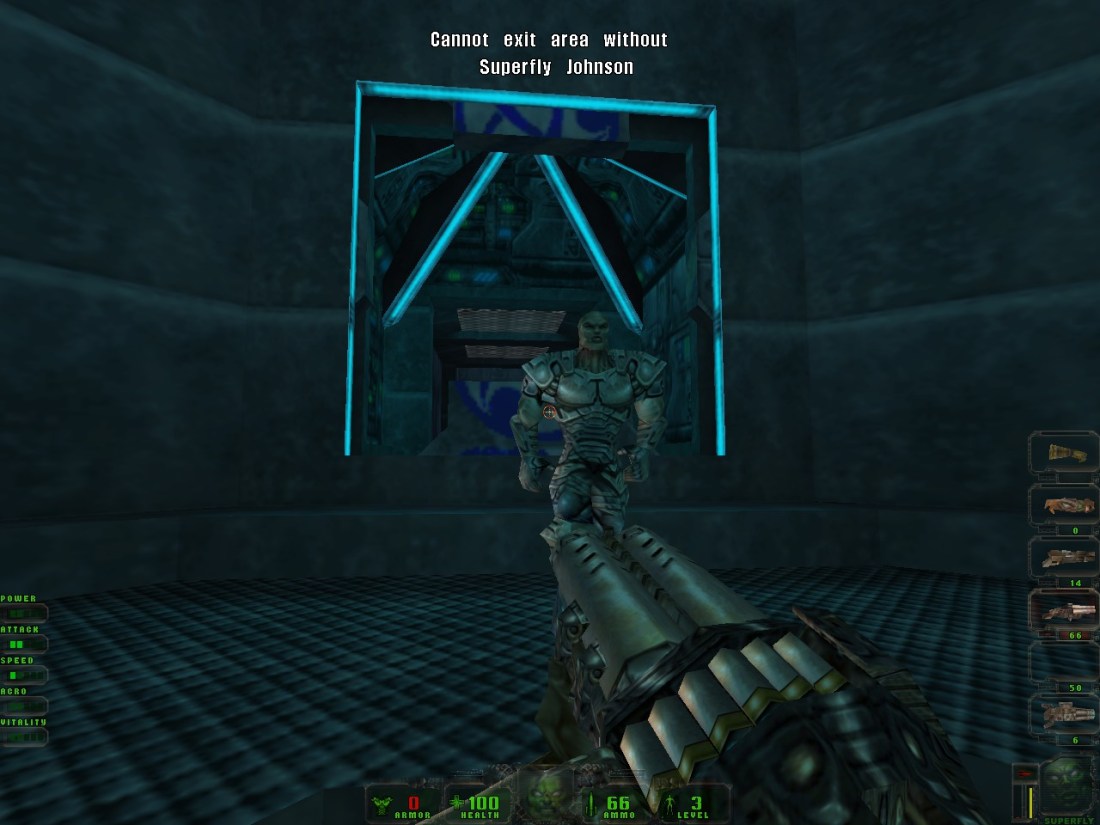
… you don’t even get a warning they’re under attack, just a Game Over (not that you’d be able to find them in time…) They misbehave too; they’ll promise “I’ll wait here” and when you return – they’ve gone. And they can go for miles – which leads to the biggest issue and one that surely must have occurred to the Devs at the time. You can’t pass through a loading screen without them, getting “I can’t leave without my buddy Superfly/Mikiko”. If they’re there, they’ll take their sweet-ass time to reach the exit, but if not … it’s backtrack time; it’s not an overstatement to say a quarter of my time was spent trying to find them. Daikatana is like a FPS Hide and Seek. Worse, you might have Superfly but not Mikiko so you go look for her, get lost, find her, walk her back only to find Superfly’s now gone … Shooters rely on quick thinking and quick moving. You can’t be in shooter mode and protect mode; I have a new-found respect for parents with toddlers, you look away for a second and they’re gone. Daikatana is one long escort mission and that overwhelms the fun. Fan-made mods remove or alter them to make it easier but come on, they’re ruinous. Oh, this level looks interesting, let’s …

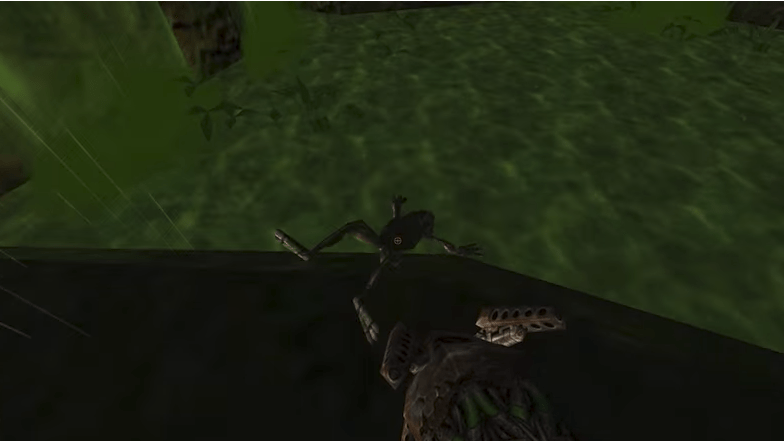
So the sidekicks are a major, game-breaking problem. But the huge variations of creatures, weapons and time-periods make up for it, right? Sure, but first we have to deal with frogs. Frogs!? What were they thinking? But they’re cyber-frogs. Okay. Cyber-frogs?! What were they thinking?! Why would a super-villain even think about wasting R&D time inventing Borgified Frogs? And then it’s mozzies dive-bombing you. Those things are worse than Fallout’s Botflies. Why is the first level just looking up at the sky or down at the ground?! To hide the fact that the opening levels are a murky brown, green, yellow as we push through a … I don’t even know where we are. I thought we were headed for Mishima’s building? You went via a swamp and the sewers? Can’t just find a side entrance Hiro?

Mishima’s building is fairly standard corridor shooter stuff, but throughout there’s NCPs that do nothing but blurt nonsensical lines and run screaming. There’s so many it’s like Serious Sam in reverse and the noise of their collective shrieking is deafening. Plus we meet scientists doing horrible experiments but they disregard Hiro even when I shoot a couple. Why do the janitors run screaming but the guys we’re more likely to be interested in ignore us? Then there’s the level design. It’s incredibly uneven. Some levels work quite nicely, others are a complete mess of backtracking and illogical layouts. And it doesn’t look great either. The art design is basic like you’re on low settings and the cut-scenes are jerky and ugly; I was never a fan of the Quake engines, finding the 3D actually made the world less vibrant than Doom or fluid like the Build Engine, but Daikatana is a game I imagined would have an energy to it, detail, but it’s often got a ‘fuck it’ look to it.

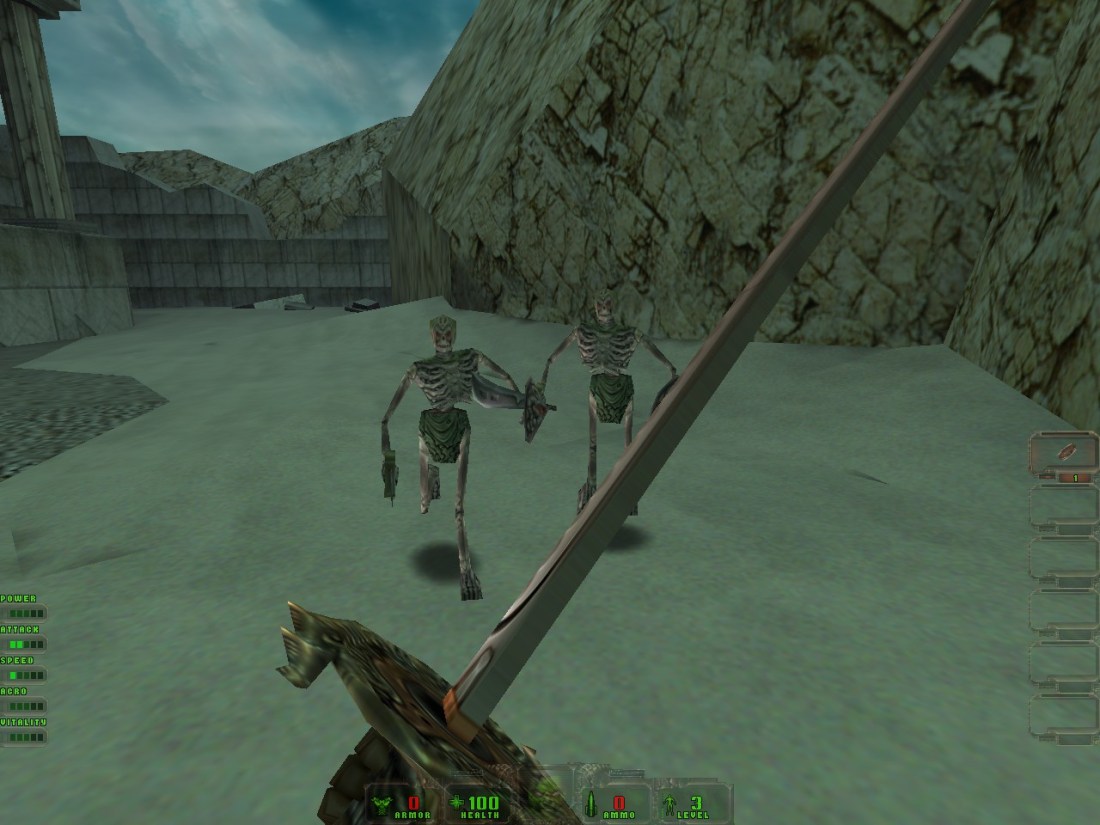
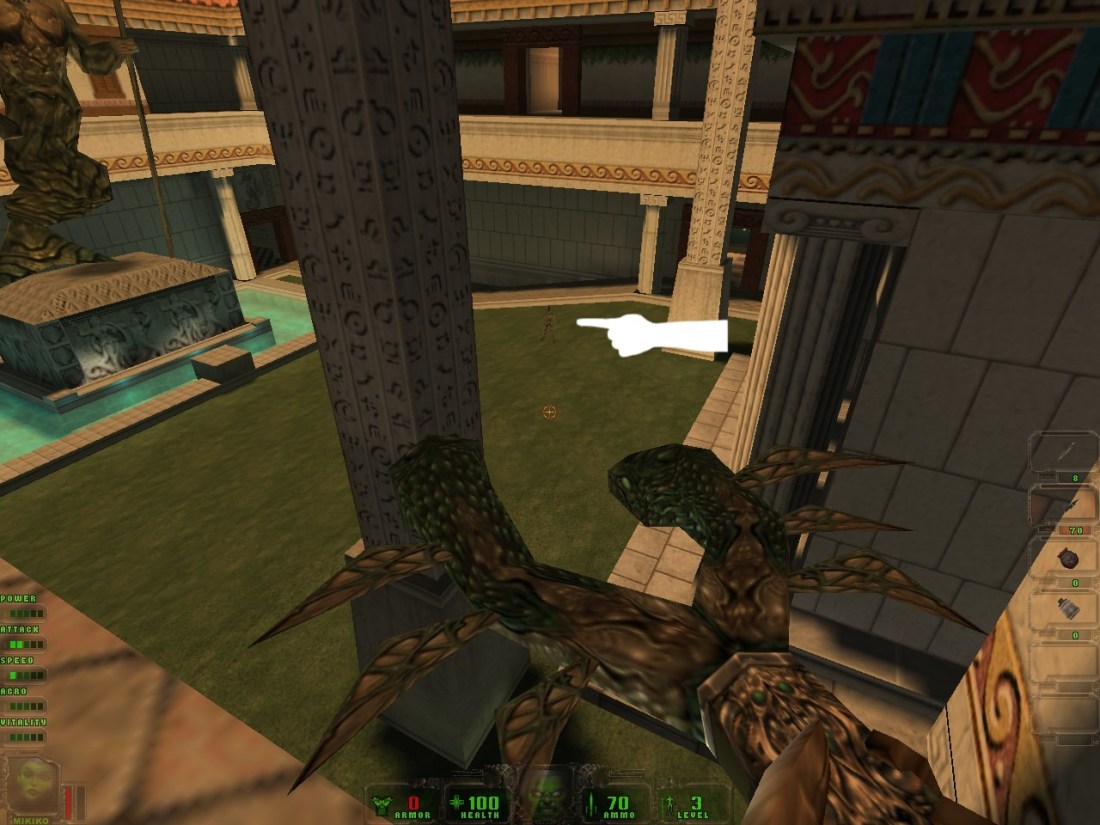
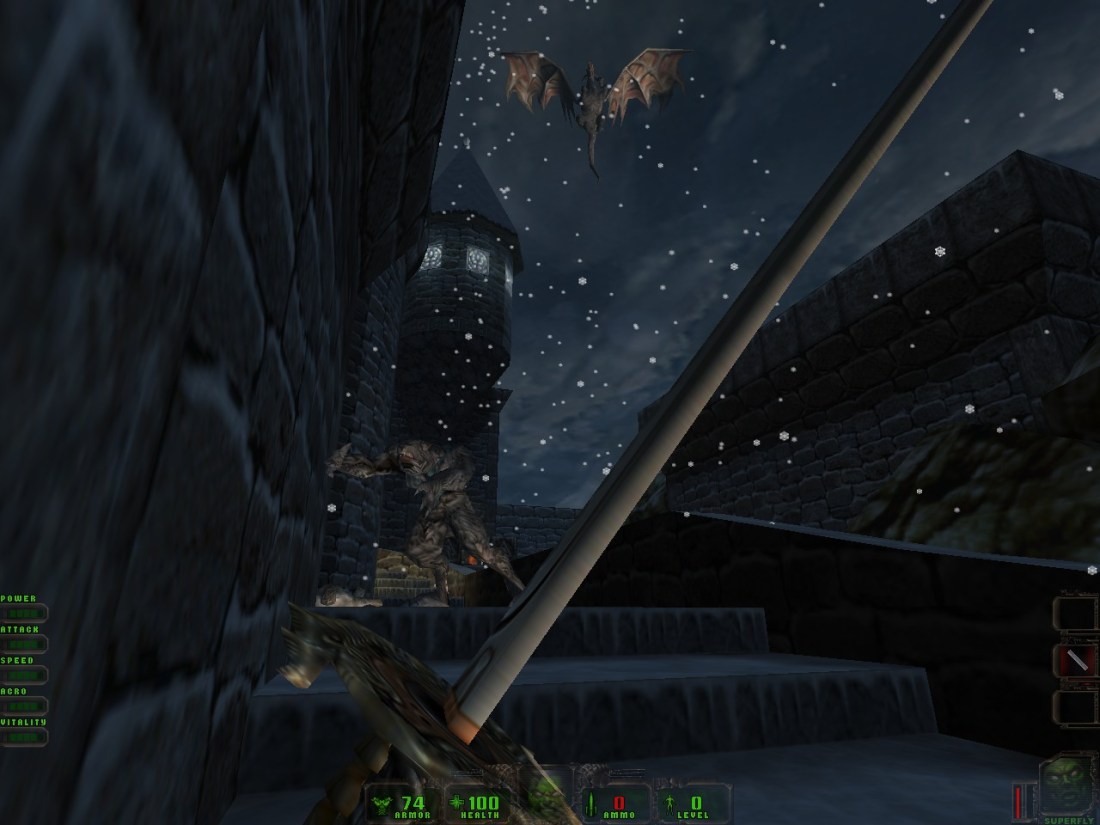
Ancient Greece is more like Ray Harryhausen’s Ancient Greece. We battle giant spiders, skeletons, iron gladiators – it’s by far the best episode, more open, interesting and experimental, and while Dark Ages is bleak and fantastical, the final sequence is largely a reheat of the first with more repeating NCPs and similar fights. The game had 24 levels all in, split between those 4 locations but they all outstay their welcome by 2-3 levels. If Mishima had just managed to squeeze in one more trip it might have flowed better. The main problem is they’re effectively reskins. While each is a different look and has its own set of weapons and nasties, your experience never varies – had Greece seen us doing swords only, Dark Ages had a bit of magic and the final base all sci-fi or facing the horrors that were implied in Mishima’s first headquarters it might have gotten interesting; or have the areas impact Hiro in some way so he’s prepared for his Shogun Showdown – not that it would matter, yo’re too busy looking for Laurel and Hardy anyway.

Like the Daikatana, I’m split on how I feel about this game. It’s both brilliant and frustrating. From a distance, Daikatana is pure genius; but when you get into it, nothing works; the cutscenes reveal a great story but go on for huge amounts of time draining any drama. The trio of heroes develop dynamics but never really build on them, the creatures are interesting but because of the level-sizes they get repetitive and each time-period is great to get into then dull mid-way through. And as a shooter, it’s effective but spoilt by the brats wandering off or getting their skulls split.

As much as I hate to admit it, Daikatana just isn’t very good. It reminds me of SiN – a well-intentioned failure that tried but didn’t quite land it, but Daikatana just crashes.

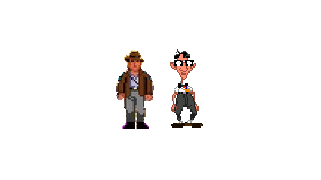
Although I said I’d ignore the development (and not rip off Masters of Doom) there are elements to Daikatana’s background that should be repeated more often; the game was made by kids Romero hired after playing their Doom WADs; for a Triple-A Development Studio to hire kids whose only skillset was killing it at Doom is huge (okay, maybe it was a folly, they had no idea what they were getting into, but neither did Romero when he made Doom) and many of those guys went onto great game careers. But most importantly, it shows that Romeo’s Ion Storm was all about the gamer in a time when the tech was becoming the most important thing. We care how it looks and how it plays, but what we remember is why we were there and what we did; one of my fave games is Indy and the Last Crusade (1989) and it’s not because of how it renders the fine leather jackets I’m selling. It’s the soul of a game you get, and that’s what Romero shot for – maybe we’d have less reskins and reheats if more Devs took his lead.

Daikatana, if I’m honest, is an awful game, but it’s heart was in the right place – and nowadays it seems there’s no place for heart in gaming. Ironically, games could do with more Superfly.

2000 | Developer Ion Storm, Publisher, Square Enix

Platform; Win (Steam)

Medal of Honor 2010

a second wind review

FBT earns his Medal of Honor; by doing what he’s told

Every generation makes a choice; The Stones or the Beatles, Blur or Oasis, Beethoven or Salieri, Coke or Pepsi, Marmite or … not. In gaming, it was Medal of Honor or Call of Duty. For me, it was the MoH series. Unfortunately, that didn’t last. MoH got more outlandish as the series tried to keep up with CoD and when they went all modern in 2007, MoH followed with this 2010 contemporary reimagining – did it overtake CoD or chase it over a cliff?

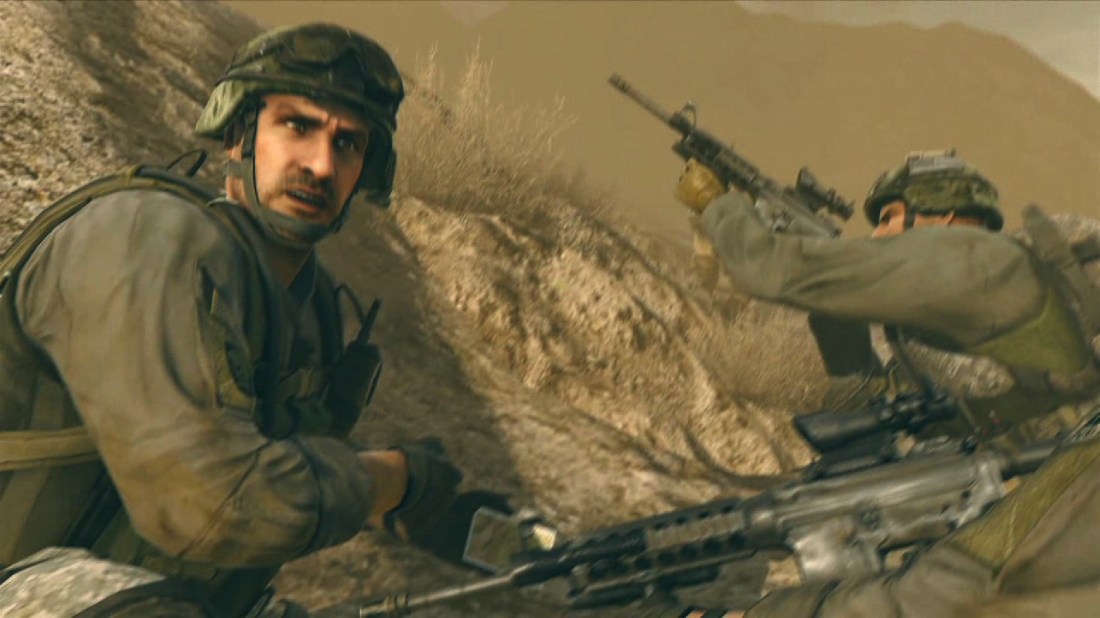
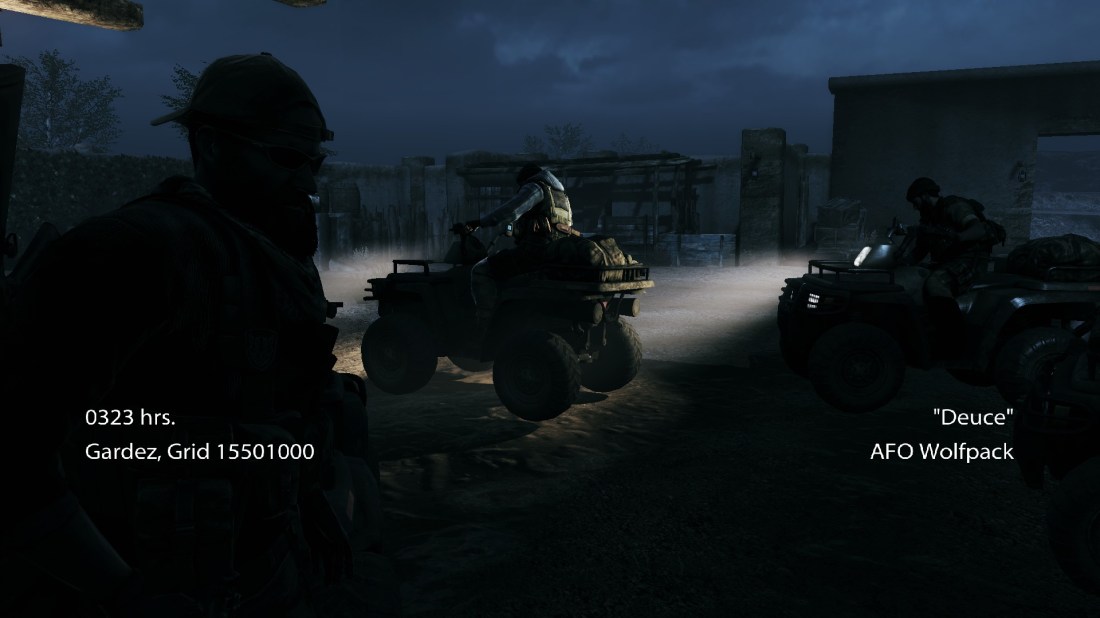
Immediately calling CoD to mind, MoH 2010 has three different characters we bounce between; “Rabbit”, an ‘operator’ collecting intelligence; “Deuce” a Delta Force commando disrupting enemy movements and “Adams” an Army Ranger, part of the US’s invasion of Afghanistan; those guys directly and indirectly affect each other as they carry out missions in the months following 9/11. Split across two days, MoH aims for a serious and realistic look at the war on terror and it seems like an epic story; the Operators discover a Taliban force the Rangers are on-route to mop up, has been grossly under-estimated. The power-that-be demand some good old-fashioned American Shock & Awe and force the unprepared Rangers into a shooting gallery. Thrilling stuff, as we cut between the Deltas disrupting Al Qaeda while the Operators thin out the Taliban and Adams and his team get cut to ribbons except … that doesn’t really happen.

Every game ever has objectives, mission markers and parameters, but in Medal of Honor you’re so locked down to specific orders and actions you never feel like it gets past tutorial stage; ‘move over there’, ‘shoot him’, ‘do that’ – constantly nagged by your teammates, you’re just their assistant; ‘snipe that guy then go get me a latté.’ I’m the sidekick? But HoM is also flat because the three characters have no character; they’re silent heroes of course, but based on the way they’re barked orders at, I’m guessing they can’t be trusted to do anything. Doesn’t feel very heroic. That might be realistic, wars aren’t won by Duke Nukem-types, it’s teamwork and precise objectives, but some investment in what’s unravelling around them, some personality, grit, ingenuity … excitement would go a long way. It’s a war-sim game. Rabbit’s missions tend to be close-quarter fights and Deuce’s are sniper and stealth based, but they are interchangeable and if it wasn’t for the NCPs round you, you’d never tell which squad you’re in. Adams’ missions are much more exciting, since he’s been deployed directly into FUBAR but it’s just agonising to never be let off the leash.

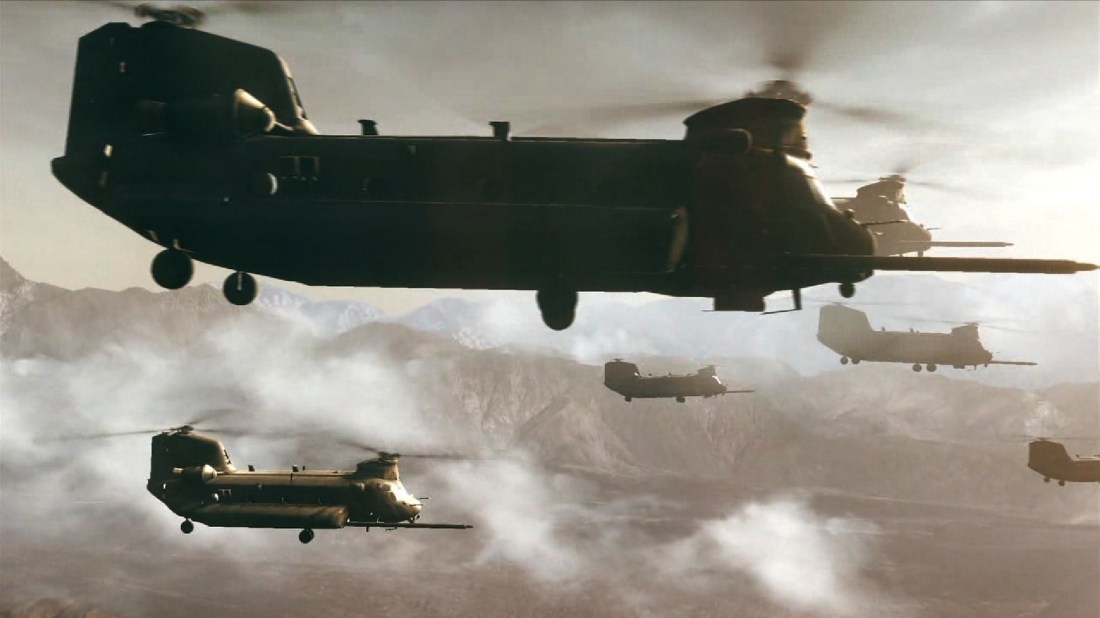
There are some great set-pieces, trying to secure an airfield (ending on the quote from Generation Kill; “that was pretty fucking Ninja”), Adams’ overrun and out of ammo moment, and a running firefight towards a Chinook that’s about to leave, but you’re never free – even running for your life is tightly controlled. Adding to that frustration, there’s moments where no one moves until you perform an action. Sometimes it’s easy to miss under the gunfire or because you’ve tuned-out the nagging, but often the game just doesn’t trigger the next action. They just keep telling you to do the thing you’re doing. So its restart at the checkpoint time and hope it works. Great, more nagging. As a shooter it’s unforgiving and realistic once the bullets start flying but it takes a lot of orders to get there.

The game does try to maintain some consistency, to show it’s all happening at once; there’s a great sequence with Adams’ team suddenly saved by an Apache Helicopter; we switch to the chopper’s gunner (since we’re not the pilot we don’t even get to choose where we go, literally a Rail-Shooter). After the chopper has cut through some enemy lines, it’s saved from AA guns by a sniper – Deuce, of course, and we slide into his mission. That’s cool, and although we see the effects of what each team is doing, since we have to complete a mission objective before it moves on, it’s not like we can fail or exceed and make this better or worst for the next lot.

Our on-the-ground CO is forced by a back-in-Washington General to get ‘boots on the ground’ and that should be our cue to get to work, Deuce and Rabbit desperately trying to even the odds while the clock ticks down to Adams’ deployment – even make it Non-Linear; if it had cut between Adams’ mission, then back to Deuce or Rabbit’s impact on it earlier in the day making it about what it took to get him there it could have been incredible; make Adams’ missions easier or harder depending on how well we did as the support teams. In fact, we don’t really get to play any hero – it’s actually Dusty, Deuce’s nagger on the box art and he, along with Adams and Rabbit’s bosses are the heroes. We just do what they tell us to.

Nagging and script trigger-issues aside, MoH does have some great moments – rushing out of a chopper into blinding sun and sand unable to see anything is an unnerving moment as is a cut-scene inside a crashing Chinook where Adams’ team goes zero-g as it spins out. Those aren’t just good game moments, those are throwbacks to prime MoH; perfectly balanced gamer experience with true depictions of war.

In the end, the three characters do converge, with Deuce providing one final support act as the Operators draw away Al Qaeda and Adams’ winds up helping them recover a captured Operator; but it’s misjudged to end on a personal mission, a ‘we never leave a man behind’ finale undoes much of what came before. Until now, it was about how small actions have huge consequences elsewhere, now everyone’s up for saving that guy no one knows? It should have stuck to its original promise, ended with Deuce and Rabbit, the unknown soldiers, watching from afar as the Rangers take the hill then report for their next assignments, our actions forever unknown and disavowed.

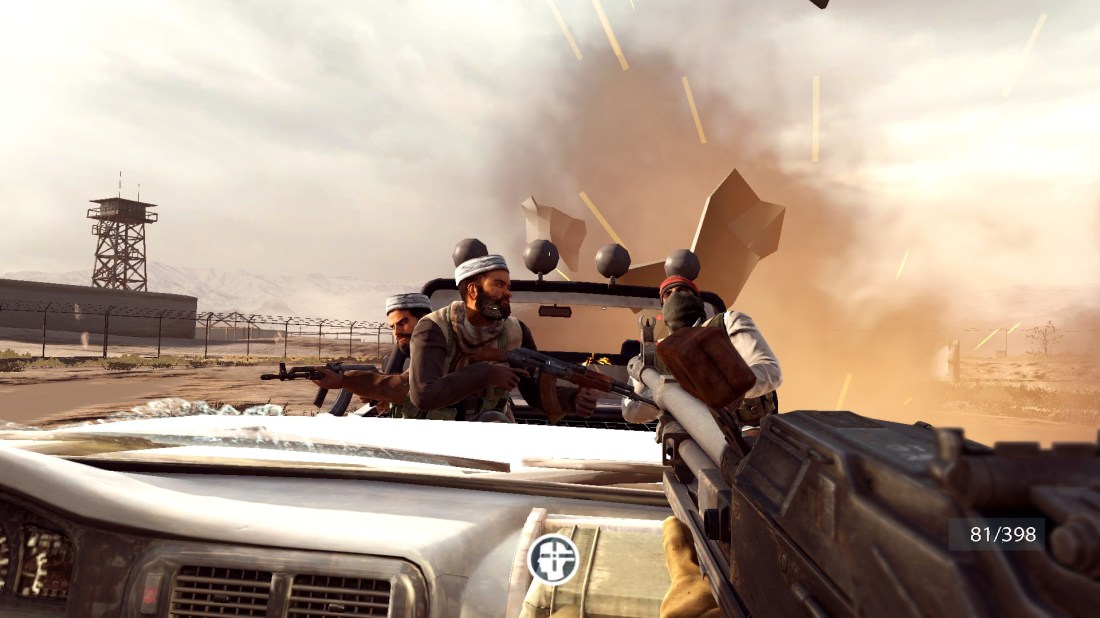
It’s not that MoH couldn’t step out of CoD:MW’s atomic shadow, but it didn’t want to. MoH seems to invite comparison to Modern Warfare; there are the multiple characters, the satellite images during load screens, the occasional extra character to play, taking control of drones, directing air-strikes and slow-mo kill-shots. Most of those are necessary in a military shooter, and would be fine if there was more to it; what’s maddening is MoH 2010 is dedicated to not sensationalising or trivialising war but it’s so flat and unfinished, like a beta-test. And you can’t help but feel it’s all about the Multiplayer – and that caused a ruckus because you could play as the Taliban. Cue lots of point-scoring politicians and media outrage that a game lets you ‘shoot our brave boys’. It does seem like EA was inviting controversy; they tried to argue ‘someone has to be the cops and someone has to be the robbers’ but that doesn’t ring true as half the time you’re fighting Chechen mercenaries; and reducing the war on terror to school playtime is insulting and as an explanation of the multiplayer it undermines the tone of the story-mission; does anyone in EA’s marketing team game?

EA followed MoH with Warfighter, which was so bad it caused the cancellation of the franchise. Which is a shame. I have very fond memories of arguing MoH was better than CoD (It is. Was.) Playing the D-Day mission it struck me that this really happened, and the game was respectful about it. My opinion of military shooters was forever influenced by Allied Assault, and MoH 2010 had the opportunity to do the same, pitting us against Al-Qaeda but it seems to get caught up in its own politics and by refusing to sensationalise the events, it ironically ends up hollow; maybe there is something to said for CoD’s bombastic heroics. Yet it does come close to commentating on the War on Terror; towards the end, Rabbit’s team happens across a village they’d captured the previous day, only to see it full of Taliban again. That’s the War on Terror in a microcosm; shame we don’t get to play in it.

2010| Developers; Danger Close / DICE | Publisher; Electronic Arts
Platform Win, PS3, X360

Train Simulator

A SECOND WIND REVIEW

FBT got Train Simulator from Secret Santa. All you had to do was follow the damn train, FBT.

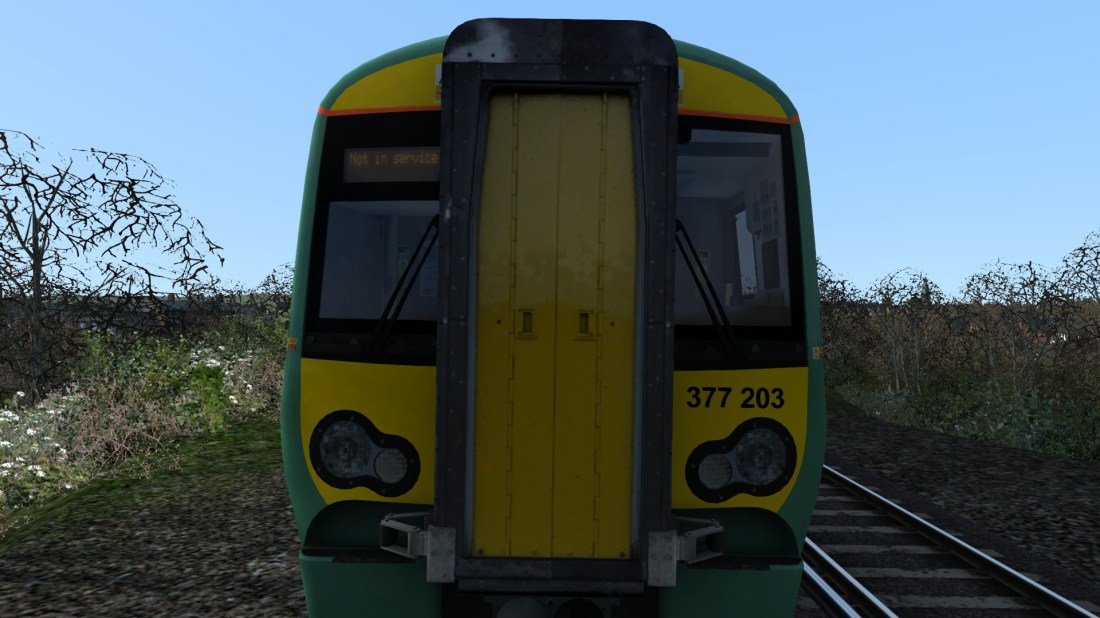
Secret Santa. The frustration of trying to work out who in the hell Barbra is. Getting the guy who no one knows what they’re into. Or getting the boss. Then opening the tat you were given, realising no one at work knows you – or worse, something so on-the-nose they know you too well. This year I got Train Simulator: London to Brighton – my daily commute. I guess all I talk about in the office is gaming and Southern Fail. Well played Barbra.

I’ve always avoided those games like a plague sim. I don’t understand why anyone would want to play something real. I get realism, but I game to be better than I am in the real world (and avoid it); why would I spend my free time doing someone else’s job? I can’t imagine a worse game to play. But … I have suffered at the hands of Southern Rail for a decade now; I know the announcements, the excuses, the world-weary sigh in the conductor’s – sorry, On-Board Supervisor’s voice as they announce the train is no longer in service. I am a Southern Fail ninja, leaping from platform to platform, hopping trains as the service crashes to its knees at the sight of a falling leaf. I’ve been cancelled, delayed, abandoned at places I’ve never heard of. I’ve missed connecting trains, parties, birthdays, films, gigs, restaurant bookings. I can’t plan anything when Southern are involved; my homepage is their delay-repay. I have a “I survived the Southern strikes” t-shirt. Southern is so bad they have to be some sort of Government sociological test like MK Ultra or the Tuskegee Syphilis Experiment. To actually spend free time playing as Southern is an insult, like the FIVE THOUSAND POUNDS A YEAR I PAY FOR THE PRIVILEGE OF TRAVELLING ON – And yet … what I have here is a chance to prove Southern can’t run a rail network; that it is as easy as it looks. I was once delayed for a total of 48 hours over a single month; enough to claim I was a missing person.

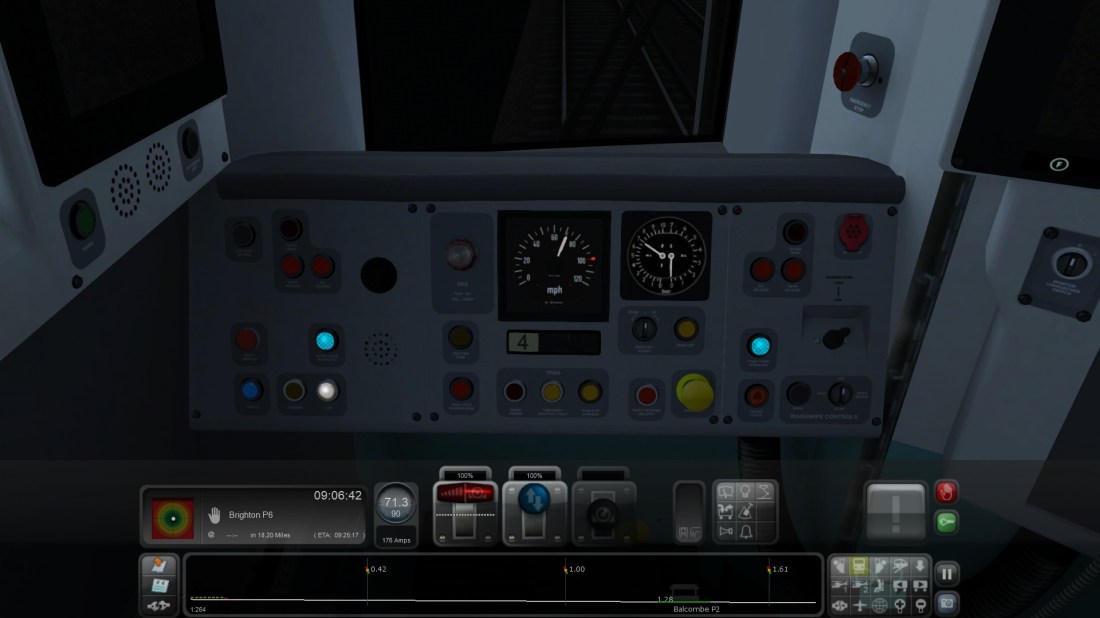
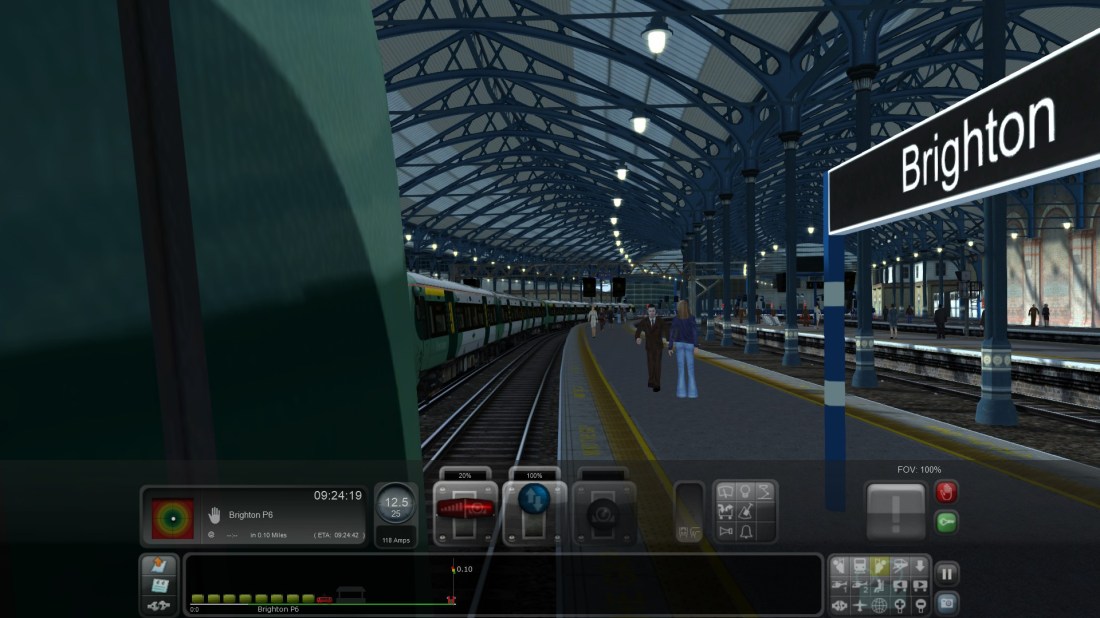
I am instantly in the mindset of Southern; I have no idea what I’m doing. There’s a HUD and the actual controls, but once past the tutorial (okay, I may have skipped most of the tutorial) and realising I can’t re-bind the keys, Driver FBT is just pressing everything to see what happens. Ohh train whistle! Toot Toot! I got this. I find the button to change view and lean out the window. The platform is basic, and there’s nowhere near the number of passengers usually at Victoria; aggravated commuters mixed with flight-missing tourists who have no idea what “cancelled due to train displacement” means. It’s a fairly accurate representation of Victoria though, even down to the lack of platform staff or helpful info. My train is announced and my passengers saunter up to the doors; boarding a Southern train is usually like a scene from World War Z but here they hang around passively. Oh yeah, the doors. Which key is it? One Google later and I have it. It’s the T key. Not D for doors. This being Southern I expected it to be C for ‘Cattle’ or some other C word. I check in on the passengers. There’s seats to spare! This isn’t realistic of Southern at all. Normally you’re so crushed together someone’s pregnant by Three Bridges. After lots of knob twiddling and pressing things, we rumble out the station. We’re off!

Southern commuters have a Bingo game; will it be congestion, ‘overrunning engineering works’, an ‘earlier incident’, ‘operator error’, a vague ‘disruption’ or the dog-ate-my-homework classic, ‘signal failure’? Yesterday it was the two-year-old announcement of Temporary Staff Shortages. Not on this train buster, this train will not be delayed. Even if it briefly starts going backwards and I get an emergency break alert. All right, we all make mistakes. Or ‘Operator Error’ as it’s called. So that’s what that means. Scary stuff. This game is giving me Siderodromophobia. AKA Southernphobia.

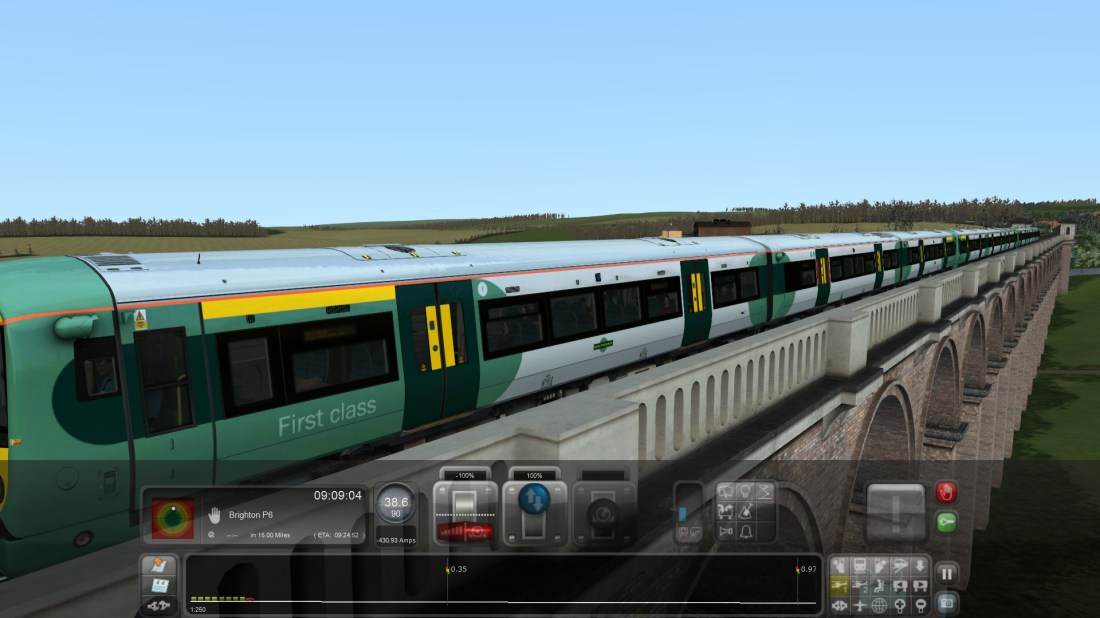
The game does reconstruct the journey incredibly well; the view from the windows is spot on, although it’s very 2002 graphically – fitting, that’s the last time Southern had a train on time. I’m kidding; they never had a train on time. I wonder if my real fellow passengers are confused by my laptop screen showing their commute – nope, they have the same listless, thousand-yard stare of my digital passengers; this is your life, and it’s ending one Southern delay at a time. Developers Dovetail Games got the Southern experience spot on.

My real train is delayed because we’re behind a ‘stopping service’. I on the other hand am blasting through the route. I’m ahead of myself. Wait, was I supposed to stop at Clapham? I hunt for a skip mission or speed up button, but this is real life. Real time. Real boring. There’s nothing to do. Oh East Croydon! As I slow down I realise it’s not going to happen. We screech past and I’m warned I’ve missed a station. Minutes later, while searching for the button to turn on the lights I run a red signal; Another Operator Fail – I’m fired. The union takes up my case, the whole network goes on strike. I’m reinstated. Bless the Union.

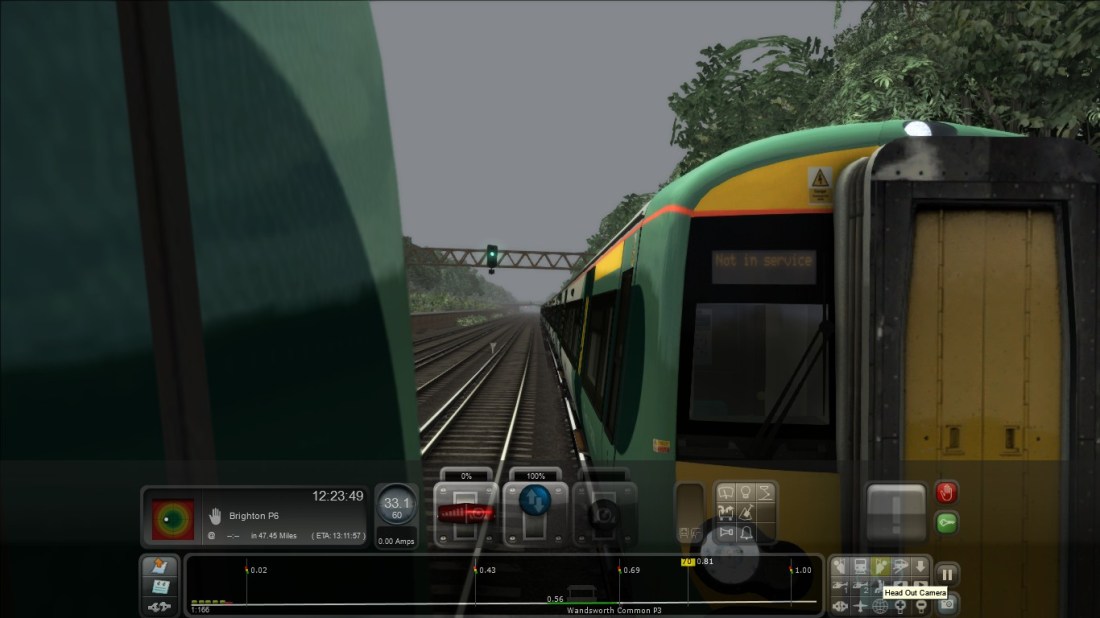
After several more operator errors, including trying to back the train up after I miss East Croydon again (it creeps up on you), I’m still determined to get to Brighton. I realise this is the first gaming experience where I have to behave and that’s hard to do, but after a while I start to get into it; there are challenges, there’s a lot to being a driver. Actually, there isn’t, the biggest challenge is not mucking about. Really, it’s stop in time and stay within the speed limit – which is interesting; on Southern’s Brighton route you get bounced about so much it’s like being on the Vomit Comet; I have gone Zero-G around Hayward’s Heath, but they insist it’s within speed limits; I was told not to sit ‘over the wheels’ if I wanted a comfier ride. What the hell kind of advice is that?! But here, whenever I get above 80 the train lurches and I get a speed warning. Suspect. I trust a computer game more than Southern.

“‘Do not lean out of the window’. I wonder why?”

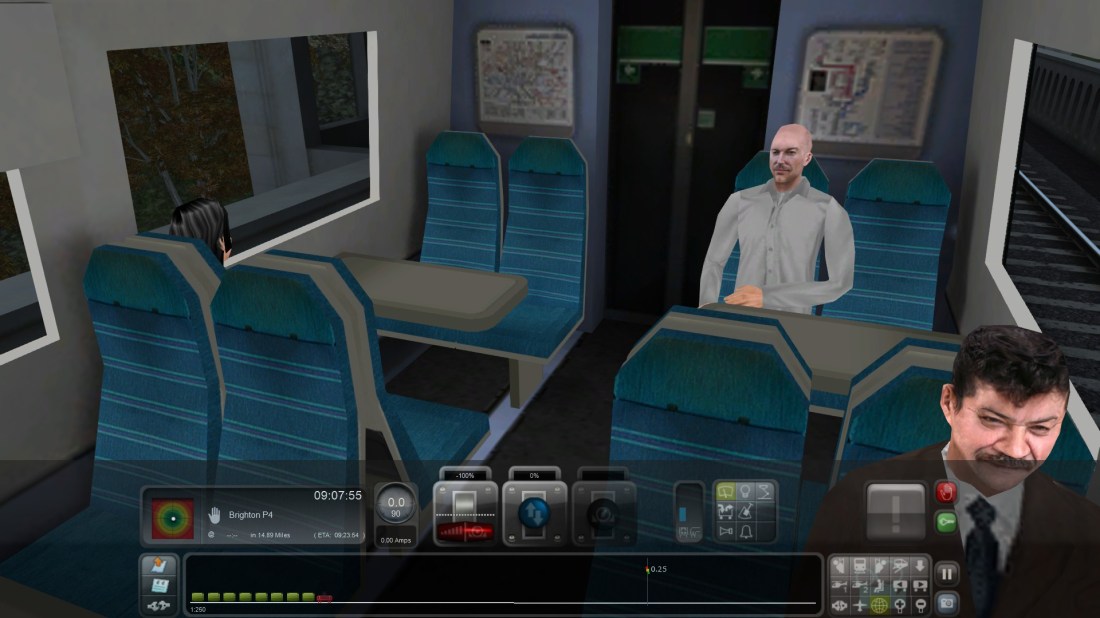
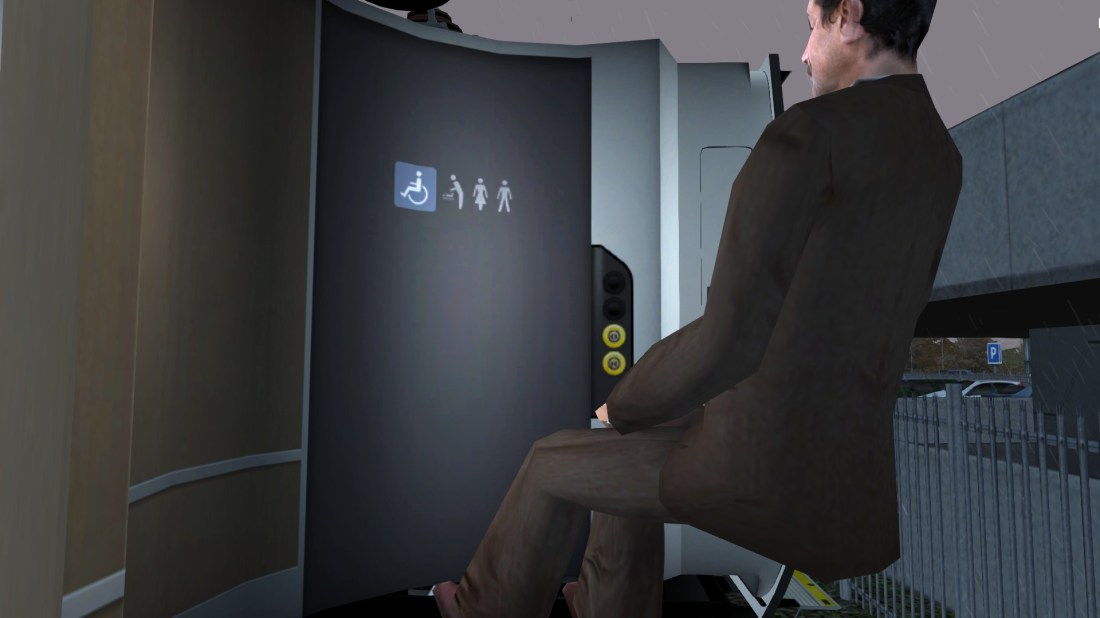
It’s fair to say that some of my befuddlement and red-light running is caused by the confusing controls; at times it’s maddening. I spent most of the time with my head stuck out the window like a dog. V is for Window Wipers; what was wrong with W? But, ignoring the messy control system and basic design, Train Sim is surprisingly realistic – except the toilets, where I find a fully clothed man sat on the loo; weird – like any of the toilets work on Southern. But it’s strangely compelling, after a while I find myself totally into it; it becomes a point of pride to hit the stations bang on time, keep on schedule. Once I’m out of the city and barrelling along I enjoy myself. It’s not fun in the traditional gaming sense and I’m not a sim convert – I still try to crash it and misbehave, closing the doors before the passengers can board, but that’s me gaining a Southern attitude, not the GTA in me – when I reach Brighton I honestly feel like I accomplished something. I’m weirdly proud to watch my passengers disembark, headed for the heavily guarded ‘Meet The Manager’ stall. Some of that enjoyment might be down to the familiarity of the route, and the fact that unlike Southern, I actually want to get me home.

Dovetail could have made a Sim based purely on Southern’s management; choosing when to blame Network Rail or Thameslink, timing cancelling a service just after the next one leaves, or once it’s full, claiming it was wrong kind of rain on the track, or the wrong kind of track, last minute alterations, diverting trains, not assigning a driver, sending people to the wrong platform; as a Southern Sim it would be more realistic to stop passengers reaching their destination, but Train Sim isn’t a Passenger sim, it’s genuinely trying to give you the train driver experience. It may be a budget game, but there’s a lot of options, including events that cause changes to the route, weather, seasons, journey options and trains other than Southern’s Cattlecarts, as well as challenges and an editor.

I appreciate what Sims do now; the same as any other game – let people experience something they admire or may never get to do in the real world. For some, that’s driving a train not beating a Boss. I did get a train from London to Brighton and it wasn’t delayed. It really isn’t that hard Southern. I actually learnt a thing or two about trains, tracks and train management too; I’ll be using those in my next Delay Repay claim. Thanks Barbra.

2015 | Developer, Dovetail Games | Publisher Dovetail Games

Platforms; Win

Doom's Clones & Killers – Pt3

FBT survived Doom and Hailed the Build engine, baby. With Quake first on the list, is FBT’s quest to find the Doom Killer at an end? (Clue; there’s a part four)

Part Three: and I don’t love Jesus

It’s 1996, and- shut up, TFI Friday’s on. I can’t hear it over all your zigazig-ha’ing. And doesn’t Tony Blair seem nice? When we weren’t distracted by Loaded Magazine or giggling at Viz, we were cheering Cocker ruining Michael Jackson’s Earth Song at the BRITs and watching Oasis make history at Knebworth. Twice. We fell in love with the Spice Girls (well, their Say You’ll Be There video) and cried when Gabby left Big Breakfast. And cried again as mums kept buying Robson & Jerome singles. Just get back on Solider Solider. Or was it London’s Burning? We had Trainspotting, The Girlie Show, Dennis Pennis, Katie Puckrik in Pyjama party, Bizarre magazine, Kate Moss was Heroin Chic and amidst all this creativity and change the only Clone was Dolly the sheep?! Who, weirdly, has a twitter account (@dollyat20) and we still hadn’t had a Doom Killer, now three years old. The only FPS game to gain any momentum wasn’t found in your local Our Price, it was at the bottom of cereal packets. id had gone on a licensing frenzy, milking the Doom engine before it became obsolete and Chex Quest turned the best game of the decade into a commercial for a breakfast cereal and copies are still traded today.

Finally, in June 1996 we had something that kept us up so late we missed breakfast. I disliked Quake intensely on release – all the technological achievements were lost on me; I didn’t care about polygons and 3D, I wanted – expected, demanded – the shock and awe of Doom. Only id could do that, reclaim the FPS mantle after so many clones but to me, their return felt clinical and clean – It might have been a giant leap for game engines but it was small step for shooters; Quake was half the game Doom was.
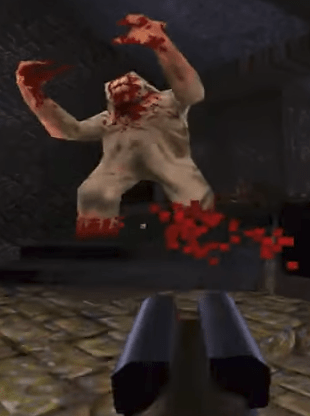
When I restart Quake with a massive clip on my shoulder, I realise it is a thing of beauty. After all those minimal pixels, the similar environments, Quake is incredible, nothing short of genius at work. You can’t exist in this world and go back to Doom and think it’s better. But then, after a few hours play … I was right the first time. Quake is so polished, so perfect, so boring. You never feel like you won a level, that you pulled off a fast-one, a lucky streak, dragged a bloodied Doomguy to the exit hoping the next level has health at the start.

There’s four different worlds to fight through, but that’s not as refreshing as it might seem. It creates a disconnect – Doom had no real plot but you descended deeper into hell as you went, whereas four different worlds feels like starting over and over, relearning the world. It’s four mini-games not one epic gun-fest. The creatures move in realistic ways, the weapons are more varied and the world is full of stuff but you’re never really there. Quake feels at arms-length; Doom reached through the monitor and grabbed you by the scruff.

A key element to Doom was that feeling you were outnumbered, that you weren’t going to survive this; Quake may not have been able to replicate that original experience but it could easily have bettered the against-the-odds, breathless victory you got after beating a Cyberdemon. Quake is Blink-182 to Doom’s The Pistols; I don’t see how it’s considered one of the most influential games of all time. The Quake engine yes, but not the experience. Yet again I find new appreciation for what Doom did.

Quake didn’t kill Doom, it killed the single player. Quake’s multiplayer was an undeniable quantum leap – towards Single Player missions being little more than a five-hour tutorial for the online experience. There’s nothing wrong with Multiplayer – clearly that’s what id thought, given Quake III was MP only and it was done right in Quake – but Single Player was compromised. This is where the rot set in.
Meanwhile, genres other than FPS were stepping up their games. The Elder Scrolls proved they weren’t just a dungeon crawler with Daggerfall while Tomb Raider kicked off in October of ’96. If Doom was the King then the Queen was Lara Croft, easily the most iconic image of 90s gaming – but it didn’t change things in the way it should; we didn’t see a sudden shift to female leads, women treated any more equally or non-sexually in games. For all of Tomb Raider’s advancements it was Lara’s pixelated adolescent dream-figure that everyone remembered. 1996 also saw the beginning of the Resident Evil series and some company called Valve. It was a hell of a digital year, and what was FPS up to? Chasing a pig called Bessie. What, you too nervous about Y2K to build games?
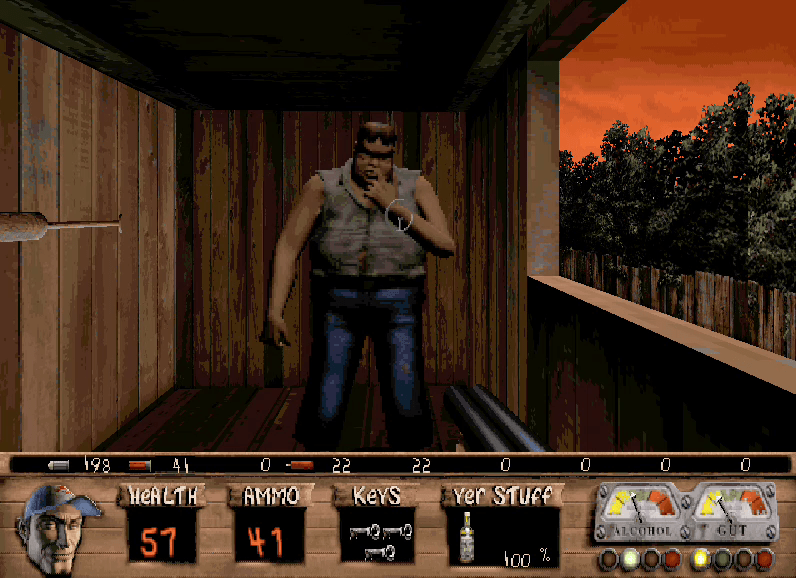
I remember mucking about in Redneck Rampage (April 1997) and not really getting it; two brothers looking for their pig, stolen by aliens who have cloned their neighbours? Now I’m rescuing a pig? How far are those Doom Clones going to push their luck? Back then I found it too silly, sacked it off as undermining a genre that was just starting to get interesting. But after the deathly dullness of Quake, when I load up RR and hear a ‘yeehaw’ I think ‘Let’s do this’.

The opening level, where you cross a road while avoiding a car zipping around running over chickens, gives you an idea of what you’re up against and while I watch the car I get shotgunned by a Bubba in overalls screeching something in Redneck. I start again, trying to work out where the Redneck came from, and get run over. Man, being a redneck is hard.

Soon though, I get my eye in – which isn’t easy as RR is set at night and the blocky graphics of Build are grating after Quake’s smoothness, but there’s something to RR I hadn’t previously got wind of (not the fart-o-meter) – actual fun; we had Duke’s bluster, but otherwise FPS is a very serious affair; what we needed was pure nutso insanity and that’s what RR is; out of nowhere I discover a game I didn’t expect – a really good one. What in tarnation? I’m yeehawing like a good ol’boy.

There’s loads going on, to look at, to press and break, and instead of regular level layout we’re stumbling through farms, shacks, grain stores and trailers – it isn’t nonlinear but there’s a nice open world feel to it, something Duke also touched on and a further step from Doom’s corridors – later levels start to feel familiar once you’re in the towns but it maintains a quirky feel; a little unhinged level-design is refreshing and the enemies – classic rednecks alongside the aliens, including a dominatrix are great fun. Take heed RotT, this is how you do daft.
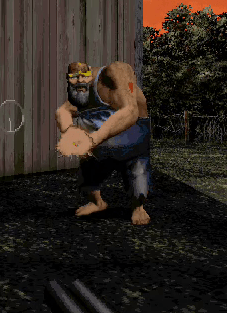
There’s the in-jokes too, and not all are aimed at the redneck caricature; while we’re somewhere between Deliverance and The Beverley Hillbillies, there’s a poster for a Troma movie, references to the artists on the soundtrack and typical alien tropes like crop circles and cows being mutilated – and tons of deep-south wisecracking from the heroes and the rednecks you gun down. The weapons are typical but there’s some homemade, jury-rigged backwoods style changes to the usual line-up, while a new trick is the burp and fart meters. Not exactly classy but they’re a fun way to add a penalty to using health powerups – drinking gets you drunk and impossible to control, eating makes you fart, giving you away. Redneck is really starting to stand out as something else; you can call it a hillbilly Duke but I’m having fun ya varmint – but not too much; it’s a subtly strong game, a lot more unforgiving than earlier FPS. Its psychobilly soundtrack (‘You Can’t Kill Me’ by Mojo Nixon is a standout as is Beat Farmers’ ‘Gettin’ Drunk’, proper psychobilly stuff not yer Cotton’Eye Joe, although now I have that stuck in my head) adds a new level too – instead of Doom’s dirge you merrily sing-along, to the point you don’t end a level ‘till the song’s finished. And you end levels by finding your dozy bro and clobbering him with a crowbar … it’s great to have a hero who instead of being heroic, complains ‘Ma head hurts, ma feet stank and I don’t love Jesus’.
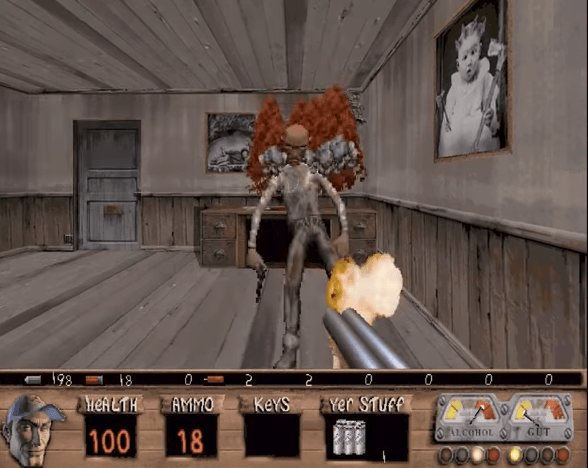
You get the sense developers Xatrix had fun and it’s infectious – Saints Row and Borderlands owe RR a nod; it paved the way for the ridiculous to slip into shooters. It had sequels but RR was perhaps too silly to be remembered; I was equally guilty of dismissing it, but I missed out; open a can of whoopass and get ready to don’t love Jesus. It’s a great Doom-era shooter. Just remember those rednecks pack a punch; it’s not all banjo playing.

Redneck Rampage reminded me of another thing missing from modern games – extras. Games used to include entire Windows themes, screensavers, audio clips, pictures, all sorts. You just don’t get that kind of thing anymore, but I still have the ‘Cuss pack’ from RR; and now I have “I’m on you like flies on shee-it” as my ringtone.

Now, who want-a som Wang?
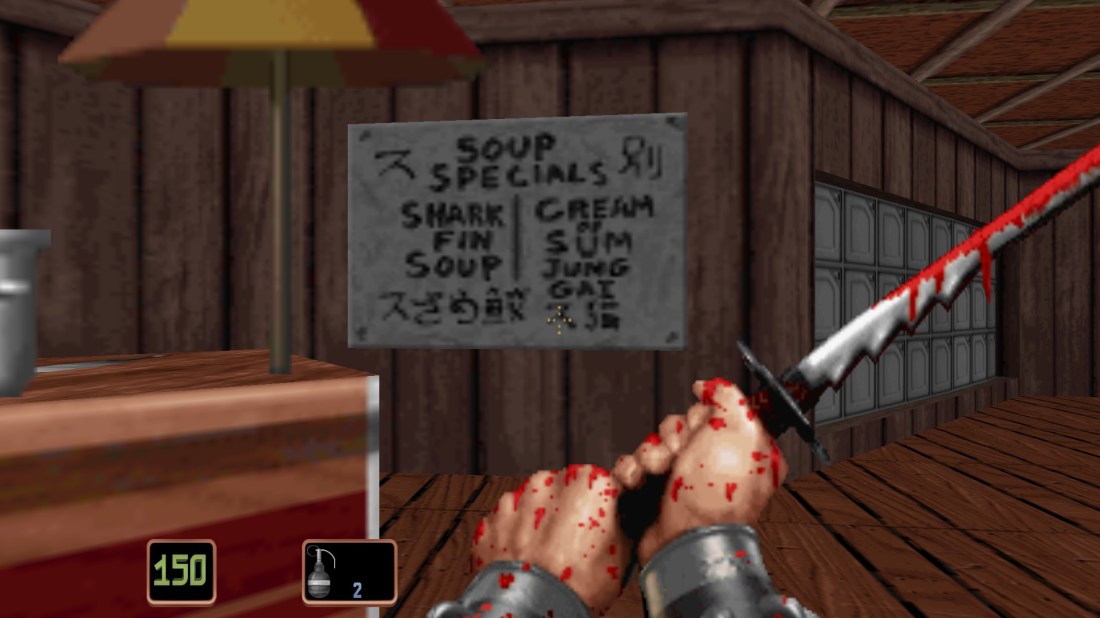
I recall Lo-Wang and Duke as buddies, equal in their abilities, including getting girls to show them their boobies. I’ve been looking forward to Shadow Warrior (May 1997) as I think I preferred Lo-Wang to Duke; he was a bit more mischievous, less Jock more Mock. SW was a straight-faced comedy, like a game based on some 1980s Ninja flick from Cannon Films. An Asian character – the kind created by a bunch of people who are not Asian – Lo-Wang revels in the innuendo of his name and doesn’t take anything seriously. Even when his old boss, Zilla, sends hordes of underworld forces to stop him, LW still treats it all like shit and giggles.
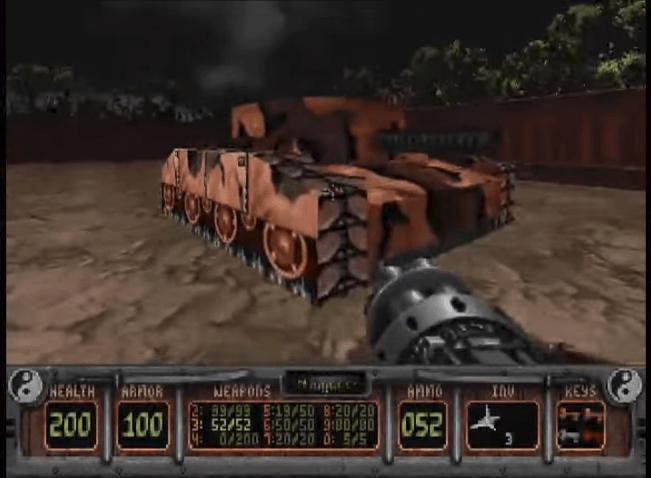
Much like Duke, Lo-Wang inhabits a world that’s fast leaving Doomguy’s behind – Build’s interactivity is at the fore in SW; LW can find repair kits to chug around in tanks, forklifts and boats, there’s puzzles and secrets that require some figuring out and he can muck about with little RC cars – we’re in the world more than ever before. It’s interesting that Quake far exceeds Build in terms of capability and environment, but SW just feels alive, immersive. The art design, which is Japanese influenced is detailed and like DN3D there’s loads going on. But Shadow Warrior starts to wear thin and one of the most important parts, one I previously loved, is to blame – Lo-Wang. Once he gets tiring, the game does. When he’s not making groan-worthy jokes about his name/manhood, he’s commenting on everything – ‘ohhh sticky bomb likes you’, ‘You are tiny grasshopper’, ‘You move like-a pregnant yak’ – he just goes on and on; an Eraser-inspired railgun is ruined by LW saying ‘you got Erased’ Every. Single. Time. And when he’s not commentating, he’s making Bruce Lee noises or giggling to himself. Super-health comes in the form of Chinese fortune cookies, which are puns like ‘man who farts in church sits in his own pew’. Okay I sniggered too and after nothing but ‘Ger, gah, uuugh’ sounds from my heroes, I should be happy to have a Chatty-Cathy for company but Lo-Wang is sidekick elevated to annoying hero.
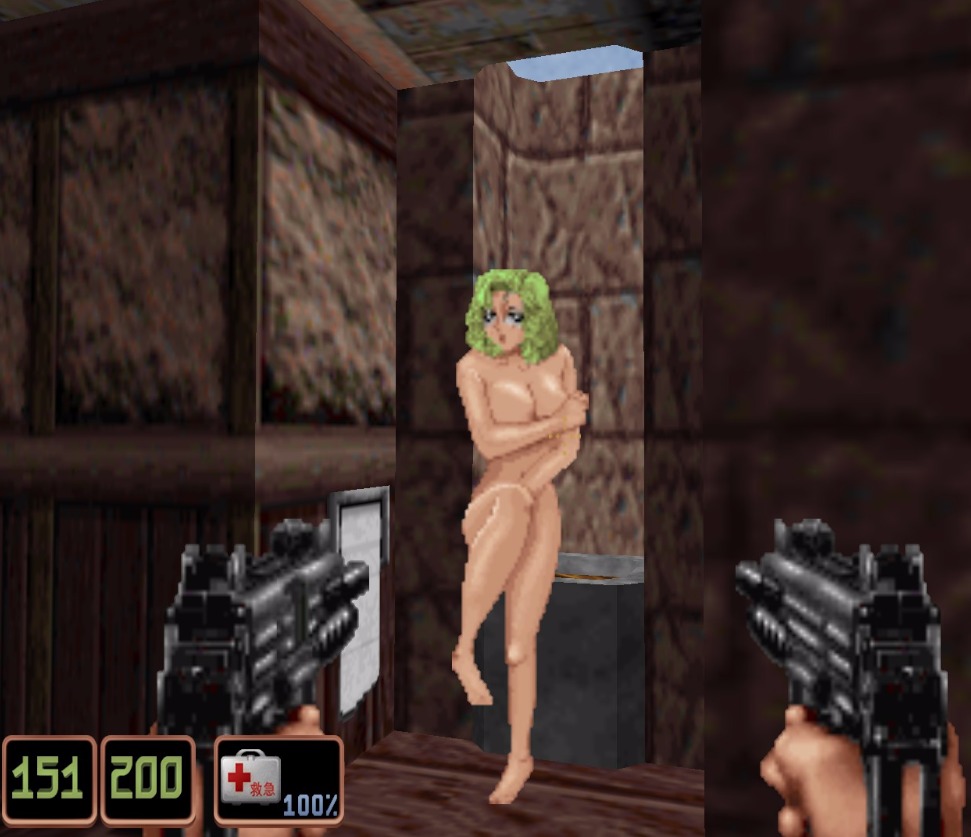
Shadow Warrior is a case of diminishing returns – this is from 3DR again and like Duke, level design isn’t their forte. There’s a lot in it but it doesn’t go anywhere; it’s too reliant on the novelties but whereas Duke saved DN3D, once Lo-Wang grates some misgivings start to creep in. 3DR just cloned Duke thinking that would be enough, amping up his juvenile antics but Lo-Wang perpetuates the Asian stereotype with his ‘Engrish’ accent, Fu-Manchu moustache and kung-fu bants, and his Duke-lite persona falls into misogyny; Lo-Wang just accosts random girls – ‘Lo Wang drop soap,’ he says to a girl he corners in a shower, ‘you bend over and get it’ or telling a girl mechanic ‘chicky, you tighten my nuts’ – Plus, the girls all seem to love his attention, including one he interrupts on the toilet. In one secret area he comes across Sailor Moon on a bed – and asks ‘peaches’ if she’d consider Mooning him. Dick. Duke had an old spice swagger that justified his ladykiller ways and, politically correct or not, he paid strippers for a flash in a strip club; he didn’t sleaze.

I haven’t been this disappointed since my Tamagotchi died. I’m saddened Lo-Wang turned out to be Lo-rent, but it really is the weakest of the ‘Big Four’ Build games; and it’s 3DR’s fault again. They should have just licensed the Build engine and left the design to those who knew what they were doing. It bleeds the Build engine dry, making SW the most interactive, touchy-feely (Sailor’s Moon aside) game so far. But the only one really enjoying himself is Lo-Wang.
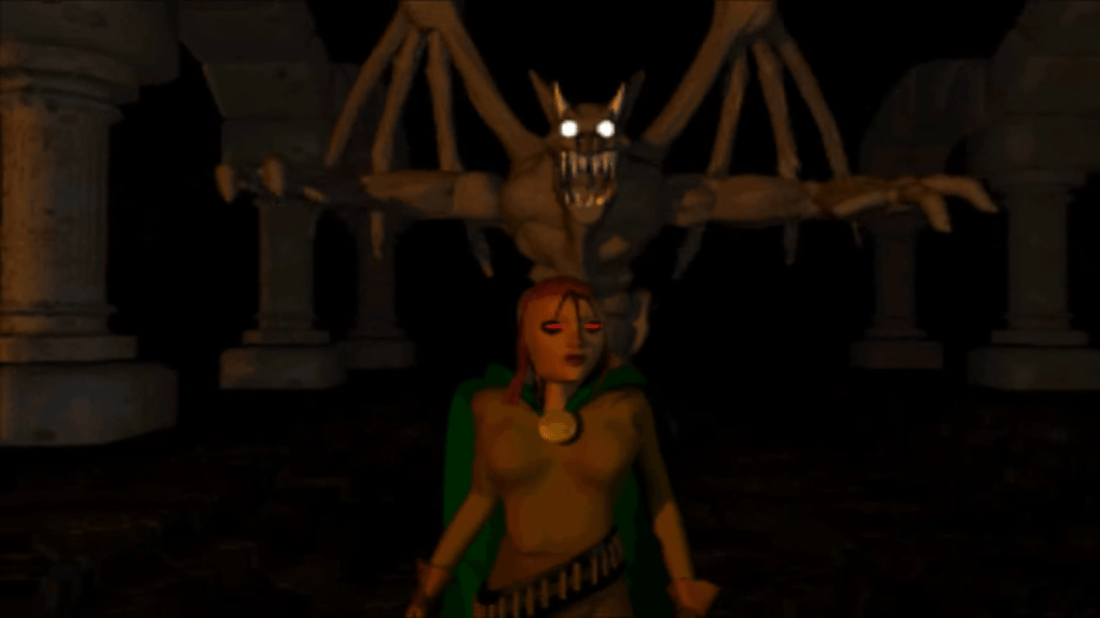
Stand back ladies and gents, we’re about to play the game that, if asked, I would have accused of killing Doom. Blood (May 1997) was the last notable game on the Build engine. Because nothing could top it, obviously. Blood’s Caleb was the Snake Plisskin of the gaming world; pissed-off, dangerous and with a singular purpose. He was awesome – the bleaker, darker anti-hero of the era who sounded a bit unhinged, muttering Evil Dead references and singing Frank Sinatra as he killed indiscriminately. I’ve been looking forward to this. Don’t let me down Caleb.
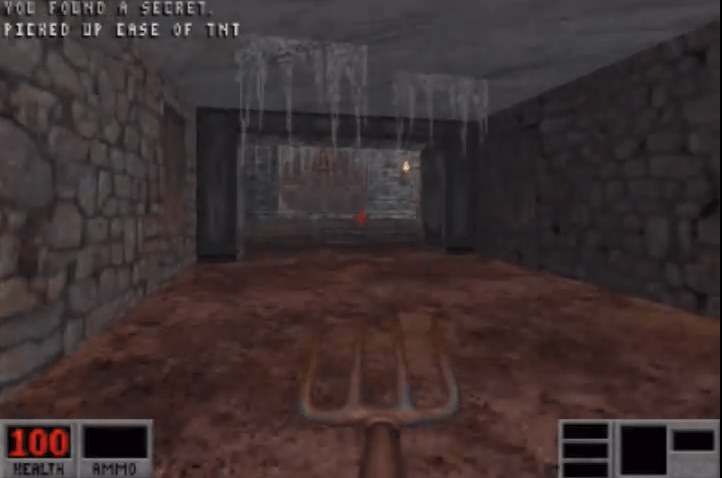
Blood has something all the others didn’t – a reason. This is where FPS actually got a story, a motive to maim your way to the end; The CGI opening sets the scene in a horribly morbid and cool way; Caleb, a brutal wild-west killer-for-hire was initiated into a dark cabal by his wife. Inexplicably, their dark god punishes them for some slight, and Caleb is buried alive after witnessing his beloved maimed by a demon. Escaping, Caleb goes on a rampage in the most imaginative levels we’ve blasted through so far.
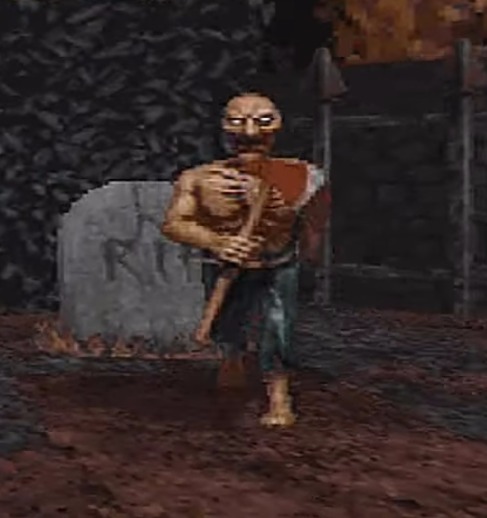
One minute you’re in Camp Crystal Lake, the next fighting through a moving train, the mazes of the overlooked hotel, a fairground-circus, a remake of Dawn of the Dead; each level is a world we recognise from our VHS collection not Doom – Every other FPS you’d struggle to recognise one level from another if they were in a line-up; But Blood’s levels are all unique and fantastic to maim through. You never get bored in Blood – the story, level design, references, there’s so much going on yet it isn’t a distraction from some killer action; Blood is relentless, and the boss-fights for the first time are not OTT arena fights – they take some strategic foot-work and weapon-picking. The weapons too are nicely macabre – voodoo dolls, tommy-guns, his melee weapon is a pitchfork. When he lobbed dynamite with bloody results, Caleb cackles maniacally. Now that’s a hero sound, not Lo-Wang’s ehehehehe kid-being-tickled gurgle. Elsewhere Caleb’s rasping voice quotes everything from The Crow to a Harrison Ford The Fugitive/Air Force One mash-up … and he’s got sarcastic putdowns; upon finding a dead Duke Nukem, he double zings with ‘looks like I got time to play with you’ followed by ‘shake it baby’. If Shadow Warrior was an ill-conceived nod to Big Trouble in Little China, then this is John Carpenter’s The Thing with a nice sideline in They Live.

What is interesting though, is Blood’s story; something we’d not needed or wanted before. But Caleb had his reasons, and each episode ended with his avenging his wife and friends, headed towards a finale -with a god no less- only to leave empty-but-bloody-handed.

Of all the Build developers, Monolith is the one to really make the engine sing; sitting perfectly between SW’s novelty distractions and Duke’s outrageous set-pieces, Blood is brilliant and should be played just see how a shooter should work. Mindless killing and a mindful plot, it’s a perfectly balanced FPS and one of the best shooters of all time.
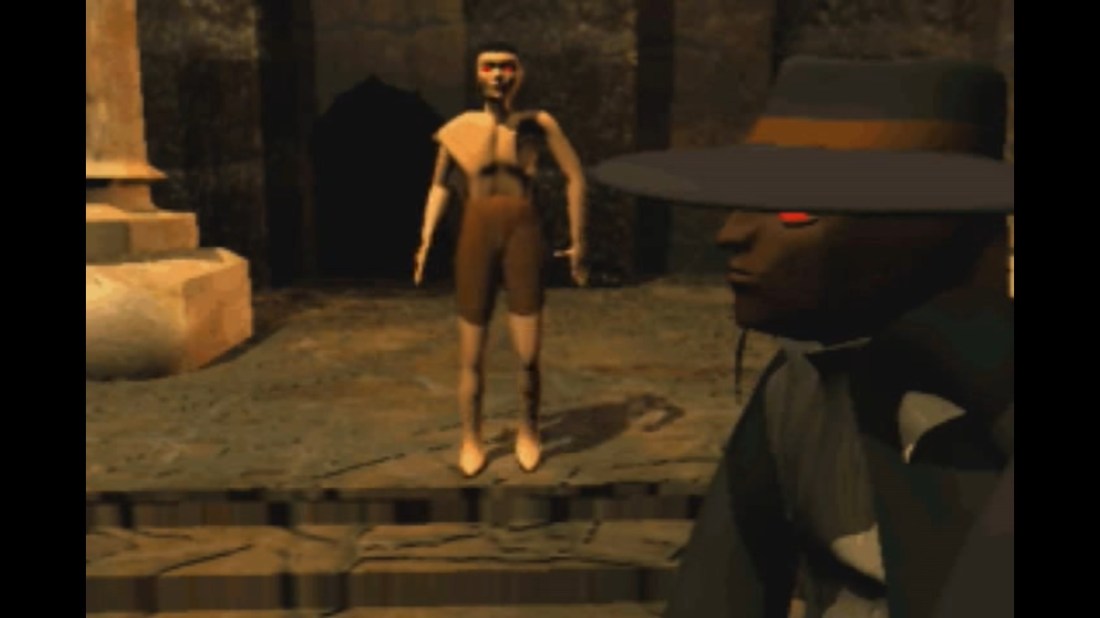
Blood didn’t kill Doom, the story-driver concept only really exists in the cutscenes and it still owes a debt to Doom but it provided that little edge as the endless blasting of FPS starts to get a little tiring. Blood is the first to seriously wound Doom.
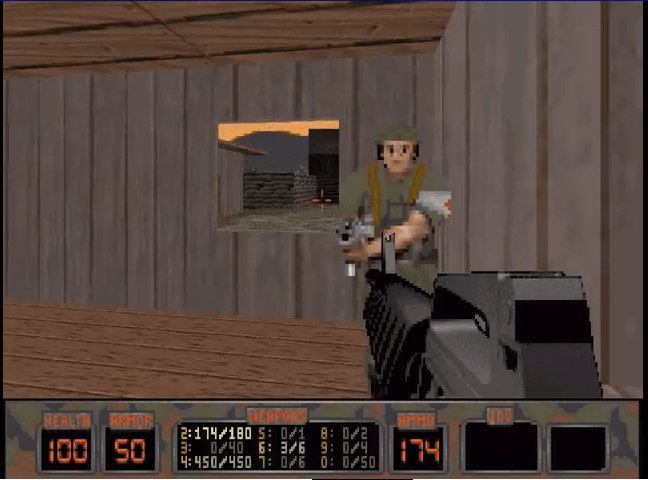
There were Build games after Blood; TNT Team released Nam in July 1998, a reskin/mod of Duke with RotT-style scanned photos and flat environments. It did have some nice touches, like picking up orders from NCPs and having followers. Oddly, I didn’t see a heads-up display. But it had a semi-sequel in ’99, WWII GI. There was also Extreme Paintbrawl in 1998; let’s not talk about that. One thing to talk about though, is the argument that Build weakened the sincerity of FPS; that as soon as we were able to ask strippers to shake it baby, it became a battle of novelties and distractions; the visceral experience got watered down. I don’t think Build is to blame for that, indeed Blood’s bare-bones plotting makes it the best of the bunch – but 3DR were to blame; they just weren’t natural level designers like Romero – instead of using Build to enrich the Doom experience, they made theme parks; Romero raised level design to an art form, able to imagine not just the world, but you in it and then make it exciting to fight your way out. 3DR settled for boobs.
And that was it for Build, which really disappoints me; besides the technical marvels, Build games made you feel like anyone Kurt Russell played in the 80s; they were filled with refs to Evil Dead, John Carpenter, Sly & Arnie’s best 80s characters, even Elvira; so much was threaded through Build’s games that you felt as if the developers were mates; they were into what we were into – this was back when being a gamer was looked down on by Jocks and their new extreme sports like surfing on snow – Build let us know we weren’t alone. Build let us be heroes.

It’s a shame 3DR decided to spend all of their cash and good-will on the twelve-year development of Duke Nukem Forever; to piss away Duke Nukem was one (upsetting) thing, but to ignore what they’d achieved with Ken Silverman was unforgivable; just imagine what could have come next. Instead, Silverman stepped away from the gaming industry and became “CTO of Ardfry Imaging, responsible for the PNG Compression tool PNGOUT” which doesn’t sound like something Duke or Caleb would say. But I’m sure it’s had an effect on my digital life. He only made one engine, yet Silverman’s contribution was massive and it entertained and impacted beyond the games it powered; All hail the real king, baby.

So, Build was a shot across the bow, but no Doom-killing cigar. Onward. Maybe Elexis Sinclair has something to do with it. I’d better frisk her.

In Part Four of this increasingly indulgent look at the classic FPS era, FBT trades in his Portable CD player for a MP3, invents conspiracy theories to explain Doom’s death and spends most if the review trying to get in an Anna Nicole Smith reference.

Doom's Clones & Killers Pt2

In the second part of Previous Weapon’s FPS retrospective, FBT makes like David Suchet and questions the clones about the identity of the Doom Killer.

Part Two: All hail the King, baby

Doom was out, and everything had changed. Even over at Apple. Bungie’s Marathon kept them going instead of Doom. It was a shooter with a storyline – a what? We don’t have time for that, Netscape Navigator was out and that meant 0.5% of us had access to the WWW – when we weren’t watching a Ford Bronco drive down the freeway that is. But the biggest news of ‘94 was still 93’s Doom. No one had touched it; well, there had been some inappropriate touching – a Doom Community sprung up thanks to the web, trading their own levels and mods; id’s decision to let gamers mess with Doom’s level design was another innovation and it turned kids into level designers and FPS into a multi-faceted hobby; playing, building and deathmatching. Doom also popularised web-chat, file-sharing and encouraged the uptake of the net; the world was changing, for us anyway. While our parents watched Blind Date and Beadle’s About, we had Terry Christian egging someone on to eat a sandwich of toenail clippings, were frothing to go on Nemesis at Alton Towers, whispered “UVAVU” while watching Geri and Kylie snog and the 11.30 Diet Coke break advert. The nineties were in full swing.

Released in December 1994, Heretic was the first Doom Clone but it wasn’t a cash-in; created by Raven, built on the Doom engine and exec-produced by Romero, it was less a clone and more a companion. You charged around locations taken over by a Saruman type, using magical weapons (a bow standing in for the shotgun, a claw that fired spells is your chaingun) while taking out Fantasy versions of Doom’s hell creatures. Okay, Heretic must have seemed a bit twee back then, a bit D&D; who wants to be in Dad’s Lord of the Rings when we had our Doom?

While Heretic is Doom reskinned, the art design is great and it’s learnt a lot about pacing and level design – It doesn’t have Doom’s aggression, you’re an elf waving a magical staff around medieval villages so not as cool as being a squad member from the Sulaco like Doomguy, but it’s good to have an alternative to Doom’s military setting which was replicated by most of the other clones.

Once I’ve got my eye past the minimal pixels and basic movement, I realise Heretic is really good; it has a great ambient feel – we hear groans and grumbles, chains rattling and whispers, the art design is really nice and it’s not stuffed with creatures; there’s areas and secrets to explore rather than just blast through, and it features an inventory (including a spell that turns creatures into chickens) – it gives Heretic an adventurer feel as we stalk through cathedrals and Mordor-like locations. When we do meet the bad guys though, they’re top notch; glamorous, chanting Wizards, giant skulls and the screeching little imps. It’s a lot further from Doom than I remembered, and while it’s possible they just got to work before Doom clone fever really gripped, maybe Raven are really good devs – they did go onto Star Trek Elite Force and Jedi Knight Outcast. Heretic doesn’t immediately call Doom to memory surprisingly enough, it stands up well despite its age and it’s got its own personality; I’m enjoying it for what it is rather than running on memories; it’s a great shooter and worth a replay. Heretic is memorable for another reason – It’s retail disk included DWANGO, the first programme to let you dial-up n’ deathmatch with folks further away than an LAN cable could reach. Online gaming was here.

I really liked Heretic. It’s one from this era that didn’t get a remaster and that’s a massive shame. Reboots you can keep but a refined Heretic would be awesome. One from this era that did get a reboot was Rise of the Triad (Feb 1995) and I have no idea why.

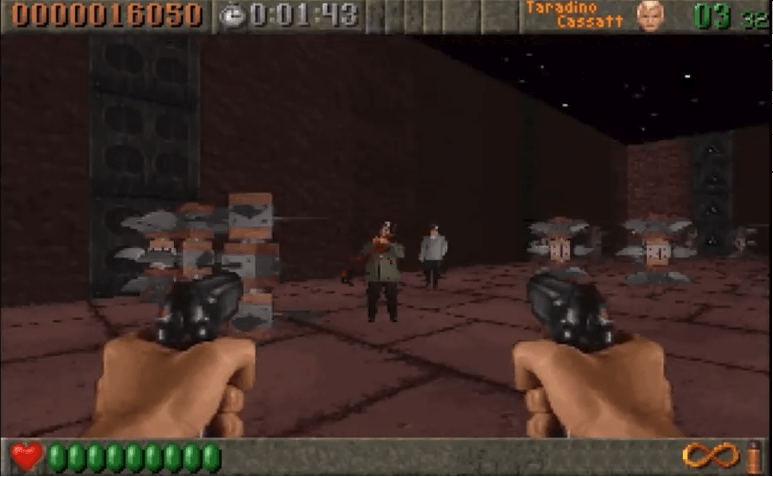
It starts off well enough; we’re the HUNT team on the, erm, hunt for bad guys who are on an island. Let’s go get those bad gu – wait, why are there trampolines in their secret lair? And why is everywhere filled with spinning coins like a Mario game, and platforms to reach them dotted around the castle? My god, RotT is awful. I thought we’d left this arcade kiddie nonsense behind. RotT came from 3DRealms and id co-founder Tom Hall; they knew intimately what Doom was and this isn’t it. Maybe that’s the point, but there’s different and then there’s daft.

I might have liked it at the time, back then you’d take anything you could get once you’d rinsed Doom but jeez this is annoying. There’s some progress here, you could dual -wield pistols and machine guns and had an assortment of explosive weapons rather than tons of oddities, there’s auto-aim too but it’s all buried under the silliness and digitised elements that don’t work; we’re being attacked by cardboard cut-outs – the sprites of Doom were 2D but they animated and moved in semi-convincing ways while those screengrabs look like a stiff breeze would blow them over. The weapons too look like photos which seem less believable. And there’s crushers, revolving walls, traps and spikes everywhere for no reason; one thing about Doom, it played by its rules – an invading force that you were repelling, but this gang’s gaff is a gauntlet the bad guys run as well. Half the time the traps kill the bad-guys for me. RotT is part Looney Tunes, Wolf-clone, arcade, platformer and forgets the FPS part. It’s so cheap looking you’d think it’s a quickie knock-off called Doomed. It’s not a Doom clone, it’s a first person Manic Miner. An Uwe Bol adaption of Doom.

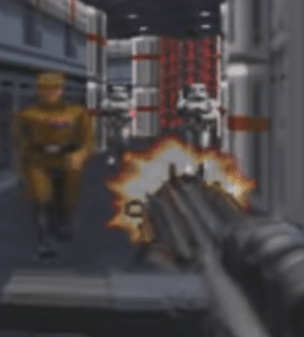
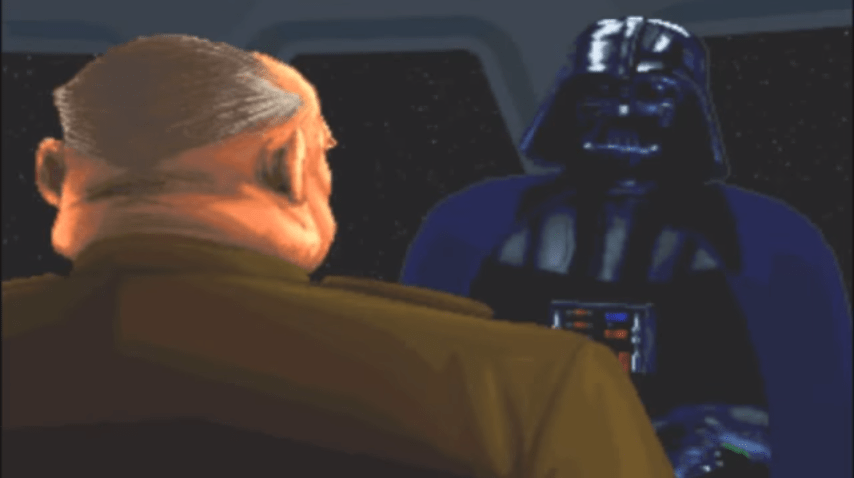
Happy New Year, 1995. The year we all got to enjoy Toy Story, and Tommy Lee and Pammy’s honeymoon. The biggest clone of 1995 was a game we’d already played – not just in Doom mods but with our own toys; Star Wars Dark Forces (Feb 1995). Released by Lucasarts, a company that could punt out instant classics like Last Crusade and Monkey Island for breakfast, for them bettering Doom must be as easy as pulling an X-Wing out of a swamp. But always with Doom it cannot be done; while SWDF provided major advancements within the world and game play, this is just Doom with a John Williams score. There’s text explaining non-cannon events to tie it in but SWDF is the best example of a Doom clone yet. It’s not a bad game and playing Star Wars is always going to carry you some of the way, but it’s lacking Doom’s dangerous quality and fatally, keeps reminding you of it. It’s just a reproduction, not an innovation. Plus, the Stormtroopers can actually hit you, how unrealistic is that? It’s Doom on the Death Star and that’s not as cool to play as it sounds – Doom is still one in a million, kid. Sad to say but the Star Doom mods were better. Leave it back in a more civilized age, when Han shot first.

Dark Forces’ biggest contribution to the gaming world was its sequels – Freed of the beat Doom mentality, the first sequel Jedi Knight was a rocking Star Wars shooter with an add-on (remember those) called Mysteries of the Sith. The second sequel, Jedi Outcast got it right; it’s a fantastic SW game and FPS in its own right, and the final sequel, Jedi Academy is a solid game that got lightsabers so spot on they turned into John Woo-level ballet. Dark Forces started as a Clone but it forged its own path to become a classic series with a better legacy than Doom.

Build, the engine that would go onto power Duke Nukem launched its first game in 1995, Witchaven, a Heretic-style goth shooter. It didn’t have much in the way of smart-arse heroes or the level of interaction that later Build Engine games did, but it had a charm to it. Like Wolf, it was a warm up for what Build could do – and what it did next was present someone so legendary, so grand and awesome it’s tough to believe a simple game could contain such an iconic hero – William Shatner. Who were you thinking of? 1995’s Tekwar brought his sci-fi novels to shooter-life and included a digitised Shat; that gives you some idea of how powerful Build was.

In September 1995, the gaming world was shaken again. Not by a game, but by a new way to play, station. Sony’s “Live in your world. Play in ours” campaign was aimed squarely at the Doom generation; aka the MTV Generation (PlayStation sponsored the 1995 MTV Music Awards to prove exactly who PS was aimed at – gaming is not for the kiddiewinks anymore) and the PS made gaming as cool as the Music and Movies of the era. We had our console, our games, we were Sorted for E’s n Wizz and wondering who is Keyser Söze? Perfect.

Meanwhile, briefly distracting us from Xena Warrior Princess was Hexen: Beyond Heretic (October) and this time we weren’t a silent hero. We were three of them. A Fighter who is melee mostly, a Mage who uses long-range magic and a Cleric who uses lower-powered versions of both. Hexen is pretty much Heretic, although not a re-heat; aside from character classes, you also transport back and forth between areas to progress (why I’m not sure, I don’t have the manual) and while the sounds and certain art is the same there’s additions like breakables, leaves falling off trees and more detailed levels. Hexen is fun to play; while it feels Doom-like, unlike Heretic, the character class is a refreshing change; RotT had characters but they made no real change to the experience, whereas in Hexen each character provides a different experience; first time FPS had replay value. I chose the fighter class and melee’ing about is a welcome change from guns again. If Heretic was Legolas prancing about then Hexen lets us play as John Rhys-Davis, and what’s wrong with that? The magnificent wizards are back too, although according to a Heretic Wiki they were ‘Disciples’. Whatever they were, they rule. But they’re not the king, baby.

Doom was loud. Apart from the gunfire and exploding barrels there was screaming, shouting, growling, howling, all underpinned by the constant industrial score yet one thing was largely quiet – Doomguy. 3DReams, already a part of the id family as their shareware distributors, called in Ken Silverman to step things up after Doom. He gave them the Build Engine and that gave us giggles alongside the guts, rock-stars instead of serious and silent. While Carmack would disagree, Build was a huge improvement on the Doom engine; for gamers anyway – it let us misbehave; if Doom was the Father of FPS then Build was the uncle who gave you sweets and let you stay up late, and in January 1996, Duke Nukem 3D gave shooters a voice – Duke was the spokesperson for FPS, it’s ambassador, the entire experience distilled into one badass with a big mouth and bigger guns. Duke was mightily pleased with himself, had every girl at his feet and paused for one-liners before doing battle. Everyone remembers when Duke told a mini-boss he was going to rip off his head and shit down his neck, and when the battle was won, promptly pulled down his trousers, took out the paper and sat on the corpse, whistling. I remember Duke more than DN3D, so to attend a reunion now is a worry; if I find out the school hero who dated the cheerleaders is now a regional manager for an insurance company and bald instead of bold I’m gonna be crushed.

I start playing and he’s really not that bad. Phew. Sure, tipping strippers for a peek is juvenile and the pigs dressed as cops isn’t subtle, but DN3D is nowhere near as insulting as I expected it to be. Just shows how horrific Duke Nukem Forever was that it’s tainted Duke Nukem 3D as well. The earthbound locations he shoots through like Porn Theatres and strip-clubs are what they are and while girls in underwear dancing, the strippers, the women used as incubators and Duke being rewarded for his hard work with a three-way during the end credits are all tough to defend, Duke is a parody of those Bond-like heroes who seduced women through sheer masculinity. It is sexist but crucially it’s not misogynistic or mean-spirited like DNF – there’s no Boob-growths in the walls to slap, glory holes to stick little Duke through or incestuous twins dressed as schoolgirls who share Duke and joke about rape and abortions before dying as Duke comforts them with ‘looks like … you’re fucked’ – I’m not saying DN3D is acceptable because it’s not as appalling as DNF, but DN3D treaded that celebration vs parody line perfectly. Duke is still the voice of a genre and generation; Silent Heroes always felt a bit awkward, especially when they’re in cut-scenes. I wouldn’t want the quiet one saving the world, I want someone who’s going to be all out of gum. I feel like a Hollywood hero, shrugging off bullets and being the only guy for the job. Duke’s gabbing does dilute some of the tension and it’s hard to take it seriously, but it’s not supposed to be taken seriously; everything up to now has been bleak, against-the-odds stuff, but this is Cobra or Commando time. Duke enjoys the challenge. And so do I.

DN3D has some good opponents to battle against and Build gives them a fighting chance rather than id’s walk-this-way AI; in Doomworld monsters walked or floated toward you but Duke’s adversaries do both; they fly, leap, hover and hide, and they react to your attacks – we have to be a little more tactical but thankfully, Build has us covered – the pipe-bomb and mines lets us get sneaky. While Heretic had timed mines you dropped as you were chased by one of the splendid wizards and hoped it went off under his cloak, in DN3D we can set traps and lob controlled pipe-bombs; and Duke would reward your game-play with a one-liner worthy of Arnie. As is standard, DN3D has episode-ending mini-bosses but this being Duke’s world, mini means massive and besting them gets you a cutscene showing just how cool and heroic Duke is, as if there was any doubt. In order to combat such extreme monsters, Duke has the kind of arsenal only a super-hero could wield; aside from the standard there’s various explosive weapons and the freeze gun which lets you shatter opponents, and the shrinker – stomping on a now-tiny bad guy is a new one.

It’s not all Mr Bombastic though – it can be a slog to get through an episode and the first, set in downtown LA is largely the same design rejigged. The Lunar levels get dull very quickly and the third mission is a disappointing return to earth and the same look again; it gets very samey once you’re over the distractions. One reason I struggled to recall the gameplay of DN3D is how much it relies on the boss; this is Duke’s show. You can imagine Duke’s Superior yelling he’s caused more destruction than the bad guys, only to have Duke wink and walk off, taking the boss’s wife with him. There’s great fights, creatures and interactions but without the big man, DN3D would be a dull game – although Duke did get some cracking add-ons; Life’s A Beach had Duke holidaying with squirt guns and it’s worth a play just for the Pig Cops in Hawaiian shirts and the Octo-thingies in raybans.

There was another Build game in 1996, PowerSlave. Originally intended as a showcase for Build before Duke started to shape up, it was largely over-shadowed by its big brother, but remained popular enough for an unofficial remake.

DN3D is a huge improvement on what we’ve played so far, but the real show-stopper, the only thing to upstage Duke is the Build engine. Build provided a world to interact with, something we’d not had before. Doom was one thing only – serious about shooting. Besides the strippers, Duke could get distracted playing pool, staring at himself in mirrors, pinball games with him on the artwork (‘I haven’t got time to play with myself’), posters to look at, buttons to press, CCTV screens; we’re crawling through vents, sewers and diving under water, using powerups like holograms and the jetpack; I suspected DN3D would be where we leave Doom behind but while it’s the stuff that would make Don Simpson call Heidi Fleiss and celebrate, what DN3D did was diverge the FPS genre; from here the seeds of the more outlandish FPS game were sown. Down the pub, Doomguy is just Duke’s wingman but on the battlefield Doom still reigns. Case closed; Duke is innocent of killing Doom. Where is it? Man, finding Doom’s killer is hard. If she hadn’t been cancelled in 1996, I’d call Jessica Fletcher in on this. Maybe my Encarta CD has the answer.

In Part Three, FBT takes on the game convicted of killing Doom. But is Quake guilty as charged? And is all this just an excuse for FBT to play Blood again and google Dani Behr?

Doom's Clones & Killers – Pt1

In this, the first of a four-part retrospective, FBT goes back to the best era in gaming (so he says) – The 1990s explosion and implosion of First Person Shooters

Part One: Gott im Himmel

They say in the Sixties everyone remembered where they were when JFK was shot. In the Eighties, everyone remembered where they were when John Lennon was shot. But in the Nineties, we remember doing the shooting – on December 10th, 1993, id unleashed Doom.

Built by gamers for gamers, Doom may have been underground but like an earthquake its impact was seismic, sending shockwaves through the gaming world and eventually reaching the real world; referenced in The Simpsons, Friends and ER, Doom was part of the nineties zeitgeist, gaming’s Nevermind or Pulp Fiction and in modern terms, it was bigger than Facebook, affecting workplace productivity and causing issues on company networks.

Doom even slowed Microsoft’s world domination; When their ads for Windows 95 asked ‘where do you want to go today?’ Gamers replied ‘DOS’ – the platform W95 was replacing and the only sure-fire way to game on PC. Gamers weren’t going to risk losing Doom (it was rumoured Doom was installed on more PCs than W95) and Microsoft, realising Doom’s dedicated fanbase was the future, developed Direct-X which allowed games to play ‘as’ a Window. It was a watershed moment; Doom was ported to Windows (by some bloke called Gabe Newell), and Bill Gates appeared ‘in’ Doom during a W95 Expo to prove Windows was the future – a video game created by a bunch of lads made Bill Gates, at the height of his power, say ‘if you can’t beat’em…’ It gave Gabe Newell some ideas too.

And Doom pissed off parents, like every good trend should. Doom wasn’t the first game to show death but this time you really were in there, up close – with a chainsaw. Stories of players passing out, getting motion sickness and post-traumatic stress triggered Parent Groups who classified Doom as top-tier evil alongside Ren & Stimpy. ‘Killology researcher’ David Grossman coined the phrase ‘murder simulator’ and it was said this new era of games could turn kids into killers; Doom was held accountable for the Columbine Massacre.

But none of that mattered to the gamers who discovered Doom that day; we had no idea we were loading up the You’re Gonna Need A Bigger Boat moment of gaming; we were in the Aliens Hive scene screaming ‘its game over man, game over!’ – And for any other game, it was. Doom was the new standard, and it launched a whole new race to be the biggest, baddest First Person Shooter – gamers couldn’t be happier. Parents, less so.

Games back then, loaded up through that DOS prompt and the shareware warning were way more exciting that anything around now. You really had no idea what you were getting into, even with a Doom Clone. It took commitment to finish a game in the nineties; we didn’t have any of your fancy auto-saves or mission skips, no walkthroughs; you had to really love a game to finish it and that stays with you. We sweated for the exit, got your head down and tapped spacebar until something opened. And the joy of finding the secret that had an exit! That meant secret level, that meant bragging rights, that meant pranks on friends. It was a great time. So, what happened? The FPS genre is awful now. Generic reheats, remakes, reboots; story-led, watered-down, XP-driven, gimmick-ridden bastard-childs of RPG. Thinking back to Doom, when is something gonna come out of nowhere and make us think ‘the fuck just happened?’ I’m going to replay FPS from Wolfenstein onwards until I track down Doom’s killer. Where it all went wrong.

Mein Leben! In May 1992 Wolfenstein 3D landed. We’d barely gotten over the Freddie Mercury Tribute concert and now we were blasting Nazis. Not sure what the connection is, but I admit I might have been listening to Extreme at the time. More than words can say how much I played Wolf back in the day; the only German I know is from Wolf (and Die Hard…) Replaying Wolf doesn’t just bring back embarrassing adolescent musical choices (I was also into Mr.Big for a while; don’t judge me, I liked Guitar Shredders at the time, Steve Vai rocks. Totally not a power-ballad phase), but it has fondly reminded me of Shareware; ripping a disk off the cover of a magazine I didn’t read and excitedly loading up every demo, game and crappy screensaver. Then borrowing the full game from mates. I think one of those mates still has me To Be With You CD single.

Wolf was Gamer’s You Know When You’ve Been Tango’ed moment. When we weren’t suffering tinnitus from ear-clapping each other in the playground, we were amazed at the fast-moving, unforgiving gameplay. It was exhilarating; Wolf wasn’t the first FPS but it was the first to get it right, to make you feel like you were there. I played Wolf endlessly, least when Gladiators wasn’t on. But unlike Jet, it’s not aged well. Really, Wolf is a maze layout fighting through pixelated Nazis over and over. I don’t know what I was expecting but once you’re through the first level you’ve played them all really, but you can appreciate the work, feel the energy that went into building this. It’s kinda quaint now and has that arcade feel but still, it’s fast and unforgiving – I expected years of digital shooting would make this a cake-walk but I spend as long reloading the game as I do the guns. If they had reload.

Wolfenstein is best left in the past; while it had me smiling, once those memories of singing Ebeneezer Goode stop flooding, the lack of ceilings and floors and the repetitiveness make Wolf a bit of a slog, but you must pay homage to the OG of FPS, the calm before the storm. What Wolf has done for me is get me excited for what’s coming next.

What came next was Blake Stone. I feel sorry for Blake, sent to a mad scientist’s space-station to stop his evil experiments; like the rest of us, he didn’t know what was coming. Released in December 1993, just before Doom landed, BS was completely steamrolled and I was mid-way through it when my friend appeared, waved a floppy and yelled ‘get ready to shit your pants’ – I remember it because I did shit my pants; that disc had Doom shareware on it. I also I never went back to BS. It felt like a kiddie game after Doom.

As I play it now, I realise I owe Blake an apology; it’s a really good game. It does look rough but there are some surprising touches absent from the others of the era; Blake gains health at vending machines and you’ll find scientists who give info – one of several ways this reminds me of Half-Life. Like all games of the era you’re looking for a key to progress but more logically, the keys unlock floors accessed via an elevator and you can return to a floor to further explore when better armed, rather than exit never to return – the floor layout, while basic is much more interesting than Wolf and the art design has a nice 50s Sci-Fi style to it, the antithesis of Doom’s slimy atheistic. It’s a lot more busy that Wolf’s basic look and while it may not have been intentional, BS feels like it was just having some fun; the monsters wouldn’t look out of place in a Goosebumps book and it has an Indy-inspired adventure feel to it. But that was exactly what we didn’t want at the time – Doom created the perfect run n’ gun; who wants to talk to Scientists, use vending machines, go back instead of relentlessly pushing forward? But there’s a lot to it, it’s harder than it looks and it’s crying out for an app re-release. It fun and worth a go if you’re bored of shitting your pants.

So this was it, September 12, 1993 – A moment I’ll never forget. Terri Hatcher in Lois & Clark. Three months later, Doom landed and nothing was the same again.

As the years passed I left Doom behind. I played it endlessly at first, but eventually recalled it becoming hollow once you’d gotten over shitting your pants and, especially after the Wolf and Blake experiences, I expect to find Doom equally dated – I’ve not played for at least ten years yet as soon as I get going, I remember secrets, barrels just around corners, which exit doors have an Imp behind them. Doom is so entrenched in my DNA, my first-born’s first word will be an Imp growl; and that familiarity isn’t the only thing I’m responding to – this is really good. Not in its scares or firefights, but the rhythm. I hadn’t appreciated how well balanced a game Doom is, how it subtly ratchets up the tension instead of exhausting you into giving up. Twenty plus years and modern shooters could still learn from this. Doom was like when you were a kid and found a wasps’ nest. You still poked it with a stick even though you knew better. Doom gave you a shotgun instead of a stick and there was no Mum with the Savlon and a scolding afterwards but you still went for it. That’s a good game.

Doom does, honestly, still have it. It isn’t even in my top ten but it should be; I realise now, Doom formed my opinion on every gun-orientated game since. It’s one thing to remember how good a game was, it’s another to be realising just how good it is. Doom 3 sucked because it went for the jump-scare. That’s not good level design or pacing, that’s lazy. No, worse than that, it’s a misunderstanding of Doom, where you hear the imp behind the door and you have to open it. That’s far scarier than something leaping out at you. You’re so into it that the minimal pixels and blocky movement melt into a pure visceral experience and while modern shooters may look the shit, they’re not In The Shit like Doom is – this is just a bunch of pixels, how is it triggering some caveman-survival instinct?

There’s a real subversive simplicity in Doom; you can describe it in a sentence, but you have to experience it to understand; Modern Shooters are nothing compared to your first Tour of Duty in Doom – take down a horde of invisible pinkie demons, then we’ll talk about your kill-streaks. Some of the impact has been lost, but when it all kicks off I’m still as mesmerised as when Terri Hatcher said “They’re real … and they’re spectacular.”

I wouldn’t have called Doom art back then, I do now.

Of course, Doom didn’t stop at the exit. The biggest shock was Deathmatch. Seeing your pal as a little Doomguy then fragging them with a rocket launcher was something gaming hasn’t ever surpassed; Multiplayer, co-op, online is a standard now but that’s nothing compared to LAN games where the only smacktalking was from your friend sitting opposite – this was just fun scrapping about, not a dickhead half-way round the word being a little big man on his mic. Fuck those guys, I miss the Doom Parties. Even when you were hilariously murdering each other, Doom brought us together. Nothing has ever topped that, and nothing ever can.

Replaying Doom does bring back some awesome memories, especially the best prank of all time on my ‘shit your pants’ mate – the secret level in episode 3. It’s a remake of the first level and I found it when I was playing alone. I saved it for future fun and at our next hang-out, suggested we speedrun episode 3. I went first and reached the exit … Then, when he was busy mocking my attempt, I loaded the secret level instead and let him have at it. His face when he hit the exit and sat back to crow but the Cyberdemon appeared instead – he actually jumped as if it was in the room with him. But then he sucked it down and got on with shooting, his voice trembling as he called me names. That’s Doom – panic and pals. I’ll admit the panic has waned, but it’s replaced with appreciation and the excitement is still there – Doom is brilliant. Who killed you? I shall avenge you. Just as soon as I’ve humped my rig over to my mate’s house and LAN’ed it up for old time’s sake.

By 1994, UK society was on the brink of collapse. Ch4 aired a lesbian kiss on Brookside and Frances Ruffle flashed Union Jack knickers (take that Ginger Spice) during a Top of the Pops performance; the children of Mary Whitehouse screamed the place down – they also felt affronted by Frances’ hip-swinging. The outrage. Hips! Swinging! Did we learn nothing from Elvis’ gyrations, sending an entire generation into an uncontrollable sexual frenzy? Good job that Brookside kiss turned us all homosexual otherwise it doesn’t bear thinking about. Society was at an end apparently though; our most beloved TV character (besides Beth Jordache) was Mr. Blobby?! How did he get a Christmas single and Zig n’ Zag didn’t?

There was little to do in the wake of Doom, except on Wednesdays when you’d get rudely awakened by the Dustmen. There was Pie in the Sky; while their game engine PitS was a bit Poundland, it was offered as an off-the-shelf product making PitS the archetype of Doom Cloning; dozens of PitS-powered shooters popped up and while they’re long-forgotten now, PitS should be remembered for filling many a floppy on the cover of PC Gamer while we waited, and watched Brookside.

And it was Doom II we were all waiting for. Released in September 1994, I was more excited about Doom II than Rachel’s haircut. I rushed it home and at first I was shrieking and screaming at the scale and intensity of it, but then I started to feel like I was playing mods of the original. And that bloody ending with the Icon of Sin – I do recall cheating and finding Romero’s head, although then I had no idea who it was. I had high-hopes for DII when I restarted this time, hoping for a new appreciation like the original, and to begin it is heart-stoppingly brutal; Those damn chain-gunners, that rocket-launching blob, the missile-launching skeletons, the goddamn Arch Vile, all (and more) between me and an exit that took effort to reach alive. Those are big levels. But then, that energy starts to dip. The expanded level-sizes are all good but it’s more of a survival game than an exhilarating rush like the original, and while the layouts are good, the larger size starts to be betray how little art design id had to work with – as good as it is, it gets samey; Doom was never a game to stand around and look at the wallpaper. It’s just not as much fun, like the id guys were distracted by what Carmack was cooking up for Quake. There’s some brilliant levels, and it’s still an awesome yardstick game, but it just doesn’t feel fresh. I’m never happy – had DII been a departure I likely would have moaned too, but DII should have been more than just more. For me, besides further improving the Deathmatching, DII greatest contribution was the killer Aliens Doom mods, complete with facehuggers, plasma rifles and Hudson as Doomguy; they’re better than Aliens Colonial Marines. But then, what isn’t?

Most games from this era punted out quickie sequels; Blake Stone turned in Planetstrike, Wolf repeated itself in Spear of Destiny – using left-over level designs, those retweaked remakes were low-cost, high-sell games and I would dismiss DII as just a Clone, but it was more than that; Doom might have been game-changing, but Doom II was industry-changing; no longer an underground, mythical thing traded in playgrounds like fuzzy VHS copies of Evil Dead, Doom II was a grown up, on the shelves game and a phenom on release – it netted id millions and cemented FPS as a major genre; it was everywhere, like that Meat Loaf song. I’d do anything for Doom but I won’t do that. It was so big even my parents knew it. I recalled my Mum saying she’s “read about some horrendous game that lets you chainsaw people, you’d better not be playing that” / “No mum, I just wanna listen to Mr Big. Did you buy the Radio Times with Lois and Clark on the cover?” – we have our first suspect in the Doom murder. Not Terri Hatcher, Doom II! The motive? DII brought FPS into the mainstream; every publisher that saw shareware as rinky-dink suddenly went ‘that could’ve been us’ and while the music industry was busy signing up every band that wore a checked shirt, publishers descended on devs and demanded more Doom. Doom II didn’t kill Doom with innovation, it killed it with success. Clone after clone followed, each a copy of a copy, until the pure Doom experience got fuzzy.

FPS was out now, there was no stuffing that demonic genie back in the bottle. As Doom II cleaned up, others were about to make things messy. But which game dealt Doom the killing blow? I had a few more suspects to question; Lo-Wang and Duke to name a few.

Check out part two of FBT’s ‘investigation’/excuse where he continues to blast his way through the best 90’s FPS had to offer while watching Earth 2 and Seaquest.

Homefront

A SECOND WIND REVIEW

FBT joins the resistance in Kaos Studios’ Red Dawn-like shooter. Wolverines!

Homefront was Kaos Studio’s do-over after Frontline. More mature than that game’s overwrought gameplay and undercooked war study, the strictly linear Homefront was released in 2011, the year of the open-world sequel; Assassin’s Creed Revelations, Batman AC, Crysis 2, Saints Row 3, Witcher 2, Skyrim – it took most of 2011 to complete those, plus there were reboots Deus Ex HR and Duke Nukem Forever, new starters L.A. Noire and Rage and established shooter stalwarts Gears of War 3 and CoD MW 3; Kaos had the worst luck with their release cycles. Homefront got buried as was Kaos soon after. Is it even worth going Home?

In the 2010s, and using real-world events as a back-drop, North and South Korea form the Greater Korean Republic (GKR) as a war in the Middle East triggers a global economic collapse and oil shortage. The USA withdraws from all non-US soil and unchallenged, the GKR expands across the Pacific and eventually invades America, annexing the Western States and leaving the rest of the US in chaos. Years later, the GKR begins to march again, starting with our town on the American-Korean border. Jacobs, a retired US Marine Pilot is bundled onto a bus headed for a ‘re-education’ camp.

From the bus window we watch the GKR soldiers brutally take apart the town. We see folks beaten and shot – fairly typical for this kind of oppressor storyline and reminiscent of Half-Life 2’s opening scenes, but as the bus corners we hear a woman pleading for her child to close his eyes. We corner just in time to see the tyke’s Mum and Dad lined up and shot, and as he runs to their bodies, the GKR soldiers saunter off. This is going to be a tough one.

Suddenly, the bus is attacked by ‘Resistance’ members Connor (Another ex-Marine, gleefully in the ‘only good Korean is a dead Korean’ camp) and Rianna (a spunky woman who has managed to maintain her humanity and midriff during the occupation). Conner explains they broke me out because they need a pilot to halt the GKR’s advance. I’d better not tell them how badly I fly ‘copters then.

Homefront is a linear shooter in the CoD mold (Conversely CoD Ghosts owes it a debt) but it tries really hard to be more than a set-up followed by a bulletfest; Kaos found time in between the firefights to remind you what you’re fighting for and our actions cause horrible retaliations by the GKR – it’s not shoot, cutscene, move on; everything has impact in Homefront not just the bullets. It’s a world which presents Connor’s resistance as possibly futile rather than ultra-heroic; at one point, while infiltrating one of the ‘re-education’ camps, we’re betrayed by a collaborator but he only cut a deal with GKR if his kids weren’t sent to the camp – the camp he is in. Connor kills him anyway. He doesn’t really care about collateral damage, seeing his mission as one for the country not the individual; he has no pity for those not taking up arms. The closest he gets to grief is angrier. Although he is an asshole, he’s the asshole we need. During that same infiltration mission, we pass a school playing-field to find it’s now a mass grave – and one we end up hiding in. Connor just couldn’t stand to watch them tractoring bodies into ditches and opened fire, causing a helicopter to investigate; the only place they’d not look is in a ditch filled with rotting corpses. It doesn’t come across as a gratuitous or a No Russian moment though; Connor is just a survivor and when he orders us to hide in the bodies, it’s horribly right; whatever it takes. Later, trying to reach oil tankers which are Connor’s goal he uses White Phosphorous to clear the troops; Rianna is disgusted while Connor gets angry if we put any of the GKR soldiers out of their misery.

Rounding off our resistance is a Korean-American, Hopper. A techie, this guy controls ‘Goliath’, the coolest bit of mech-tech since the Godzillabot in Bulletstorm. Goliath is an AI controlled Ground Drone, like a monster-truck with a minigun, emulating D0g from HL2 – but without the cuteness. It’s awesome as it crashes through buildings, runs over GKR soldiers and guns them down. You control its rocket systems, but it’s not just a side-kick; while some missions revolve around ‘protecting’ it, Goliath is a kickass thing to have around and actually saved my life a few times, unscripted. It was great having Goliath trundle alongside.

In look and tone, Homefront feels Half-Life 2; replace the Combine with the GKR and it’s pretty close bar the Headcrabs. There’s no cut-scenes, everything is detailed in real-time and while Jacobs is a Gordon-style Silent Hero he has Conner screaming every five minutes to fill in the silence. Homefront is well paced too. It is the usual two weapons load out, duck and cover, getting shot hurts scenarios where the GKR are smart opponents and better shots, but the firefights are very well staged and its skin-of-your-teeth survival rate makes it just the right side of tough. From decimated suburbia and shopping malls to survivalist camps, there’s not an ounce of fat on Homefront; it’s lean and desperate without becoming shallow. It’s one of those games you find yourself caught up in and can’t stop, like a season of 24. Unlike 24 The Game. The Survivalist mission is a nervy standout, and not just because we’re there to negotiate the use of their chopper (yeah, about that piloting thing…). The negotiations don’t go so well, and as we stealth through the compound looking for the chopper there’s sly commentary on Survivalists being right after all and how possibly, we’re not much better than the GKR given the measures we stoop to. Eventually we get to de chopper and as Connor yells at me to get it in the air, I’m all set to rage-quit , bitching about shooter’s terrible piloting missions. But…
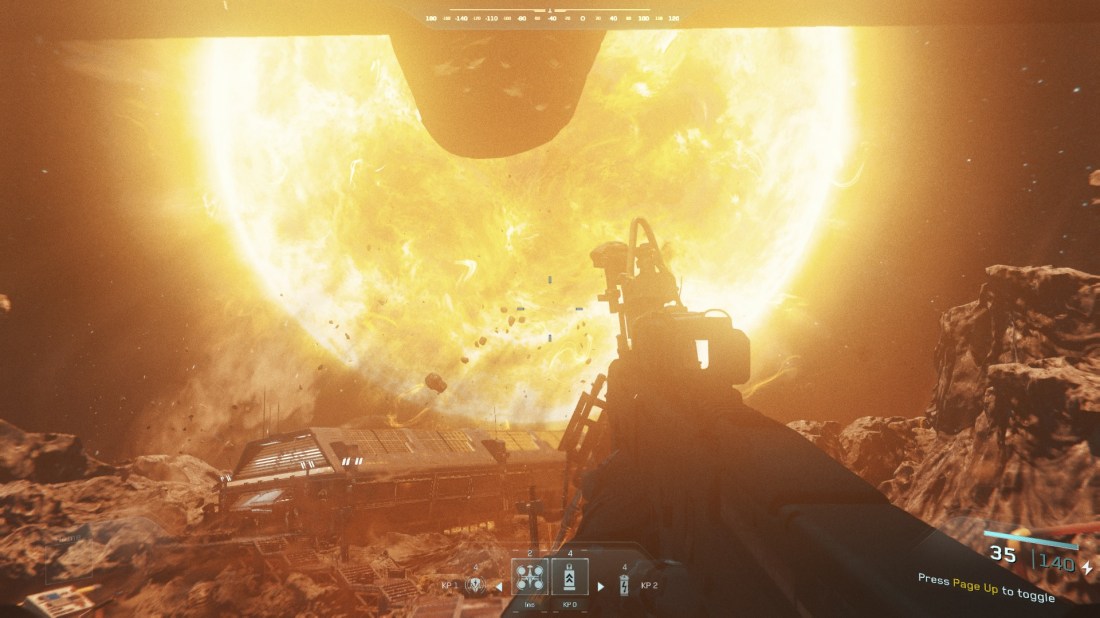
The chopper mission is one of the best flying missions I’ve ever played. It’s like a Fast and the Furious set-piece, completely impossible and insane and I’m finally a Flying Ace. This is what Jacobs is here for, the reason the resistance rescued me and the game makes sure you prove you were worth the trouble. I’m zipping through tunnels, avoiding SAMs and skimming the tarmac as the team jump aboard and hijack the tankers (Hopper and Rianna just throw the drivers out their cabs; Connor stabs and beats his driver). We’re taking out tanks, Humvees – nothing original but the chopper is such fun to fly and fight with as we go through a mountain range, tunnels, freeways, through a town and over/under bridges, defending the tankers and making Connor holler as I blow shit up. I actually miss the chopper once I land. That’s a first.

With that, we join the military for their last stand on the Golden Gate Bridge, and what a stand it is. A non-stop fight to the end, worthy of Michael Bay on a good day – Humvee chases, GKR-controlled Goliaths, jets and ‘copters blasting the hell out of everything, it’s insanely heroic. It couldn’t have ended any other way and I’m glad it comes through. I feel … patriotic.

John Milius was involved as a story consultant and it does have his jingoistic Red Dawn paws all over it; it’s a Boys Own adventure with completely outrageous heroism and extreme moments, but there’s commentary on what it means to be a patriot, on unchecked regimes and superpowers’ role as deterrents. As a shooter, Homefront doesn’t add anything new to the genre but it is a rarity; an engrossing CoD era shooter, and one that doesn’t feel like a tutorial for the multiplayer. It’s a great game.

Homefront was Kaos’ swansong after their first, Frontlines. It’s a shame they didn’t get another outing; Homefront shares Frontlines’ DNA but it’s no refined reskin; this game is immeasurably better and Kaos could have come up with something even better third time out. It wasn’t the end for Homefront though, the rights were picked up during THQ’s firesale by Deep Silver, who rebooted it as an open-world game, focusing more on the guerrilla tactics of a resistance. Homefront The Revolution got mixed reviews and missed the all-or-nothing point of the original. Give the reboot a miss and come Home.
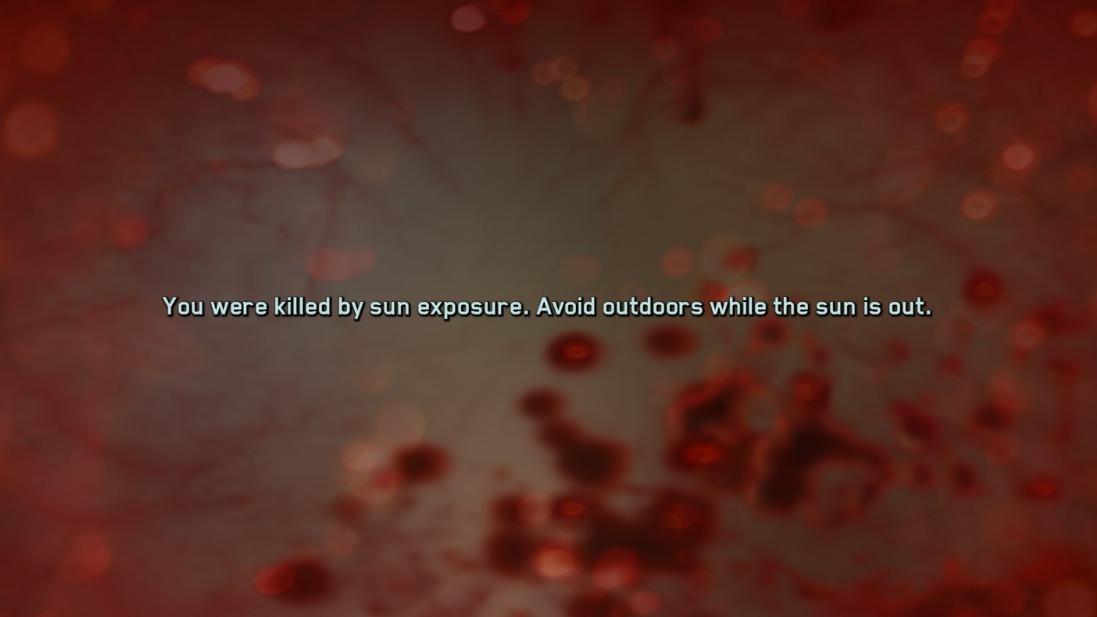
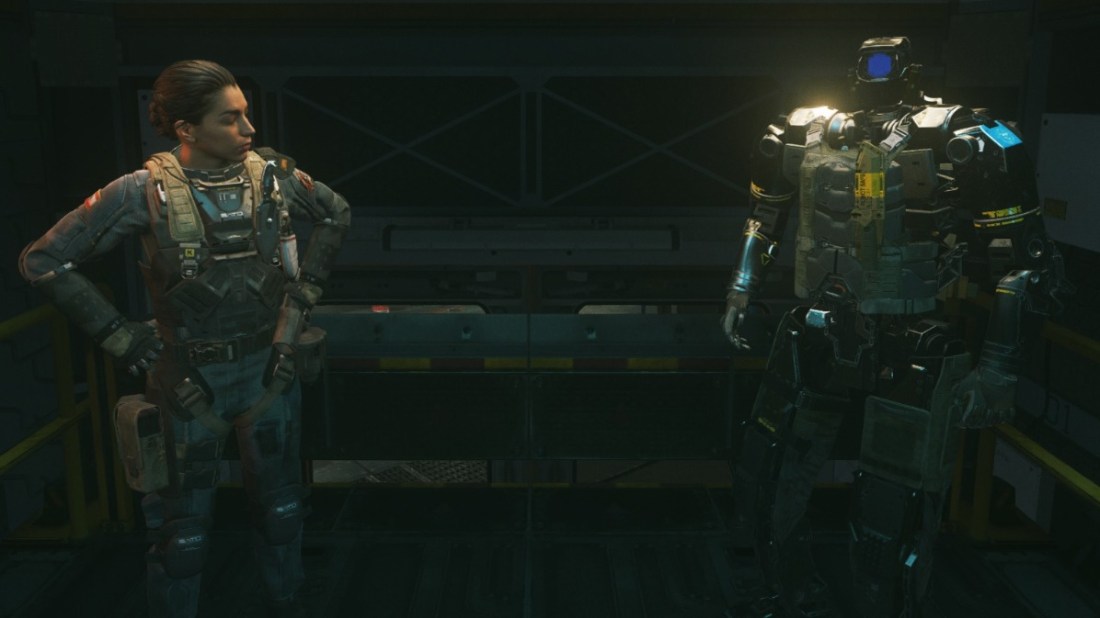
2011 | Developer Kaos Studios | Publisher THQ

Platforms Windows | PS 3 | Xbox 360