Doom's Clones & Killers Pt2

In the second part of Previous Weapon’s FPS retrospective, FBT makes like David Suchet and questions the clones about the identity of the Doom Killer.

Part Two: All hail the King, baby

Doom was out, and everything had changed. Even over at Apple. Bungie’s Marathon kept them going instead of Doom. It was a shooter with a storyline – a what? We don’t have time for that, Netscape Navigator was out and that meant 0.5% of us had access to the WWW – when we weren’t watching a Ford Bronco drive down the freeway that is. But the biggest news of ‘94 was still 93’s Doom. No one had touched it; well, there had been some inappropriate touching – a Doom Community sprung up thanks to the web, trading their own levels and mods; id’s decision to let gamers mess with Doom’s level design was another innovation and it turned kids into level designers and FPS into a multi-faceted hobby; playing, building and deathmatching. Doom also popularised web-chat, file-sharing and encouraged the uptake of the net; the world was changing, for us anyway. While our parents watched Blind Date and Beadle’s About, we had Terry Christian egging someone on to eat a sandwich of toenail clippings, were frothing to go on Nemesis at Alton Towers, whispered “UVAVU” while watching Geri and Kylie snog and the 11.30 Diet Coke break advert. The nineties were in full swing.

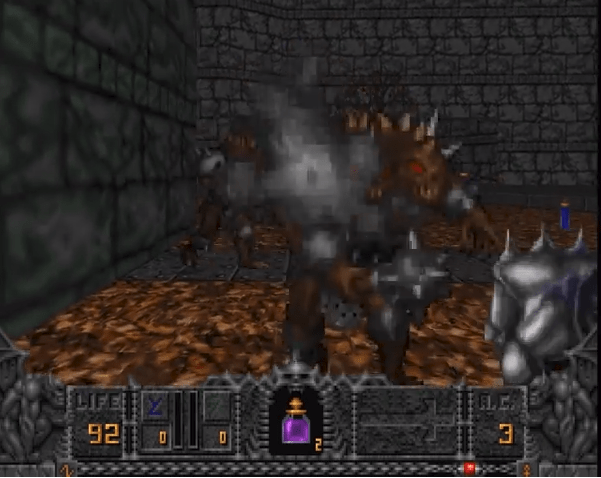
Released in December 1994, Heretic was the first Doom Clone but it wasn’t a cash-in; created by Raven, built on the Doom engine and exec-produced by Romero, it was less a clone and more a companion. You charged around locations taken over by a Saruman type, using magical weapons (a bow standing in for the shotgun, a claw that fired spells is your chaingun) while taking out Fantasy versions of Doom’s hell creatures. Okay, Heretic must have seemed a bit twee back then, a bit D&D; who wants to be in Dad’s Lord of the Rings when we had our Doom?

While Heretic is Doom reskinned, the art design is great and it’s learnt a lot about pacing and level design – It doesn’t have Doom’s aggression, you’re an elf waving a magical staff around medieval villages so not as cool as being a squad member from the Sulaco like Doomguy, but it’s good to have an alternative to Doom’s military setting which was replicated by most of the other clones.

Once I’ve got my eye past the minimal pixels and basic movement, I realise Heretic is really good; it has a great ambient feel – we hear groans and grumbles, chains rattling and whispers, the art design is really nice and it’s not stuffed with creatures; there’s areas and secrets to explore rather than just blast through, and it features an inventory (including a spell that turns creatures into chickens) – it gives Heretic an adventurer feel as we stalk through cathedrals and Mordor-like locations. When we do meet the bad guys though, they’re top notch; glamorous, chanting Wizards, giant skulls and the screeching little imps. It’s a lot further from Doom than I remembered, and while it’s possible they just got to work before Doom clone fever really gripped, maybe Raven are really good devs – they did go onto Star Trek Elite Force and Jedi Knight Outcast. Heretic doesn’t immediately call Doom to memory surprisingly enough, it stands up well despite its age and it’s got its own personality; I’m enjoying it for what it is rather than running on memories; it’s a great shooter and worth a replay. Heretic is memorable for another reason – It’s retail disk included DWANGO, the first programme to let you dial-up n’ deathmatch with folks further away than an LAN cable could reach. Online gaming was here.

I really liked Heretic. It’s one from this era that didn’t get a remaster and that’s a massive shame. Reboots you can keep but a refined Heretic would be awesome. One from this era that did get a reboot was Rise of the Triad (Feb 1995) and I have no idea why.

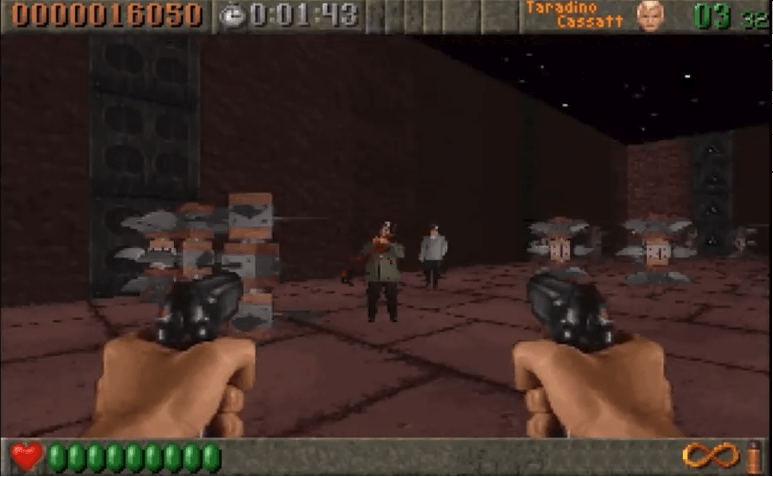
It starts off well enough; we’re the HUNT team on the, erm, hunt for bad guys who are on an island. Let’s go get those bad gu – wait, why are there trampolines in their secret lair? And why is everywhere filled with spinning coins like a Mario game, and platforms to reach them dotted around the castle? My god, RotT is awful. I thought we’d left this arcade kiddie nonsense behind. RotT came from 3DRealms and id co-founder Tom Hall; they knew intimately what Doom was and this isn’t it. Maybe that’s the point, but there’s different and then there’s daft.

I might have liked it at the time, back then you’d take anything you could get once you’d rinsed Doom but jeez this is annoying. There’s some progress here, you could dual -wield pistols and machine guns and had an assortment of explosive weapons rather than tons of oddities, there’s auto-aim too but it’s all buried under the silliness and digitised elements that don’t work; we’re being attacked by cardboard cut-outs – the sprites of Doom were 2D but they animated and moved in semi-convincing ways while those screengrabs look like a stiff breeze would blow them over. The weapons too look like photos which seem less believable. And there’s crushers, revolving walls, traps and spikes everywhere for no reason; one thing about Doom, it played by its rules – an invading force that you were repelling, but this gang’s gaff is a gauntlet the bad guys run as well. Half the time the traps kill the bad-guys for me. RotT is part Looney Tunes, Wolf-clone, arcade, platformer and forgets the FPS part. It’s so cheap looking you’d think it’s a quickie knock-off called Doomed. It’s not a Doom clone, it’s a first person Manic Miner. An Uwe Bol adaption of Doom.

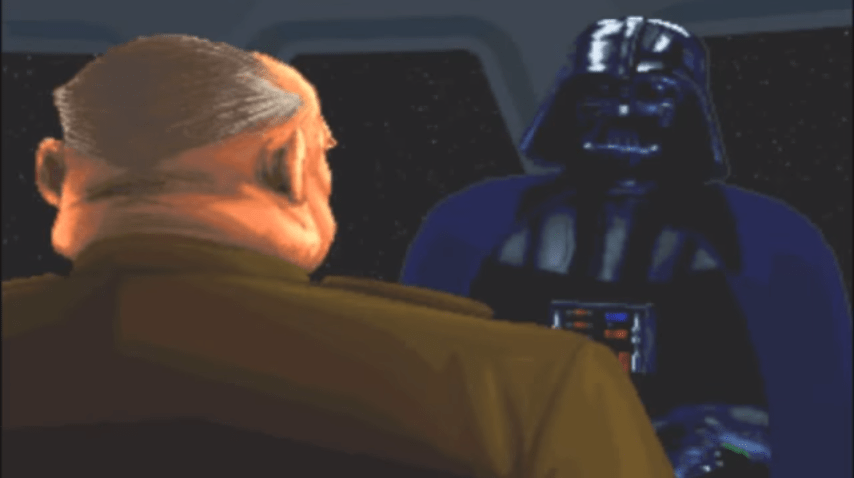
Happy New Year, 1995. The year we all got to enjoy Toy Story, and Tommy Lee and Pammy’s honeymoon. The biggest clone of 1995 was a game we’d already played – not just in Doom mods but with our own toys; Star Wars Dark Forces (Feb 1995). Released by Lucasarts, a company that could punt out instant classics like Last Crusade and Monkey Island for breakfast, for them bettering Doom must be as easy as pulling an X-Wing out of a swamp. But always with Doom it cannot be done; while SWDF provided major advancements within the world and game play, this is just Doom with a John Williams score. There’s text explaining non-cannon events to tie it in but SWDF is the best example of a Doom clone yet. It’s not a bad game and playing Star Wars is always going to carry you some of the way, but it’s lacking Doom’s dangerous quality and fatally, keeps reminding you of it. It’s just a reproduction, not an innovation. Plus, the Stormtroopers can actually hit you, how unrealistic is that? It’s Doom on the Death Star and that’s not as cool to play as it sounds – Doom is still one in a million, kid. Sad to say but the Star Doom mods were better. Leave it back in a more civilized age, when Han shot first.

Dark Forces’ biggest contribution to the gaming world was its sequels – Freed of the beat Doom mentality, the first sequel Jedi Knight was a rocking Star Wars shooter with an add-on (remember those) called Mysteries of the Sith. The second sequel, Jedi Outcast got it right; it’s a fantastic SW game and FPS in its own right, and the final sequel, Jedi Academy is a solid game that got lightsabers so spot on they turned into John Woo-level ballet. Dark Forces started as a Clone but it forged its own path to become a classic series with a better legacy than Doom.

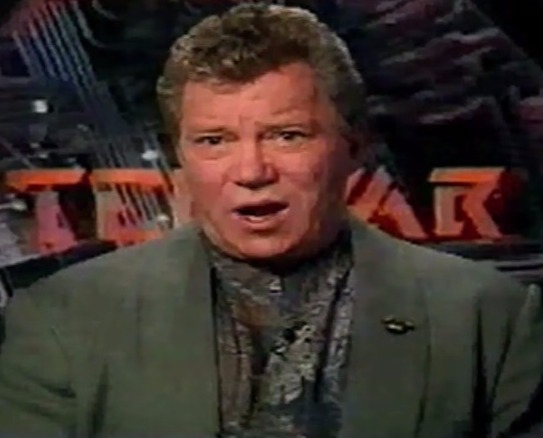
Build, the engine that would go onto power Duke Nukem launched its first game in 1995, Witchaven, a Heretic-style goth shooter. It didn’t have much in the way of smart-arse heroes or the level of interaction that later Build Engine games did, but it had a charm to it. Like Wolf, it was a warm up for what Build could do – and what it did next was present someone so legendary, so grand and awesome it’s tough to believe a simple game could contain such an iconic hero – William Shatner. Who were you thinking of? 1995’s Tekwar brought his sci-fi novels to shooter-life and included a digitised Shat; that gives you some idea of how powerful Build was.

In September 1995, the gaming world was shaken again. Not by a game, but by a new way to play, station. Sony’s “Live in your world. Play in ours” campaign was aimed squarely at the Doom generation; aka the MTV Generation (PlayStation sponsored the 1995 MTV Music Awards to prove exactly who PS was aimed at – gaming is not for the kiddiewinks anymore) and the PS made gaming as cool as the Music and Movies of the era. We had our console, our games, we were Sorted for E’s n Wizz and wondering who is Keyser Söze? Perfect.

Meanwhile, briefly distracting us from Xena Warrior Princess was Hexen: Beyond Heretic (October) and this time we weren’t a silent hero. We were three of them. A Fighter who is melee mostly, a Mage who uses long-range magic and a Cleric who uses lower-powered versions of both. Hexen is pretty much Heretic, although not a re-heat; aside from character classes, you also transport back and forth between areas to progress (why I’m not sure, I don’t have the manual) and while the sounds and certain art is the same there’s additions like breakables, leaves falling off trees and more detailed levels. Hexen is fun to play; while it feels Doom-like, unlike Heretic, the character class is a refreshing change; RotT had characters but they made no real change to the experience, whereas in Hexen each character provides a different experience; first time FPS had replay value. I chose the fighter class and melee’ing about is a welcome change from guns again. If Heretic was Legolas prancing about then Hexen lets us play as John Rhys-Davis, and what’s wrong with that? The magnificent wizards are back too, although according to a Heretic Wiki they were ‘Disciples’. Whatever they were, they rule. But they’re not the king, baby.

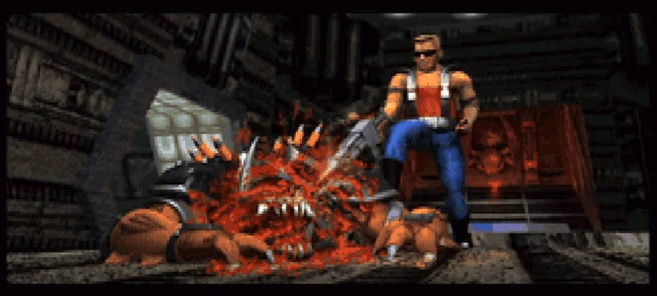
Doom was loud. Apart from the gunfire and exploding barrels there was screaming, shouting, growling, howling, all underpinned by the constant industrial score yet one thing was largely quiet – Doomguy. 3DReams, already a part of the id family as their shareware distributors, called in Ken Silverman to step things up after Doom. He gave them the Build Engine and that gave us giggles alongside the guts, rock-stars instead of serious and silent. While Carmack would disagree, Build was a huge improvement on the Doom engine; for gamers anyway – it let us misbehave; if Doom was the Father of FPS then Build was the uncle who gave you sweets and let you stay up late, and in January 1996, Duke Nukem 3D gave shooters a voice – Duke was the spokesperson for FPS, it’s ambassador, the entire experience distilled into one badass with a big mouth and bigger guns. Duke was mightily pleased with himself, had every girl at his feet and paused for one-liners before doing battle. Everyone remembers when Duke told a mini-boss he was going to rip off his head and shit down his neck, and when the battle was won, promptly pulled down his trousers, took out the paper and sat on the corpse, whistling. I remember Duke more than DN3D, so to attend a reunion now is a worry; if I find out the school hero who dated the cheerleaders is now a regional manager for an insurance company and bald instead of bold I’m gonna be crushed.

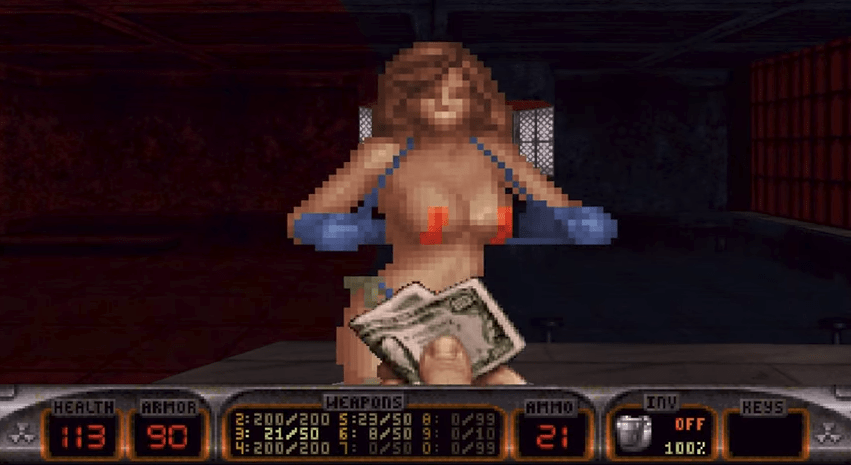
I start playing and he’s really not that bad. Phew. Sure, tipping strippers for a peek is juvenile and the pigs dressed as cops isn’t subtle, but DN3D is nowhere near as insulting as I expected it to be. Just shows how horrific Duke Nukem Forever was that it’s tainted Duke Nukem 3D as well. The earthbound locations he shoots through like Porn Theatres and strip-clubs are what they are and while girls in underwear dancing, the strippers, the women used as incubators and Duke being rewarded for his hard work with a three-way during the end credits are all tough to defend, Duke is a parody of those Bond-like heroes who seduced women through sheer masculinity. It is sexist but crucially it’s not misogynistic or mean-spirited like DNF – there’s no Boob-growths in the walls to slap, glory holes to stick little Duke through or incestuous twins dressed as schoolgirls who share Duke and joke about rape and abortions before dying as Duke comforts them with ‘looks like … you’re fucked’ – I’m not saying DN3D is acceptable because it’s not as appalling as DNF, but DN3D treaded that celebration vs parody line perfectly. Duke is still the voice of a genre and generation; Silent Heroes always felt a bit awkward, especially when they’re in cut-scenes. I wouldn’t want the quiet one saving the world, I want someone who’s going to be all out of gum. I feel like a Hollywood hero, shrugging off bullets and being the only guy for the job. Duke’s gabbing does dilute some of the tension and it’s hard to take it seriously, but it’s not supposed to be taken seriously; everything up to now has been bleak, against-the-odds stuff, but this is Cobra or Commando time. Duke enjoys the challenge. And so do I.

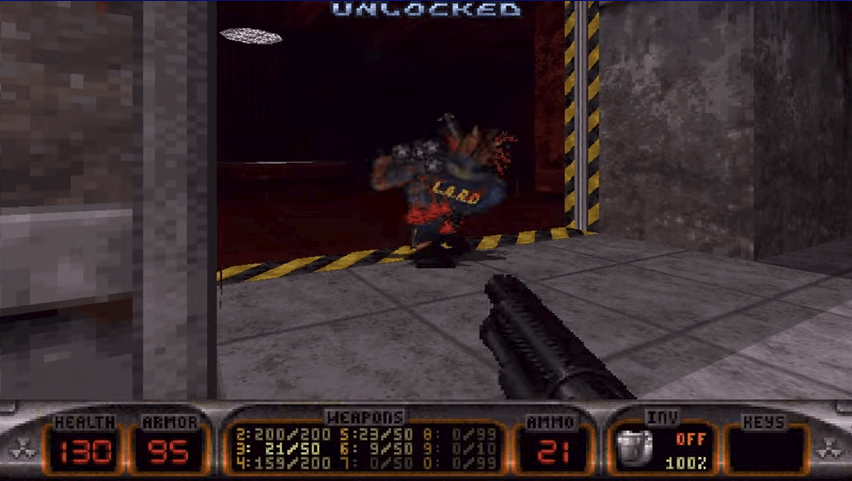
DN3D has some good opponents to battle against and Build gives them a fighting chance rather than id’s walk-this-way AI; in Doomworld monsters walked or floated toward you but Duke’s adversaries do both; they fly, leap, hover and hide, and they react to your attacks – we have to be a little more tactical but thankfully, Build has us covered – the pipe-bomb and mines lets us get sneaky. While Heretic had timed mines you dropped as you were chased by one of the splendid wizards and hoped it went off under his cloak, in DN3D we can set traps and lob controlled pipe-bombs; and Duke would reward your game-play with a one-liner worthy of Arnie. As is standard, DN3D has episode-ending mini-bosses but this being Duke’s world, mini means massive and besting them gets you a cutscene showing just how cool and heroic Duke is, as if there was any doubt. In order to combat such extreme monsters, Duke has the kind of arsenal only a super-hero could wield; aside from the standard there’s various explosive weapons and the freeze gun which lets you shatter opponents, and the shrinker – stomping on a now-tiny bad guy is a new one.

It’s not all Mr Bombastic though – it can be a slog to get through an episode and the first, set in downtown LA is largely the same design rejigged. The Lunar levels get dull very quickly and the third mission is a disappointing return to earth and the same look again; it gets very samey once you’re over the distractions. One reason I struggled to recall the gameplay of DN3D is how much it relies on the boss; this is Duke’s show. You can imagine Duke’s Superior yelling he’s caused more destruction than the bad guys, only to have Duke wink and walk off, taking the boss’s wife with him. There’s great fights, creatures and interactions but without the big man, DN3D would be a dull game – although Duke did get some cracking add-ons; Life’s A Beach had Duke holidaying with squirt guns and it’s worth a play just for the Pig Cops in Hawaiian shirts and the Octo-thingies in raybans.

There was another Build game in 1996, PowerSlave. Originally intended as a showcase for Build before Duke started to shape up, it was largely over-shadowed by its big brother, but remained popular enough for an unofficial remake.

DN3D is a huge improvement on what we’ve played so far, but the real show-stopper, the only thing to upstage Duke is the Build engine. Build provided a world to interact with, something we’d not had before. Doom was one thing only – serious about shooting. Besides the strippers, Duke could get distracted playing pool, staring at himself in mirrors, pinball games with him on the artwork (‘I haven’t got time to play with myself’), posters to look at, buttons to press, CCTV screens; we’re crawling through vents, sewers and diving under water, using powerups like holograms and the jetpack; I suspected DN3D would be where we leave Doom behind but while it’s the stuff that would make Don Simpson call Heidi Fleiss and celebrate, what DN3D did was diverge the FPS genre; from here the seeds of the more outlandish FPS game were sown. Down the pub, Doomguy is just Duke’s wingman but on the battlefield Doom still reigns. Case closed; Duke is innocent of killing Doom. Where is it? Man, finding Doom’s killer is hard. If she hadn’t been cancelled in 1996, I’d call Jessica Fletcher in on this. Maybe my Encarta CD has the answer.

In Part Three, FBT takes on the game convicted of killing Doom. But is Quake guilty as charged? And is all this just an excuse for FBT to play Blood again and google Dani Behr?

Doom's Clones & Killers – Pt1

In this, the first of a four-part retrospective, FBT goes back to the best era in gaming (so he says) – The 1990s explosion and implosion of First Person Shooters

Part One: Gott im Himmel

They say in the Sixties everyone remembered where they were when JFK was shot. In the Eighties, everyone remembered where they were when John Lennon was shot. But in the Nineties, we remember doing the shooting – on December 10th, 1993, id unleashed Doom.

Built by gamers for gamers, Doom may have been underground but like an earthquake its impact was seismic, sending shockwaves through the gaming world and eventually reaching the real world; referenced in The Simpsons, Friends and ER, Doom was part of the nineties zeitgeist, gaming’s Nevermind or Pulp Fiction and in modern terms, it was bigger than Facebook, affecting workplace productivity and causing issues on company networks.

Doom even slowed Microsoft’s world domination; When their ads for Windows 95 asked ‘where do you want to go today?’ Gamers replied ‘DOS’ – the platform W95 was replacing and the only sure-fire way to game on PC. Gamers weren’t going to risk losing Doom (it was rumoured Doom was installed on more PCs than W95) and Microsoft, realising Doom’s dedicated fanbase was the future, developed Direct-X which allowed games to play ‘as’ a Window. It was a watershed moment; Doom was ported to Windows (by some bloke called Gabe Newell), and Bill Gates appeared ‘in’ Doom during a W95 Expo to prove Windows was the future – a video game created by a bunch of lads made Bill Gates, at the height of his power, say ‘if you can’t beat’em…’ It gave Gabe Newell some ideas too.

And Doom pissed off parents, like every good trend should. Doom wasn’t the first game to show death but this time you really were in there, up close – with a chainsaw. Stories of players passing out, getting motion sickness and post-traumatic stress triggered Parent Groups who classified Doom as top-tier evil alongside Ren & Stimpy. ‘Killology researcher’ David Grossman coined the phrase ‘murder simulator’ and it was said this new era of games could turn kids into killers; Doom was held accountable for the Columbine Massacre.

But none of that mattered to the gamers who discovered Doom that day; we had no idea we were loading up the You’re Gonna Need A Bigger Boat moment of gaming; we were in the Aliens Hive scene screaming ‘its game over man, game over!’ – And for any other game, it was. Doom was the new standard, and it launched a whole new race to be the biggest, baddest First Person Shooter – gamers couldn’t be happier. Parents, less so.

Games back then, loaded up through that DOS prompt and the shareware warning were way more exciting that anything around now. You really had no idea what you were getting into, even with a Doom Clone. It took commitment to finish a game in the nineties; we didn’t have any of your fancy auto-saves or mission skips, no walkthroughs; you had to really love a game to finish it and that stays with you. We sweated for the exit, got your head down and tapped spacebar until something opened. And the joy of finding the secret that had an exit! That meant secret level, that meant bragging rights, that meant pranks on friends. It was a great time. So, what happened? The FPS genre is awful now. Generic reheats, remakes, reboots; story-led, watered-down, XP-driven, gimmick-ridden bastard-childs of RPG. Thinking back to Doom, when is something gonna come out of nowhere and make us think ‘the fuck just happened?’ I’m going to replay FPS from Wolfenstein onwards until I track down Doom’s killer. Where it all went wrong.

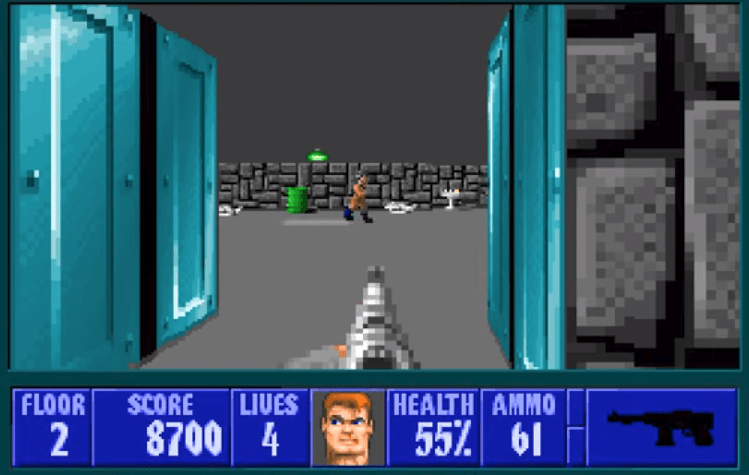
Mein Leben! In May 1992 Wolfenstein 3D landed. We’d barely gotten over the Freddie Mercury Tribute concert and now we were blasting Nazis. Not sure what the connection is, but I admit I might have been listening to Extreme at the time. More than words can say how much I played Wolf back in the day; the only German I know is from Wolf (and Die Hard…) Replaying Wolf doesn’t just bring back embarrassing adolescent musical choices (I was also into Mr.Big for a while; don’t judge me, I liked Guitar Shredders at the time, Steve Vai rocks. Totally not a power-ballad phase), but it has fondly reminded me of Shareware; ripping a disk off the cover of a magazine I didn’t read and excitedly loading up every demo, game and crappy screensaver. Then borrowing the full game from mates. I think one of those mates still has me To Be With You CD single.

Wolf was Gamer’s You Know When You’ve Been Tango’ed moment. When we weren’t suffering tinnitus from ear-clapping each other in the playground, we were amazed at the fast-moving, unforgiving gameplay. It was exhilarating; Wolf wasn’t the first FPS but it was the first to get it right, to make you feel like you were there. I played Wolf endlessly, least when Gladiators wasn’t on. But unlike Jet, it’s not aged well. Really, Wolf is a maze layout fighting through pixelated Nazis over and over. I don’t know what I was expecting but once you’re through the first level you’ve played them all really, but you can appreciate the work, feel the energy that went into building this. It’s kinda quaint now and has that arcade feel but still, it’s fast and unforgiving – I expected years of digital shooting would make this a cake-walk but I spend as long reloading the game as I do the guns. If they had reload.

Wolfenstein is best left in the past; while it had me smiling, once those memories of singing Ebeneezer Goode stop flooding, the lack of ceilings and floors and the repetitiveness make Wolf a bit of a slog, but you must pay homage to the OG of FPS, the calm before the storm. What Wolf has done for me is get me excited for what’s coming next.

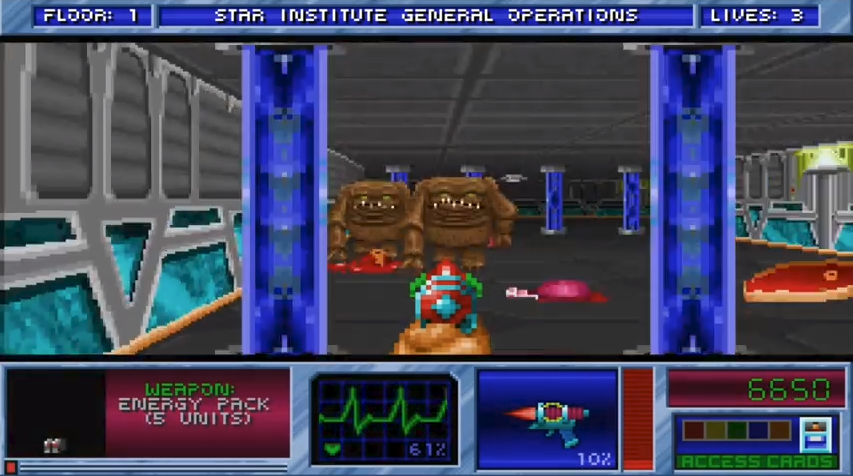
What came next was Blake Stone. I feel sorry for Blake, sent to a mad scientist’s space-station to stop his evil experiments; like the rest of us, he didn’t know what was coming. Released in December 1993, just before Doom landed, BS was completely steamrolled and I was mid-way through it when my friend appeared, waved a floppy and yelled ‘get ready to shit your pants’ – I remember it because I did shit my pants; that disc had Doom shareware on it. I also I never went back to BS. It felt like a kiddie game after Doom.

As I play it now, I realise I owe Blake an apology; it’s a really good game. It does look rough but there are some surprising touches absent from the others of the era; Blake gains health at vending machines and you’ll find scientists who give info – one of several ways this reminds me of Half-Life. Like all games of the era you’re looking for a key to progress but more logically, the keys unlock floors accessed via an elevator and you can return to a floor to further explore when better armed, rather than exit never to return – the floor layout, while basic is much more interesting than Wolf and the art design has a nice 50s Sci-Fi style to it, the antithesis of Doom’s slimy atheistic. It’s a lot more busy that Wolf’s basic look and while it may not have been intentional, BS feels like it was just having some fun; the monsters wouldn’t look out of place in a Goosebumps book and it has an Indy-inspired adventure feel to it. But that was exactly what we didn’t want at the time – Doom created the perfect run n’ gun; who wants to talk to Scientists, use vending machines, go back instead of relentlessly pushing forward? But there’s a lot to it, it’s harder than it looks and it’s crying out for an app re-release. It fun and worth a go if you’re bored of shitting your pants.

So this was it, September 12, 1993 – A moment I’ll never forget. Terri Hatcher in Lois & Clark. Three months later, Doom landed and nothing was the same again.

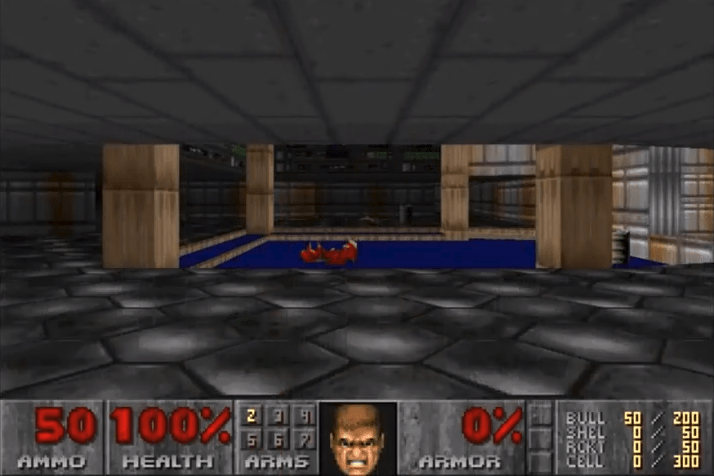
As the years passed I left Doom behind. I played it endlessly at first, but eventually recalled it becoming hollow once you’d gotten over shitting your pants and, especially after the Wolf and Blake experiences, I expect to find Doom equally dated – I’ve not played for at least ten years yet as soon as I get going, I remember secrets, barrels just around corners, which exit doors have an Imp behind them. Doom is so entrenched in my DNA, my first-born’s first word will be an Imp growl; and that familiarity isn’t the only thing I’m responding to – this is really good. Not in its scares or firefights, but the rhythm. I hadn’t appreciated how well balanced a game Doom is, how it subtly ratchets up the tension instead of exhausting you into giving up. Twenty plus years and modern shooters could still learn from this. Doom was like when you were a kid and found a wasps’ nest. You still poked it with a stick even though you knew better. Doom gave you a shotgun instead of a stick and there was no Mum with the Savlon and a scolding afterwards but you still went for it. That’s a good game.

Doom does, honestly, still have it. It isn’t even in my top ten but it should be; I realise now, Doom formed my opinion on every gun-orientated game since. It’s one thing to remember how good a game was, it’s another to be realising just how good it is. Doom 3 sucked because it went for the jump-scare. That’s not good level design or pacing, that’s lazy. No, worse than that, it’s a misunderstanding of Doom, where you hear the imp behind the door and you have to open it. That’s far scarier than something leaping out at you. You’re so into it that the minimal pixels and blocky movement melt into a pure visceral experience and while modern shooters may look the shit, they’re not In The Shit like Doom is – this is just a bunch of pixels, how is it triggering some caveman-survival instinct?

There’s a real subversive simplicity in Doom; you can describe it in a sentence, but you have to experience it to understand; Modern Shooters are nothing compared to your first Tour of Duty in Doom – take down a horde of invisible pinkie demons, then we’ll talk about your kill-streaks. Some of the impact has been lost, but when it all kicks off I’m still as mesmerised as when Terri Hatcher said “They’re real … and they’re spectacular.”

I wouldn’t have called Doom art back then, I do now.

Of course, Doom didn’t stop at the exit. The biggest shock was Deathmatch. Seeing your pal as a little Doomguy then fragging them with a rocket launcher was something gaming hasn’t ever surpassed; Multiplayer, co-op, online is a standard now but that’s nothing compared to LAN games where the only smacktalking was from your friend sitting opposite – this was just fun scrapping about, not a dickhead half-way round the word being a little big man on his mic. Fuck those guys, I miss the Doom Parties. Even when you were hilariously murdering each other, Doom brought us together. Nothing has ever topped that, and nothing ever can.

Replaying Doom does bring back some awesome memories, especially the best prank of all time on my ‘shit your pants’ mate – the secret level in episode 3. It’s a remake of the first level and I found it when I was playing alone. I saved it for future fun and at our next hang-out, suggested we speedrun episode 3. I went first and reached the exit … Then, when he was busy mocking my attempt, I loaded the secret level instead and let him have at it. His face when he hit the exit and sat back to crow but the Cyberdemon appeared instead – he actually jumped as if it was in the room with him. But then he sucked it down and got on with shooting, his voice trembling as he called me names. That’s Doom – panic and pals. I’ll admit the panic has waned, but it’s replaced with appreciation and the excitement is still there – Doom is brilliant. Who killed you? I shall avenge you. Just as soon as I’ve humped my rig over to my mate’s house and LAN’ed it up for old time’s sake.

By 1994, UK society was on the brink of collapse. Ch4 aired a lesbian kiss on Brookside and Frances Ruffle flashed Union Jack knickers (take that Ginger Spice) during a Top of the Pops performance; the children of Mary Whitehouse screamed the place down – they also felt affronted by Frances’ hip-swinging. The outrage. Hips! Swinging! Did we learn nothing from Elvis’ gyrations, sending an entire generation into an uncontrollable sexual frenzy? Good job that Brookside kiss turned us all homosexual otherwise it doesn’t bear thinking about. Society was at an end apparently though; our most beloved TV character (besides Beth Jordache) was Mr. Blobby?! How did he get a Christmas single and Zig n’ Zag didn’t?

There was little to do in the wake of Doom, except on Wednesdays when you’d get rudely awakened by the Dustmen. There was Pie in the Sky; while their game engine PitS was a bit Poundland, it was offered as an off-the-shelf product making PitS the archetype of Doom Cloning; dozens of PitS-powered shooters popped up and while they’re long-forgotten now, PitS should be remembered for filling many a floppy on the cover of PC Gamer while we waited, and watched Brookside.

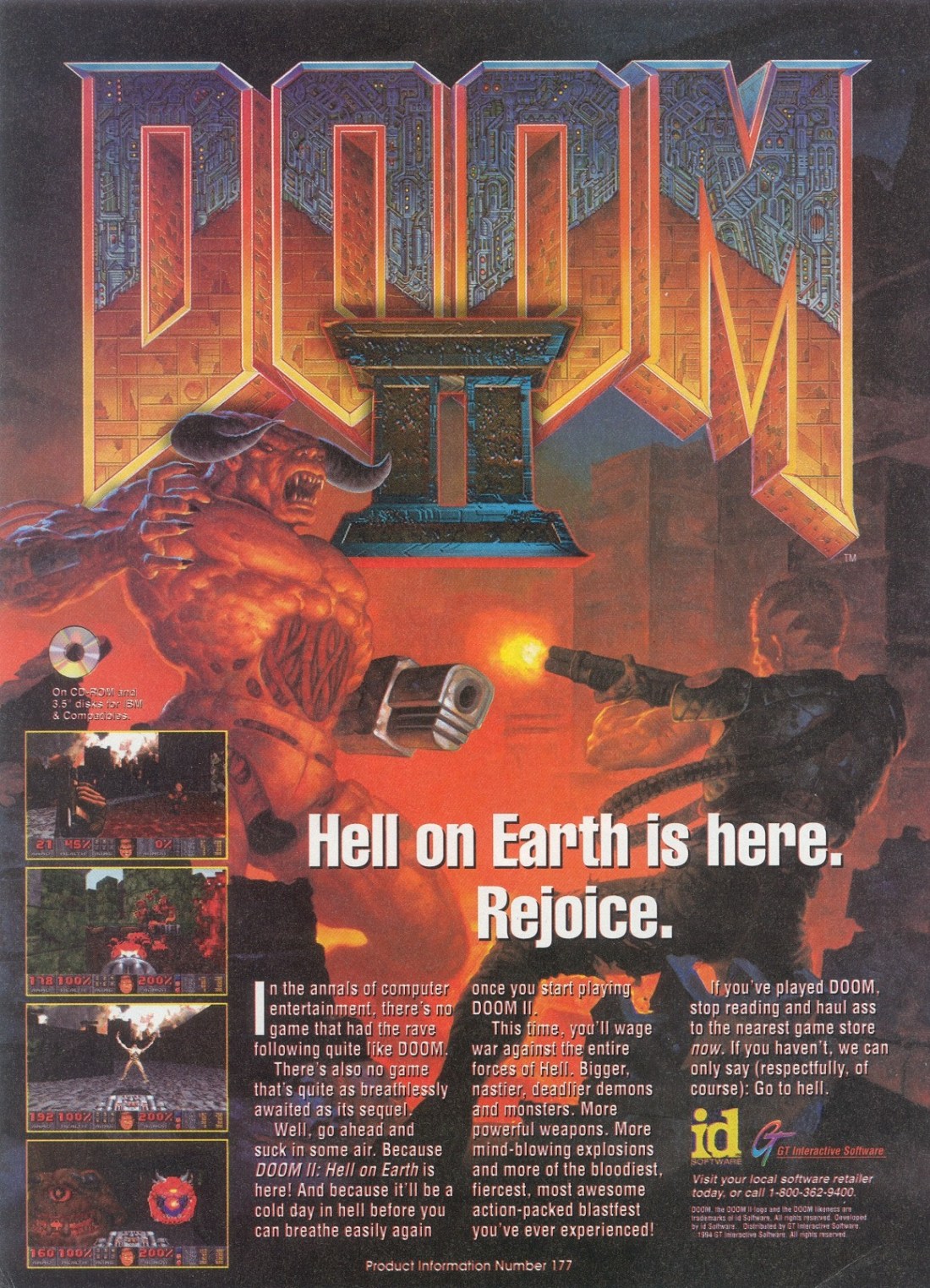
And it was Doom II we were all waiting for. Released in September 1994, I was more excited about Doom II than Rachel’s haircut. I rushed it home and at first I was shrieking and screaming at the scale and intensity of it, but then I started to feel like I was playing mods of the original. And that bloody ending with the Icon of Sin – I do recall cheating and finding Romero’s head, although then I had no idea who it was. I had high-hopes for DII when I restarted this time, hoping for a new appreciation like the original, and to begin it is heart-stoppingly brutal; Those damn chain-gunners, that rocket-launching blob, the missile-launching skeletons, the goddamn Arch Vile, all (and more) between me and an exit that took effort to reach alive. Those are big levels. But then, that energy starts to dip. The expanded level-sizes are all good but it’s more of a survival game than an exhilarating rush like the original, and while the layouts are good, the larger size starts to be betray how little art design id had to work with – as good as it is, it gets samey; Doom was never a game to stand around and look at the wallpaper. It’s just not as much fun, like the id guys were distracted by what Carmack was cooking up for Quake. There’s some brilliant levels, and it’s still an awesome yardstick game, but it just doesn’t feel fresh. I’m never happy – had DII been a departure I likely would have moaned too, but DII should have been more than just more. For me, besides further improving the Deathmatching, DII greatest contribution was the killer Aliens Doom mods, complete with facehuggers, plasma rifles and Hudson as Doomguy; they’re better than Aliens Colonial Marines. But then, what isn’t?

Most games from this era punted out quickie sequels; Blake Stone turned in Planetstrike, Wolf repeated itself in Spear of Destiny – using left-over level designs, those retweaked remakes were low-cost, high-sell games and I would dismiss DII as just a Clone, but it was more than that; Doom might have been game-changing, but Doom II was industry-changing; no longer an underground, mythical thing traded in playgrounds like fuzzy VHS copies of Evil Dead, Doom II was a grown up, on the shelves game and a phenom on release – it netted id millions and cemented FPS as a major genre; it was everywhere, like that Meat Loaf song. I’d do anything for Doom but I won’t do that. It was so big even my parents knew it. I recalled my Mum saying she’s “read about some horrendous game that lets you chainsaw people, you’d better not be playing that” / “No mum, I just wanna listen to Mr Big. Did you buy the Radio Times with Lois and Clark on the cover?” – we have our first suspect in the Doom murder. Not Terri Hatcher, Doom II! The motive? DII brought FPS into the mainstream; every publisher that saw shareware as rinky-dink suddenly went ‘that could’ve been us’ and while the music industry was busy signing up every band that wore a checked shirt, publishers descended on devs and demanded more Doom. Doom II didn’t kill Doom with innovation, it killed it with success. Clone after clone followed, each a copy of a copy, until the pure Doom experience got fuzzy.

FPS was out now, there was no stuffing that demonic genie back in the bottle. As Doom II cleaned up, others were about to make things messy. But which game dealt Doom the killing blow? I had a few more suspects to question; Lo-Wang and Duke to name a few.

Check out part two of FBT’s ‘investigation’/excuse where he continues to blast his way through the best 90’s FPS had to offer while watching Earth 2 and Seaquest.

Doom’s Clones & Killers – Pt1

In this, the first of a four-part retrospective, FBT goes back to the best era in gaming (so he says) – The 1990s explosion and implosion of First Person Shooters

Part One: Gott im Himmel

They say in the Sixties everyone remembered where they were when JFK was shot. In the Eighties, everyone remembered where they were when John Lennon was shot. But in the Nineties, we remember doing the shooting – on December 10th, 1993, id unleashed Doom.

Built by gamers for gamers, Doom may have been underground but like an earthquake its impact was seismic, sending shockwaves through the gaming world and eventually reaching the real world; referenced in The Simpsons, Friends and ER, Doom was part of the nineties zeitgeist, gaming’s Nevermind or Pulp Fiction and in modern terms, it was bigger than Facebook, affecting workplace productivity and causing issues on company networks.

Doom even slowed Microsoft’s world domination; When their ads for Windows 95 asked ‘where do you want to go today?’ Gamers replied ‘DOS’ – the platform W95 was replacing and the only sure-fire way to game on PC. Gamers weren’t going to risk losing Doom (it was rumoured Doom was installed on more PCs than W95) and Microsoft, realising Doom’s dedicated fanbase was the future, developed Direct-X which allowed games to play ‘as’ a Window. It was a watershed moment; Doom was ported to Windows (by some bloke called Gabe Newell), and Bill Gates appeared ‘in’ Doom during a W95 Expo to prove Windows was the future – a video game created by a bunch of lads made Bill Gates, at the height of his power, say ‘if you can’t beat’em…’ It gave Gabe Newell some ideas too.

And Doom pissed off parents, like every good trend should. Doom wasn’t the first game to show death but this time you really were in there, up close – with a chainsaw. Stories of players passing out, getting motion sickness and post-traumatic stress triggered Parent Groups who classified Doom as top-tier evil alongside Ren & Stimpy. ‘Killology researcher’ David Grossman coined the phrase ‘murder simulator’ and it was said this new era of games could turn kids into killers; Doom was held accountable for the Columbine Massacre.

But none of that mattered to the gamers who discovered Doom that day; we had no idea we were loading up the You’re Gonna Need A Bigger Boat moment of gaming; we were in the Aliens Hive scene screaming ‘its game over man, game over!’ – And for any other game, it was. Doom was the new standard, and it launched a whole new race to be the biggest, baddest First Person Shooter – gamers couldn’t be happier. Parents, less so.

Games back then, loaded up through that DOS prompt and the shareware warning were way more exciting that anything around now. You really had no idea what you were getting into, even with a Doom Clone. It took commitment to finish a game in the nineties; we didn’t have any of your fancy auto-saves or mission skips, no walkthroughs; you had to really love a game to finish it and that stays with you. We sweated for the exit, got your head down and tapped spacebar until something opened. And the joy of finding the secret that had an exit! That meant secret level, that meant bragging rights, that meant pranks on friends. It was a great time. So, what happened? The FPS genre is awful now. Generic reheats, remakes, reboots; story-led, watered-down, XP-driven, gimmick-ridden bastard-childs of RPG. Thinking back to Doom, when is something gonna come out of nowhere and make us think ‘the fuck just happened?’ I’m going to replay FPS from Wolfenstein onwards until I track down Doom’s killer. Where it all went wrong.

Mein Leben! In May 1992 Wolfenstein 3D landed. We’d barely gotten over the Freddie Mercury Tribute concert and now we were blasting Nazis. Not sure what the connection is, but I admit I might have been listening to Extreme at the time. More than words can say how much I played Wolf back in the day; the only German I know is from Wolf (and Die Hard…) Replaying Wolf doesn’t just bring back embarrassing adolescent musical choices (I was also into Mr.Big for a while; don’t judge me, I liked Guitar Shredders at the time, Steve Vai rocks. Totally not a power-ballad phase), but it has fondly reminded me of Shareware; ripping a disk off the cover of a magazine I didn’t read and excitedly loading up every demo, game and crappy screensaver. Then borrowing the full game from mates. I think one of those mates still has me To Be With You CD single.

Wolf was Gamer’s You Know When You’ve Been Tango’ed moment. When we weren’t suffering tinnitus from ear-clapping each other in the playground, we were amazed at the fast-moving, unforgiving gameplay. It was exhilarating; Wolf wasn’t the first FPS but it was the first to get it right, to make you feel like you were there. I played Wolf endlessly, least when Gladiators wasn’t on. But unlike Jet, it’s not aged well. Really, Wolf is a maze layout fighting through pixelated Nazis over and over. I don’t know what I was expecting but once you’re through the first level you’ve played them all really, but you can appreciate the work, feel the energy that went into building this. It’s kinda quaint now and has that arcade feel but still, it’s fast and unforgiving – I expected years of digital shooting would make this a cake-walk but I spend as long reloading the game as I do the guns. If they had reload.

Wolfenstein is best left in the past; while it had me smiling, once those memories of singing Ebeneezer Goode stop flooding, the lack of ceilings and floors and the repetitiveness make Wolf a bit of a slog, but you must pay homage to the OG of FPS, the calm before the storm. What Wolf has done for me is get me excited for what’s coming next.

What came next was Blake Stone. I feel sorry for Blake, sent to a mad scientist’s space-station to stop his evil experiments; like the rest of us, he didn’t know what was coming. Released in December 1993, just before Doom landed, BS was completely steamrolled and I was mid-way through it when my friend appeared, waved a floppy and yelled ‘get ready to shit your pants’ – I remember it because I did shit my pants; that disc had Doom shareware on it. I also I never went back to BS. It felt like a kiddie game after Doom.

As I play it now, I realise I owe Blake an apology; it’s a really good game. It does look rough but there are some surprising touches absent from the others of the era; Blake gains health at vending machines and you’ll find scientists who give info – one of several ways this reminds me of Half-Life. Like all games of the era you’re looking for a key to progress but more logically, the keys unlock floors accessed via an elevator and you can return to a floor to further explore when better armed, rather than exit never to return – the floor layout, while basic is much more interesting than Wolf and the art design has a nice 50s Sci-Fi style to it, the antithesis of Doom’s slimy atheistic. It’s a lot more busy that Wolf’s basic look and while it may not have been intentional, BS feels like it was just having some fun; the monsters wouldn’t look out of place in a Goosebumps book and it has an Indy-inspired adventure feel to it. But that was exactly what we didn’t want at the time – Doom created the perfect run n’ gun; who wants to talk to Scientists, use vending machines, go back instead of relentlessly pushing forward? But there’s a lot to it, it’s harder than it looks and it’s crying out for an app re-release. It fun and worth a go if you’re bored of shitting your pants.

So this was it, September 12, 1993 – A moment I’ll never forget. Terri Hatcher in Lois & Clark. Three months later, Doom landed and nothing was the same again.

As the years passed I left Doom behind. I played it endlessly at first, but eventually recalled it becoming hollow once you’d gotten over shitting your pants and, especially after the Wolf and Blake experiences, I expect to find Doom equally dated – I’ve not played for at least ten years yet as soon as I get going, I remember secrets, barrels just around corners, which exit doors have an Imp behind them. Doom is so entrenched in my DNA, my first-born’s first word will be an Imp growl; and that familiarity isn’t the only thing I’m responding to – this is really good. Not in its scares or firefights, but the rhythm. I hadn’t appreciated how well balanced a game Doom is, how it subtly ratchets up the tension instead of exhausting you into giving up. Twenty plus years and modern shooters could still learn from this. Doom was like when you were a kid and found a wasps’ nest. You still poked it with a stick even though you knew better. Doom gave you a shotgun instead of a stick and there was no Mum with the Savlon and a scolding afterwards but you still went for it. That’s a good game.

Doom does, honestly, still have it. It isn’t even in my top ten but it should be; I realise now, Doom formed my opinion on every gun-orientated game since. It’s one thing to remember how good a game was, it’s another to be realising just how good it is. Doom 3 sucked because it went for the jump-scare. That’s not good level design or pacing, that’s lazy. No, worse than that, it’s a misunderstanding of Doom, where you hear the imp behind the door and you have to open it. That’s far scarier than something leaping out at you. You’re so into it that the minimal pixels and blocky movement melt into a pure visceral experience and while modern shooters may look the shit, they’re not In The Shit like Doom is – this is just a bunch of pixels, how is it triggering some caveman-survival instinct?

There’s a real subversive simplicity in Doom; you can describe it in a sentence, but you have to experience it to understand; Modern Shooters are nothing compared to your first Tour of Duty in Doom – take down a horde of invisible pinkie demons, then we’ll talk about your kill-streaks. Some of the impact has been lost, but when it all kicks off I’m still as mesmerised as when Terri Hatcher said “They’re real … and they’re spectacular.”

I wouldn’t have called Doom art back then, I do now.

Of course, Doom didn’t stop at the exit. The biggest shock was Deathmatch. Seeing your pal as a little Doomguy then fragging them with a rocket launcher was something gaming hasn’t ever surpassed; Multiplayer, co-op, online is a standard now but that’s nothing compared to LAN games where the only smacktalking was from your friend sitting opposite – this was just fun scrapping about, not a dickhead half-way round the word being a little big man on his mic. Fuck those guys, I miss the Doom Parties. Even when you were hilariously murdering each other, Doom brought us together. Nothing has ever topped that, and nothing ever can.

Replaying Doom does bring back some awesome memories, especially the best prank of all time on my ‘shit your pants’ mate – the secret level in episode 3. It’s a remake of the first level and I found it when I was playing alone. I saved it for future fun and at our next hang-out, suggested we speedrun episode 3. I went first and reached the exit … Then, when he was busy mocking my attempt, I loaded the secret level instead and let him have at it. His face when he hit the exit and sat back to crow but the Cyberdemon appeared instead – he actually jumped as if it was in the room with him. But then he sucked it down and got on with shooting, his voice trembling as he called me names. That’s Doom – panic and pals. I’ll admit the panic has waned, but it’s replaced with appreciation and the excitement is still there – Doom is brilliant. Who killed you? I shall avenge you. Just as soon as I’ve humped my rig over to my mate’s house and LAN’ed it up for old time’s sake.

By 1994, UK society was on the brink of collapse. Ch4 aired a lesbian kiss on Brookside and Frances Ruffle flashed Union Jack knickers (take that Ginger Spice) during a Top of the Pops performance; the children of Mary Whitehouse screamed the place down – they also felt affronted by Frances’ hip-swinging. The outrage. Hips! Swinging! Did we learn nothing from Elvis’ gyrations, sending an entire generation into an uncontrollable sexual frenzy? Good job that Brookside kiss turned us all homosexual otherwise it doesn’t bear thinking about. Society was at an end apparently though; our most beloved TV character (besides Beth Jordache) was Mr. Blobby?! How did he get a Christmas single and Zig n’ Zag didn’t?

There was little to do in the wake of Doom, except on Wednesdays when you’d get rudely awakened by the Dustmen. There was Pie in the Sky; while their game engine PitS was a bit Poundland, it was offered as an off-the-shelf product making PitS the archetype of Doom Cloning; dozens of PitS-powered shooters popped up and while they’re long-forgotten now, PitS should be remembered for filling many a floppy on the cover of PC Gamer while we waited, and watched Brookside.

And it was Doom II we were all waiting for. Released in September 1994, I was more excited about Doom II than Rachel’s haircut. I rushed it home and at first I was shrieking and screaming at the scale and intensity of it, but then I started to feel like I was playing mods of the original. And that bloody ending with the Icon of Sin – I do recall cheating and finding Romero’s head, although then I had no idea who it was. I had high-hopes for DII when I restarted this time, hoping for a new appreciation like the original, and to begin it is heart-stoppingly brutal; Those damn chain-gunners, that rocket-launching blob, the missile-launching skeletons, the goddamn Arch Vile, all (and more) between me and an exit that took effort to reach alive. Those are big levels. But then, that energy starts to dip. The expanded level-sizes are all good but it’s more of a survival game than an exhilarating rush like the original, and while the layouts are good, the larger size starts to be betray how little art design id had to work with – as good as it is, it gets samey; Doom was never a game to stand around and look at the wallpaper. It’s just not as much fun, like the id guys were distracted by what Carmack was cooking up for Quake. There’s some brilliant levels, and it’s still an awesome yardstick game, but it just doesn’t feel fresh. I’m never happy – had DII been a departure I likely would have moaned too, but DII should have been more than just more. For me, besides further improving the Deathmatching, DII greatest contribution was the killer Aliens Doom mods, complete with facehuggers, plasma rifles and Hudson as Doomguy; they’re better than Aliens Colonial Marines. But then, what isn’t?

Most games from this era punted out quickie sequels; Blake Stone turned in Planetstrike, Wolf repeated itself in Spear of Destiny – using left-over level designs, those retweaked remakes were low-cost, high-sell games and I would dismiss DII as just a Clone, but it was more than that; Doom might have been game-changing, but Doom II was industry-changing; no longer an underground, mythical thing traded in playgrounds like fuzzy VHS copies of Evil Dead, Doom II was a grown up, on the shelves game and a phenom on release – it netted id millions and cemented FPS as a major genre; it was everywhere, like that Meat Loaf song. I’d do anything for Doom but I won’t do that. It was so big even my parents knew it. I recalled my Mum saying she’s “read about some horrendous game that lets you chainsaw people, you’d better not be playing that” / “No mum, I just wanna listen to Mr Big. Did you buy the Radio Times with Lois and Clark on the cover?” – we have our first suspect in the Doom murder. Not Terri Hatcher, Doom II! The motive? DII brought FPS into the mainstream; every publisher that saw shareware as rinky-dink suddenly went ‘that could’ve been us’ and while the music industry was busy signing up every band that wore a checked shirt, publishers descended on devs and demanded more Doom. Doom II didn’t kill Doom with innovation, it killed it with success. Clone after clone followed, each a copy of a copy, until the pure Doom experience got fuzzy.

FPS was out now, there was no stuffing that demonic genie back in the bottle. As Doom II cleaned up, others were about to make things messy. But which game dealt Doom the killing blow? I had a few more suspects to question; Lo-Wang and Duke to name a few.

Check out part two of FBT’s ‘investigation’/excuse where he continues to blast his way through the best 90’s FPS had to offer while watching Earth 2 and Seaquest.

#FPS #Shooter #blastfromthepast #playthrough #FBT #GOAT #extendedplay #Doomera

Bioshock Infinite Pt2

In part two of FBT’s scathing Bioshock Infinite review, he basically rants for pages about how infuriating the game is. TLDR; FBT hates Infinite.

* Spoiler Alert – Plot-points and character fates are mentioned throughout *

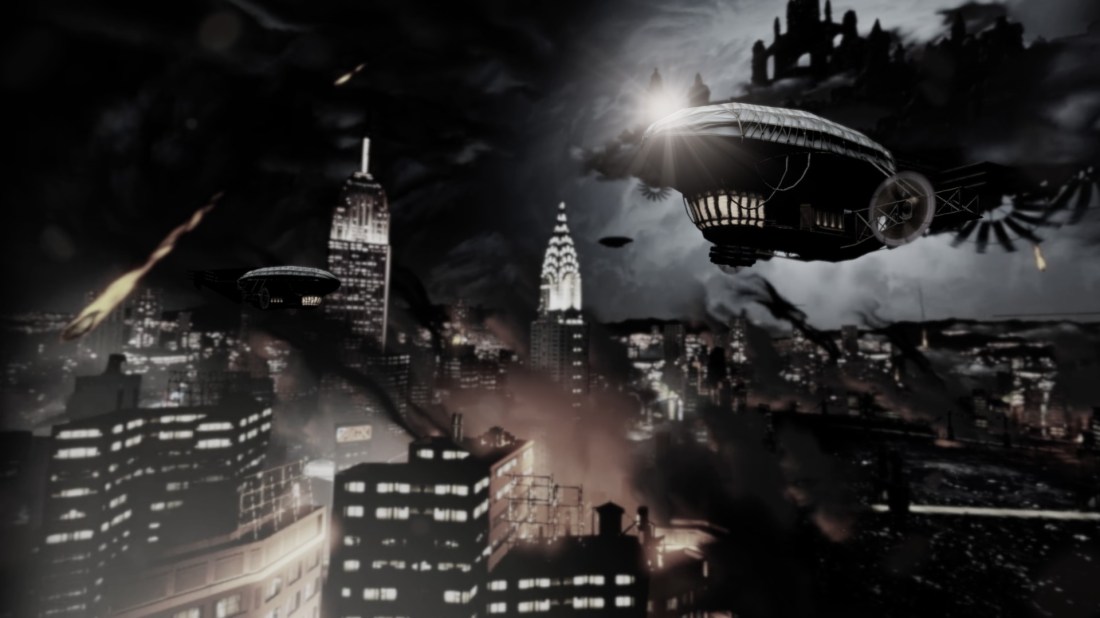
Thus far Infinite has us shooting through a quantum physics-based plot murdering racist religious fanatics -and those who oppose them- while hop-scotching around multiverses to escape a floating city with a Disney Princess who can alter reality and pass through dimensions with her mind but not conjure an exit. While being chased by a giant mechanical crow.

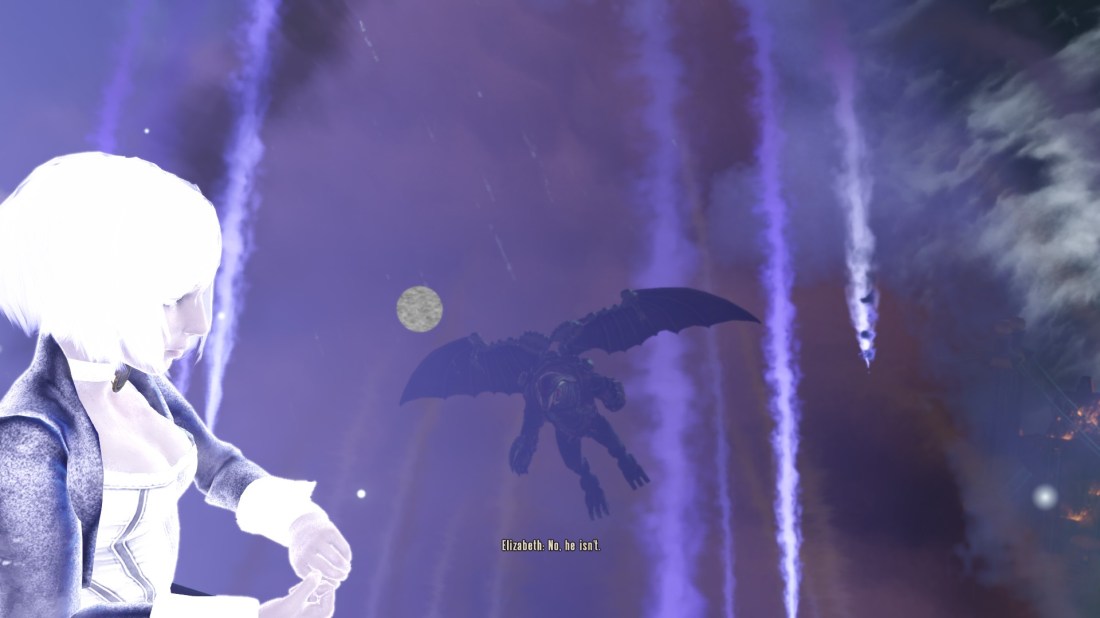
Having reached Comstock’s airship, there’s nothing stopping us escaping so Songbird swoops down and swipes Liz. Then we’re in the future. 1984 to be clichéd exact. Without Booker to protect her, the years of conditioning turned Liz into the superweapon Comstock prophesied; Columbia is the Ark and Elizabeth the flood. We finally see what her potential really was … directing the Columbia airships to launch missiles. What? Comstock said she was God’s instrument, we’ve seen elements of her power and this is it? I wanted to see her tears pouring death from above, real fire and brimstone stuff, Sleeping Beauty become Maleficent. Nope. No Tear in sight. Just ‘drop a bomb there’. Not even Songbird!

Turns out Old Liz pulled us into this time to stop it happening. Okay, (deep breath) I thought she was on Comstock’s side now? She can’t be brain-washed and aware it’s wrong; Why not have a mini-boss battle with her? Save her, break the conditioning. Imagine that. And, she can time-tear? Oh and, because Old Liz sent us back with a clue to stop Comstock, that means not only can we affect the timeline but that this future won’t happen so we won’t get the clue which means … oh phew, here comes Levine waving his Quantum Theory for Dummies book, now with an all-new Grandfather Paradox Explained chapter!

Back to reality. We arrive just in time to see Young Liz’s super-charged powers open a tear to a tornado which wipes out everyone experimenting on her. THAT’S what I’m talking about! Go Liz! Then she NEVER does it again. So, with zero help from Tornado Liz, we storm Comstock’s airship. Comstock’s got to be impressive, charismatic, commanding, convincing to have pulled all this off; with the scene of Ryan playing golf while Rapture crumbles in mind, we wonder if we’ll meet the Devil or a con-man.

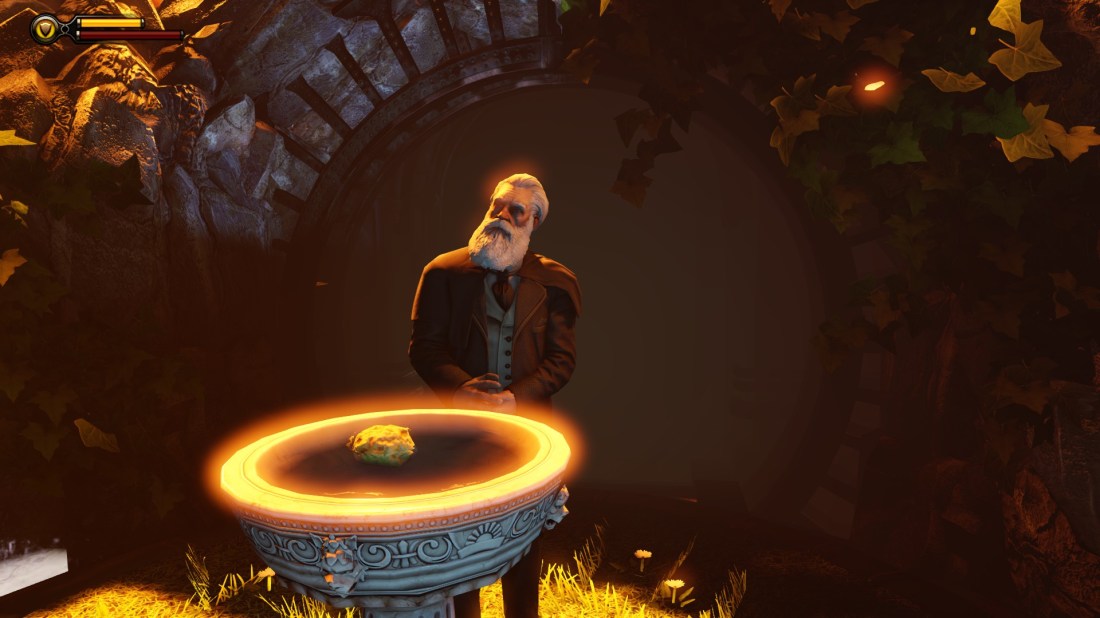
One good thing about this scene; I’ll never again be lost for an example of a game let-down. Comstock could have been one of the most complicated villains in gaming history; he seems to believe in his Old Testament sermons, but we also know he faked his Prophet-like status, using the Tears to gain knowledge. He was building an army to wipe clean the earth but because God told him to or a power-mad desire? And what of his segregation/slavery beliefs? We’ll never know because no sooner have we got past the pleasantries when Booker inexplicably kills him. Just like that. There’s only one reason why that happened. There’s a twist coming. Why is this entire game acting like it’s a ‘previously on’? Comstock, the Luteces, they all know but won’t let on – unless withholding the reveal is key to our final success, this game will be an unconscionable cheat. Before we have a chance to realise we got cheated, the game quickly spirals into an aggravating wave battle while Liz realises the clue from her future-self lets her control Songbird – that’s awesome cool! Sod Comstock, I wanna play Songbird! Wait … Why am I playing Serious Sam with the Vox while Songbird is relegated to background attacks in a hurried point and click? Why can’t we just fly Songbird about?! Massive Crow. Check. Remote control for Crow. Check. Tons of revolutionary, down with the racist and religious nut Vox soldiers to uncomfortably slaughter? Check. Instead I’m busy shooting like I’ve done throughout?

So, given Songbird was the thing stopping us leaving and we have control of it, there’s nothing stopping us leaving – Yes, there is. Booker DROPS the remote over the side. That’s a moment of sickeningly bad, lazy storytelling. Songbird comes in for the kill and Liz opens a tear and transports us to … Rapture! The game already (desperately) justified the Vigors by showing they were Plasmids stolen through a tear so it seemed like we might visit. It’s nice, apart from watching Songbird die outside in the crushing water. It’s really quite sad; Songbird was such a tragic, disturbing creature and not just some automaton, it was a mix between Kong and a Big Daddy and it loved Liz, it’s only joy was looking after her. It’s a beautiful, heart-breaking, touching scene and completely out of place in the rest of this shitty, cheating story. God I hate this game.

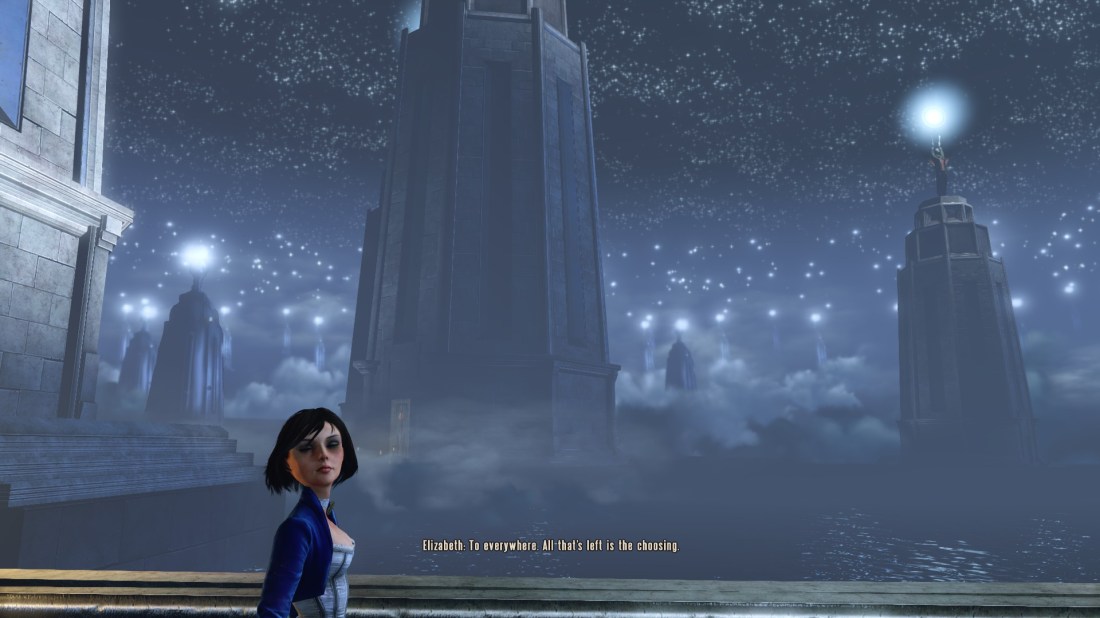
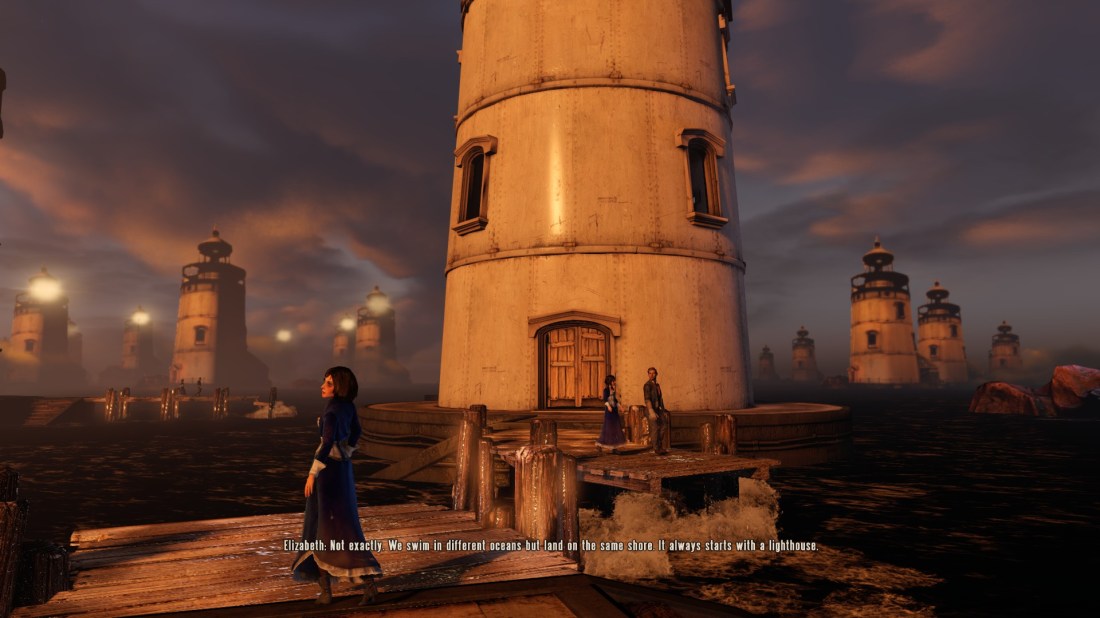
So, Comstock dead, Songbird gone, free of Columbia; we’re all good, right? Roll the credits. Wrong. Liz’s full powers are unleashed and that gives her … the power to become a know-it-all. We float toward the surface catching a glimpse of Rapture as we go, but of course the moment is spoilt; Booker smirks ‘a city under the sea? Ridiculous’. You’ve just been on a floating … oh I’m done with you. Once by the lighthouse, Liz continues to ramble on; just like Comstock and the Luteces, she knows something she’s not telling me.

Remember that scene in the Matrix when the little kid explains reality; ‘There is no spoon’? and we understood; back to the bullet-time. If you ask Liz she’d talk about a bowl from the spoon’s perspective. Infinite has become Levine’s half-term paper on Quantum Theory and he’s just padding it to reach the word-count. There’s an apocryphal Feynman quote, “If you can’t explain it to a six-year-old, you don’t really understand it.” And here we are. Infinite isn’t hard to understand until they explain it, then you realise they don’t know either.

The biggest surprise though is why huge plot twists deserved to be left until the end. We sit through moments that are completely drained of impact because we literally just walking behind Liz who explains everything. It’s like a magician explaining their trick, the power, the wonder is drained out of it.

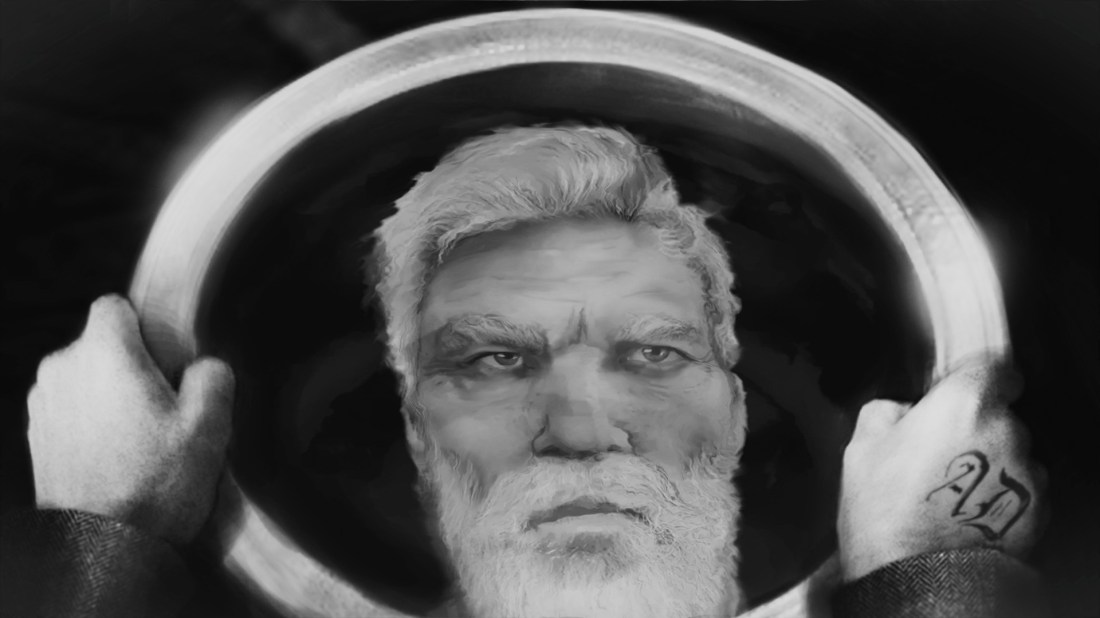
Comstock is Booker in this reality. Whoa! Imagine working up to meeting yourself?! Questioning yourself, what your doppelganger did, wondering if you were capable. That would have been horrible; it’s not now, being told after the fact just makes you go ‘oh’. The moment Jack sees the ‘would you kindly’ quote on Ryan’s wall, that blew your mind. It was in front of you the whole time, a masterful twist, but Infinite never gives you that realisation. Next!

Comstock’s tear use aged him. Why? Oh of course, so the game wouldn’t tip it’s hand and let me recognise him. It also caused him to become infertile. Jeez you weren’t kidding when you said anything’s possible with Quantum Theory. Oh god, that means … Liz is my daughter! I don’t seem to react to that whatsoever. Neither does she. I get reunions are difficult but come on. Again, that could have been an interesting reveal midway through, change Booker’s opinion of her, from a payday to his daughter, revaluate himself while they awkwardly get to know each other. But hang on, this throws up all sorts of ques – Oh god, it’s the Luteces isn’t it.

Comstock made them open a tear to another reality where Booker, a burn-out after acts he committed in the war, sells the Luteces his daughter, Anna; but at the last second he regrets it and the tear closes and she loses a finger. That is an incredibly strong, shocking scene. But the game panics; we’re sitting there going ‘how did I forget all this?’ and it hurriedly explains Booker lost key memories passing through the tear at the beginning due to his mind trying to reconcile being in Comstock’s reality. Quantum Theory is so bloody convenient. I remember my acts in the war but not a daughter I regretted selling to pay off gambling debts? No sense.

Then there’s the finger thing. It’s because of that Liz can tear between realities? Not just those two, all realities? See, if her Pinkie is in our dimension and her body in Comstock’s why multiverses? Why not just the two? That would have been clean and concise; Comstock universe, Booker universe. Missing daughter, found daughter. Exciting game, emotional game. There’s ironically more potential in two universes than in infinite ones.

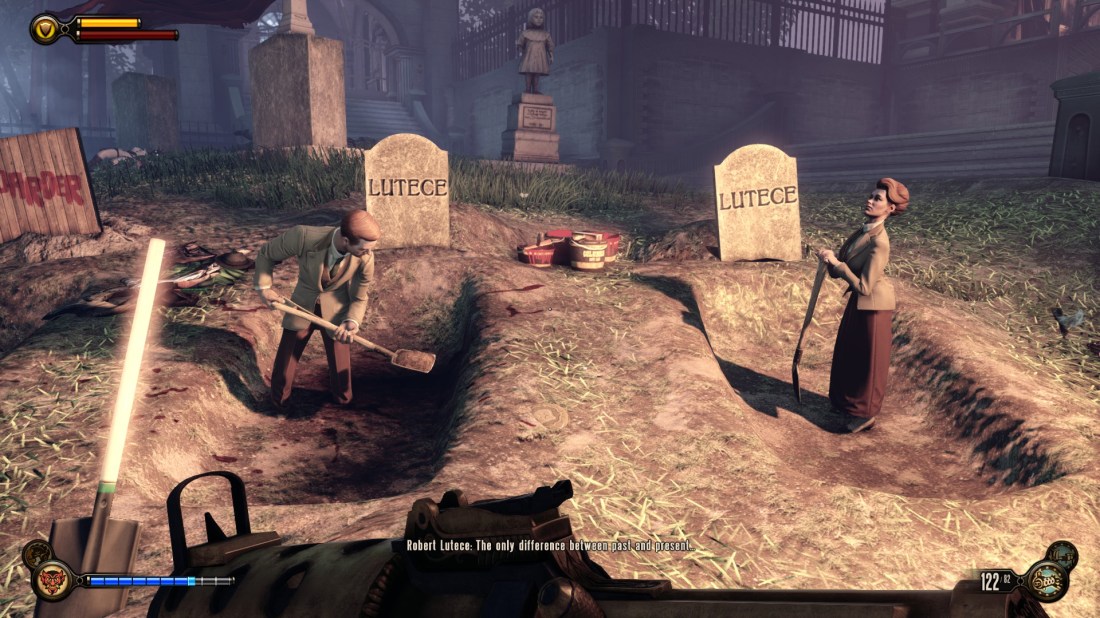
The first bit of good news is the fate of the Luteces; after being murdered (yay!) by Comstock to cover his plot, they were spread across all known realities and realised what Comstock had in store for the girl. They resolved to find a Booker and send him into the world to rescue the girl, and hundreds of Bookers later it was our turn, explaining all the see, saw, seen guff. If they wanted to break the cycle why did they continue with their non-sequitur ‘if only you knew’ bants?! They had critical info that would have helped, not knowing didn’t change the outcome just made it harder to achieve! The dicks. The Luteces are the only ones who could have tortured the lighthouse keeper to get the access code at the start. So they themselves can alter and affect things, they didn’t even NEED a Booker or at the very least, they had no reason to keep it from him. It was all for this twist. Bad, cheaty storytelling. Dead. Died. Die.

Eventually Liz leads us back to a baptism that our Booker refused while that Booker took and became Comstock, setting him on his floating-city journey. Somehow. The only way to stop the cycle is for Comstock to never exist. As in, kill Booker to ensure Comstock never lives. Thing is, her thinking is flawed – we’re in a game called Infinite, so that means endless Comstocks; that means there’s a Columbia that helped to usher in world peace, a reality where Booker and Anna lived happily and at least one where Comstock wasn’t an extremist – not every believer is a religious terrorist and you want to kill them too? When you think about it, killing Booker only saves the Luteces. Godamnit! Although, that would be an ending; the whole thing was them just saving themselves. And what’s to stop them giving the tear concept to someone else who is equally nefarious? They’re the villains. We just get Liz joined by other-reality Liz’s for no reason except it looks cool and they drown me. Good.

Of course, there’s one final cheat; Mid-credits, Booker awakes to the sound of Anna crying. Did Infinite just imply it was all a dream?! If not, that undermines the entire game. Liz, open a tear to the exit menu.

Infinite is an incredibly offensive game; raising religious extremism and racism then jettisoning them – you do not use such contentious subjects as filler – having the Vox suddenly become the villains because they’re violent, casting Comstock as a religious zealot and imply he’s a fake – not to mention that his conversion to religion caused all of this; it’s just wrong. And then there’s the plot holes; What about Comstock’s vision, why did they fire on China and why did he prepare the citizens for the coming of the False Shepard; he had no reason to assume the Luteces would turn on him, he killed them to make sure Booker couldn’t follow him. And of course the unresolved issue that that the game lets me be racist; in Bioshock we could murder little girls but you made that call and lived with it and the consequences – it’s as if the stoning scene is an in-joke; something so horrible has no consequences after-all; haha, you thought it was a moral choice, tricked you. Well fuck you Infinite, stoning a mixed-race couple is not a punchline.

There’s so many ways it could have gone; Comstock be a deadhead controlled by the Luteces and we’re just rats in their lab, or Liz even; planned it all to gain her full power. If this game wanted to explore any social issue it should have been the cult of personality; Why folks follow someone like Comstock, we see it in the real world every day. That would have justified almost all of it. It’s not even a very good shooter.

DLC

Clash in the Clouds is the worst kind of DLC – an arena battle. You expect something more; liberating the Vox, a tear-based experience, anything but this. I’d half expect it to just be surviving waves of non-sequitur exposition from the Luteces.

The second and third DLC though, Burial at Sea, seemed more like it. Set in Rapture as a prequel, this was going give us what we wanted in the first place, before it all happened.

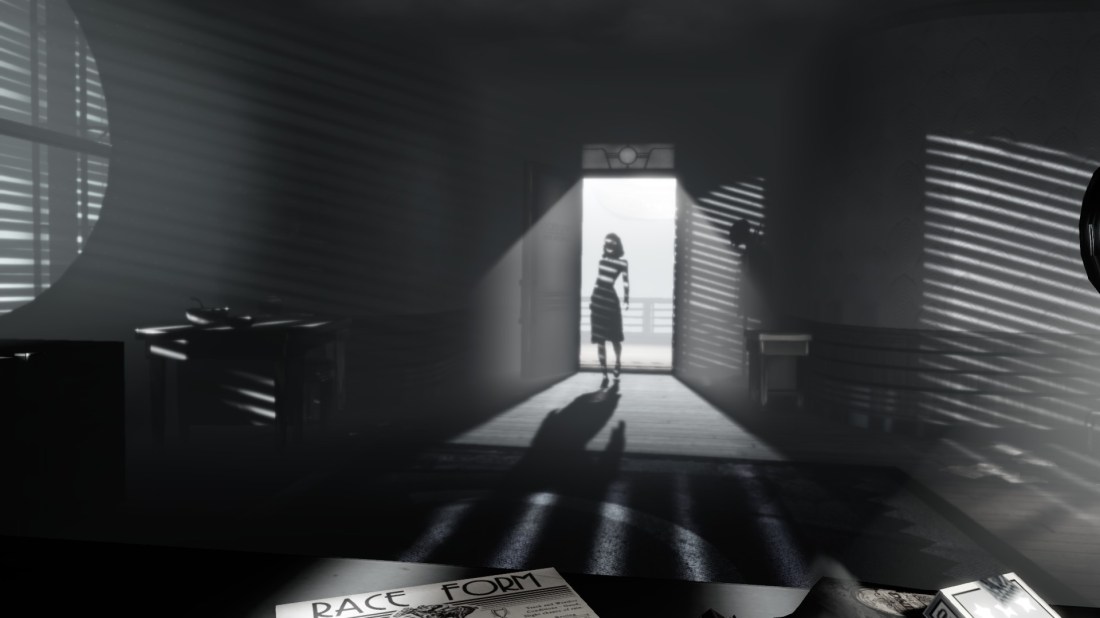
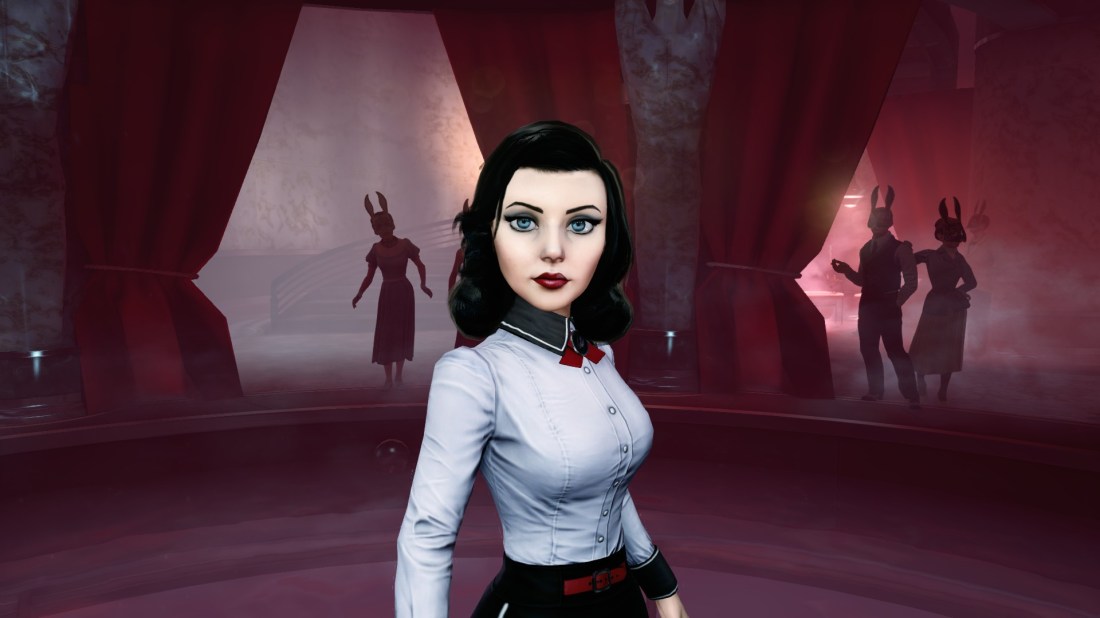
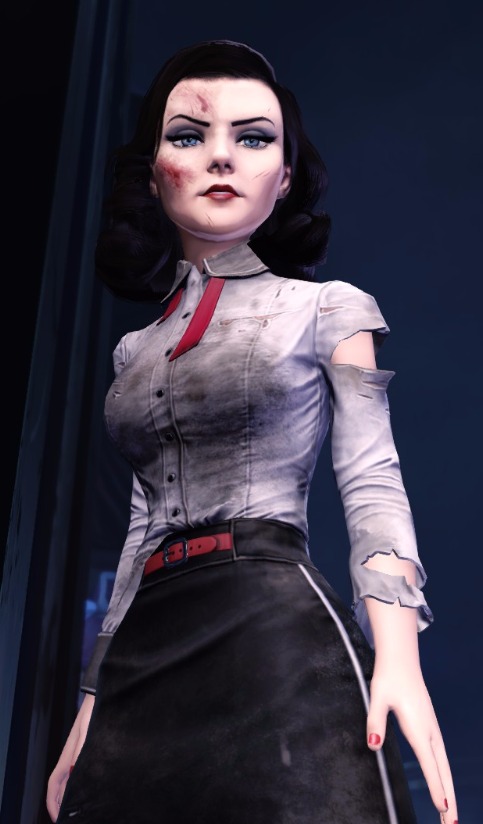
Pre-War Rapture. Into Private Eye Booker’s office sashays femme-fatale Liz – in Infinite she was a waifish Disney Princess, in Burial she’s an hourglass-figured Kitty Collins. Liz engages Booker to find Sally, one of several little girls who’ve gone missing recently, and as we follow her Rita Hayworth walk to the door … there is Rapture. In it’s prime, right when life couldn’t get any better beneath the waves. It is absolutely beautiful and I spend an age just taking it in. We light Liz’s cigarette with a click of our fingers, a waiter uses his Houdini plasmid to deliver drinks quicker, it’s amazing. I’m not triggering any story-related stuff, I’m just going to live here.

But it’s short-lived. After a cameo from Sander Coen, we’re headed for Fontaine’s Department Store, where Sally was last seen. This place is unfortunately the Rapture we know; decrepit and looted after Ryan sunk it to banish Fontaine’s followers. There’s no splicers but we do have weapons and plasmid-Vigors to batter Fontaine’s men with; Once we find Little Sister Sally (it was obvious) Booker is surprisingly offed by her Big Daddy. For the first third, that was an awesome run through Rapture and felt like pure, honest fan-service. But never fear, the Luteces are here to ruin it all.

In brief, this Booker’s Anna was killed during an attempt to steal her. Taking pity on him, the Letuces wiped his memory and deposited him in Rapture. He tries to apologise to Liz for cutting his her in half but she’s having none of it and it turns out she’s only here to see another Booker bite the dust. This girl’s got Daddy issues.

So we’ve missed an entire sequence where this Liz became some sort of inter-dimensional time-traveling assassin systematically killing surviving Bookers/Comstocks? Because that would have been awesome; an Assassin’s Creed Infinite? Although, if there’s one surviving Booker then the drowning didn’t work? Still, with Booker very dead where’s part two going? Where doesn’t it go!

Part two picks up almost straight away, after a blatant dream sequence – GET ON WITH IT. Once over, a dazed Liz watches as Atlas captures Little Sister Sally. Awesome, we’re Liz?! We’re gonna get to play God and use tears and run rampant! Then Booker reappears and coaches Liz to say what Atlas needs to hear before he kills her. Kills her? Wait …

Because Irrational missed sexism off their list of bungled social issues in the main game, Burial pt2 strips Liz of everything that made her special, different, powerful. Through whiny monologues, Liz explains to her dead dad conscience (shouldn’t he know?) that she felt guilt about using Sally to expose Booker and the Big Daddy subsequently killed her; the Luteces sent dead Liz back through a tear to rescue Sally but due to reasons, she now has no tears and no foresight. Sigh. Aside from the loss of her powers, Pt2 is primarily a stealth game – Liz can’t take down a Big Daddy, doesn’t get anywhere near the destructive level of Plasmid-Vigors that Booker did, nor does she have any heavy weaponry; Liz even has some non-lethal weapons – she drowned her own dad, I don’t think murder is a problem for Liz.

After helping Atlas reach Rapture, he of course betrays us then puts her through some unnecessary torture during which Liz passes out and misses the war. Goddamnit. She’s awakened just as Atlas is on the ropes and saves herself by offering to find the ‘ace in the hole’. Now weapon-less, Liz has become as much a Little Sister as Sally, driven by the will of men and its uncomfortable given Infinite was all about her freedom. She just walks through the ‘previously on Bioshock’ backstory, getting Atlas Jack’s trigger phrase. We couldn’t just have her finding Sally and the two escaping Rapture, have a mini-adventure, a self-contained view of the war? No, because that would have been great. Instead, it’s got to be all so epic and worthy; Liz realised the only way to save Sally is Jack; by ensuring Jack is brought to Rapture, Sally will be saved. At least she didn’t go back and drown Ryan who turned out to be Jack who was also her dad.

As a return to Rapture, Burial is a total con. We already know the story; Liz’s meddling isn’t interesting to play/watch as we never had any questions about Atlas’ rise. We barely spend any time in the period we’re most curious about and unforgivably miss the key defining moment, the 1959 New Year’s Eve War. The stealthing to avoid a Big Daddy does feel more realistic given their reputation but it would have been better during Booker’s part not Liz; she just jumps through hoops instead of tears and its a shame she’s reduced to a victim – turning Liz into a tragic character betrays her and makes a mockery of the main game’s own ending; plus, what if we played Jack as a bad-guy and killed all the Little Sisters? If the ‘good’ ending to Bioshock is the franchise cannon, then you’ve undermined that game as well. Even Bioshock 2 was kind enough to avoid Jack’s actions beyond the show down with Ryan/Fontaine. Not even an argument that Burial is Irrational’s love poem to where it all started holds water because it betrays everything Bioshock stood for. Ryan would call Infinite a parasite.

Developer; Irrational Games | Publisher; 2K games

platforms; Win | PS 3/4 | X360/One

Bioshock Infinite Pt 1

A SECOND WIND special REVIEW

In this, the first part of FBT’s all-inclusive trip to Columbia, he wrestles with quantum physics and his quantum of patience. *as a complete playthrough review, this contains spoilers*

Bioshock is one of my favourite games. So when that teaser trailer for Infinite showed a Big Daddy as an aquarium ornament and us trapped by sky not sea, I was concerned. Is Infinite going to sing Rise, Rapture, Rise or get in the sea?

At the opening, all the Bioshock references are here – It’s night, we have a box with a gun and a photo and we’re headed for a lighthouse. This time, we’re on our way to ‘get the girl and wipe away the debt’. My name is Booker DeWitt, I’m a private eye – in a rowing boat, with two people in yellow sou’westers. Very noir. This is nowhere near the dizzying impact of Bioshock’s opening; sitting comfortably on a plane hearing “They told me, ‘Son, you’re special. You were born to do great things.’ You know what? They were right.” Then the sounds of screaming and the plane crashing. That was an opening. Instead, Infinite gives us a rowing boat and the rowers chatting;


“One goes into an experiment knowing one could fail.

But one does not undertake an experiment knowing one HAS failed.

Can we get back to the rowing?

I suggest you do, or we’re never going to get there.

No, I mean I’d greatly appreciate it if you would assist.

Perhaps you should ask him. I imagine he has a greater interest in getting there than I do.

I suppose he does…but there’s no point in asking.

Why not?

Because he doesn’t row.

He doesn’t row?

No. He doesn’t row.

Ah. I see what you mean”


So do I. It means you’re pretentious. And that’s just a slice of what we endure during the game. The rowers are The Luteces and as our guides, they pop up just to aggravate you. They’re award-winning characters with a strong fanbase who think they’r

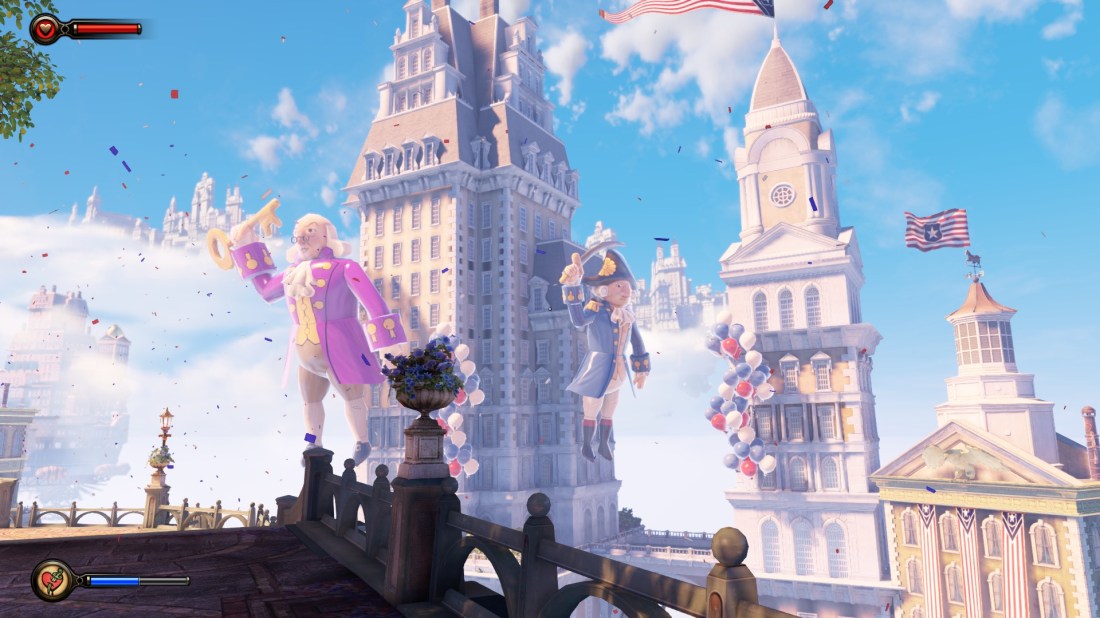
e brilliant and subversive. They’re not. Freed of the Luteces (or as they would say; freed, free, will be free – sod, sods, sod off), I head into the lighthouse where I find a dead body and a warning not to fail. I get launched up into the sky rather than sink into the depths and I’m … I’m in Pixar’s Up the Video Game? It’s kinda cool and surreal, it looks like Bake-Off. I’m forced into a baptism and emerge from the purifying waters to see statues of the American founding fathers. Welcome to Columbia; worship and submission vs Rapture’s self and laissez-faire lifestyle. Why is this called Bioshock? If Infinite is yet another ‘spiritual successor’ to Systemshock (let it go), why not call this Godshock? Skyshock?

By now I’ve wandered into a fair, with stalls and candy-floss. I like the walking with the enemy style, I don’t even have a weapon or see any threat; but there’s a rot creeping in; I notice white people enjoying the day and POC cleaning up after them, deeply offensive advertising that encourages kids to fear the minority races below. How did we get above though?

Rosalind Lutece discovered how to make an atom float or something and for some reason shows it to God-botherer Comstock, who wants to build a floating city he saw in a vision. They do so, and Columbia is proclaimed a new state of America. It goes on a world tour, announcing the USA’s new superpower status but after firing on China, Columbia is disavowed then disappears. Comstock becomes a Prophet, able to see sins and the future, gaining the devotion of Columbia’s people while his daughter is set to lead the Prophet’s flock to the Promised Land. I bet that’s the girl we need.

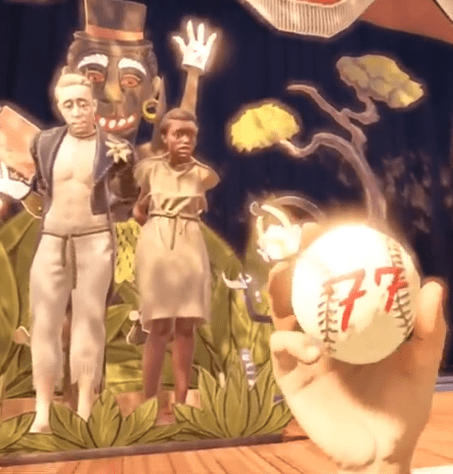
While I am itching to start putting things right as violently as possible, I kinda hope I have to keep up the pretence rather than everything go black and white (as it were) shooter style. I take in a show … and see a mixed-race couple wheeled onto the stage to be stoned (with that symbol of America, the baseball). It falls to me of course, to make the Ceremonial first throw. He winds into the pitch and … the game actually gives me the option to fastball the couple. What? I choose not to and risk blowing my cover; I aim for the ringmaster instead but get stopped before making the pitch by a conveniently placed policeman, who spotted a brand on my hand – ‘AD’ – apparently, the mark of the ‘False Shepherd’ prophesied to steal the daughter. You’d think the Luteces would have warned me about that. Booker even spots it on a poster, warning the populace – but he doesn’t try to hide the mark because too easy. In the panic I murder the policeman with his own melee weapon; the ‘skyhook’. A wrench with gears on it, the Skyhook allows me to beat them to death or pop their heads off like a cork. It’s gory and extreme but they’re racists so it’s okay. The rest of Columbia has scarpered rather than stop the false shepherd, so I guess they’re not evil after all. They even left their baseballs behind. But before I carry on, I could stone a mixed-race couple?

I reload and reach this point again, and this time aim for the couple. Same result; same copper stops me, same branding, same mayhem. That’s unsettling. I expected to remain unknown if I did it. I’m guessing this has a future impact – It is Bioshock afterall, master of the moral choice and this can’t go unanswered; you just play as racist or not? I reload again, feeling a bit disgusted and aim for Ringmaster to set things right. Later, the couple offer me a power-up as a thank you. That was it? I was originally reminded of Sherley Jackson’s The Lottery as that scene started, and an isolated, extreme community that’s lost its humanity, a futuristic paganism-style Wicker Man instead of Atlas Shrugged could make for a good game, but now I’m unsure Infinite is going that way; soon after, the Luteces’ block my way and demand I flip a coin, which lands the same side as has done dozens of times before. Before? Ohho, we’ve done this before haven’t we. It’s about constants and variables isn’t it. That suspiciously suggests all this class-struggle, racism and religious extremism is a smoke-screen for something ‘mind-bending’. The only mind-bending I’m doing is how that justifies being allowed to stone someone. It just bothers me, and it bothers me that this is based in the game series where choice means something; again, call it something else because if this doesn’t have key themes of Bioshock – self-determination for one, it’s going to start annoying me.

Still, hoping there’s more to it, I press on, now weaponised. Weapons in Columbia follow a standard loadout but you can only carry two at a time because Booker is a pussy. Jack, who was technically a toddler could carry eight weapons. But, we have Vigors.

Why do we have Vigors? Because you’re in a Bioshock game. When you wandered Rapture, you saw advertising for the Plasmids – Incinerate’s ad showed a man lighting his date’s cigarette; they were fads, the protein shakes and slimming pills of Rapture. That they became weapons during the war showed the desperation and ingenuity of Rapture’s people but Columbia’s Vigors already are weapons. Who are they defending themselves against, pigeons? A Murder of Crows to peck people apart; freeze, fireballs, bullet shields; what does your everyday Southern Belle need with a bullet shield? While we meet the occasional copper or mini-boss who’s full of Vigor, not one regular opponent or by-stander has them – so why can I buy them from vending machines?

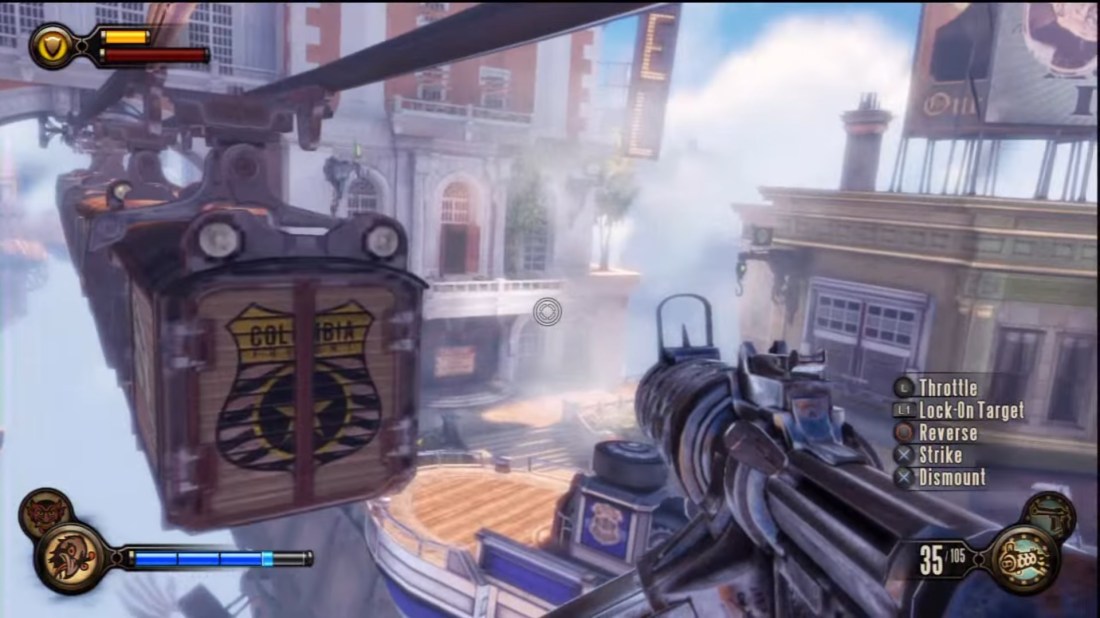
Now public enemy number one, everyone wants to kill us so we return the favour. Tramlines snake around the buildings to ferry goods and you can use the Skyhook to travel on them, leap from building to building or swing to higher ground. Should be great, yeah? It’s not.

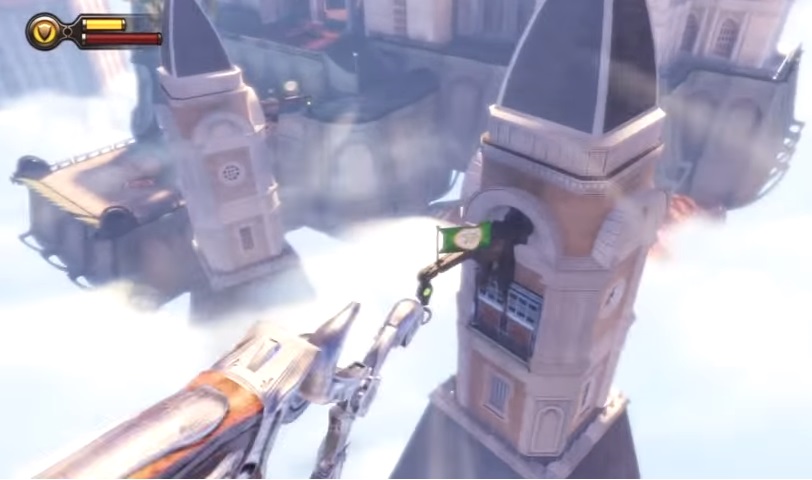
Fighting in Infinite is the same as fighting in any FPS – as in, being miles in the sky makes no difference. The Skyhook doesn’t add the aerial combat you’d hope for. Scratch that; it doesn’t add the aerial combat that absolutely should have been key to the entire game; the tracks contain you within the fight and since you’re always flying over cloud it’s not particularly exciting or nerve racking – Booker’s 30ft leaps are explained by the Skyhook being magnetic (?!) and if it’s highlighted he’ll make it, meaning there’s no thrill, no hope-for-the-best leaps. Fighting across floating buildings should be more thrilling than not at all thrilling. I should be leaping through neighbourhoods like Ferris Buller meets Jason Bourne, scrambling from building to building, desperately grasping for edges and ledges and making nerve-shredding jumps – Assassin’s Creed without the ground. And why isn’t there a Flying Vigor?! If I can summon crows surely I can float? There’s not even a stealth or parkour element to it. But the biggest let-down is that you can’t be let down; neither you nor the bad guys can fall off the edge and if you do manage a swandive, you’re mysteriously and conveniently transported back! How can I never feel scared of heights?! The fights are standard as it is, if being in the air doesn’t actually offer anything beyond the standard FPS fare what is Infinite offering? At least the story has some depth. Right?

When we finally reach the daughter, Elizabeth, it turns out we’re saving a Disney Princess – huge eyes, over-exaggerated movements and reactions. It’s Belle. Before we can rescue Rapunzel from her tower though, we must get Songbird out of her hair. A huge raven-like mech, Songbird is utterly devoted to Elizabeth. The first time you see him you’re staggered. He’s steampunk Goth and a tragic character because you assume there’s the Big Daddy-style remnants of man inside; his love for Elizabeth is heart-breaking and scary – it’s the best thing in the game until it becomes clear Songbird will only get in the way when we find an exit, and it loses all threat. They’re always great moments but Songbird is as terrifying as it is incredible as it is underused as it is frustrating.

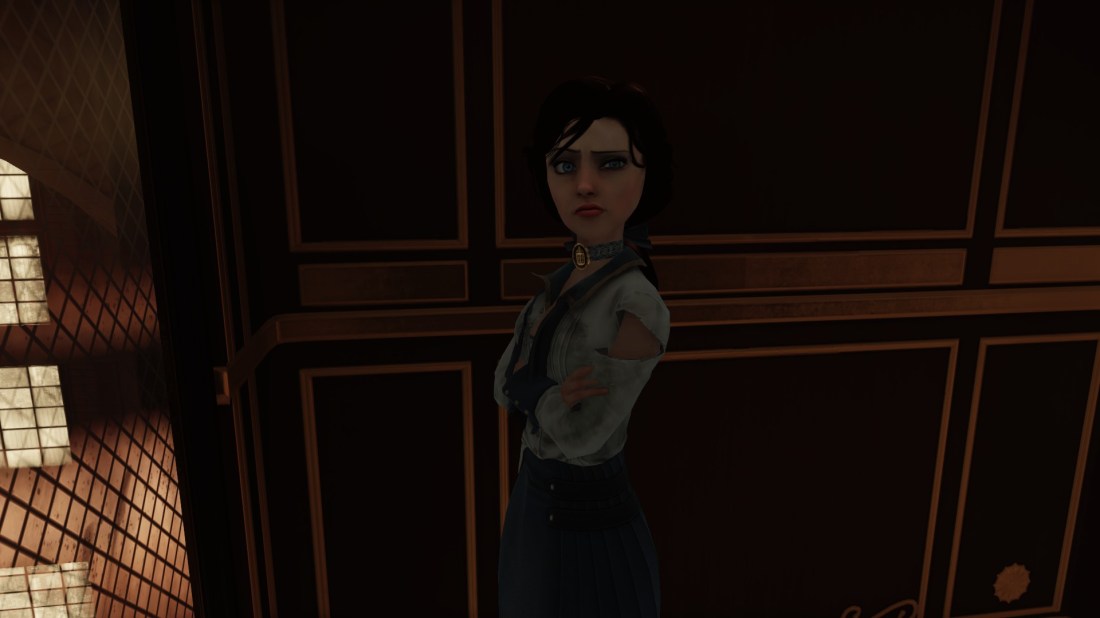
Liz meanwhile, is cute, care-free and excitable now we’ve freed her, and it is fun trying to keep tabs on her as she discovers the world outside her prison tower. The game, at least early on, is split between battle arenas and peaceful spots we navigate through, and during those times we learn more about Liz’s backstory and Comstock’s rise to power, how he’d been baptised and born again, determined to return the world to a God-fearing place. Liz knows she’s a part of that plan, but we don’t have a picture of how; yet. But Liz’s little parlour trick might have something to do with it.

Throughout Columbia we find rips, supposedly in the space-time continuum or something. Most folks ignore them, but our little princess can open and control them. And that means escape! That means we have a weapon! No it doesn’t mean those things. And this is where the stupidity of the Vigors really comes to the fore –why not have Liz open tears like Plasmids, dropping ice, rocks, the sea, storms, lightning, hurricanes, random things that could make the fights better or worse; imagine how thrilling that would be, or tears we can fight through like a shooter Portal, asking her to open them behind bad guys to give us any edge, oh the fun we don’t get to have with this. All Liz can muster is hooks, ammo or an occasional turret and they just signal there’s a battle ahead like an suspicious Auto-Save.

On top of that, Liz herself is a huge disappointment. Firstly, she can’t be killed. Second, if you get killed she nurses you back to health then nicks money off you (She steals from her saviour while he’s unconscious? Why!?) yet points out money on the floor. Thirdly, since she can’t get involved in battles Liz is reduced to passive ammo-finder and shrieker. She’s a little sister with mega-plasmids at her fingertips and all she can do is hide? At one point, she opens a tear into a corn field. To let out a bee. And we still don’t escape. A bee. Meanwhile I’m hanging off an imaginary hook in the middle of a firefight. That makes no sense. But never fear, the Luteces are here. They explain the tears as rips into parallel universes. Okay cool, got it. They continue by using a coin to explain; Heads, tails, two sides, same coin (Gotcha, let’s go) Someone might be dead in our universe but in the other he’ll be alive (Okay!) It’s a matter of perspective (I KNOW), it’s like riding a bicycle, you – Why? WHY?! Why go on about it, it’s not rocket science to a gamer, we’ve been pissing about with portals since Jet Set Willy. The perspective I see is padding – you’ve still not explained why Liz can also create portals to places other than Columbia but only Bees can use them. This is a major fault in Infinite, it seems to thoroughly enjoy telling you how mind-bending it all is, but the more it does it the more you pull your ‘bullshit’ face.

Liz opens a tear into another Columbia where we find a revolution in full swing. The Vox Populi, an under-class uprising is taking the city by force; so we’re gonna fight alongside those guys to explore and tear down nationalism, extremism and racism right? Nope. We were sent into this dimension to get ‘our’ Vox Populi some weapons to begin their revolution in return for access to the airship and escape. I think. We reach the gunsmith but he’s a ghost – Liz explains it thusly; ‘remember we found him dead? How would you reconcile that?’ Well, I’d lie down and, wait … what? Levine smugly claimed theorist Max Planck once said ‘If thinking about quantum mechanics doesn’t make you angry, you’re doing it wrong.’ But Levine is making me angry. Quantum mechanics can make no sense but the game has to; you’re making it all up as you go. That would make Planck angry but what makes me angry is Liz then papers over it with; ‘I don’t know if I brought us to a world or created one’ – where are you getting that from?! You think can create alternative universes with your mind? So think of Paris and get us TF out of here. FFS don’t create an opportunity then ignore it, it’s like Doom giving you the BFG but no ammo.

It’s all forgotten anyway because soon after we have the head of the Vox blocking our exit. She’s holding a child hostage. Now they’re the villains? We’re putting down the revolution? And I kill every Vox that appears, yet the theocracy-loving, isolationist slaver population can’t be shot? Is there a reality where this game isn’t misjudged?

As we fight towards the Airship and our escape, Liz carries on with her wild assumptions and even wilder actions such as reanimating her dead mother. Liz explains the ghost is actually her own feelings of resentment for her father; you what now? And the Mother makes us follow her about opening tears to past events – So not only are the tears interdimensional but Liz can conjure key events from the past she didn’t witness. At one point Liz says ‘I don’t understand it either’. Oh for fucks sake. The only reason this isn’t a Rage Quit review is I want to see what bullshit they come up with next.

We’ll take a breather here and let FBT calm down. But read part two where he completely loses it (Nobody tell him about the DLCs being set in Rapture)

Morrowind | Oblivion | Skyrim – Pt2

A SECOND WIND special REVIEW

Morrowind, Oblivion & Skyrim – Pt2

Part Two of FBT’s special rambling ramble through the world of The Elder Scrolls. After winning the minds of Morrowind and the heart of Martin in Oblivion, he winds up in Skyrim without a visa. *spoilers*

I find myself on a horse-drawn cart. A hayride, how exciting after the prison ship of Morrowind and prison cell of Oblivion. Opposite me is a local. With a gag over his mouth. My hands are bound. A prison cart?! As we idle our way through a striking forest, another prisoner fills me in on what’s happening. Gag-guy is a ‘Jarl’, a local ruler called Ulfric who murdered the High-king of Skyrim for supporting Imperial rule rather than leading Skyrim’s succeeding from their control. Now we’re facing civil war between the Skyrim folk and the Imperial forces from Cyrodiil. Well me-laddo given me and my bro Martin just saved the empire I think I’ll have something to say about that, even if you can’t. As we reach a small, quaint town it turns out I won’t have time to say anything as I’m off to the headsman. Then we hear a strange roar. It’s all strange to me, but everyone else looks up and wonders what the hell was that. As the axe swings we hear another. By the nine it’s a dragon! Except, someone proclaims ‘By the eight it’s a dragon!’ Ohhh what happened to ‘By the Nine’, a phrase we heard throughou – Oh yeah, dragon. Dragon!

A huge, exciting dragon makes short work of the village and most of the folks in it. It’s a visceral moment, an absolute killer opening; the dragon is HUGE and I’m running about like a maniac until I realise I’m in an interactive cut-scene. There’s a hundred foot long dragon smacking holy hell out of everything and I’m safe from it even when I’m a foot away. I reach a guard and the prisoner who filled us in earlier; both ask me to follow them. I chose the hayride guy since the imperials were happy to kill me. Safe from the safe dragon, we tutorial our way through a ruined building looking for an escape. Fighting, spells, lock-picking (this doesn’t need a tutorial if you’ve played Fallout 3 or 4), and so on. Free, Hayrider thanks me for my help –he couldn’t have escaped without me following him– and suggests I go visit his sister (now that is a thank you), then takes off. I take my first step into Skyrim.

Skyrim is a huge step from Oblivion. There was five years between Oblivion and Skyrim but even so, the woodland, beautiful little streams, swaying grass, it’s so incredibly real – as in, not fantasy; it’s so close to a modern woodland I expect to see one of those dog poop bins. I debate which way to walk and take a look at the menu instead. Oblivion’s menu felt warm, like we were flicking through an old leather-bound book as did Morrowind’s insane diary, but Skyrim’s menu feels like an iOS; minimalist, clean, cold. The level up system looks beautiful though, with each ability represented as a star sign. We’ve got the usual inventory, which will get full of junk, weapons, magic and the much-shouted-about Dragon shouts. I’m looking forward to being a loudmouth so, against habit, I resolve to head towards Miss Hayride to get the main mission under way.

Where the hell is she?

The map is incredible and aggravating. It can be tilted and panned like Google Maps, but clouds pass over it obscuring everything. A map gives an RPG’er a sense not of direction, but how epic their adventure has been and how much more there is to do; it encourages exploring. From up here the adventure just looks cloudy and it keeps you at a distance.

Let’s make with the walking. There is a lot to walk in Skyrim and things to walk in to. The woodlands are lush with trees giving way to gorgeous rivers cutting through cliffs leading to castles, keeps, dungeons, forts, huge Dwemer ruins, camps, villages, graves, more ruins, but it all feels a bit realistic, familiar. More real than unreal, more recognisable than the high-fantasy of Morrowind. This just seems like 1970s Scotland. Most of the time fog descends, grey clouds roll over and it feels a bit depressed. Okay so it’s supposed to be an isolated and insulated part of Tamriel but Skyrim feels like I’m taking a shortcut through some inner-city park, where a bunch of scruffy kids will give me a quest to buy them a pack of Lambert & Butlers. The towns are cold and miserable and so are the NPCs. Sure, there’s a war on, that’ll make anyone grumpy but they’re as grey and humourless as their surroundings. It’s like the game was built to grey-scale rather than the lush colours of Oblivion or Morrowind’s stark contrasts. And if you’re not trudging through grey it’s white – snow is never interesting to look at in a game.

Fighting in Skyrim is hella fun, just repetitive. In Oblivion you can dual-wield sort of, if you had a sword in one hand and a spell or shield in the other. Skyrim goes for the ambidextrous look with two of almost anything, weapons and/or spells, except two-handed weapons of course. It doesn’t make a huge difference, you’ll still hack the hell out of everything, but in reskinning the death-animations from Fallout 3, you get some killer slo-mo kills; even on Dragons on occasion.

Problem is, the creatures are boring; dogs, wolves, bears, walruses, saber-cats and mammoths make up most of Skyrim’s creature features; it feels more like an alternative pre-history than fantasy game. None of the pure originality of a Netch or Guar, nothing truly fantasy. Worse, you quickly start to anticipate what you’ll encounter; every tomb has the zombie dead-walker types, every cave has a giant spider – cool, but when you’re unsurprised by a giant spider, something’s off and part of the problem is Skyrim’s sheer size. Dozens of samey crypts and caves means dozens of the samey creatures. Skyrim? Samerim.

There are some semi-human baddies we face up to, but they’re frustratingly under-used considering their backstory. We kill lots of the decrepit Falmer; Once ‘snow elves’, they were hunted to near extinction by Skyrim locals, the Nords, and hid in Dwemer ruins where subsiding on fungus turned them into blind monstrous slaves. It would have been involving to explore their tragic turn but they’re just fodder. Same goes for Hagraven; the only really f’ed up villains in the game who are criminally underused; a half bird woman!? That’s the stuff of nightmares. We do encounter a non-hostile Hagraven, which disappointingly behaves like a hiss and cackle witch from a kids tv show – how did the Hagraven end up so wasted? They’re amazing. Every time I encounter one I’m scared and disappointed in equal measure. Then there’s The Forsworn, reskinned Fallout 3 Raiders with a better backstory; forced into the wilderness by the Nords, they worship the Hagravens and demand the return of their land – there’s rumours they have spies in the cities sabotaging and weakening defences. Why aren’t they more heavily involved in the power struggle between the Nords and the Imperials? To get a well-organised and feared terrorist group on side in return for giving back their land seems like a no-brainer (Shepard would find a way) and the repercussions could be great; do you mobilise a dangerous group, can you control them, can they be trusted? None of that happens. Why does none of that happen?

There’s boo-hiss villains in the shape of the Thalmor who politically control the empire by using/abusing a peace-treaty struck after the power vacuum caused by the events of Oblivion (sorry). It’s their refusal to allow Talos worship (Martin’s ancestor! And the missing ‘Nine’) that triggers much of the events in Skyrim, but do we tangle with the Thalmor? Engage them, weaken their stranglehold, expose their machinations? Nope. They’re the power behind the throne, arguably the reason for all this unrest and coupled with the Forsworn and others we meet, this has the makings of a grand conspiracy, power-shifts, manipulations, sides to chose and repercussions to face; we are in the midst of a civil war after all, desperate times, desperate measures? Naa.

Anyway, Hayride explained when Talos worship was outlawed, Ulfric used it as a catalyst to rally the rest of the Nords to demand secession from the Empire and when – Sorry, can I just interject for a second? Ahem … DRAGONS! Anyone? I came for the giant flying lizards not to be tricked into Brexit the Video Game. Although you can choose allegiances you’re going to side with the Nords because they’re portrayed as the little guys trying to eke out a living vs the controlling Empire – plus you’ll go Nord if you’ve played Oblivion; Talos means something. Neither side is particularly compelling or pleasant though; the Imperials are not those of Oblivion and if you’d played as a Nord previously you’ll be disappointed at how racist your family is; although even that’s not consistent; they’re forcing everyone out of Skyrim who’s not pale-white with a mangled Norwegian accent yet they welcome me, an anthropomorphised Cat. Typical racist double-standards. I hate both sides, I’m gonna go make my own friends.

First stop, the Fighter’s guild – There is no fighter’s guild. Gone! Run off by the Nords I suppose. In its place, the Nord Companions. Companions? How is that cooler that FIGHTER’S GUILD!? The Companions?! It sounds like a local charity. What are we going to be doing, delivering meals on wheels, knitting scarfs? Who’s our sworn enemy, the Women’s Institute? They themselves aren’t too bad, sending you on odd-jobs, usually a tomb or crypt that needs clearing. That is until an internal issue pops up for you to sort out and be named as the new leader. It does offer a wicked cool option to be a werewolf, and they are brutal. Once that questline kicks in, I take back what I said about the Companions and I’m totally behind their church fete quest.

At first I thought why not have the FG replaced with someone we know, like the Blades. If Skyrim is isolationist it makes sense guilds wouldn’t have a presence, but the Blades would; He’s no Martin but there is an Emperor; he’d have sent the Blades in to see what’s what. That could be interesting – Nope. No new ‘spy guild’ for us. The Thalmor had the Blades disbanded and run off (By the Nords most likely) and all that’s left is a grumpy woman and an old fart. And, begrudgingly this time, me. They’re crow-barred in as a TES requirement and all they do is explain things and hate dragons as it turns out. Instead of endless rambling and driving the Dragon quest in a ‘you take care of this’ way that would have made Morrowind proud, we could have rebuilt the Blades and fumbled with the Thalmor! Re-forge them – No. We’ll stick with generic linear scripts we’ve used in TES since Arena thank you. When folks talk about the sheer size of Skyrim they’re talking about all the empty space where opportunity could have been.

The Thieves’ guild is also a shadow of its former self, living in the sewers and doing jobs for a local Crime Boss who runs the run-down town of Riften. The Thief we spend most of the time getting missions from just bangs on about restoring us to our former glory (We’re thieves, where’s the glory? It wasn’t glorious in Morrowind or Oblivion either); As we rob, ruin and intimidate folks for the Crime Boss, I realise I am actually a criminal and start to think this is refreshing. But that all gets dropped in favour of a completely obvious betrayal (They’re Thieves! Corrupt!) and guess who has to restore honour. I do this by joining an ancient group – Wait a minute, is it, could it be … Morrowind’s Bal Molagmer? Because that would be awes- no it’s the Nightingales. The what? Nightingales? I’m a hoodlum, not a 60s-back-up singer. The Thieves’ guild has fallen out of favour with its Daedric patron and her acolytes, Gladys Knight and the Nightingales must win her favour to bring down the betrayer. Something to do with the Daedra allots Thieves their luck. It was a lack of luck that got us betrayed, not the illegal aspect of our work attracting the wrong sort? Right. We best the betrayer and … Nothing. Why end just when it could have got interesting – the moral thievery they’ve been banging on about, become robin hoods, restart the Bal Molagmer, turn muddy Riften into a prosperous town, turn the tables on the Crime Boss; They’ve got a grand house, I figured we’d reclaim that as our new base but no it just ends and the Crime Boss literally craps on us from above. At Bethesda, someone looked at that quest line and said ‘End it with them still in the sewers? Job done.’ Just tell me the Dark Brotherhood are alive and well, killing.

After a deliciously nasty initiation ritual (Which you can ignore in favour of hunting down the Brotherhood instead) I find them living in a cave. Step up from a sewer I suppose but nothing on Oblivion’s creepy abandoned house in the middle of a town. My new friends are appropriately evil although not anywhere near as jovial or eccentric as those in Oblivion (“Good luck! I hope you don’t get killed!”). It’s another example Skyrim’s humourless characters; you rarely enjoy meeting them. Amongst my new clan are Astrid who leads our not-merry band and Babette who’s ripped shamelessly from Interview with the Vampire’s Claudia. The early missions are on a par with Oblivion’s, that is until a jester-like assassin, Cicero turns up. The Brotherhood needs a new Listener (top dog who gets kill orders from our Daedra, The Night Mother) and we all know who the Night Mother is going to choose … and then we’re betrayed. Technically twice. To be fair, the Dark Brotherhood quest has a lot of drama, another Shadowmere and it does end with the biggest assassination quest of the entire series, plus they do reclaim an old Brotherhood fort once I’m the Listener. And I get a spell to recall the spirit of my old Mentor from Oblivion. Nice to see him, under the circumstances.

The mages guild isn’t in Skyrim either (Nords deported them I’m guessing), but there is the College of Winterhold which feels like a DLC they forgot to put a lock on. I join the beginner’s class (Despite wielding spells pretty well by now) and on our first field trip we find something suspicious; a huge glowing ball. We’re then sent off to gather research while an even more suspicious mage takes an interest in it. Then … betrayal yadya yadya yadya. I kept playing truant because magic levels up with use anyway so why go to school and a big glowing ball just isn’t that interesting. There’s a subplot about super-mages who don’t want us unlocking the power of the big ball but all they do is tell me to stop touching it. Plus, this betrayal thing is getting old; Didn’t that guy in the office at Bethesda notice all the quests hinge on a traitor? “Another betrayal? They’ll never expect it a third time!”

Other than that, there’s only really the Bard’s College which does offer some light-heartedness, if you’re mischievous enough. The Head Bard asks you to search out an old parchment detailing a historical moment so he can create a story for the amusement of our Jarl but elements are missing; he asks you to help fill the blanks from knowledge gained during the adventure, and you can have some fun messing with the lines then watch him recite it for the Jarl. Well, not really, it’s another missed opportunity to inject some fun into the misery. Plus, the whole reason we doing this is to convince the Jarl to have a fete (put on by the Companions?) – her husband died so she’s not in the mood to judge the best marrow or whatever. Could Skyrim be any bleaker? Skyrim is just not fun. I’m going home.

Much like Oblivion, where I had to gain the pleasure of a city’s ruler to buy property, in Skyrim I need to curry favour with the Jarls. Helping locals will gain you their trust and a house you’ll forget you had; Rescuing a woman’s daughter from cannibals, investigating a ghost, they are more entertaining and original and like Morrowind, I start to avoid the main quest in favour of tracking down the random quests – At one point I joined in a drinking game and woke up with no memory and a Giant’s toe in my pocket, in what became a fantasy version of The Hangover. Swearing to never drink mead again, I go find me some dragons.

There’s no way to criticise dragon battles, but I’ll give it a go; Once you reach a certain point, like Oblivion’s Kvatch, dragons randomly appear and it’s great to trudge along and see one in the distance circling. It’s also a terrifying moment when you walk past a ruin and admire the giant dragon statue curled up on it – that’s not a statue is it. They also appear around the smaller villages when you fast travel in. You will die a lot but it is one of the most exhilarating experiences. Trying to avoid the shouts, the mouth, the claws, the wings, the tail, not to mention the sheer size of the things. It’s an epic encounter, terrifying when you hear one let alone see one. Think of the opportunities dragons present; finding a town now abandoned and you have to drive the dragon away to let it be repopulated, coming across a line of refugees and deciding if you’ll walk in the opposite direction to chase away the dragon that decimated their village, or one attacks and you’re forced to abandon the village or camp because you can’t beat it, swearing to return one day and avenge your people; see Dragons decimate areas, come across a burning field and get nervous knowing that means a dragon is about. But nothing remotely close to that happens. GTA SA managed to have ‘hoods under attack, why can’t dragons attack the villages and inns we find, give us a connection, a reason to charge into a clearly one-sided battle? Dragon appearances and behaviors are so heavily scripted that after a while you’re fighting on auto-pilot in pre-set circumstances. You never find one on the ground for example; imagine blundering into one feeding on a mammoth like you’re out for a swim and see a Shark Fin; you take off running, the adrenaline, the scare as you run screaming into a wood and watch it smash through trees, circling around, you trapped, looking for a way out or to face it – of course, a dragon could burn down a wood. Can’t it? No. They can’t even dragon properly; breathing fire on a wooden hut should do more damage than none. They just appear, act like a mini-boss and that’s that. This is the world-ending threat? Once I walked under one and into a shop, where the shopkeeper acts like nothing’s going on either then I left, because it doesn’t really matter what it does. Good games made you launch into battle even when you knew you’ll likely fail because you want to, or need to, but in Skyrim even a Dragon is nothing to Shout about.

Turns out when you do a Dragon Shout, the most anticipated part of Skyrim, it’s literally a magic yell, a kind of taunt between dragons. Being incinerated is both literally and figuratively a burn. I unlock shouts by finding dragon language on walls. I do this on my own; how the hell did I just pronounce that squiggle?! What am I, Prince? I may be the ‘Dragonborn’, but surely I at least need some language lessons. Most shouts are just XXL spells like fire, ice and so on; Shout should be a game-changer but it’s a huge let down. I can only power them up by discovering new wall-words which turns Shouts into a driver for exploring the same dingy dungeons (Zombies and Spiders, yay) for more words. Most of the shouts are too random or unhelpful anyway; Causing a thunderstorm was cool, until lightning killed the horse I was sitting on and what does a 100-foot long Dragon want with a shout that makes lower-level animals cower? Once fully charged they do some damage and the one that sends things flying is fun (everyone uses it on Ulfric’s dinner table) but they should be more than super-powered spells, and that they barely stagger Dragons is the biggest tell-tale that Shout wasn’t really thought through. They should be like the force in Jedi Outcast; so effective, so powerful that’s all you use – yet it’s a one shout then a recharge? Waste of time. Maybe it’s my accent.

Suppose we’d best go find out why Dragons returned and what this Dragonborn nickname’s about. Via the bunch of old guys in robes who can Dragonspeak, and the grumpy Blades, it turns out that dragon at the beginning had a name, Alduin; ‘The World Eater’ – Long ago, Alduin united the dragons and concluded he must destroy everything that’s not Dragon. Bit like the Nords really. He was eventually bested by the Blades who basically sent him into the future to give folks time to figure out how to stop him but their plan was to just wait until he returned it seems. While Alduin continues his prophecy, the old guys have their own; Someone who can pass an assault course of Shouts will be named Dragonborn, now prophesied to kill Alduin; What is it with Tamriel and their ‘someone else’ll do it’ prophecies? I like the idea that this generation of Blades has to face up to what the previous generation did but that’s not what it’s about unfortunately. Neither is the tension between the Old Guys being pro-Dragon and the Blades being anti-Dragon; they both want Alduin gone but that goes absolutely nowhere considering I’m heavily involved in both their plans. I just side with one at the end; I am the worst hero ever. Skyrim is really showing it’s age, even back then; it’s the most linear open world game I’ve ever played – Mass Effect 1 was 4 years before and had me agonising over what to do about Conrad; Skyrim constantly gives you black or white choices, ironic given how grey the rest of it is.

The other main quest, the ownership of Skyrim seems more interesting (that anything is more interesting than Dragons is a worry). The Imperials are portrayed as invaders and in theory, you’ve come to love Skyrim and want to protect it. You won’t. All that been happening is me wandering about taking over Imperial camps while Ulfric and his grumpy pal bitch about the invaders. I wonder if Ulfric is actually a coward, like this is part of the plot. It isn’t, he’s just woefully underdeveloped. How does Oblivion, some five years younger, run emotional rings around something as huge as Skyrim? This is the guy I’m supposed to follow, like Martin? No one does anything except me; in Oblivion everyone got involved. It would be nice to come across more action that’s not dependent on me triggering it, as if there really is progress, like there is a war on like they keep saying. War isn’t hell in Skyrim, I’m not sure it’s even in Skyrim. I’m gonna go see what the DLC has to offer, maybe there’s something there worth saving.

Dawnguard pits you against the single most hated characters in all of Tamriel; Vampires. A Vampire Lord is planning on using an Elder Scroll to blot out the sun. In Skyrim? I’ve not seen the sun yet. To be fair, Bethesda do seem to know how debilitating being a vampire is and Dawnguard turns into something quite tempting. The dragons are a bit beefier and you gain more areas and stuff to do in Skyrim, but do you really want more Skyrim? What about more Morrowind? Whoa.

Dragonborn takes place in Solstheim, off the Morrowind coast. I just saw a Netch! There’s a house made of Mushroom! Silt Strider! It’s good to be home. We’re looking for a guy calling himself First Dragonborn who wants to kill me, Incumbent Dragonborn. We hunt him through lairs like a Goth’s fever dream and there’s freaky creatures that would make a Morrowind local nervous – no one’s watching those things mate for ‘research’. It’s a throw-back romp that’s carried by good feelings for Morrowind and a plot that affects you rather than a bunch of racist NPCs and you gain a Shout that allows you to ride Dragons (Not as much fun as you think, this is Skyrim afterall). Also, why would a Dragon have a word for ‘ride another dragon’? Best ask those Morrowind research guys.

Hearthfire allows you to design and build your own home. It’s a nice way to delve into the world of Skyrim a little more and you can adopt some kids to move in once you’ve wooed a local to be the stay-at-home parent (Everyone available for love seems to be both gender and species neutral – they may be racist but love conquers all). They bake while the kids pester you and you can hire a steward, bard and a hayride driver – there’s other homely distractions like tending crops or beehives, go farming or fishing. It’s one of the very few elements of Skyrim that really pin you to the world and give you a reason to go dragon slaying or topple governments. Hearthfire shouldn’t have been a DLC it should have been the tutorial; a home you want to protect – then you’d care about the world a little more.

Eventually the war and dragon quest-lines intersect. We need to use a place called Dragonreach to capture a dragon alive and reach Alduin. How do we do that? We all sit around a table. What? The various factions we’ve tangled with thus far; Imperial and Nords, the Blades and the Valmor, the Old Guys; they talk for hours about everyone’s grumbles and gripes until a ceasefire is agreed. It may be realistic but there’s dragons outside, how’s about we GET ON WITH IT. Shepard wouldn’t have stood for this, she/he would have made some pithy speech or clobbered someone, something decisive – All I do is sit quietly and occasionally get a ‘what does the dragonborn think?’ option. I dunno I wasn’t listening. I’m the Dragonborn, I’m tasked with killing the King of the Dragons yet I can’t bring a meeting to order? Dragons! No urgency, no panic? All this scene does is draw attention to the lack of impact both the war and the dragons have had on the world. And when we get Dragonreach, why the hell doesn’t the Worldeater have something to say about it? I just walk in and capture a dragon. Alduin must have guessed this course of action. With just a bit of rejigging and imagination, some guts, we’d have an epic, visceral, memorable Skyrim defining moment; Imagine an army of Dragons waiting outside Dragonreach? How amazing would that have been? In Oblivion, you had to assemble an army to fight a Great Oblivion Gate, it would have been brilliant to assemble troops of Nords and Imperials having helped resolve their differences, then launch an attack backed up by my guilds; Thieves, Assassins, Companion werewolves, Mages with their big ball, Bards playing sick riffs as we all ran at a load of Dragons. Braveheart it. If Mass Effect 3 can do it… It would have been awesomeness. Pull all the disparate threads together. The epicness, oh how cool would that have been, everyone doing it for Skyrim, inspired by me; a true hero. Anything but this, our ‘hero’ listening passively to a bunch of old white men bicker about politics. It’s like watching medieval Question Time.

And what of Alduin? Facing him is the culmination of everything we’ve worked towards – this guy made his home in the afterlife, he’s so pissed at humanity he hunts them even after they’ve died; I’m beginning to wish I’d died at the beginning, particularly when it degenerates into a roustabout with a few token shouts thrown in. And as added annoyance, I’m warned surviving dragons won’t take kindly to their king being offed – In other words there’s still dragons to fight. Literally nothing has changed.

So it’s back to the real world to bring the soap-opera war to a close. Ulfric becomes King Coward and the Imperials are ousted. But, some will stick around less than pleased about their General being offed. Sounds familiar. Ulfric does nothing kingly, nothing heroic or even underhanded; I at least expected him to thank me then banish me, make it bitter-sweet what with me not being a Nord and all. No. Disgusted, I don’t even bother sticking around for his victory speech.

So Talos is free to be worshiped again but I’m not sure he’d want to be worshiped by this lot. I know I don’t; if I could, I would have joined Alduin’s faction and eaten this world myself. Even the Valmor are still knocking about. Nothing changed and that’s infuriating after some fifty hours spent in this hellhole. There’s one final mission; the Blades are banging on about a surviving dragon they demand I kill. It’s true, we did meet a Big Friendly Dragon (yet more missed opportunities) but I know Skyrim now; it’s taken the safe option every time and killing BFD will make no difference, plus he was the only interesting thing in the game – I hoped BFD would suggest I kill the Blades to protect him (My preferred option) but he doesn’t so Skyrim just … stops.

Skyrim is incredibly involving, deep and detailed. It’s huge. Insanely huge, overwhelming huge. It is an incredible achievement but just not really fun; it’s hard to muster the energy to keep wandering the misty, grey landscape and want to make it a better place, help the locals, adventure the way you did in Morrowind or Oblivion. The level of detail, of RPG opportunity is off the charts – building your home, your weapons, armour, even relationships but the broad strokes; dragons and war are frustratingly low impact and almost every place you investigate is the same as the last one. One location, a deep cave beneath a Dwemer ruin is bigger than most DLCs; a thing of beauty lit by bioluminescent mushrooms, I must have spent three hours just in that cave – it even had it’s own mini-missions; that’s amazing. But Skyrim is too big to maintain that level of wonderment; it’s so vast it levels out, flatlines

As I head for the Steam departures lounge, I reflect on the time it took to rinse The Elder Scrolls Morrowind, Oblivion and Skyrim; there is no richer franchise in gaming and I’ve barely touched on my experiences. During Morrowind, I was constantly frustrated by the lack of drive until I realised how freeing it was – I truly lived a fantasy life; I didn’t have to take on every mission, join every guild, I overwhelmed myself by meddling in everything. Oblivion is an experience; you get involved and alongside characters you care about, in a world you want to see put right, you reach an ending that makes you sit back and say ‘I did it’.

what did I doSkyrim though. There’s no doubting it’s a rich, interesting world. But the core of the Elder Scrolls is getting dull; as the games get bigger, the missions get smaller; Keeping guilds so linear and segmented, a main mission that doesn’t have an impact, all set in a world that doesn’t change – RPG doesn’t work like that anymore. Fallout 3, Far Cry 3, Mass Effect 2; they all arrived before Skyrim and all featured side-quests and plots that got tangled up, had moments you can’t take back. Skyrim refuses to change; it starts out as a battered, bitter world and ends the same – you’re left asking ? Skyrim is safe, and that’s no way to adventure.

The Real Elder Scrolls Adventurers

Morrowind the game is old, making Morrowind the world hard to disappear into. It’s quaint, but clunky. I wondered why folks love Morrowind enough to rebuild it for free.

TESRenewal ProjectI soon found out. The ‘s Morroblivion breathes life into something that was never struggling for breath, just a modern outlet. Every detail is there in a clean, astonishingly committed recreation. There’s some concessions but it’s a beautiful reproduction and a pleasure to get lost yet again. That they’re now committed to modding it into Skyrim’s engine means as long as there’s TES there’ll be a new Morrowind and I can’t wait to replay Morrowind every time Bethesda releases a new TES.

Finally, my trip could not have been made possible without the TES equivalent of the Lonely Planet; Unofficial Elder Scrolls Project – An independent site established in 1995, UESP details every aspect of Elder Scrolls. If it’s in the game it’s on this site, all 50 thousand pages of it – so far. That’s a testament not to the sheer scale of Bethesda’s world but the fans that keep it alive. I would not have survived Tamriel without UESP.

Developer; Bethesda Game Studios | Publisher; Bethesda Softworks

Morrowind 2002

Oblivion 2006

Skyrim 2011

platforms; win | xbox 360 | PS3

Morrowind | Oblivion | Skyrim – Pt1

A SECOND WIND special REVIEW

Morrowind, Oblivion & Skyrim – Pt1

In this, the first of a two part special, FBT decides to take a Gap Year in Tamriel. Will he survive the Cliff Racers? Take an Arrow to the knee? Or just doss about getting lost and forget what he’s doing? Let’s find out. *spoilers*
I felt it was time for a holiday. But not some all-inclusive linear break, I wanted to travel my own path, my own adventure on my own terms, see what the world was all about. The world of Tamriel, land of The Elder Scrolls; the gamer’s equivalent of Tolkien. Like a mashup between Greek and Geek Mythology, TES is fantasy in digital form; Sword and Sorcery, Chose Your Own Adventure, Dungeons & Dragons, those hokey 80s fantasy videos that didn’t live up to the scantily clad front cover; it’s all here. Morrowind, Oblivion and Skyrim were my destinations. Shouldn’t take long.
My trip began like any other – I wake next to a bare-chested man and get thrown off a cruise ship. I’m a criminal mysteriously set free, here at a small fishing village in Morrowind. It had been ten years since I’d visited Morrowind and only finished it once. This was where my TES love began – Wandering around the tiny seaside village, I wondered why I hadn’t returned more often; it looks great, otherworldly. A little aged but there’s an exciting, mysterious sense to the place. I’m itching to explore, sit on the beach at sunset and get a henna tattoo. As is always the case with an RPG, my first order of business was to avoid all orders of business. I decided to stick to the coast and see how far I could get. Not far, it turned out.

Morrowind is both bleak and rich. Even though it was released in 2002 and feels it, Morrowind is still engrossing. There’s a lot of nothingness but it feels unexplored rather than empty with a nice eerie feel. I encounter the loveable Netch and the infamous Cliff-racers, just a few of the truly fantasy-inspired creatures that kill me as I ramble; and the places you explore; castles, keeps, mines, foreboding crypts and caves, imposing gothic shrines, Aztec-style buildings, hidden doors in tree roots, marshes and swamplands filled with more creatures that kill me. Meanwhile the citizens of Morrowind have made this land homely; giant mushrooms and trees hollowed out into towns, villages on stilts with rickety bridges, campsites; they all feel right in this environment. Vivec, the centre of Morrowind is a huge town made up of enclosed buildings over a lake while Ald’ruhn is centred on a huge hollowed out crab carapace. But all of that is way ahead of me; a quick look at the map shows I’d barely moved a pixel. This was going to be a long trip. A lack of optional fast travel means walking. Walking, fighting a cliff racer, walking, fighting another cliff racer. But there’s always something along the way, a distraction, a thing to check out, a a cliff-racer. It’s impossible to walk in a straight line. Partly because within moments I’ve collected enough junk to slow my walk to a crawl. It’s then that I realise the lack of fast travel means weight management, a sturdy silver sword and lockpicks aplenty. And potions. Good armour. Magic spells. None of which I have. I’m underprepared and overwhelmed. I drag my over-encumbered self back to town catching diseases from Mud Crabs and pecked by cliff-racers all the way; Morrowind isn’t for the flashpackers.
Fighting in Morrowind, be it with folks or creatures is something of a crapshoot. A kind of turn-based roustabout, you flail at your opponent and mostly miss. But you have a lot of choice to miss with; big swords, little swords, daggers, spears, long and short bows, crossbows, throwing stars, plus magic. Spells that lob fire, ice and defensive options like invisibility and resistance make life in the fantasy bush much easier. Morrowind gives you as much freedom as it can for you to become the mighty hero you dreamed of and dress like one too. Armour, magical cloaks, masks, hats, gloves, all interchangeable. And what’s under the clothes is just as important; character creation includes male or female from 10 different races with 3 skill disciplines across 21 classes – or build your own.

So, back where I started, what the hell am I doing here? How do I get involved? Reaching one of the bigger towns without walking means pre-set fast travel, via a Mages Guild (if a member), boats or one of the unnerving Silt Striders; huge aphid-type creatures which have had their innards scooped out to allow you to sit inside while the driver squeezes its brain to make it walk about. Animal cruelty doesn’t seem to be an issue in Morrowind. Neither is slavery. It’s legal in Morrowind, although opinion on the practice is divided and I quickly join a mini game around rescuing slaves. It’s an odd subplot that doesn’t go anywhere; aside from being recognised as a friend to slaves nothing really comes of it. It’s not a subject you just leave unresolved – especially if your character is the same type as is often enslaved.

So I finally reach Balmora, a more upmarket town to the one I just left then staggered back to. I find my Air BnB booking and meet the landlord, another shirtless chap who offers to let me share his single bed. He explains I was freed on the Emperor’s orders and sets me off running errands for him. Not sure this is exactly what the emperor had in mind, but okay. He also suggests I get in with the locals and soon enough, I’ve fallen in with the Thieves Guild. I also join the Mage’s guild, Fighter’s guild, Imperial’s Legion and Cult, the Temple and … think that’s it. In all cases, joining them basically requires me to find, fetch or kill something. The Thieves guild has a great side-mission where you restart legendary Robin Hood types the Bal Molagmer, while the Fighter’s guild missions reveal themselves in an interesting way; they’ve fallen under the influence of a mafia (the Camonna Tong) and want to muscle in on the Thieves’. Although it seems you’ll have to take a side, it doesn’t really go anywhere; having joined both it would have been great to cleanse and team them up to fight the C.Tong but it just kind of fizzles out. Most of the guild quests do this, you reach ‘no more missions for you’ and the leader retires and promotes you or you kill them and promote yourself.
Talking of getting away with murder, I track down and join the Morag Tong, basically official assassins. This should make for interesting missions, but as a Tong you’re above the law meaning assassination eventually becomes a bit … dull. Hump over here, kill this person, show your writ of execution and quest complete. I’m getting my first inkling of why I struggled to finish Morrowind. It takes a lot to stay enthusiastic; unlike other RPGs with big, dramatic missions to keep you moving or preparing, if the quest doesn’t run out of steam I do. If it’s not the sheer distance it’s what I have to do when I get there – one mission has me finding some mud. There’s some lovely little random missions though, like finding a woman on the road who has been mugged only to fall in love with the mugger. Guess I’ll track him down for you then love? I come across a naked barbarian who was tricked out of his clothes by a witch, a guy stuck in a river cos someone stole his trousers and find two bachelors who were watching animals mate ‘for research’. Can I get the doggers to safety without disturbing the rutting monsters? Don’t see that in your everyday RPG game. Morrowind was sold on the fact I could ignore missions if I wanted to but with nothing to drive you forward it takes real commitment to finish when no one else seems to want you to. What am I doing again? Oh yes, the diary will remind me.

The diary. Oh God. Every comment is recorded in it, and it becomes impossible to keep track of what’s going on. The DLCs revamped it but it’s still like listening to someone describe a dream. With no mission marker, my first playthrough I kept a real diary noting locations and missions so I could figure out what was going on. Morrowind is not for those who dip in an out. Diary entries like ‘maybe someone in Balmora knows more’ abound. There’s 120-plus folks in Balmora. I can’t even remember what I’m asking around about. There’s over 2,800 people across the game, and you can talk to all of them! Talking to people means clicking through dozens of dialogue options, some of which will reveal more topics. Soon you’re button mashing through chat like a sword battle.
So after many chores for my shirtless landlord, he admits he’s one of the ‘Blades’, a secret group of the Emperor’s spies and protectors and explains the Emperor freed me because I might be the ‘Nerevarine’ – a reincarnation of a past hero who will return and defeat Dagoth Ur, an immortal nasty who intends to destroy Tamriel. Epic. Well, epic amount of missioning and walking, and epic amount of indifference; Ur is going to lay waste to the land and no one seems to care, no one’s panicking. The only real visual reminder is an ‘blight storm’ that appears randomly and the occasional ash creature that escapes from the mountain Ur is dwelling in – trapped behind a wall of magic, further disconnecting me from the drama.

I find myself drawn to the DLCs, just for a change of pace. The first, Tribunal is set after the main mission within Mournhold, a walled city self-contained from the main game. Tribunal attempts to continue the story, to examine the ramifications of my actions –if I ever complete them– its brave but isn’t strong enough; why not have it unfold in Vivec, prolong the game naturally (Can’t believe I’m suggesting that) in the world I’m connected to? Why here in a self-contained village? It’s just not interesting, and while there’s upwards of 40 quests including some great side missions like helping a woman meet the man of her dreams, replacing an actor in a street theatre, it’s not worth the effort beyond scamming some slightly better weaponry. Back to the main mission. I can do this. After another 30 or so quests, I’ve been recognised as the Nerevarine and I get to build my own mini-town where I convince settlers to join my commune, although I have to wait weeks to see it built. I miss modern RPG games where I do a mission, get back and the quest-giver already knows and has a new mission lined up. While the builders fanny about I escape to Solstheim, the setting for the second DLC, Bloodmoon. Here no one cares I’m the Nerevarine, they’re more concerned about folks turning into wolves. This is more like it. Solstheim is a tiny snow-capped island and after a few fairly typical missions, I get turned into a werewolf and can play as one whenever it’s nighttime. It’s fun for a while, then a bit of a pain; not as painful as becoming a vampire but still. Problem is, due to a random bug the mission path gets broken and I never resolve it. Bethesda are good at two things – Creating huge RPG games and filling them with bugs. Given their game’s sheer scale and the intricate rules and paths it’s inevitable but frustrating. I’m completely stuck and so it’s back to an earlier pre-Bloodmoon save. My commune is back to just scaffolding. But, Bloodmoon does distil much of Morrowind into a leaner experience. And you get to be a werewolf.

So back where I started I push on. My character is someone to be reckoned with, the map looks suitability stomped on and I realise I’ve become an adventurer, I’m living in this world and I’m curiously involved in it, enjoying the wandering and discovering. I even just talk to folks to see if they have any new gossip. I’m a local. Now I feel Morrowind’s leisurely pace is refreshing; I’ve carved a place in the world and enjoy just setting off, looking for adventure, having a great time just lost and finishing up side-quests as I go rather than focused on them. Eventually though, I save the day and to be honest, I’ve fought mud crabs more fearsome. Plus, I walk out a hero and everyone’s carrying on as if nothing happened; at best I get dialogue options like ‘Ur is defeated! Morrowind is free. Did you pick up my shirt?’

As I leave my house in Balmora for the last time (I say my house; with the exception of your commune you can’t own houses so I murdered a shopkeeper and lived with his corpse – you really can do anything in Morrowind), I look around at the piles of junk and treasure I accumulated and feel a twinge of sadness to be leaving. Rather than pull you in with drama and panic, Morrowind’s strength is you make it what it is and I made it great. Eventually. It’s a game you have to get not a game that gets you. I look at the horizon, listen to the forlorn call of the Strider, watch folks milling about. You know, I never did pick up that shirt. I start walking.
So, having decimated the local cliff racer population, it was time for this tourist to move on. I was being called to a more vibrant, happening part of the world, soak up what it means to be a citizen of Tamriel. I was going to Cyrodiil; aka Oblivion.
I wake up in jail where I’m visited by none other than the emperor, who says I’m the person from his dreams. Oh-ho. It transpires he’s only interested in an escape route via my cell. The Emperor’s under attack from a secret sect intent on bringing Mehrunes Dagon, a Daedra prince into our realm and he explains this was all foretold in his vision, including my involvement; I believe him because he’s got Patrick Stewart’s voice. During our escape, he explains Oblivion -where Mehrunes lives- and Tamriel are kept separate by Dragonfire which stays lit while an ancestor of Talos, such as himself is on the throne. Then Patrick gets murdered. I’m sorry! I was distracted by his voice. But, he had a secret illegitimate son just for this eventuality (that old excuse; ‘Queenie, babes, it’s not what it looks like, I had a vision and it said me and the maid must …’), so it’s on me to find this last heir and restore him to the throne before Mehrunes makes his entrance. So off I go, and stop dead. Wow, Cyrodiil looks a lot different to Morrowind. It’s rich and warm; grass, trees, very unlike Morrowind’s desolation and dug-in tone. Even the mud crabs are dainty compared to the yobs marauding about in Morrowind. Learning nothing from my early ramble into Morrowind’s wastes, I head off in any random direction.

After only a short period of time wandering along a gorgeous coastline, skipping over mud crabs and running shrieking from flappy Imps, I feel myself drawn to finding the Emperor’s son. Patrick and I only spent a relatively short tutorial of time together, but his assassination, the promise I made and the surviving guard’s reaction to the loss were compelling. I want to see where this story goes. It felt immediately big in comparison to Morrowind’s slow-burn. I make a bee-line for the mission marker (Mission marker! Thank Talos) and try and fail to not get distracted along the way.
Oblivion does look great, but a little more accessible, relatable, commercial than Morrowind. The creatures you encounter are more recognisable; gone are the Cliff Racers, there’s no Nix-Hounds or Guar, the Silt Striders are no more. Instead we have wolves and bear while scampering about are deer and sheep but there’s some fantasy still; in the woods, watch out for the (unnervingly attractive) Spriggan, a kind of half woman, half tree thing that can summon bears while the rest are fairly seen-it-before; goblins and ogres, minotaurs and the ruins have their ghosts and skeletons. Oblivion just feels more mainstream than geekdream. We’re running about in the Yorkshire Dales and the towns look more Middle England than Middle Earth, but I don’t harbour that feeling of sell-out for long. It makes sense that the Imperial city area would be more civilised and colonised. Towns have been built rather than hollowed out and they have identities; Bravil is all muddy roads and wooden lob-sided huts, a fishing town on hard times while the port of Anvil is that bit richer, reflected in the grand buildings and the inhabitants. We stumble into little farms and villages, inns set by rivers and lakes; it’s idyllic but missing that grittiness of Morrowind, that cut from the land feel. I miss that horrible wail you’d hear while exploring crypts; instead we get expansive ‘Ayleid’ Ruins. Gentrification for you.

Playing in Oblivion is easier too. Swinging swords is not the squabbles of Morrowind; blocking is now an action rather than luck and landing hits is easier as is spell casting. There’s a great selection of weapons too, if pared down from Morrowind’s armoury but there’s a ton of magic spells to have fun with. The character’s wardrobe has been slimmed down too – for example you can’t layer; who goes adventuring without layering? It’s not that impactful, it just feels more restrictive that Morrowind, which insisted you have complete control – Oblivion is a tighter, more focused game; exactly what I complained was missing from Morrowind, yet here I am missing that freedom. Much like Morrowind you start off as a ruffian and just hack and cast until I’ve levelled-up to a more refined, specialist style; it’s just more Oblivion’s style than mine. Interaction with NCPs is a huge step forward from Morrowind’s endless text adventures though, although you can’t insult folks into attacking. I miss that.

There’s not much else I miss from Morrowind now I’m into it; we have, bless Talos, a quest diary that makes sense and a fast-travel menu. After a while though, the map reveals how little I explore when I can fast travel about. I rarely plan my quest the way I would in Morrowind; study the map, ask around, prepare, then set out and get distracted. I miss the Morrowind shuffle, limping into town triumphant, weighed down with goodies. Nothing stopping me of course – Oblivion has just exposed I’m a bit of a lazy adventurer.

Trading in Oblivion is roughly the same as in Morrowind, getting a trader to like you will mean better prices, but over-play it and you’ll piss them off. Most traders won’t accept stolen goods (How’d you know I stole that apple?) and will only buy items that reflect their wares. So trying to sell a sword to a seamstress is a no-go. This does mean you end up browsing the entire Imperial city shopping mall or find a friendly Thieves’ guild fence to take everything off your hands.
Continuing to ignore the main quest I join the Thieves’, Fighter’s and Mage’s Guilds. The Imperials can’t be joined this time nor can the Morag Tong; instead, there’s the more evil splinter group, The Dark Brotherhood; entry is via murdering someone. This is harder than it seems. Exactly how the guards see you commit crimes I’ll never know. I heard ‘Stop! You’ve broken the law!’ so many times I started looking for CCTV; sometimes I was wanted and had no idea what I’d done. Accepting punishment mean losing all your ill-gotten gains and costs XP so your best bet is join the Thieves who can bribe the guards. Eventually I’m in the Brotherhood though, and unlike the Tong, this time there’s no writs of execution. We’re strictly murdering for profit. Planning and ‘executing’ the murders is mostly left up to me, but others in the clan offer suggestions on how to go about it. I shouldn’t really enjoy it this much but its great planning and getting away with murder and as the missions’ progress, they don’t just get harder to pull off but something really sinister begins to emerge within the Brotherhood. Plus I get ‘shadowmere’, a jet black horse with red eyes. You can ride horses in Oblivion although even if you own the horse they tend to wander. Sometimes they pop up later, other times they’re gone for good. At one point I discovered a unicorn and managed to ride that before losing it. Still, I was briefly the most fabulous looking fighter in all of Cyrodiil. Later I needed the unicorn for a mission and it was still missing. Worth it though, so fabulous.

The Fighter’s guild missions are great; varied and centre around rivals The Blackwood Company. The Thieves’ guild takes a while to get going but the last mission is a great heist; the final prize the biggest thief of all though. There’s no Bal Molagmer quests which is a shame, I would have liked to have seen them re-emerge after Morrowind. The Mages guild mission turns into a great mini-war that could have been expanded even more; the arch mage’s edict that necromancy is to be purged triggers a fight for supremacy between mages and necromancers. But before I can get in the middle of it I have to go around, Morrowind style and get the buy-in from every Mage’s Hall. Unlike Morrowind’s ‘find me some mushrooms’, those are interesting – One standout is adopt a clan of Scamps and find them a new home. You often find Mages and Necromancers having fights and the end is pretty dark.
Quest time

Another sort of mini quest is the Daedric shrines. Dotted around the wilderness you’ll come across various NCPs praying to statutes of the Daedra, supernatural sort-of Gods like Mehrunes who alter and manipulate mankind for their amusement. If you have the right offering you will be tasked with a challenge or quest and completing it will net you a Daedric weapon. Some are awesome, most will end up in your houses’ display cabinets but the missions are always an enjoyable distraction and a glimpse into the Daedric world – Gods have problems too.

There’s Arena battles, as Gladiator-style I fight for the entertainment of the crowd and the fame (and Oblivion’s most infamous character, Adoring Fan) and there’s great stumble-on missions to be found; Overall, there’s a lot less questing in Oblivion (some 280 to Morrowind’s 450+ quests) but there’s rarely a dud – and then there’s Oblivion’s famous DLC.

If you are GOTY’ing, you have the infamous horse armour (I couldn’t armour the unicorn which would have been really fabulous). It was a rip-off, no matter what Bethesda claim was their intention and shamefully, publishers didn’t take the public reaction to heart and continued hawking rip-off filler; Horse Armour will always be the meme for crappy DLC. Thankfully though, the rest of Oblivion’s DLC is mostly top notch. Mostly.

Oblivion’s main DLC, Shivering Isles takes place elsewhere, and like Morrowind’s Tribunal it’s a misstep to remove me from the world I just spent an age defending, and it plays as disjointed as it sounds; northern Mania is identical to southern Dementia but one is vibrant and insane, the other dark and oppressive. You’re tasked by the ruler of this Daedric land, the Madgod Sheogorath to stop the Greymarch; an entity which destroys everything in his kingdom in an endless Reaper-like cycle. Shivering is a hard place to get into, let alone save; it’s disorientating and the quests are abstract; while some elements are startling, its a change of pace the main game didn’t need. The weaponry is nice though, it’s worth jumping in long enough to tool up and get an edge back in the real world.

Conversely, the much smaller Knights of the Nine could have been a lot bigger. A really fun mission, lots of fighting and exploring and general derring-do as you rebuild the Order of the Knights, culminating in an amazing airborne fight miles above Cyrodiil. The result is armour you’ll likely never use, a location you can crash in and your own mini militia you can call on. They, and others dotted around the game can be brought along as companions but you’ll spend most of you time getting them out of trouble rather than them helping you out of it. There’s no kissy stuff with them either.

The second mini-DLC is a fairly linear story to recover Mehrunes’ Razor. This is worth attempting early on, as the razor -an enchanted dagger- is brutally strong for low-level characters as it has the chance to deliver one-hit kills. It’s a running fight through dungeons, mines and ruins to reach it and there’s a Morag Tong assassin knocking about too. If you find him, he’s wearing some of the best armour in the game. Alternatively, you can chance letting him continue on his mission and clear you a path – then try to track him down for that armour. There’s a good end mission too before you can claim that badass dagger.
Welcome

There’s some nice DLC options for the homemakers too. By far the best is Battlehorn Castle. Besting some leveled bandits gets you an entire castle to call your own, complete with a militia and staff including a smith and even a taxidermist who will stuff your kills. This would have felt better tied into Knights of the Nine but it’s still a great addition and within the mysterious walls you can uncover the fate of the original owner’s ancestors. Other locations include a mage’s tower where you can hone your skills and create beasties as companions, a vampire’s retreat complete with a butler who will find kills for you (and a way to cure vampirism), and a pirate’s cavern complete with a Goonies-style ship inside a caved-in cove; once claimed and fully upgraded (who knew Pirates were so house-proud) you’ll build a crew and send them off to loot. The only problem really is something of an embarrassment of riches. Why would I spent thousands on a Bravil hut when I have a castle? Fast travel means I don’t have to worry about finding a safe haven to dump all my crap as I go like Morrowind, so I only invest in city houses when I have more money than sense. To think in Morrowind I lived as a squatter with a dead body and spent hours shuttling items back and forth, and here I am frustrated I can’t recall which of my thirteen homes I left Mehrunes’ Razor in. There’s an Imperial Orrery you can help build too, which is pretty and gives some useful power-ups. So, having wandered around and gotten a feel for the world I’d better find that bastard of Patrick’s.

The bastard, or Martin as he prefers, is trapped in a town called Kvatch, under siege from the vanguard of Mehrunes’ invasion. This sequence is really well done; Kvatch looks sacked and ruined, the Daedra are dug in and getting them out isn’t easy. The fights are brutal and it’s hard to not get killed, or kill your fellow soldiers. In the midst of battle when you’re merrily swinging at Scamps, a comrade will decide the best place for him to stand is between your sword and the Scamp. All the other soldiers stop what they’re doing to yell ‘murder!’ – If I just wound them I get ‘you’ve broken the law!’ or at the very least, they scowl constantly. Fighting drains your strength as well as the soldiers patience, but leveling up allows you to extend strength as well as Health and Magic, along with adding to your other abilities. You can pick multiple disciplines, raising your ability to talk, lockpick etc., refining you hero.

So, the battlefield strewn with the bodies of my fallen comrades (sorry), I push on and reach an Oblivion Gate – Those gates are, as the name suggests, portals into Mehrunes’ world and a staging ground for his troops. The nightmarish world inside is filled with lava, nasties and horrible black gothic spires I fight my way up to reach a keystone known as the Sigil Stone. Removing it closes the gate and stops the invasion. I am now ‘the hero of Kvatch’ so hail the surviving and scowling guards.
My Best Friend

Kvatch saved, I find Martin and greet him by accidentally whacking him with my sword, mixing up my interact and murderer buttons. Luckily, for me at least, I only knocked the heir-apparent unconscious. Story-critical NPCs can’t be killed, although they’re rarely happy about it. That’s a change from Morrowind where everyone’s vulnerable and you can break the main mission with one swing but Martin gets up unharmed and afterwards, despite referring to me as his saviour and eventually his greatest friend, from that meeting onwards he always gave me a scowl that would make the guards proud.

Martin and I reach the safety of the Blades, who fill Martin in on his dad and his legacy and I’m made a Blade too so Martin tasks me, his friend/attempted murderer, with finding the items he needs to relight the Dragonfire and stop Mehrunes. Martin helps to keep the main mission focused; to begin, he seems convinced it’s hopeless but as I chip away at the tasks and we talk, he starts to gain a glimmer of hope. I hadn’t put a lot of thought into voice-acting before, but Martin, voiced brilliantly by Sean Bean really comes to life. You can hear the self-doubt that plagues him and understand the scale of what we’re attempting to achieve. Martin is essentially just the main-quest-quest-giver but somehow becomes more, along the lines of Mass Effect’s Anderson; he may not adventure with you but he’s a friend and returning to him battered and bloody is compelling because he appreciates what you’ve been through and apologises for sending you back into further danger. I like the bastard.

Another one

As Mehrunes gets a grip on the world, Oblivion Gates begin opening all over Cyrodiil and his denizens start to put in more appearances, from the Clannfears and unnervingly attractive Spider-women to the brutal Deadroth, a kind of Killer Croc thing. Leaving Gates unattended doesn’t do a great deal but closing it gets you a Sigil Stone which can be used to magic-up your weaponry and armour so they’re worth the slog. But that slog isn’t to be taken lightly; even the plants can injure you and inside the spires there’s traps, close-quarter fighting and general unpleasantness. But once free of Oblivion you’ll be proudly if exhaustedly staring at the ruined gate with your newly enchanted weapon, a ton of loot, a fame point (raising the disposition of NPCs) and likely spot yet another gate in the distance. The Gates are a constant reminder that something wicked is this way coming. They scare the NCPs, as does the coming of Mehrunes; you hear talk about Oblivion, monsters coming from gates, friends lost at Kvatch; it feels ominous. NPCs are thankful if you closed a gate nearby and the decimated areas, ruined gates and gangs of hot spider-women (those legs, man) add a constant reminder that all is not good. I find myself pulled back to the main mission to see how far Martin has got in solving the puzzle.

Settled in, I realise Oblivion is an incredibly well-balanced game; You feel like you’re progressing, becoming a stronger character. The world is perfectly set out, you’re busy and at a loose-end, determined and lost in equal measure. People’s routines and habits are more life-like than Morrowind’s walking around in circles – they eat, sleep, have favourite spots and friends, go for walks, get into fights, you feel like the world is happening around you; It’s lacking the whimsical nature of Morrowind but instead feels grounded, real. You can still mix potions, sharpen weapons, generally live off-mission, but you feel like you’re neglecting things in Oblivion, rather than Morrowind’s ‘only if you want to’ attitude.

After some really top-notch missions to recover items and research, including a timed run through a Great Oblivion gate, the peoples of Cyrodiil create a statue in my honour – a statue! It’s a really nice touch after all my moaning about those Morrowind ingrates and I only realised because someone said I looked just like that statue. I went to check it out and there I am, in all my heroic glory. And all the crap I was carrying at the time. I look like a bag-lady. Damnit. The statue reflects your most powerful inventory items so if you’re particularly vain, dress for sculpturing not battle and leave everything else behind. I tried it a few times in just my underwear but never made it through. What an effigy that would have made.

Eventually, it’s up to me to clear a path for Martin while he claims his lineage and saves the day. Due to the relationship built between Martin and I (Grumpy-face aside), it doesn’t feel like a cheat to be the bridesmaid not the bride for the final battle – and what a bride I would have made, riding in on that Unicorn. It’s a scrambling, frantic fight to get Martin crowned and our focus is on banishing Mehrunes rather than killing him – we avoid a boss fight and it feels right; it’s never been about killing Mehrunes, only proving Martin is the rightful heir. I’m so involved it didn’t occur to me until after that Oblivion could have gone down a clichéd “He’s mortal in this world, kill him!” route and that really sets it apart, it’s a very brave move and pays off amazingly well.

Peace has been restored to Tamriel and what Martin and I have achieved feels real. Ironically though, Oblivion is a little empty after what we’ve accomplished. It’s undoubtedly involving, but after that main mission I can’t really find the will to carry on wandering; I’ve done enough. I take a tour around my houses, still don’t find Mehrunes’ Razor, get congratulated on saving the day and then call it a day. It’s time to pack up and travel north. I’m Skyrim-bound. I’ve always wanted to see a Dragon.
Check out Part Two of Previous Weapon’s Elder Scrolls special, as soon as FBT checks out of his backpacker hostel and stops posting photos of him and martin on Insta.
Kane & Lynch Dead Men | Dog Days

A SECOND WIND SPECIAL

Kane & Lynch Dead Men | Kane & Lynch Dog Days

FBT takes a walk on the wild, bloody, morally shaky side with this Kane and Lynch double-bill special review

The Kane & Lynch series was polarizing; critics either applauded it or were appalled by it, and for the same reasons; morally ambiguous, ultra-violence, glorification of criminals, bad hair dos. But both sides agreed that beneath the Heat-inspired set-pieces were formulaic shooters and that while Dead Men’s ambitious reach exceeded its graphical grasp, Dog Days was just seedy and unnecessarily brutal. Meh, I wanna play Heat the Video Game.
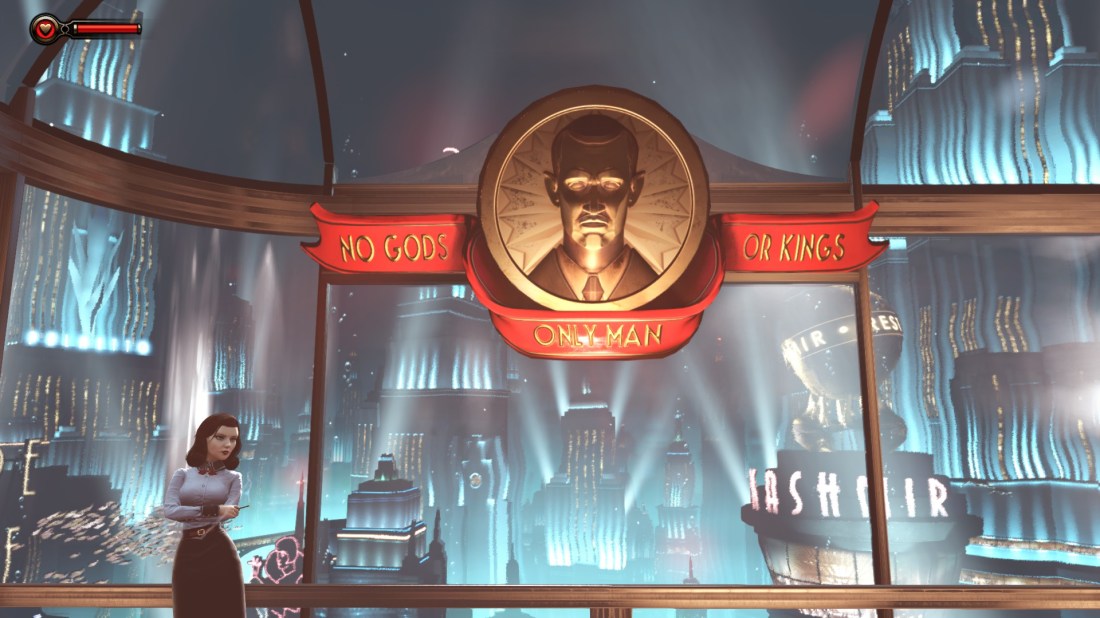
In Dead Men, we meet grizzled mercenary Kane, composing a letter to estranged daughter Jenny while in a prison van headed for death row. He’s promptly broken out by Lynch, channeling Heat’s Waingro and taken to a warehouse, via an extended tutorial/shootout in which more cops than you can shake a donut at are shot. Kane was on death row because a job went drastically wrong and he lost a ton of money for ‘The7’, a collection of high-end mercs who’ve kidnapped his ex-wife and daughter; get the money back and they live. Kane’s dead either way. Lynch, a low-level thug with some serious psychological issues is looking to get into The7’s crew. If he can babysit Kane and bring the money, they’ll have him aboard.

After another mini tutorial and more cops shot, we infiltrate a bank for Kane’s dirty money, leaving Lynch to control the bank customers. Instead, Lynch panics and suddenly kills most of the hostages; I’ve not even finished the first mission and I reckon the death count is reaching triple figures. I killed two or three security guards just walking in the place. After shooting a ton more, we fight our way out of the bank and along the freeway, eventually escaping on the subway where we fill time waiting for a train by killing more cops.

Dead Men feels pretty good so far; everyone’s a bad guy, the situation is bad, the solution is going to be bad and the ending doesn’t look good either. It feels stripped back like Heat, focused and driven; there’s nothing in this game that we can’t drop in thirty seconds flat and Kane & Lynch are a good, if dysfunctional team. Kane knows how to shoot, he’s Heat’s Coffee House scene come to digital life – He’s boxed in and he’s not hesitating. He isn’t like Tarantino’s cool killers, sporting a Gittes-style nose bandage after getting pistol whipped and a scar across a white eye, we’d never see him jiving in the Jack Rabbit. He’s coolly efficient and pissed at Lynch not for opening up on the hostages but for the police interest it draws. We did just bankrupt the Police Department’s Widows and Orphans fund.

Apparently unhindered by what would be by now the biggest manhunt in US history, K&L pop over to Japan to kidnap the daughter of Japan’s biggest mobster. Kane intends to ransom her for the rest of the money, but first we have to shoot our way out of the nightclub we found her in. Cue innocent lives lost as we try to cut through the panicking crowd in the dark strobe-lit club picking out mobsters scanning the crowds for us. Unfortunately, once clear, Lynch misunderstands Kane’s deal with the mobster and causes the situation to … escalate. Lynch, with his Mr Kidd meets 70s porn-star look is, unlike Kane’s precise coldness, really well balanced considering how unbalanced he is. He’s noted in the game as being a self-medicating psychopath, but he’s more complex than that. He’s quite needy and naive despite his brutality and pessimism and you get the sense there’s a lot more to him. He’s the most interesting thing in the game and it’s a shame we don’t explore Lynch further. He’s apologetic about the hostages and explains he blacks out when stressed, adding a complication and turning Kane into the babysitter instead as Lynch occasionally just races off to murder and when he comes too he often assumes Kane was responsible for the bloodshed. As a follower, Lynch can be directed about (He does get amusingly snippy if you order him about too much or demand he swap out his favourite weapon) and you can revive him – he’ll do the same for you as will other followers, although if it happens too often Kane will die of an overdose. Even health can kill you in DM. Lynch tries to bond with Kane telling him his wife was murdered (it’s implied that he might have done it during a blackout); Kane, of course, stays resolutely distant and grimly points out The7 will kill his family which Lynch didn’t seem to realise. He also sarcastically warns Lynch there’s no way The7 would have a loose cannon like him aboard; they’re just using him.

Sure enough, once they return from Japan (empty handed even after having killed most of Japan) it’s double-cross time and Kane decides the only thing left to do is off The7, while Lynch just wants revenge. The7 being somewhat powerful means K&L first establish a crew of their own, the Dead Men by freeing several other ex-The7s from a high-security prison. And then it’s a simple task of returning to Japan for the money, then Havana for some Che Guevara nonsense and finally Venezuela where The7, who have reached Bond levels of supervillainy, have a hide-out. It’s when we reach Havana that DM takes a dip it never really surfaces from. Away from the intensity and focus of the streets, running around in camo and a beret helping the Cuban army and assaulting a hidden fortress just seems daft – we’re now in Dirty Dozen meets Commando. It’s practically The Expendables.

Believability is a problem in Dead Men. Games are escapism and the key element of a shooter is you’re not required to worry about repercussions – As a Heat homage, DM is missing the Heat – cops have no impact other than bullet impacts. There’s no Vincent closing in and they get away with the most extraordinary crimes; the cops might as well be imps. DM is closer to the infamous North Hollywood Shootout; look how that ended for the robbers. It would have been better to emulate that, make it a death run, stay head of the cops just long enough, not kill enough to trigger the freedom of a cut-scene; it is unforgiving, react or die mayhem within the game, but the plot is draggy drama and catching red-eyes all over the globe at the drop of a clip slows the intensity, loses the fight-or-die tone. Another problem with DM is the environment, or lack of it. The game world feels bare – this was 2007, the year games got immersive but this looks like 2004; blocky cars and buildings, no layers of clutter. There’s a lack of depth and atmosphere – when the screen isn’t turning red from bullets – which undoes some clever level design.

Of the seven hours game play, you only really get about five hours before it gets silly and that’s a shame. DM is nowhere near as slick as it thinks it is and it’s incredibly narcissistic – there’s no one in it doing anything for anyone except themselves. That is until a sudden moral choice near the end which makes zero sense; you expect me to slay hundreds of innocents then pause and make a moral call? Even if Kane catches the feels at the end, why suddenly force me to decide? Kane’s been in control all this time, including more than a few moments I’ve thought “are you sure Kane?” – Now he needs a second opinion? It’s like playing Renegade the entire time then opting for a Paragon ending. What game would offer that choice? You’re not even party to his thinking until after making the call. Ultimately what makes Dead Men interesting is Kane and Lynch themselves. They are refreshingly unapologetic; for all the controversy about Dead Men glamorising violence, it’s not as glamorous as we thought. It’s actually pretty awful being lawless.

Regardless of the ending you chose, Kane & Lynch Dog Days ignores it. It turns out Dog Days means unbearable heat so maybe this time it’ll be a little more Heat-like; but, it also means back luck…

Opening on brief flashes of Kane & Lynch being tortured with box-cutters, it’s pretty clear Dog Days isn’t a watered down, consumer-tested sequel. This is a harsh way to get reacquainted with our ‘heroes’. Rewinding to before the boxcutters, we learn Lynch escaped to Shanghai, settling down with a local girl, Xiu to become a bagman for an ex-pat / Guy Ritchie-extra called Glazer. He needs some muscle to help shift guns to Africa and Lynch has a certain muscle in mind.

But before we get to bless the rains down in Africa, Lynch needs to strong-arm a mob rival on the way to Kane’s hotel. Naturally, it goes pear-shaped and we’re chasing through gang-controlled Shanghai as the mobster uses a naked woman as a shield. Eventually we catch up with him and the girl catches a stray bullet. The guy, realising she’s dead calmly cuts his own throat. Oh-ho.

The first thing that strikes you about Dog Days, aside from the torture, naked chick and throat slitting is we’re in the psychotic shoes of Lynch this time. Fine except Kane takes over as the story-driver in the cut scenes, yet is a mute follower in the game. I’m leading the game but a follower in the cut scenes? Lynch isn’t even unhinged anymore; you’d assume some kind of clichéd psycho bullettime at least, but there’s nothing to differentiate him from every other character you’ve shot as; none of that unpredictability or subtle threat that made him interesting in Dead Men. Lynch was something different, someone you could trust yet not turn your back on but now he’s just the back of a head.

Also, in some sort of comment that doesn’t say anything, the game is presented as found footage. It’s interesting and different at first; when Lynch runs the image wobbles and loses focus, nudity is pixelated as are any head shots and the auto-save is Time Code popping up but you keep asking ‘who’s footage is this?’ The key to found footage is it’s the opposite of a voyeur; they’re part of the event. It really wouldn’t have been that big a leap to add someone – Jenny for example; Kane intending for them to fly to Africa for a new life. It would make sense since all this started during a routine chore; have her mucking about with the camera filming Shanghai while dad goes to deal with something, hears a sound, investigates, throat slitting. Things escalate and it’s too dangerous to leave her alone so have to bring her along. Then Kane would be invested, and he and Lynch would be looking to us, protecting us, drawing us into their violence beyond the usual gamer experience – and we’d be wondering who is reviewing the content, who’s censoring it, what happened to everyone. That would be interesting and a comment on user generated content especially in those increasingly uncomfortable Facebook Live and personal videos-as-news times, and a sly one on gaming violence. Dog Days could have been prophetic now and compellingly original then. But no, there’s no one behind the camera and it’s just a gimmick.

It transpires the girl we shot was the daughter of a rather powerful chap in the government – considering her BF would rather slit his own throat than tell dad the bad news I’m guessing he’s trouble. They agree to go through with the deal but that means killing a lot of everyone to keep the truth hidden from Glazer long enough to reach the shipment. How well does that go? Well this is Kane & Lynch; eventually we have the army after us.

The shootouts are quick and clean, an early fight through traffic protecting Glazer’s limo is a standout, as is a run through a Shanghai slum protecting Xiu as thugs try to reach her on the other side. Cops are fair game again of course, slightly more justified as being described as in the pocket of that government bigwig who’s daughter someone recently shot.

Weaponry is typical; two weapon choices and you’ll use them a lot. The ‘bad guys’ are aggressive and tenacious, they’ll sweep around, react and they’ve got the numbers. As to where you fight them, the neon rundown streets of Shanghai is a step up from Dead Men’s plain environments and sticking to one location keeps the pressure on. There is an air of claustrophobia fighting in such close quarters but eventually it feels repetitive; most of the fights take place in back alleys and seeing variations on the same location makes it seem like they’re running around in circles and fighting their way out of self-contained episodes – If Dead Men took its inspiration from Heat, Dog Days should have been a homage to The Warriors; stuck in an unfamiliar and dangerous place, a cut off and exposed Kane & Lynch are on a relentless run across town – They’re are perfect for that kind of experience; their intensity would have worked so well.

Eventually we catch up with the torture scene, which is horrible and unintentionally (or perhaps intentionally) amusing, because they’re both naked and their bits are pixelated. We escape, catching little pixelated flashes of Lynch’s impressive undercarriage as he runs. The scene seems gratuitous, there to court controversy and live up to the original’s undeserved reputation for being ultra-violent. It wasn’t and we never sympathised with Kane & Lynch so how are we supposed to react to their suffering? It is nice to note though that Kane & Lynch aren’t ripped heroes. Under the blood and cuts there’s love-handles and a paunch.

Kane & Lynch, the tubby little scrappers that they are push on through the set-pieces until they hijack a helicopter and attack the government man’s building. It’s intense but shooting RPGs out of the air and taking down enemy choppers, while not quite on the same scale as Dead Men’s government toppling (we just topple their building this time) is overblown. Of course, once the scene is over they just walk out. Guess there’s no cops left in Shanghai. Kane & Lynch work best down and dirty in the streets, laying down so much gunfire the cops yell “there’s nothing we have that can stop them” not stuff more at home in CoD.

At a generous five hours gameplay (I mean I’m being generous giving it five hours) Dog Days is a fast, lean experience that demands that you play with nothing to lose. Instead of an unexpected and unwelcome moral choice, this ending is bleakly truthful to the characters, but is then followed by a needless escape epilogue that plays like a ‘next episode on Kane & Lynch’ teaser that never happened and seems to be some final Heat nod for old-times sake. It would have been better to end in the building, what they’ve done sinking in. Why did IO Interactive keep fudging the last third of the Kane & Lynch games? Why that insistence that they need to step up rather than double-down? Both games could have been elevated had they stuck to their bleakly fatalistic guns rather than attempted some genre-pleasing final sequence.

The biggest let down in Dog Days is the huge disservice to Lynch. He’s lost almost everything that made him interesting in Dead Men; a heart-breaking scene makes you feel for the guy and you think ‘oh crap, he’s going to kick offffffff’ but he doesn’t. Meanwhile Kane is completely emasculated (and not during the torture); he does have a manipulative moment, when he convinces a distraught Lynch to head for the deal even when it has to be suicidal, but it’s too little too late. At least Lynch finally behaves like himself at the government man meeting. By making things worse.

Ever since Max Payne, memorable shooters are the ones where we care about who’s doing the shooting; the standout element of the Kane & Lynch games is Kane and Lynch. They may be dangerous, unlikable and, well, murderers, but Kane and Lynch are great characters – Dead Men and Dog Days, while having their moments, weren’t the games for those two reprobates. Dog Days looks and plays nicely while Dead Men has more drive and interesting set-pieces, the club and prison breakout are standouts but overall they’re nothing special; standard shooters. I’d like to play Kane and Lynch again, but not in Dog Days or Dead Men. There is a game out there for them, but IO Interactive left them on a mother of a cliff-hanger then ran back to the safety of their other morally ambiguous creation, Hitman. There was talk of a movie but it’s still in development hell. Let’s hope it stays there. Kane & Lynch have suffered enough.

Dead Men 2007 | Dog Days 2010

Developer IO Interactive | Publisher Eidos / Square Enix

Platforms Win, PS3, X360